Author: azeeadmin

30 Sep 2018

Until data is misused, Facebook’s breach will be forgotten

We cared about Cambridge Analytica because it could have helped elect Trump. We ignored LocationSmart because even the though the company was selling and exposing the real-time GPS coordinates of our phones, it was never clear exactly if or how that data was misused.

This idea, that privacy issues are abstract concepts for most people until they become security or ideological problems, is important to understanding Facebook’s massive breach revealed this week. 

The social network’s engineering was sloppy, allowing three bugs to be combined to steal the access tokens of 50 million people. In pursuit of rapid growth at affordable efficiency, Facebook failed to protect its users. This assessment doesn’t discount that. Facebook screwed up big time.

But despite the potential that those access tokens could have let the attackers take over user accounts, act as them, and scrape their personal info, it’s unclear how much users really care. That’s because for now, Facebook and it’s watchdogs aren’t sure exactly what data was stolen or how it was wrongly used.

The Hack That Broke The Camel’s Back?

This could all change tomorrow. If Facebook discovers the hack was perpetrated by a foreign government to interfere with elections, by criminals to bypass identity theft security checkpoints and steal people’s bank accounts or social media profiles, or to target individuals for physical harm, out will come the pitchforks and torches. 

Given a sufficiently scary application for the data, the breach could finish the job of destroying Facebook’s brand. If users start clearing their profile data, reducing their feed browsing, and ceasing to share, the breach could have significant financial and network effect consequences for Facebook. After years of scandals, this could be the hack that’s broke the camel’s back.

Yet in the absence of that evil utilization of the hacked data, the breach could fade into the background for users. Similar to the tension-filled departures of the founders of Facebook’s acquisitions Instagram and WhatsApp, the brunt of the backlash may not come from the public.

The hack could hasten regulation of social media. Senator Warner called on Congress to “step up” following the hack. He’s previously advocated for privacy laws similar to Europe’s GDPR. That includes data portability and interoperability rules that could make it easier to switch social networks. That threat of people moving to competing apps could succeed in compelling Facebook to treat user privacy and security better.

The FTC or European Union could hand down significant fines to Facebook for the breach. But given it earns billions in profit per quarter, those fees would have to be historically massive be a serious penalty for Facebook.

One of the biggest questions about the attack is whether the tokens were used to access other services like Airbnb or Spotify that rely on Facebook Login. The breach could steer potential partners away from building atop Facebook’s identity platform. But at least you don’t have to worry about changing all your passwords. Unlike hacks that steal usernames and passwords, the lasting danger of the Facebook breach is limited. The access tokens have already been invalidated, whereas password reuse can lead people to have their other apps hacked long after the initial breach.

Desensitized

If government investigators, journalists, or anti-Facebook activists want to make the company pay for its negligence, they’ll need to connect it to some concrete threat to how we live or what we believe.

For now, without a nefarious application of the breached data, this scandal could blend into the rest of Facebook’s troubles. Every week, sometimes multiple times a week, Facebook has some headline grabbing problem. Over time, those are adding up to deter usage of Facebook and spur more users to delete it. But without an independent general purpose social network they can easily switch to, many users have endured Facebook’s stumbles in exchange for the connective utility it provides. 

As breaches become more common, the public may be desensitized. At worst, we could become complacent. Corporations should be held accountable for privacy failures even when the damage done is vague. But between Equifax, Yahoo, and the cell phone companies, we’re growing accustomed to letting out a deep sigh with maybe some expletives, and moving on with our lives. The ones we’ll remember will be those where the danger metastasized from the digital world into our offline lives.

[Featured image via Getty]

30 Sep 2018

Carpooling service Klaxit partners with Uber for last-minute changes

French startup Klaxit connects drivers with riders so that you don’t have to take your car to work every day. And the company recently announced a new feature with the help of Uber. If your driver cancels your ride home, Klaxit will book an Uber for you.

Klaxit is a ride-sharing startup that focuses on one thing — commuting to work. And this problem is more complicated than you might think. You can’t just go to work with the same person every day because you don’t always go to work at the same time. Similarly, sometimes your driver has to leave work early, leaving you at the office with no alternative.

As a driver, you want to take the quickest route to work. So you want to be matched with riders who are exactly on the way to work.

Klaxit currently handles 300,000 rides per day. In particular, the company has partnered with 150 companies, including big French companies such as BNP Paribas, Veolia, Vinci and Sodexo.

Klaxit can be particularly useful for companies with large office buildings outside of big cities. Promoting Klaxit instantly fosters supply and demand from and to this office. But you don’t have to work for one of those companies to use Klaxit.

Local governments can also financially support Klaxit to improve traffic conditions and mobility for users who don’t have a car or a driver’s license. “Subsidizing rides on Klaxit is 8 to 10 times cheaper than building a bus line,” co-founder and CEO Julien Honnart told me.

One of the biggest concerns as a rider is that you’re going to be stuck at work in the evening. Klaxit is now asking its users to request a ride with two other drivers. If they both decline your request, Klaxit will book you an Uber ride to go back home.

You don’t have to pay the Uber ride and then get reimbursed, Klaxit pays Uber directly. You don’t need an Uber account either as Klaxit is using Uber for Business. MAIF is the insurance company behind this insurance feature, and also one of Klaxit’s investors. This is a neat feature to convince new users that they can trust Klaxit.

Klaxit competes with other French startups on this market, such as Karos and BlaBlaCar’s BlaBlaLines.

30 Sep 2018

Relike lets you turn a Facebook page into a newsletter

French startup Ownpage has recently released a new product called Relike. Relike is one of the easiest ways to get started with email newsletters. You enter the web address of your Facebook page and that’s about it.

The company automatically pulls your most recent posts from your Facebook page and lets you set up an emailing campaign in a few clicks. You can either automatically pick your most popular Facebook posts or manually select a few posts.

Just like any emailing service, you can choose between multiple templates, decide the day of the week and time of the day, import a database of email addresses and more. If you’ve used Mailchimp in the past, you’ll feel right at home.

But the idea isn’t to compete directly with newsletter services. Many social media managers, media organizations, small companies, nonprofits and sports teams already have a Facebook page but aren’t doing anything on the email front.

Relike is free if you send less than 2,000 emails per month and don’t need advanced features. If you want to get open rates, click-through rates and other features, you’ll need to pay €5 per month and €0.50 every time you send 1,000 emails.

The company’s other product Ownpage is a bit different. Ownpage has been working with media organizations to optimize their email newsletters. The company is tracking reading habits on a news site and sending personalized email newsletters.

This way, readers will get tailored news and will more likely come back to your site. Many big French news sites use Ownpage for their newsletters, such as Les Echos, L’Express, 20 Minutes, BFM TV, Le Parisien, etc.

Ownpage founder and CEO Stéphane Cambon told me that Relike was the obvious second act. Using browsing data for customized newsletters is one thing, but many talented social media managers know how to contextualize stories and maximize clicks (even if it means clickbait, sure).

The startup was looking at a way to get this data, and ended up creating Relike, which could appeal to customers beyond news organizations. For now, both products will stick around. In the future, the company plans to add Twitter and Instagram integrations as well as better signup flows for newsletter subscribers.

30 Sep 2018

What the heck is going on with measures of programming language popularity?

I looked at the TIOBE index today, as I do every so often, as most of the software pros I know do every so often. It purports to measure the popularity of the world’s programming languages, and its popularity-over-time chart tells a simple story: Java and C are, and have been since time immemorial, by some distance the co-kings of language.

But wait. Not so fast. The rival “PYPL Index” (PopularitY of Programming Languages) says that Python and Java are co-kings, and C (which is lumped in with C++, surprisingly) is way down the list. What’s going on here?

What’s going on is that the two indexes have very different methodologies … although what their methodologies have in common is both are very questionable, if the objective is to measure the popularity of programming languages. TIOBE measures the sheer quantity of search engine hits. PYPL measures how often language tutorials are Googled.

Both are bad measures. We can expect the availability of online resources to be an extremely lagging indicator; a once-dominant dead language would probably still have millions of relict web pages devoted to it, zombie sites and blog posts unread for years. And the frequency of tutorial searches will be very heavily biased towards languages taught en masse to students. That’s not a meaningful measure of which languages are actually in use by practitioners.

There are lots of weird anomalies when you look harder at the numbers. According to TIOBE, last C went from its all-time lowest rating to Programming Language Of The Year in five months. I can buy that C has had a resurgence in embedded systems. But I can also easily envision this being an artifact of a highly imperfect measure.

The more flagrant anomaly, though, in both of those measures, is the relative performance of Objective-C and Swift, the two languages used to write native iOS apps. I can certainly believe that, combined, they have recently seen a decline in the face of the popularity of cross-platform alternatives such as Xamarin and React Native. But I have a lot of trouble believing that, after four years of Apple pushing Swift — to my mind, an objectively far superior language — Objective-C is still more popular / widely used. In my day job I deal with a lot of iOS/tvOS/watchOS apps, and interview a lot of iOS developers. It’s extremely rare to find someone who hasn’t already moved from Objective-C to Swift.

But hey, anecdotes are not data, right? If the only available measures conflict with my own personal experience, I should probably conclude that the latter is tainted by selection bias. And I’d be perfectly willing to do that …

… except there is another measure of programming language popularity out there. I’m referring to GitHub’s annual reports of the fifteen most popular programming languages on its platform. Those numbers are basically a perfect match for my own experience … and they are way disjoint from the claims of both both TIOBE and PYPL.

According to GitHub’s 2016 and 2017 reports, the world’s most popular programming language, by a considerable distance, is Javascript. Python is second. Java is third, and Ruby a close fourth. This is in stark contrast to TIOBE, which has Java and C, then a big gap, then Python and C++ (Javascript is eighth) — and also to PYPL, which claims the order is: Python and Java, a huge gap, then Javascript and PHP.

Obviously the GitHub numbers are not representative of the entire field either; their sample size is very large, but only considers open-source projects. But I note that GitHub is the only measure which counts Swift as more popular than Objective-C. That makes it a lot more convincing, to me … but its open-source selection bias means it’s still far from definitive.

These statistics do actually matter, beyond being an entertaining curiosity and/or snapshot of the industry. Languages aren’t all-important, but they’re not irrelevant either. People determine what languages to study, and sometimes even what jobs to seek and accept, based on their popularity and their (related) projected future value. So it’s a little upsetting that these three measures are so starkly, radically different. Sadly, though, we seem to still be stuck with tea leaves rather than hard numbers.

29 Sep 2018

Solve, MIT’s take on social innovation challenges, may be different enough to work

Since McKinsey released a report on how best to use prizes to incentivize innovation nearly a decade ago, an entire industry has grown around social innovation challenges. The formula for these “save the world” competitions has become standard. Drum up a lot of buzz around an award. Partner with big names to get funding and high-profile judges. Try and get as many submissions as possible from across the world. Whittle down the submissions and come up with a list of finalists that get to pitch at a glitzy event with a lot of media attention.

On the final stage, based on pitches that last for mere minutes, judges typically pick one winner that can get upwards of millions in prize funding. Don’t have a software platform to run a challenge of this kind? No worries, numerous for-profit vendors have sprung up that can do all the work for you—for anywhere from ten to a few hundred thousand dollars. The growth has been so exponential that prizes awarded through competitions has grown from less than $20 million in 1970 to a whopping $375 million just four decades later.

But do these prizes get the sort of world-saving results they aim for? There’s little quantified evidence to back that, and some leaders in philanthropy are broadly skeptical.

For its part, the Massachusetts Institute of Technology is trying a different approach to innovation challenges with Solve, taking some of what’s worked in these challenges and fusing it with elements of tech accelerator programs, including a post-award training program that focuses on results.

Solve is entering an already crowded field of innovation challenges. Many of these prizes overlap, with each vying to be the “Nobel” of its field. More prizes means more noise—which has led to a race to offer more money to get attention.

But even private-sector riches do not guarantee that prize money for innovation gets good results. In 2004, Bigelow Enterprises sponsored a $50 million Space Prize but it failed to capture the imagination of space researchers and eventually folded. Back in 2009, Netflix invited outside teams to improve it movie recommendation algorithm by 10% for a $1 million reward. The Netflix Prize led to a race among programmers, only for Netflix to eventually kill the entire plan because it was getting better results in-house.

Overall, the social innovation competitions tend to reward presentation, glitz and charisma, and penalize speaking English as a second language, introversion and inability to make flashy slides.

Now let’s take a look at Solve, which held its third annual finalists event on Sunday September 23 in New York.

Unlike other contests where questions are internally decided, Solve crowdsources the questions to begin with. Its team takes months to run hackathons and workshops around the world to decide on the four most pressing questions to become the focus of that year’s challenge. This year, the questions focused on teachers and educators, workforce of the future, frontlines of health and coastal communities.

The competition is then opened up to participants from around the world with relatively low barriers to entry, resulting in 1,150 submissions from 110 countries in the last competition round. (That’s at least one submission from nearly 60 percent of all countries in the world.)
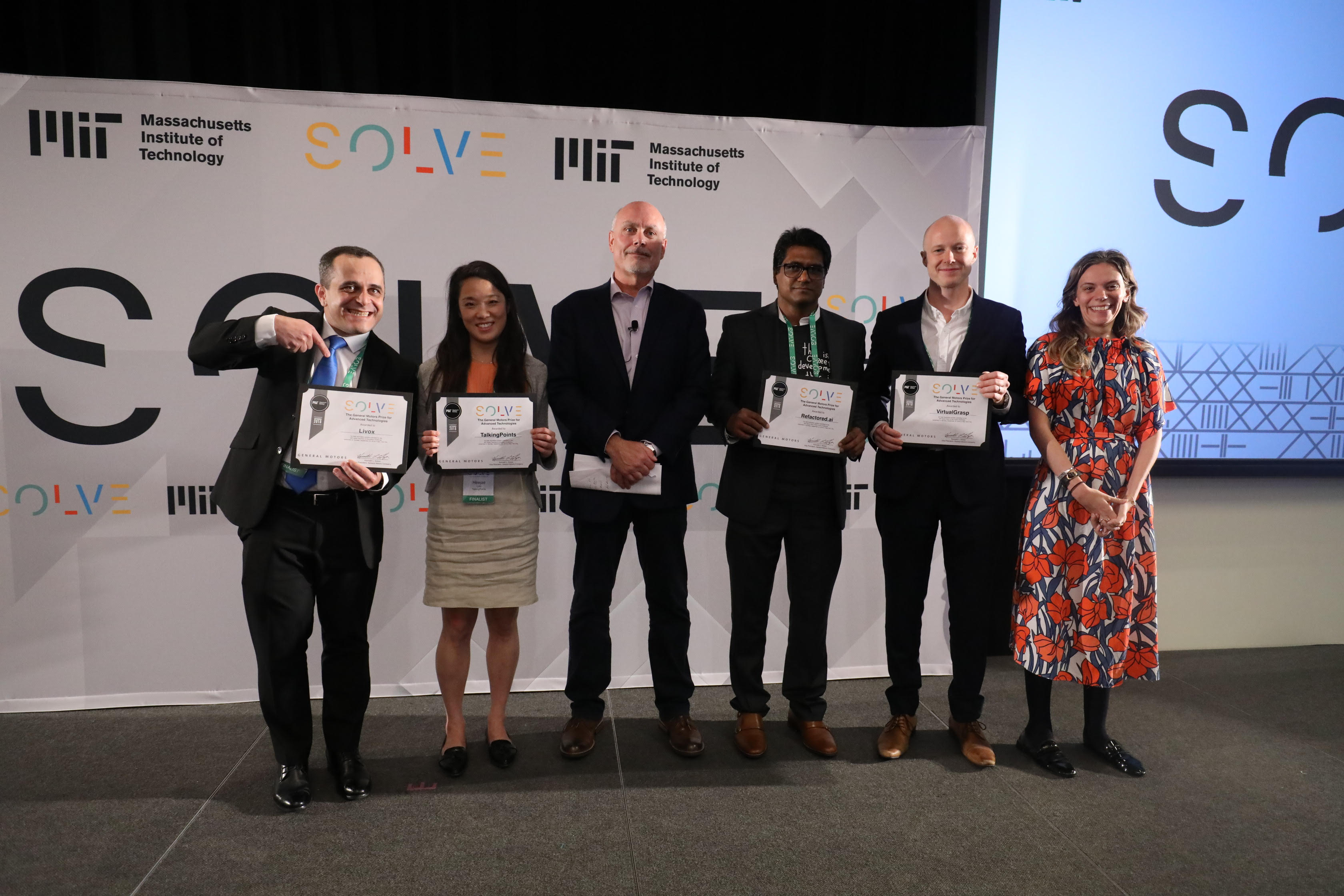
The prize recipients of the GM Prize for Advanced Technology. Photo: Adam Schultz | MIT Solve

To qualify, though, participants need to have more than just an idea. They must have a prototype that works, be either in the growth, pilot or scale stage, and be tech-driven. Submissions are then evaluated by judges from across industry, intergovernmental organizations and academia to get to 15 finalists for each of the four challenge questions. These 60 finalists get a full day with judges to be asked in-depth questions and have their ideas evaluated.

The day after, with all the preparations completed, the finalists get three minutes apiece to present on stage. Crucially, instead of one winner, eight finalists are chosen for each of the challenge questions.

Each finalist receives an initial $10,000 prize, plus a pool of hundreds of thousands of dollars provided by partners including General Motors, the Patrick J. McGovern Foundation, Consensys, and RISE.

This year, for example, Ugandan health care startup Neopenda brought in an additional $30,000 in funding through Solve, from a UN program sponsored by Citi. An intelligent messaging app called TalkingPoints, meanwhile, received backing from General Motors and Save the Children to develop its personalized coaching technology for parents and educators. (You can see more details on this year’s winners and prizes here.)

As opposed to being a “one and done competition” where winning the prize money marks the end of the competition, managing director of community Hala Hanna tells me that the real work begins once the Solver teams are selected. Each qualifying Solver team gets 12 months of engagement and support from the organization. “Our value-add is providing a network, from MIT and beyond, and then brokering partnerships,” she explains.

Solve also produces a series of co-branded programs with other educational and nonprofit organizations around the world. As a result, the Australian government uses the platform to run a smaller-scale challenge focused on issues in APAC, while the Mohammed Bin Rashid Foundation is using it for a larger scale Global Maker Challenge.

Perhaps the biggest testament to the Solve method getting traction is its funders putting in even more cash in support. At the closing event on Sunday, an upbeat Matthew Minor, Solve’s director for international programs, took to the stage decked out in Solve-branded socks and a broad smile. He announced the winning finalists—and more funding opportunities. Two of Solve’s original backers, the Atlassian Foundation and the Australian government, are continuing to invest out of a standing $2.6 million budget for companies in the workforce track. RISE, a global impact investing fund, is putting an additional $1 million into companies focused on coastal communities.

The Australians have already put in funding to help past winners scale after the program. One of them is Ruangguru, a digital boot camp in Indonesia that gives youth dropouts resources they need to earn graduation certificates. The startup had reached nearly a million Indonesians prior to participating in Solve; through the program and the additional funding, it assisted more than 3 million Indonesian youth by the end of last year. Iman Usman, one of Ruangguru’s founders, tells me that Solve enabled them to enter into partnerships that helped them scale across Indonesia in a way they would have never been able to do on their own.

Solve has also been unequivocally good at ensuring diversity, both in its own staffing and—perhaps for related reasons—in those that are chosen as finalists. Of Solve’s 20 full-time staff, 14 are women, as are six out of the seven leadership team members and—by my count—at least seven nationalities from four continents are represented on staff.

The 33 Solver teams selected at the finals this year hail from 28 different countries, with 61 percent of them being women-led. At a time when the tech industry is struggling to increase diversity, Solve’s emphasis on diversity in challenge design and promotion has led to applicants and finalists that reflect the world Solve aims to help.

Hanna noted that increasing diversity is not as difficult as it’s made out to be. “Honestly, we’re not even trying that hard,” she explained. “So whoever says there are no women in tech, I say, crazy talk.”
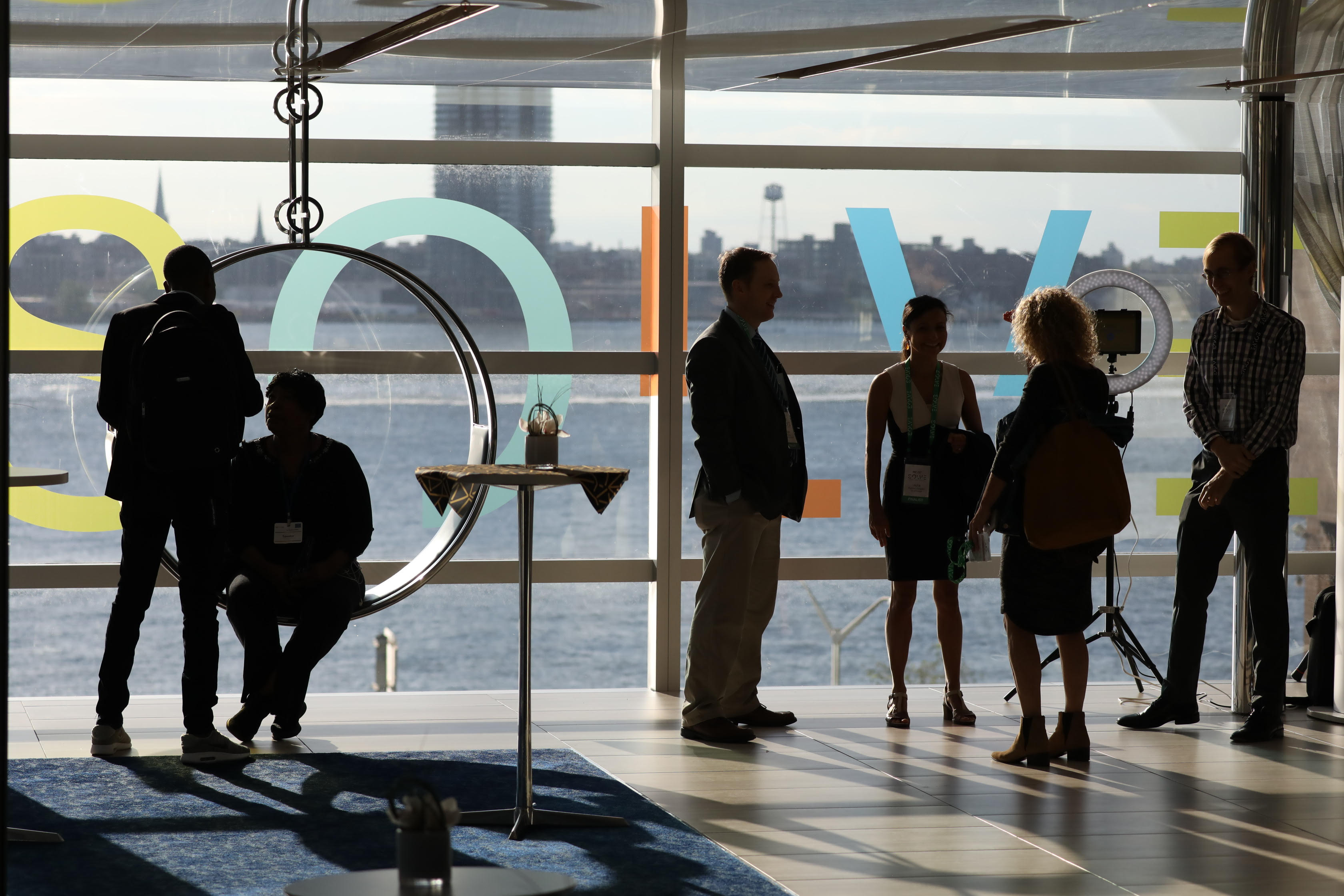
The view from the Apella at Solve Challenge Finals on Sept. 23. Photo: Adam Schulz | MIT Solve

Still, Solve does have a few kinks to work out. By taking on extremely broad topics, the competition can sometimes lack focus. Lofty questions mean you can get very disparate answers, making it hard to compare them in a way that feels fair. The work of the future challenge, for example, had one team pitching on adding jobs related to knitting in Brazil, while another managed to fit in every possible buzzword (artificial intelligence, crypto and automation) in three minutes without quite explaining what it does.

And while it’s great that the award monies are not all given to a single winner, it is not quite clear how funders pick the teams that do get funding. 15 qualifying finalists this year ended up winning money awards, some winning more than one, while the remaining 18 qualifying teams went home with the minimum amount. This is because Solve funders get to pick which of the teams that qualify at the finals get their respective monetary prizes. Of course, all 33 qualifying teams equally get to be a part of the Solve class with all the support and training that includes.

Another kink is the audience choice award—selected through open online voting prior to the finals—but not tied to any clear concrete benefit. Take the example of Science for Sharing (Sci4S), a Mexico-based startup that trains teachers to better engage students in STEM and has already reached nearly a million children across Latin America. It garnered 419 community votes in the Education Challenge, more votes than any other participant in the category, and handedly won the audience choice award, but ultimately was not selected as a Solver team. Another education startup, Kenya-based Moringa School, only got two votes but was selected. While Moringa and others were compelling and qualified in their own right, but it’s still hard not to think that Sci4S should have focused all of its time on its presentation and ignored the audience vote.

All in all, Solve does get a number of things right where other innovation challenges have failed. Instead of anointing one winner for the entire competition, it selects a class of dozens—reflecting the simple fact that the world’s most intractable problems are not going to be solved by any singular idea. Unlike many challenges put on by educational institutions and open only to their own students, Solve opens its doors wide. And winning at the finals doesn’t end your connection with MIT, it only starts it, with all qualifying finalists getting a year of individualized support, training and mentorship.

Done right, prizes can be effective at incentivizing startups to focus on pressing societal issues that can truly benefit from tech-drive solutions. But prizes for the sake of prizes can add to the noise and dissipate scarce public resources and entrepreneur attention. In the increasingly crowded world of innovation challenges promising to change the world, MIT’s Solve is a step away from the noise and towards effective prize granting.


29 Sep 2018

Ne-Yo wants to make Silicon Valley more diverse, one investment at a time

Dressed in a Naruto t-shirt and a hat emblazoned with the phrase “lone wolf,” Ne-Yo slouches over in a chair inside a Holberton School classroom. The Grammy-winning recording artist is struggling to remember the name of “that actor,” the one who’s had a successful career in both the entertainment industry and tech investing.

“I learned about all the things he was doing and I thought it was great for him,” Ne-Yo told TechCrunch. “But I didn’t really know what my place in tech would be.”

It turns out “that actor” is Ashton Kutcher, widely known in Hollywood and beyond for his role in several blockbusters and the TV sitcom That ’70s Show, and respected in Silicon Valley for his investments via Sound Ventures and A-Grade in Uber, Airbnb, Spotify, Bird and several others.

Ne-Yo, for his part, is known for a string of R&B hits including So Sick, One in a Million and Because of You. His latest album, Good Man, came out in June.

Ne-Yo, like Kutcher, is interested in pursuing a side gig in investing but he doesn’t want to waste time chasing down the next big thing. His goal, he explained, is to use his wealth to encourage people like him to view software engineering and other technical careers as viable options.

“Little black kids growing up don’t say things like ‘I want to be a coder when I grow up,’ because it’s not real to them, they don’t see people that look like me doing it,” Ne-Yo said. “But tech is changing the world, like literally by the day, by the second, so I feel like it just makes the most sense to have it accessible to everyone.”

Last year, Ne-Yo finally made the leap into venture capital investing: his first deal, an investment in Holberton School, a two-year coding academy founded by Julien Barbier and Sylvain Kalache that trains full-stack engineers. The singer returned to San Francisco earlier this month for the grand opening of Holberton’s remodeled headquarters on Mission Street in the city’s SoMa neighborhood.

[gallery ids="1722954,1722952,1722953,1722955"]

Holberton, a proposed alternative to a computer science degree, is free to students until they graduate and land a job, at which point they are asked to pay 17 percent of their salaries during their first three years in the workforce.

It has a different teaching philosophy than your average coding academy or four-year university. It relies on project-based and peer learning, i.e. students helping and teaching each other; there are no formal teachers or lecturers. The concept appears to be working. Holberton says their former students are now employed at Apple, NASA, LinkedIn, Facebook, Dropbox and Tesla.

Ne-Yo participated in Holberton’s $2.3 million round in February 2017 alongside Reach Capital and Insight Venture Partners, as well as Trinity Ventures, the VC firm that introduced Ne-Yo to the edtech startup. Holberton has since raised an additional $8 million from existing and new investors like daphni, Omidyar Network, Yahoo! co-founder Jerry Yang and Slideshare co-founder Jonathan Boutelle.

Holberton has used that capital to expand beyond the Bay Area. A school in New Haven, Conn., where the company hopes to reach students who can’t afford to live in tech’s hubs, is in development.

The startup’s emphasis on diversity is what attracted Ne-Yo to the project and why he signed on as a member of the board of trustees. More than half of Holberton’s students are people of color and 35 percent are women. Since Ne-Yo got involved, the number of African American applicants has doubled from roughly 5 percent to 11.5 percent.

“I didn’t really know what my place in tech would be.”

Before Ne-Yo’s preliminary meetings with Holberton’s founders, he says he wasn’t aware of the racial and gender diversity problem in tech.

“When it was brought to my attention, I was like ‘ok, this is definitely a problem that needs to be addressed,'” he said. “It makes no sense that this thing that affects us all isn’t available to us all. If you don’t have the money or you don’t have the schooling, it’s not available to you, however, it’s affecting their lives the same way it’s affecting the rich guys’ lives.”

Holberton’s founders joked with TechCrunch that Ne-Yo has actually been more supportive and helpful in the last year than many of the venture capitalists who back Holberton. He’s very “hands-on,” they said. Despite the fact that he’s balancing a successful music career and doesn’t exactly have a lot of free time, he’s made sure to attend events at Holberton, like the recent grand opening, and will Skype with students occasionally.

“I wanted it to be grassroots and authentic.”

Ne-Yo was very careful to explain that he didn’t put money in Holberton for the good optics.

“This isn’t something I just wanted to put my name on,” he said. “I wanted to make sure [the founders] knew this was something I was going to be serious about and not just do the celebrity thing. I wanted it to be grassroots and authentic so we dropped whatever we were doing and came down, met these guys, hung out with the students and hung out at the school to see what it’s really about.”

What’s next for Ne-Yo? A career in venture capital, perhaps? He’s definitely interested and will be making more investments soon, but a full pivot into VC is unlikely.

At the end of the day, Silicon Valley doesn’t need more people with fat wallets and a hankering for the billionaire lifestyle. What it needs are people who have the money and resources necessary to bolster the right businesses and who care enough to prioritize diversity and inclusivity over yet another payday.

“Not to toot the horn or brag, but I’m not missing any meals,” Ne-Yo said. “So, if I’m going to do it, let it mean something.”

29 Sep 2018

Elon Musk agrees to resign as Tesla chairman in settlement with SEC

Tesla CEO Elon Musk will step down as chairman of the electric automaker and pay a $20 million fine under a settlement reached with the U.S Securities and Exchange commission. Musk will remain CEO.

Musk will resign from his role as chairman of the Tesla board within 45 days of the agreement, which was filed Saturday. He has agreed to not seek reelection or accept an appointment as chairman for three years.

Tesla will pay a separate $20 million penalty, according to the SEC.

The SEC filed a complaint Thursday in federal district court alleged that Musk lied when he tweeted on August 7 that he had “funding secured” for a private takeover of the company at $420 per share. Federal securities regulators reportedly served Tesla with a subpoena just a week after the tweet. Investigations can take years before any action is taken, if at all.

The SEC said in the complaint that Musk violated anti-fraud provisions of the federal securities laws. The commission has asked the court to fine Musk and bar the billionaire entrepreneur from serving as an officer or director of a public company.

Musk described fraud charges an “unjustified action” that has left him “deeply saddened and disappointed.”

Tesla and the board later issued a joint statement supporting Musk.

The complaint contained a number of eye-browing raising details, including he had talked to the board about an offer to take Tesla private as early as August 2 when he sent to Tesla’s board of directors, chief financial officer and general counsel an email with the subject, “Offer to Take Tesla Private at $420.”

29 Sep 2018

Best Buy stocked an unannounced Chromecast ahead of Google’s hardware event

Google’s big hardware event, scheduled for October 9, is expected to feature the new Pixel 3 and Pixel 3 XL phones. But now we know that Google will probably reveal a third-generation model of Chromecast, thanks to one recent Best Buy customer who discovered the device on store shelves.

Whoops.

“GroveStreetHomie” detailed his experience on a Reddit post entitled “I think I bought the 3rd gen Chromecast too early.”

According to the Reddit post, the customer went to Best Buy earlier to pick up a Chromecast for a new TV. That’s when “GroveStreetHomie” noticed the packaging and design was different from an earlier version.

The cashier wasn’t able to scan the item because it wasn’t in the system yet. The release date was labeled October 9 — the same day as the 2018 Google hardware event.

“But since I already had it in my hand and was the same price as the 2nd generation Chromecast, they let me have it under the old SKU,” the post read.

This new unannounced Chromecast is apparently thicker than the second-generation model. The Chrome logo has been replaced with Google one. The new device still has a micro-USB. The HDMI connector on the tip and base has been removed, according to the user.

29 Sep 2018

The 2019 BMW i3 now has 153 miles of range thanks to a bigger battery

The BMW i3 is getting an upgraded battery — plus a bunch of other improvements —that will give the 2019 model about 153 miles of range. That’s roughly a 30% improvement from the previous model.

The boost in range is noteworthy, yet it still lags behind the Chevy Bolt and the Tesla Model S, Model X and Model 3 vehicles. And it’s only a smidge better than the much cheaper Nissan Leaf.

The upshot: it’s a steady improvement that expresses some continued investment and interest in the i3 brand. But will it be enough to keep this city car in the EV mix?

When the BMW i3 first went into production in 2013 it had a 22.6-kilowatt hour battery pack containing 60 ampere hours (Ah) batteries. That first i3 had range of 81 miles, according to EPA estimates. The company’s second-generation battery, introduced in 2016, grew to 33 kwh of gross energy (94 amp hours) and had a range of about 115 miles under the EPA cycle.

2019 BMW i3-new

Now the 2019 model, which will comes with 120 Ah batteries in a 42.2-kWh-battery pack, will be able to travel about 153 miles on a single charge, BMW said.

The upgraded battery will be available in both the i3 and the i3s. Pricing was not announced. Previous i3 model year is priced at about $45,000 for the base model.

Power hasn’t changed in the new 2019 models, which will go into production this November. The standard i3 comes with a 170-horsepower electric motor that will take it from zero to 60 miles per hour in 7.2 seconds. The sportier i3s will have a 181-horsepower motor that can go from zero to 60 in 6.8 seconds.


2019 BMW i3

The automaker is giving the i3 a few other improvements as well, including a new exterior color called Jucaro Beige metallic and adaptive LED headlights with automatic high beams. The exterior paint finishes Mineral Grey metallic, Imperial Blue metallic, Melbourne Red metallic, Capparis White and Fluid Black are still available.

Wireless charging and a Wi-Fi hotspot that can accommodate up to 10 devices will also be available for the BMW i3 and BMW i3s, the company said.

Customers will also new options for the sports package, which will include black wheel arch surrounds and a suspension with specific dampers, springs and stabilizers, lowered suspension, a widened track and 20-inch light alloy wheels.

29 Sep 2018

Autonomous shuttle startup May Mobility expands to a third U.S. city

May Mobility launched its first low-speed autonomous shuttle service in Detroit this summer. By March, the Ann Arbor, Michigan-based company will be operating in at least three U.S. cities.

The company, which just announced plans to expand to Columbus, Ohio, is planning to add another route in Grand Rapids, Michigan. It’s a rapid acceleration for a company that was founded less than two years ago.

May Mobility is different from other companies racing to deploy autonomous vehicles at a commercial scale. The startup, which was founded by veterans in the self-driving and automotive industry, has developed low-speed autonomous shuttles that are designed to run along a specific route in business districts or corporate and college campuses.

The company said it will bring four of its six-seat electric shuttles to Grand Rapids. The one-year pilot will begin March 2019.

This latest shuttle launch is part of a broader effort called the Grand Rapids Autonomous Mobility Initiative, a coalition of companies that includes Consumers Energy, French automotive supplier Faurecia, Gentex, Rockford Construction, Seamless and furniture maker Steelcase .

The aim of the program is to study how mobility impacts city infrastructure and prepare the community for autonomous vehicles. The program will also focus on how these autonomous vehicles improve or affect the mobility of elderly and disabled people.

The fleet will operate on a 3.2-mile section of an existing bus route that provides access to downtown and two of the city’s business districts. The route includes 22 stops, 30 traffic lights and 12 turns, including three left turns, according to the initiative.

Shuttles, which will be free for riders, will run complementary to the city’s existing DASH transportation fleet.

Fleet operations for the May Mobility vehicles will be housed at Rockford Construction’s
West Side offices within Circuit West, an area that boasts an innovative electric generation and distribution system.

May Mobility raised $11.5 million in seed funding in 2018 from BMW iVentures, Toyota AI and others. Trucks, Maven Venture and Tandem Ventures are also investors in the company.