Author: azeeadmin

27 Sep 2018

Coinbase now lets users buy ‘bundles’ and launches its own index for the top 50 coins

Coinbase is shaking things up quite a bit lately and its latest tools are geared toward cryptocurrency traders just getting their toes wet.

On Thursday, the company announced that it would add a feature called Coinbase Bundle. The new offering lets users purchase a market-weighted sampling of Coinbase’s five available cryptocurrencies: Bitcoin, Ethereum, Bitcoin Cash, Litecoin and Ethereum Classic. The idea is that a bundle of coins offers users a starter pack for cryptocurrency trading on the platform with stakes of their choosing. In reality, until Coinbase adds more coins, it’s not exactly a diversified portfolio so much as a slightly counterbalanced selection of Coinbase’s current limited offerings.

In June, Coinbase introduced index funds targeted toward institutional investors in the U.S. While those funds required an investment between $250,000 and $20 million, Coinbase Bundle is geared toward the casual individual investor with bundles that start at $25. For beginning traders that prefer to follow rather than beat the market, betting on broad growth over time, a product like Coinbase Bundle makes sense. Or rather it will when Coinbase adds a lot more coins.

Users who buy a Coinbase Bundle can expect to see the funds appear in their wallet like normal. There, the funds will behave like separate assets that can be sold and sent elsewhere.

Beyond bundles, Coinbase is also launching a few educational cryptocurrency tools geared toward anyone still learned the ropes. The first of those tools is Coinbase Asset Pages, the company’s own CoinMarketCap-like database where anyone can view details about the top 50 coins by market cap, whether they’re listed by Coinbase or not.

Like other resources, Coinbase’s new tool will provide “historic trading data, current market cap, a description of the cryptocurrency, and links to relevant white papers and project websites.” Unlike other resources, Coinbase artificially lists its own offerings at the top rather than depicting those coins where they actually fall in terms of market cap.

Coinbase is also launching a dedicated learning hub on its site where new users can browse topics like “What is blockchain?” and “Where do cryptocurrencies get their value?” — in many cases, a good question. Given Coinbase’s appeal to brand new users, it’s kind of surprising that this didn’t already exist. Particularly that it wasn’t implemented late last year when many wide-eyed investors bought it at all-time highs and were handed big losses in the months to come.

After mainstream interest in digital currencies cooled from the fever-dream highs of late 2017, making Coinbase’s famously user-friendly entrypoint into the cryptocurrency world even more approachable for first-time buyers, if many remain, can’t hurt. The company is also clearly readying for its plan to list coins well beyond its current limited offerings, a transformation that will see the platform evolve from its historical identity as a blue chip stock shop to something more akin to digital currency’s attractive, well-lit corner store.

Coinbase’s new top 50 asset pages and learning hub are live now. Coinbase Bundles, limited to the U.S. and Europe, will start showing up for users today and the rollout will continue through the next few weeks.
27 Sep 2018

Alphabet’s Chronicle launches an enterprise version of VirusTotal

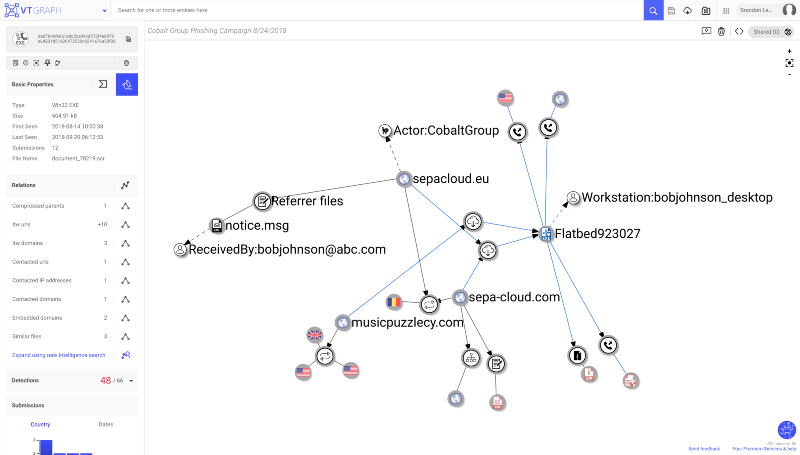
VirusTotal, the virus and malware scanning service own by Alphabet’s Chronicle, launched an enterprise-grade version of its service today. VirusTotal Enterprise offers significantly faster and more customizable malware search, as well as a new feature called Private Graph, which allows enterprises to create their own private visualizations of their infrastructure and malware that affects their machines.

The Private Graph makes it easier for enterprises to create an inventory of their internal infrastructure and users to help security teams investigate incidents (and where they started). In the process of building this graph, VirtusTotal also looks are commonalities between different nodes to be able to detect changes that could signal potential issues.

The company stresses that these graphs are obviously kept private. That’s worth noting because VirusTotal already offered a similar tool for its premium users — the VirusTotal Graph. All of the information there, however, was public.

As for the faster and more advanced search tools, VirusTotal notes that its service benefits from Alphabet’s massive infrastructure and search expertise. This allows VirusTotal Enterprise to offers a 100x speed increase, as well as better search accuracy. Using the advanced search, the company notes, a security team could now extract the icon from a fake application, for example, and then return all malware samples that share the same file.

VirusTotal says that it plans to “continue to leverage the power of Google infrastructure” and expand this enterprise service over time.

Google acquired VirusTotal back in 2012. For the longest time, the service didn’t see too many changes, but earlier this year, Google’s parent company Alphabet moved VirusTotal under the Chronicle brand and the development pace seems to have picked up since.

27 Sep 2018

Pew: A majority of U.S. teens are bullied online

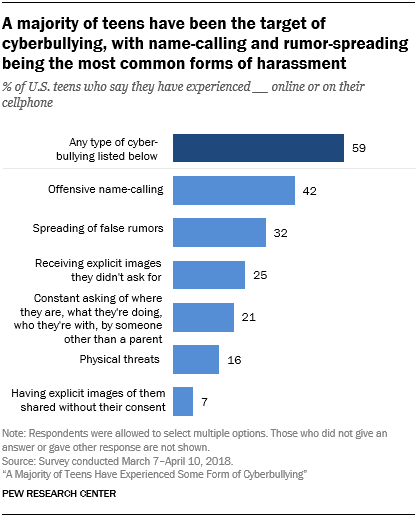
A majority of U.S. teens have been subject to online abuse, according to a new study from Pew Research Center, out this morning. Specifically, that means they’ve experienced at least one of a half-dozen types of online cyberbullying, including name-calling, being subject to false rumors, receiving explicit images they didn’t ask for, having explicit images of themselves shared without their consent, physical threats, or being constantly asked about their location and activities in a stalker-ish fashion by someone who is not their parents.

Of these, name-calling and being subject to false rumors were the top two categories of abuse teens were subject to, with 42% and 32% of teens reporting it had happened to them.


Pew says that texting and digital messaging has paved the way for these types of interactions, and parents and teens alike are both aware of the dangers and concerned.

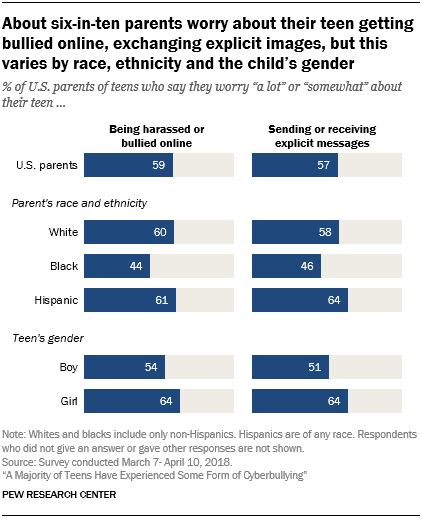
Parents, in particular, are worried about teens sending and receiving explicit images, with 57% saying that’s a concern, and a quarter of them worry about this “a lot.” And parents of girls worry more. (64% do.)

Meanwhile, a large majority – 90% – of teens now believe that online harassment is a problem and 63% say it’s what they consider a “major” problem.

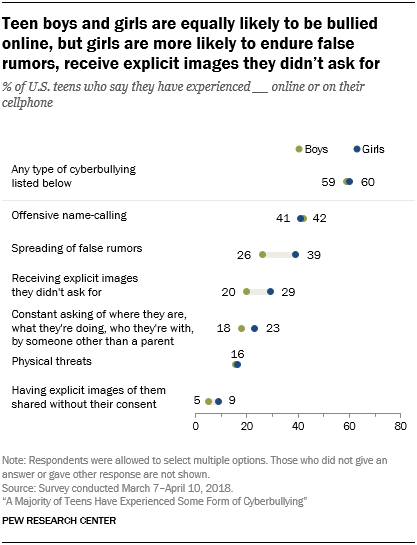
Pew also found that girls and boys are both harassed online in fairly equal measure, with 60% of girls and 59% of boys reporting having experienced some sort of online abuse. That’s a figure that may surprise some. However, it’s important to clarify that this finding is about whether or not the teen had ever had experienced online abuse – not how often or how much.

Not surprisingly, Pew found that girls are more likely than boys to have experienced two or more types of abuse, and 15% of girls have been the target of at least 4 types of abuse, compared with 6% of boys.

Girls are also more likely to be the recipient of explicit images they didn’t ask for, as 29% of teens girls reported this happened to them, versus 20% of boys.

And as the teen girls get older, they receive even more of these types of images, with 35% of girls ages 15 to 17 saying they received them, compared with only 1 out of 5 boys.

Several factors seem to play no role in whether the teens experience abuse, including race, ethnicity, or parents’ educational attainment, Pew noted. But having money does seem to matter somehow – as 24% of teens whose household income was less than $30K per year said they received online threats, compared with only 12% of those whose household incomes was greater than $75K per year. (Pew’s report doesn’t attempt to explain this finding.)

Beyond that factor, receiving or avoiding abuse is directly tied to how much screen time teens put in.

That is, the more teens go online, the more abuse they’ll receive.

Forty-five percent of teens say they’re online almost constantly, and they are more likely to be harassed, as a result. Sixty-seven percent of them say they’ve been cyberbullied, compared with 53% who use the internet several times a day or less. And half the constantly online teens have been called offensive names, compared with just about a third (36%) who use the internet less often.

Major tech companies, including Apple, Google, and Facebook, have begun to address the issues around device addiction and screen time with software updates and parental controls.

Apple, in iOS 12, rolled out Screen Time controls that allows Apple device users to measure, monitor and restrict how often they’re on their phones, when, what type of content is blocked, and which apps they can use. In adults, the software can nudge them in the right direction, but parents also have the option of locking down their children’s phones using Screen Time controls. (Of course, savvy kids have already found the loopholes to avoid this, according to new reports.)

Google also introduced time management controls in the new version of Android, and offers parental controls around screen time through its Family Link software.

And both Google and Facebook have begun to introduce screen time reminders and settings for addictive apps like YouTube, Facebook and Instagram.

Teens seem to respect parents’ involvement in their digital lives, the report also found.

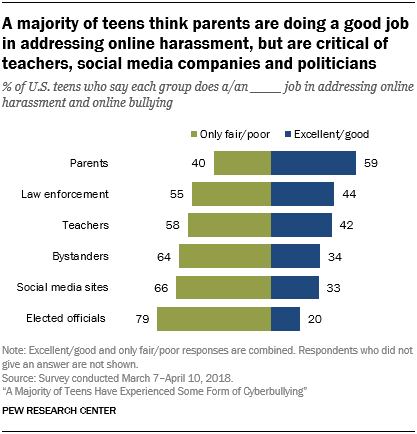
A majority – 59% – of U.S. teens say their parents are doing a good job with regard to addressing online harassment. However, 79% say elected officials are failing to protect them through legislation, 66% say social media sites are doing a poor job at stamping down abuse, and 58% of teachers are doing a poor job at handling abuse, as well.

Many of the top media sites were largely built by young people when they were first founded, and those people were often men. The sites were created in an almost naive fashion, with regard to online abuse. Protections – like muting, filters, blocking, and reporting – were generally introduced in a reactive fashion, not as proactive controls.

Instagram, for example – one of teens’ most-used apps – only introduced comment filters, blocklists, and comment blocking in 2016, and just four months ago added account muting. The app was launched in October 2010.

Pew’s findings indicate that parents would do well by their kids by using screen time management and control systems – not simply to stop their teenagers from being bullied and abused as often, but also to help the teens practice how to interact with the web in a less addictive fashion as they grow into adults.

After all, device addiction resulting in increased exposure to online abuse is not a plague that only affects teens.

Pew’s full study involves surveys of 743 teens and 1,058 parents living in the U.S. conducted March 7 to April 10, 2018. It counted “teens” as those ages 13 to 17, and “parents of teens” are those who are the parent or guardian of someone in that age range. The full report is here.

27 Sep 2018

Spotify launches Co.Lab to teach musicians about the industry

The music industry has always been cut-throat, and on-going internet fragmentation only complicates matters. Musicians have to be their own promoters, tour managers, bookers and a million other things, just to get off the ground.

If nothing else, Spotify’s new Co.Lab event series is a potentially useful attempt to help new and emerging artists make sense of it all. The programming launches in the middle of next month, providing a number of different workshops aimed at shedding light on topics like touring, merchandising and revenue streams.

That last one no doubt hits close to home for Spotify. The streaming service’s payment models have long been accused of making life even more difficult for working musicians. Earlier this month, however, the company launched a new initiative that lets independent artists upload music directly. The feature is a direct shot at record labels, which like Spotify itself, have had a complex relationship with the artists they distribute.

On some small scale, perhaps, the new series could help fill in the void left behind with the quiet shuttling of the CMJ Music Marathon, which used to occur every year right around this time. Signups are open to verified Spotify artists and those with 1,000 or more followers are prioritized — which sounds like it could be a lesson plan in and of itself. 

27 Sep 2018

SwiftKey on Android now has two-way translation baked in. Qué bien

The Internet is of course amazing if you want to send messages across borders. But different languages can still put a wrinkle in your conversational flow, even with all the handy translation apps also on tap to help turn zut alors into shucks!

So Microsoft -owned SwiftKey is probably still onto something with a new feature launching today in its Android app that bakes two-way translation right into the keyboard — which should save a lot of tedious copy-pasting, at least if you’re frequently conversing across language barriers.

It’s not clear whether the translation feature will be coming to SwiftKey on iOS too (we’ve asked and will update with any additional details).

Microsoft Translator is the underlying technology powering the core linguistic automagic. So SwiftKey’s parent is intimately involved in this feature addition.

Microsoft’s tech does continue to exist in a standalone app form too, though. And that app is getting a cross-promotional push, via the SwiftKey addition, with the company touting an added benefit for users if they install Microsoft Translator — as the keyboard translation feature will then work offline.

(SwiftKey had some 300M active users at the time of its acquisition by Microsoft, three years ago, so the size of that promotional push for Translator is potentially pretty large.)

The translation option is being added to SwiftKey via a relatively recently launched Toolbar that lets users customize the keyboard — such as by adding stickers, location or calendar.

To access the Toolbar (and the various add-ons nested within it) users tap on the ‘+’ in the upper left corner.

With translation enabled, users of the next word predicting keyboard can then switch between input and output languages to turn incoming missives from one of more than 60 languages into another tongue at the tap of a button, as well as translate their outgoing replies back the other way without needing to know how to write in that other language.

Supported languages include Italian, Spanish, Germany, Russian and Turkish, to name a few.

And while the machine translation technology is doing away with the immediate need for human foreign language expertise, there’s at least a chance app users will learn a bit as they go along — i.e. as they watch their words get rendered in another tongue right before their eyes.

As tech magic goes, translation is hard to beat. Even though machine translation can often still be very rough round the edges. But here, for helping with everyday chatting on mobiule messaging apps, there’s no doubt it will be a great help.

Commenting on the new feature in a statement, Colleen Hall, senior product manager at SwiftKey, said: “The integration of Microsoft Translator into SwiftKey is a great, natural fit, enhancing the raft of language-focused features we know our users love to use.”

27 Sep 2018

Dropbox overhauls internal search to improve speed and accuracy

Over the last several months,Dropbox has been undertaking an overhaul of its internal search engine for the first time since 2015. Today, the company announced that the new version, dubbed Nautilus, is ready for the world. The new search tool takes advantage of a new architecture powered by machine learning to help pinpoint the exact piece of content a user is looking for.

While an individual user may have a much smaller body of documents to search than the World Wide Web, the paradox of search says the fewer documents that you have, the harder it is to find the correct one. Yet Dropbox faces of a host of additional challenges when it comes to search. It has more than 500 million users and hundreds of billions of documents, making finding the correct piece even more difficult. The company had to take all of this into consideration when it was rebuilding its internal search engine.

One way for the search team to attack a problem of this scale was to put machine learning to bear on it, but it required more than an underlying level of intelligence to make this work. It also required completely rethinking the entire search tool from an architectural level.

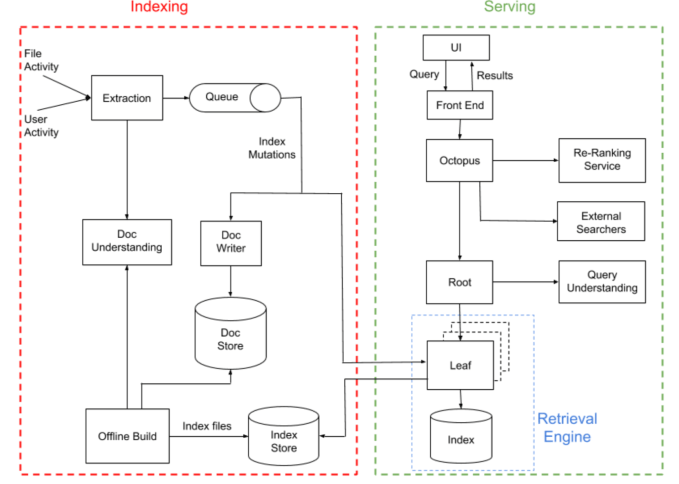
That meant separating two main pieces of the system, indexing and serving. The indexing piece is crucial of course in any search engine. A system of this size and scope needs a fast indexing engine to cover the number of documents in a whirl of changing content. This is the piece that’s hidden behind the scenes. The serving side of the equation is what end users see when they query the search and the system generates a set of results.

Nautilus Architecture Diagram: Dropbox

Dropbox described the indexing system in a blog post announcing the new search engine: “The role of the indexing pipeline is to process file and user activity, extract content and metadata out of it, and create a search index.” They added that the easiest way to index a corpus of documents would be to just keep checking and iterating, but that couldn’t keep up with a system this large and complex, especially one that is focused on a unique set of content for each user (or group of users in the business tool).

They account for that in a couple of ways. They create offline builds every few days, but they also watch as users interact with their content and try to learn from that. As that happens, Dropbox creates what it calls “index mutations,” which they merge with the running indexes from the offline builds to help provide ever more accurate results.

The indexing process has to take into account the textual content assuming it’s a document, but it also has to look at the underlying metadata as a clue to the content. They use this information to feed a retrieval engine, whose job is to find as many documents as it can, as fast it can and worry about accuracy later.

It has to make sure it checks all of the repositories. For instance, Dropbox Paper is a separate repository, so the answer could be found there. It also has to take into account the access-level security, only displaying content that the person querying has the right to access.

Once it has a set of possible results, it uses machine learning to pinpoint the correct content. “The ranking engine is powered by a [machine learning] model that outputs a score for each document based on a variety of signals. Some signals measure the relevance of the document to the query (e.g., BM25), while others measure the relevance of the document to the user at the current moment in time,” they explained in the blog post.

After the system has a list of potential candidates, it ranks them and displays the results for the end user in the search interface, but a lot of work goes into that from the moment the user types the query until it displays a set of potential files. This new system is designed to make that process as fast and accurate as possible.

27 Sep 2018

Yes Facebook is using your 2FA phone number to target you with ads

Facebook has confirmed it does in fact use phone numbers that users provided it for security purposes to also target them with ads.

Specifically a phone number handed over for two factor authentication (2FA) — a security technique that adds a second layer of authentication to help keep accounts secure.

Facebook’s confession follows a story Gizmodo ran a story yesterday, related to research work carried out by academics at two U.S. universities who ran a study in which they say they were able to demonstrate the company uses pieces of personal information that individuals did not explicitly provide it to, nonetheless, target them with ads.

While it’s been — if not clear, then at least evident — for a number of years that Facebook uses contact details of individuals who never personally provided their information for ad targeting purposes (harvesting people’s personal data by other means, such as other users’ mobile phone contact books which the Facebook app uploads), the revelation that numbers provided to Facebook by users in good faith, for the purpose of 2FA, are also, in its view, fair game for ads has not been so explicitly ‘fessed up to before.

Some months ago Facebook did say that users who were getting spammed with Facebook notifications to the number they provided for 2FA was a bug. “The last thing we want is for people to avoid helpful security features because they fear they will receive unrelated notifications,” Facebook then-CSO Alex Stamos wrote in a blog post at the time.

Apparently not thinking to mention the rather pertinent additional side-detail that it’s nonetheless happy to repurpose the same security feature for ad targeting.

Because $$$s, presumably.

We asked Facebook to confirm this is indeed what it’s doing — to make doubly doubly sure. Because, srsly wtaf. And it sent us a statement confirming that it repurposes digits handed to it by people wanting to secure their accounts to target them with marketing.

Here’s the statement, attributed to a Facebook spokesperson: “We use the information people provide to offer a better, more personalized experience on Facebook, including ads. We are clear about how we use the information we collect, including the contact information that people upload or add to their own accounts. You can manage and delete the contact information you’ve uploaded at any time.”

A spokesman also told us that users can opt out of this ad-based repurposing of their security digits by not using phone number based 2FA. (Albeit, the company only added the ability to do non-mobile phone based 2FA back in May, so anyone before then was all outta luck.)

On the ‘shadow profiles’ front — aka Facebook maintaining profiles of non-users based on the data it has been able to scrape about them from users and other data sources — the company has also been less than transparent.

Founder Mark Zuckerberg feigned confusion when questioned about the practice by US lawmakers earlier this year — claiming it only gathers data on non-users for “security purposes”.

Well it seems Facebook is also using the (valid) security concerns of actual users to extend its ability to target individuals with ads — by using numbers provided for 2FA to also carry out ad targeting.

Safe to say criticism of the company has been swift and sharp.

Soon Facebook will also be using behind-the-scenes tech means to target ads at WhatsApp users — despite also providing a robust encrypted security wrapper around their actual messages.

Stamos — now Facebook’s ex-CSO — has also defended its actions on that front.

27 Sep 2018

Wimdu, Rocket Internet’s Airbnb clone, to shut down this year ‘ facing significant business challenges’

They say imitation is the sincerest form of flattery. But it doesn’t guarantee success, and today, an Airbnb clone learned that the hard way. Wimdu, a startup originally hatched out of the Rocket Internet startup factory in Berlin and modelled on the travel acomodation US startup Airbnb, announced that it would be shutting down at the end of 2018, citing “significant financial and business challenges.” 100 employees based across Berlin and Lisbon will be affected by the decision, it said.

“The stakeholders and management are working closely with the staff; primary goals are the fair treatment of employees affected by the closure and the management of forward bookings for our guests and hosts,” an announcement on the site reads. “All guests and hosts having 2018 bookings – with a check-in date occurring before or on the 31-December-2018 – will be carried out professionally and reliably. All guests with 2019 bookings – with a check-in date occurring after the 31-December-2018 – will be contacted separately to deal with their respective booking.”

The company has about 350,000 properties on its books and it is not clear whether Wimdu will work with any other organization to transfer those to another lettings platform. We have contacted the company to ask and will update as we learn more.

The news puts to an end a long-standing attempt by Rocket Internet, and then Novasol — another property rental platform that acquired the company in 2016 — to turn Wimdu into the Airbnb of Europe.

(It turns out that Airbnb also wanted to become the Airbnb of Europe, and it has largely succeeded.)

Things were different when Wimdu was founded in 2011, and Airbnb was much smaller. Armed with $90 million in funding (a large sum at the time, especially for a European startup), Wimdu and other clones competed aggressively against their US rival in building essentially the same business: a marketplace where people can offer and rent rooms and entire private homes for short-term visits, as an alternative to staying in a hotel.

Hatched out of the Rocket Internet startup factory — which has built international clones of other US businesses such as eBay, Groupon, Airbnb, Square, Amazon, sometimes selling some of these to the companies they cloned — Wimdu’s growth-hacking tactics were modelled on a template, one that was laid bare when Airbnb decided to fight back by writing to hosts to ward them off working with its imitators. In a letter, it laid out the tactics used by Wimdu and the rest:

A new type of scam has been brought to our attention: Airbnb clones posing as competition. We’ve discovered that these scam artists have a history of copying a website, aggressively poaching from their community, then attempting to sell the company back to the original.

After receiving emails from many of you who are upset with these tactics, it’s time to address this issue as a community. Hosts are reporting these issues about the clone sites so far:

  • They falsely claim to be affiliated with Airbnb, or be the “international version” of Airbnb.
  • They claim that they are part of Ebay and/or Groupon. We’ve confirmed that this is not the case.
  • Their employees pretend to be Airbnb travelers in order to give you a sales pitch in your home.
  • They are duplicating personal profiles, descriptions, and photos of your Airbnb listing without your permission.

It seems that early on, at least some of Wimdu’s effort to win territories worked. Airbnb at one point shuttered operations in Austria and consolidated that business in Germany. And in a couple of other cases Airbnb did buy its clones.

But if Airbnb seemed to buckle here and there, those were small battles, not the war. Longer term, it seems that Wimdu never raised more funding beyond the $90 million, and in 2016, it merged with another clone, 9Flats, amid reports of an attempted fire sale. That brought the total home inventory for the two companies to between 250,000 and 500,000.

This wasn’t enough to compete with Airbnb on scale, though: the larger company had 2 million properties on its platform at the time.

Then just weeks later Wimdu got acquired, by another European home lettings platform called Novasol, owned by Wyndham Worldwide.

Wyndham Worldwide then sold Novasol to PE firm Platinum Equity earlier this year for $1.3 billion, and yesterday Novasol announced a new CEO, so it looks like the Wimdu closure is part of how the new owner is now cleaning house and cutting out loss-making operations.

Airbnb has been on a growth tear these last several years: the company is now valued at upwards of $31 billion, is profitable on an Ebitda basis, and expects to ready to go public by June 2019 (it will have the pieces in place at that point but it hasn’t set a date for an IPO). Even with a dose of controversy, the Airbnb machine shows no sign of slowing down, and so the writing may have been on the wall for Wimdu and its owners.

27 Sep 2018

Meet the startups that pitched at EF’s 10th Demo Day in London

Entrepreneur First (EF), the company builder and “talent first” investor, held its tenth London Demo Day this afternoon. This time around the even had a decidedly more international bent as it combined pitches from the London and recently launched Berlin programs.

Once again, the pitches took place in front of a nearly overcapacity crowd at King’s Place in London’s King Cross area, and saw a 24 startups pitch their wares to investors, press and other actors in the European tech scene.

EF stands out from the many other demo days that the U.K. capital city hosts because of the way the investor backs individuals “pre-team, pre-idea” — meaning that the companies pitching only came into existence over the last 6 months and perhaps may never have done so without the founders bashing heads during the program.

Unusually, aside from the upstarts presenting on stage, there were no other EF announcements today, which is in stark contrast to most previous demo days. However, I’m hearing there could be some big EF news coming quite shortly and this is likely a case of EF lining up its PR ducks in a row and choosing to shoot them down one news opportunity at a time. Besides, the company builder has had more than its fair share of announcements over the last twelve months.

In addition to existing programs in London and Singapore, this year saw EF expand to Hong Kong and Paris, as well as Berlin. And almost exactly a year ago, EF announced a $12.4 million funding round led by Silicon Valley’s Greylock Partners, and that Greylock’s Reid Hoffman had joined the company builder’s board. The capital — to be used for operational purposes and separate from EF’s multiple investment funds — was raised to enable EF to scale its program in multiple tech startup/academic hubs around the world, and where it deemed the EF “secret sauce” can bring the most value.

Meanwhile, the themes for EF’s tenth London Demo Day continued to reflect the company builder’s focus on recruiting the best technical and domain expert talent — both recent graduates and also people already working at tech companies. They spanned AR headsets, “massive simulations,” genome sequencing, machine intelligence, and cryptocurrencies.

After tuning in to the live stream and enduring 24 rounds of ‘pitchlash’, my cursory 3 picks this time around are as follows:

MyLevels

With a mission to “empower people to build a new relationship with food, myLevels uses data from Continuous Glucose Monitors combined with its own Bayesian-based machine learning models to measure the impact that food has on an individual’s body and metabolism. This is because the effect different food has on a person’s blood sugar levels — and the sometimes horrible spike followed by craving — varies person by person, and until now it has been difficult to build a personalised understanding of this. Once you have that understanding it becomes easier to lose weight and increase higher energy levels and even concentration.

Juno Bio

There’s gold in those microbiome, apparently. Juno Bio is “unlocking the potential of the microbiome” (bacteria that lives in our guts and other places, such as animals and soil), which the startup says has unprecedented potential to disrupt various industries such as the $195 billion fertiliser industry. More broadly, Juno Bio says there is an arms race for understanding and harnessing the information that microbiome hold. To that end, Juno Bio uses machine learning and state of the art bioinformatics to analyse and predict how best to manipulate microbiomes, significantly reducing the time and resources needed to improve their functionality.

Circuit Mind

Circuit Mind wants to use AI to automate the design of electronic circuits. The startup reckons that every year £40bn and 1.5bn hours are spent globally in “tedious and repetitive circuit board design” work, making building hardware even harder than it needs to be. To fix this, the company is building artificial intelligence that takes in the requirements for a circuit board and outputs the circuit board final design, ready for manufacture. “This means better circuits, designed orders of magnitude faster, at a fraction of the cost,” says Circuit Mind. Chalk this one up as another industry 4.0 play, of which EF already has a promising track record.

The full list of presenting teams (in their own words)

Nodes & Links is taming the complexity of modern projects.
CodeREG makes regulatory change in finance as simple as a software update.
QFlow enables construction teams to track, analyse and respond to environmental
risks.
Moonsift is the first platform for shoppers to create their own digital twin for product
discovery.
Homewards is the next generation of home ownership.
Popsure gives personalised insurance advice.
Metomic is data privacy made simple.
Teamflow unlocks the power of human intelligence in organisations to improve
productivity
myLevels empowers people to build a new relationship with food.
Phantasma Labs is helping self-driving cars understand humans better.
Juno Bio is unlocking the potential of the microbiome.
Magic Sandbox produces world class software engineers at scale.
Faultless AI eliminates human error in manufacturing.
Janus Genomics builds AI tools to enable biomedical data sharing while preserving
data privacy.
Lumenora is the world’s first compact, high field-of-view Augmented Reality
headset.
Donut enables increased crypto adoption through personalised portfolios. Fully
regulated.
Juniper uses hybrid deep learning to empower oncologists.
WILD AI empowers humans to reach their personal best through datalogy.
Holotron unleashes the true potential of VR & humanoid robots.
Data Hygge helps companies spot, prioritise and solve experience issues.
Yo-Da is the personal data management platform making consumer data protection
quick, easy, and profitable.
Insurami is removing friction in office space onboarding.
Atlas ML is a development platform for machine learning.
Circuit Mind is using AI to completely automate the design of electronic circuits.

27 Sep 2018

In-car commerce startup Cargo raises $22 million led by Founders Fund

Cargo, the startup that helps ridesharing drivers earn money by bringing the convenience store into their vehicles, has raised $22 million in a Series A round led by Founders Fund .

Additional investment came from Coatue Management, Aquiline Technology Growth as well as a number of  high-profile entertainment, gaming, and technology executives who include Zynga founder Mark Pincus, Twitch’s former CSO Colin Carrier, media investor Vivi Nevo, former NBA commissioner David Stern, Def Jam Records CEO Paul Rosenberg, Steve Aoki, Maria Shriver, and Patrick and Christina Schwarzenegger.

To date, Cargo has raised $30 million in venture funding. As part of this latest round, Founders Fund partner Cyan Banister is joining the board.

Cargo provides qualified ridesharing drivers with free boxes filled with the kinds of goods you might find in a convenience store, including snacks and phone chargers. Riders can use Cargo’s mobile web menu on their smartphones (without downloading an app) to buy what they need. Cargo has previously partnered with Kellogg’s, Starbucks and Mars Wrigley Confectionery — companies looking for ways to market their goods to consumers.

“In just a few years, ridesharing has evolved from a niche service to an indispensable element of our global transportation system,” Banister said in a statement. “Founders Fund is excited to support Cargo in driving the next evolution: a better on-trip experience for riders and new revenue generating opportunities for drivers.” 

The round follows Cargo’s partnership with Uber and an international licensing deal with Grab. The company, which was founded in 2017, has activated more than 12,000 drivers across 10 cities.

Cargo says it will use the capital to scale its business in the U.S. and internationally. It’s also working on new digital services —a development Banister eludes to —that will improve users on-trip experience.  The strategic investments from gaming and entertainment executives is designed to help Cargo develop those digital services for riders.

“Our default behavior in an Uber is to shop, play games and listen to music on our phone. Riders have ordered more than two million products and today transact with us every five seconds” Cargo founder and CEO Jeff Cripe said in a statement. “We brought riders instant commerce, now we’ll help them discover and enjoy games, music, and entertainment on one in-car platform.”

Existing Cargo investors participating in the round include CRCM Ventures, Rosecliff Ventures, Kellogg’s eighteen94 capital, RiverPark Ventures, and former Uber executives including Chief Business Officer Emil Michael, New York City General Manager Josh Mohrer, and former West Coast General Manager William Barnes.