
Author: azeeadmin

26 Sep 2018

Meet 13 startups launching out of the Entrepreneurs Roundtable Accelerator

Today, a new crop of startups is launching out of the Entrepreneurs Roundtable Accelerator. This marks the 15th ERA class, the past 14 classes comprising 165 startups with a combined market capitalization of $2B+.

Thirteen companies in total are participating in demo day today, spanning a wide variety of industries including e-commerce, real estate, and voice collaboration.

Here are the new startups:

Agilis is a B2B commerce platform for chemical distributors. The supply chain for chemical distribution is often complex, but Agilis aggregates supply and demand and facilitates transactions on behalf of all parties involved, from producers to distributors to buyers.

As voice interfaces continue to grow in prominence, Airbud is looking to offer developers and companies a way to add voice capabilities to their websites and apps. Airbud’s technology quickly ingests the information on a website or app to allow users to interact with that information with their voice.

Bikky looks to give restaurant owners more insight into their customers, aggregating data across online ordering channels and using SMS to get real-time feedback on orders. The customer analytics platform for restaurants hopes to help businesses increase their customer retention and better understand what is and isn’t working with their business.

Daivergent was founded by Byran Dai. Inspired by his brother, who has autisim, he created Daivergent to allow businesses to hire individuals with autism who are particularly well-suited to perform complex data tasks. The platform provides training, management and workflow functions alongside making the initial connection between these highly skilled workers and companies.

Ettitude is a D2C bedding and homewares brand looking to compete with the likes of Broolinen. Unlike most competitors, however, Ettitude uses a proprietary supply of organic bamboo lyocell fabric to make soft, cooling, hypoallergenic sheets, pillowcases, etc.

LVRG is a vendor relationship management platform for the enterprise, allowing decision-makers within organizations to make collaborative, informed purchasing decisions with the help of an AI algorithm.

Maivino reinvents the idea of boxed wine by letting users subscribe to receive premium wine in a pouch. Unlike a box or a bottle, Maivino’s pouch keeps wine fresh for 32 days after opening, letting users have control of their own pace.

ProdPerfect wants to make quality assurance regression tests for web applications easier and more effective. By analyzing live user traffic to build test cases from behavior patterns, the company gives engineering teams QA testing coverage that continuously and automatically updates as they add new features.

Rocket Cloud is looking to be the Angie’s List for industrial suppliers. The company has created a marketplace that connects electrical, plumbing and HVAC equipment manufacturers and suppliers to online customers.

Rubik is a data platform for real estate investors, providing up-to-date financial data on 70 million single family homes in the U.S., letting investors search based on their own investment criteria.

Threshing Floor Security collects, aggregates and analyzes internet background noise, network scans, web scrapers, and authentication attempts to let security teams find alerts that matter to them. The company integrates its technology with the most popular enterprise security products out there.

Triyo is a secure project collaboration platform for highly regulated industries, particularly financial services. As teams work together on a project, they can use Triyo to collaborate on documents, presentations, and spreadsheets efficiently without duplicating work, all within the bounds of internal compliance and regulatory rules.

Woveon is a CRM tool that aggregates data from all channels, including phone calls, email, social media and CRM, so that companies can get a bird’s eye view of their customer relations. The platform is powered by AI, allowing Woveon to point out the most relevant information for resolving customer inquiries.

26 Sep 2018

Meet 13 startups launching out of the Entrepreneurs Roundtable Accelerator

Today, a new crop of startups is launching out of the Entrepreneurs Roundtable Accelerator. This marks the 15th ERA class, the past 14 classes comprising 165 startups with a combined market capitalization of $2B+.

Thirteen companies in total are participating in demo day today, spanning a wide variety of industries including e-commerce, real estate, and voice collaboration.

Here are the new startups:

Agilis is a B2B commerce platform for chemical distributors. The supply chain for chemical distribution is often complex, but Agilis aggregates supply and demand and facilitates transactions on behalf of all parties involved, from producers to distributors to buyers.

As voice interfaces continue to grow in prominence, Airbud is looking to offer developers and companies a way to add voice capabilities to their websites and apps. Airbud’s technology quickly ingests the information on a website or app to allow users to interact with that information with their voice.

Bikky looks to give restaurant owners more insight into their customers, aggregating data across online ordering channels and using SMS to get real-time feedback on orders. The customer analytics platform for restaurants hopes to help businesses increase their customer retention and better understand what is and isn’t working with their business.

Daivergent was founded by Byran Dai. Inspired by his brother, who has autisim, he created Daivergent to allow businesses to hire individuals with autism who are particularly well-suited to perform complex data tasks. The platform provides training, management and workflow functions alongside making the initial connection between these highly skilled workers and companies.

Ettitude is a D2C bedding and homewares brand looking to compete with the likes of Broolinen. Unlike most competitors, however, Ettitude uses a proprietary supply of organic bamboo lyocell fabric to make soft, cooling, hypoallergenic sheets, pillowcases, etc.

LVRG is a vendor relationship management platform for the enterprise, allowing decision-makers within organizations to make collaborative, informed purchasing decisions with the help of an AI algorithm.

Maivino reinvents the idea of boxed wine by letting users subscribe to receive premium wine in a pouch. Unlike a box or a bottle, Maivino’s pouch keeps wine fresh for 32 days after opening, letting users have control of their own pace.

ProdPerfect wants to make quality assurance regression tests for web applications easier and more effective. By analyzing live user traffic to build test cases from behavior patterns, the company gives engineering teams QA testing coverage that continuously and automatically updates as they add new features.

Rocket Cloud is looking to be the Angie’s List for industrial suppliers. The company has created a marketplace that connects electrical, plumbing and HVAC equipment manufacturers and suppliers to online customers.

Rubik is a data platform for real estate investors, providing up-to-date financial data on 70 million single family homes in the U.S., letting investors search based on their own investment criteria.

Threshing Floor Security collects, aggregates and analyzes internet background noise, network scans, web scrapers, and authentication attempts to let security teams find alerts that matter to them. The company integrates its technology with the most popular enterprise security products out there.

Triyo is a secure project collaboration platform for highly regulated industries, particularly financial services. As teams work together on a project, they can use Triyo to collaborate on documents, presentations, and spreadsheets efficiently without duplicating work, all within the bounds of internal compliance and regulatory rules.

Woveon is a CRM tool that aggregates data from all channels, including phone calls, email, social media and CRM, so that companies can get a bird’s eye view of their customer relations. The platform is powered by AI, allowing Woveon to point out the most relevant information for resolving customer inquiries.

26 Sep 2018

Plex kills off support for Cloud Sync, Plugins and bookmarking features

Plex is continuing to streamline its software by shutting down features that weren’t broadly adopted or all that functional. The company says it will soon sunset a handful of options in its media player software, including Plugins, Cloud Sync, and its “Watch Later” bookmarking feature.

The move to kill off these features comes shortly after Plex announced it would soon shut down its Plex Cloud service, due to technical difficulties.

The company had originally began its life as a way for users to organize their personal media collections of photos, music, TV shows and films. But it has more recently expanded into the cord cutting market. This shift in focus has seen Plex adding features that support the ability to watch and record from live TV.

However, the change has also meant that support for things like Plex Cloud – which allowed users to stream their media from cloud storage sites like Google Drive and Dropbox – no longer take precedence.

However, Plex says that its decision to shut down this other group of features has to do more with their lack of use.

“Watch Later,” it says, was costly to maintain and hard to justify when only a small handful of folks used it, for example. Meanwhile, Cloud Sync was adopted by so few that Plex jokingly challenged any upset users to “DM us a photo of your Cloud Sync library and today’s newspaper,” to prove they actually used it.

Still, Cloud Sync’s removal is another example of Plex stepping away from supporting other cloud platforms. In this case, the feature allowed subscribers to select some content from their local media library, then sync a copy to a cloud storage provider for access when the local Plex Media Server was unavailable.

The decision to shut down Plugins seems to have given Plex the most concern, and was not taken lightly, the company says.

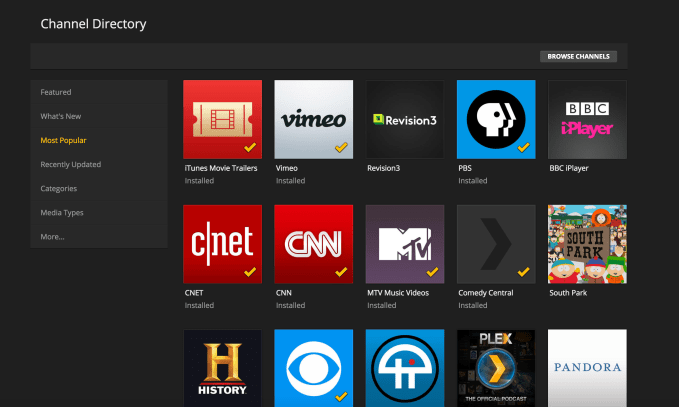
The Plugins feature allows users to add various channels and other third-party add-ons to their account, so they can access online content, including video, audio and other photo services. Among the most popular were plugins for services like Pandora, CNN, Vimeo, and others.

But Plex says that less than 2% of people were using Plugins, and it was built with an outdated protocol that’s difficult to support. Essentially, it’s at the point where Plex would need to rebuild the feature to keep it around, but can’t justify doing so when so little of the user base takes advantage of the option.

Plugins also make less sense for Plex’s business as it continues its push into live TV streaming, as many of the Plugins were workarounds for not being able to access TV content – like ABC, CBS, or NBC shows, for instance, or a newscast of some sort. But Plex itself bought a streaming news service, Watchup, last year and quickly added a dedicated news hub right in its app as a result. It has also added native support for podcasts, as another means of getting news and informational content.

The company explained its reasoning for all the closures in a blog post:

The Plex ecosystem is quite large, and over the years, we’ve sometimes added things that might have made sense at the time, but didn’t age well. We’ve also been incredibly reluctant to take anything away from people who may be using a given feature. Or kill support for a platform with low usage or other challenges. And while any given case might not be significant, they can add up over a decade to a death by a thousand (paper) cuts. So we set out to do some house-cleaning…

We didn’t approach the process lightly; we looked over usage numbers and took into account maintenance costs and general customer satisfaction. In some cases, we have plans for a future in which a better replacement shows up. Other things, we’re just stabbing in the chest repeatedly with a wooden stake (and hoping it’s not a zombie). But the philosophy is the same—we want to focus our finite energy on providing awesome functionality that works great and makes the folks who use it happy.

Alongside the shutdowns, Plex also added support for subtitles, which will roll out to Plex Pass Preview in the days ahead with launches on web (desktop), Xbox One, most LG TVs, Plex Media Player, Android mobile, and Android TV with iOS and Apple TV to follow.

26 Sep 2018

Plex kills off support for Cloud Sync, Plugins and bookmarking features

Plex is continuing to streamline its software by shutting down features that weren’t broadly adopted or all that functional. The company says it will soon sunset a handful of options in its media player software, including Plugins, Cloud Sync, and its “Watch Later” bookmarking feature.

The move to kill off these features comes shortly after Plex announced it would soon shut down its Plex Cloud service, due to technical difficulties.

The company had originally began its life as a way for users to organize their personal media collections of photos, music, TV shows and films. But it has more recently expanded into the cord cutting market. This shift in focus has seen Plex adding features that support the ability to watch and record from live TV.

However, the change has also meant that support for things like Plex Cloud – which allowed users to stream their media from cloud storage sites like Google Drive and Dropbox – no longer take precedence.

However, Plex says that its decision to shut down this other group of features has to do more with their lack of use.

“Watch Later,” it says, was costly to maintain and hard to justify when only a small handful of folks used it, for example. Meanwhile, Cloud Sync was adopted by so few that Plex jokingly challenged any upset users to “DM us a photo of your Cloud Sync library and today’s newspaper,” to prove they actually used it.

Still, Cloud Sync’s removal is another example of Plex stepping away from supporting other cloud platforms. In this case, the feature allowed subscribers to select some content from their local media library, then sync a copy to a cloud storage provider for access when the local Plex Media Server was unavailable.

The decision to shut down Plugins seems to have given Plex the most concern, and was not taken lightly, the company says.

The Plugins feature allows users to add various channels and other third-party add-ons to their account, so they can access online content, including video, audio and other photo services. Among the most popular were plugins for services like Pandora, CNN, Vimeo, and others.

But Plex says that less than 2% of people were using Plugins, and it was built with an outdated protocol that’s difficult to support. Essentially, it’s at the point where Plex would need to rebuild the feature to keep it around, but can’t justify doing so when so little of the user base takes advantage of the option.

Plugins also make less sense for Plex’s business as it continues its push into live TV streaming, as many of the Plugins were workarounds for not being able to access TV content – like ABC, CBS, or NBC shows, for instance, or a newscast of some sort. But Plex itself bought a streaming news service, Watchup, last year and quickly added a dedicated news hub right in its app as a result. It has also added native support for podcasts, as another means of getting news and informational content.

The company explained its reasoning for all the closures in a blog post:

The Plex ecosystem is quite large, and over the years, we’ve sometimes added things that might have made sense at the time, but didn’t age well. We’ve also been incredibly reluctant to take anything away from people who may be using a given feature. Or kill support for a platform with low usage or other challenges. And while any given case might not be significant, they can add up over a decade to a death by a thousand (paper) cuts. So we set out to do some house-cleaning…

We didn’t approach the process lightly; we looked over usage numbers and took into account maintenance costs and general customer satisfaction. In some cases, we have plans for a future in which a better replacement shows up. Other things, we’re just stabbing in the chest repeatedly with a wooden stake (and hoping it’s not a zombie). But the philosophy is the same—we want to focus our finite energy on providing awesome functionality that works great and makes the folks who use it happy.

Alongside the shutdowns, Plex also added support for subtitles, which will roll out to Plex Pass Preview in the days ahead with launches on web (desktop), Xbox One, most LG TVs, Plex Media Player, Android mobile, and Android TV with iOS and Apple TV to follow.

26 Sep 2018

Sony is finally opening Fortnite cross-play on the PS4

Cross-play has been one of the biggest selling post for Fortnite, allowing players to engage in the battle royale, regardless of platform. There has, however, been one major holdout — until now. While PS4 have been able to play one another, Sony has been dragging its heels at the seemingly inevitable update.

Today, however, the company is taking key steps toward letting users battle it out, regardless of platform. Sony Interactive Entertainment President and CEO John Kodera announced via blog post that the company is opening up cross-play beta, beginning with the crazy popular sandbox survival game.

“Following a comprehensive evaluation process,” the exec writes, “SIE has identified a path toward supporting cross-platform features for select third party content. We recognize that PS4 players have been eagerly awaiting an update, and we appreciate the community’s continued patience as we have navigated through this issue to find a solution.”

That “path forward” will feature the major platforms that support the title, including, Android, iOS, Nintendo Switch, Xbox One, Windows and macOS. As Kodera notes, the update is a pretty sizable policy shift, so the company, “will update the community once we have more details to share, including more specifics regarding the beta timeframe, and what this means for other titles going forward.”

Until now, Sony has suggested that such a move could pose a security risk to users.  Observers, on the other hand, have suggested it was holding out purely out of monetary concern for the company.

26 Sep 2018

Sony is finally opening Fortnite cross-play on the PS4

Cross-play has been one of the biggest selling post for Fortnite, allowing players to engage in the battle royale, regardless of platform. There has, however, been one major holdout — until now. While PS4 have been able to play one another, Sony has been dragging its heels at the seemingly inevitable update.

Today, however, the company is taking key steps toward letting users battle it out, regardless of platform. Sony Interactive Entertainment President and CEO John Kodera announced via blog post that the company is opening up cross-play beta, beginning with the crazy popular sandbox survival game.

“Following a comprehensive evaluation process,” the exec writes, “SIE has identified a path toward supporting cross-platform features for select third party content. We recognize that PS4 players have been eagerly awaiting an update, and we appreciate the community’s continued patience as we have navigated through this issue to find a solution.”

That “path forward” will feature the major platforms that support the title, including, Android, iOS, Nintendo Switch, Xbox One, Windows and macOS. As Kodera notes, the update is a pretty sizable policy shift, so the company, “will update the community once we have more details to share, including more specifics regarding the beta timeframe, and what this means for other titles going forward.”

Until now, Sony has suggested that such a move could pose a security risk to users.  Observers, on the other hand, have suggested it was holding out purely out of monetary concern for the company.

26 Sep 2018

Watch this tiny robot crawl through a wet stomach

While this video shows a tiny robot from the City University of Hong Kong doing what amounts to a mitzvah, we can all imagine a future in which this little fellow could stab you in the kishkes.

This wild little robot uses electromagnetic force to swim or flop back and forth to pull itself forward through harsh environments. Researchers can remotely control it from outside of the body.

“Most animals have a leg-length to leg-gap ratio of 2:1 to 1:1. So we decided to create our robot using 1:1 proportion,” said Dr. Shen Yajing of CityU’s Department of Biomedical Engineering.

The legs are .65 mm long and pointed, reducing friction. The robot is made of “silicon material called polydimethylsiloxane (PDMS) embedded with magnetic particles which enables it to be remotely controlled by applying electromagnetic force.” It can bend almost 90 degrees to climb over obstacles.

The researchers have sent the little fellow through multiple rough environments including this wet model of a stomach. It can also carry medicines and drop them off as needed.

“The rugged surface and changing texture of different tissues inside the human body make transportation challenging. Our multi-legged robot shows an impressive performance in various terrains and hence open wide applications for drug delivery inside the body,” said Professor Wang Zuankai.

The team hopes to create a biodegradable robot in the future which would allow the little fellow to climb down your esophagus and into your guts and then, when it has dropped its payload, dissolve into nothingness or come out your tuchus.

26 Sep 2018

Watch this tiny robot crawl through a wet stomach

While this video shows a tiny robot from the City University of Hong Kong doing what amounts to a mitzvah, we can all imagine a future in which this little fellow could stab you in the kishkes.

This wild little robot uses electromagnetic force to swim or flop back and forth to pull itself forward through harsh environments. Researchers can remotely control it from outside of the body.

“Most animals have a leg-length to leg-gap ratio of 2:1 to 1:1. So we decided to create our robot using 1:1 proportion,” said Dr. Shen Yajing of CityU’s Department of Biomedical Engineering.

The legs are .65 mm long and pointed, reducing friction. The robot is made of “silicon material called polydimethylsiloxane (PDMS) embedded with magnetic particles which enables it to be remotely controlled by applying electromagnetic force.” It can bend almost 90 degrees to climb over obstacles.

The researchers have sent the little fellow through multiple rough environments including this wet model of a stomach. It can also carry medicines and drop them off as needed.

“The rugged surface and changing texture of different tissues inside the human body make transportation challenging. Our multi-legged robot shows an impressive performance in various terrains and hence open wide applications for drug delivery inside the body,” said Professor Wang Zuankai.

The team hopes to create a biodegradable robot in the future which would allow the little fellow to climb down your esophagus and into your guts and then, when it has dropped its payload, dissolve into nothingness or come out your tuchus.

26 Sep 2018

GoPro’s stock price opens over 10% on stock upgrade

GoPro’s stock price is on a bit of rebound this morning. The stock opened at $7.36, up from its previous close of $6.62, and is continuing to climb on news that Oppenheimer analyst Andrew Uerkwitz is now bullish on the action camera maker. He cites optimism around GoPro’s refreshed product line.

Uerkwitz changed his rating on the company from perform to outperform and issued a stock price target of $9, up 36% from GoPro’s most recent close of $6.62. GoPro last traded at $9 a share in November 2017.

GoPro’s latest products bring improved mechanics and additional features to the action cameras. The new flagship model retails for $400 and includes built-in stabilization and the ability to live stream video to the internet. The company also introduced two less expensive cameras and cancelled the GoPro Session product line. The new offering is streamlined and cohesive.

The Oppenheimer analyst seeming agrees, writing to clients “With compelling features such as live streaming and gimbal-like image stabilization, we believe the products are compelling” and adding “In summary, overlooked GoPro should be a buy.”

26 Sep 2018

GoPro’s stock price opens over 10% on stock upgrade

GoPro’s stock price is on a bit of rebound this morning. The stock opened at $7.36, up from its previous close of $6.62, and is continuing to climb on news that Oppenheimer analyst Andrew Uerkwitz is now bullish on the action camera maker. He cites optimism around GoPro’s refreshed product line.

Uerkwitz changed his rating on the company from perform to outperform and issued a stock price target of $9, up 36% from GoPro’s most recent close of $6.62. GoPro last traded at $9 a share in November 2017.

GoPro’s latest products bring improved mechanics and additional features to the action cameras. The new flagship model retails for $400 and includes built-in stabilization and the ability to live stream video to the internet. The company also introduced two less expensive cameras and cancelled the GoPro Session product line. The new offering is streamlined and cohesive.

The Oppenheimer analyst seeming agrees, writing to clients “With compelling features such as live streaming and gimbal-like image stabilization, we believe the products are compelling” and adding “In summary, overlooked GoPro should be a buy.”