Author: azeeadmin

26 Sep 2018

CrunchMatch for all at Disrupt Berlin 2018

Verbinden wie nie zuvor! Very roughly translated that means “connect like never before.” If you’re planning to attend Disrupt Berlin 2018 on November 29-30, we’re happy to tell you that networking will be easier and more exacting than ever. How? We’re making our CrunchMatch platform available to all attendees.

Not familiar with CrunchMatch? It’s our free business match-making service that connects investors and founders — who want to discuss potential funding opportunities — based on their specific criteria, goals and interests. CrunchMatch (powered by our partner Brella) uses algorithmic magic to suggest matches and, if approved, send meeting requests and propose meeting times.

CrunchMatch really works well, if you ask TestCard CEO Luke Heron’s about his experience with the platform at Disrupt Berlin 2017. “We used the CrunchMatch platform to schedule a meetings with six or seven VCs and, by and large, they were very positive meetings.” So positive, in fact, that Heron recently wrote us to say that TestCard “just closed $1.7 million in funding (which is thanks to you and your team, bless you!) You guys are fantastic — the lifeblood of the startup scene.” At Disrupt San Francisco in September, several founders who used CrunchMatch walked away from their meetings with term sheets.

On the VC side of the investment coin, Michael Kocan, managing partner at Trend Discovery, noted that CrunchMatch helps him find startups that have a good chance of meeting his investment criteria.

“I get the most value at the intersection of CrunchMatch and Startup Battlefield. If I see an interesting company present on stage, I use CrunchMatch to quickly schedule a meeting with them for later that day. It makes vetting deals extremely efficient.”

The platform’s powerful combination of curation and automated efficiency means you make the most of your limited time at Disrupt — and still find the people you need in the easiest way possible. Think of CrunchMatch as the solution to the age-old needle-in-a-haystack scenario.

Disrupt Berlin 2018 marks the first time we’re opening up CrunchMatch to all attendees — not just investors and founders. Who else can benefit from using CrunchMatch? Let’s say founders looking for developers, technology service providers eager to help founders, founders looking for marketing help — the list is endless. But with CrunchMatch, Disrupt Berlin attendees can spell out what they are looking for and discover other attendees who are a fit.

And of course, investors and founders can still use it to discuss potential funding opportunities.

Now that CrunchMatch will be available to all Disrupt Berlin 2018 attendees, here’s what you need to know to make the most of this opportunity.

Once we launch CrunchMatch, registered Disrupt Berlin attendees will receive an email explaining how to access the platform and fill out their profiles. Simply identify your role (developer, service provider, founder, etc.) and who you want to connect with at Disrupt. CrunchMatch will get to work and make suggestions, which you can approve — and CrunchMatch will do the rest.

Disrupt Berlin 2018 takes place on November 29-30. Be sure to buy your tickets today and get ready to network. CrunchMatch saves you time, it saves you shoe leather and it helps you connect like never before. Verbinden wie nie zuvor!

26 Sep 2018

China’s Didi Chuxing adds more safety features following passenger murder

Didi Chuxing, China’s largest ride-hailing firm, is rolling out new security systems one month after a female customer was raped and murdered by a driver, the second such fatality on its Hitch service this year.

Today the company said it introduced a number of new safety features which include random biometric ID testing for drivers (in addition to a selfie-based log-in each day) and the introduction of an SOS button within Didi’s driver app which connects directly to police. Didi said that SOS feature is tied into “a streamlined critical response process” — which includes “a special police response team” set up to assist with issues on the Didi service — and there are fatigue and tiredness alerts for drivers.

Earlier this month, Didi added a safety center featuring guidelines and help, and updated the SOS button within the passenger app so it goes directly to the police rather than customer support agents. The company also started trialing an on-route audio recording function for its Express and Premier services.

Didi’s CEO and chairwoman earlier said that it plans to prioritize user safety over growth.

The company faced strong criticism after it emerged that its own systems had been at fault in both murders. For the first fatality, the driver who committed the murder bypassed Didi’s driver authentication system (using an account belonging to his father) while a sexual harassment complaint lodged against the account before the incident was not followed up on.

The second murder showed further problems. The driver had been flagged to Didi’s safety team just one day before the murder after a female passenger complained that he had requested her to ride in the front seat and then followed her for some time after she left his vehicle. Yet, the safety center representative who handled the complaint had not followed company policy of initiating an investigation within two hours.

Didi fired two executives following the second murder — the general manager for Hitch and the company’s vice president of customer services — and it suspended the Hitch service for the second time this year.

China instituted new regulations around ride-sharing last month which included tasking provinces and autonomous regions with setting up passenger safety committees and ensuring that incidents are investigated promptly.

Rival Meituan, which raised $4 billion from an IPO in Hong Kong last week, entered the ride-hailing space earlier this year. The company has been keen to battle Didi but, perhaps sensing the difficulty of the moment, it suspended plans to expand beyond Nanjing and Shanghai and into more parts of China.

Didi has been without a strong direct competitor since it reached a deal to acquire Uber’s China-based service two years ago.

26 Sep 2018

Google to give Chrome users an opt-out to ‘forced login’ after privacy backlash

Google has responded to blowback about a privacy hostile change it made this week, which removes user agency by automating Chrome browser sign-ins, by rowing back slightly — saying it will give users the ability to disable this linking of web-based sign-in with browser-based sign-in in a forthcoming update (Chrome 70), due mid next month.

The update to Chrome 69 means users are automatically logged into the browser when they are signed into another Google service, giving them no option to keep these digital identities separate.

Now Google is saying there will be an option to prevent it pinning your Chrome browsing to your Google account — but you’ll have to wait about a month to get it.

And of course for the millions of web users who never touch default settings being automatically signed into Google’s browser when they are using another Google service like Gmail or YouTube will be the new normal.

Matthew Green, a cryptography professor at Johns Hopkins, flagged the change in a critical blog post at the weekend — entitled Why I’m done with Chrome — arguing that the new “forced login” feature blurs the previously strong barrier between “never logged in” and “signed in”, and thus erodes user trust.

Prior to the Chrome 69 update, users had to actively opt in to linking their web-based and browser-based IDs. But Google’s change flips that switch — making the default setting hostile to privacy by folding a Chrome user’s browsing activity into their Google identity.

In its blog post Google claims that being signed in to Chrome does not mean Chrome sync gets turned on.

So it’s basically saying that despite it auto-linking your Chrome browsing and (Google) web-based activity it’s not automatically copying your browsing data to its own servers, where it would then be able to derive all sorts of fresh linked intel about you for its ad-targeting purposes.

“Users who want data like their browsing history, passwords, and bookmarks available on other devices must take additional action, such as turning on sync,” writes Chrome product manager Zach Koch.

But in his blog post, Green is also highly critical of Google’s UI around Chrome sync — dubbing it a dark pattern, and pointing out that it’s now all too easy for a user to accidentally send Google a massive personal data dump — because, in a fell swoop, the company “has transformed the question of consenting to data upload from something affirmative that I actually had to put effort into — entering my Google credentials and signing into Chrome — into something I can now do with a single accidental click”.

“The fact of the matter is that I’d never even heard of Chrome’s “sync” option — for the simple reason that up until September 2018, I had never logged into Chrome. Now I’m forced to learn these new terms, and hope that the Chrome team keeps promises to keep all of my data local as the barriers between “signed in” and “not signed in” are gradually eroded away,” Green also wrote.

Hence his decision to dump Chrome. (Other browsers are certainly available, though Chrome accounts for by far the biggest chunk of global browser usage.)

Responding to what Koch colorlessly terms “feedback” about the controversial changes, he says Google is going to “better communicate our changes”.

“We’re updating our UIs to better communicate a user’s sync state,” he writes. “We want to be clearer about your sign-in state and whether or not you’re syncing data to your Google Account.”

His explanation for Google flipping the default to be privacy hostile (rather than user affirmative) is to claim that “we think sign-in consistency will help many of our users”, saying Google has “received feedback from users on shared devices that they were confused about Chrome’s sign-in state”.

“We think these UI changes help prevent users from inadvertently performing searches or navigating to websites that could be saved to a different user’s synced account,” he also writes.

Though, as Green points out, making more people sign in to Chrome (rather than fewer) is a fuzzy sort of fix for an account ‘pollution’ issue.

Chrome’s flipped switch also now means users have to take Google’s word for it that it won’t suddenly auto sync their data to its own servers — say by making another opaque change, in the future, to further automate the harvesting of users’ personal data.

Privacy policies that can just be unilaterally rewritten at any point, without obtaining fresh consent from the user, aren’t worth the pixels they’re claiming to be inked in.

Let’s also not forget this is the same company that, back in 2012, combined around 60 separate privacy policies into a single overarching policy and Google account covering multiple, distinct web products — thereby, also in a fell swoop, collapsing multiple user identities which, prior to then, people had been able to maintain (to try to control what Google knew about them).

Google’s push where privacy is concerned is pretty clearly one way — away from individual agency and control, and towards it being able to join up ever more personal data dots which its ad-targeting business can use.

With the Chrome update the company has rubbed out yet another privacy firewall for users wanting to fight its amassing of conglomerate profiles of their online activity.

And even with the after-the-fact switch that’s being announced now (and only after a critical backlash), which from next month will let settings pros disable the default Chrome auto-link, the company’s general direction of travel does not respect user agency at all. Quite the opposite.

Google seems to be trying to make consent itself an after thought — i.e. for the few who know to poke around in the settings. Instead of what it should be: An affirmative, baked in by design to ensure privacy is available for everyone.

Google’s push to erode privacy looks likely to bring it problems in Europe, where a tough new regional data protection framework makes privacy by design and default mandatory.

Failure to comply with this element of the GDPR can attract fines as large as 2% of a company’s global annual turnover — which would not be a trivial sum for a company as revenue-heavy as Alphabet.

And, as others have pointed out, Google making a major change to how Chrome handles sign-ins does not look like business as usual for the product. So the company would have been well advised to have carried out a privacy impact assessment — to ensure the changes it’s making were compliant with GDPR.

We’ve asked Google whether it carried out a data protection impact assessment (DPIA) ahead of pushing out the change to sign-ins on Chrome 69 and will update this report with any response. Or whether it’s handling sign-ins differently in the EU (which does not seem to be the case).

We’ve also asked if it will commit to making any DPIA for Chrome public.

A spokesman acknowledged receipt of our questions but at the time of writing the company had not sent any answers.

There’s another potentially problematic issue for Google here too, vis-a-vis GDPR, because according to Koch’s blog post it is not currently clearing Google auth cookies when cookies are cleared by the user.

He writes that it will “change this behavior that so all cookies are deleted and you will be signed out”. But that’s going to take about a month.

In the meanwhile a user action (clearing cookies) is not resulting in Google clearing all cookies — which looks like a pretty clear violation of EU privacy rules, albeit temporarily (if it’s going to fix it next month).

We also asked Google about its failure to clear all cookies.

Safe to say, Google’s privacy hostile actions look sure to attract close scrutiny in the EU where privacy is a fundamental right.

But the company is also set to face questions on the topic in a Senate committee hearing today — and is expected to acknowledge that it has made “mistakes” on privacy issues, according to documents seen by Reuters

Though it will also apparently claim it has “learned, and improved our robust privacy program”.

Certain Chrome users would probably take a very different view.

26 Sep 2018

Instana raises $30M for its application performance monitoring service

Instana, an application performance monitoring (APM) service with a focus on modern containerized services, today announced that it has raised a $30 million Series C funding round. The round was led by Meritech Capital, with participation from existing investor Accel. This brings Instana’s total funding to $57 million.

The company, which counts the likes of Audi, Edmunds.com, Yahoo Japan and Franklin American Mortgage as its customers, considers itself an APM 3.0 player. It argues that its solution is far lighter than those of older players like New Relic and AppDynamics (which sold to Cisco hours before it was supposed to go public). Those solutions, the company says, weren’t built for modern software organizations (though I’m sure they would dispute that).

What really makes Instana stand out is its ability to automatically discover and monitor the ever-changing infrastructure that makes up a modern application, especially when it comes to running containerized microservices. The service automatically catalogs all of the endpoints that make up a service’s infrastructure, and then monitors them. It’s also worth noting that the company says that it can offer far more granular metrics that its competitors.

Instana says that its annual sales grew 600 percent over the course of the last year, something that surely attracted this new investment.

“Monitoring containerized microservice applications has become a critical requirement for today’s digital enterprises,” said Meritech Capital’s Alex Kurland. “Instana is packed with industry veterans who understand the APM industry, as well as the paradigm shifts now occurring in agile software development. Meritech is excited to partner with Instana as they continue to disrupt one of the largest and most important markets with their automated APM experience.”

The company plans to use the new funding to fulfill the demand for its service and expand its product line.

26 Sep 2018

Google launches its group planning feature for Maps

Earlier this year, Google announced its revamped Google Maps, which puts a stronger emphasis on discovery. Some of the features the company announced back then have already launched, including many of the promised discovery and exploration tools, but the one feature that was still missing was group planning. But you won’t have to wait much longer to collaboratively plan your outings with friends in Google Maps because today, these collaboration tools are finally launching.

The basic problem Google is trying to solve here probably feels familiar to everybody who has ever tried to get a group of more than two people to decide on where to go for dinner — or any other outing, really. It usually takes way too many text messages to get everybody to agree.

Now, however, you’ll be able to create a list of places in Google Maps and then share those with your friends. And then, like in any good democracy, your friends can vote on where to go. Group members can also veto places by removing them from the shortlist and add other ones that they’d prefer (nobody said democracy was easy, right?).

Once you have created a list, you can share it just like any other link and your friends will be taken right to Google Maps on mobile or the web to join in the planning fun.

26 Sep 2018

Sequoia backs Maven, a virtual health clinic for women

Despite the increase in women in the U.S. workforce and public pledges from several high-profile CEOs to close the gender pay gap, women, especially working mothers, often find themselves without the resources necessary to succeed at work.

Maven, a digital health startup and benefits platform focused on improving access to healthcare for women, has emerged specifically to help businesses help their female employees.

Maven has garnered the support of Sequoia Capital, a household name in Silicon Valley and a venture capital firm that has seldom backed female-focused businesses. Today, the company is announcing a $27 million Series B co-led by Sequoia and Oak HC/FT. Existing investors Spring Mountain Group, 14W and Female Founders Fund have also participated in the round.

As part of the deal, Sequoia’s Jess Lee and Oak’s Nancy Brown will join Maven’s all-female board of directors.

The company was founded by Kate Ryder, a journalist-turned-venture capitalist-turned-founder. Before joining Index Ventures as an early-stage investor in 2012, Ryder was a reporter at The New Yorker and The Economist.

During her time as a VC, digital health and telemedicine were the nascent sectors to watch. Professionally, Ryder realized the huge market opportunity, meanwhile, personally, she was reminded of the major lack of resources for women at work.

“A lot of my friends started having kids while I was working in venture capital, so I started hearing about the difficulties of having kids or postpartum depression,” Ryder told TechCrunch. “It’s not like you as a woman get educated on what all this is while you’re in school.”

In 2014, Ryder left her VC job to create Maven . Her goal: become a one-stop shop for working women starting families. Since launching the company, Ryder herself has become a mother of two.

“You go through this enormous life experience; it’s hugely transformative to have a child,” she said. “You do it when your careers is moving up — they call it the rush hour of life — and with no one supporting you on the other end, it’s easy to say ‘screw it, I’m going home to my family’ … If someone leaves the workforce, that’s fine, it’s their choice but they shouldn’t feel forced to because they don’t have support.”

Maven partners with companies, including Snap and Bumble, to provide employees access to its women’s and family health provider network. The platform connects users to OB-GYNs, pediatricians, therapists, career coaches and other services including resources for families interested in adoption, IVF or maternity care.

Users can also video chat or direct message healthcare practitioners using the Maven app.

Along with the Series B financing, Maven is announcing the launch of a breastmilk service, Maven Milk, which it says is its next step toward closing the resource and care gap for working mothers.

26 Sep 2018

48 hours left to apply as a TC Top Pick at Disrupt Berlin 2018

Disrupt Berlin 2018, Europe’s most exciting tech conference, takes place on November 29-30 and plays host to hundreds of early-stage startups and thousands of attendees. We’re talking boundary-pushing founders, investors, hackers and tech leaders. Not to mention legendary events like Startup Battlefield, the startup competition that’s launched more than 750 companies.

Does your early-stage startup have what it takes to be chosen as a TC Top Pick and earn the right to exhibit in Startup Alley for free? Only one way to find out, friends. You have 48 hours left before the application window closes on September 28. Don’t miss your chance: apply to be a TC Top Pick right now.

TechCrunch editors will closely vet every application and ultimately select up to five stellar startups to be a TC Top Pick in each of these categories:

  • AI/Machine Learning
  • Blockchain
  • CRM/Enterprise
  • E-commerce
  • Education
  • Fintech
  • Healthtech/Biotech
  • Hardware, Robotics, IoT
  • Mobility
  • Gaming

Each Top Pick startup receives one Startup Alley Exhibitor Package, which includes a one-day exhibit space, three Disrupt Berlin Founder passes, access to CrunchMatch (our free investor-to-startup matching platform) and access to the Disrupt press list. The access to influencers, technologists and investors has the potential to take a TC Top Pick startup from anonymity onto the world stage.

Simply showcasing your company in Startup Alley, Disrupt’s heart, soul and exhibition hall, provides limitless opportunity. TestCard CEO Luke Heron had this to say about the benefits of exhibiting in Startup Alley: “TechCrunch uses a curation process regarding the companies it accepts, so being in Startup Alley — among all these other fantastic startups — has a hugely positive impact when you’re fundraising.”

Side note: Heron recently told us that TestCard just closed $1.7 million in financing, a fact he attributes in part to TechCrunch. Not. Too. Shabby.

“Thanks to you and your team and bless you! You guys are fantastic — the lifeblood of the startup scene.”

Disrupt is practically crawling with media outlets searching for compelling stories and, in addition to any spontaneous media coverage, TC Top Picks receive a three-minute interview with a TechCrunch editor on the Showcase Stage, which we promote across our social media platforms. The benefits of that kind of media exposure last long after the conference ends.

Disrupt Berlin 2018 takes place on November 29-30. There are so many benefits to being chosen as a TC Top Pick — including the best possible ROI anywhere. The September 28 deadline is just 48 hours away. Don’t let anything stop you. Apply right here, right now. We can’t wait to see you in Berlin!

26 Sep 2018

Crypto giant Binance looks to the future with fiat trading and a decentralized exchange

Binance, the one-year-old startup that appeared from nowhere to become the world’s top crypto exchange, is making major moves as it enters the next phase of its business. That includes a plan to offer fiat-to-crypto trading in international markets and the release of a decentralized exchange to complement its current trading site.

The company routinely trades more than $1 billion in crypto volumes daily — even in this current bear market — but to date it has only allowed crypto-to-crypto trading. That’s primarily down to the need for regulation in order to offer fiat currency conversation, but that’s set to change.

Speaking at a Coindesk event in Singapore last week, CEO Changpeng “CZ” Zhao revealed plans to launch a slew of local exchanges offering fiat conversation in markets across the world and he provided further details in an interview with TechCrunch.

“Right now, we are centralized crypto-to-crypto,” Zhao told us. “We don’t offer fiat gateways and so we rely on others to do that. But through discussions with different regulators across the world, we now have those channels. We want to make it easier for fiat currency to get into the crypto world.”

There’s certainly a need for institutional money. Crypto prices are down as much as 55 percent on January’ highs, according to analysis from Bloomberg, so it figures that major players like Binance need the backing of big names and large amounts to reverse the trend. While many in the space say they are happy to see a low price since it drives out less sincere operators, dwindling interest in crypto isn’t ideal for those who get paid by facilitating trades.

Zhao said the plan is to open three fiat exchanges this year with a view to growing the number to 10 in 2019, with “ideally two per continent.” Part of the goal is to help larger, institutional investors bring money into the crypto ecosystem, a move that would help Binance and the rest of the industry, too.

“We want to” reach both retail and institutional investors he added. “Our target has always been more retail focused, but now institutions are coming into crypto and we are seeing that.”

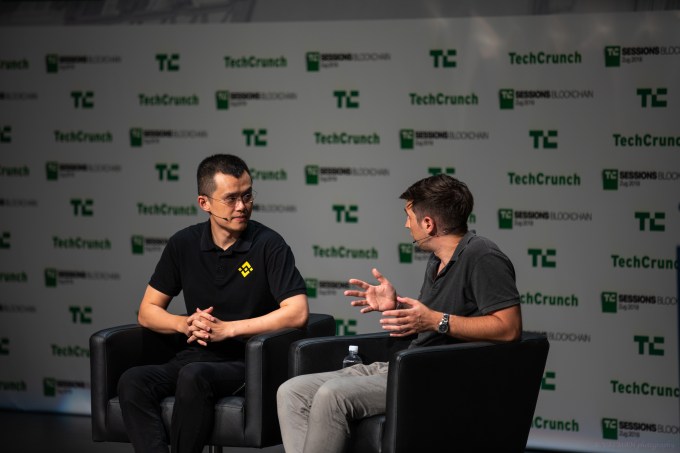
Binance CEO Changpeng “CZ” Zhao speaks at TechCrunch’s blockchain event in Zug in July 2018 [Image: Daniel Vaiman/Explore To Create]

Already, Binance has opened a joint venture in Lichtenstein, it has announced plans to offer fiat in Malta, and it is working on a launch Singapore. Currently in a limited beta, Zhao said the Singapore-based exchange should go live within the next month after stress testing on areas like KYC, trading flow and scalability is done.

While he didn’t specifically call out other markets that Binance is looking at, he did rule out launching in China, Japan and the U.S, which are three major markets for crypto despite respective legal roadblocks. China banned ICOs and exchanges some time ago, the U.S. has begun cracking down on crypto and Japan has tight licensing around exchanges which, for one thing, imposes regulations on what tokens can be listed on exchanges.

“Japan is progressive on crypto but their exchange regulation is too strict,” Zhao said. “It makes it very hard for exchanges.”

Indeed, it stands to reason that Binance — which once had an office in Tokyo before deciding against operating a local entity — would need to modify its token selection in line with Japanese laws were it to gain a license to operate in Japan. Either way, Zhao doesn’t seem key to reevaluate the country just yet.

Elsewhere, Zhao said he “respects” China’s decision to ban ICOs and exchanges, while he is happy to let others do the heavy lifting in the U.S.

“We are interested in the U.S. but that’s not a top priority and we will probably let the other guys go in first,” he told TechCrunch.

That’s hardly surprising since Binance is one of three exchanges mentioned by in a report by New York attorney general Barbara Underwood who believes they may have violated state trading law. Zhao declined to comment. Either way, it seems like a lot would have to change — either on the U.S. regulation side or Binance’s side — in order for the exchange to operate in the U.S. within the law.

Binance — which has flocked to crypto-friendly nations like Malta and Bermuda instead — said it would open an office in Singapore should the proposed exchange rollout go successfully.

Beyond fiat, the company is also getting closer to launching a decentralized exchange (dex) which would allow buyers and sellers to trade tokens directly without the exchange acting as an intermediatory.

High-profile figures have criticized central exchanges. Ethereum creator Vitalik Buterin went so far as to say that they should “burn in hell” for their position controlling asset selection, price and more. Binance seems to be making as much progress as anyone with its dex which, simply because of the company’s market position, could force others to follow suit.

The Binance dex would significantly alter the trading flow as it stands today, but Binance itself — which Zhao told Coindesk made a profit of $350 million over the past six months — would still draw revenue. That’s because the dex would operate on Binance’s own blockchain with the company operating a number of nodes itself. Zhao said that when its nodes are used in transactions, it would gain some of the network fee.

While, equally, the firm stands to profit from increased dex use because that could make Binance’s BNB token more valuable, Zhao argued.

The company recently released a very early demo of the dex — spoiler alert: it is underwhelming — but Zhao said a fully-working service should be available by the end of this year or early 2019 at the latest. The Binance CEO, who once build software for futures trading for Bloomberg, is leading the development of the project.

“Development is going well,” he added. “Our dex is very simple but it’s fast.”

Beyond its exchange business, Binance is also putting itself to work on growing the crypto industry. Earlier this year it announced an investment fund that it said is worth $1 billion and would invest directly into companies and new crypto investment funds, too. It also has aggressive plans to run early-stage accelerator programs across the world to help develop new businesses that support the crypto ecosystem.

Ellie Zhang, who runs the Binance Labs division that manages both projects, candidly told TechCrunch last month that real use cases for blockchain and crypto are crucial if Binance is to “thrive” as a business.

Note: The author owns a small amount of cryptocurrency. Enough to gain an understanding, not enough to change a life.

26 Sep 2018

It looks like Coinbase is preparing to add a lot more cryptocurrencies

Coinbase aspires to be the New York Stock Exchange of crypto, and it is taking a small — but not insignificant – step to offering a lot more cryptocurrencies after it revamped the process of listing new digital assets.

The exchange currently only supports just five cryptocurrencies — Ethereum, Bitcoin, Bitcoin Cash, Ethereum Classic and Litecoin — and the process of adding each one has been gradual. The company would announce plans, and then later announce when listing the asset. The idea being to reduce the potential to send the value of a token skyrocketing. (Since support from Coinbase potentially adds a lot more trading volume.)

That clearly isn’t a sustainable process if Coinbase is to add “hundreds” of tokens, as CEO Brian Amstrong told an audience at TechCrunch Disrupt it eventually plans to.

Regulatory concern is high on the scale when evaluating support for new cryptocurrencies, so now Coinbase is speeding up the process by limiting trading of some tokens to specific locations where necessary.

“Today we’re announcing a new process that will allow us to rapidly list most digital assets that are compliant with local law, by satisfying listing requests in a jurisdiction-by-jurisdiction manner. In practice, this means some new assets listed on our platform may only be available to customers in select jurisdictions for a period of time,” the company said in a blog post.

That’ll mean an end to the double announcement — ‘token X is coming soon’ and ‘token X is now supported’ — and instead a single reveal. That indicates that a large number of new assets may be incoming — for an idea of which ones, Coinbase recently said it is looking over a number of cryptocurrencies.

Interestingly, the company also noted that it may introduce a listing fee — this is common with many other exchanges — in the future in order to cover costs around adding some projects.

“Initially there will be no application fee. Depending on the volume of submissions, we reserve the right to impose an application fee in the future to defray the legal and operational costs associated with evaluating and listing new assets,” it explained.

The company has opened a listing proposal link, here. If similar features from other exchanges are anything to go by, Coinbase’s will be flooded by naive token holders who think they have a shot at getting listed on Coinbase, which will take them to the moon. Good luck maintaining that list, guys.

Note: The author owns a small amount of cryptocurrency. Enough to gain an understanding, not enough to change a life.

26 Sep 2018

As Magic Leap preps for its first developer conference, the focus shifts to content

Even as Magic Leap has cleared the milestone of its first hardware release, the augmented reality startup still has big challenges ahead as it aims to entice developers to build the content for its wild new device.

The $2,295 Magic Leap One headset is a very polished-looking developer kit, but it didn’t ship with a ton of software for buyers to play around with at launch, just a couple short experiences that were essentially concept proofs.

The startup, which was most recently valued at north of $6 billion, is just a few weeks away from its first developer conference taking place down in Los Angeles. The L.E.A.P. conference will be an opportunity for the company to bring more developers to its platform to build up a content library ahead of an eventual more consumer-facing release.

At L.E.A.P., Magic Leap is planning to show off more than a dozen demos from developers, the company tells TechCrunch.

We’ve already taken a hands-on look at a full Angry Birds game for Magic Leap One from Rovio and Resolution Games. Other demos to be showcased include Wingnut‘s Funhouse Pest ControlFunomena‘s Luna: Moondust GardenMeow Wolf‘s The Mech, Wayfair Sketch and Magic Leap’s own Create title. We’ll also finally see the first demo of Dr. Grordbort’s Invaders, a shooter title by Weta Workshops that Magic Leap has been hyping since its first-ever teaser video.

Though building up content for a new device category is certainly daunting, Magic Leap has the benefit of having seen the major players of the VR industry brute force their way past some of these issues.

For the VR industry’s first two years following the releases of the HTC Vive and Oculus Rift, one of the big issues was that you could play through most of the good available titles in a week or two. The “content problem,” as it was called, led Facebook to pump hundreds of millions of dollars into upstart studios to build games that wouldn’t have otherwise been created. Fast forward to 2018 and there are plenty of high-quality games available on the Oculus and Steam stores though groups like Oculus and HTC are still investing just as heavily.

With Microsoft pointing its HoloLens AR developer ecosystem towards the enterprise, Magic Leap is in the somewhat lonely position of wrangling developers around building stuff for an AR headset that appeals to consumers, though plenty are excited to just get in on the ground floor.

“I’ve always been very fascinated at being able to do things at the forefront of technology, I definitely think that games are going to be trailblazing on these platforms when it comes to user interface and just coming up with what you can use it for,” Resolution Games CEO Tommy Palm told TechCrunch. “I think we’re among a lot of small and big companies that are believing that this is going to be a very big computing platform in the future.”

Magic Leap has several partnerships built up already with game studios, media orgs like The New York Times, and, just announced today, medtech company Brainlab.

Getting other partners to invest significant resources into the early platform could require Magic Leap to invest more of its own funds into kickstarting the content ecosystem. The startup has raised at least $2.3 billion according to Crunchbase, but as it takes an end-to-end approach to the entire ecosystem, it’s going to have to decide where its efforts are best spent. Things will certainly be expedited if and when Apple and/or Google embrace AR headset hardware and bring their developer networks into the fold, but Magic Leap will obviously want to make the most of its head start before then.

Magic Leap may be an entirely new platform with some big investors and big ideas. It’s newest challenge is a very old one however, getting developers pumped up for something new.