Author: azeeadmin

27 May 2021

Airspace Link raises $10m to make drones safer for both operators and communities

Airspace Link is today announcing it raised a $10 million Series A from Altos Ventures, Thales, and others. The Detroit, Michigan-based startup anticipates using the additional funds to expand its domestic offering and expand overseas.

CEO Michael Healander explains to TechCrunch that the company sees airspaces as digital infrastructure lacking critical regulations. “Today you have rules and regulations on the road,” he says, explaining that the company is building digital roads and management for drones. Airspace Link’s novel platform addresses drone operators’ and communities’ concerns, enabling pilots to safely fly while complying with local airspace restrictions.

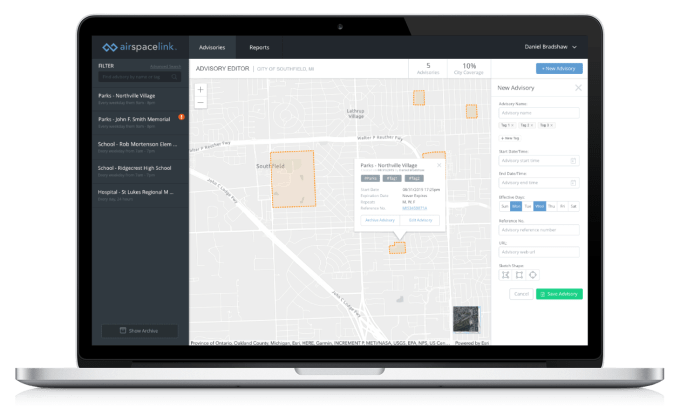
Airspace Link’s AirHub™ is the first cloud-based drone platform focused exclusively on merging the needs of state & local government with the operational planning tools pilots already use.

Airspace Links offers drone operation planning tools, including API access that allows developers to incorporate Airspace Link’s data into third-party platforms. The company’s system complies with the FAA’s Low Altitude Authorization and Notification Capability (LAANC), enabling drone pilots to submit operations while flying in controlled airspace. The company is one of seven FAA-approved companies to provide this service.

With the Series A funding, Healander says the goal is to integrate with as many transportation groups as possible.

Founded in 2018 by Michael Healander, Daniel Bradshaw, and Ana Healander, the Detroit-based startup employs 20 full-time staff. The company says in a press release that it has partnerships with over 40 government agencies and municipalities in the United States. Going forward, the company is looking to expand to Australia and Canada.

According to Healander, what distinguishes Airspace Link from the other competitors in the market is its integration with mapping tools used by municipal governments to provide information on ground-based risk.

“Our core purpose is to safely integrate drones into the national airspace and our communities at scale,” said Healander. “We thank Altos Ventures and Thales for joining our vision of paving the way for the drone economy with shared, neutral, and affordable UAS infrastructure.”

For Healander, Airspace Link is only the latest entrepreneurial venture. He previously founded GeoMetri, an indoor GPS tracking company, which was acquired by Acuity Brands.

Altos Ventures led Airspace Link’s Series A round, with participation from Thales, a global leader of air traffic management systems.

“As Unmanned Aircraft Systems (UAS) usage continues to grow, for safe, low altitude operations around communities, airspace management must combine both air and ground insights,” said Todd Donovan, Thales Vice President, Airspace Mobility Solutions Americas. “Our deep knowledge of airspace management and Airspace Link’s expertise in geospatial intelligence are the perfect combination to address this complex challenge.”

27 May 2021

Next-gen Bird Three scooter comes with bigger battery and better software

Bird is rolling out a next-generation scooter with a bigger, longer-range battery and a diagnostic monitoring system to New York and Berlin this summer, as the micromobility startup seeks out ways to improve its margins and ultimately become profitable.

The Bird Three, which is already available in Tel Aviv, is designed to last longer and require less maintenance as well as improve comfort and safety for customers, according to the company. The launch comes just a week after Bird announced a merger with special-purpose acquisition company Switchback II. The regulatory filings that accompanied the announcement demonstrated just how difficult it is to turn a profit given the unit economics of shared scooters.

The cost of building and servicing vehicles is one of the biggest barriers to profitability, which explains why Bird has invested in developing a scooter with a longer-lasting vehicle and battery as well as the software needed to monitor the device’s health.

Bird writes its own proprietary operating system, called Bird OS, as well as its motor controller IoT system, according to Scott Rushforth, Bird’s chief vehicle officer. The self-diagnostics system allows the battery to communicate with the backend and internally within the connected vehicle network. That means if, for example, the machine gets too warm, it’ll send the server an alert and will also automatically correct itself by riding at a slower speed to keep cool.

“There’s tons of health monitoring and data that comes off the battery,” Rushforth told TechCrunch. “Every individual cell is monitored. There’s probably about 75 different diagnostics that we track within the battery system itself.”

Superpedestrian, which recently lost a bid for New York City’s first e-scooter pilot to Bird, Lime and Veo, has touted its self-diagnostics software and in-house written OS as one of its USPs for years. The company boasts that its LINK scooters, which are powered by its Vehicle Intelligent Safety (VIS) system, run 1,000 vehicle health checks every second a ride is taking place, checking for things like battery cell temperature imbalances, water penetration and brake issues.

Bird’s batteries are encased in “hermetically sealed, tamper-proof, industry-leading IP68-rated protection to keep [them] safe from dust, water and theft,” according to the company, which also claims the battery on the Bird Three is the largest in the industry at 1kWh capacity. Superpedestrian, a company that shares Bird’s aversion to swappable batteries, has just about the same battery capacity at .986kWh, according to a spokesperson for the company. Lime, Bird’s biggest competitor, has gone the small, swappable battery route, and thus its battery capacity is .460kWh, according to a Lime spokesperson.

Lime and other companies that use swappable batteries argue this strategy generates less emissions because the scooters can be serviced by gig economy workers on ebikes. Scooters have traditionally been rounded up, charged and then redistributed to public streets by gig economy workers driving around in gas-powered vans.

With its latest scooter, Bird is doubling down on the big, static battery strategy.

“The battery is so big that we don’t really need to charge it very often, and it can go 15,000 to 20,000 miles before it has any type of serviceability event,” said Rushforth, who noted in major markets, Bird’s scooters are being charged roughly once a week. “We spend less time charging, less time rebalancing, less time going out and having to do maintenance and chase these vehicles around, which means we’re actually using less cars than you would generally when you have swappable batteries and have to go out all the time to swap them.”

So far it’s not clear which strategy is the most eco-friendly, but a sustainable scooter isn’t all about the battery. Rushforth says the Bird Three is designed to last 24 to 36 months on the street.

“We’re trying to make the most green vehicle in the world, and to accomplish that, the system needs to be extremely durable,” he said. “As long as the vehicles last longer, we need less vehicles overall.”

Because Bird Three is built on the same platform as Bird Two, many of the parts are the same which makes it easier to reduce, reuse and recycle at the end of the vehicle’s life. Once a battery reaches the end of its life, Bird turns to partners like ITAP to be responsibly recycled.

Other updates on the Bird Three revolve around comfortability and safety, including a new braking system with front and rear brakes and an automatic emergency braking that detects a fault in the mechanical braking system and digitally stops the vehicle using the motor.

Rushforth also noted that the vehicle ergonomics feel sturdier, with a longer wheelbase, wider handlebars and antimicrobial grips. The Bird Three has a new headlight and taillight that are globally certified so they can be used in places like Germany where scooters have more stringent requirements. Just in time for Bird to expand outward into Europe.

27 May 2021

Next-gen Bird Three scooter comes with bigger battery and better software

Bird is rolling out a next-generation scooter with a bigger, longer-range battery and a diagnostic monitoring system to New York and Berlin this summer, as the micromobility startup seeks out ways to improve its margins and ultimately become profitable.

The Bird Three, which is already available in Tel Aviv, is designed to last longer and require less maintenance as well as improve comfort and safety for customers, according to the company. The launch comes just a week after Bird announced a merger with special-purpose acquisition company Switchback II. The regulatory filings that accompanied the announcement demonstrated just how difficult it is to turn a profit given the unit economics of shared scooters.

The cost of building and servicing vehicles is one of the biggest barriers to profitability, which explains why Bird has invested in developing a scooter with a longer-lasting vehicle and battery as well as the software needed to monitor the device’s health.

Bird writes its own proprietary operating system, called Bird OS, as well as its motor controller IoT system, according to Scott Rushforth, Bird’s chief vehicle officer. The self-diagnostics system allows the battery to communicate with the backend and internally within the connected vehicle network. That means if, for example, the machine gets too warm, it’ll send the server an alert and will also automatically correct itself by riding at a slower speed to keep cool.

“There’s tons of health monitoring and data that comes off the battery,” Rushforth told TechCrunch. “Every individual cell is monitored. There’s probably about 75 different diagnostics that we track within the battery system itself.”

Superpedestrian, which recently lost a bid for New York City’s first e-scooter pilot to Bird, Lime and Veo, has touted its self-diagnostics software and in-house written OS as one of its USPs for years. The company boasts that its LINK scooters, which are powered by its Vehicle Intelligent Safety (VIS) system, run 1,000 vehicle health checks every second a ride is taking place, checking for things like battery cell temperature imbalances, water penetration and brake issues.

Bird’s batteries are encased in “hermetically sealed, tamper-proof, industry-leading IP68-rated protection to keep [them] safe from dust, water and theft,” according to the company, which also claims the battery on the Bird Three is the largest in the industry at 1kWh capacity. Superpedestrian, a company that shares Bird’s aversion to swappable batteries, has just about the same battery capacity at .986kWh, according to a spokesperson for the company. Lime, Bird’s biggest competitor, has gone the small, swappable battery route, and thus its battery capacity is .460kWh, according to a Lime spokesperson.

Lime and other companies that use swappable batteries argue this strategy generates less emissions because the scooters can be serviced by gig economy workers on ebikes. Scooters have traditionally been rounded up, charged and then redistributed to public streets by gig economy workers driving around in gas-powered vans.

With its latest scooter, Bird is doubling down on the big, static battery strategy.

“The battery is so big that we don’t really need to charge it very often, and it can go 15,000 to 20,000 miles before it has any type of serviceability event,” said Rushforth, who noted in major markets, Bird’s scooters are being charged roughly once a week. “We spend less time charging, less time rebalancing, less time going out and having to do maintenance and chase these vehicles around, which means we’re actually using less cars than you would generally when you have swappable batteries and have to go out all the time to swap them.”

So far it’s not clear which strategy is the most eco-friendly, but a sustainable scooter isn’t all about the battery. Rushforth says the Bird Three is designed to last 24 to 36 months on the street.

“We’re trying to make the most green vehicle in the world, and to accomplish that, the system needs to be extremely durable,” he said. “As long as the vehicles last longer, we need less vehicles overall.”

Because Bird Three is built on the same platform as Bird Two, many of the parts are the same which makes it easier to reduce, reuse and recycle at the end of the vehicle’s life. Once a battery reaches the end of its life, Bird turns to partners like ITAP to be responsibly recycled.

Other updates on the Bird Three revolve around comfortability and safety, including a new braking system with front and rear brakes and an automatic emergency braking that detects a fault in the mechanical braking system and digitally stops the vehicle using the motor.

Rushforth also noted that the vehicle ergonomics feel sturdier, with a longer wheelbase, wider handlebars and antimicrobial grips. The Bird Three has a new headlight and taillight that are globally certified so they can be used in places like Germany where scooters have more stringent requirements. Just in time for Bird to expand outward into Europe.

27 May 2021

Homeward secures $371M to help people make all-cash offers on houses

Trying to buy a house in a competitive market is perhaps one of the most stressful things an adult can go through.

Competing with a bunch of people all putting offers on a house that fly off the market in a matter of days is not fun. One startup that is trying to give home buyers a competitive edge by giving them a way to offer all cash on a home has just raised a boatload of money to help it keep growing.

Austin-based Homeward, which aims to help people buy homes faster, announced today it has raised $136 million in a Series B funding round led by Norwest Venture Partners at a valuation “just north of $800 million.” The company has also secured $235 million in debt.

Blackstone, Breyer Capital and existing backers Adams Street, Javelin and LiveOak Venture Partners also participated in the equity financing, which brings Homeward’s total equity raised since inception to $160 million. 

Homeward’s model seems to be appealing to both home buyers (including first time ones) and agents alike, with lots of growth occurring since May 2020 when it raised $105 million in debt and equity. The company declined to reveal hard revenue figures but noted that its GMV (gross merchandise value) run rate is up over 600%+ year over year.

Also, as of March, Homeward says it had experienced a 5x increase in the volume of homes transacted and 9x year over growth in the number of new customers. Plus, It’s hired 161 employees since January alone, and currently has a headcount of 203, up from about 33 at this time last year. 

CEO Tim Heyl founded the real estate startup in late 2018 on the premise that in most cases, sellers prefer to receive all cash offers because they are more likely to close. Loans can fall through, but cash is cash.

Heyl started the company after having worked in the industry for the previous decade, first as a broker then as the owner of a title company. During that time, he saw firsthand many of the problems in the industry. And one conundrum he frequently ran into was people not wanting to make an offer on a home without knowing for sure their current house would sell in a certain amount of time. This is a dilemma many are facing during the COVID-19 pandemic as demand outweighs supply in many major U.S. cities.

“The pandemic has greatly increased demand for our product,” Heyl told TechCrunch. “It’s a historic seller’s market with unprecedented demand from buyers and the lowest inventory levels in decades.”

The company plans to use its new capital to “double down” on its offering, scale up to meet “outsized demand” and open additional markets. Currently, Homeward operates in Texas, Colorado and Georgia.

“Right now, we have a waiting list in every market across the country, so this growth capital will enable us to meet that demand,” Heyl said. Its ultimate goal is to open its offering to agents nationwide.

Homeward also plans to double the size of its title and mortgage teams in the latter half of the year so it can offer its clients and partner agents “a single streamlined experience.” It’s also planning to integrate its consumer and internal software systems for approvals, offers and closing “so everyone can be on a single platform and we can eliminate confusion and waste,” Heyl added.

So, how does it work exactly? Homeward will make an all-cash offer on behalf of a customer wanting to buy a house. Meanwhile, that customer can hire an agent (from brokerages such as Redfin or Keller Williams) to list their home with less pressure to sell it in a certain amount of time or at a discounted price. Once Homeward buys a home, it will lease the property back to its customer until they sell their house, get a mortgage, and can buy the property back from Homeward, plus a 2 percent to 3 percent convenience fee. During the process, Homeward offers a predetermined guaranteed price for its customer’s home with the promise that if it’s unable to sell the house for at least that amount, it’ll buy the house from them.

Heyl believes Homeward’s “alternative iBuyer” model is a better deal for customers since it doesn’t purchase a customer’s old home for below market value. The company also works with agents, and not against them, he said. For example, its offerings are available to any agent, but the company “strategically” partners with top brokerages and teams, providing them with what it describes as “dedicated support, white-label branding, and digital marketing tools to help them stand out from the crowd and attract more clients.”

“Most alternatives to traditional real estate minimize or replace the agent,” Heyl said. “But we are agents ourselves, and we’ve built this for agents.”

Homeward is profitable on a per unit basis if you count transaction revenue minus costs to acquire and complete each transaction, according to Heyl. However, it is not yet profitable on a net income basis.

Jeff Crowe, managing partner at Norwest Venture Partners, will join Homeward’s board as part of the funding.

“Homeward is innovating at the intersection of real estate and fintech — that’s the next frontier,” he said. “Homeward’s cash offer addresses real problems for homebuyers in all market conditions, and the team has identified a winning strategy by partnering with agents and their clients.”

Jim Breyer of Breyer Capital describes Homeward as one of Austin’s most innovative companies.

“We are inspired by the company’s mission to build home finance solutions to overcome the limitations of the traditional mortgage and we are proud to support them as they continue to scale rapidly and efficiently,” he said.

27 May 2021

Homeward secures $371M to help people make all-cash offers on houses

Trying to buy a house in a competitive market is perhaps one of the most stressful things an adult can go through.

Competing with a bunch of people all putting offers on a house that fly off the market in a matter of days is not fun. One startup that is trying to give home buyers a competitive edge by giving them a way to offer all cash on a home has just raised a boatload of money to help it keep growing.

Austin-based Homeward, which aims to help people buy homes faster, announced today it has raised $136 million in a Series B funding round led by Norwest Venture Partners at a valuation “just north of $800 million.” The company has also secured $235 million in debt.

Blackstone, Breyer Capital and existing backers Adams Street, Javelin and LiveOak Venture Partners also participated in the equity financing, which brings Homeward’s total equity raised since inception to $160 million. 

Homeward’s model seems to be appealing to both home buyers (including first time ones) and agents alike, with lots of growth occurring since May 2020 when it raised $105 million in debt and equity. The company declined to reveal hard revenue figures but noted that its GMV (gross merchandise value) run rate is up over 600%+ year over year.

Also, as of March, Homeward says it had experienced a 5x increase in the volume of homes transacted and 9x year over growth in the number of new customers. Plus, It’s hired 161 employees since January alone, and currently has a headcount of 203, up from about 33 at this time last year. 

CEO Tim Heyl founded the real estate startup in late 2018 on the premise that in most cases, sellers prefer to receive all cash offers because they are more likely to close. Loans can fall through, but cash is cash.

Heyl started the company after having worked in the industry for the previous decade, first as a broker then as the owner of a title company. During that time, he saw firsthand many of the problems in the industry. And one conundrum he frequently ran into was people not wanting to make an offer on a home without knowing for sure their current house would sell in a certain amount of time. This is a dilemma many are facing during the COVID-19 pandemic as demand outweighs supply in many major U.S. cities.

“The pandemic has greatly increased demand for our product,” Heyl told TechCrunch. “It’s a historic seller’s market with unprecedented demand from buyers and the lowest inventory levels in decades.”

The company plans to use its new capital to “double down” on its offering, scale up to meet “outsized demand” and open additional markets. Currently, Homeward operates in Texas, Colorado and Georgia.

“Right now, we have a waiting list in every market across the country, so this growth capital will enable us to meet that demand,” Heyl said. Its ultimate goal is to open its offering to agents nationwide.

Homeward also plans to double the size of its title and mortgage teams in the latter half of the year so it can offer its clients and partner agents “a single streamlined experience.” It’s also planning to integrate its consumer and internal software systems for approvals, offers and closing “so everyone can be on a single platform and we can eliminate confusion and waste,” Heyl added.

So, how does it work exactly? Homeward will make an all-cash offer on behalf of a customer wanting to buy a house. Meanwhile, that customer can hire an agent (from brokerages such as Redfin or Keller Williams) to list their home with less pressure to sell it in a certain amount of time or at a discounted price. Once Homeward buys a home, it will lease the property back to its customer until they sell their house, get a mortgage, and can buy the property back from Homeward, plus a 2 percent to 3 percent convenience fee. During the process, Homeward offers a predetermined guaranteed price for its customer’s home with the promise that if it’s unable to sell the house for at least that amount, it’ll buy the house from them.

Heyl believes Homeward’s “alternative iBuyer” model is a better deal for customers since it doesn’t purchase a customer’s old home for below market value. The company also works with agents, and not against them, he said. For example, its offerings are available to any agent, but the company “strategically” partners with top brokerages and teams, providing them with what it describes as “dedicated support, white-label branding, and digital marketing tools to help them stand out from the crowd and attract more clients.”

“Most alternatives to traditional real estate minimize or replace the agent,” Heyl said. “But we are agents ourselves, and we’ve built this for agents.”

Homeward is profitable on a per unit basis if you count transaction revenue minus costs to acquire and complete each transaction, according to Heyl. However, it is not yet profitable on a net income basis.

Jeff Crowe, managing partner at Norwest Venture Partners, will join Homeward’s board as part of the funding.

“Homeward is innovating at the intersection of real estate and fintech — that’s the next frontier,” he said. “Homeward’s cash offer addresses real problems for homebuyers in all market conditions, and the team has identified a winning strategy by partnering with agents and their clients.”

Jim Breyer of Breyer Capital describes Homeward as one of Austin’s most innovative companies.

“We are inspired by the company’s mission to build home finance solutions to overcome the limitations of the traditional mortgage and we are proud to support them as they continue to scale rapidly and efficiently,” he said.

27 May 2021

Ada Health closes $90M Series B led by Leaps by Bayer

The digital health space continues cooking on gas: Berlin-based Ada Health has closed a $90M Series B round of funding led by Leaps by Bayer, the impact investment arm of the German multinational pharma giant, Bayer AG. Other investors in the round include Samsung Catalyst Fund, Vitruvian Partners, Inteligo Bank, F4 and Mutschler Ventures.

The startup last raised around four years’ ago, reporting a $47M Series A round in 2017. But don’t be fooled by the low lettering of these rounds: Ada Health has been working on its symptom assessment tech for around a decade at this point — relying, in the first several years of its mission, on private funding from high net worth individuals in Germany and elsewhere in Europe.

Initially it was also focused on building a decision support tool for doctors before pivoting to directly addressing patients via an AI-driven symptom assessment app.

It’s not alone in offering this type of tool. Others in the space include Babylon, Buoy, K Health, Mediktor, Symptomate, WebMD and Your.MD — but Ada claims its app is the most used and highest rated by users. It can also point to a peer reviewed study it led, which was published in the BMJ, and compared the condition coverage, accuracy and safety of eight competitors. The study found its app led the pack on all fronts.

One reason for that edge is that Ada Health’s medical knowledge base covers around 30,000 ICD-10 codes (aka the alphanumeric codes used by doctors to represent different diagnoses) at this point — which co-founder and CEO, Daniel Nathrath, tells us is “by far the largest coverage of any of the systems in this space”.

The Ada Health app, which launched in late 2016 — and remains free to use — has been downloaded by more than 11 million people across 150 countries so far. Users have completed some 23M assessments using the tool which he likens to having “24/7 access to your trusted family doctor”.

Currently, the app has support for 10 languages. But the goal with the funding is to push for truly massive scale.

“The idea is to help as many people as possible get better access to healthcare around the world,” Nathrath tells TechCrunch. “Our ambition is, in a few years, that a billion people instead of 11M people will be using out technology. In order to get there we think that working with the right investors can help us accelerate that growth path and give more people the benefit of our technology faster.”

“With 11M app downloads I believe we are the most used AI symptom assessment technology that I know of in the world,” he goes on. “We are also the most rated and reviewed app in the medical category of the App Store and Google Play Store ever — after, what, just four years. With about 300,000 ratings and reviews, most of them five-star. So… we have gained some users but we think it’s just the beginning.

“Digital health — with all the things you see going on — is at an inflection point where it’s being realized not only by the users who have already been using our technology but also by health systems, governments, and payers, insurers, and life sciences companies — I think everyone has realized digital health is here to stay.”

As well as putting its symptom assessment app directly in the hands of patients, Ada Health offers a suite of enterprise solutions where partners pay it to be able to embed and deeply integrate its triage technology into their websites and digital services. That means they can use it to offer an entry point for their users — to help direct them to the correct service and provide administrative support by arming clinicians with health information provided by patient via the Ada interface (and the AI’s own assessment) ahead of the appointment.

One publicly disclosed customer for Ada’s enterprise offering is Sutter Health, in the Bay Area.

“They have integrated Ada into their own homepage and into their app so people can use it as a digital front door to the entire service of Sutter,” says Nathrath, explaining that the difference vs the version of the app that patients can download is “people don’t just get generic advice”. “It’s fully integrated. So if it says — for instance — you need to go to the emergency room… then you can go straight into appointment booking.

“And not only that; when you book the appointment the outcome of the Ada pre-assessment can then be shared with the health professional who will then look at you so the doctor doesn’t start from a blank sheet of paper but is already pre-briefed and gets decision support in terms of ‘this is constellation of symptoms the patient is reporting’ and ‘based on that these could be the most likely diagnosis and these should be the tests, examinations or investigations I should consider next to get to the confirmed diagnosis’.”

The added advantage for Ada’s enterprise partners is that patient data arrives with the doctor that sees them already structured so — after a few confirmations — they can easily import it into their documentation, saying precious minutes per patient, per Nathrath. “[If] you save a few minutes with each patient that means you have more time for the patients who really need you and not the patients who maybe has a cold and shows up in the emergency room, which unfortunately is a reality,” he adds.

With this enterprise strand of its business Ada is continuing to provide support for doctors. Nathrath suggests its patient-facing app is also being used for some informal decision support for doctors too.

More and more doctors are using the app “together with their patients”, he tells us, or else recommending it to their patients —  asking them “so what did Ada say?”.

The role of AI in healthcare will be a core one, Nathrath predicts — given that demand for healthcare professionals is always going to outstrip supply.

He argues that’s true even with rising use of telehealth platforms which can certainly make more efficient use of doctors’ time.

Ada did, at one point, offer a telehealth service itself — before deciding to fully focus its efforts on AI — so its approach now is to partner and integrate with other healthcare and health data providers throughout the care ecosystem.

“We think there’s a place for telehealth, obviously. It adds convenience. During the pandemic I guess it had a special role where for many it was almost the only way to interact with a doctor,” he says. “So we do see a place for telehealth but we also see an issue with telehealth in that it doesn’t address the structural issue in healthcare — that simply there aren’t enough doctors to serve the entire population of the world.”

“We’re building Ada as a multi-sided platform,” he adds. “We’ll be computing different sources of input data — which is sensor data, wearables data, lab data, genetic testing data — that’s on the input side — and then on the more downstream, on the next step after Ada, we can partner with any telehealth company in the world. And we’re seeing enormous interest from literally all corners of the world where telehealth companies approach us. And insurance companies and governments — where they say yes there is a use-case for telehealth but we basically need something before that, that filters people to the right next step.”

Whatever that right next step is in a patient’s care journey, “Ada is like the gatekeeper at the beginning of the journey that then sends you on your way,” is how Nathrath puts it.

The overarching vision is that Ada becomes not just an app in your pocket but an omnipresent “personal health companion” — or what it describes as “a personal operating system for health” — which is powerful enough to deliver preventative healthcare by being able to aggregate all sorts of data and spot health issues sooner so as to enable earlier and less costly interventions.

“What we’re building is really much more than a symptom assessment technology,” he tells TechCrunch. “Where you would also take into account lab results which can now be done much more direct to consumer than was previously possible, sensors and wearables data — and you probably say that Samsung is one of our investors but we’re obviously talking to all the large players in the space about this; how we can integrate that data best — and all the way to genetic testing and even the full genome sequence.

“When you take all these different sources of health information and compute them against each other on a continuous basis you’ll have something like an early warning system for your health — which, again, from a population health and system level perspective should be desirable for anyone who’s in charge of providing healthcare or paying for healthcare because you can catch the problem when it’s still a £100 problem and not yet a £100,000 a year problem.”

Given that ambition it’s interesting that big pharma is investing in Ada. (And its PR notes that it’s also in talks with Bayer on a potential strategic partnership.) But Nathrath suggests that the industry is well aware of the shifts being driven by digital health — and keen to avoid its own ‘Kodak moment’, i.e. by not adapting to the coming changes in a timely enough manner.

If AI-powered health interventions end up being so successful that they can shrink drug bills through earlier intervention and more preventative care then it makes good business sense for big pharma to be plugged into the cutting edge of digital health.

At the same time this type of tech might end up driving demand for medicines — exactly because of its scalability and because it can present a higher dimension view of more people’s health — meaning there’s more opportunity for increased prescription. So there’s not really a downside for pharma to get involved here.

“We’re really excited about the possibilities we can find by working together [with pharmaceutical companies] to really deliver a better healthcare experience to patients,” says Nathrath. “If you look at Bayer they have a consumer health business, they also have a pharmaceutical business and if you look at the cases within Ada if you look at the top ten most common ones it’s very comparable to what a GP would see all the time and a lot of those basically can end up in the recommendation towards healthcare where oftentimes an over the counter drug will be enough to address the issue. One area where Bayer has a lot of offerings, of course. But then their spectrum goes all the way towards rare diseases — where we’re also particularly strong. Where they have some drugs that help patients with very rare conditions.”

There are also potentially major research riches to be derived from the health data generated via Ada’s app which could also be interesting to pharma companies doing drug discovery.

Although Nathrath emphasizes that app users’ data is never used for research purpose without explicit consent from the individual (as is required under Europe’s General Data Protection Act).

But he also notes that Ada is able to do some interesting studies based on aggregated user data, too — giving an example of how it looked at kids mental health during COVID-19 lockdowns, comparing areas where schools had been shut vs those where they had remained open. “You could really compare what happened in different countries,” he says, noting that rates of depression in kids in Germany where schools and pre-schools were closed went up by over 100%, whereas in Switzerland where schools remained opened throughout there was no rise and even a slight improvement in children’s mental health.

In another example, involving aggregated data from usage of the app in US, he says it was able to show that it could have spotted a measles epidemic via the cases in the app slightly sooner than the CDC’s official announcement of an epidemic.

“If you think about the potential of that, in terms of spotting outbreaks earlier, that can be quite significant,” he suggests.

“We think there’s really a long list of ways we can work together [with researchers, policymakers and pharma companies] for the benefit of patients,” he adds. “The mission of all the people I spoke to at Bayer was really similar to ours — which is to help people, basically… That’s why we’re really happy to work with them.”

Commenting on the funding in a statement, Dr. Jürgen Eckhardt, head of Leaps by Bayer, added: “Investing in breakthrough technologies that drive digital change in healthcare is one of the strategic imperatives for Leaps by Bayer and for the entire field of healthcare. Ada’s truly transformative technology, combining powerful artificial intelligence with an emphasis on medical rigor and high levels of clinical accuracy will lead the way in helping more patients and consumers in achieving better health outcomes sooner by intervening earlier in their healthcare journey.”


27 May 2021

Ada Health closes $90M Series B led by Leaps by Bayer

The digital health space continues cooking on gas: Berlin-based Ada Health has closed a $90M Series B round of funding led by Leaps by Bayer, the impact investment arm of the German multinational pharma giant, Bayer AG. Other investors in the round include Samsung Catalyst Fund, Vitruvian Partners, Inteligo Bank, F4 and Mutschler Ventures.

The startup last raised around four years’ ago, reporting a $47M Series A round in 2017. But don’t be fooled by the low lettering of these rounds: Ada Health has been working on its symptom assessment tech for around a decade at this point — relying, in the first several years of its mission, on private funding from high net worth individuals in Germany and elsewhere in Europe.

Initially it was also focused on building a decision support tool for doctors before pivoting to directly addressing patients via an AI-driven symptom assessment app.

It’s not alone in offering this type of tool. Others in the space include Babylon, Buoy, K Health, Mediktor, Symptomate, WebMD and Your.MD — but Ada claims its app is the most used and highest rated by users. It can also point to a peer reviewed study it led, which was published in the BMJ, and compared the condition coverage, accuracy and safety of eight competitors. The study found its app led the pack on all fronts.

One reason for that edge is that Ada Health’s medical knowledge base covers around 30,000 ICD-10 codes (aka the alphanumeric codes used by doctors to represent different diagnoses) at this point — which co-founder and CEO, Daniel Nathrath, tells us is “by far the largest coverage of any of the systems in this space”.

The Ada Health app, which launched in late 2016 — and remains free to use — has been downloaded by more than 11 million people across 150 countries so far. Users have completed some 23M assessments using the tool which he likens to having “24/7 access to your trusted family doctor”.

Currently, the app has support for 10 languages. But the goal with the funding is to push for truly massive scale.

“The idea is to help as many people as possible get better access to healthcare around the world,” Nathrath tells TechCrunch. “Our ambition is, in a few years, that a billion people instead of 11M people will be using out technology. In order to get there we think that working with the right investors can help us accelerate that growth path and give more people the benefit of our technology faster.”

“With 11M app downloads I believe we are the most used AI symptom assessment technology that I know of in the world,” he goes on. “We are also the most rated and reviewed app in the medical category of the App Store and Google Play Store ever — after, what, just four years. With about 300,000 ratings and reviews, most of them five-star. So… we have gained some users but we think it’s just the beginning.

“Digital health — with all the things you see going on — is at an inflection point where it’s being realized not only by the users who have already been using our technology but also by health systems, governments, and payers, insurers, and life sciences companies — I think everyone has realized digital health is here to stay.”

As well as putting its symptom assessment app directly in the hands of patients, Ada Health offers a suite of enterprise solutions where partners pay it to be able to embed and deeply integrate its triage technology into their websites and digital services. That means they can use it to offer an entry point for their users — to help direct them to the correct service and provide administrative support by arming clinicians with health information provided by patient via the Ada interface (and the AI’s own assessment) ahead of the appointment.

One publicly disclosed customer for Ada’s enterprise offering is Sutter Health, in the Bay Area.

“They have integrated Ada into their own homepage and into their app so people can use it as a digital front door to the entire service of Sutter,” says Nathrath, explaining that the difference vs the version of the app that patients can download is “people don’t just get generic advice”. “It’s fully integrated. So if it says — for instance — you need to go to the emergency room… then you can go straight into appointment booking.

“And not only that; when you book the appointment the outcome of the Ada pre-assessment can then be shared with the health professional who will then look at you so the doctor doesn’t start from a blank sheet of paper but is already pre-briefed and gets decision support in terms of ‘this is constellation of symptoms the patient is reporting’ and ‘based on that these could be the most likely diagnosis and these should be the tests, examinations or investigations I should consider next to get to the confirmed diagnosis’.”

The added advantage for Ada’s enterprise partners is that patient data arrives with the doctor that sees them already structured so — after a few confirmations — they can easily import it into their documentation, saying precious minutes per patient, per Nathrath. “[If] you save a few minutes with each patient that means you have more time for the patients who really need you and not the patients who maybe has a cold and shows up in the emergency room, which unfortunately is a reality,” he adds.

With this enterprise strand of its business Ada is continuing to provide support for doctors. Nathrath suggests its patient-facing app is also being used for some informal decision support for doctors too.

More and more doctors are using the app “together with their patients”, he tells us, or else recommending it to their patients —  asking them “so what did Ada say?”.

The role of AI in healthcare will be a core one, Nathrath predicts — given that demand for healthcare professionals is always going to outstrip supply.

He argues that’s true even with rising use of telehealth platforms which can certainly make more efficient use of doctors’ time.

Ada did, at one point, offer a telehealth service itself — before deciding to fully focus its efforts on AI — so its approach now is to partner and integrate with other healthcare and health data providers throughout the care ecosystem.

“We think there’s a place for telehealth, obviously. It adds convenience. During the pandemic I guess it had a special role where for many it was almost the only way to interact with a doctor,” he says. “So we do see a place for telehealth but we also see an issue with telehealth in that it doesn’t address the structural issue in healthcare — that simply there aren’t enough doctors to serve the entire population of the world.”

“We’re building Ada as a multi-sided platform,” he adds. “We’ll be computing different sources of input data — which is sensor data, wearables data, lab data, genetic testing data — that’s on the input side — and then on the more downstream, on the next step after Ada, we can partner with any telehealth company in the world. And we’re seeing enormous interest from literally all corners of the world where telehealth companies approach us. And insurance companies and governments — where they say yes there is a use-case for telehealth but we basically need something before that, that filters people to the right next step.”

Whatever that right next step is in a patient’s care journey, “Ada is like the gatekeeper at the beginning of the journey that then sends you on your way,” is how Nathrath puts it.

The overarching vision is that Ada becomes not just an app in your pocket but an omnipresent “personal health companion” — or what it describes as “a personal operating system for health” — which is powerful enough to deliver preventative healthcare by being able to aggregate all sorts of data and spot health issues sooner so as to enable earlier and less costly interventions.

“What we’re building is really much more than a symptom assessment technology,” he tells TechCrunch. “Where you would also take into account lab results which can now be done much more direct to consumer than was previously possible, sensors and wearables data — and you probably say that Samsung is one of our investors but we’re obviously talking to all the large players in the space about this; how we can integrate that data best — and all the way to genetic testing and even the full genome sequence.

“When you take all these different sources of health information and compute them against each other on a continuous basis you’ll have something like an early warning system for your health — which, again, from a population health and system level perspective should be desirable for anyone who’s in charge of providing healthcare or paying for healthcare because you can catch the problem when it’s still a £100 problem and not yet a £100,000 a year problem.”

Given that ambition it’s interesting that big pharma is investing in Ada. (And its PR notes that it’s also in talks with Bayer on a potential strategic partnership.) But Nathrath suggests that the industry is well aware of the shifts being driven by digital health — and keen to avoid its own ‘Kodak moment’, i.e. by not adapting to the coming changes in a timely enough manner.

If AI-powered health interventions end up being so successful that they can shrink drug bills through earlier intervention and more preventative care then it makes good business sense for big pharma to be plugged into the cutting edge of digital health.

At the same time this type of tech might end up driving demand for medicines — exactly because of its scalability and because it can present a higher dimension view of more people’s health — meaning there’s more opportunity for increased prescription. So there’s not really a downside for pharma to get involved here.

“We’re really excited about the possibilities we can find by working together [with pharmaceutical companies] to really deliver a better healthcare experience to patients,” says Nathrath. “If you look at Bayer they have a consumer health business, they also have a pharmaceutical business and if you look at the cases within Ada if you look at the top ten most common ones it’s very comparable to what a GP would see all the time and a lot of those basically can end up in the recommendation towards healthcare where oftentimes an over the counter drug will be enough to address the issue. One area where Bayer has a lot of offerings, of course. But then their spectrum goes all the way towards rare diseases — where we’re also particularly strong. Where they have some drugs that help patients with very rare conditions.”

There are also potentially major research riches to be derived from the health data generated via Ada’s app which could also be interesting to pharma companies doing drug discovery.

Although Nathrath emphasizes that app users’ data is never used for research purpose without explicit consent from the individual (as is required under Europe’s General Data Protection Act).

But he also notes that Ada is able to do some interesting studies based on aggregated user data, too — giving an example of how it looked at kids mental health during COVID-19 lockdowns, comparing areas where schools had been shut vs those where they had remained open. “You could really compare what happened in different countries,” he says, noting that rates of depression in kids in Germany where schools and pre-schools were closed went up by over 100%, whereas in Switzerland where schools remained opened throughout there was no rise and even a slight improvement in children’s mental health.

In another example, involving aggregated data from usage of the app in US, he says it was able to show that it could have spotted a measles epidemic via the cases in the app slightly sooner than the CDC’s official announcement of an epidemic.

“If you think about the potential of that, in terms of spotting outbreaks earlier, that can be quite significant,” he suggests.

“We think there’s really a long list of ways we can work together [with researchers, policymakers and pharma companies] for the benefit of patients,” he adds. “The mission of all the people I spoke to at Bayer was really similar to ours — which is to help people, basically… That’s why we’re really happy to work with them.”

Commenting on the funding in a statement, Dr. Jürgen Eckhardt, head of Leaps by Bayer, added: “Investing in breakthrough technologies that drive digital change in healthcare is one of the strategic imperatives for Leaps by Bayer and for the entire field of healthcare. Ada’s truly transformative technology, combining powerful artificial intelligence with an emphasis on medical rigor and high levels of clinical accuracy will lead the way in helping more patients and consumers in achieving better health outcomes sooner by intervening earlier in their healthcare journey.”
27 May 2021

Wayflyer raises $76M to provide ‘revenue-based’ financing to e-commerce merchants

Wayflyer, a revenue-based financing platform for e-commerce merchants, has raised $76 million in a Series A funding round led by Left Lane Capital.

“Partners” of DST Global, QED Investors, Speedinvest and Zinal Growth — the family office of Guillaume Pousaz (founder of Checkout.com) — also put money in the round. The raise comes just after Wayflyer raised $100 million in debt funding to support its cash advance product, and 14 months after the Dublin, Ireland-based startup launched its first product.

With an e-commerce boom fueled by the COVID-19 pandemic, Wayflyer is the latest in a group of startups focused on the space that has attracted investor interest as of late. The company aims to help e-commerce merchants “unlock growth” by giving them access to working capital (from $10,000 up to $20 million) so they can improve cash flow and drive sales. For example, more cash can help these merchants do things like buy more inventory in bulk so they can meet customer demand and save money. 

In a nutshell, Wayflyer uses analytics and sends merchants cash to make inventory purchases or investments in their business. Those merchants then repay Wayflyer using a percentage of their revenue until the money is paid back (plus a fee charged for the cash advance). So essentially, the merchants are using their revenue to get financing, hence the term revenue-based financing. The advantage, Wayflyer says, is that companies make repayments as a percentage of their sales. So if they have a slow month, they will pay back less. So, there’s more flexibility involved than with other mechanisms such as traditional bank loans.

Co-founder Aidan Corbett believes that in a crowded space, Wayflyer’s use of big data gives it an edge over competitors.

Corbett and former VC Jack Pierse spun Wayflyer out of a marketing analytics company that Corbett had also started, called Conjura, in September 2019.

“Jack came to me and said, ‘You should stop using our marketing analytics engine to do these big enterprise SaaS solutions, and instead use them to underwrite e-commerce businesses for short-term finance,’ ” Corbett recalls.

And so he did.

“We just had our heads down and started repurposing the platform for it to be an underwriting platform,” Corbett said. It launched in April 2020, doing about $600,000 in advances at the time. In March of 2021, Wayflyer did about $36 million in advances.

“So, it’s been a pretty aggressive kind of growth,” Corbett said.

Over the past six months alone, the company has seen its business grow 290% as it has deployed over $150 million of funding across 10 markets with a focus on the U.S., the United Kingdom and Australia. About 75% of its customers are U.S. based.

Wayflyer plans to use its new capital toward product development and global expansion with the goal of entering “multiple” new markets in the coming months. The company recently opened a sales office in Atlanta, and also has locations in the U.K., the Netherlands and Spain.

To Corbett, the company’s offering is more compelling than buy now, pay later solutions for consumers for example, in that it is funding the merchant directly and able to add services on top of that.

“There’s a lot more opportunity for companies like ourselves to differentiate because essentially, we focus on the merchants. And when we underwrite the merchant by getting data from the merchant, there’s a lot of additional services that you can put in on top,” Corbett explained. “Whereas with buy now, pay later, you get information on the consumer, and there’s not as much room to add additional services on top.”

For example, if a business requests an advance and either is not approved for one, or doesn’t choose to take it, Wayflyer’s analytics platform is free to anybody who signs up to help them optimize their marketing spend.

“This is a critical driver of value for e-commerce businesses. If you can’t acquire customers at a reasonable price, you’re not going to be around very long. And a lot of early-stage e-commerce businesses struggle with that,” Corbett said.

It also can pair up a merchant with a marketing analytics “specialist” to analyze its marketing performance or an inventory “specialist” to look at the current terms and price a business is getting from a supplier.

“Our focus from the very beginning is really supporting the merchants, not just providing them with working capital,” Corbett said.  

Another way the company claims to be different is in how it deploys funds. As mentioned above, merchants can pay the money back at varied terms, depending on how sales are going. The company makes money by charging a principal on advances, and then a “remittance rate” on revenues until the total amount is paid back.

“We tend to be more flexible than competition in this way,” Corbett said. “Also, some competitors will pay invoices on merchants’ behalf or give them a pre-charged card to use on advertising spend,” Corbett said. “We always give cash into a merchant’s account.” 

Wayflyer recently inked an agreement with Adobe Commerce, a partnership it said would provide a new channel to further amplify its growth with the goal of funding 8,000 e-commerce businesses in the first year of the partnership.

For his part, Left Lane Capital Partner Dan Ahrens said that his firm was impressed by Wayflyer’s “nuanced understanding of what will drive value for their clients.”

“The team’s focus, specialization, and deep analytical expertise within the e-commerce market also drives superior underwriting,” he told TechCrunch. “Their explosive growth has not come about by taking on undue risk. We are big believers that their underwriting will only improve with scale, and that Wayflyer will be able to compound its competitive advantages over time.”

As mentioned, this is an increasingly crowded space. Earlier this month, Settle announced it had raised $15 million in a Series A funding round led by Kleiner Perkins to give e-commerce and consumer packaged goods (CPG) companies access to non-dilutive capital.

27 May 2021

Twitter says concerned with India intimidation, requests 3 more months to comply with new IT rules

Twitter called the recent visit by police to its Indian offices a form of intimidation and said it was concerned by some of the requirements in New Delhi’s new IT rules.

Speaking for the first time since a special squad of Delhi police made a surprise visit to two of its offices on Monday, Twitter said it is “concerned by recent events regarding our employees in India and the potential threat to freedom of expression for the people we serve.”

The company also said that it joins many organizations in India and around the world that have “concerns with regards to the use of intimidation tactics by the police in response to enforcement of our global Terms of Service, as well as with core elements of the new IT Rules.”

A Twitter spokesperson added: “We plan to advocate for changes to elements of these regulations that inhibit free, open public conversation. We will continue our constructive dialogue with the Indian Government and believe it is critical to adopt a collaborative approach. It is the collective responsibility of elected officials, industry, and civil society to safeguard the interests of the public.”

Tension between American tech giants Twitter and Facebook and the Indian government has been brewing for months. Twitter faced heat from politicians after it refused to block accounts that criticised New Delhi’s reforms and Indian Prime Minister Narendra Modi.

India is one of the largest markets for American tech firms that poured billions of dollars in the South Asian nation in the past decade to get more people connected to the web. According to Indian government estimates, Twitter has 175 million users in India, while WhatsApp has amassed over 530 million users.

Their tension escalated Wednesday after WhatsApp sued the Indian government in a court in Delhi over the new IT rules that it said would compromise users’ privacy and give New Delhi the power to conduct mass surveillance.

India announced the new IT rules in February and gave firms three months to comply. The deadline expired this week, and on Wednesday the Ministry of Electronics and IT asked social media firms for an update on their compliant status, TechCrunch first reported.

Twitter said Thursday that the new IT rules’ requirements to make a compliance officer criminally liable for content on the platform, proactive monitoring, and blanket authority to seek information about users represented a dangerous overreach that was inconsistent with open and democratic principles.

The microblogging platform also requested New Delhi to consider granting a minimum of 3 months extension to comply with the new IT rules and publish Standard Operating Protocols on aspects of compliance of public consultation.

Twitter said it was recently served with another non-compliance notice in India and withheld a portion of the content identified in the notice under. The content identified in the notice, Twitter said, was originally reported in the blocking orders since February 2021.

It said in recent months it has been compelled to withhold content in response to a non-compliance notice. Not doing so, it said, poses penal consequences with many risks for Twitter employees.

27 May 2021

A new dating app, Schmooze, matches people based on their affinity for memes

Vidya Madhavan always wanted to be in business. Growing up in India, she thought she might be in the business of running a factory, given the power and influence of outfits like Tata Group, the Indian multinational conglomerate.

She certainly had an affinity for school, graduating at the top of her high school class, nabbing a mechanical engineering degree in India and more recently landing at Stanford’s business school. Except that instead of create the more traditional business she once had in mind, Madhavan found herself tinkering with an entirely different idea: a matchmaking app called Schmooze that combines machine learning and memes to connect people based on what Madhavan calls a humor algorithm.

The idea dates back several years when, as an analyst with McKinsey in India who was debating whether or not to attend grad school in California, Madhavan cold-emailed 10 people on LinkedIn who she could see attended U.S. business schools and hoped might be helpful. Only one of them replied, but over the next couple of days, she says, “we exchanged, like, 200 emails, all of them fundamentally jokes.”

Reader, she is now married to that person. Indeed, she says it’s her belief that their shared sense of humor brought them together that she began tinkering with the idea of Schmooze, initially as a way to foster new friendships. It was when she saw the way things were trending –people were really looking for a love match — that she refocused the idea as a dating app for Gen Z users who already communicate largely with memes.

It has been taking off since, says Madhavan. Though it hasn’t yet spread Facebook-like across college campuses, a beta test in late summer with 200 Stanford students has since led to more than 10,000 downloads around the country, where people are swiping right — or left — to more than 5,000 memes that are culled entirely by still-in-beta Schmooze (until it’s big enough to deal with content moderation). Currently about 200 memes are added each day, while others are deleted. “No one cares about the U.S. elections anymore,” Madhavan notes.

Using tagging and machine learning, combined with the bios that users create for themselves, Schmooze gets to work. Some users might show a predilection for particular topics, for example, like physics or finance. Some who say they’re interested in entrepreneurship might reveal an even stronger passion for music through their choices. There are similar divides when it comes to dark humor, and people who really love puns — and those who hate them.

Whether the algorithm truly works will take time, and lasting unions, to know. Madhavan says that 90,000 matches have been made to date, but naturally, a far smaller number have moved from the match to the in-app messaging.

Schmooze has plenty of competition in the meantime, both from traditional dating services and newer dating apps and questionnaires that look to pair people based on share interests rather than that use looks as a starting point.

Still, investors think it has promise. Schmooze recently closed on $270,000 in seed funding from Ulu Ventures and others to tinker with its product.

The company has been finding some success reaching its audience on TikTok.

There is also a lot of money to be made in the world of online dating, as industry watchers see over and over again.

As for Madhaven, she is in love, to her own surprise, with her startup. Partly because of her formative years and partly because she never made it onto a dating app before meeting her husband through LinkedIn, she says with a laugh of Schmooze: “It’s unexpected in many many ways.”