Author: azeeadmin

26 May 2021

Peloton and Echelon profile photos exposed riders’ real-world locations

Security researchers say at-home exercise giant Peloton and its closest rival Echelon were not stripping user-uploaded profile photos of their metadata, in some cases exposing users’ real-world location data.

Almost every file, photo or document contains metadata, which is data about the file itself, such as how big it is, when it was created, and by whom. Photos and video will often also include the location from where they were taken. That location data helps online services tag your photos or videos that you were at this restaurant or that other landmark.

But those online services — especially social platforms, where you see people’s profile photos — are supposed to remove location data from the file’s metadata so other users can’t snoop on where you’ve been, since location data can reveal where you live, work, where you go, and who you see. Others have been slow to adopt metadata stripping, like Slack, even if it got there in the end.

Jan Masters, a security researcher at Pen Test Partners, found the metadata exposure as part of a wider look at Peloton’s leaky API. TechCrunch verified the bug by uploading a profile photo with GPS coordinates of our New York office, and checking the metadata of the file while it was on the server.

The bugs were privately reported to both Peloton and Echelon.

Peloton fixed its API issues earlier this month but said it needed more time to fix the metadata bug and to strip existing profile photos of any location data. A Peloton spokesperson confirmed the bugs were fixed last week. Echelon fixed its version of the bug earlier this month. But TechCrunch held this report until we had confirmation that both companies had fixed the bug and that metadata had been stripped from old profile photos.

It’s not known how long the bug existed or if anyone maliciously exploited it to scrape users’ personal information. Any copies, whether cached or scraped, could represent a significant privacy risk to users whose location identifies their home address, workplace, or other private location.

Read more:

26 May 2021

Datacy raises $2.4M to help consumers monetize their own damn data

This morning Datacy, a startup with its headquarters in Wilmington, Delaware, announced that it has closed $2.4 million in new funding to continue building its consumer-friendly data collection and monetization service.

The company is effectively an argument that the preceding sentence is possible. Datacy is a tool that allows individuals to collect their browsing data, manage it, have it anonymized and aggregated with others and then sold. The end-user gets 85% of the resulting revenue, while Datacy takes 15%.

Its model has found financial backing, with its new capital coming from Trend Forward Capital, Truesight Ventures, Redhawk VC, the Female Founders Alliance and others. The startup raised the funds using a convertible note that was capped at $9.5 million, though TechCrunch is not certain whether or not there were other terms associated with the fundraising mechanism.

Regardless, Datacy’s model fits into the modestly more privacy-forward stance that the technology world has taken in recent years; Apple is not the only company looking to make hay off of what some consider to be rising consumer interest in keeping their activities, and data, to themselves. But what Datacy wants to do is merge the consumer privacy impulse with profit.

According to company co-founder Paroma Indilo, her startup is not a cookie blocker. She told TechCrunch that if someone wants to block data collection, there are good tools for the task in the market already. What Datacy wants to do, she said, is evolve from its current status as a control platform to the way that data is shared and exchanged, built atop user consent. With monetization, we’d add.

It’s a better vision for the future than the hellscape adtech and data-vendor market that we’ve become accustomed to.

Today the startup has live beta users, allowing it to learn and collect initial data. The company is waiting to make the business side of its operation open to all until it has 50,000 users; Indilo told TechCrunch that individual data is not worth much, but in aggregate it can be worth quite a lot. So to see the startup wait to scale up its sales operations until it has a larger user base is reasonable.

It may not be too long until Datacy reaches that 50,000 user mark. From a current base of 10,000, and what Indilo described as 30% monthly growth via word of mouth, it could hit that mark in a half-year or so.

Datacy is one of those early-stage bets that has a lot of potential, but also a notable helping of risk. If it can attract the masses it needs to prove out the economics of its model, its payments to its user base could make growth a self-fulfilling destiny. But if its ability to garner more users slows, it could fail to reach sufficient scale for its model to work whatsoever.

So it’s a good use of venture capital, in other words. We’ll check back in with Datacy in a few months to see how close it is to its 50,000 user goal. And how its bet that consumers want their data back is playing out.

26 May 2021

Databricks introduces Delta Sharing, an open source tool for sharing data

Databricks launched its fifth open source project today, a new tool called Delta Sharing designed to be a vendor neutral way to share data with any cloud infrastructure or SaaS product, so long as you have the appropriate connector. It’s part of the broader Databricks open source Delta Lake project.

As CEO Ali Ghodsi points out, data is exploding and moving data from Point A to Point B is an increasingly difficult problem to solve with proprietary tooling. “The number one barrier for organizations to succeed with data is sharing data, sharing it between different views, sharing it across organizations — that’s the number one issue we’ve seen in organizations,” Ghodsi explained.

Delta Sharing is an open source protocol designed to solve that problem. “This is the industry’s first ever open protocol, an open standard for sharing a data set securely. […] They can standardize on Databricks or something else. For instance, they might have standardized on using AWS Data Exchange, Power BI or Tableau — and they can then access that data securely.”

The tool is designed to work with multiple cloud infrastructure and SaaS services and out of the gate there are multiple partners involved including the Big Three cloud infrastructure vendors Amazon, Microsoft and Google, as well as data visualization and management vendors like Qlik, Starburst, Collibra and Alation and data providers like Nasdaq, S&P and Foursquare

Ghodsi said the key to making this work is the open nature of the project. By doing that and donating it to The Linux Foundation, he is trying to ensure that it can work across different environments. Another big aspect of this is the partnerships and the companies involved. When you can get big name companies involved in a project like this, it’s more likely to succeed because it works across this broad set of popular services. In fact, there are a number of connectors available today, but Databricks expects that number to increase over time as contributors build more connectors to other services.

Databricks operates on a consumption pricing model much like Snowflake, meaning the more data you move through its software, the more money it’s going to make, but the Delta Sharing tool means you can share with anyone, not just another Databricks customer. Ghodsi says that the open source nature of Delta Sharing means his company can still win, while giving customers more flexibility to move data between services.

The infrastructure vendors also love this model because the cloud data lake tools move massive amounts of data through their services and they make money too, which probably explains why they are all on board with this.

One of the big fears of modern cloud customers is being tied to a single vendor as they often were in the 1990s and early 2000s when most companies bought a stack of services from a single vendor like Microsoft, IBM or Oracle. On one hand, you had the veritable single throat to choke, but you were beholden to the vendor because the cost of moving to another one was prohibitively high. Companies don’t want to be locked in like that again and open source tooling is one way to prevent that.

Databricks was founded in 2013 and has raised almost $2 billion since. The latest round was in February for $1 billion at a $28 billion valuation, an astonishing number for a private company. Snowflake, a primary competitor, went public last September. As of today, it has a market cap of over $66 billion.

26 May 2021

EV fast charger developer Tritium to go public via SPAC merger at $1.2B valuation

Another day, another mobility SPAC deal. This time, it’s Tritium, a Brisbane-based developer and producer of direct current fast EV chargers that is taking the SPAC path to the public market in a deal valuing the company at $1.2 billion.

Tritium said Wednesday it will be heading to the Nasdaq via a merger with special purpose acquisition company Decarbonization Plus Acquisition Corp. II, or DCRN. The transaction is expected to generate gross proceeds of up to $403 million. Tritium will be listed under the ticker “DCFC.” This particular SPAC deal is unusual in that it does not include private investment in public equity, or PIPE — a fundraising round that typically occurs at the time of the merger and injects more capital into the company.

Founded in 2001, Tritium manufactures charger hardware and software for direct current fast chargers. Its products can recharge an EV battery, adding 20 miles in a minute or 100 miles in five minutes, DPAC II chairman Robert Tichio said during an investors call Wednesday. DC chargers are more costly than alternating current (AC) chargers but they send power to the vehicle much more quickly. Generally, AC chargers are installed at home, where a driver can plug in their vehicle overnight, while DC chargers are more frequently found at public charging stations.

“Drivers will want the experience of public charging to be as close as possible to their current experience at the gas pump – just a few minutes to get enough range to get on with your day,” Hunter said.

Tritium’s largest market is Europe, which composes around 70% of the company’s revenue, followed by North America at 20% and Asia at 10%, Tritium CEO Jane Hunter told investors Wednesday. The company will use the capital from the transaction to expand its manufacturing capacity and grow sales.

Demand for public EV charging stations is expected to mushroom over the next two decades alongside the growing market share of EVs. According to analysts Grandview Research, the EV charging infrastructure market was valued at $2 billion in 2020. It is expected to grow by nearly 39% through 2028. President Joe Biden said building out a national EV charging network was a key priority under his proposed $2 trillion infrastructure plan.

26 May 2021

Rock picking robotics startup TerraClear raises $25 million

Rock picking is probably not the first thing you think about when you think agricultural robotics. Understandably so. There are a number of companies out there looking to automate aspects like fruit and vegetable picking, weeding and field tending, but rocks are still a major issue for many farmers. They’re big, they’re heavy and they can really mess up a piece of machinery.

“This is something I’ve personally dealt with my entire life,” TerraClear CEO and Brent Frei said in a press release. “There are more than 400 million arable acres worldwide that have been waiting for a cost-effective and productive solution to this problem. Repetitive tasks like this are optimal targets for automation, and the technologies we are bringing to the field dramatically reduce the labor and time needed to prep fields for planting.”

TerraClear has built an automated robotic solution, capable of picking up to 400 rocks per hour and picking and moving ones weighing up to 300 pounds. Back in 2019, the Bellevue, Washington based company announced a $6 million dollar raise to expand its offering, and today it’s announced a $25 million Series A.

Madrona Venture Group  returns to lead the round, which brings its total funding up to $38 million to date. The funding will go toward scaling up the company’s production and sales for next year, as well as growing headcount. TerraClear’s Rock Picker robot is now up for pre-order. The system works with mapping and 3rd party drone systems, using AI to identify large rocks, which the robot can then be deployed to clear out.

26 May 2021

SpotOn raises $125M in a16z-led Series D, triples valuation to $1.875B

Certain industries were hit harder by the COVID-19 pandemic than others, especially in its early days.

Small businesses, including retailers and restaurants, were negatively impacted by lockdowns and the resulting closures. They had to adapt quickly to survive. If they didn’t use much technology before, they were suddenly being forced to, as so many things shifted to digital last year in response to the COVID-19 pandemic. For companies like SpotOn, it was a pivotal moment. 

The startup, which provides software and payments for restaurants and SMBs, had to step up to help the businesses it serves. Not only for their sake, but its own.

“We really took a hard look at what was happening to our clients. And we realized we needed to pivot, just to be able to support them,” co-CEO and co-founder Matt Hyman recalls. “We had to make a decision because our revenues also were taking a big hit, just like our clients were. Rather than lay off staff or require salary deductions, we stayed true to our core values and just kept plugging away.”

All that “plugging away” has paid off. Today, SpotOn announced it has achieved unicorn status with a $125 million Series D funding round led by Andreessen Horowitz (a16z).

Existing backers DST Global, 01 Advisors, Dragoneer Investment Group and Franklin Templeton also participated in the financing, in addition to new investor Mubadala Investment Company. 

Notably, the round triples the company’s valuation to $1.875 billion compared to its $625 million valuation at the time of its Series C raise last September. It also marks San Francisco-based SpotOn’s third funding event since March 2020, and brings the startup’s total funding to $328 million since its 2017 inception.

Its efforts have also led to impressive growth for the company, which has seen its revenue triple since February 2020, according to Hyman.

Put simply, SpotOn is taking on the likes of Square in the payments space. But the company says its offering extends beyond traditional payment processing and point-of-sale (POS) software. Its platform aims to give SMBs the ability to run their businesses “from building a brand to taking payments and everything in-between.” SpotOn’s goal is to be a “one-stop shop” by incorporating tools that include things such as custom website development, scheduling software, marketing, appointment scheduling, review management, analytics and digital loyalty.
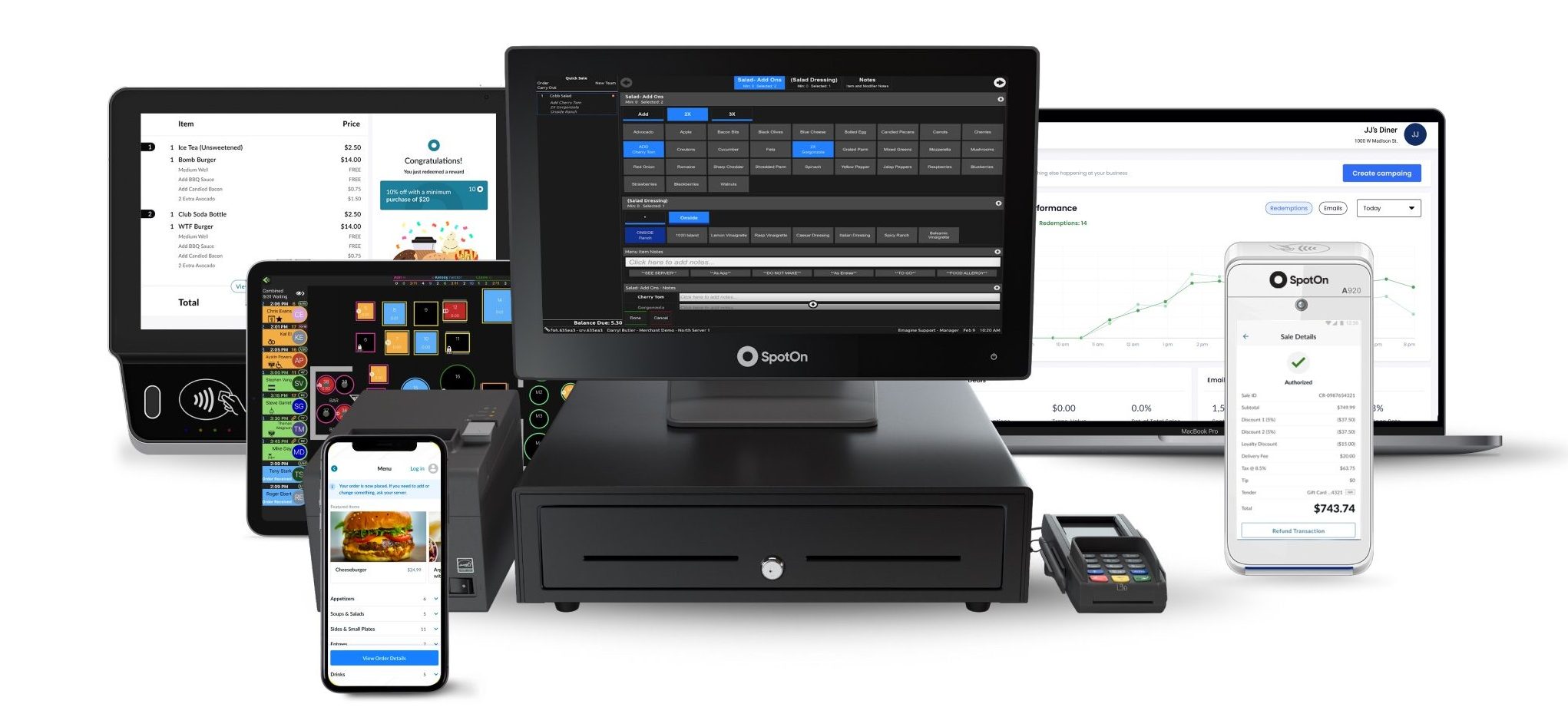
When the pandemic hit, SpotOn ramped up and rolled out 400 “new product innovations,” Hyman said. It also did things like waive $1.5 million in fees (it’s a SaaS business, so for several months it waived its monthly fee, for example, for its integrated restaurant management system). It also acquired a company, SeatNinja, so that it could expand its offering.

“Because a lot of these businesses had to go digital literally overnight, we built a free website for them all,” Hyman said. SpotOn also did things like offer commission-free online ordering for restaurants and helped retail merchants update their websites for e-commerce. “Obviously these businesses were resilient,” Hyman said. “But such efforts also created a lot of loyalty.” 

Today, more than 30,000 businesses use SpotOn’s platform, according to Hyman, with nearly 8,000 of those signing on this year. The company expects that number to triple by year’s end.

Currently, its customers are split about 60% retail and 40% restaurants, but the restaurant side of its business is growing rapidly, according to Hyman.

The reason for that, the company believes, is while restaurants initially rushed to add online ordering for delivery or curbside pickup, they soon realized they “wanted a more affordable and more integrated solution.”

Image Credits: SpotOn co-founders Zach Hyman, Doron Friedman and Matt Hyman / SpotOn

What makes SpotOn so appealing to its customers, Hyman said, is the fact that it offers an integrated platform so that businesses that use it can save “thousands of dollars” in payments and software fees to multiple, “à la carte” vendors. But it also can integrate with other platforms if needed.

In addition to growing its customer base and revenue, SpotOn has also boosted its headcount to about 1,250 employees (from 850 in March of 2020). Those employees are spread across its offices in San Francisco, Chicago, Detroit, Denver, Mexico City, Mexico and Krakow, Poland.

SpotOn is not currently profitable, which Hyman says is “by choice.”

“We could be cash flow positive technically whenever we choose to be. Right now we’re just so focused on product innovation and talent to exceed the needs of our clients,” he said. “We chose the capital plan so that we could really just double down on what’s working so well.”

The new capital will go toward further accelerating product development and expanding its market presence.

“We’re doubling down on our single integrated restaurant management system,” Hyman said. 

The raise marks the first time that a16z has put money in the startup, although General Partner David George told TechCrunch he was familiar with co-founders Matt Hyman and Zach Hyman through mutual friends.

George estimates that about 80% of restaurants and SMBs use legacy solutions “that are clunky and outdated, and not very customer friendly.” The COVID-19 pandemic has led to more of these businesses seeking digital options.

“We think we’re in the very early days in the transition [to digital], and the opportunity is massive,” he told TechCrunch. “We believe we’re at the tipping point of a big tech replacement cycle for restaurant and small business software, and at the very early stages of this transition to modern cloud-native solutions.”

George was also effusive in his praise for how SpotOn has executed over the past 14 months.

“There are companies that build great products, and companies that can build great sales teams. And there are companies that offer really great customer service,” he said. “It’s rare that you find two of those and extremely rare to find all three of those as we have in SpotOn.”


26 May 2021

Emile Learning bets it can make high school students study, not scroll

Edtech has realized it needs to build for the TikTok generation. It’s part of the reason we’re seeing a rise in supplemental, aspirational companies such as Outschool and Masterclass, which both lean on snappy editing, engaging content, and most of all, on demand learning.

But a nut that is yet to be cracked is how to add measurable outcomes to the mix. As with every edtech startup, a common tension exists: the platform has to be hard enough to teach consumers something, but fun (or easy) enough for them to actually use it.

The latest startup to throw its hat into the ring of frictionless learning is Emile Learning, which offers on-demand high school classes, accredited or not, with high-quality production. The startup just closed a $3 million seed round led by Kleiner Perkins, which has also backed the likes of Duolingo and Coursera.

Other investors include the Softbank Opportunity Fund, Uber Alum Syndicate, Owl Ventures, John Thornton, the former president of Goldman Sachs, Steven Galanis, founder of Cameo, and Ankur Nagpal, founder of Teachable. With the round, Emile’s total capital raised to date is $5.3 million.

Founded in 2020, Emile is built by a trio of Latino founders: CEO Felix Ruano, a McKinsey and Harvard alum, COO Michael Vilardo, an Uber and Nike alum and CTO Jon Quiros, a Dun & Bradstreet and CSU Pomona alum.

“We want to create the go-to platform where a student, anywhere in the world, can access content in the most frictionless way possible,” Ruano said. “Not just for fun, not just logging into Youtube on the weekends, but instead a full end-to-end course and receiving high school credit for it.”

And given the fact that “Zoom University” has struggled with accountability and engagement, the founder is optimistic that its a good time for Emile to launch more broadly.

The company serves up virtual, high-quality production high school classes, ranging from AP language and AP biology to personal finance and acting. Emile began as a way to help students prepare for AP exams – since a good score can help a student get college credit once they enter undergrad and save them thousands of dollars.

Now, less than a year since founding, it added on an accredited set of classes that can be used in high school, too. Students can get high school credit via a WASC accredited transcript, in addition to college credit via AP classes.

Vilardo explained how APs were a wedge to get them into the minds of high schoolers, but thinks the bigger opportunity will be for-credit within the schools themselves.

“The students may come for AP piece, but they’re gonna have a chance with low risk, high potential to engage in some of these experiential style courses, and maybe they end up deciding early in high school if they love finance or they love coding,” he said.

To create its content, Emile company sources top high school and college teachers across the United States, flys them to Los Angeles and shoots content there. Right now there are over 20 classes on the platform, with the goal of getting to 30 classes by September.

Over 50,000 students have used its platform to date, the company claims.

‘99% of investors still have no idea’

Emile charges students an annual fee to use its platform, a sum that can range between $100 to $200. While this is more economically accessible than private tutoring, the team isn’t set on this as Emile’s only monetization strategy.

“The way this becomes a billion-dollar company is the government-funded system,” he said. The COO estimates that around $600 billion flows into high school education in the United States every year from the government. The COVID-19 relief fund, which has recently begun hitting high schools, is part of this wave – and Emile could be recipient of those dollars if it is successful.

Ruano explained how, even with a bigger spotlight on edtech in the wake of the pandemic, “99% of investors still have no idea” about the importance of optionality in high school coursework.

“On average, they’ve gone through the best learning experiences their entire lives,” he said. “The idea that there is a legacy edtech market around for-credit classes is a completely new concept to them.” The key here was finding investors who came from diverse learning backgrounds to understand the importance of Emile’s pitch.

There’s been a number of high-school focused startups that have raised in the past year, including Galileo, Fiveable and Sora Schools. Kleiner Perkins, the lead check in Emile’s seed round, took two days from pitch to check.

It will be key to see how these companies don’t repeat the history of AltSchool, a San Francisco-based edtech company that opened up physical schools to replace traditional grade schools. While investors flocked to the company, families and educators ultimately got frustrated at the pressure that scaling put on AltSchool students and outcomes. Unlike Emile, AltSchool was selling personalized education to younger kids – not high schoolers.

Nonetheless, the past has given any startup that aims to replace traditional schooling a clear message: go slow, and don’t break too many things when it comes to education.

26 May 2021

Self-driving truck startup Kodiak partnering with SK Group to expand into Asia

Kodiak Robotics, the U.S.-based self-driving truck startup, is partnering with South Korean conglomerate SK to explore the possibility of deploying its autonomous vehicle technology in Asia.

The ultimate aim of the partnership is to sell and distribute Kodiak’s self-driving technology in the region. Kodiak will examine how it can use SK’s products, components and technology for its autonomous system, including artificial intelligence microprocessors and advanced emergency braking systems. Both companies have also agreed to work together to provide fleet management services for customers in Asia.

Kodiak co-founder and CEO Don Burnette couched the initial agreement as a first step towards a commercial enterprise in Asia.

“This is really just the first handful of steps to explore the possibility,” Burnette said. “What would it would look like to bring Kodiak’s AV technologies to Asian markets? What would be required? Who would be the partners? What are the regulatory forces that we have to contend with?”

Kodiak, which is based in Mountain View, Calif. and has operations in Texas, would be squaring off against at least two other self-driving companies — Plus and TuSimple — that already have a presence in the region. Both Plus and TuSimple announced mergers in the past six months with special purpose acquisition companies, an increasingly popular path for startup to go public.

While the partnership is at its earliest stage, it does connect Kodiak with a company that has a vast reach in South Korea as well as other countries in the region. The partnership is with SK Inc., a holding company of SK Group that has more than 120 operating companies, including ones connected to the logistics industry.

“Our partnership with Kodiak will help accelerate the commercialization of self-driving trucks in Asia,” said Jungho Shin, executive vice president of SK Inc. “Kodiak’s industry-leading technology and SK’s unrivaled reach in Korea and across Asia make this a natural partnership. We look forward to working with Kodiak to make autonomous trucking a reality around the globe.”

Burnette told TechCrunch the partnership agreement was reached after SK conducted an extensive technical review.

“They recognize the importance of AV technology broadly, they recognize the safety benefits, the economic benefits, and they want to play a role,” he said.

This is Kodiak’s first international expansion. But it might not be the last. Burnette said the company has been interested in certain international markets since it launched in 2018.

“We’ve had conversations about the Australian market,” Burnette noted. “I think Australia is another great market with future potential for this AV technology, particularly the long-haul highway, out-in-the-middle-of-nowhere kind of driving. There’s South American markets. Brazil is a big one that’s interesting to us, and, of course, Europe.

This partnership with SK Inc. follows an announcement with the U.S. Air Force for a contract to bring autonomous transportation to the U.S. Department of Defense’s Dover Air Force base in Delaware.

26 May 2021

Instagram launches a new section for shopping product drops

Instagram today announced it’s adding a new feature to help connect online shoppers to product drops through its app. Drops, which are a newer e-commerce trend, help sellers create buzz for forthcoming products in the days and weeks leading up to their availability. The products themselves are often only available in limited supplies or for a short period of time, increasing demand.

On Instagram, drops will now have their own destination inside the app at the top of the Shop tab, where consumers can discover, browse and shop all the latest product launches as well as view upcoming launches. Shoppers can also sign up to receive reminders about products they’re interested in from here, and look through products and collections from other drops that recently took place on Instagram.

Image Credits: screenshot of Drops on Instagram

Like other online shopping offered through Instagram, consumers can make their Drops purchases directly in the Instagram app itself via Checkout on Instagram, not by visiting third-party websites. This model will eventually allow Instagram to collect fees on purchases — something that’s become a more important part of Facebook and Instagram’s overall business model in the wake of Apple’s privacy crackdown on iOS apps that impacts Facebook’s ad revenues.

However, Instagram has temporarily waived its selling fees to both help businesses who are recovering from the last year of Covid. The move will also help it to gain ground in online shopping against new competitors, including TikTok.

Brands on Instagram had already been running drops before today, following Instagram’s release of a product reminders feature back in 2019 that allowed consumers to get notified when an item they were interested in became available for purchase. To date, brands across fashion, beauty, streetwear and others have leveraged the feature, the company says, including Hill House Home, Dragun Beauty, adidas, and others.

The new Drops location simply organizes the product launches in one place to make it easier to browse and shop. Instagram tells us it’s curating the featured drops in this section. To be considered, brands need to use the product launch feature which is available to businesses on Checkout with Instagram.

At launch, some of the drops available include today’s Drake x NOCTA ‘Cardinal Stock’ collection and upcoming drops like Wren + Glory hand-painted summer collection and Charlotte Tilbury Exclusive Pillow Talk Lips & Dreams Lashes Kit. This week, there are five total drops available. This number will vary from week to week as Instagram continues to test the new feature, the company tells us.

Image Credits: screenshot of Drops on Instagram

On an individual brand’s page inside Drops, consumers can view info like when the product became available, pricing, and other item details. They can also bookmark the item to add it to a wishlist or share the drop with a friend through Instagram’s direct messaging feature. From the top of the Drops page, users can return to their Cart or Wishlist at any time to complete the checkout — assuming they aren’t too late, of course.

In addition, the brand’s Live shopping can be scheduled to align with their product drop. When the brand goes live for a drop, there’s an on-screen countdown and confetti animation when the product becomes available.

The new feature is currently only available in the Instagram app in the U.S., and only on mobile devices (iOS and Android), not the web.

26 May 2021

Flywire’s flotation suggests the IPO slowdown is behind us

Boston-based payment processor Flywire announced its IPO pricing last night. The company sold 10.44 million shares at $24 per share, the upper limit of its $22 to $24 per share price range. At that share count and price, Flywire’s gross IPO proceeds stood at $250.6 million.

Renaissance Capital pegs the company’s fully diluted valuation at $2.8 billion. Using a simple share count, the company is worth $2.40 billion at its IPO price.


The Exchange explores startups, markets and money. 

Read it every morning on Extra Crunch or get The Exchange newsletter every Saturday.


The Flywire IPO is neat from a financial perspective and notable in that it’s a Boston exit as opposed to yet another New York or San Francisco-based flotation. It’s nice to see some other cities put points on the board.

But more than that, this IPO is a useful measuring stick for keeping tabs on the IPO market as a whole. This year and the last are shaping up to be key exit periods for startups and unicorns of all shapes and sizes; many a venture capital fund return rests on these public debuts.