Author: azeeadmin

25 May 2021

Daily Crunch: Before the pandemic, Expensify made remote work cool and profitable

To get a roundup of TechCrunch’s biggest and most important stories delivered to your inbox every day at 3 p.m. PDT, subscribe here.

Welcome to Daily Crunch for May 25, 2021. Whether you are a developer, a startup fanatic or merely someone with wanderlust, we have something for everyone today. Well, except for disappointed investors in Lordstown Motors. They are stuck holding the bag today after the American electric vehicle company announced a pretty awful set of earnings.

But for the rest of us, there’s quite a lot of tech and startup news to enjoy. Let’s get to it! — Alex

The TechCrunch Top 3

  • TechCrunch’s deep dive into Expensify continues: Ahead of its IPO, TechCrunch is digging into Expensify’s growth from startup to unicorn, with our latest entry discussing how the company shed its “Silicon Valley arrogance” to go global.
  • $300M for vertical farming: Startups shaking up the agricultural world is no longer a surprising idea, but the recent Bowery Farms round did make us sit up and take note. The company is now worth $2.3 billion, and its “vertically farmed produce is now available in 850 grocery stores.”
  • Venture capital’s global march continues: New data from Africa indicates that the continent’s historically lagging venture capital results are making up for lost time. Tage Kene-Okafor reports that VC activity in Africa could reach “between $2.25 billion and $2.8 billion” this year. That would be a new record.

Startups and VC

$26M for Airbyte, which is working to better connect data to where it’s needed: Having data is one thing, but startups are starting to get into not only storing data, but also how it gets ingested (Monte Carlo is working on that), and making sure it’s moved to where it’s needed. That’s where Airbyte comes in. And the company’s latest round comes just months after it raised a $5.6 million seed deal.

We asked our own Ron Miller what induced him to cover the round. Here’s what he had to say: “What attracted me to this round was the fact that the founders were using open source to drive the development of a community of users, then worrying about monetization down the road.”

Twilio opens wallet for Hyro: Whenever a company well known for leading a sea change in the tech world cuts a check, we tend to take notice. Recall when Salesforce was hip; its investments made waves. Today, Twilio is the BigCo in question, and Hyro the startup it is backing.

Per our own Jordan Crook, Hyro “calls itself an adaptive communications platform, which essentially means that customers use plug-and-play tools to get information to end users in a conversational way.” Very cool.

$50M for Whatnot, which wants to livestream e-commerce: Look, if you are not into buying things, Whatnot is not going to be your jam. But if you are, it has a neat take on e-commerce that is popular around the world, but has yet to take off in North America. Notably this round comes mere months after Whatnot raised $20 million.

Something something real-life NFTs?: What happens when you cross a startup that wants to bring blockchain to the real estate market and NFTs? You get this: Propy. The startup in question, is “auctioning a real apartment as an NFT.” I don’t get it! But maybe that’s the point.

$65M for social engineering-fighting Tessian: U.K.-based Tessian is a cybersecurity company, which means that of course it raised a huge new round. The cybersecurity market is hotter than all heck given waves arms around at all the breaches lately. But what makes Tessian neat is that it is taking on the human side of things by “flagging problematic [usage] patterns [that] could signify risky stuff is happening.”

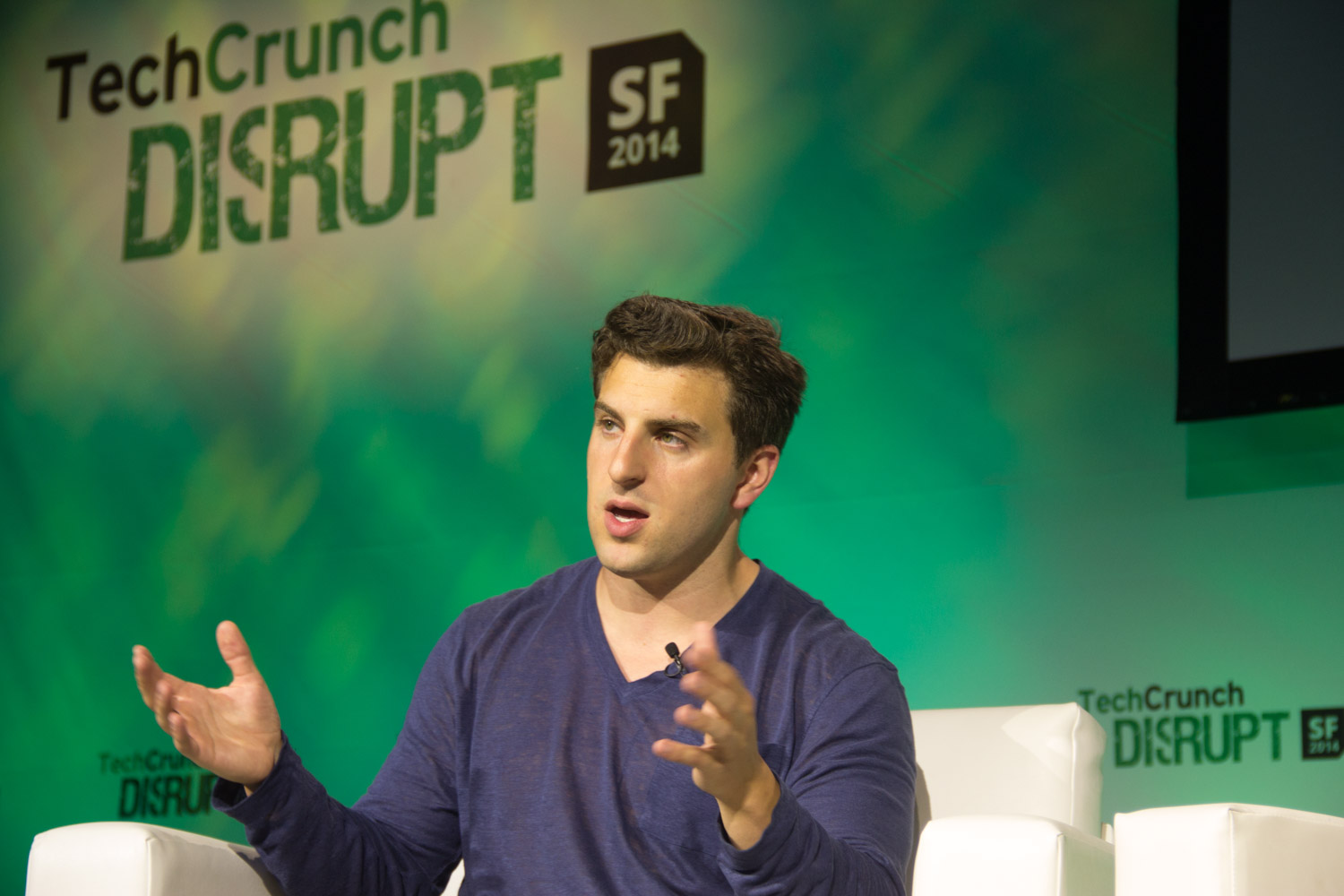
Brian Chesky describes a faster, nimbler post-pandemic Airbnb

Managing Editor Jordan Crook interviewed Airbnb co-founder and CEO Brian Chesky to discuss the future of travel and what it was like leading the world’s biggest hospitality startup during a global pandemic.

“Our business initially dropped 80% in eight weeks. I say it’s like driving a car. You can’t go 80 miles an hour, slam on the brakes and expect nothing really bad to happen.

“Now imagine you’re going 80 miles an hour, slam on the brakes, then rebuild the car kind of while still moving and then try to accelerate into an IPO, all on Zoom.”

(Extra Crunch is our membership program, which helps founders and startup teams get ahead. You can sign up here.)

Big Tech Inc.

Today was Microsoft’s Build conference, the second time that the annual Redmond developer confab took place virtually. But before we get into that, a short note on autonomous deliveries.

Getting stuff brought to your house without human power is a long-running technology dream. Remember those Amazon drones that everyone got super stoked about and then we never heard from again (not once, but twice)? Or the cute Postmates robot? Well, there’s another set of players in the space, namely JD.com and Meituan. TechCrunch has the latest on their self-driving delivery efforts.

Back to Build — oh boy was there a lot of news. From top to bottom, Microsoft is bringing more Azure services to Kubernetes, new tools for developers building on top of Teams, updates to its Edge browser as Internet Explorer shuffles off this mortal coil, enterprise Azure support for PyTorch, and, my personal favorite, the company is leveraging GPT-3 (which I think is super cool) to help people code in natural language.

I used to be a Microsoft beat reporter. I kinda miss those days. It’s a huge company with a finger in nearly every pie, which makes covering it surprisingly horizontal. Regardless, enjoy Frederic’s coverage!

 

Community

Some of us have started traveling again … revenge travel, if you will. Our own Jordan Crook chatted with Airbnb’s CEO and we asked him if he thinks “the trends we’re seeing in travel right now, like more rural destinations and decreased business travel, are here to stay?” See what he had to say here and tell us what you think here.

Do you like data? How about BIG Data? Come hang out with us on Clubhouse and chat about our recent Extra Crunch article on the topic this Thursday at 9 a.m. PDT/12 p.m. EDT. Need a Clubhouse invite? We got you; just swing on by the Discord server and ask.

TechCrunch Experts: Email Marketing

Intellect illustration

Image Credits: Getty Images

Who do you turn to when you need to know how to lay out your content, how to improve your open rates or for general email marketing advice?

TechCrunch wants to find the top growth marketers in tech! We’re looking to founders for their recommendations on email marketers.

Fill out the survey here.

This feedback will help shape our editorial coverage moving forward, so make sure your voice is heard. Find more details at techcrunch.com/experts.


25 May 2021

Tesla is no longer using radar sensors in Model 3 and Model Y vehicles built in North America

Tesla Model Y and Model 3 vehicles bound for North American customers are being built without radar, fulfilling a desire by CEO Elon Musk to only use cameras combined with machine learning to support its advanced driver assistance system and other active safety features.

Like many of Tesla’s moves, the decision to stop using the sensor runs counter to the industry standard. For now, the radar-less cars will only be sold in North America. Tesla didn’t state when or if it might remove the radar sensor in vehicles built for Chinese and European customers. Automakers typically use a combination of radar and cameras — and even lidar — to provide the sensing required to deliver advanced driver assistance system features like adaptive cruise control, which matches the speed of a car to surrounding traffic, as well as lane keeping and automatic lane changes.

Musk has touted the potential of its branded “Tesla Vision” system, which only uses cameras and so-called neural net processing to detect and understand what is happening in the environment surrounding the vehicle and then respond appropriately. Neural nets are a form of machine learning that work similarly to how humans learn. It is a sophisticated form of artificial intelligence algorithms that allows a computer to learn by using a series of connected networks to identify patterns in data. Many companies developing self-driving tech use deep neural networks to handle specific problems. But they wall off the deep nets and use rules-based algorithms to tie into the broader system.

The company detailed the transition away from radar in an update on its website, noting that the switch started this month. This camera-plus-machine learning (specifically neural net processing) approach has been dubbed Tesla Vision and will be used in its standard Autopilot advanced driver assistance system as well as its the additional $10,000 upgraded feature that has been branded Full Self-Driving or FSD. Tesla vehicles are not self-driving and require a human driver to remain engaged.

Tesla vehicles that are delivered without radar will initially limit Autopilot, including the lane keeping feature known as Autosteer. For a short period of time, Autosteer will be limited to a maximum speed of 75 mph and a longer minimum following distance. The system’s emergency lane departure avoidance feature and smart summon, which allows the driver to summon its vehicle in parking lot, may be disabled at delivery, Tesla said.

The company plans to restore these features through wireless software updates in the coming weeks. Tesla didn’t provide a specific timeline. All other available Autopilot and Full Self-Driving features will be active at delivery, depending on order configuration, the company said.

Meanwhile, new Model S and Model X vehicles as well as every model built for markets outside of North America, will continue to be equipped with radar and will have radar-supported Autopilot functionality.

“Model 3 and Model Y are our higher volume vehicles,” Tesla noted in its frequently asked questions section. “Transitioning them to Tesla Vision first allows us to analyze a large volume of real-world data in a short amount of time, which ultimately speeds up the roll-out of features based on Tesla Vision.”

25 May 2021

Extra Crunch roundup: Lordstown Motors’ woes, how co-CEOs work, Brian Chesky interview

Lordstown Motors released its Q1 earnings yesterday, and the electric vehicle manufacturer is facing a few challenges.

Expenses were higher than expected, it plans to slash production by about 50%, and the company reported zero revenue and a net loss of $125 million. Oh, it also needs more capital.

“But there’s more to the Lordstown mess than merely a single bad quarter,” writes Alex Wilhelm. “Lordstown’s earnings mess and the resulting dissonance with its own predictions are notable on their own, but they also point to what could be shifting sentiment regarding SPAC combinations.”

In light of the company’s lackluster earnings report (and a pending SEC investigation), Alex unpacks the company’s Q1, “but don’t think that we’re only singling out one company; others fit the bill, and more will in time.”

May 27 Clubhouse chat: How to ensure data quality in the era of Big Data

TC unwind chat with Ron Miller and Patrik Liu Tran

Image Credits: TechCrunch

Join TechCrunch reporter Ron Miller and Patrik Liu Tran, co-founder and CEO of automated real-time data validation and quality monitoring platform Validio, on Thursday, May 27 at 9 a.m. PDT/noon EDT for a Clubhouse chat about ensuring data quality in the era of Big Data.

The world produces 2.5 quintillion bytes of data daily, but modern data infrastructure still lacks solutions for monitoring data quality and data validation.

Among other topics, they’ll discuss the build versus buy debate, how to better understand data failures, and why traditional methods for identifying data failures are no longer operational.

Click here to join the conversation.

Thanks very much for reading Extra Crunch; have a great week!

Walter Thompson
Senior Editor, TechCrunch
@yourprotagonist


Full Extra Crunch articles are only available to members.
Use discount code ECFriday to save 20% off a one- or two-year subscription.


How Expensify shed Silicon Valley arrogance to realize its global ambitions

The Expensify origin story

Image Credits: Nigel Sussman

Expensify may be the most ambitious software company ever to mostly abandon the Bay Area as the center of its operations.

The startup’s history is tied to places representative of San Francisco: The founding team worked out of Peet’s Coffee on Mission Street for a few months, then crashed at a penthouse lounge near the 4th and King Caltrain station, followed by a tiny office and then a slightly bigger one in the Flatiron building near Market Street.

Thirteen years later, Expensify still has an office a few blocks away on Kearny Street, but it’s no longer a San Francisco company or even a Silicon Valley firm. The company is truly global with employees across the world — and it did that before COVID-19 made remote working cool.

It makes sense that a company founded by internet pirates would let its workforce live anywhere they please and however they want to. Yet, how does it manage to make it all work well enough to reach $100 million in annual revenue with just a tad more than 100 employees?

As I described in Part 2 of this EC-1, that staffing efficiency is partly due to its culture and who it hires. It’s also because it has attracted top talent from across the world by giving them benefits like the option to work remotely all year as well as paying SF-level salaries even to those not based in the tech hub. It’s also got annual fully paid month-long “workcations” for every employee, their partner and kids.

Brian Chesky describes a faster, nimbler post-pandemic Airbnb

Image Credits: TechCrunch

Managing Editor Jordan Crook interviewed Airbnb co-founder and CEO Brian Chesky to discuss the future of travel and what it was like leading the world’s biggest hospitality startup during a global pandemic.

“Our business initially dropped 80% in eight weeks. I say it’s like driving a car. You can’t go 80 miles an hour, slam on the brakes, and expect nothing really bad to happen.

Now imagine you’re going 80 miles an hour, slam on the brakes, then rebuild the car kind of while still moving, and then try to accelerate into an IPO, all on Zoom.”

Embedded finance will help fill the life insurance coverage gap

Image of a keyboard with one key featuring a family covered by an umbrella to represent life insurance.

Image Credits: alexsl (opens in a new window)/ Getty Images

There’s latent demand for life insurance currently unaddressed by much of the financial services industry, and embedded finance can be the solution.

It’s imperative for companies to consider product lines and partnerships to expand markets, create new revenue streams and provide added value to their customers.

Connecting consumers with products they need through channels they already know and trust is both a massive revenue opportunity and a social good, providing financial resilience to families at a time when they need it most.

Zeta Global’s IPO filing uncovers modest growth, strong adjusted profitability

Zeta Global raised north of $600 million in private capital in the form of both equity financing and debt, making it a unicorn worth understanding.

The gist is that Zeta ingests and crunches lots of data, helping its users market to their customers on a targeted basis throughout their individual buying lifecycles. In simpler terms, Zeta helps companies pitch customers in varied manners depending on their own characteristics.

You can imagine that, as the digital economy has grown, the sort of work Zeta Global supports has only expanded. So, has Zeta itself grown quickly? And does it have an attractive business profile? We want to know.

5 predictions for the future of e-commerce

Image of hands holding credit card and using laptop to represent online shopping/e-commerce.

Image Credits: Busakorn Pongparnit (opens in a new window) / Getty Images

In 2016, more than 20 years after Amazon’s founding and 10 years since Shopify launched, it would have been easy to assume e-commerce penetration (the percentage of total retail spend where the goods were bought and sold online) would be over 50%.

But what we found was shocking: The U.S. was only approximately 8% penetrated — only 8% for arguably the most advanced economy in the world!

Despite e-commerce growth skyrocketing over the past year, the reality is the U.S. has still only reached an e-commerce penetration rate of around 17%. During the last 18 months, we’ve closed the gap to South Korea and China’s e-commerce penetration of more than 25%, but there is still much progress to be made.

Here are five key predictions for what this road to further penetration will hold.

Develop a buyer’s guide to educate your startup’s sales team and customers

Every company wants to be innovative, but innovation comes with its share of difficulties. One key challenge for early-stage companies that are disrupting a particular space or creating a new category is figuring out how to sell a unique product to customers who have never bought such a solution.

This is especially the case when a solution doesn’t have many reference points and its significance may not be obvious.

Some buyers could use a walkthrough of the buying process. If you are building a singular product in a nascent market that necessitates forward-looking customers and want to drastically shorten sales cycles, create a buyer’s guide.

When to walk away from a VC who wants to invest in your startup

lighted fire exit sign

Image Credits: cruphoto (opens in a new window) / Getty Images

Pay attention to red flags when meeting with VCs: If they cancel late or leave you waiting, it’s a sign, just like being asked generic questions that demonstrate little or no understanding of the proposition. If they critique you or your business, that’s fine (obviously), but make sure you find out what’s behind their assertions to judge how well informed they are.

If you’re going to face these people each month and debate the direction of your business, the least you can expect is a robust argument outlining precisely why you may not have all the right answers.

If you fail to spot the warning signs, you’ll live to regret it. But do your due diligence and work constructively with them and, together, you might actually build a sustainable future.

Deep Science: Robots, meet world

Image via Getty Images / Westend61

This column aims to collect some of the most relevant recent discoveries and papers — particularly in, but not limited to, artificial intelligence — and explain why they matter.

In this edition, we have a lot of items concerned with the interface between AI or robotics and the real world. Of course, most applications of this type of technology have real-world applications, but specifically, this research is about the inevitable difficulties that occur due to limitations on either side of the real-virtual divide.

2 CEOs are better than 1

Defocussed shot of two silhouetted businesspeople having a meeting in the boardroom

Image Credits: PeopleImages (opens in a new window) / Getty Images

Netflix has two CEOs: Co-founder Reed Hastings oversees the streaming side of the company, while Ted Sarandos guides Netflix’s content.

Warby Parker has co-CEOs as well — its co-founders went to college together. Other companies like the tech giant Oracle and luggage maker Away have shifted from having co-CEOs in recent years, sparking a wave of headlines suggesting that the model is broken.

While there isn’t a lot of research on companies with multiple CEOs, the data is more promising than the headlines would suggest. One study on public companies with co-CEOs revealed that the average tenure for co-CEOs, about 4.5 years, was comparable to solitary CEOs, “suggesting that this arrangement is more stable than previously believed.”

Furthermore, it’s impossible to be in two places at once or clone yourself. With co-CEOs, you can effectively do just that.

25 May 2021

We owe it to our kids to put an age limit on social media

For societies with long histories of protecting children with laws and regulations, isn’t it surprising that nothing is being done to similarly shield them from the various and proven dangers of social media? We need to institute the same kinds of age limits and protections for technology and web use as we’ve done for decades in almost every other sphere.

Think about it. We don’t let young people drive, drink, smoke, get married, join the Army, get a tattoo or vote until we feel they’re old enough to handle it.

But we put some of the most powerful technologies ever known to humankind in the hands of a 13-year-old, and then stand back in amazement when online bullying and body dysmorphia issues go off the charts, when self-harm and suicide rates explode, when rape culture is inculcated within a generation of young children steeped in porn.

For parents with teenage kids, there is a growing, horrifying realization that over the last 10 years, we’ve knowingly surrendered our offspring as guinea pigs to a grand scheme from tech companies focused on “maximizing engagement” for the sake of profit, with little or no regard to the consequences.

For societies with long histories of protecting children with laws and regulations, isn’t it surprising that nothing is being done to similarly shield them from the various and proven dangers of social media?

We parents were so in love with cool tech ourselves that we thought it hip and helpful and safe to get Johnny and Jane a phone, with a similar disregard for what damage this could do to their self-esteem and healthy development. The first little emoji text we got from them seemed cute. We didn’t realize it was going to turn into 100, then 500, then 1,000 — a day.

Forgive us, Lord, for we know not what we do.

Try putting your phone down. Go on, do it now. Count how long you can go before you can’t resist picking it up again. How long did you manage? Not long, right? You (like most of us) are a tech addict, and you’re an adult, with willpower and the ability to defer gratification that your upbringing drilled into you. Imagine what it’s like for a 16-year-old whose whole life has been a never-ending carousel of instant gratification.

And we’re surprised when our kids look washed out in the morning before school, after a night of Instagram, Snapchat, TikTok and a whole bunch of apps your kids know about but you’ve never heard of. School that now involves even more time staring at a screen.

A license to scroll

Having an age limit — we suggest 18 for phones and social media — will begin the process of readjusting our relationship with technology toward our better angels. Just as we teach young people to drive a car with driving lessons, classwork, a highway code guide and a test, let’s teach them how to use social media in a way that won’t harm them. Let’s introduce a “social media user license” that requires passing a test and can be revoked if they don’t follow the rules of the “information superhighway.”

Some people think social media is now so pervasive that it’s impossible to put the genie back in the bottle. But we disagree. In fact, we feel that a fatalistic acceptance of what’s going on is morally unconscionable. Remember, all it takes for evil to flourish is for good people to do nothing.

We’ve proved we can introduce rules and regulations to ensure the wise use of powerful technologies. We’ve done it before, with the aforementioned cars, with radiography and nuclear energy — in fact, with all dual-purpose technologies we’ve created. What’s different about social media? Indeed, in some countries, legislation is beginning to emerge. The U.K., as an example, recently introduced proposed laws that would fine, or even shut down, social media platforms that fail to protect children from harm online.

Some people think that even if we wanted to put age limits in place we couldn’t enforce them, logistically. Of course we could — with the biometric security systems now commonplace on our phones (fingerprint readers, facial recognition, etc.) and with the algorithms that routinely customize feeds for billions of active users per day, or with any variety of existing technical solutions. It is simply a question of having the will. Then the way will emerge.

Keeping a good from becoming evil

We don’t want to ban social media. When used responsibly, it’s a wonderful thing. Particularly now, during the pandemic, social media has been a lifeline against isolation and loneliness. Who can even imagine how much worse sheltering in place and quarantine would have been without technology that allowed us to connect with each other at the exact time we were forced apart? In just a matter of weeks, we simultaneously became more separated — physically — and connected — digitally — than ever before in history.

But social media has grown so vast and so powerful that we’re now past the point where we can continue to justify naïveté and youthful exuberance. It’s time to admit that the inventors, company leaders and consumers — yes, us, too — of these new technologies all know what we are doing. And worse, what we’re doing to our children’s minds.

The final objection to our argument is that, even if there were an age limit in place, kids would find a way around it. This is obviously true. Some kids would find a way to access the tech and apps they see adults using, just as some kids drink and smoke before they’re of the legal age. But if we believed that because some people break laws, there’s no point in having them, anarchy would await. Imperfect compliance with the law is no argument for its absence.

Young people are not mature enough to be exposed to the bottomless scroll of FOMO, YOLO, trolling, abuse, lunacy and unadulterated filth that is just another day on social media. There’s so much evidence of the harm that is being done to kids by it, if you care to look. San Diego State University professor of psychology Jean Twenge’s “iGen” has a lot of the details — if you dare to look.

It’s a parental instinct to protect your children, so let’s act now and set an age limit to spare them from social media’s dark side until they’re mature enough to make responsible choices.

25 May 2021

We owe it to our kids to put an age limit on social media

For societies with long histories of protecting children with laws and regulations, isn’t it surprising that nothing is being done to similarly shield them from the various and proven dangers of social media? We need to institute the same kinds of age limits and protections for technology and web use as we’ve done for decades in almost every other sphere.

Think about it. We don’t let young people drive, drink, smoke, get married, join the Army, get a tattoo or vote until we feel they’re old enough to handle it.

But we put some of the most powerful technologies ever known to humankind in the hands of a 13-year-old, and then stand back in amazement when online bullying and body dysmorphia issues go off the charts, when self-harm and suicide rates explode, when rape culture is inculcated within a generation of young children steeped in porn.

For parents with teenage kids, there is a growing, horrifying realization that over the last 10 years, we’ve knowingly surrendered our offspring as guinea pigs to a grand scheme from tech companies focused on “maximizing engagement” for the sake of profit, with little or no regard to the consequences.

For societies with long histories of protecting children with laws and regulations, isn’t it surprising that nothing is being done to similarly shield them from the various and proven dangers of social media?

We parents were so in love with cool tech ourselves that we thought it hip and helpful and safe to get Johnny and Jane a phone, with a similar disregard for what damage this could do to their self-esteem and healthy development. The first little emoji text we got from them seemed cute. We didn’t realize it was going to turn into 100, then 500, then 1,000 — a day.

Forgive us, Lord, for we know not what we do.

Try putting your phone down. Go on, do it now. Count how long you can go before you can’t resist picking it up again. How long did you manage? Not long, right? You (like most of us) are a tech addict, and you’re an adult, with willpower and the ability to defer gratification that your upbringing drilled into you. Imagine what it’s like for a 16-year-old whose whole life has been a never-ending carousel of instant gratification.

And we’re surprised when our kids look washed out in the morning before school, after a night of Instagram, Snapchat, TikTok and a whole bunch of apps your kids know about but you’ve never heard of. School that now involves even more time staring at a screen.

A license to scroll

Having an age limit — we suggest 18 for phones and social media — will begin the process of readjusting our relationship with technology toward our better angels. Just as we teach young people to drive a car with driving lessons, classwork, a highway code guide and a test, let’s teach them how to use social media in a way that won’t harm them. Let’s introduce a “social media user license” that requires passing a test and can be revoked if they don’t follow the rules of the “information superhighway.”

Some people think social media is now so pervasive that it’s impossible to put the genie back in the bottle. But we disagree. In fact, we feel that a fatalistic acceptance of what’s going on is morally unconscionable. Remember, all it takes for evil to flourish is for good people to do nothing.

We’ve proved we can introduce rules and regulations to ensure the wise use of powerful technologies. We’ve done it before, with the aforementioned cars, with radiography and nuclear energy — in fact, with all dual-purpose technologies we’ve created. What’s different about social media? Indeed, in some countries, legislation is beginning to emerge. The U.K., as an example, recently introduced proposed laws that would fine, or even shut down, social media platforms that fail to protect children from harm online.

Some people think that even if we wanted to put age limits in place we couldn’t enforce them, logistically. Of course we could — with the biometric security systems now commonplace on our phones (fingerprint readers, facial recognition, etc.) and with the algorithms that routinely customize feeds for billions of active users per day, or with any variety of existing technical solutions. It is simply a question of having the will. Then the way will emerge.

Keeping a good from becoming evil

We don’t want to ban social media. When used responsibly, it’s a wonderful thing. Particularly now, during the pandemic, social media has been a lifeline against isolation and loneliness. Who can even imagine how much worse sheltering in place and quarantine would have been without technology that allowed us to connect with each other at the exact time we were forced apart? In just a matter of weeks, we simultaneously became more separated — physically — and connected — digitally — than ever before in history.

But social media has grown so vast and so powerful that we’re now past the point where we can continue to justify naïveté and youthful exuberance. It’s time to admit that the inventors, company leaders and consumers — yes, us, too — of these new technologies all know what we are doing. And worse, what we’re doing to our children’s minds.

The final objection to our argument is that, even if there were an age limit in place, kids would find a way around it. This is obviously true. Some kids would find a way to access the tech and apps they see adults using, just as some kids drink and smoke before they’re of the legal age. But if we believed that because some people break laws, there’s no point in having them, anarchy would await. Imperfect compliance with the law is no argument for its absence.

Young people are not mature enough to be exposed to the bottomless scroll of FOMO, YOLO, trolling, abuse, lunacy and unadulterated filth that is just another day on social media. There’s so much evidence of the harm that is being done to kids by it, if you care to look. San Diego State University professor of psychology Jean Twenge’s “iGen” has a lot of the details — if you dare to look.

It’s a parental instinct to protect your children, so let’s act now and set an age limit to spare them from social media’s dark side until they’re mature enough to make responsible choices.

25 May 2021

A new book coauthored by Brad Feld invites founders to get their weekly Nietzsche

In all likelihood, you do not currently associate Friedrich Nietzsche, the German philosopher, essayist and cultural critic, with entrepreneurship.

Serial entrepreneurs Brad Feld and Dave Jilk — whose friendship dates back to their college days at MIT — think that you should. Indeed, in the forward of their new book, The Entrepreneur’s Weekly Nietzsche: A Book For Disruptors, another renowned entrepreneur (and formerly philosophy student), Reid Hoffman, explains how Nietzsche has inspired him to think differently throughout his own career, noting that, like disruptive entrepreneurs, Nietzsche “wanted to destroy the old mindsets that locked people into the past” and that his “fierce allegiance to the new” is as relevant today as it was 150 years ago.

If setting aside precious time to study Nietzche sounds daunting, don’t worry; Feld and Jilk clearly get it. Their new book tries to make his writings accessible, but they really focus more on their modern-day applicability, arranging their new book in fifty-two individual chapters — one for each week — that begins with a quote from one of Nietzsche’s works then quickly delves into an oral history from a founder that brings the quote to life.

Yesterday, we asked Feld, who has written books about venture capital and startup communities in the past, about the book. Our exchange has been edited lightly for length.

TC: What was the impetus for this new book?


BF: This has been an on-again, off-again project with Dave, my first business partner, that began in 2013. We were spending the weekend in Keystone with our wives Amy and Maureen, which generally involved a lot of sitting around reading. Dave was reading On Nietzsche by Eric Steinhart. He read a quote to me and asked if I thought it sounded like an entrepreneur. Dave remembers me saying, “Hmmm, it sure does.” Then we both went back to our books.

As Dave went deeper into studying Nietzsche, we kept talking about Nietzsche quotes that prompted discussions around aspects of entrepreneurship. I had gone deep into Stoicism and was in love with what Ryan Holiday was doing with his writing. His book The Obstacle is the Way had a huge impact on me.

By 2016, we’d started working on the book. When Ryan came out with The Daily Stoic, I suggested to Dave that we write a book using this format. After a little more work, we changed the approach a little, focusing on 52 quotes instead of 365, making our interpretation a little longer, and adding a narrative from an entrepreneur to many  of the quotes.

Nietzsche is an incredibly important and deeply misunderstood philosopher. He’s the bridge between many things that came before him — beyond just philosophy — and many things that have come after him. Rather than state the answer, he provokes and encourages deep thought. In some ways, he’s the perfect philosophical mentor for an entrepreneur since you can apply his quotes in many different ways.

TC: Should this be placed in the business section or philosophy section of a bookstore?

BF: Well, according to Amazon, it’s already showing up in both! Dave and I wrote this to be an entrepreneurship book, as applied philosophy, but our fantasy is that philosophers who appreciate applications will like what we’ve done. We’re not experts on Nietzsche, nor do we pretend to be Nietzsche scholars. However, we have both read a lot of Nietzsche in the (translated) original at this point, and Dave has studied Nietzsche extensively, so we’ve been deliberate in the quotes we’ve chosen and how we interpret them.

TC: Entrepreneurs are often too busy to be introspective, as you acknowledge in the book. How do you persuade them to make the time?


BF: Entrepreneurship is extremely challenging. It can be excruciatingly difficult. The highs are extraordinary. The lows are devastating. They come endlessly, with unexpected frequency.

If you don’t know your “why,” being an entrepreneur is much more difficult than it needs to be. And, no one can tell you your “why” – you have to discover it for yourself. As you grow, experience, and age, your “why” will change. You have to build the muscle to continually figure out your “why,” and figure out how it relates to what you are doing.

If you can’t make the time for this, your journey as an entrepreneur will be much harder. When you face failure, it could be catastrophic or permanent rather than episodic. When you find yourself struggling emotionally, you won’t have the tools to figure out what to do to emerge stronger. While you may utter Nietzsche’s famous quote “What does not kill me makes me stronger,” if you haven’t thought about it, you are echoing a cliché rather than incorporating an important concept into your way of being.

As for when [to find the time], we talk in the book about establishing cycles of “stepping back” from the business. We discuss the notion of a “meta-strategy” – what is your strategy for periodically revising your strategy? We also observe that when things are going well you are likely to plateau, making that an important — though counterintuitive — time to think hard.

TC:
 There are great oral histories throughout this book. How did you choose the storytellers, and were they interviewed or did you email them questions, then edit down their responses?


BF: We focused on experiences we were aware of and people we thought might have some connection to the quote. We used our primary network but didn’t try to be exhaustive. Some of the experiences we already knew about or had played a role in; others were new to us.

We emailed them the quote and a short guideline of what we were looking for. In most cases they wrote a nearly-finished narrative; in a few cases, they gave us an outline and we filled it in, or we interviewed them and wrote the text ourselves. We wanted these narratives to feel like the entrepreneurs were talking to the reader in their own voices, and telling the stories that occurred to them, rather than making it an extension of the essay.

We especially love the [stories] where the narrative went in a different direction than our preceding essay, as it demonstrates the different ways Nietzsche can provoke thoughts from a simple quote.

25 May 2021

What Vimeo’s growth, profits and value tell us about the online video market

The spinout of video platform Vimeo from IAC completed today, with the smaller company now trading as an independent entity under the ticker symbol VMEO.

If you missed the news that the internet conglomerate was spinning out the video service, don’t feel bad; it slipped past many radars. But with the company now trading, with our access to its historical results, and with our minds still enthralled by YouTube’s recent financial performance for Alphabet, it’s worth taking a moment to digest the company’s health.

Let’s answer a few questions: How quickly is Vimeo growing, how profitable is its business, and what can its spinout tell us about the larger video market? Recall that Kaltura, another video-powering company, recently put its IPO back into the pipeline after a small delay during what felt like a snap-freeze of the public markets toward the start of the second quarter.

So the Vimeo debut could impact a possible forthcoming unicorn IPO. With that in mind, let’s dig into the numbers.

Growth

From Q1 2020 to Q1 2021, Vimeo’s revenues expanded from $57.0 million to $89.4 million, a gain of around 57%. That’s a solid pace of expansion, but not a surprising one considering how much digital video the world consumed during the COVID-19 pandemic, a fact that could have bolstered the company’s recent performance.

Over the same time frame, Vimeo’s gross profit grew from $38.6 million to $64.5 million, a gain of around 67%. As you can infer from faster-rising gross profit than revenue, Vimeo’s gross margins improved during Q1 2021 compared to the first quarter of 2020, from 68% to 72%.

25 May 2021

Call it a comeback: Turntable.fm raises $7.5M

Earlier this year, Turntable.fm’s founder Billy Chasen dusted off the old site and resurrected it for the pandemic age. I know I wasn’t the only one feeling a wistful pang of nostalgia for the service during the long, dull days of sheltering in place. And while March 2020 would have been the best time for a relaunch, March 2021 was pretty good, too.

Today Chasen announced that the service has received a nice little slice of VC backing to help the service (which has thus far been invite/password only) take the next step. Andreessen Horowitz led the $7.5 million round a decade after the site’s original launch. Funding had thus far been limited to fans through services like Patreon and Venmo. He notes that he will be turning off the service’s Patreon.

Chasen is staying mum as far as where the funding will go, stating, “And now with the new fundraising, we can continue to innovate and truly explore the cross section of social + music. I have a lot of ideas for the space and I’m excited to start building them.”

Though, a blog post does note that the company is hiring engineers and designers. Understandable, though as someone who’s been enjoying the site these last few months, I’m actually pretty surprised at how fresh the whole thing feels.

The team found a clever loophole around music rights in the form of YouTube videos, but perhaps a future version of the service will involve more direct music licensing or ties to popular apps like Spotify. A mobile app would be nice, if I’m just spitballing here.

Turntable.fm initially shut down back in 2013, stating at the time, “It was a tough decision to make because we love this community so much, but the cost of running a music service has been too expensive and we can’t outpace it with our efforts to monetize it and cut costs.” The service added that it was focusing on a live events platform instead.

Notably, Turntable.fm is not the only Turntable service looking to relaunch in 2021. There’s also Turntable.org (confusingly located at TT.fm), which is seeking fan funding, as well as looking toward a subscription fee. It announced that it had raised $500,000 in March and was aiming for an April launch for a mobile and desktop version. The site currently reads, “We’re building a new version just as much fun as the original.”

The two Turntables are not affiliated.

25 May 2021

Call it a comeback: Turntable.fm raises $7.5M

Earlier this year, Turntable.fm’s founder Billy Chasen dusted off the old site and resurrected it for the pandemic age. I know I wasn’t the only one feeling a wistful pang of nostalgia for the service during the long, dull days of sheltering in place. And while March 2020 would have been the best time for a relaunch, March 2021 was pretty good, too.

Today Chasen announced that the service has received a nice little slice of VC backing to help the service (which has thus far been invite/password only) take the next step. Andreessen Horowitz led the $7.5 million round a decade after the site’s original launch. Funding had thus far been limited to fans through services like Patreon and Venmo. He notes that he will be turning off the service’s Patreon.

Chasen is staying mum as far as where the funding will go, stating, “And now with the new fundraising, we can continue to innovate and truly explore the cross section of social + music. I have a lot of ideas for the space and I’m excited to start building them.”

Though, a blog post does note that the company is hiring engineers and designers. Understandable, though as someone who’s been enjoying the site these last few months, I’m actually pretty surprised at how fresh the whole thing feels.

The team found a clever loophole around music rights in the form of YouTube videos, but perhaps a future version of the service will involve more direct music licensing or ties to popular apps like Spotify. A mobile app would be nice, if I’m just spitballing here.

Turntable.fm initially shut down back in 2013, stating at the time, “It was a tough decision to make because we love this community so much, but the cost of running a music service has been too expensive and we can’t outpace it with our efforts to monetize it and cut costs.” The service added that it was focusing on a live events platform instead.

Notably, Turntable.fm is not the only Turntable service looking to relaunch in 2021. There’s also Turntable.org (confusingly located at TT.fm), which is seeking fan funding, as well as looking toward a subscription fee. It announced that it had raised $500,000 in March and was aiming for an April launch for a mobile and desktop version. The site currently reads, “We’re building a new version just as much fun as the original.”

The two Turntables are not affiliated.

25 May 2021

Raising a round? AngelList Venture CEO Avlok Kohli will share insights at TC Early Stage

What’s it like raising a round in 2021? How has it changed over the last few months, as some glimmer of normalcy seems, at least, within reach? What do early-stage founders (and investors!) need to know about the current state of the industry?

Few are in a better place to outline this than Avlok Kohli, the CEO of AngelList Venture who will let you know at TC Early Stage on July 8-9. With more than $2.2 billion in assets under management and over 5,000 startups funded on the platform, AngelList has data-driven insights that just about no one else could offer. Kohli joined AngelList Venture as CEO in mid-2019, giving him a remarkably unique view of the industry through a particularly wild time.

Kohli also knows what it’s like to be a founder, having been in that seat multiple times. In 2014 he founded Fastbite, a low-cost meal delivery service; in 2015, he sold it to Square. He dove back in with a daily house cleaning service called Fairy in 2017, and sold it to Postmates at the beginning of 2019.

We’re super excited to announce that Avlok Kohli will join us at TC Early Stage on July 8-9 to get us all up to speed on the state of play in early-stage investing.

TC Early Stage is our event series all about startups that are… well, early stage. From raising money to marketing the right way to just getting people to care, we go deep on the topics that matter most to founders.

We’ll kick this session off with a presentation from Kohli on the state of early-stage investing, then we’ll get right into audience Q&A and try to get your most burning questions answered live.

TC Early Stage: Marketing & Fundraising goes down on July 8th and 9th — and because it’s virtual, you can attend right from the comfort of your couch. Or office chair. Or a hammock. We don’t care, just come watch. Get your tickets here!