Author: azeeadmin

25 May 2021

DC Attorney General files antitrust suit against Amazon over third-party seller agreements

Washington DC Attorney General Karl Racine announced a new antitrust suit against Amazon Tuesday, accusing the company of stifling competition by exerting control over third-party sellers.

The lawsuit, filed in DC Superior Court, alleges that Amazon fixed prices on its massive online retail platform by blocking third-party sellers from selling their products for less elsewhere. Racine argues that this kind of arrangement means that sellers roll Amazon’s hefty fees into their prices, creating an “artificially high” price floor across the online retail market.

That practice may run afoul of the District of Columbia’s Antitrust Act. The AG’s office argues that the practice allows Amazon to exert monopoly power in online retail.

“Amazon has used its dominant position in the online retail market to win at all costs. It maximizes its profits at the expense of third-party sellers and consumers, while harming competition, stifling innovation, and illegally tilting the playing field in its favor,” Racine said.

“We filed this antitrust lawsuit to put an end to Amazon’s illegal control of prices across the online retail market. We need a fair online marketplace that expands options available to District residents and promotes competition, innovation, and choice.”

The DC AG lawsuit is the latest state-level effort to take tech’s most powerful companies down a notch. Facebook and Google are both facing multi-state lawsuits for alleged anticompetitive behavior, even as federal lawmakers creep toward major antitrust reform.

25 May 2021

Whatnot raises $50M to let people sell Pokémon cards, Funko Pops, and more via livestream

Whatnot exists with one primary goal in mind: to give people a place to buy and sell collectibles (like Pokémon cards, sports cards, pins, etc) in a safe, authenticated way.

The company started out with intentions of being a GOAT/StockX-style resale marketplace, where the products up for sale lived on neat little pages with row after row of static images. As they started experimenting with other formats, they found one that really seemed to catch on: livestream sales. Think QVC or the Home Shopping Network… but instead of hosts in huge studios selling jewelry and patio furniture, it’s users with smartphones selling Charizard cards and Yoda figurines.

Image Credits: Whatnot

I first wrote about Whatnot last year. In the short time since, the company has raised three increasingly large rounds: $4 million in December, $20 million in March, and, as of this morning, another $50 million.

While Whatnot still offers the more standard product pages to give sellers a 24/7 presence on the site, the livestreaming side of things has become the primary driver — by far. Co-founder Grant LaFontaine tells me that livestreaming is currently “95% of the focus”; it’s where most of their sales are happening, and what users seem to care most about.

Another thing users seem to care about? Sports cards. Whatnot opened up the site to sports card sellers in January, and it almost immediately took over as the site’s best selling category. The one category now accounts for “millions of dollars” in sales each month, the company says.


The Whatnot team itself is growing quickly as well. When I first spoke to them, it was just a handful of employees; by January of this year, they were up to ten. Today it’s 45 fulltimers. By the end of the year, says Grant, they expect to be nearing one hundred.

While anyone can sell on Whatnot’s marketplace, only users that have been vetted/invited can sell via livestream. This helps to keep fraud low; sellers know that if they try to sneak in fake cards or rip anyone off, their access to livestreaming — and thus their audience — could vanish.

The company tells me that this Series B round was led by Anu Hariharan of Y Combinator Continuity fund, and backed by Andreessen Horowitz, Animal Capital, and a number of angels.


25 May 2021

Qualified raises $51M to help Salesforce users improve their sales and marketing conversations

Salesforce dominates the world of CRM today, but while it’s a popular and well-used tool for organizing contacts and information, it doesn’t have all the answers when it comes to helping salespeople and marketers sell better, especially when meetings are not in person. Today, one of the startups that has emerged to help fill the gap is announcing a round of growth funding on the back of a huge year for its business.

Qualified — which builds better interactions for B2B sales and marketing teams that already use Salesforce by tapping into extra data sources to develop a better profile of those visiting your website, in aid of improving and personalizing the outreach (hence the name: you’re building “qualified” leads) — has picked up $51 million in funding. The startup will be using the Series B to continue building out its business with more functionality in the platform, and hiring across the board to expand business development and more.

Led by Salesforce Ventures, the funding round also included Norwest Venture Partners and Redpoint Ventures, both previous backers, among others. As with so many rounds at the moment — the venture world is flush with funding at the moment — this one is coming less than a year after Qualified’s last raise. It closed a $12 million Series A in August of last year.

Qualified was co-founded by two Salesforce veterans — ex-Salesforce CMO Kraig Swensrud and ex-SVP of Salesforce.com Sean Whiteley — serial entrepreneurs who you could say have long been hammering away at the challenges of building digital tools for sales and marketing people to do their jobs better online. The pair have founded and sold two other startups filling holes to that end: GetFeedback, acquired by SurveyMonkey; and Kieden, acquired by Salesforce.

The gap that they’re aiming to fill with this latest venture is the fact that when sales and marketing teams want to connect with prospects directly through, say, a phone call, they might have all of that contact’s information at their disposal. But if those teams want to make a more engaged contact when someone is visiting their site — a sign that a person is actually interested and thinking already about engaging with a company — usually the sales and marketing teams are in the dark about who those visitors are.

“We founded Qualified on the premise that a website should be more than a marketing brochure, but not just a sales site,” Swensrud, who is the CEO, said in an interview.

Qualified has built a tool that essentially takes several signals from Salesforce as well as other places to build up some information about the site visitor. It then uses it to give the sales and marketing teams more of a steer so that when they reach out via a screen chat to say “how can I help?” they actually have more information and can target their questions in a better way. A sales or marketing rep might know which pages a person is also visiting, and can then use the conversation that starts with an online chat to progress to a voice or video call, or a meeting.

If a person is already in your Salesforce rolodex, you get more information; but even without that there is some detail provided to be slightly less impersonal. (Example: when I logged into Qualified to look around the site, a chat popped up with a person greeing me “across the pond”… I’m in London.)

Qualified also integrates with a number of other tools that are used to help source data and build its customer profiles, including Slack, Microsoft Teams, 6sense, Demandbase, Marketo, HubSpot, Oracle Eloqua, Clearbit, ZoomInfo and Outreach.

Additional data is part and parcel of the kinds of information that sales and marketing people always need when reaching out to prospective customers, whether it’s via a “virtual” digital channel or in person. However, in the last year — where in-person meetings, team meetings, and working side-by-side with those who can give advice have all disappeared — having extra tools like these arguably have proven indispensable.

“Sales reps would heavily rely on their ‘road warrior’ image,” Swensrud said. “But all that stuff is gone, so as a result every seller is sitting at an office, at home, expecting digital interactions to happen that never existed before.”

And it seems some believe that even outside of Covid-19 enforcing a different way of doing things, the trend for “virtual selling”, as it’s often called, is here to stay: Gartner forecasts that by 2025, some 80% of B2B sales interactions will take place in digital channels. (So long to the expense account lunch, I guess.)

It’s because of the events of 2020, plus those bigger trends, that Qualified has seen revenues in the last year grow some 800% and its net customer revenue retention rate hover at 175%, with funding rounds come in relatively close succession in the wake of that.

There is something interesting to Qualified that reminds me a bit of more targeted ad retargeting, as it were, and in that, you can imagine a lot of other opportunities for how Qualified might expand in scenarios where it would be more useful to know why someone is visiting your site, without outright asking them and bothering them with the question. That could include customer service, or even a version that might sell better to consumers coming to, say, a clothes site after reading something about orange being the new black.

For now, though, it’s focused on the B2B opportunity.

There are a number of tools on the market that are competing with Salesforce as the go-to platform for people to organise and run CRM operations, but Swensrud is bullish for now on the idea of building specifically for the Salesforce ecosystem.

“Our product is being driven by and runs on Salesforce,” he noted, pointing out that it’s through Salesforce that you’re able to go from chatting to a phone call by routing the information to the data you have on file there. “Our roots go very deep.”

The funding round today is a sign that Salesforce is also happy with that close arrangement, which gives it a customization that its competitors lack.

“Qualified represents an entirely new way for B2B companies to engage buyers,” said Bill Patterson, EVP of CRM Applications at Salesforce, in a statement. “When marketing and inbound sales teams use this solution with Sales Cloud… they see a notable impact on pipeline. We are thrilled about our growing partnership with Qualified and their success within the Salesforce ecosystem.”

25 May 2021

Struum launches its ‘ClassPass for streaming’ service to the public

Struum, the new streaming service from former Disney and Discovery execs, is today officially launching to the public. Unlike traditional on-demand streamers, such as Netflix, the Struum model is more akin to a “ClassPass for streaming,” as its plan is to aggregate content from smaller video services then provide access under its own subscription.

Today, the streaming landscape is dominated by larger subscription services, including Netflix, Hulu, Amazon Prime Video, Apple TV+, HBO Max, Disney+, and YouTube, who together have a 75% share of the market, according to Nielsen. But Struum believes there’s a potential for another service powered by the long tail of  the over 250 niche and speciality streamers.

Many of these smaller services offer their own subscriptions, but will never achieve Netflix-size scale because of their more limited catalog and scope. Struum offers them an alternative path to revenue. Each month, Struum customers will pay a $4.99 subscription fee to access the Struum app where they’re then provided with 100 “credits” they can use to sample and consume content — just as ClassPass did with gym classes.

Over time, if the customer continues to use their subscription to routinely access content from one service, they can then opt to become a subscriber to that service from within the Struum app. This part of the business isn’t all that different from Amazon Prime Video Channels or others like it. But the difference is that Struum’s sampling model is what helped the customer discover the niche streamer in the first place.

Struum, meanwhile, generates its own revenue from customers’ subscriptions, which it shares with its content partners. It won’t say what sort of cut it takes, however.
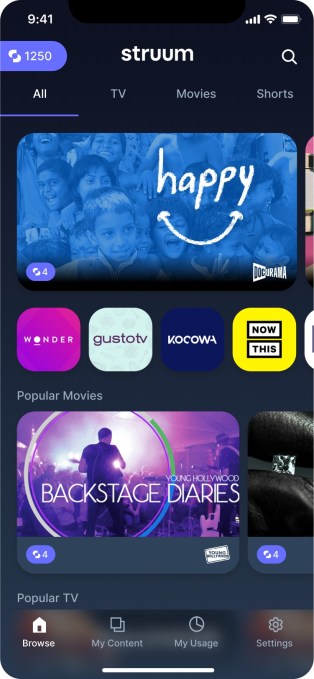
Image Credits: Struum

At launch, there are more than 25 partners available through the Struum app, including Tastemade, Tribeca, Cheddar News, Kocowa, Dekkoo, Magellan TV, History Hit, Gusto, Young Hollywood, Indieflix, Filmbox, Echoboom Sports, Social Club TV, Cinedigm, Magnolia Pictures, Little Dot Studios, Group 9, Stingray and SPI/Filmhub.

Later this summer, the lineup will grow to more than 50 partners, with additions that include BBC SELECT, REVOLT, France Channels, InsightTV, Docubay, FuelTV, The Great Courses Signature Collection, Shout Factory TV, OUTtv, SVTV, CGOOD TV and Alchimie.

In total, Struum’s partners will provide customers with access to tens of movies and TV shows across a range of categories and genres, like classic films, indies, foreign content, cult hits, lifestyle programming, reality, true crime, and more.
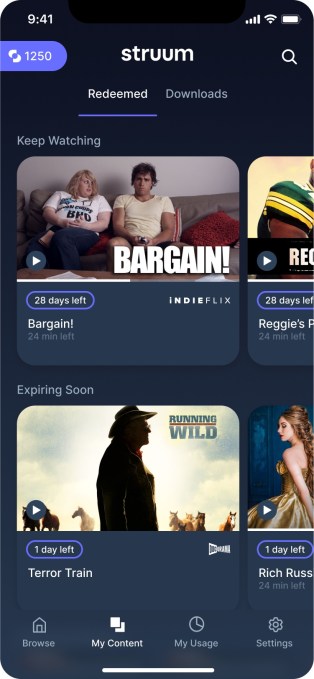
Image Credits: Struum

Struum’s app guides users to their interests through a simple interface where it curates content into editorial groupings organized much like the rows of recommendations you’d find in Netflix. This includes the company’s own picks (“Struum Selects”), as well as groupings by genre — like Comedy, Action Thrillers, LGBTQ + Documentaries, Class Movies, Incredible Science, and others. You can also browse by type from categories across the top, to filter by only Movies, TV shows or Shorts.

When you find something you want to watch, you can click a button to stream the content for a certain amount of credits. You can then view that content at any time for the next 30 days and even download it for offline access.

At launch, Struum’s service is available on iOS and web, and supports AirPlay and Chromecast. This summer, it will expand to more platforms, including Android, Apple TV, Android TV, Amazon Fire TV, and Roku.

Image Credits: Struum

The idea for the company comes from founders Lauren DeVillier, the former head of Product for Discovery Ventures; Eugene Liew, former vice president of Product and Technology at Disney+; Paul Pastor, former executive vice president of Strategy, Revenue and Operations at Discovery Networks; and Thomas Wadsworth, the former lead of Advanced Product Development for Walt Disney Imagineering.

The team came together in 2020, just before the Covid-19 pandemic broke out across the U.S., which drove increased demand for streaming content. And though that demand may be here to stay, it remains to be seen whether Struum’s ClassPass-like model makes the best sense for streaming’s long tail.

Despite its unique streaming business model, the service will effectively compete with AVOD (ad-supported video on demand) players in terms of aggregating both older and niche content. AVOD services — like Tubi, Pluto TV, The Roku Channel, IMDb TV, and others — also help users who can’t find anything they want to watch on their preferred paid subscription apps. And they often aid consumers who are in search of a particular movie or show but don’t want to pay for a rental. Struum believes by aggregating content it can encourage these users to pay for yet another subscription.

In other words, Struum will have to convince users to change their existing TV habits in order to find success, and that’s a risky bet.

But Struum believes the fragmentation of the streaming market may actually work in its favor. As consumers get fed up so many different services and content that jumps around as rights owners forge new licensing agreements, Struum could step in as someone’s fourth subscription.

We view ourselves as the ultimate complementary service and a perfect fit for TV and film lovers who are increasingly frustrated by the costs, complexity and effort required to discover and watch what they want,” noted Struum CEO Lauren DeViller.

Struum is backed by a multi-million-dollar investment from former Disney CEO Michael Eisner through his firm, Tornante Company. Other investors include Firstlight Media, whose technology powers the video service, and Gaingels, which focuses on backing LGBTQ+ founders and allies.


25 May 2021

Airbyte announces $26M Series A for open source data connector platform

One of the major issues facing companies these days isn’t finding relevant data, so much as moving it to where it’s needed. Enter Airbyte, an early stage startup that is building an open source data integration platform to help solve that problem. Today the company announced a $26 million Series A, just a couple of months after announcing its $5.2 million seed round.

Benchmark led the investment with help from 8VC, Accel, SV Angel, Y Combinator and multiple tech industry luminaries. The company has raised over $31 million, all of it coming this year.

“What we’re building is an open source data integration platform to bring data wherever it is, whether it’s a database, a file or an API into the destination of your choice whether it is a data warehouse or a data lake,” company co-founder and CEO Michel Tricot told TechCrunch. This involves building connectors to various data types. The company is providing the open source platform and an SDK to build connectors, and inviting the community to add their own connectors, while building some too.

Things are moving quickly for the startup. In addition to the funding, it released its Connected Development Kit or CDK earlier this month. “It’s a local framework that enables you to build a custom connector within two hours instead of two or three days,” company co-founder John Lafleur explained. To this point, the community has contributed approximately 20% of the platform’s 70 connectors, but the two founders expect that percentage to increase as the CDK has time to spread in the community.

Airbyte was founded just last year and the company plans to spend this year trying to expand the rapidly growing community, which is up to 1200 members and 500 active users to this point. The long-term plan is to build a hosted version, which they will charge for, while continuing to work on the open source project.

Chetan Puttagunta, general partner at Benchmark, who is leading today’s investment, says that Benchmark has a long history of investing in open source startups including being an early investor in Red Hat, as well as Elastic, MongoDB, Acquia and many others.

He says that his firm approached Airbyte after seeing a lot of developer activity in the community in a short time. “We reached out to them just based on our involvement in the developer community. We started seeing Airbyte spike everywhere, and it started to become very quickly the de facto standard for how folks wanted to integrate data. And that was a remarkable achievement for a company that has been around for just several months.”

The rapid growth has led to the number of employees doubling to 14 in a short time. When it comes to diversity and inclusion, the founders have actually written a company handbook that includes a detailed section with definitions and goals around diversity and inclusion, not something you often see from an early stage company.

“We try to constantly improve on diversity inclusion and belonging, which is a continuous [thing]. [We] never would think it was done, We always have room to improve,” Tricot said.

25 May 2021

How Expensify shed Silicon Valley arrogance to realize its global ambitions

Expensify may be the most ambitious software company ever to mostly abandon the Bay Area as the center of its operations.

Expensify may be the most ambitious software company ever to mostly abandon the Bay Area as the center of its operations.

The startup’s history is tied to places representative of San Francisco: The founding team worked out of Peet’s Coffee on Mission Street for a few months, then crashed at a penthouse lounge near the 4th and King Caltrain station, followed by a tiny office and then a slightly bigger one in the Flatiron building near Market Street.

Thirteen years later, Expensify still has an office a few blocks away on Kearny Street, but it’s no longer a San Francisco company or even a Silicon Valley firm. The company is truly global with employees across the world — and it did that before COVID-19 made remote working cool.

“Things got so much better when we stopped viewing ourselves as a Silicon Valley company. We basically said, no, we’re just a global company,” CEO David Barrett told TechCrunch. That globalism led to it opening a major office in — of all places —a small town in rural Michigan. That Ironwood expansion would eventually lead to a cultural makeover that would see the company broadly abandon its focus on the Bay Area, expanding from a headquarters in Portland to offices around the globe.

It makes sense that a company founded by internet pirates would let its workforce live anywhere they please and however they want to. Yet, how does it manage to make it all work well enough to reach $100 million in annual revenue with just a tad more than 100 employees?

As I described in Part 2 of this EC-1, that staffing efficiency is partly due to its culture and who it hires. It’s also because it has attracted top talent from across the world by giving them benefits like the option to work remotely all year as well as paying SF-level salaries even to those not based in the tech hub. It’s also got annual fully paid month-long “workcations” for every employee, their partner and kids.

Yet the real story is how a company can become untethered from its original geography, willing to adapt to new places and new cultures, and ultimately, give up the past while building the future.

25 May 2021

Brian Chesky describes a faster, nimbler post-pandemic Airbnb

As we transition from the pandemic to whatever comes next, Airbnb is evolving. The company announced a major redesign of its website and introduced a bevy of features focused on both hosts and guests today. All told, the release includes more than 100 new features or upgrades, with the goal of increasing and diversifying the supply side of the business to not only fuel overall growth but also meet the changing demands of guests.

The changes come in response to the way travel has evolved during the pandemic; Airbnb as a company has changed, too.

TechCrunch sat down with Brian Chesky, Airbnb co-founder and CEO, to discuss the future of travel, how his company worked to support a changing market and what it was like leading the world’s biggest travel startup during a global pandemic.

If you want to read more about today’s update, you can check out our article on it here.

The TL;DR version is as follows:

  • New search flexibility around dates, destinations and matching criteria
  • Easier onboarding and efficiency for hosts
  • Increased and enhanced customer support

From a very high level, the first change is designed to help drive demand, the second to boost supply and the third to keep both sides of the marketplace healthy.

TechCrunch’s interview with Chesky follows. It has been lightly edited for length and clarity.

TechCrunch: A lot of the announcement today comes from the fact that we’ve been through more than a year of a pandemic and travel has evolved, and you are responding to that. As a CEO, you’ve been through so many big moments, from the IPO to the early launch days to a long regulatory journey. Where does leading a company during a pandemic fit into the CEO journey for you?

Brian Chesky: Yeah, Jordan, I would probably say that I never thought we would do anything as crazy as starting Airbnb. I kind of assumed, until last year, that that would probably be the craziest story I’ll ever have. Little did I know that a travel company in a pandemic might even be crazier than starting a company based on strangers living together. I kind of feel like I’m now 39 going on 49. It was definitely the craziest year ever.

Our business initially dropped 80% in eight weeks. I say it’s like driving a car. You can’t go 80 miles an hour, slam on the brakes, and expect nothing really bad to happen. Now imagine you’re going 80 miles an hour, slam on the brakes, then rebuild the car kind of while still moving, and then try to accelerate into an IPO, all on Zoom.

25 May 2021

Microsoft Azure launches enterprise support for PyTorch

Microsoft today announced PyTorch Enterprise, a new Azure service that provides developers with additional support when using PyTorch on Azure. It’s basically Microsoft’s commercial support offering for PyTorch

PyTorch is a Python-centric open-source machine learning framework with a focus on computer vision and natural language processing. It was originally developed by Facebook and is, at least to some degree, comparable to Google’s popular TensorFlow framework.

Frank X. Shaw, Microsoft’s corporate VP for communications, described the new PyTorch Enterprise service as providing developers with “a more reliable production experience for organizations using PyTorch in their data sciences work.”

With PyTorch Enterprise, members of Microsoft’s Premier and Unified support program will get benefits like prioritized requests, hands-on support and solutions for hotfixes, bugs and security patches, Shaw explained. Every year, Microsoft will also select one PyTorch support for long-term support.

Azure already made it relatively easy to use PyTorch and Microsoft has long invested in the library by, for example, taking over the development of PyTorch for Windows last year. As Microsoft noted in today’s announcement, the latest release of PyTorch will be integrated with Azure Machine Learning and the company promises to feed back the PyTorch code it developers back to the public PyTorch distribution.

Enterprise support will be available for PyTorch version 1.8.1 and up on Windows 10 and a number of popular Linux distributions.

“This new enterprise-level offering by Microsoft closes an important gap. PyTorch gives our researchers unprecedented flexibility in designing their models and running their experiments,” said Jeremy Jancsary, Senior Principal Research Scientist at Nuance. “Serving these models in production, however, can be a challenge. The direct involvement of Microsoft lets us deploy new versions of PyTorch to Azure with confidence.”

With this new offering, Microsoft is taking a page out of the open-source monetization playbook for startups by offering additional services on top of an open-source project. Since PyTorch wasn’t developed by a startup, only to have a major cloud provider then offer its own commercial version on top of the open-source code, this feels like a rather uncontroversial move.

read

25 May 2021

Microsoft uses GPT-3 to let you code in natural language

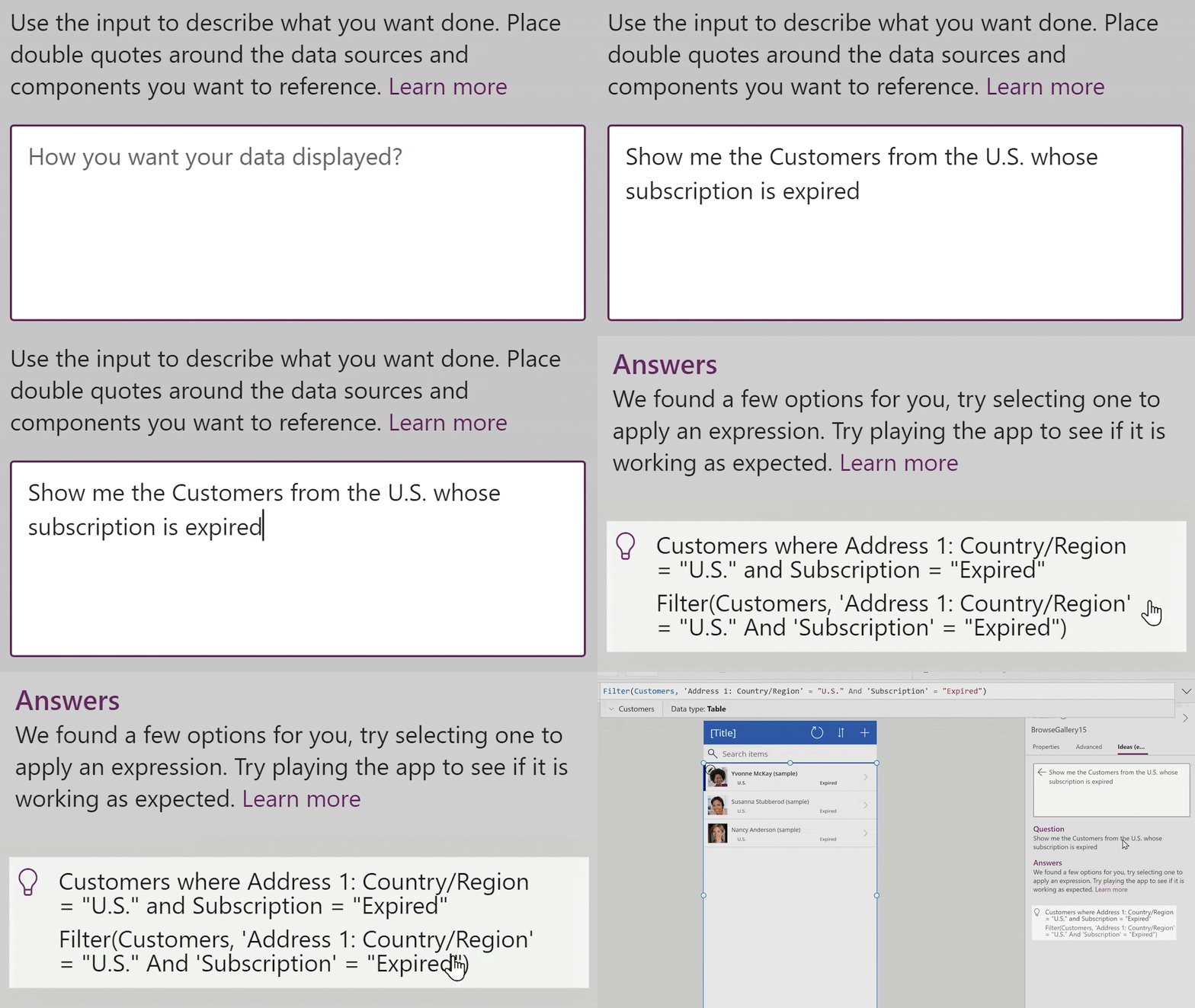
Unlike in other years, this year’s Microsoft Build developer conference is not packed with huge surprises — but there’s one announcement that will surely make developers’ ears perk up: The company is now using OpenAI’s massive GPT-3 natural language model in its no-code/low-code Power Apps service to translate spoken text into code in its recently announced Power Fx language.

Now don’t get carried away. You’re not going to develop the next TikTok while only using natural language. Instead, what Microsoft is doing here is taking some of the low-code aspects of a tool like Power Apps and using AI to essentially turn those into no-code experiences, too. For now, the focus here is on Power Apps formulas, which despite the low-code nature of the service, is something you’ll have to write sooner or later if you want to build an app of any sophistication.

“Using an advanced AI model like this can help our low-code tools become even more widely available to an even bigger audience by truly becoming what we call no code,” said Charles Lamanna, corporate vice president for Microsoft’s low-code application platform.

In practice, this looks like the citizen programmer writing “find products where the name starts with ‘kids’ ” — and Power Apps then rendering that as “Filter(‘BC Orders’ Left(‘Product Name’,4)=”Kids”)”.

Because Microsoft is an investor in OpenAI, it’s no surprise the company chose its model to power this experience.

Image Credits: Microsoft

It’s important to note that while this makes programming easier, Microsoft itself stresses that users still have to understand the logic of the application they are building. “The features don’t replace the need for a person to understand the code they are implementing but are designed to assist people who are learning the Power Fx programming language and help them choose the right formulas to get the result they need. That can dramatically expand access to more advanced app building and more rapidly train people to use low code tools,” the company explains in today’s announcement.

To some degree, this isn’t all that different from using the natural language query functions that are now available in tools like Excel, PowerBI or Google Sheets. These, too, translate natural language into a formula, after all. GPT-3 is probably a bit more sophisticated than this and capable of understanding more complex queries, but translating natural language into formulas isn’t all that new.

The long-term promise here, though, is for tools like this to become smarter over time and be able to handle more complicated programming tasks. But that’s a big step up from what is essentially a translation problem, though. More complex queries require more of an understanding of a program as a whole. A formula, for the most part, is a pretty self-contained statement but a similar model that could generate “real” code would have to contend with a lot more context.

These new features will go live in public preview in English to users in North America by the end of June.

read

25 May 2021

Microsoft’s Edge browser can now start up faster and put your tabs to sleep

At its annual Build conference today, Microsoft announced a couple of new features for version 91 of its Edge browser that, like so much at Build this year, aren’t earth-shattering (developer velocity!) but nice quality-of-life upgrades for its users. Since Microsoft develops Edge in the open, these may also feel familiar to those who keep a close eye on the Edge roadmap – indeed, I think I’ve seen most of these in Edge 90 already…

One new feature is Startup Boost, which allows Edge to start up almost instantly. The way Microsoft does this is pretty straightforward. It simply loads some of the core Edge processes whenever you boot up your Windows machine, so when you task Edge with starting up, there isn’t all that much work left to do. This shouldn’t have too much of an effect on your Windows 10 bootup time, so it’s probably a trade-off worth making, but I also can’t recall anybody complaining about browser startup times in the last couple of years either.

The other new feature is ‘sleeping tabs,’ which does pretty much what you expect it to do. It puts your tabs to sleep so they don’t use up unnecessary memory and CPU cycles.

Microsoft first announced that it was testing this feature back in December and at the time, the Edge team said that it reduces memory usage by 32% and helps improve battery life as well, given that sleeping tabs use 37% less CPU on average compared to non-sleeping tabs.

It’s worth noting that Google’s Chrome browser, which shares many of its underlying technology with Edge, also features tools to limit resource usage, including what Google calls ‘tab freezing,’ as does virtually every other major browser today.

read