Author: azeeadmin

25 May 2021

Flexibits updates contacts app Cardhop, adds deeper integration with Fantastical

Flexibits, the company behind productivity apps Fantastical and Cardhop, is releasing a new version of Cardhop for both macOS and iOS. This is the second major version of the app and it adds new features, such as business card scanning, widgets, organizational charts and a deeper integration with Fantastical.

Cardhop is a clever take on contact management. It uses the same address book as the default Contacts app on your Mac, iPhone and iPad. But it lets you search, add and edit contacts much more efficiently.

On the Mac, Cardhop sits in the menu bar. When you click on the icon or hit a keyboard shortcut, you can see your contacts but you can also start typing. This is when it gets interesting.

As expected, you can find a contact card by typing a few letters. But you can also add information to an existing contact this way.

Image Credits: Flexibits

For instance, if you type a name followed by a phone number, Cardhop automatically figures out that the phone number doesn’t exist in the existing contact entry — hit enter and the number is saved. If the person isn’t even in your address book, you can create a new contact just by dumping information in the search field.

The app truly shines if you think about Cardhop as a sort of command-line interface to interact with your contacts. You can type ‘call Jane’, ‘email Tom’ or ‘whatsapp Natasha’ — Cardhop parses the action for you. It can be particularly handy to initiate calls on your iPhone from your Mac.

With Cardhop 2, the design has been updated and there are a handful of new features. You can now create widgets with your favorite actions. On iOS, you can add it to your home screen. On macOS, you can access it from the Notification Center. Widgets have been a popular feature of iOS 14 and many users will like that new feature.

If you’re also using Fantastical, you can send a calendar invite to someone else from Cardhop. And if you tend to invite the same group of people to your events, you can create a group in Cardhop. The next time you want to send an invitation, you can create an event with everyone in the group from Cardhop. This is going to be a good alternative to email aliases.

Cardhop can now also generate organizational charts and family trees based on relationships in your contacts. And if you work for a big company with a contact directory, you could easily find the right person to talk with using this new feature.

On iOS, Flexibits has also added a business card scanning feature. You can add contacts just by pointing your phone at a business card. There are many apps that offer that feature already, but now it’s integrated.

Image Credits: Flexibits

Flexibits has been around for 10 years. Originally, the company released new major updates and users had to pay to download the new version. That’s how independent development companies used to charge for apps.

Last year, the company launched a new version of Fantastical with a freemium model. New users could download the app for free and would have to pay a subscription of $4.99 per month or $39.99 per year to unlock all features. Existing users could keep using the app for free as all existing features had been unlocked for them.

After switching to this new model, Flexibits released quite a few updates to Fantastical already. For instance, you can now join conference calls quickly with shortcuts in the menu bar and in the app. Fantastical now also supports Zoom, Google Meet and Microsoft Teams.

Flexibits wants to go one step further and create an ecosystem of productivity apps. Cardhop 2 is a free app with a few free features. If you want to unlock everything, you have to subscribe to the same Flexibits Premium subscription.

In other words, the company is bundling premium versions of Fantastical and Cardhop in a single subscription — and the price isn’t changing. Existing Cardhop users who don’t want to subscribe will also keep everything that was available in Cardhop 1 for free.

And if you’re already using Cardhop, it’s nice to see an update. It means that the app is going to be supported going forward. When you rely on an app for your work, it’s better when it’s regularly updated and keeps working as expected years after years. And I suspect many Fantastical users will try out Cardhop thanks to the new Flexibits Premium subscription.
25 May 2021

Security startup Tessian, which uses AI to fight social engineering, trousers $65M

In the latest chunky funding round out of Europe, UK-based email security startup, Tessian, has closed $65 million in Series C funding. The startup applies machine learning to build individual behavior models for enterprise email use that aims to combat human error by flagging problematic patterns which could signify risky stuff is happening — such as phishing or data exfiltration.

The Series C round was led by March Capital. Existing investors Accel, Balderton Capital, Latitude and Sequoia Capital also participated, along with new investor Schroder Adveq.

The latest financing brings Tessian’s total raised to-date to $120M+, and values the company at $500M, it said today.

The 2013 founded startup last raised back in January 2019 when it closed a $40M Series B (news that was scooped by former TCer, Steve O’Hear). Prior to that it grabbed a $13M Series A in mid 2018.

Tessian has around 350 global customers at this stage, across the legal, financial services, healthcare and technology sectors — name-checking the likes of Affirm, Arm, Investec and RealPagem among them.

Over the past year there has been much coverage of the security risks associated with the pandemic-sparked remote working boom, as scores of white collars workers started logging on from home — expanding the attack surface area which enterprises needed to manage.

It’s a risk that’s been good for Tessian’s business: The startup says it tripled its Fortune 500-level customer base last year — “as enterprises required a solution that could protect them against human layer security threats”, as it puts it.

It says the new funding will go on expanding its platform’s capabilities; helping companies replace their secure email gateways and legacy data loss prevention solutions; and on growing its team (it plans to triple headcount in short order with a particular focus on growing its sales team in North America).

The Series C funds will also support a plan to expand beyond email to offer security protections for other interfaces such as messaging, web and collaboration platforms — which it says is on the cards “soon”.

Commenting on the round in a statement, Jamie Montgomery, co-founder and managing partner at March Capital said: “Human activity — whether inadvertent or malicious — is the leading cause of data breaches. In Tessian, we found a best-in-class solution that automatically stops threats in real-time, without disrupting the normal flow of business. It is rare to hear such overwhelmingly positive feedback from CISOs and business users alike. We came to the same conclusion; Tessian is rapidly emerging as the leader in human layer security for the enterprise.”

A number of UK-based AI security startups have been building momentum in recent years, with others like Red Shift and Senseon also getting traction by applying machine learning to tackle risks.

In April, Cambridge-based Darktrace — a category pioneer — led the pack by floating on the London Stock Exchange where it saw its shares pop 32% in the IPO debut.

While, last year, the UK government pledged to ramp up R&D spending on AI as part of a major defense spending hike.

25 May 2021

AcuityMD raises $7M to better track the evolving world of medical hardware

In a world defined by tons of noise and little signal, startups that make it easier for consumers to make a choice just make sense. Career Karma helps students pick a tech bootcamp, Stackin’ helps millennials navigate the world of neobank and savings apps, and a new Boston-based company is helping doctors keep track of the most up-to-date medical devices on the market.

AcuityMD, founded in 2019 by Mike Monovoukas, Lee Smith, and Robert Coe, is an enterprise software company that wants to unlock the often siloed world of medical device data. And to do so, it landed a $7 million seed round this week, led by Benchmark.

As part of the deal, Benchmark GP Eric Vishria will join AcuityMD’s board of directors. Ajax Health, which closed $100 million in 2019 to back medtech companies, also participated in the round. With seed capital, Monovoukas said that AcuityMD plans to double its eight-person team by the end of the year, and invest heavily in one specific area: “product, product, product.”

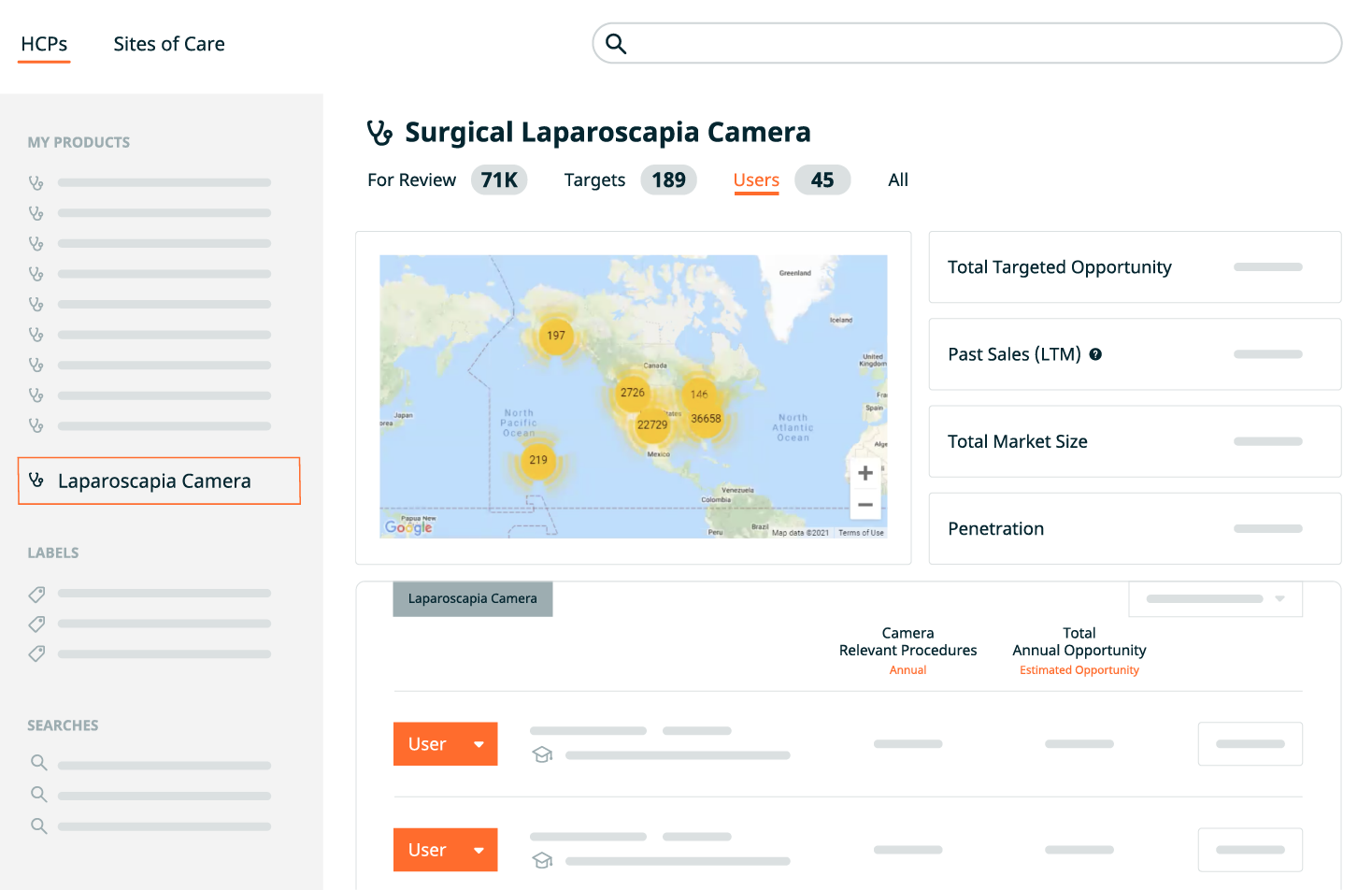
AcuityMD is a data platform that tracks the entire medical device lifecycle – from the sale of an item to a patient’s outcome after a surgery. It aggregates industry and market data on individual medical devices to give a metadata of sorts on a singular product.

“There are 1000s of products being launched each year and so it’s almost impossible for a surgeon, after they’ve graduated fellowship or residency to keep track of the latest and greatest medical technology out there,” Monovoukas said. “We view this as a software and coordination problem, where you have all this data out there and it’s inefficient in getting to the decision-maker.”

Monovoukas experienced noticed inefficiencies in medical device management first-hand when a family member needed to go through a series of surgeries.

“What was fascinating to me is that the manufacturer holds a lot of information about what to use, [and] sometimes that didn’t get disseminated to the right surgeon at the right point of time,” he said. “The fundamental realization I had was that the information flow in this industry was a little bit broken…It wasn’t an issue of being competent doctors or surgeons, but a lack of information transfer, which is kind of crazy in a data driven world.”

So, the entrepreneur, who worked at Bain & Company as well as a medical device company prior, began thinking of how to use data to make medical devices more responsive to long-term patient outcomes. While doctor’s were a key stakeholder set to benefit from more information, AcuityMD’s team landed on selling to device manufacturers as their key customer.

Now, part of that reason might be because hospitals and doctors are notoriously a pain to sell to. The other reason, Monovouukas tells me, is that performance data on medical devices is a key signal that Sales teams within manufacturers can use to beef up, and better target, their pitches. The co-founder explained how manufacturers want visibility into the market for their products, ranging from data on where high volume surgeons might need one of their devices to long-term outcomes on certain devices over time.

The data could help a sales rep pre-emptively figure out how targeting 10 surgeons for a specific product impacts the manufacturer financially and in context with the rest of the market.


AcuityMD is teeing itself up to become a real-time database of medical devices. Long-term, it could position itself as a Same Day Shipping service connecting manufacturers to surgeons in high-demand and vital transactions. Monovaukus says that while logistics and inventory is a “visceral” problem for the medical device industry, it doesn’t have a solution in place yet. He could see the startup getting to a point in the future where they can predict inventory levels required at each facility – similar to how some companies already like Medinas, co-founded by Chloe Alpert, operate and manage within hospital systems.

But for now, AcuityMD thinks it can best use its platform and millions of venture-backed capital outside the provider system. It sources a lot of its data on hospitals and surgeons from Medicare CMS and insurance companies, so leaving no action required on the end of providers.

A challenge will be making sure those data sources are good enough to extract true signals. The startup is still defining good.

“I heard someone once say that any digital health company eventually becomes a healthcare data company,” he said. “We’re approaching things a little bit differently.”

25 May 2021

Forter raises $300M on a $3B valuation to combat e-commerce fraud

E-commerce is on the rise, but that also means the risk, and occurrence, of e-commerce fraud is, too. Now, Forter, one of the startups building a business to tackle that malicious activity, has closed $300 million in funding — a sign both of the size of the issue, and its success in tackling it to date.

The new funding, a Series F, values Forter at $3 billion — notable not least because the funding is coming only about six months since Forter’s previous round, a $125 million Series E that valued it at over $1.3 billion.

Tiger Global Management is leading this latest equity infusion, with new backers Third Point Ventures and Adage Capital Management, and existing investors Bessemer Venture Partners, Sequoia Capital, March Capital, NewView Capital, Salesforce Ventures and Scale Venture Partners, also involved.

The plan will be to use to the money to expand Forter — founded in Tel Aviv and now based in New York — geographically, to bring more functionality into its product, and to look at adjacent areas where Forter might expand its capabilities, either organically or by way of acquisition.

Forter today focuses mainly on identifying fraud at the point of transaction and building an AI-based platform that “learns” more behaviors to improve its accuracy; it also builds models that keep more people transacting and helps bring down the number of “false positives” where activity that appears suspicious actually is not.

One area on its roadmap for expansion is remediation after the fraud occurs, said Liron Damri, Forter’s co-founder and president.

“Our vision is to serve the merchant as the go-to trusted partner for everything, so remediation is definitely on our roadmap,” he said of potential acquisition targets.

Damri, who co-founded the company with Michael Reitblat, CEO, and Alon Shemesh, chief analyst, said in an interview that the startup — which works with some 350 large customers like Priceline and Instacart and a growing number of service providers like FreedomPay and Flutterwave, altogether seeing some $250 billion dollars worth of transactions globally last year — wasn’t proactively looking for more money.

“All we wanted to do was go back to run the company,” he said. “But in the past six months we’ve seen such a great momentum, doubling revenue and ARR, and seeing our customer volumes grow.”

That led to a lot of investors proactively reaching out and ask questions, he continued. He described Tiger as a “kingmaker” in the category of e-commerce, so it was an easy decision to make, and gave it the “gas” it needed to take its next growth steps.

E-commerce has been one of the major technology growth stories of the last year, fueled by a rush of consumers and businesses playing out their lives online at a time when it has been harder, and in some cases impossible, to transact in person.

While we have definitely seen a lot of growth, and growing sophistication, in the number of tools on the market to combat cybercrime, it’s in some ways an ouroboros of a problem: the more transactions that are made, the more there are that need to be monitored for suspicious activity. And in any case fraud in e-commerce is not exactly going away. It’s estimated that it will cost retailers some $20 billion in 2021 and is always on the rise.

Forter got its start in 2013 focusing first on monitoring activity on sites wherever customers happened to be to identify suspicious behavior — a sign that it might be a bot or someone on an illicit spending spree racking up a lot of items in quick succession — with the bigger concept being to build a network of activity from which to learn and help make more informed decisions over time.

In more recent years, the essence of the issue has expanded somewhat, and also grown more sophisticated. As companies have grown their businesses to reach beyond early adopters and core audiences, and into a more “omnichannel” environment beyond basic check-outs on their own sites, so too have the kinds of consumers coming to shop.

This has meant that traditional “signals” of legitimate buyers no longer were the same as before — a predicament that really rose in profile in the last year, as many newcomers came to e-commerce for the first time during the pandemic. In fact, Damri told me that in 2020 there were seven times more “newcomers” to sites than in 2019, huge growth of that segment.

So with most of the flagging of suspicious activity coming up at the point of transaction, Forter expanded to analyzing activity there.

As with a recent acquisition of Stripe’s, Bouncer, to build out its own anti-fraud product, a large part of Forter’s attention these days is on providing tools to companies to identify suspicious purchasing, but even more than that, to make sure that the many occasions that might look suspicious are not, to help reduce the amount of “cart abandonment” and increase conversions.

The old way of doing things, Damri said, involved “thousands of rules and applying suspicion on everyone. You were guilty unless proved otherwise.”

Using its AI engine and a some risk analysis (not unlike the kind that, say, an insurance or loan provider might apply in their businesses), Forter turned the proposition on its head.

“We wanted to approve as much as possible. We wanted to gradually increase the trust you have of your own customers. We changed the sentiment and approach… especially in areas that were neglected, such as those who saw significant changes in life,” Damri said. “This was extremely important as Covid-19 hit.”

Forter’s risk tolerance model, it seems, has so far proven out. Damri said that its algorithms applied reduce the total number of declines by 80%, but also reduce the number of chargebacks — one indicator of a mistake — by 60%.

This implies that it’s blocking more of the “wrong” kind of purchases, and letting through more of the legitimate ones.  (That is, he pointed out, in addition to a few bad actors Forter intentionally lets buy things, just to learn how they operate. Damri referred to this as “paid-tuition.”)

Risk-based approvals, coupled with algorithms to learn what is truly bad, has resonated with customers, and investors.

“With the unprecedented rate of digital transformation and the fierce competition in creating the slickest user experience, superior fraud prevention plays an ever more critical role in e-commerce revenue growth” said John Curtius, a partner at Tiger Global Management, in a statement. “After we talked with dozens of customers of every relevant solution in this space, it was very clear to us that Forter is the clear leader in performance and scale.”

“As a longtime investor, it’s been incredible to see Forter’s ascent,” added Ravi Viswanathan, NewView Capital. “It’s a testament to the leadership team’s vision and execution in allowing merchants to provide the seamless experiences customers expect and to be able to accept as many transactions as possible, while still accurately identifying and blocking fraud.”

25 May 2021

Atlan raises $16M led by Insight Partners to build a collaboration hub for data-driven teams

Young startup Atlan, which has built a SaaS data collaboration platform and is courting customers in international markets, has now won the trust of some high-profile investors.

Atlan said on Tuesday it has raised $16 million in its Series A financing round that was led by Insight Partners. Bob Muglia (former CEO of Snowflake), Bob Moore and Jake Stei (founders of Stitch) and Auren Hoffman (founder of Safegraph and Liveramp) also invested in the round, as did existing investors Sequoia Surge and Waterbridge Ventures.

The startup, which was founded in India, operates an eponymous data stack that brings together diverse data from internal and external sources such as Snowflake and Databricks to one interface and allows teams to collaborate easily.

The thesis behind Atlan is that the way most people in enterprises deal with data is inefficient. This is because of the fundamental diversity of people involved — scientists, analysts, engineers, business users — who all have their own skill sets and tool preferences.

This makes collaboration between the teams a challenge as they struggle to find the right data at the right time, for instance.

It’s a challenge that the founders of Atlan — Prukalpa Sankar and Varun Banka — faced first hand at their first venture, SocialCops. The venture was behind several data science for social good projects including India’s National Data Platform and SDGs global monitoring in collaboration with the United Nations.

Atlan started out as an internal tool to help the data team at SocialCops carry out projects more efficiently, before being opened up to teams around the world. 

“We are reimagining the human experience with data — why can’t data assets be shared as easily as sharing a link on Google Docs, or if Google Analytics can tell you usage on a website, why can’t we do the same for our data?” said Sankar.

Teddie Wardi, Managing Director at Insight Partners, likened Atlan’s relevance to companies just as Figma is crucial to design teams and Github is important to engineering teams.

Atlan Discovery 2

Dashboard of Atlan (Atlan)

In an interview with TechCrunch, Sankar said more than 60% of Atlan’s clients today are in the U.S., and the market will be a big focus as the startup scales. She declined to reveal the number of clients the startup has amassed, but said the startup has grown 16X times in the last two quarters.

Some of its clients include giants such as Unilever, Scripps Health, Postman, and Techstyle, one of the world’s largest membership-based fashion firms with a diverse portfolio of brands including Fabletics, Savage X Fenty, JustFab, FabKids, and ShoeDazzle.

“As we rolled-out our modern data platform, we were looking for a product that made it easier to democratize our data and was less dependent on someone central answering each individual analyst’s questions on a one-off basis. Legacy solutions in the market were tailored to legacy systems and approaches where IT or a single data stewardship team owns the data,” said Danielle Boeglin Ragan, Vice President of Data & Analytics at Techstyle, in a statement.

“Atlan was the only solution that was built for a collaborative, bottom-up approach. With native integrations with our modern analytics stack like Snowflake and Tableau, Atlan was very easy to set-up – we had all of our data sources flowing within the first day.”

The startup plans to deploy the fresh capital to expand its team of 40 people across marketing, sales, and customer success, said Banka.

“Atlan has become a valuable resource for the data team to get context about data. In the long run, for our data democratization vision, we see the entire organization working towards analyzing the data and taking actions in a coherent, seamless fashion. Having Atlan in the mix of our toolchains opens the possibility of providing data context at scale, thereby enabling the entire org to be data aware and data driven.” said Prudhvi Vasa, Analytics Leader at Postman, in a statement.

25 May 2021

Indoor farming company Bowery raises $300M

New York City-based vertical farming startup Bowery Farming this week has announced a $300 million Series C. The round, which brings its total funding north of $472 million, values the company at $2.3 billion.

Fidelity Management & Research Company led the beefy round, with participation from existing investors GV (formerly Google Ventures), General Catalyst, GGV Capital, Temasek and Groupe Artémis. Amplo and Gaingels participated, as well, along with some celebrity individual investors, including Lewis Hamilton, Chris Paul, Natalie Portman, José Andrés and Justin Timberlake.

The funding comes as Bowery has experienced some impressive real-world growth, touting a 750% increase in availability since January of last year. If anything, the company appears to have thrived during the pandemic. Its vertically farmed produce is now available in 850 grocery stores, including big-name chains like Albertsons (incl. Safeway and Acme), Giant Food, Walmart and Whole Foods.

Image Credits: Bowery Farming

Amazon Fresh has also provided a sizable e-commerce footprint — a big must during the pandemic-fueled shutdowns of the past year.

“This infusion of new capital from Fidelity, other new investors, and the additional support of our long-term investor partners is acknowledgement of the critical need for new solutions to our current agricultural system, and the enormous economic opportunity that comes with supporting our mission,” CEO Irving Fain said in a release. “This funding not only fuels our continued expansion but the ongoing development of our proprietary technology, which sits at the core of our business and our ability to rapidly and efficiently scale towards an increasingly important opportunity in front of us.”

Image Credits: Bowery Farming

The company says the massive windfall will go toward expanding its indoor farms to additional locations in the United States, as well as investing in headcount and R&D. Included in the former is a new site located in an industrial area in Bethlehem, Pennsylvania, which Bowery says will be its largest to date.


25 May 2021

Canvas lands $20M so tech’s biggest companies can find diverse talent

Ben Herman and Adam Gefkovicz launched Jumpstart in 2017 with a clear mission: to make the world more equitable via a more fair and balanced hiring process.

The company released its “Diversity Recruitment Platform” in July of 2018 with the aim of helping people earlier in their careers get a “jumpstart” via technology.

Over the years, the startup’s mission has evolved beyond helping college grads to helping all employees — regardless of career stage — get a fair shot at jobs. And it’s doing that by teaming up with hundreds of companies — such as Airbnb, Bloomberg, Coinbase, Samsung, Lyft, Pinterest, Plaid, Roblox, Audible, Headspace and Stripe — to help them hire a more diverse pool of candidates.

Demand has accelerated exponentially, and the San Francisco-based startup saw its revenue grow “3x” in 2020 compared to 2019, although execs declined to provide hard figures. Considering its broadened focus, Jumpstart has rebranded to Canvas and announced today that it has closed on $20 million in funding. Early Stripe employee and angel investor Lachy Groom and Sequoia Capital co-led the round, which included participation from Four Rivers Capital. The raise brings Canvas’ total raised to $32.5 million.

“We knew we were only scratching the surface of our vision, and knew we had a solution that could reimagine diversity hiring for everyone,” said co-founder and CEO Ben Herman. “You know how everyone has a CRM? We believe every company should have a DRP, which is a diversity recruitment platform. That’s the category we want to create and we want to be the largest in that space.”

No doubt that the Black Lives Matter movement in the aftermath of George Floyd’s murder helped, well jumpstart, the company’s efforts. Canvas is able to sell its offering as more companies “are being held accountable for their promises of equity and hiring diverse talent,” Herman said.

“Hiring diverse teams is not only a matter of corporate social responsibility,” he added. “Diversity and inclusion are a competitive advantage and strategic priority for every company in today’s landscape. We believe representation is a huge part of what we stand for. So we want everyone to be able to create their own canvas, and to be able to paint their own picture.”

Canvas describes its SaaS offering as a “fully virtual” recruiting platform that is based on self-reported data. About 87% of candidates on its platform disclose their demographic information (which it says is 7x the industry standard), according to the startup. Canvas also says it gives companies the ability to narrow down the priority groups and talent it wants to focus on by filtering over 75+ self-reported candidate data points.

The startup claims that it’s different from others in the space for that reason, among other features.

“Unlike other solutions that might utilize inferred data that could be inaccurate or illegal, Canvas helps create a more accurate data set to identify diverse candidates, helping to solve the core problem of talent discovery,” Herman said. 

It also — unlike some diversity hiring platforms — does not rely on artificial intelligence, a fact that Herman is actually proud of.

“We don’t believe that AI is the future. It’s not about getting someone’s gender or ethnicity based off of their name, or to inform the hiring decision without candidates knowing,” Herman told TechCrunch. “It’s all about how to empower talent to self-identify…We want to enable the talent to own their data, and truly be able to represent themselves in unique ways. That’s not leveraging AI.”

Canvas also gives companies a way to design, promote and run events, such as webinars, aimed at hiring diverse talent.

The startup also wants to get to a place where companies are working together “to complete the diversity data gap.”

“The problem is about accessibility, and so we want to give equal access to anyone and everyone — from all companies to all candidates,” Herman said. “And so that is really the most important part of what we are creating — the ability for companies to share data.”

So, how does it measure its own success? Canvas claims that 56% of all hires on the Canvas platform are made from underrepresented groups (URGs), and that it helps employers achieve a 30% reduction in time to hire.

Herman is not your typical startup founder, having dropped out of high school and starting his own recruitment agency at the age of 21. His tenacity is one of the things that attracted Sequoia partner and Canvas board member Mike Vernal to back the company.

“When we first met Ben, it was clear that he was…a natural-born talent scout,” Vernal told TechCrunch. “He thought there was a better way for the industry to work — one where companies and recruiters were more collaborative and used technology to build stronger, more diverse teams.”

Since its initial investment in the company, Vernal believes building diverse teams has never been more important.

“Those teams create better products, make stronger business decisions, and it’s just the right thing to do,” he said. “We believe companies can do a better job sourcing underrepresented talent using Canvas than on their own.” 

Canvas plans to use its new capital to expand the product into other industries and verticals beyond technology and continue to address the recruiting process for later stages of people’s careers. The company currently has 70 employees and expects to have 100 by the end of 2021.

As mentioned above, hiring diverse talent is becoming a bigger priority for big tech companies (such as HP) and startups alike. Earlier this year, diverse hiring startup SeekOut raised $65 million. The company has built out a database with hundreds of millions of profiles using its AI-powered talent search engine and “deep interactive analytics.”

25 May 2021

Sinch, a Swedish customer engagement giant, raises $1.1B, SoftBank and Temasek participating

Sinch — a Twilio competitor based out of Sweden that provides a suite of services to companies to build communications and specifically “customer engagement” into their services by way of APIs — has been on a steady funding and acquisitions march in the last several months to scale its business, and today comes the latest development on that front.

The company has announced that it has raised another $1.1 billion in a direct share issue, with significant chunks of that funding coming from Temasek and SoftBank, in order to continue building its business.

Specifically, the company — which is traded on the Swedish stock exchange Nasdaq Stockhom and currently has a market cap of around $11 billion — said that it was making a new share issue of 7,232,077 shares at SEK 1,300 per share, raising approximately SEK 9.4 billion (equivalent to around $1.1 billion at current rates).

Sinch said that investors buying the shares included “selected Swedish and international investors of institutional character,” highlighting that Temasek and SB Management (a direct subsidiary of SoftBank Group Corp.) would  respectively take SEK 2,085 million and 0.7 million shares. This works out to a $252 million investment for Temasek, and $110 million for SoftBank.

SoftBank last December took a $690 million stake in Sinch (when it was valued at $8.2 billion). That was just ahead of the company scooping up Inteliquent in the U.S. in January for $1.14 billion to move a little closer to Twilio’s home turf.

Sinch is not saying much more beyond the announcement of the share issue for now, except that the raise was made to shore up its financial position ahead of more M&A activity.

“Sinch has an active M&A-agenda and a track record of successful acquisitions, making [it] well placed to drive continued consolidation of the messaging and [communications platform as a service, CPaaS] market,” it said in a short statement. “Furthermore, the increased financial flexibility that the directed new share issue entails further strengthens the Company’s position as a relevant and competitive buyer.”

The company is profitable and active in more than 40 markets, and CEO Oscar Werner said in Sinch’s most recent earnings report that in the last quarter alone that its communications APIs — which works across  channels like SMS, WhatsApp, Facebook Messenger, chatbots, voice and video — handled 40 billion mobile messages.

Notably, its strategy has a strong foothold in the U.S. because of the Inteliquent acquisition. It will be interesting to see how and if it continues to consolidate to build up market share in that part of the world, or whether it focuses elsewhere, given the heft of two very strong Asian investors now in its stable. 

“Becoming a leader in the U.S. voice market is key to establish Sinch as the leading global cloud communications platform,” said Werner in January.

While Sinch has focused much of its business, like Twilio, around an API-based model focused on communications services, its acquisition of Inteliquent also gave it access to a large, legacy Infrastructure-as-a-Service (IaaS) product set, aimed at telcos to provide off-net call termination (when a call is handed off from one carrier to another) and toll-free numbers.

Tellingly, when Sinch acquired Inteliquent, the two divisions each accounted for roughly half of its total business, but the CPaaS business is growing at twice the rate of IaaS, which points to how Sinch views the future for itself, too.

25 May 2021

Google’s data terms are now in Germany’s competition crosshairs

Germany’s national competition regulator, the Bundeskartellamt, has continued its investigative charge against big tech — announcing that it’s opened two proceedings into Google.

The move follows earlier proceedings targeting Amazon and Facebook — both of which are also looking to determine whether their businesses are of “paramount significance for competition across markets”, as German competition law puts it. (The regulator is also probing Facebook’s tying of Oculus to Facebook accounts.)

In Google’s case, one of the Bundeskartellamt’s new proceedings will confirm whether amended competition rules, which came into force in January, apply in its case — which would enable the FCO to target it with proactive interventions in the interests of fostering digital competition.

The second, parallel procedure will see the Federal Cartel Office (FCO) undertake an in-depth analysis of Google’s data processing terms in a move that looks intended to avoid wasting time — i.e. that its working assumption is that Google/Alphabet’s business meets the legal bar in the GWB Digitalisation Act.

By running the two Google procedures in parallel the German competition regulator will be in a position to act faster — assuming the first proceeding confirms it can indeed intervene.

The second probe running alongside would then identify potential problems to shape any intervention — with the FCO saying for example that it will look at whether Google/Alphabet “makes the use of services conditional on the users agreeing to the processing of their data without giving them sufficient choice as to whether, how and for what purpose such data are processed”.

It also says it will “examine the extent to which the terms provide Google with an opportunity to process data on an extensive cross-service basis” and will seek to clarify “how the company’s data processing policy applies to the processing of user data obtained from third-party websites and apps” (such as through Google’s advertising services).

Another key element of the proceeding will aim to establish what choice users actually have with regard to Google’s processing of their data, with the FCO noting that protecting consumer choice is a primary aim of competition law.

Given those point of focus it’s possible to imagine a future order from the FCO to Google could require it to simplify how it asks users for consent, to ensure genuine choice — and also shrink its ability to link first party user data with information obtained on people elsewhere online.

Commenting in a statement, Andreas Mundt, president of the Bundeskartellamt said: “An ecosystem which extends across various markets may be an indication that a company holds such a market position [i.e. whether it is of paramount significance across markets]. It is often very difficult for other companies to challenge this position of power. Due to the large number of digital services offered by Google, such as the Google search engine, YouTube, Google Maps, the Android operating system or the Chrome browser, the company could be considered to be of paramount significance for competition across markets.”

“Google’s business model relies to a very large extent on processing data relating to its users. Due to its established access to data relevant for competition, Google enjoys a strategic advantage. We will therefore take a close look at the company’s data processing terms. A key question in this context is whether consumers wishing to use Google’s services have sufficient choice as to how Google will use their data,” he added.

Reached for comment on the FCO proceedings, Google said it will fully cooperate with the FCO’s process but rejected the charge that people are forced to use its services — further claiming in a statement attributed to spokesperson, Ralf Bremer, that it offers “simple controls” so people can “limit” its use of their information:

“People choose Google because it’s helpful, not because they’re forced to, or because they can’t find alternatives. German consumers have enormous choice online and we give people simple controls to manage their information and limit the use of personal data. We will cooperate fully with the German Competition Authority and look forward to answering their questions.”

The Bundeskartellamt‘s in-depth prove of Google’s data processing terms picks up on long running criticism that the tech giant relies on forced and/or manipulative consent from users to obtain their data. Whereas the pan-EU legal standard if consent is used as a legal basis to process people’s information is that it should be clear, informed and freely given.

Back in 2019 Google was fined $57M by France’s data protection watchdog under the EU’s General Data Protection Regulation (GDPR) over a failure to provide “sufficiently clear” information to Android users when it sought their consent to use their data for targeted ads.

However, subsequent to the CNIL’s action, the tech giant limited its exposure to the privacy regulation by changing the legal jurisdiction of where it processes European users’ data to Ireland.

The Irish Data Protection Commission (DPC) then became Google’s lead data supervisor under the GDPR’s one-stop-shop mechanism. And the DPC has not decided a single GDPR complaint against Google — though it has a number of open investigations. It continues to face high level criticism over its enforcement record on key cross-border cases against big tech.

The awakening of European competition regulators to the issue of how abuse of user privacy is an anti-competitive tactic that can lock in the dominance of digital giants by unfairly enabling them to grab and link people’s data is thus a very important development in the regulation of big tech — and one where the Bundeskartellamt has already been a pioneer.

In an earlier FCO ‘super profiling’ case against Facebook — which predates the amendments to national digital competition law — it ordered the social media behemoth not to combine user data from across its different products.

Facebook has sought to block the order in the German courts. And, back in March, the case was referred to Europe’s top court — meaning the FCO’s order to it remains on hold pending the CJEU’s ruling (which could take years to be handed down).

The FCO confirmed today that the Facebook case is still pending before the court, reiterating the decision of the Düsseldorf Higher Regional Court to refer certain issues relating to the application of the GDPR to the European Court of Justice — which means that a decision on the merits of the case “can only be rendered after these issues have been clarified”.

The Bundeskartellamt’s investigation of Facebook’s data practices started all the way back in in March 2016. So it’s a safe bet that the regulator’s experience of digging into the detail of how tech giants process people’s data — and how hard it is to make cases stick against them — has helped inform the amendments to Germany’s competition law that introduce ex ante powers to tackle digital giants deemed to be of “paramount significance for competition across markets”.

Although there is still another waiting period baked in to this approach — as the regulator must first assess whether tech giants meet that legal bar.

The EU has proposed a similar ex ante approach for what it dubs as digital “gatekeepers”, under the Digital Markets Act, which it introduced at the end of last year.

Although with the bloc’s co-legislative process ongoing that regulation is likely some years away from adoption and pan-EU application — meaning Germany’s national law and the energetic FCO could be a significant actor in the meanwhile.

The EU’s competition commission are also digging into Google’s adtech practices — though they’re having to do so under existing powers, for now, which have been shown to be a painstakingly slow and not very effective route to tackle digital market power.

Elsewhere in Europe, the UK, which now sits outside the bloc, is also shaping its own an ex ante regime to curb the market power of digital giants. So regardless of political cross-currents in the region — and the problem of patchy privacy enforcement — there is growing consensus that European competition authorities must be empowered to step in proactively to tackle digital market abuses.


25 May 2021

Weight-loss platform Noom bulks up on $540 million in new funding

Since the pandemic began last year, nearly 61% of adults in the United States gained weight, with the average adult surveyed gaining 15 pounds, according to a report from the American Psychological Association. Likely as a result of that rise in girths, Noom witnessed a surge of demand for its weight-loss app, generating $400 million in revenues in 2020 — almost twice the $237 million it made the year before.

Following on the heels of a banner year, and to fuel expansion into new categories and new countries around the globe, Noom announced this morning it had raised a $540 million Series F round led by Silver Lake. Other investors who participated in the round included Oak HC/FT, Temasek, Novo Holdings, Sequoia Capital, RRE, and Samsung Ventures.

“Most people want to eat healthier, exercise more, be less stressed, and get better sleep, but it’s not easy to change these behaviors,” said Saeju Jeong, co-founder and CEO of Noom in a statement. “This strategic round of funding reflects our investors’ confidence in the immense opportunity we have in building a business around helping as many people as possible live healthier lives through behavior change.”

Noom also announced the addition of two new board members, Silver Lake managing director Adam Karol, and former TaskRabbit CEO Stacy Brown-Philpot.

The Noom app may be a success now with 45 million downloads to date in 100 countries including the U.S., UK, Canada, Australia, Ireland, and New Zealand, but cofounders Jeong and Artem Petakov officially founded their startup in 2007 as a different venture entirely, experimenting with a connected bike and calorie-counting app. It had some early success, but it wasn’t until 2017, when Jeong and Petakov released a customer-focused and weight-loss-oriented app that the startup finally hit its stride, resonating with legions of people who longed to shed the weight they’d gained. The company raised $58 million of funding in mid-2019 led by Sequoia.

“If you go and you say, ‘Hey, I can solve hypertension for you, nobody cares,” explains Noom president and co-founder Artem Petakov. “So we put our heads together, and thought, ‘how do you make it work with consumers?’ Well, weight loss is a human value proposition that’s working. Can we double-down on that?”

Though the Noom app enables users to count the number of calories they consume each day — a feature that other apps like MyFitnessPal, LoseIt!, and MyPlate Calorie Counter share — Noom says the key to its users keeping the weight off in the medium-to-long term lies in its use of Cognitive Behavioral Therapy, a goal-oriented psychotherapy treatment that helps people understand and combat the things that trigger negative thoughts, compulsive actions, and unwelcome consequences.

Whether Noom can maintain its momentum remains to be seen. According to a Bloomberg report last week, the startup has reportedly met with potential advisers to gear up for an IPO later this year or early next year with a targeted valuation of nearly $10 billion.