
Author: azeeadmin

25 May 2021

Affirm spinout Resolve raises $60M for its B2B ‘buy now, pay later’ platform

Buy now, pay later is everywhere these days, mostly focused on the consumer.

Resolve — a San Francisco-based startup in the space specializing in “buy now, pay later” capabilities for B2B transactions — announced today that it has raised $60 million in funding. Initialized Capital led the round — the company’s first funding since its 2019 inception. KSD Capital, Haystack VC, Commerce Ventures, Clocktower Ventures and others also participated.

The funding is a combination of equity and asset funding according to co-founder and CEO Chris Tsai, although he declined to reveal the breakdown.

Since launching as a spinout from Affirm in 2019, Resolve says it has seen “overwhelming” demand for its B2B buy now, pay later (BNPL) billing offering for business purchases. Notably, the two companies refer business to each other. Tsai describes Affirm founder Max Levchin as a “friend” with whom he has been working in a variety of capacities since 2012. (He’s also reportedly an investor in the company.)

Unlike Affirm — which is more focused on the consumer — Resolve is exclusively focused on business-to-business billing by automating the process of billing and purchasing on credit. What it’s doing is basically allowing businesses to defer payments digitally and on better terms than what they’ve seen historically via an automated underwriting process, the company claims. This, it says, can lead to faster invoice payment and thus, improved cash flow. 

The company also claims it can offer extended payment terms with buyers not having to pay any interest or fees if accounts are repaid within the agreed-upon terms. Meanwhile, merchants receive full payment (minus any fees) as soon as an order is placed. 

Resolve offers businesses loan terms ranging from 30 to 90 days and gives them more control of their billing and cash flow, according to Tsai. While he declined to give specifics around any growth metrics, he said the company has seen a “significant and meaningful” uptick in growth in the wake of the COVID-19 pandemic because of so many businesses’ shift to digital e-commerce. For example, one of its customers is a bike merchant that had to expand into online selling in the wake of the pandemic.

“This is not a new transaction type, but being able to do it in this new digital or e-commerce way of buy now, pay later, like Affirm — that’s very new and in fact it’s still very much not the norm yet,” he told TechCrunch. “But we’re finding, especially post-pandemic, incredible demand for switching to more digital e-commerce payment formats.”
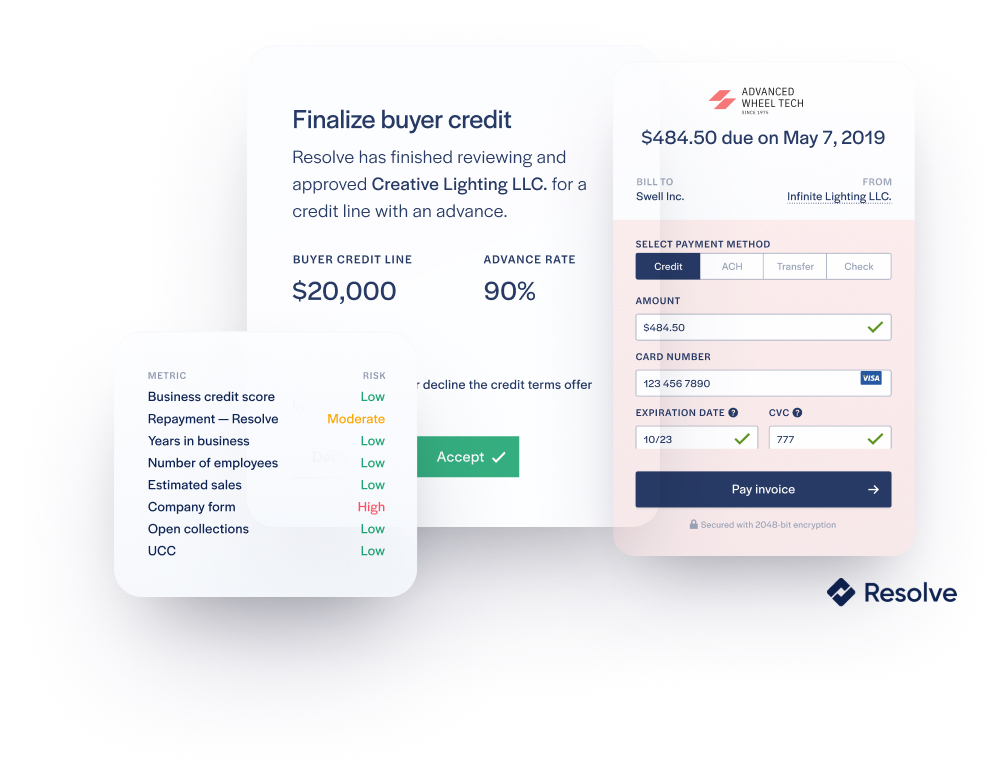
Image Credits: Resolve

Among Resolve’s features is a “Smart Credit Engine,” which the company says creates a direct sync with a merchant’s real-time data feed of past payment histories to allow for “immediate” credit line decisioning with no input required from buyers.

Its embedded bill payment portal gives its B2B customers a way to pay vendor bills “while building their business credit history” bureaus, the company says.

“Digital and e-commerce transformation is coming for B2B payments,” Tsai said. “Growing companies must balance heightened demand for deferring payments from their business customers with their own limited capacities to satisfy that demand.”

The embedded nature of Resolve’s platform gives it an edge, Tsai believes, in that it integrates into a company’s existing financial tech stack. The benefit to the business, he said, is increased growth and sales revenue as well as optimized cash flow “while removing risk for the company.”

Initialized Capital General Partner Alda Leu Dennis said she was familiar with Tsai and co-founder Brian Nguyen since their days at Celery, their prior startup. She views them as experienced and determined.

We also have conviction around the clear market need for digitizing net terms for small businesses that are increasingly moving their ordering online,” she said.

In her view, Resolve’s unique differentiation is that it provides software that solves net terms billing complexity. 

“Businesses desperately need to manage their B2B billing operations, from helping them gauge the strength of their customers to chasing down payments,” she told TechCrunch. “Their [Resolve’s] approach of accelerating payments and collections via software and offering payment terms as an ancillary service is a powerful pairing; it provides an easy yet comprehensive way for merchants to improve their entire system of managing receivables and billing on credit.”

The San Francisco startup is using the money primarily to grow its embedded billing platform.

“We’re doing a lot of work to scale the platform. So we’re investing heavily in products and the customer sides of the business, given all the demand that we’ve seen,” Tsai said. “The operations software that we’ve built is very seamless for our customers, but there’s a lot going on in the background that we have to do to reduce the complexity for our customers.”
25 May 2021

Venture capital investment in Africa predicted to reach a record high this year

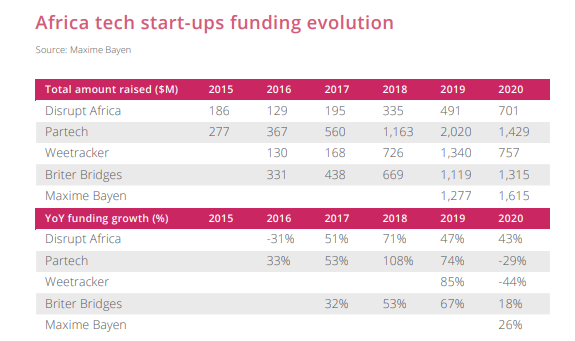
Investments in African startups keep growing at a healthy pace ever since reports started keeping count in 2015. That year, publications Disrupt Africa and Partech released independently researched and contrasting figures showing that venture capital investments hit $186 million and $277 million, respectively. Those are ridiculously low figures for a continent when you consider that four-year-old Snapchat raised more than $500 million in one round that same year. However, while the disparity in funding between Africa and a single high-growth U.S. startup continues, the good news is that more money is coming into the continent.

In 2019, Africa’s venture capital investments rose to an all-time high, per Partech’s report. According to Partech, 234 African tech companies raised $2.02 billion in 250 equity rounds. This indicated a 74% increase from 2018’s figure of $1.163 billion raised by 146 startups in 164 rounds.  

There was shared optimism that 2020 would record a new high, but that was before the pandemic struck. For that reason, African tech ecosystem accelerator AfricArena predicted that venture capital funding in the continent’s startups would fall between $1.2 billion and $1.8 billion. In what may be described as an educated guess or a calculated prediction by the publication, year-end reports by Partech and Briter Bridges pegged total investment raised at $1.4 billion and $1.3 billion, respectively.

This year, AfricArena, in a new report, is predicting that VC funding in the continent’s startups would increase between $2.25 billion and $2.8 billion, which, if met, will surpass 2019 figures for a record high on the continent.

Here’s the rationale behind the prediction from an excerpt in the report:

We foresee that the first two quarters of 2021 will be similar Q4 2020 with the mix of factors. Vaccine campaigns will likely take longer than hoped to have a meaningful impact. However, this rollout – regardless of how long they will actually take – will eliminate the major uncertainty about the end of the pandemic, which is only a question of time.

As a result, we expect an extremely strong acceleration of deals from seed to Series B as well as major growth deals, together with some IPOs (Nigeria’s Interswitch, for example), that will propel deal activity to never seen before levels of activity. As of April 2020, our forecast for 2021 ranged from under $1.6 billion to over $3 billion. The worst-case scenario was based on a prolonged and fragmented impact on the African economies and the best-case scenario factoring in a full recovery Q1 2021. Based on the above observations, our views are now that 2021 will range between $2.25 and $2.8 billion.

As of April 30, the total disclosed venture capital funding stood a little over $800 million, according to Maxime Bayen, deal tracker and senior venture builder at BFA Global. If that pace is kept throughout the year, African startups might raise more than $2 billion.

AfricArena

Image Credits: AfricArena

In 2020, the number of early-stage deals increased, but there was a drop in growth deals and overall ticket sizes, constituting the drop in funding activities. Per Partech, seed rounds grew 80% year-on-year and accounted for 64% of all deals made. In total, African startups raised $220 million in seed funding, which was a 47% increase year on year. Series A and B rounds grew likewise. Series A deals went up 9% (86 rounds), and Series B deals, 16% (29 rounds), yet their investment sizes dropped 5% ($447 million) and 8% ($449 million), respectively.

Growth deals also dropped by 16%, and only two deals closed above $50 million compared to the 10 that took place in 2019, some of which include Interswitch, OPay, Branch and Andela.

The driving force to exceed the $2 billion mark in 2021 lies on VCs to make more deals and startups to replicate the large growth rounds of 2019. The former appears to be in place as African startups continue to raise money week in and week out. However, there’s still work to be done for the latter, as only two African startups have raised more than $100 million in a single round so far — fintech startups Flutterwave and TymeBank.

25 May 2021

Indian logistics SaaS startup FarEye raises $100 million

FarEye, an Indian SaaS startup that helps firms globally optimize their supply chain and logistics operations, said on Tuesday it has raised a new financing round, its third since the pandemic broke last year, as it looks to further expand in international markets.

The Noida-headquartered startup has raised $100 million in its Series E round, which was co-led by high-profile backers TCV and Dragoneer Investment Group. Existing investors Eight Roads Ventures, Fundamentum, Honeywell also participated in the round, which takes seven-and-a-half-year-old startup’s to-date raise to about $153 million.

FarEye helps companies orchestrate, track, and optimize their logistics operations. The startup’s flagship logistics management software supports the entire supply chain — from first-mile seller pick-ups to last-mile delivery — to provide end-to-end logistics visibility, reduce operational costs and improve customer experience.

One use case of FarEye’s technology, as we wrote last year:

Say you order a pizza from Domino’s, the eatery uses FarEye’s service, which integrates into the system it is using, to quickly inform the customer how long they need to wait for the food to reach them.

Behind the scenes, FarEye is helping Domino’s evaluate a number of moving pieces. How many delivery people are in the vicinity? Can it bundle a few orders? What’s the maximum number of items one can carry? How experienced is the delivery person? What’s the best route to reach the customer? And, would the restaurant need the same number of delivery people the following day?

The startup works with over 150 e-commerce and delivery companies globally including popular names such as Walmart, UPS, DHL e-commerce, Domino’s, Posti, and Gordon Foods, and Amway, and processes over 100 million transactions each month.

More than two million vehicles and over 25,000 drivers are on FarEye’s platform today.

The coronavirus pandemic has helped the business as more companies, including large FMCG brands and retailers, begin to engage directly with customers, sort out their logistics and look for optimizing the cost, said Nahata in an interview.

“It’s not like these companies didn’t knew,” Nahata said, referring to companies building and digitizing their own logistics. “Earlier this was on their three-to-five year plans, but now they want to deploy this in within a quarter.”

“The logistics and supply chain industry is going through a long awaited software-led creative disruption, led by emerging leaders like FarEye that provide multi- tenant SaaS platforms with low code configuration to enhance visibility to the enterprise and deliver superlative last mile experiences for the end consumer. Gopi Vaddi, General Partner at TCV,

Customers are also beginning to place more orders online. “For existing customers, we have seen an increase in volume of orders especially in grocery and food categories,” he said.

The firm today also has clients in several international markets including the U.S., Europe, and Singapore, that is already bringing more than half of revenues for the startup and has grown nearly three times in the past 12 months.

Nahata said the startup didn’t initially think that Western markets would be prone to similar logistics challenges as those in India and other Asian markets, but he said despite the growth of e-commerce in some markets, some common underlying issues remain.

Nahata also pointed out that the payments infrastructure that has emerged in India in recent years still doesn’t exist in other markets, which creates an additional challenge to tackle for the firm.

“FarEye’s leading delivery management platform provides impressive visibility and control across the supply chain, which has never been more critical for retailers, manufacturers and 3PLs,” said Eric Jones, Partner at Dragoneer Investment Group, in a statement. “We look forward to partnering with FarEye as they continue to redefine how products are delivered across diverse logistics networks and expand their footprint in Europe and North America.”

The startup recently hired a number of senior executives including a new CRO (Amit Bagga — formerly President of APAC at BlueYonder and  and strategic sales leader at Oracle), and a new CPO (Suvrat Joshi — former executive at Dropbox, Amazon, Facebook, Microsoft.) It’s looking to further expand the team and is also open to exploring acquisition of smaller firms in international markets, said Nahata.

25 May 2021

Interactio, a remote interpretation platform, grabs $30M after seeing 12x growth during COVID-19

Interactio, a remote interpretation platform whose customers include massive institutions like the United Nations, European Commission and Parliament along with corporates like BMW, JP Morgan and Microsoft, has closed a whopping $30 million Series A after usage of its tools grew 12x between 2019 and 2020 as demand for online meeting platforms surged during the coronavirus pandemic.

The Series A funding is led by Eight Roads Ventures and Silicon Valley-based Storm Ventures, along with participation from Practica Capital, Notion Capital, as well as notable angels such as Jaan Tallinn, the co-founder of Skype, and Young Sohn, ex-chief strategy officer of Samsung.

The Vilnius, Lithuania-based startup offers digital tools to connect meetings with certified interpreters who carry out real-time interpretation to bridge language divides between participants. It does also offer a video conferencing platform which its customers can use to run remote meetings but will happily integrate with thirty party software like Zoom, Webex etc. (Last year it says its digital tools were used alongside 43 different video streaming platforms.)

Interactio’s interpreters can be in the room where the meeting is taking place or doing the real-time interpretation entirely remotely by watching and listening to a stream of the meeting. (Or, indeed, it can support a mix of remote and on-site interpretation, if a client wishes.)

It can also supply all the interpreters for a meeting — and it touts a strict vetting procedure for onboarding certified interpreters to its platform — or else it will provide training to a customer’s interpreters on the use of its tools to ensure things run smoothly on the day.

At present, Interactio says it works with 1,000+ freelance interpreters, as well as touting “strong relations with interpretation agencies” — claiming it can easily quadruple the pool of available interpreters to step up to meet rising demand.

It offers its customers interpretation in any language — and in an unlimited number of languages per event. And last year it says it hosted 18,000+ meetings with 390,000 listeners spread across more than 70 countries.

Now, flush with a huge Series A, Interactio is gearing up for a future filled with increasing numbers of multi-lingual online meetings — as the coronavirus continues to inject friction into business travel.

“When we started, our biggest competition was simultaneous interpretation hardware for on-site interpretation. At that time, we were on the mission to fully replace it with our software that required zero additional hardware for attendees besides their phone and headphones. However, for institutions, which became our primary focus, hybrid meetings are the key, so we started partnering with simultaneous interpretation hardware manufacturers and integrators by working together on hybrid events, where participants use hardware on-site, and online participants use us,” a spokeswoman told us.

“This is how we differentiate ourselves from other platforms — by offering a fully hybrid solution, that can be integrated with hardware on-site basically via one cable.”

“Moreover, when we look at the market trends, we still see Zoom as the most used solution, so we compliment it by offering professional interpretation solutions,” she added.

A focus on customer support is another tactic that Interactio says it relies upon to stand out — and its iOS and Android apps do have high ratings on aggregate. (Albeit, there are bunch of historical complaints mixed in suggesting it’s had issues scaling its service to large audiences in the past, as well as sporadic problems with things like audio quality over the years.)

While already profitable, the 2014-founded startup says the  Series A will be used to step on the gas to continue to meet the accelerated demand and exponential growth it’s seen during the remote work boom.

Specifically, the funds will go on enhancing its tech and UX/UI — with a focus on ensuring ease of access/simplicity for those needing to access interpretation, and also on upgrading the tools it provides to interpreters (so they have “the best working conditions from their chosen place of work”).

It will also be spending to expand its client base — and is especially seeking to onboard more corporates and other types of customers. (“Last year’s focus was and still is institutions (e.g. European Commission, European Parliament, United Nations), where there is no place for an error and they need the most professional solution. The next step will be to expand our client base to corporate clients and a larger public that needs interpretation,” it told us.)

The new funding will also be used to expand the size of its team to support those goals, including growing the number of qualified interpreters it works with so it can keep pace with rising demand.

While major institutions like the UN are never going to be tempted to skimp on the quality of translation provided to diplomats and politicians by not using human interpreters (either on premise or working remotely), there may be a limit on how far professional real-time translation can scale given the availability of real-time machine translation technology — which offers a cheap alternative to support more basic meeting scenarios, such as between two professionals having an informal meeting.

Google, for example, offers a real-time translator mode that’s accessible to users of its smartphone platform via the Google voice assistant AI. Hardware startups are also trying to target real-time translation. The dream of a real-life AI-powered ‘Babel Fish’ remains strong.

Nonetheless, such efforts aren’t well suited to supporting meetings and conferences at scale — where having a centralized delivery service that’s also responsible for troubleshooting any audio quality or other issues which may arise looks essential.

And while machine translation has undoubtedly got a lot better over the years (albeit performance can vary, depending on the languages involved) there is still a risk that key details could be lost in translation if/when the machine gets it wrong. So offering highly scalable human translation via a digital platform looks like a safe bet as the world gets accustomed to more remote work (and less globetrotting) being the new normal.

“AI-driven translation is a great tool when you need a quick solution and are willing to sacrifice the quality,” says Interactio when we ask about this. “Our clients are large corporations and institutions, therefore, any kind of misunderstanding can be crucial. Here, the translation is not about saying a word in a different language, it’s about giving the meaning and communicating a context via interpretation.

“We strongly believe that only humans can understand the true context and meaning of conversations, where sometimes a tone of voice, an emotion and a figure speech can make a huge difference, that is unnoticed by a machine.”

25 May 2021

AnyClip snaps up $47M for its video search and analytics technology

Video is, quite literally, what gets the world moving online these days, expected to account for 82% of all IP traffic this year. Today a startup that has built a set of tools to help better parse, index and ultimately discover that trove of content is announcing a big round of funding to expand its business after seeing 600% growth in the last year.

AnyClip — which combines artificial intelligence with more standard search tools to provide better video analytics for content providers to improve how those videos can be used and viewed — has raised $47 million, money that it will be using to build out its platform and where it can be applied.

The funding is being led by JVP, with La Maison, Bank Mizrahi and internal investors also participating. The company is not officially disclosing its valuation but has raised $70 million to date and I understand from reliable sources that it is around $300 million.

Founded in Tel Aviv and now co-headquartered in New York, the challenge that AnyClip is tackling is the fact that there is a huge amount of video out in the world today, and it remains one of the most-used content mediums, whether you are a consumer binging a Netflix series, someone trying to dig up an obscure classical music recording on YouTube, a business user on Zoom, or something in the very large in-between those scenarios. The problem is that in most cases, people are just scratching the surface when they search.

That’s not just because hosts tweak algorithms to lead to watching some things instead of others; it’s because in most cases it’s too difficult, and some might say impossible, to search everything in an efficient way.

AnyClip is among the tech companies that believe it’s not impossible. Using technologies that include deep learning models based on computer vision, NLP, speech-to-text, OCR, patented key frame detection and closed captioning to “read” the content in videos. It can recognize people, brands, products, actions, millions of keywords and build taxonomies based around what the videos contain. These can be based on, for example, content category, brand safety, or whatever a customer requests.

The videos that AnyClip currently works with are hosted by AnyClip itself — on AWS, president and CEO Gil Becker tells me — and the process of reading and indexing is super quick, “10x faster than real time.”

The resulting data and what can be done with it, as you might guess, has a lot of potential uses. Currently, Becker said that AnyClip is finding a strong audience among customers that are looking for ways of better organising their video content for a variety of use cases, whether that’s for internal purposes, for B2B purposes, or for consumers to better discover something.

And as the illustration above shows, that tech can be used, naturally, to better monetize video. By identifying more objects, themes, moods and language in videos more efficiently, AnyClip essentially can build a framework not just for people to better discover videos, but for advertisers to place ads next to whatever they want to be near (or conversely, better avoid content that they do not want any association with at all).

The list of those it works with is pretty impressive — it includes although Becker would not get very specific on what it does for all of its clients. It includes Samsung, Microsoft, AT&T, Amazon (Prime Video specifically), Heineken, Discovery, Warner Media (the latter two soon to be one), Tencent, Internet Brands and Google.

Among the work it does with Google, AnyClip does not count Google as an investor per se, but it has received funding from it, specifically as part of its Google News Initiative’s Innovation Challenge to create a streaming video page experience for media companies that mimics the functionality and design of today’s most popular video-on-demand services while accessing advanced video management tools supported by AnyClip’s AI backbone.  AnyClip was chosen from among hundreds of companies for its solution that allows companies to transform any library into a ‘Netflix or YouTube-like” library, creating channels and subchannels, in less than 30 seconds.

AnyClip has an interesting history that led to it building the search and discovery tools that it sells today. It started life back in 2009 with a concept that spoke directly to its name: it let media companies create clips of films that could be shared around the internet, which it hosted on a site of its own. These could be found using a number of taxonomies built by AnyClip’s algorithms, by humans at the company, and by contributors. Kind of like a Giphy before its time, if you will. 

It turned out to be possibly too far ahead of its time. At a time when piracy was still a big deal, and there were no Netflixes or other places for streaming efficiently and legally, the idea proved to be too complicated and too hard of a sell for rights owners. The company subsequently pivoted to building a video-based ad network, which itself was probably too early, too.

But there was something to the technology, given the right place and right time, and that seems to be where the startup has landed today, with patents behind what it has built and a team of engineers continuing to expand the tech. It hopes that this will be enough to keep it ahead of competitors, which include the likes of Kaltura, Brightcove and many others. And naturally, given the size of the opportunity, that competition will not be disappearing soon.

Notably, AnyClip’s own growth, on the back of what has up to now been a modest amount of funding ($30 million in 12 years) definitely speaks of its own ability not just to win business against them, but be capital efficient in what is typically considered a very bandwidth and resource-intensive medium.

“There is a revolution coming in the way enterprises use video to convey their message and their identity”, says Erel Margalit, JVP founder and Chairman, and Anyclip’s Board Chairman, in a statement. “For the first time, AI meets video. Companies and organizations are now working to utilize this to create a new mode of communications, internally and externally, in all areas where video dominates in a much stronger way than text. Whether it’s how to create videos for consumers or training videos for the organization, or learning how to manage conferences run by video on zoom which need intelligent management in the retrieving of content. This is a new era, and AnyClip is a vital tool for anyone embarking upon it.”

25 May 2021

Facebook co-founder Saverin’s B Capital doubles down on SaaS in China

B Capital Group, the six-year-old venture capital fund formed by Facebook co-founder Eduardo Saverin and Bain Capital veteran Raj Ganguly, is doubling down on China as it looks to allocate $500 million to $1 billion of its fund into Chinese tech companies over the next few years.

With $1.9 billion assets under management, B Capital is going after enterprise software providers in China, an area that has seen “explosive growth” but is still only a “fraction the size of the U.S. SaaS market,” Ganguly said in an interview with TechCrunch.

The idea that Chinese companies are reluctant to shell out for software is “very backward-looking thinking”, he added.

One force fueling the boom of B2B companies in China is surging labor costs. As such, B Capital is hunting down software that could make labor and business operations more productive, and subsequently, give companies a competitive edge. Covid-19 accelerated the shift, as well-digitized companies had proven much more resilient to disruptions caused by the pandemic.

B Capital is able to discern what enterprises need thanks to its close partnership with Boston Consulting Group, which has a raft of customers ranging from healthcare, finance to transportation looking to digitize.

These large corporations “understand that their internal technology can’t be the only solution and they have to look to the outside and be willing to partner with early-stage, high-growth, or late-stage tech companies,” Ganguly suggested. They are also more willing to pay for software compared to scrappy, cash-strapped startups.

B Capital began deploying capital in China early this year and has already closed three deals. It’s stage-agnostic — though growth-stage startups are the focus — and plans to back 15-20 projects in China over the next few years. About 15 of its investment and operating employees are based out of Hong Kong and Beijing. It has around 110 staff worldwide.

Ganguly declined to disclose the names of its Chinese investees at this stage but said they include a biotech company, an automotive parts business, and an e-commerce enabler. Leveraging BCG’s expertise, the biotech company is learning how it can bring actual drugs to market faster. And the automotive business is similarly working with BCG to figure out its pricing and go-to-market strategy.

Going global

Overall, B Capital looks for opportunities in healthcare, fintech, industrial digitalization, and other horizontal enterprise services. Chinese startups that interest B Capital most are also those with the intention and ability to cross borders.

“Biotech is the area that we’ve been the most impressed by what’s happening in China and how that technology can be exported to other countries,” Ganguly said. B Capital has backed one biotech startup with offices in both Shanghai and Cambridge, Massachusettes, and is on track to close a deal with another that also straddles China and the U.S.

The other target is e-commerce, which Ganguly described as “cross-border by its nature” because a product is often sourced in one country, made in another, and then sold in a third market.

The investor is certainly right about the potential of cross-border e-commerce in China, where consumers have a big appetite for imported goods and manufacturers look for new ways to sell globally.

China is also in a good position to export its enterprise software, similar to how Indian counterparts have succeeded overseas, said Ganguly. The difference is that few Indian corporations are willing to pay big bucks for software, which forces B2B entrepreneurs to seek market abroad, whereas China’s domestic companies have an increasing demand for SaaS.

Despite ongoing geopolitical complications, Ganguly is optimistic that the world “is still moving towards globalization” over the long term.

“Certain innovation cycles have started in Silicon Valley and spread to places like China and Southeast Asia. But frankly, other innovation cycles have started in China and gone to South and Southeast Asia and the U.S. We think that China’s enterprise [software], artificial intelligence and biotech are some of the best technology that we’ve seen.”

But these globalizing companies must be able to adapt, hire talent outside their core market, get regulatory approvals, and build the right distribution networks, the investor suggested.

“I think that there are aspects of globalization that have become very politicized, and I think that’s unfortunate but understandable. Our belief is that businesses that we invest in have the ability to cross borders. Sometimes that means going from China to South and Southeast Asia, and sometimes that means extending to the U.S. Sometimes it just means the ability to import or export their products or software, and even staying in China where they can sell their technologies overseas.”

25 May 2021

Germany gives greenlight to driverless vehicles on public roads

Germany has adopted legislation that will allow driverless vehicles on public roads by 2022, laying out a path for companies to deploy robotaxis and delivery services in the country at scale. While autonomous testing is currently permitted in Germany, this would allow operations of driverless vehicles without a human safety operator behind the wheel. 

The bill, which last week passed the Bundestag, Germany’s lower house of parliament, specifically looks at vehicles with Level 4 autonomy. Level 4 autonomy is a designation by the Society of Automobile Engineers (SAE) which means the computer handles all the driving in certain conditions or environments. In Germany, these vehicles will be limited to  geographic areas. 

“In the future, autonomous vehicles should be able to drive nationwide without a physically present driver in specified operating areas of public road traffic in regular operation,” reads the legislation. “According to the Federal Government, further steps must be taken to introduce corresponding systems into regular operation so that the potential of these technologies can be exploited and society can participate in them.” 

The bill still needs to pass through the upper chamber of parliament, or the Bundesrat. Included in the bill are possible initial applications for self-driving cars on German roads, such as public passenger transport, business and supply trips, logistics, company shuttles that handle employee traffic and trips between medical centers and retirement homes.

Companies looking to operate commercial driverless vehicles in Germany will need to adhere to a number of other rules, such as carrying liability insurance and having access to stop autonomous operations remotely.

Companies already testing in Germany might have an upper hand in Europe’s largest economy. Argo AI, for example, has been testing its autonomous vehicles at the LabCampus innovation center at Munich Airport. Last June, the company opened its European headquarters in the Bavarian city, and this summer it will open its test site in partnership with Volkswagen to test the VW ID.Buzz electric vans. Intel-subsidiary Mobileye also has a footprint testing AVs in Germany

Several U.S. states and countries have regulations around testing and potentially commercial deployment. Last week, Chinese robotaxi startup Pony.ai became the eighth company to be granted a permit to test driverless vehicles in California, and Nuro is the only company with a deployment permit to operate commercially on public roads in the state. In China, companies like Alibaba-backed AutoX are also testing driverless fleets on public roads. Germany’s legislation is a step beyond testing in the direction of integration into regular traffic. 

25 May 2021

Light is the key to long-range, fully autonomous EVs

Advanced driver assistance systems (ADAS) hold immense promise. At times, the headlines about the autonomous vehicle (AV) industry seem ominous, with a focus on accidents, regulation or company valuations that some find undeserving. None of this is unreasonable, but it makes the amazing possibilities of a world of AVs seem opaque.

One of the universally accepted upsides of AVs is the potential positive impact on the environment, as most AVs will also be electric vehicles (EVs).

Industry analyst reports project that by 2023, 7.3 million vehicles (7% of the total market) will have autonomous driving capabilities requiring $1.5 billion of autonomous-driving-dedicated processors. This is expected to grow to $14 billion in 2030, when upward of 50% of all vehicles sold will be classified as SAE Level 3 or higher, as defined by the National Highway Traffic Safety Administration (NHTSA).

Fundamental innovation in computing and battery technology may be required to fully deliver on the promise of AEVs with the range, safety and performance demanded by consumers.

While photonic chips are faster and more energy efficient, fewer chips will be needed to reach SAE Level 3; however, we can expect this increased compute performance to accelerate the development and availability of fully SAE Level 5 autonomous vehicles. In that case, the market for autonomous driving photonic processors will likely far surpass the projection of $14 billion by 2030.

When you consider all of the broad-based potential uses of autonomous electric vehicles (AEVs) — including taxis and service vehicles in major cities, or the clean transport of goods on our highways — we begin to see how this technology can rapidly begin to significantly impact our environment: by helping to bring clean air to some of the most populated and polluted cities.

The problem is that AEVs currently have a sustainability problem.

To operate efficiently and safely, AEVs must leverage a dizzying array of sensors: cameras, lidar, radar and ultrasonic sensors, to name just a few. These work together, gathering data to detect, react and predict in real time, essentially becoming the “eyes” for the vehicle.

While there’s some debate surrounding the specific numbers of sensors required to ensure effective and safe AV, one thing is unanimously agreed upon: These cars will create massive amounts of data.

Reacting to the data generated by these sensors, even in a simplistic way, requires tremendous computational power — not to mention the battery power required to operate the sensors themselves. Processing and analyzing the data involves deep learning algorithms, a branch of AI notorious for its outsized carbon footprint.

To be a viable alternative, both in energy efficiency and economics, AEVs need to get close to matching gas-powered vehicles in range. However, the more sensors and algorithms an AEV has running over the course of a journey, the lower the battery range — and the driving range — of the vehicle.

Today, EVs are barely capable of reaching 300 miles before they need to be recharged, while a traditional combustion engine averages 412 miles on a single tank of gas, according to the U.S. Department of Energy. Adding autonomous driving into the mix widens this gap even further and potentially accelerates battery degradation.

Recent work published in the journal Nature Energy claims that the range of an automated electric vehicle is reduced by 10%-15% during city driving.

At the 2019 Tesla Autonomy Day event, it was revealed that driving range could be reduced by up to 25% when Tesla’s driver-assist system is enabled during city driving. This reduces the typical range for EVs from 300 miles to 225 — crossing a perceived threshold of attractiveness for consumers.

A first-principle analysis takes this a step further. NVIDIA’s AI compute solution for robotaxis, DRIVE, has a power consumption of 800 watts, while a Tesla Model 3 has an energy consumption rate of about 11.9 kWh/100 km. At the typical city speed limit of 50 km/hour (about 30 mph), the Model 3 is consuming approximately 6 kW — meaning power solely dedicated to AI compute is consuming approximately 13% of total battery power intended for driving.

This illustrates how the power-hungry compute engines used for automated EVs pose a significant problem for battery life, vehicle range and consumer adoption.

This problem is further compounded by the power overhead associated with cooling the current generation of the power-hungry computer chips that are currently used for advanced AI algorithms. When processing heavy AI workloads, these semiconductor chip architectures generate massive amounts of heat.

As these chips process AI workloads, they generate heat, which increases their temperature and, as a consequence, performance declines. More effort is then needed and energy wasted on heat sinks, fans and other cooling methods to dissipate this heat, further reducing battery power and ultimately EV range. As the AV industry continues to evolve, new solutions to eliminate this AI compute chip heat problem are urgently needed.

The chip architecture problem

For decades, we have relied on Moore’s law, and its lesser-known cousin Dennard scaling, to deliver more compute power per footprint repeatedly year after year. Today, it’s well known that electronic computers are no longer significantly improving in performance per watt, resulting in overheating data centers all over the world.

The largest gains to be had in computing are at the chip architecture level, specifically in custom chips, each for specific applications. However, architectural breakthroughs are a one-off trick — they can only be made at singular points in time in computing history.

Currently, the compute power required to train artificial intelligence algorithms and perform inference with the resulting models is growing exponentially — five times faster than the rate of progress under Moore’s law. One consequence of that is a huge gap between the amount of computing needed to deliver on the massive economic promise of autonomous vehicles and the current state of computing.

Autonomous EVs find themselves in a tug of war between maintaining battery range and the real-time compute power required to deliver autonomy.

Photonic computers give AEVs a more sustainable future

Fundamental innovation in computing and battery technology may be required to fully deliver on the promise of AEVs with the range, safety and performance demanded by consumers. While quantum computers are an unlikely short- or even medium-term solution to this AEV conundrum, there’s another, more available solution making a breakthrough right now: photonic computing.

Photonic computers use laser light, instead of electrical signals, to compute and transport data. This results in a dramatic reduction in power consumption and an improvement in critical, performance-related processor parameters, including clock speed and latency.

Photonic computers also enable inputs from a multitude of sensors to run inference tasks concurrently on a single processor core (each input encoded in a unique color), while a traditional processor can only accommodate one job at a time.

The advantage that hybrid photonic semiconductors have over conventional architectures lies within the special properties of light itself. Each data input is encoded in a different wavelength, i.e., color, while each runs on the same neural network model. This means that photonic processors not only produce more throughput compared to their electronic counterparts, but are significantly more energy efficient.

Photonic computers excel in applications that require extreme throughput with low latency and relatively low power consumption — applications like cloud computing and, potentially, autonomous driving, where the real-time processing of vast amounts of data is required.

Photonic computing technology is on the brink of becoming commercially available and has the potential to supercharge the current roadmap of autonomous driving while also reducing its carbon footprint. It’s clear that interest in the benefits of self-driving vehicles is increasing and consumer demand is imminent.

So it is crucial for us to not only consider the industries it will transform and the safety it can bring to our roads, but also ensure the sustainability of its impact on our planet. In other words, it’s time to shine a little light on autonomous EVs.

24 May 2021

Hyundai is launching in-car payments in the all-electric Ioniq 5

Hyundai developed an in-car payment system that will debut in its upcoming all-electric Ioniq 5 crossover that will offer drivers the ability to find and pay for EV charging, food and parking — the latest example of automakers finding new ways to generate revenue and offer customers features that are typically associated with smartphones.

When the vehicle comes to North America in fall 2021, the payments system will launch with Dominoes, ParkWhiz and Chargehub, the company said Monday. The in-car payments system was just one of several new details released during the Ioniq 5’s North American debut.

The payments feature works through Bluelink, Hyundai’s branded connected car system that gives users control over various vehicle functions and services. Bluelink, which requires a subscription, is offered in three different packages that cover areas such as vehicle maintenance and alerts, remote climate control and unlocking and locking as well as destination search. Bluelink also can be linked to a user’s Google Assistant feature on their smartphone to send information to their Hyundai vehicle.

The in-car payments system will eventually expand to include other companies that fall into the charging, food and coffee on-the-go and parking categories. A company spokesperson said Hyundai will continue to add new merchants regularly via the Xevo Marketplace platform.

The Ioniq 5 is the company’s first dedicated battery-electric vehicle built on the new Electric-Global Modular Platform, or E-GMP platform. This platform is shared with Kia and is the underlying foundation of the new EV6.

If the Ioniq name sounds familiar, it’s because it already exists. In 2016, Hyundai introduced the Ioniq, a hatchback that came in hybrid, plug-in hybrid and electric versions. The Korean automaker is using that vehicle as the jumping off point for its new EV brand.

All of the vehicles under the Ioniq brand will have the E-GMP platform. The Ioniq 5 is based on Hyundai’s Concept 45, a monocoque-style body crossover that the company unveiled in 2019 at the International Motor Show in Frankfurt. Designers of the Concept 45 leaned on some of the lines and characteristics from Hyundai’s first concept, the 1974 Pony Coupe. The “45” name comes, in part, from the 45-degree angles at the front and rear of the vehicle.

Hyundai has yet to release pricing for the Ioniq 5.

24 May 2021

Florida’s ban on bans will test First Amendment rights of social media companies

Florida governor Ron DeSantis has signed into law a restriction on social media companies’ ability to ban candidates for state offices and news outlets, and in doing so offered a direct challenge to those companies’ perceived free speech rights. The law is almost certain to be challenged in court as both unconstitutional and in direct conflict with federal rules.

The law, Florida Senate Bill 7072, provides several new checks on tech and social media companies. Among other things:

  • Platforms cannot ban or deprioritize candidates for state office
  • Platforms cannot ban or deprioritize any news outlet meeting certain size requirements
  • Platforms must be transparent about moderation processes and give users notice of moderation actions
  • Users and the state will have the right to sue companies that violate the law

The law establishes rules affecting these companies’ moderation practices; that much is clear. But whether doing so amounts to censorship — actual government censorship, not the general concept of limitation frequently associated with the word — is an open question, if a somewhat obvious one, that will likely be forced by legal action against SB 7072.

While there is a great deal of circumstantial precedent and analysis, the problem of “are moderation practices of social media companies protected by the First Amendment” is as yet unsettled. Legal scholars and existing cases fall strongly on the side of “yes,” but there is no single definitive precedent that Facebook or Twitter can point to.

The First Amendment argument starts with the idea that although social media are very unlike newspapers or book publishers, they are protected in much the same way by the Constitution from government interference. “Free speech” is a term that is interpreted extremely liberally, but if a company spending money is considered a protected expression of ideas, it’s not a stretch to suggest that same company applying a policy of hosting or not hosting content should be as well. If it is, then the government is prohibited from interfering with it beyond very narrow definitions of unprotected speech (think shouting “fire” in a crowded theater). That would sink Florida’s law on constitutional grounds.

The other conflict is with federal law, specifically the much-discussed Section 230, which protects companies from being liable for content they publish (i.e. the creator is responsible instead), and also for the choice to take down content via rules of their own choice. As the law’s co-author Senator Ron Wyden (D-OR) has put it, this gives those companies both a shield and a sword with which to do battle against risky speech on their platforms.

But SB 7072 removes both sword and shield: it would limit who can be moderated, and also creates a novel cause for legal action against the companies for their remaining moderation practices.

Federal and state law are often in disagreement, and there is no handbook for how to reconcile them. On one hand, witness raids of state-legalized marijuana shops and farms by federal authorities. On the other, observe how strong consumer protection laws at the state level aren’t preempted by weaker federal ones because to do so would put people at risk.

On the matter of Section 230 it’s not straightforward who is protecting whom. Florida’s current state government claims that it is protecting “real Floridians” against the “Silicon Valley elites.” But no doubt those elites (and let us be candid — that is exactly what they are) will point out that in fact this is a clear-cut case of government overreach, censorship in the literal sense.

These strong legal objections will inform the inevitable lawsuits by the companies affected, which will probably be filed ahead of the law taking effect and aim to have it overturned.

Interestingly, two companies that will not be affected by the law are two of the biggest, most uncompromising corporations in the world: Disney and Comcast. Why, you ask? Because the law has a special exemption for any company “that owns and operates a theme park or entertainment complex” of a certain size.

That’s right, there’s a Mouse-shaped hole in this law — and Comcast, which owns Universal Studios, just happens to fit through as well. Notably this was added in an amendment, suggesting two of the largest employers in the state were unhappy at the idea of new liabilities for any of their digital properties.

This naked pandering to local corporate donors puts proponents of this law at something of an ethical disadvantage in their righteous battle against the elites, but favor may be moot in a few months’ time when the legal challenges, probably being drafted at this moment, call for an injunction against SB 7072.