Author: azeeadmin

20 May 2021

Electric hypercar phenom and founder Mate Rimac is heading to TC Sessions: Mobility 2021

A decade ago, Rimac Automobili was one-person startup in a garage. Today, the EV and technology company founded by Mate Rimac employs more than 1,000 people, has partnerships with Porsche and Hyundai Motor Group and is on track to launch its 1,914 hp, all-electric C_Two hypercar this year.

If that weren’t enough, Rimac also launched a subsidiary company Greyp Bikes to produce electrically assisted bicycles. It’s a notable run for a company that Mate Rimac founded after converting a 1984 BMW into an electric vehicle that at one time was the fastest in the world. What makes it remarkable is he started the company in Croatia and at time that lacked the typical network found in Silicon Valley.

“Ten years ago today, I was still like one guy in a garage and we did this in a location in Croatia where there is not a lot of technology or industry in general,” he said in an interview with TechCrunch earlier this year. “So it was crazy, I didn’t have a single venture capital fund. There were no tech startups. There was no industry in general, not just like automotive, but industry as such. So, there was no talent, there were no buildings we could use. So, we had a very tough upcoming, and was very hard for us to start we were just surviving and, you know from month to month and trying to pay the bills and most of the times we were struggling with that so the first six or seven years of our life most of the time for me was focusing on keeping the company going and how the hell I’m going to pay the next payroll or the next rent and stuff like that.”

Rimac overcame those challenges, gaining Porsche and Hyundai as investors and importantly, generating revenue from the beginning — and even profits.

And Mate Rimac isn’t done.

The founder and CEO recently unveiled a design for new headquarters in Croatia that will include an on-site test track, an R&D and production facility, museum, gym and day care for employees and even an-site organic food production and farm animals. The complex, which is expected to be completed by 2023, will allow the company to ramp up from prototype and smaller projects to high-volume production of its high-performance electric drivetrain and battery systems for customers that include Porsche, Hyundai-Kia, SEAT, Renault and Pininfarina.

We’re excited to announce that Mate Rimac will be joining us at TC Sessions: Mobility 2021, a one-day virtual event that is scheduled June 9. We have a lot of ground to cover with Mate Rimac from how he started a company outside of a traditional incubator or VC network, his upcoming electric hypercar and plans for the company’s future.

In case, you’re not familiar, each year we bring together engineers and founders, investors and CEOs who are working on all the present and future ways people and packages will get from Point A to Point B. The agenda is packed with leaders in electric vehicles — that would be Mate Rimac — autonomous vehicle technology, micromobility and even urban and regional air taxis.

Among the growing list of speakers are Motional President Karl Iagnemma and Aurora co-founder and CEO Chris Urmson, who will team up to talk about technical problems that remain to be solved, the war over talent, the best business models and applications of autonomous vehicles and maybe even hear a few stories from the early days of testing and launching a startup.

Other guests include GM‘s VP of Global Innovation Pam Fletcher, Scale AI CEO Alexandr Wang, Joby Aviation founder and CEO JoeBen Bevirt, investor and LinkedIn founder Reid Hoffman (whose special purpose acquisition company just merged with Joby), investors Clara Brenner of Urban Innovation Fund, Quin Garcia of Autotech Ventures and Rachel Holt of Construct Capital, Zoox co-founder and CTO Jesse Levinson, community organizer, transportation consultant and lawyer Tamika L. Butler, Remix co-founder and CEO Tiffany Chu and Revel co-founder and CEO Frank Reig.

We also recently announced a panel dedicated to China’s robotaxi industry. We’re bringing together three female leaders from Chinese autonomous vehicle startups that have an overseas footprint: Jewel Li from AutoX, which is backed by Chinese state-owned automakers Dongfeng Motor and SAIC Motor; Huan Sun from Momenta, which attracted Bosch, Daimler and Toyota in its $500 million round closed in March; and Jennifer Li from WeRide, whose valuation jumped to $3 billion after a financing round in May.

Don’t wait to book your tickets to TC Sessions: Mobility as prices go up at the door. Grab your passes right now and hear from today’s biggest mobility leaders.

20 May 2021

Geospatial startup Unfolded.ai acquired by Foursquare

Well, that was fast.

Just a few months after raising its seed round, Unfolded.ai announced today that it is being acquired by Foursquare. Terms of the deal were not disclosed. The startup had raised a total of about $6 million when we last checked in with them.

The company, founded by a group of ex-Uber geospatial engineers, was building on top of popular open-source libraries that its founders had created including Kepler.gl, a web application that can take geospatial datasets and visualize them, and Deck.gl, which offers an extensible application framework for processing geospatial datasets and preparing them for visualization.

As I wrote earlier this year:

The startup’s main product is called Unfolded Studio, which acts as a backend-as-a-service for applications built on top of Kepler.gl (which is only a frontend library itself) handling components like data management and server communications. In particular, the product is designed to bring different geospatial datasets together and allow them all to interact with each other in one unified view.

The acquisition by Foursquare is designed to bring Unfolded’s geospatial technology into Foursquare Everywhere, the company’s new brand and product focus on delivering scalable location services to all sorts of customers.

Foursquare has evolved significantly in recent years to become a location-focused advertising and marketing platform. It announced that it was merging with Factual back in April 2020, and switched out CEO David Shim with Gary Little in November, who assumed the titles of CEO and president. This acquisition appears to be the first for Little since he took the helm.

Foursquare CEO and president Gary Little. Image Credits: Foursquare

In its press statement, the company said that “this acquisition propels Foursquare’s evolution into the singular source companies turn to for high quality, easy-to-use location data and the technology they need to make sense of it.”

20 May 2021

Don’t tweet about $ASS

I am not a smart man.

Earlier today I tweeted about $ASS, a cryptocurrency named after a dog. In this case, Australian Shepherds. And after doing that obviously stupid thing, my Twitter feed became chock-full of ass-related imagery, memes, and $ASS coin stans breathing on me.

It’s all very annoying as I run Tweetdeck on a work laptop which is now very, well, dicey a proposition given what I’m being sent.

$ASS is short for Australian Safe Shepherd, by the by. It’s a cryptocurrency that, much like Dogecoin, is a joke.

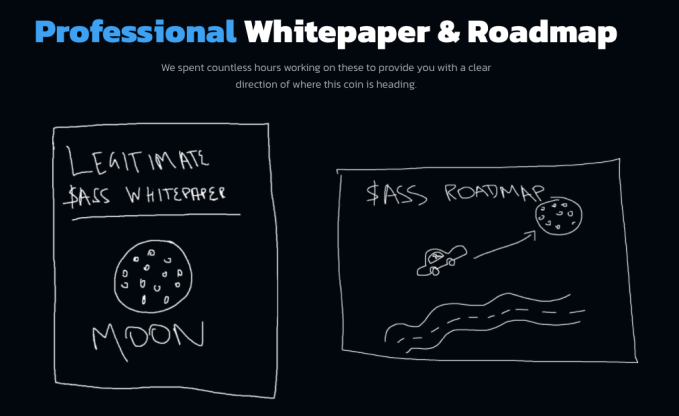
A joke that its own website doesn’t take too seriously. For example, if you navigate to AssFinance, you will find a very detailed look at $ASS’s technical underpinnings, and plans for the future:

I found this hilarious. So I tweeted about it. And then everyone in the $ASS world began to assault my Twitter. Pro-tip: This is not a good way to get taken seriously. But as $ASS is not trying to be taken seriously, does that even matter?

The coin is effectively a limid pump, a cryptocurrency designed to get early adopters to spread the word about it, and then hold. It built its economics around just those goals:

But enough of all that. Why do we give a shit about $ASS? A few reasons:

  • This sort of financial stupidity is funny, but some regular folks are going to get burned.
  • The $ASS pump is indicative of the level of speculation present in the cryptocurrency world today, which is likely to the credibility detriment of more serious projects. And helps explain how bitcoin has managed the price appreciation it has in recent quarters.
  • $ASS coin is up 1794.3% in the last 14 days, per CoinGecko. This is likely key to its current charm; people love free money and past gains make for an attractive lie to oneself concerning future returns.

As a concept, $ASS fits neatly into my budding view that as current generations of people in their 20s and 30s are desperate for a firmer foothold on a middle-class life than today’s wage-weak, healthcare-deficient, and labor-unfriendly economy is willing to provide, moon-shots on speculative bullshit have outsized appeal compared to other times in American history when it was easier to afford a house.

And while it’s hard to be serious about a butt dog-themed bit of Internet money, $ASS is, well, very 2021. And who are we to pretend to be better than covering a shitcoin? Even if only to mock it.

Bloomberg has more on $ASS if you want a more serious take about an unserious project.

20 May 2021

Don’t tweet about $ASS

I am not a smart man.

Earlier today I tweeted about $ASS, a cryptocurrency named after a dog. In this case, Australian Shepherds. And after doing that obviously stupid thing, my Twitter feed became chock-full of ass-related imagery, memes, and $ASS coin stans breathing on me.

It’s all very annoying as I run Tweetdeck on a work laptop which is now very, well, dicey a proposition given what I’m being sent.

$ASS is short for Australian Safe Shepherd, by the by. It’s a cryptocurrency that, much like Dogecoin, is a joke.

A joke that its own website doesn’t take too seriously. For example, if you navigate to AssFinance, you will find a very detailed look at $ASS’s technical underpinnings, and plans for the future:

I found this hilarious. So I tweeted about it. And then everyone in the $ASS world began to assault my Twitter. Pro-tip: This is not a good way to get taken seriously. But as $ASS is not trying to be taken seriously, does that even matter?

The coin is effectively a limid pump, a cryptocurrency designed to get early adopters to spread the word about it, and then hold. It built its economics around just those goals:

But enough of all that. Why do we give a shit about $ASS? A few reasons:

  • This sort of financial stupidity is funny, but some regular folks are going to get burned.
  • The $ASS pump is indicative of the level of speculation present in the cryptocurrency world today, which is likely to the credibility detriment of more serious projects. And helps explain how bitcoin has managed the price appreciation it has in recent quarters.
  • $ASS coin is up 1794.3% in the last 14 days, per CoinGecko. This is likely key to its current charm; people love free money and past gains make for an attractive lie to oneself concerning future returns.

As a concept, $ASS fits neatly into my budding view that as current generations of people in their 20s and 30s are desperate for a firmer foothold on a middle-class life than today’s wage-weak, healthcare-deficient, and labor-unfriendly economy is willing to provide, moon-shots on speculative bullshit have outsized appeal compared to other times in American history when it was easier to afford a house.

And while it’s hard to be serious about a butt dog-themed bit of Internet money, $ASS is, well, very 2021. And who are we to pretend to be better than covering a shitcoin? Even if only to mock it.

Bloomberg has more on $ASS if you want a more serious take about an unserious project.

20 May 2021

Slicing up pizza robots

So, true story. Over the weekend I was talking to someone about restaurant robotics. It’s a concept people often have trouble visualizing — and understandably so. Among other things, there’s really no commonly accepted form factor in a category that sometimes is literally a robot arm flipping hamburgers.

My short response was, “they’re large kiosks that make pizza.” And honestly, that’s not really far from the truth. These sorts of self-contained assembly line robots are probably about as close as we have to a consensus design in the category — and for good reason. They’re designed to operate with minimal interaction — largely the employee’s involvement is limited to order input, restocking ingredients and cleaning.

The pizza part is two-fold. First: people like pizza. It’s plentiful and popular, so it makes sense that it would be one of the first foodstuffs you’d want to automate. Second: it’s relatively easy to automate. The process for making it is consistent and the constraints are clear. It’s something that can be broken down into an easy to follow, step by step set of instructions.

I covered two restaurant robots in the past week. It’s a category that saw a pretty sizable boost in interest during the pandemic, as restaurants were short-staffed essential services looking for ways to minimize human contact with food as the scientific world was scrambling to determine how the novel coronavirus is spread.

Picnic very much fits in with the aforementioned description. It is, quite literally, a big, pizza-making box. This week the Seattle-based company announced a $16.3 million raise that includes a $3 million bridge filed last fall. It’s targeting restaurants, as well as public gathering spaces (remember those?) like schools, stadiums and hospitals. There are a handful of companies in the category, including XRobotics — though the formerly best known, Zume, bailed out of the pizza robot space a while back.

Chef Robotics announced a $7.7 million raise this week. I can’t really tell you what the final robot looks like yet, because that’s still trade secret stuff. Here’s what the company says:

Chef is designed to mimic the flexibility of humans, allowing customers to handle thousands of different kinds of food using minimal hardware changes. Chef does this using artificial intelligence that can learn how to handle more and more ingredients over time and that also improves. This allows customers to do things like change their menu often. Additionally, Chef’s modular architecture allows customers to quickly scale up just as they would by hiring more staff (but unlike humans, Chef always shows up on time and doesn’t need breaks).

Not a lot to go off there, but the modularity bit is interesting — and something a lot of these companies are exploring. If you can get a robot to automate a simple, repetitive task, you can potentially offer swappable hardware that can apply the technology to different kinds of food.

Other notable raises for the week include Mech-Mind robots. The Beijing-based company announced a Series C. It hasn’t revealed a specific figure, but given that it says the raise brings its total funding to over $100 million and it had previously raised a total of $79 million (including a $15 million Series B last year), you can extrapolate from there.

Mech-Mind is an industrial robotics and AI company focused on various manufacturing tasks.

20 May 2021

Slicing up pizza robots

So, true story. Over the weekend I was talking to someone about restaurant robotics. It’s a concept people often have trouble visualizing — and understandably so. Among other things, there’s really no commonly accepted form factor in a category that sometimes is literally a robot arm flipping hamburgers.

My short response was, “they’re large kiosks that make pizza.” And honestly, that’s not really far from the truth. These sorts of self-contained assembly line robots are probably about as close as we have to a consensus design in the category — and for good reason. They’re designed to operate with minimal interaction — largely the employee’s involvement is limited to order input, restocking ingredients and cleaning.

The pizza part is two-fold. First: people like pizza. It’s plentiful and popular, so it makes sense that it would be one of the first foodstuffs you’d want to automate. Second: it’s relatively easy to automate. The process for making it is consistent and the constraints are clear. It’s something that can be broken down into an easy to follow, step by step set of instructions.

I covered two restaurant robots in the past week. It’s a category that saw a pretty sizable boost in interest during the pandemic, as restaurants were short-staffed essential services looking for ways to minimize human contact with food as the scientific world was scrambling to determine how the novel coronavirus is spread.

Picnic very much fits in with the aforementioned description. It is, quite literally, a big, pizza-making box. This week the Seattle-based company announced a $16.3 million raise that includes a $3 million bridge filed last fall. It’s targeting restaurants, as well as public gathering spaces (remember those?) like schools, stadiums and hospitals. There are a handful of companies in the category, including XRobotics — though the formerly best known, Zume, bailed out of the pizza robot space a while back.

Chef Robotics announced a $7.7 million raise this week. I can’t really tell you what the final robot looks like yet, because that’s still trade secret stuff. Here’s what the company says:

Chef is designed to mimic the flexibility of humans, allowing customers to handle thousands of different kinds of food using minimal hardware changes. Chef does this using artificial intelligence that can learn how to handle more and more ingredients over time and that also improves. This allows customers to do things like change their menu often. Additionally, Chef’s modular architecture allows customers to quickly scale up just as they would by hiring more staff (but unlike humans, Chef always shows up on time and doesn’t need breaks).

Not a lot to go off there, but the modularity bit is interesting — and something a lot of these companies are exploring. If you can get a robot to automate a simple, repetitive task, you can potentially offer swappable hardware that can apply the technology to different kinds of food.

Other notable raises for the week include Mech-Mind robots. The Beijing-based company announced a Series C. It hasn’t revealed a specific figure, but given that it says the raise brings its total funding to over $100 million and it had previously raised a total of $79 million (including a $15 million Series B last year), you can extrapolate from there.

Mech-Mind is an industrial robotics and AI company focused on various manufacturing tasks.

20 May 2021

Robinhood’s epic Q1 growth explains its fundraising boom

An initial analysis of Robinhood’s Q1 2021 payment for order flow (PFOF) revenues sourced from company filings shows that the free-trading unicorn had a strong start to the year. Given the raucous trading activity of the first quarter, that news is not a surprise.

The aggregate revenue data helps explain how Robinhood was able to raise as much capital as it did in the first quarter despite running into issues with its technology and the United States government; the company found itself at the center of the GameStop speculative rush, which likely led to strong trading volumes, along with what The Exchange presumes was an unwelcome level of attention from regulators.


The Exchange explores startups, markets and money. 

Read it every morning on Extra Crunch or get The Exchange newsletter every Saturday.


This morning, we’re sticking close to the company’s financial results using the lens of PFOF income, which the company said during a congressional hearing constitutes the majority of its revenues.

This particular revenue growth — or the lack thereof — is a good way to understand not only Robinhood’s own results but also its larger market. If Robinhood is seeing rapid growth and strong trading volumes, we can infer with some confidence that others in its space are enjoying a related, if not similar, level of interest.

For Public.com, eToro and others like Freetrade (as well as our own understanding), how Robinhood performed recently is key. So, let’s explore the data.

An epic Q1

Per an initial TechCrunch analysis of Robinhood’s collected PFOF disclosure data for the first quarter, including its revenues from fees related to the trading of stocks that are part of the S&P 500, stocks that are not, and options incomes, here’s how the company performed:

20 May 2021

Google is opening a retail store in New York this summer

Google’s explored storefronts for a while now. Here’s a pop-up Manhattan’s SoHo district that we took a trip to some 4+ years back. But the company’s own branded retail experience has been fairly limited – unsurprising, given that it has always been a software company first.

This summer, however, the company is joining a growing number of tech companies will their own retail stores. The first Google Store is opening in New York City’s Chelsea neighborhood, in the former Port Authority building that also houses the company’s NY offices.

The move follows in the footsteps of Apple and Samsung – both of whom have stores nearby (Amazon’s got its own book store, as well, but that’s further up town near the Empire State Building).

Like the competition, the shopping experience will center on Google hardware products first – that means things like Pixel phones and various Nest home devices. Google’s product offerings are still fairly limited compared to the likes of Apple and Samsung, though the recent closing of its Fitbit acquisition should go a ways toward offering a bit more variety in its brightly lit aisles.

This year is a particularly weird time to open your first retail store. Google’s had a fair amount of retail space in Chelsea for a while now, but Covid-19 almost certainly put a damper on any plans to launch last year. Though NYC has been pretty quick to vaccinate its massive population, with 41% of adults fully vaccinated as of earlier this month.

Still, Google is prioritizing safety here. Per a blog post,

Masks, hand sanitation and social distancing will be required in the Google Store, and we’ll clean all spaces multiple times a day. The number of guests inside will be limited to ensure our customers feel safe during their shopping experience, and easy pickup options will also be available. We will continue to closely follow the guidance of the local and national authorities to adapt our health and safety procedures as needed.

This sounds to be part of a bigger hardware push for the company, which has struggled of late – particularly in the mobile category. Google calls the first store, “an important next step in our hardware journey.”


20 May 2021

Twitter to revamp user profiles with About tab, support for pronouns, ‘confirmed’ status and more

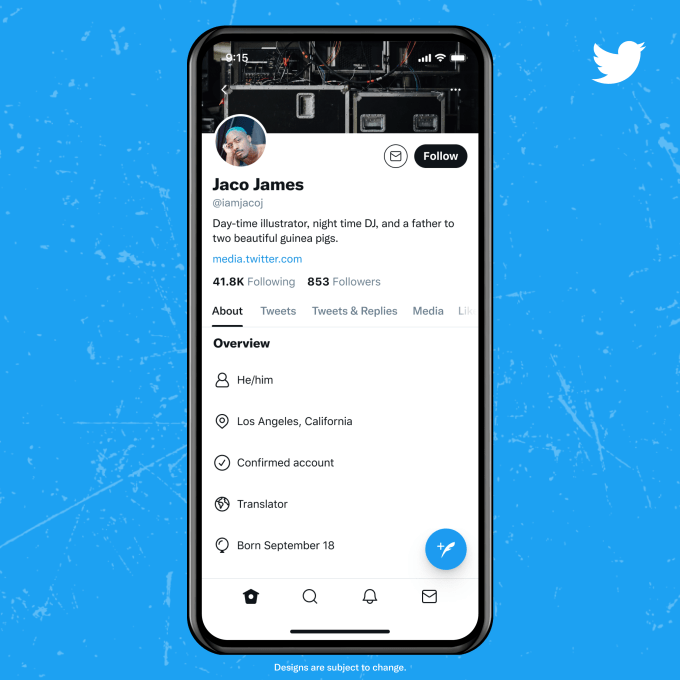
Alongside news that Twitter is relaunching its account verification system to the public, the company previewed a slate of changes that will soon come to Twitter profiles. In addition to your name, photo, banner, bio and other features available today, the new Twitter profile will include an “About” tab that appears to the left of the tabs for Tweets, Tweets & Replies, Media and Likes. This expansion will allow Twitter users to share more about themselves, including their pronouns, location, interests and more.

“The profile hasn’t been meaningfully updated since 2014, which is a little mind blowing, considering how much both Twitter and the world have changed since then,” said Andrea Conway, the lead designer on Twitter’s Identity & Profiles team. “Today, we don’t give people a ton of ways to express themselves and, in turn, we limit the number of signals available to understand the quality of that account, and help people determine who and what to trust on Twitter,” she says. “Additionally, from a design perspective, we’re dealing with a serious lack of space on the profile, and we really want to change that.”

Image Credits: Twitter

Twitter wants the revamped profiles to not only expand the ways users can express themselves, it also envisions the profile as a new entry point to other areas of engagement on the platform in the future. That could be areas like Topics or Spaces, or something else. Though Twitter didn’t detail this point, it’s possible that as it rolls out the new Super Follow button for creators, it may make sense for those users to have more ways to share what they’re all about rather than relying on one of those “link in bio” website builders, for instance.

Twitter also sees the potential for using the profile to increase user engagement.

“We think it’s important to know not only who an account is, and the information they’ve shared proactively, but also what an account is into — because we think that if you’re interested in an account, you might also be interested in what they’re interested in. And this space has the potential to make that a whole lot easier,” Conway adds.

In addition to allowing users to share their pronouns in the new About tab, the redesigned profile will include other fields, sections and components.

Another notable new feature will be the ability to display whether your Twitter account is confirmed. That means you’ve verified your account with Twitter via email or phone. It’s a signal that could help to invite trust — or at least keep you from being trolled by being called a “bot,” a common Twitter insult that’s often levied during heated debates. And it’s a way to “verify” your account even if you don’t qualify for the coveted blue badge — a badge people often want because if conveys some sense of legitimacy.

Other fields currently found in your profile today may move into this About tab, like your location, birthday, join date or translator badge, Twitter says. And going forward, Twitter believes this tab will allow it to be more flexible when it comes to what information people what to share and how they share it.

The company didn’t offer a time frame until the new profiles will launch, but said they would be “coming soon.”

20 May 2021

Twitter opens account verification applications to the public under new guidelines

The coveted blue badge may soon be within your reach. Twitter announced today it will begin rolling out its new verification application system, which allows public figures and other accounts of high public interest to distinguish themselves with a checkmark that indicates they are who they say they are — like a government official, journalist, celeb, brand or business, or other notable name.

Over the next few weeks, Twitter will begin to display the new verification application directly in the Account Setting tab to all users globally. From here, you can submit your application. You’ll then receive an emailed response in one to four weeks, depending on how many open applications are in the queue at the time.

Applications are processed by a newly expanded team at Twitter, not automated, which is why things may slow down at busy times.

If approved, you’ll receive the profile badge automatically. And if denied, you can reapply 30 days after receiving Twitter’s decision. There’s no limit on how many times you can reapply, however.

Image Credits: Twitter; image of verification application screen

The return of verification will greatly expand access to the blue badge that only around 360,000 Twitter users hold today.

The system was officially paused in 2017 as the company grappled with consumer confusion over what it meant to be verified. While the checkmark was only meant to serve as an indicator that someone’s account was authentic, many viewed badgeholders as having some sort of elevated status on Twitter’s platform.

This issue came to a head when it was discovered Twitter had verified the account belonging to Jason Keller, the person who organized the deadly white supremacist rally in Charlottesville, Virginia, even as genuinely noteworthy individuals were struggling to get their own accounts verified.

Although Twitter quietly continued to verify candidates running for public office, public officials, journalists and others in the years since, there was no longer an “official” means of requesting verification.

In late 2020, Twitter finally announced it would relaunch account verifications in early 2021 and debuted a draft of its policy for public feedback. Although Twitter is running a little behind schedule — it’s closer to mid-2021, after all — it is again reopening applications and publishing its new guidelines, which are largely unchanged from their initial publication.

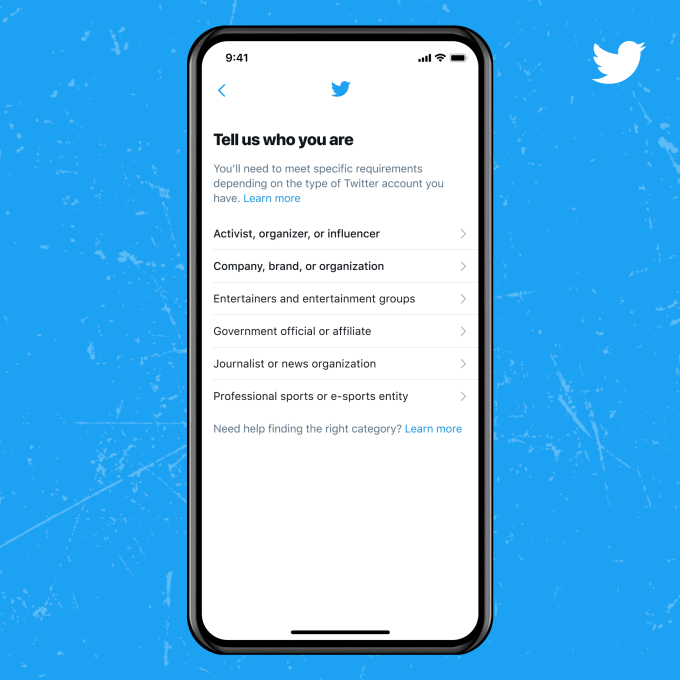
Going forward, to qualify for verification, Twitter users must fit the criteria of one of the six following categories:

  • Government
  • Companies, brands and organizations
  • News organizations and journalists
  • Entertainment
  • Sports and gaming
  • Activists, organizer and other influential individuals

These categories are just the start, Twitter says. It will later expand verification to include scientists, academics and religious leaders later this summer.

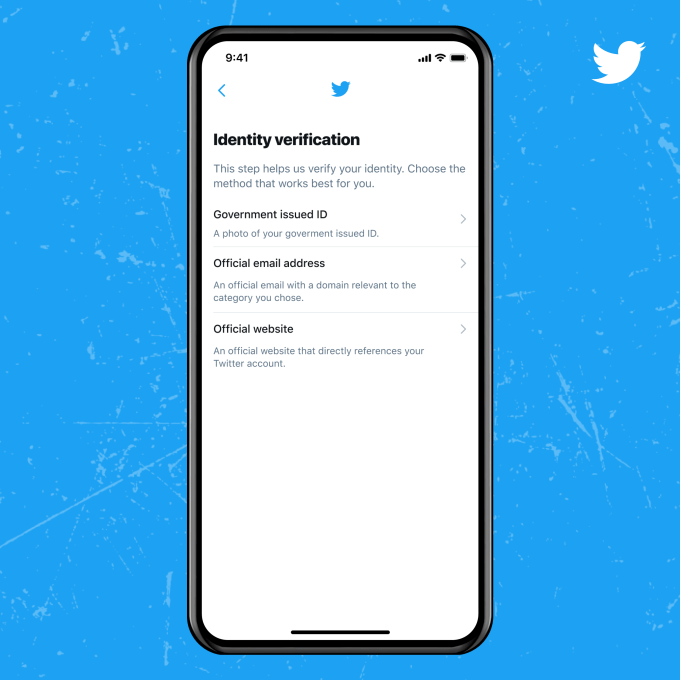
To become verified, an account must first establish its authenticity by providing a photo of an official government-issued ID, or by providing an official email address relevant to the category chosen, or an official website referencing the Twitter account.

Image Credits: Twitter

Each of the specified categories then has its own sets of rules for what qualifies a person for verification.

While these are far too extensive to detail here (you can read through the full policy for that), there are a few rules worth highlighting. For example, journalists have to adhere to professional standards, like fact-checking, to qualify. Being listed in professional databases, like IMDb or Sportradar, can aid in verification for those in entertainment or gaming. And being mentioned by verified press in news articles can help brands and many individuals qualify.

The full rules are fairly detailed, and particularly when it comes to the catch-all category of “other influential individuals.” Here, Twitter has come up with a system that requires a combination of criteria related to both Twitter activity and off-site notability to be deemed noteworthy.

For example, a stable Wikipedia article, profile on Google Trends, news mentions or being listed among the leadership on an official website with “known advocacy work,” can help influential individuals qualify, along with at least one indication of being influential on Twitter itself. This includes meeting a bar for follower count or on-site activity, as defined by Twitter’s criteria.

Image Credits: Twitter

Twitter says it will hold verified accounts accountable for their tweets. In addition to having to follow the Twitter Rules like everyone else (even Trump couldn’t avoid penalty, you probably recall), verified accounts that violate rules will be stripped of their badge. This penalty may be determined on a case-by-case basis, Twitter says. An egregious violation could see the badge immediately removed, but other violations may not see the same measure taken.

Verified accounts also have to have a “complete” profile, meaning profile name, profile image and either a confirmed email or confirmed phone number. The account must be active in the last six months, as well, and can’t have a Twitter Rule violation in the last 12 months that resulted in a seven-day or 12-hour lockout.

This focus on violations as blockers to verification is meant to keep unworthy individuals from getting badged — which was an issue in the past — but it still relies on Twitter’s Trust & Safety team to do their job. And that’s been an area of concern for Twitter, where there are verified users who routinely harass others, including verified female journalists. For verification to work and be trusted, online Twitter Rule-breakers will need to feel the penalty of being un-badged.

Twitter says verification is only one way it’s changing how profiles on its platform will work.

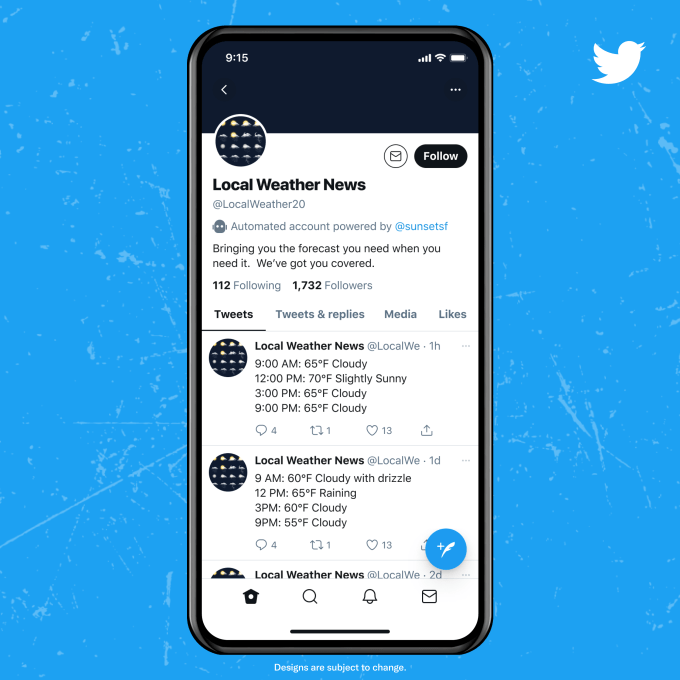
In the future, Twitter will introduce new ways to designate other types of accounts, including “helpful” bots — the automated accounts that provide information that’s useful, like COVID-19 updates or earthquake warnings, for example; or those that use Twitter in a creative way.

Later, Twitter will tackle handling memorialized accounts. But these changes will be about adding designations, not verification.

Image Credits: Twitter; image of an automated account profile

Demand for verification has been growing over the years, particularly as the creator economy has taken shape, where high-profile individuals translate their online fame to real-world success and cash. Creators may not meet Twitter’s criteria for verification, but they’ll soon be able to add “Super Follow” buttons to their profile that will allow subscribers to pay for special access, like exclusive content or newsletters. Meanwhile, Twitter itself is reportedly working on a paid subscription program, Twitter Blue, but this is about gaining access to advanced features, like Undo Tweets and bookmark collections, not about paid access to verification.

To combat the need for everyone to feel important and trusted on Twitter, the company will also be revamping Twitter profiles. (More on that here).

In short, the new profiles will be able to display more information about who they are, including support for pronouns, what they’re interested in, and whether they’re a “confirmed” user — meaning, they’ve verified themselves via an email or phone number.

Image Credits: Twitter

Twitter says it will continue to update and audit it policies around these areas as it moves forward with public applications for verification and the other new features.

“People come to Twitter to read about what’s happening with current events, the global pandemic elections, and other government conversations happening across a variety of topics and interests,” said B Byrne, Twitter’s product lead focused on identity, speaking to reporters about the changes. “The blue verified badge gives people on Twitter more context about who they’re interacting with. They can determine if the content is trustworthy and make their own decisions regarding the sources they choose to follow, which we believe leads to healthier, more informed conversations,” he said.