Author: azeeadmin

20 May 2021

Firefly Aerospace’s lunar lander will fly to the Moon on a SpaceX Falcon 9 in 2023

Firefly Aerospace may be developing rockets of its own, but it’s also simultaneously building Blue Ghost, its first lunar lander. Blue Ghost will hop a ride with a rocket from a different launch company — SpaceX — in 2023, the companies announced today.

While Firefly Aerospace is in the process of developing its own launch vehicles, the company is still looking forward to its first orbital flight of its Alpha rocket, which is not a rocket capable of taking large payloads to the Moon. SpaceX, meanwhile, hasn’t yet sent a Falcon 9 on a lunar mission, but it has flown a lot of successful missions, and its specs allow for Moon deliveries, with many other commercial lunar lander developers selecting the vehicle as their launch vehicle of choice.

Firefly’s Blue Ghost aims to fly in just a couple years’ time, and it’s tasked with carrying 10 payloads on behalf of NASA as part of their Commercial Lunar Payload Services (CLPS) program. NASA is using that program to award private companies missions to carry experiments to the Moon’s surface, in part as preparation for the forthcoming Artemis human Moon exploration (and, eventually, long-term habitation) missions.

SpaceX got the nod in part because the Falcon 9’s performance specs mean the Blue Ghost can conserve more of its own fuel, making it possible for the lander to take on around 150 kg (330 lbs) of cargo. Firefly, like many other CLPS providers, also intends to take up payloads alongside the NASA experiments from other commercial entities, selling off that space to make more revenue.

The first lander launching under CLPS is scheduled to fly sometime in the fourth quarter of this year, and a total of six are currently awarded and planned for tentative launches through 2023.

20 May 2021

Spotify expands into the audiobooks market by partnering with Storytel

Spotify is further expanding into audiobooks — but not in the way you may think. The company today announced a new partnership with audiobooks platform, Storytel, which will allow existing Storytel subscribers to connect their account through Spotify to access their audiobooks within Spotify’s app. The partnership is the first example of what’s possible with Spotify’s recently introduced Open Access Platform, which aims to give creators and publishers a way to extend their reach.

The company briefly spoke about its plans for Open Access Platform during its press event, Stream On, earlier this year where it also detailed plans for paid podcast subscriptions, Spotify HiFi,  and other new features. The Open Access Platform gives a publisher or creator a new way to deliver their content to their existing subscriber base, by allowing their customers to stream the content through Spotify.

The technology supports using the creator or publisher’s existing login system and allows them to maintain direct control over their relationship with listeners. For example, a paid podcast could use the system to stream to existing subscribers. In Storytel’s case, however, the company offers audiobook content, not podcasts.

“We want everyone to have access to great stories, and today Storytel offers more than 500,000 audiobooks on a global basis across 25 markets,” said Jonas Tellander, Storytel founder and CEO, in the company’s announcement. “Partnering with Spotify make amazing audiobook experiences and exciting authorships easier than ever to access for our customers, while we will also be tapping into the opportunity of reaching new audiences who are on Spotify today, but have not yet experienced the magic of audiobooks,” he added.

A competitor to Audible, Storytel offers audiobooks in a variety of languages, including some in English, for a fixed monthly price. Its unlimited library access may make it a better deal for people who listen to more than one than one audiobook per month. Typically, Storytel customers would stream via the mobile app for iOS or Android.

The company has 1.6 million subscribers, per a Reuters report. Spotify, meanwhile, has 356 million users, including 158 million subscribers across 178 markets.

The integration itself will go live later in 2021, allowing Storytel customers to sign into their accounts then stream through Spotify by linking their accounts.

Spotify had dabbled in audiobooks before Storytel. In January this year, for example, it began testing the format with a handful of classics, like “Frankenstein,” “Jane Eyre,” “Persuasion,” and others, narrated by celebs. It had also previously offered the first “Harry Potter” book with chapters narrated by stars like Daniel Radcliffe, David Beckham, and Dakota Fanning.

More partners for the Open Access Platform will be introduced this summer, Spotify says.

20 May 2021

OMG is Canada’s startup answer to the local news crisis

Local news has been battered over the past two decades. The rise of the internet shredded some of the long-held monopolies of newspapers and local TV stations on news and classified ads, while social networks like Facebook, Nextdoor, and Citizen have increasingly pulled in reader attention for neighborhood updates. Newspapers have closed, journalists have been decimated, and there are increasing numbers of “news deserts” with no coverage whatsoever.

At the same time, there is a creator revolution underway right now in online media. Audience development, community, and subscription are coming together in fresh ways that seem particularly opportune for local journalism today. Will these new sets of tools finally allow for the rebuilding of local journalism after the last era of hollowing out?

Overstory Media Group (which goes by the expressive OMG) believes precisely that the software tools and business models have been honed to dramatically change the equation for local news. Co-founded and led by Farhan Mohamed, who was formerly editor-in-chief of Vancouver-focused news site Daily Hive, the company operates 10 local news brands and has hired 30 full-time employees as it creates a sustainable and dare I say profitable approach to local media.

“I had my own email newsletter when I was a kid,” Mohamed recounts. I “saw a gap: no one is telling me what is happening around me.” To get a sense of the bootstrapped nature of the operation, he sent the newsletter through Hotmail, and he eventually migrated into the modern world of local journalism. What he found was distressing. The “user experience is terrible, stories are terrible… I don’t know how normal people do this,” he said.

He saw an opportunity in starting over with the basics of what local news means for its own community. “I come from a background of community building, rather than just the news and journalism,” he said. He felt that there was a model of using modern internet technologies to allow readers to be stakeholders in these news operations.

He ultimately linked up with Andrew Wilkinson, who runs Tiny Capital, a fund that buys tiny internet businesses and scales them up while allowing their original founders to exit. He had created a newsletter-driven publication called Capital Daily to cover the developments in Victoria, British Columbia. Very quickly, the publication started getting tens of thousands of subscribers, all for a region with just a few hundred thousand people in it.

Mohamed and Wilkinson came together to found OMG and start to scale the Capital Daily model to more publications. They built out a tech stack centered on Pico, which just closed a new $6.5 million seed round last month, and also designed growth and brand playbooks for switching on new brands.

The goal with each new brand is to get to breakeven as quickly as possible. “We have our models and projections on how long it takes to get a brand sustainable, and with each brand, we are refining that model,” Mohamed said. “Maybe it’s not 12 months to sustainability, but 10 months or even 9 months.” His goal is ambitious: he wants to get to 50 brands and 250 journalists by 2023, and “I also think we could get to 100 brands.”

While the company has what I would dub playbooks, it understands that not every brand is going to be identical. It has a basic structure for how each brand should be built and what cadence new stories need to be delivered, but it is also flexible in responding to the unique needs of each new audience it brings to the table.

For journalists, the company’s pitch is centered on stability and focus on growth. “You have editorial control, you just do what you need to,” he said. “We can help you… we know what is going to work” when it comes to building out community and growth marketing. Perhaps most valuable for journalists is the community of other reporters who are walking the same path and are confronting similar challenges as they expand their communities and subscriber bases.

While the company has been exclusively focused on Canadian brands so far, covering cities as diverse as Vancouver, Victoria, Fraser and Calgary, it also sees opportunities to export its model outside the great white north. “We’ve had conversations with people in the States, in Southeast Asia, in Europe,” Mohamed says.

Obviously at this point, a certain cynicism can enter into any analysis of local news, what with decades of misfires and overly-optimistic dreams of success amidst the rubble of legacy publishing empires. But OMG has a bit of that pop that says, this time, it might just be different.

20 May 2021

Chasing hype is human nature: The tyranny of startup trends

I think it’s important that we explicitly discuss something that every VC instinctively knows: The hype around a given business or category has become a form of bias for investors and founders when vetting ideas to pursue. At any point in time, you can find FOMO-flavored bad business decisions based on false market signals somewhere in tech. It’s human nature for excitement to be contagious, but treating it as a leading factor when considering a new opportunity is not a good idea.

It’s human nature for excitement to be contagious, but treating it as a leading factor when considering a new opportunity is not a good idea.

Take the 17th century tulip-mania, when, at one point, Dutch speculators drove tulip futures so high that one bulb of a particularly rare species was valued at more than a fully furnished luxury house1. We can look at this and collectively lampoon anyone who could possibly have bought into that absurd trend.

But that’s the rule with mega-hyped markets. The dot-com apocalypse was inevitable in hindsight. So was the consumer lending bubble that set off the global financial crisis. But major market catastrophes aside, newly hyped sectors in tech seem to pop up, like Moore’s Law clockwork, every year or so.

In the last 15 years, giant bonfires of cash have turned to ash financing companies in hyped up sectors like SoLoMo (I bet many people reading this have never even heard of this trend), clean tech, VR gaming, daily deals, crypto (which spawned flashy undercard entries like PotCoin, BurgerKing’s WhopperCoin, and yes, TrumpCoin), the sharing economy, scooters (in which Bird, Lime, Lyft and Uber competed around little more than the color scheme of the otherwise identical Segway Ninebots), and SPACs (through which the aforementioned white-colored scooter company is going public).

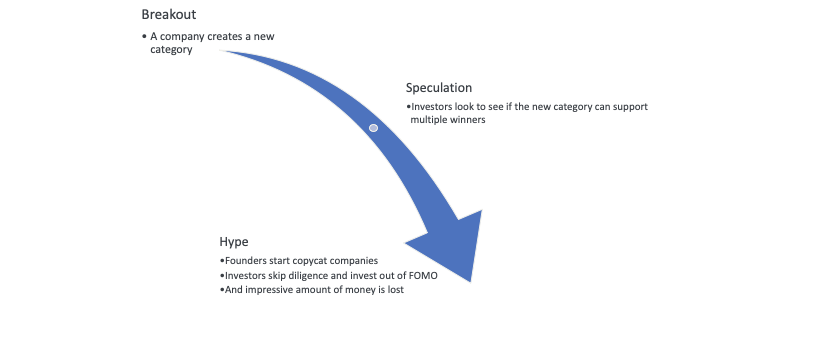
Usually, these bubbles start when a breakout company creates a discontinuity in the market — a technology that changes how we live (Apple’s iPhone), or delivers an exceptional solution to a ubiquitous pain point better and more cost effectively than before (Uber’s ride-sharing). Rational speculators look to apply lessons from these breakouts to identify other massive winners. If a few seem to take off, irrational FOMO takes over.

The hype-driven race to the bottom

The hype-driven race to the bottom. Image Credits: Victor Echevarria

What does that look like? Here’s an actual example, per data sourced from PitchBook:

  • Yelp creates a new way for local businesses to engage their customers.
20 May 2021

Workrise, once known as RigUp, raises $300M at a $2.9B valuation

Workrise, which has built a workforce management platform for the skilled trades, announced today that it has raised $300 million in a Series E round led by UK-based Baillie Gifford that values the company at $2.9 billion.

New investor Franklin Templeton joined existing backers including Founders Fund, Bedrock Capital, Andreessen Horowitz (a16z), Moore Strategic Ventures, 137 Ventures and Brookfield Growth Partners in putting money in the round. WIth this latest financing, Workrise has now raised over $750 million.

You may know Austin-based Workrise better as its former name, RigUp. The company changed its name earlier this year to reflect a new emphasis on industries other than just oil and gas after the industry took a beating in recent years.

In 2020, Workrise laid off one-quarter of its corporate employees as the industry took an even bigger hit from the COVID-19 pandemic. It currently has over 600 employees in 25 offices.

Workrise was founded in 2014 as a marketplace for on-demand services and skilled labor in the energy industry. In October 2019, it raised a $300 million Series D round led by Andreessen Horowitz(a16z) that valued the company at $1.9 billion.

Since then, Workrise has broadened its reach to include wind, solar, commercial construction and defense industries. In a nutshell, the company connects skilled laborers with infrastructure and energy companies looking to staff and manage projects efficiently. The company’s online platform matches workers with over 500 companies in its network, manages payroll and benefits and provides access to training.

The company plans to use its new capital to continue to expand into new markets.

“The shift to clean energy and a redoubling of investment in infrastructure are opening up jobs that are desperately in need of filling,” said Workrise co-founder and CEO (and former energy investor) Xuan Yong in a statement. “Our platform makes it easier for skilled workers to find work and for companies to hire in-demand workers.”

Dave Bujnowski, investment manager at Baillie Gifford, points out that Workrise’s online management platform is “disrupting a sector that’s so far been slow to adopt new technologies.”

Workrise now serves more than 70 metro areas in the U.S., including Atlanta, where the company is matching trade workers with commercial construction companies, and in Broomfield, CO where the company trains and matches workers to jobs across the U.S. wind industry. 

The company also offers trade workers access to training that equips them for energy and infrastructure jobs that are on the rise. Last year, Workrise placed more than 4,500 workers, or nearly a third of all its workers placed in 2020, in renewable-energy jobs. 


20 May 2021

Kleiner spots Spot Meetings $5M to modernize walk-and-talks for the Zoom generation

Trees, those deciduous entities you can occasionally see outdoors when not locked down or strapped down at a desktop ruminating on a video call, have long been the inspiration for fresh new ideas. Stories abound of how founders built companies while walking the foothills in Silicon Valley or around parks in San Francisco, and yet, we’ve managed over the past year to take movement mostly out of our remote work lives.

Chicago-based Spot Meetings wants to reinvigorate our meetings — and displace Zoom as the default meeting medium at the same time.

The product and company are just a few months old and remain in closed beta (albeit opening up a bit shortly here), and today it’s announcing $5 million in seed funding led by Ilya Fushman at Kleiner Perkins. That follows a $1.9 million pre-seed round led by Chapter One earlier this year.

CEO and co-founder Greg Caplan said that the team is looking to rebuild the meeting from the ground up for an audio-only environment. “On mobile, it needs to be abundantly simple to be very functional and understood for users so that they can actually use it on the go,” he described. In practice, that requires product development across a wide range of layers.

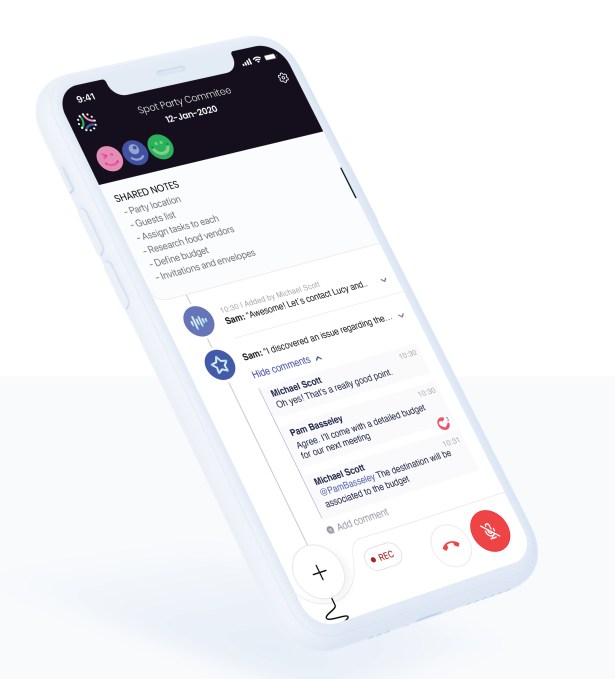
The product’s most notable feature today is that it has an assistant, aptly named Spot, which listens in on the call and which participants can direct commands to while speaking. For instance, saying “Spot Fetch” will pull the last 40 seconds of conversation, transcribe it, create a note in the meeting, and save it for follow-up. That prevents the multi-hand tapping required to save a note or to-do list for follow up with our current meeting products. You “don’t even need to take your phone out,” Caplan points out.

What gets more interesting is the collaboration layer the company has built into the product. Every audio meeting has a text-based scratch pad shared with all participants, allowing users to copy and paste snippets into the meeting as needed. Those notes and any information that Spot pulls in are saved into workspaces that can be referenced later. Spot also sends out emails to participants with follow-ups from these notes. If the same participants join another audio meeting later, Spot will pull in the notes from their last meeting so there is a running timeline of what’s been happening.

Spot’s product design emphasizes collaboration within an audio-focused experience. Image Credits: Spot Meetings

Obviously, transcription features are built-in, but Spot sees opportunities in offering edited transcripts of long calls where only a few minutes of snippets might be worth specifically following up on. So the product is a bit more deliberate in encouraging users to select the parts of a conversation that are relevant for their needs, rather than delivering a whole bolus of text that no one is ever actually going to read.

“Collaboration from now and the future is going to be primarily digital … in-person is forever going to be the exception and not the rule,” Caplan explained. Longer term, the company wants to add additional voice commands to the product and continue building an audio-first (and really, an audio-only) environment. Audio “very uniquely helps people focus on the conversation at hand,” he said, noting that video fatigue is a very real phenomenon today for workers. To that end, more audio features like smarter muting are coming. When a participant isn’t talking, their background noise will automatically melt away.

Before Spot Meetings, Caplan was the CEO and co-founder of Remote Year, a startup that was designing a service for company employees to take working trips overseas. I first covered it back in 2015, and it went on to raise some serious venture dollars before the pandemic hit last year and the company laid off 50% of its workforce. Caplan left as CEO in April last year, and the company was ultimately sold to Selina, which offers co-working spaces to travelers, in October.

Caplan’s co-founder who leads product and engineering at Spot Meetings is Hans Petter “HP” Eikemo. The duo met each other during the very first Remote Year cohort. “He has been a software engineer for two decades [and was] literally the first person I called,” Caplan said. The team will grow further with the new funding, and the company hopes to start opening its beta to its 6,000 waitlist users over the next 3-4 weeks.

20 May 2021

Ford and SK Innovation announce battery manufacturing joint venture BlueOvalSK

Ford Motor Company and Seoul, South Korea-based SK Innovation signed a memorandum of understanding to establish a joint venture to domestically manufacture batteries for electric vehicles, the two companies said Thursday. The new venture, dubbed BlueOvalSK, will produce around 60 GWh annually starting mid-decade. The MOU is the latest sign that Ford intends to vertically develop its battery capabilities.

“Initially with just a Mustang Mach-E, we felt like it was most efficient for us to purchase the batteries from the supply base, but as we start to move up that adoption curve, and move from just the early adopters to the early majority [. . .] we now have sufficient volume to justify this level of investment and this is why we’re pursuing this partnership,” Ford’s chief product platform and operations officer Hau Thai-Tang said Thursday.

Ownership structures will be worked out in the future, Lisa Drake, Ford’s chief operating officer, told reporters Thursday. The 60 GWh production capacity would likely span two manufacturing sites but the companies are still determining those plans, including locations of the plants across North America, Drake added. 60 GWh roughly translates to enough battery capacity to build 600,000 vehicles, Thai-Tang said.

Ford has taken strides in recent months to build a vertically-integrated capability to manufacture battery cells at scale. In April the Dearborn, Michigan-based automaker said it would open a battery technology development center in Michigan. It also led, with BMW, a $130 million investment into solid-state battery developer Solid Power’s Series B round.

But Ford has not always been so bullish on making batteries in-house. “Our product plans changed dramatically,” Thai-Tang said.

The news comes less than 24 hours after Ford debuted its F-150 Lighting, the electric version of its iconic nameplate vehicle and the best-selling truck in America. The Lighting is one of three EVs that Ford has debuted in the past year and will be a cornerstone of the company’s plans to invest $22 billion in EVs through 2025.

SK Innovation already has two separate EV battery plants under construction in Georgia under a collective investment of $2.6 billion. One of the batteries is already producing batteries and the other is set to become operational in 2023. The company is also building a separate factory in Tennessee with Volkswagen AG as its customer. Ford and SK Innovation’s relationship spans many years, with the automaker selecting SK as its battery supplier for the Lightning in 2018.

The company recently completed a $1.8 billion settlement in April over trade secret disputes with rival LG Energy Solutions. The resolution came after a two-year dispute that nearly led to SK Innovation shutting down its Georgia plans.

The two Korean conglomerates have invested billions in American battery manufacturing alongside their automaker partners. LG Energy is building manufacturing facilities in Ohio and Tennessee under its joint venture with General Motors, Ultium Cells LLC.

“The scale just makes sense now,” Drake said. “It’s the perfect time to start to do this.”

20 May 2021

Pitch, a platform for making and sharing presentations, raises $85M on a $600M valuation

Powerpoint may still dominate the landscape for presentations in many people’s minds, but some might say that legacy status also makes Microsoft’s software ripe for disruption. Now, a startup out of Berlin called Pitch has just picked up a substantial Series B of $80 million to take it on with what it believes is a more dynamic approach.

The round is being led by Lakestar and Tiger Global, with previous backers Index Ventures and Thrive Capital also participating. We understand from sources close to the company that the valuation is now at $600 million for the Berlin-based startup.

In the words of CEO and co-founder Christian Reber, the ambition is to create the “YouTube for presentations” with the ability for people to create, create, collaborate on, and share presentations with each other through an online-based interface.

His interest, meanwhile, in taking on Microsoft has a deeper story to it. As we have covered before, Reber’s previous startup, the planning startup Wunderlist, was acquired by Microsoft and folded into its productivity suite, only to eventually be killed off, much to Reber’s disbelief and disappointment.

Not to dwell too much in the past, the funding Pitch has now raised will be used in several areas, including hiring more people and reach. The startup has already seen good progress on the latter front. Pitch is already being used by tens of thousands of teams, it ways, who have created some 125,000 workspaces on the platform. Customers include (ironically) a number of other trailblazers in the world of business productivity: Intercom, Superhuman and Notion are among the list.

The plan will be to work on bringing on more users into its freemium universe, while converting more to its Pitch Pro $10/user/month paid tier, which includes more extensions like unlimited storage, video uploads, version history, and advanced permissioning. Pro already has a “couple of thousand” subscribers, Reber said, enough to prove out that “we definitely see our business model working.” Pitch is also working on rolling out an enterprise version so that it can sell Pitch into the bigger businesses and deployments that dominate usage of Powerpoint.

And the other way that Pitch plans to bring more people into the fold will be with more functionality. Along with the funding, Pitch is rolling out some new features that will include the beginnings of an ecosystem, where presentation designers and creators will be able to upload both presentation templates, as well as presentations themselves, to help other people get started in creating their own presentations.

The idea here is to celebrate creators, Reber said, but it’s (at least for now) stopping short of paying them, seeing this more as a way of sharing designs and ideas in a more collaborative exchange with each other. Both, however, seem to me to be ripe opportunities down the line for building a marketplace. Creating a great pitch deck for a startup is great to share as a resource, but if you are also, say, a leadership coach who makes a living out of giving people inspiring direction on how to handle something, a pitch deck with that IP in it perhaps might not be something you’d always be willing to part with for free. (Reber says his inspiration here was the world of design forums like Dribble where an exchange of ideas has thrived.)

Initially, the user-generated content will be selected by Pitch itself, although the plan over time will be to make it something that will be open to everyone, Reber said.

Another new feature will be presentation analytics. This will not be unlike the kind of data that people currently can apply to, say, email or web traffic to measure what people are clicking on, how long they are spending looking at content, and where they are dropping off. Pitch will apply the same to its presentations — which are HTML-coded — so that those who are making them and sending them around can get a better idea of how they are performing, and even begin the process of A-B testing to try out different approaches.

Reber points out that analytics will be opt-in only: if users choose not to share that tracking it won’t be shared, he said.

“As a German business, we have a special relationship with data privacy in the greatest sense,” he said. “We care deeply about making sure we approach features in a privacy-first way.” The idea is to make it less like spyware, and more like the kind of analytics one might have on YouTube for videos there.

Finally, it’s adding in more video features to bring in narrative recording and playback. These first will be “recorded” around the presentations themselves, but longer term, it’s likely that the feature will also have a live element, which makes a lot of sense since a lot of presentations have had their most highly trafficked exposure by way of webinars or live presentations (say, around an earnings call), where you might not only have multiple presenters talking along a slide deck, but also people feeding back, asking questions in relation to the presentation and so on.

If this all sounds a little WordPress-like, that’s not a coincidence. Reber noted that website building is something else that Pitch wants to bring into the platform. “We are experimenting with that,” he said. “In my opinion, presentations are collections of information and we want to publish them in various ways. Slides just happens to be one format. But if it’s all already written in HTML, why not build it also into a site? That will be another feature coming, and something that we will be also using the funding for.”

Indeed that may not work for deeper content efforts (such as publications like the one you are reading right now) but would be perfectly adequate for, say, basic sites along the kind that are built on sites like Squarespace to lay out some online real estate for a small business. The scope of what you can already do, and what Pitch wants you to do, is precisely what makes this all so interesting to investors, they say.

“The exciting vision that Christian and the team at Pitch have is beyond just being a superior alternative to legacy presentation software,” said Stephen Nundy, partner at Lakestar, in a statement. “A reimagining of the entire workflow surrounding presentations is very much overdue, and when coupled with the ability to harness new data and media integrations, Pitch will lead the way in changing how stories are told. I’m very proud to be joining the board of a European company with its sights set on a truly global opportunity.”

“We are incredibly impressed by the quality of Pitch’s offering today and Christian’s vision for the future. Pitch will be a true productivity platform, and we are excited to become investors in this special company,” John Curtius, partner at Tiger Global, added.

Reber’s take on the new tools also here:

20 May 2021

A16z bets millions on Maven, a platform for cohort-based courses

Maven, a startup that helps professionals teach cohort-based classes, has raised $20 million in a Series A round led by Andreessen Horowitz. The round places A16z general partner Andrew Chen on Maven’s board – and is his latest lead check in a creator-focused company, similarly pouring millions into recent rounds for Clubhouse and Substack.

The investment comes seven months after Maven, then nameless, left stealth alongside a $4.3 million round led by First Round Capital, and three months after it raised a $750,000 equity crowdfunding round. While the company declined to disclose valuation, we do know that it’s a lot of fast cash earmarked toward fueling the same bet: that the future of cohort-based learning is the future of education.

And if you’re wondering why, I’d tell you it’s two-fold. First, the startup has an impressive founding team: Udemy co-founder Gagan Biyani, altMBA co-founder Wes Kao, and early Venmo employee and Socratic co-founder Shreyans Bhansali.

Second, Maven has some impressive growth to tout, showing its potential. Maven’s core product right now is a suite of services that makes it easier to run a cohort-based course, while taking a 10% fee – similar to Substack – from a professional’s revenue. In three months after its January launch, four Maven courses earned over $100,000. To date, over $1 million worth of courses has been sold on Maven.

With the new capital, Kao tells me that her team is focused on getting instructors to see the value of CBCs. The startup has had over 2,000 people apply to become instructors, and expects to grow from 7 to 100 instructors by end of the year. Some of Maven’s investors, including Sahil Lavingia and Li Jin, are instructors on its platform. Long-term, the startup sees its competitive differentiation as helping experts who aren’t “conventional instructors” start sharing their knowledge.

The co-founder teaches a course to all incoming Maven instructors – meta, I know – from deciding to put in a curriculum to understanding course-market fit and building buzz for the course.

While Kao explained that instructors like the idea of turning free advice in modular, revenue-generating classes, she said “monetizing that expertise is often really hard.”

“Traditional platforms—Instagram, TikTok, Twitter—create a division between activities intended to monetize and those meant for community building,” she said. “Meaning, creators give away valuable content, and then monetize via brand partnerships or low-margin merchandise—activities that often detract from community-building.”

The biggest challenge ahead, she thinks, is expanding the mindshare about CBCs for creators. It needs to show the importance of signal in the cacophony of air horns that want creator’s attention.

It’s a problem that Maven is all too familiar with it.

“One of the biggest things we had to untangle early on was the difference between “content” and the Maven offering,” Kao explained. “There’s no shortage of content in our world.” The startup had to spend a good chunk of time figuring out how to create a cohort-based class experience that pairs community and accountability with that content. And it still has ways to go.”

“At the end of the day, it ended up being quite simple. In our view, we’ve reached the Post Content Age,” she said. “In other words: Content is no longer scarce in education. It’s either free or low cost, and it’s abundant.”

20 May 2021

HP outlines ambitious diversity goals

HP today announced a series of ambitious goals aimed at driving “a more diverse, equitable and inclusive” tech industry.

The tech giant, of course, is not the first company to have made strong claims about its intentions around diversity. As former TC reporter Megan Rose Dickey reported extensively, diversity and inclusion as an idea has been on the agenda of tech companies for years now. 

HP Chief Diversity Officer Lesley Slaton Brown says diversity and inclusion is something that the company has been focused on since its 1939 inception. Today, HP has roughly 50,000 employees globally with 31% of its leadership roles and 22% of its technical roles currently held by women – numbers that appear to be higher than most industry averages.

In order to further improve these numbers, HP announced three goals that Slaton Brown says the company is determined to achieve by 2030: 50/50 gender equality in HP leadership (defined as director level and up); greater than 30% technical women and women in engineering; and meet or exceed labor market representation for racial/ethnic minorities. 

I talked with Slaton Brown to get more details on the goals themselves, how the company plans to achieve them and what it plans to do to hold itself accountable. 

This interview has been edited for brevity and clarity.


TC:  Tell me more about the genesis of these goals and what HP has done up until now to achieve more equality – whether it be with regard to gender, race or ethnicity – within the company?

Slaton Brown: It’s foundationally something that we’ve always been focused on. We’re now at a place where I think going into COVID and quarantine last year and the impact that the George Floyd murder had on us as a nation really allowed us to do the double click down into racial equality and the systemic and structural discrimination that exists. 

From that, we were able to then stand up our Racial Equality and Social Justice Task Force. One of our goals has been to increase the representation of Black and African Americans in particular at HP. And also look at what we would need to do to increase the opportunity of Black and African American suppliers and vendors who work with and partner with HP. And then ultimately, how can we impact the communities locally and nationally – whether it’s from policy and legislation to working with municipalities in order to provide bias training and things like that. So all of that was stood up, and now a year later, we’ve made some great progress. 

HP Chief Diversity Officer Lesley Slaton Brown / HP

We have also launched our Human Rights Initiative. We’re looking at standing up for equal and human rights. We’re really focused on how we go after climate action and human rights.

TC: It sounds like that you are committing to a variety of things in terms of more balance among leadership and technical talent in terms of gender, for one. So it’s not just about race. But I’d like to hear more specifics on these particular goals and what you have done historically to work toward greater diversity and inclusion.

Slaton Brown: When we separated in 2015 from HP Co. We were very intentional about creating a diverse board of directors, first and foremost. And so today when I think about our board composition, we’re made up of I think it’s about 45% women, 35% ethnic minorities and over 60% total minorities with just our board of directors alone. We’re one of the most diverse boards in the tech industry. Now why is that important? The importance of building or standing up a board of directors is because they help with the vision of the company and help guide the strategy for the company.

That was one of the first things we did, and when I came into this role at that time, my goal was to embed diversity, equity and inclusion into everything that we do. 

TC: How are you holding yourselves accountable?

Slaton Brown: We’re really talking about answering all the way up to the board of directors on what we’re doing – our dashboards, our matrices that we pulled together will go to our board of directors to say, ‘Here’s what we said we’re going to do, how are we tracking, and then ultimately what was the impact.’ And so that’s what we’re building today. I consider that the infrastructure. So from the board of directors down cascading to your executive leadership team, ensuring that we have a strong narrative built.

By having this goal, we can then drive the actions, the programs, and then the implementation through our infrastructure and an ecosystem to achieve those goals. That includes things like working with organizations like the Society of Women Engineers, the Society of Black Engineers and the Society of Asian Engineers. And not only working with them, but building and investing in them so that we build the partnership in order to get to that pipeline.

TC: Can you be more specific in terms of what you mean by meeting or exceeding labor market representation?

Slaton Brown: I can see where that would be confusing. First, what it doesn’t mean is trying to match the demographics of the overall population, but rather to the labor market in the tech industry. For example, we’re at nearly 4% of having African Americans in a leadership position. Our goal is to achieve hiring at or more than 6% by 2025.

TC: What if you’re not getting enough women or minorities to apply for these leadership and technical roles? Would you rule out qualified white males, for example?

Slaton Brown: We are standing up for equal human rights. What we’re focusing on is also accelerating our gender, racial equality and social justice efforts. Part of that is looking at how do we increase our pipeline? And, how do we increase the talent pool? 

I would submit there is not a shortage of talent. It’s about how do you get to the talent? It has traditionally been through top tier schools such as Stanford and MIT. But you know what? Smart people and great talent are everywhere. People are sometimes financially challenged and so they may go the community college route, and then they might move into some of the top tier schools. That’s one means in addition to HBCUs (historically Black colleges and universities).

For example, we’ve stood up a very good program in the HBCU space to ensure that students that have not traditionally had the opportunity to compete for certain positions have that opportunity and not only have that opportunity, but have the ability to travel to HP sites to see where they would be likely interning. Our goal is to have a 100% conversion rate in terms of converting interns into full-time hires based off of performance, of course. And so it is a holistic or an end-to-end approach.

Okay, so now you’ve made these goals for women and for ethnic minorities and the white guy might say, ‘I’m left out.’ I think the interesting thing about that is that within the tech industry, the white male is the majority. What we’re doing at HP is building a powerful culture of inclusion and belonging. So we’re still getting white guys, but we’re also getting very talented women, and US ethnic minorities, as well, in addition to veterans and people with disabilities. 

It’s about where you go, how you show up as a brand of choice – which is a goal of ours: to be a destination of choice for the underrepresented group – and  then how you welcome them. It’s the attraction, the hiring, the retention, the investment you make in their learning and development, and then in promotion, as well. And so those are some of the things that we’re doing.

TC: What are other ways you are fighting for human rights?

Slaton Brown: This announcement is around how we’re doubling down on our workforce, workforce empowerment, and that is about how we do things is just as important as what we do. And that’s about respecting human rights, and making it a priority. Our commitment to our supply chain workers is to ensure that our vendors are not contributing to the modern day slavery, or bringing in people with degrees and education and then bringing them into a system that charges them charges them ginormous fees and takes their passport.

We want to ensure that we create an environment, and create visibility and a resilient supply chain to ensure that that doesn’t happen, that we respect human rights, and that our manufacturing suppliers are contributing to that, as well.

TC:  In press materials, the company claimed to be the first Fortune 100 tech company to commit to gender parity in leadership.” Hopefully you’ll be setting an example and others will follow.

Slaton Brown: Well, it’s a huge goal and so some of the strategies and best practices that we’ve put in place really is not just about bringing women in as a checkbox exercise for us, but to really establish a new standard.

Our goal and our vision is to become the most sustainable and just tech company in the world. And so we can’t just say that we have to do it. And that’s what I love about the culture of HP – it’s moving from the talk, and really showing the actions in which we’re going to get to that place of being sustainable and just by 2030.