Author: azeeadmin

20 May 2021

Ex-Square execs launch Found to help the self-employed, raise $12.75M from Sequoia

If you’ve ever been self-employed you know what a pain it is to keep up with the hassles of running a business. From bookkeeping to invoicing to paying taxes — it’s one big headache.

Freelancers and self-employed people often turn to a number of different solutions to try and address different aspects of running their business. It can be a lot to keep up with.

Enter Found. Previously called Indie, the startup was founded by two former Square execs who got firsthand insight into how SMBs paid their employees.

Lauren Myrick joined Square in 2010 and was the second project manager at the company. She helped launch its first POS (point-of-sale) product and its SaaS products. She eventually became GM of its payroll business unit, and that was her first foray into taxes and understanding their implication. Co-founder Connor Dunn ran engineering for Square Payroll.

After that experience, the pair saw an opportunity to launch a suite of services for self-employed businesses, which have been growing even faster during COVID.

“We started to pay attention to the movement toward self-employment,” Myrick told TechCrunch.

So in 2019, the pair interviewed “lots” of self-employed people to better understand their pain points. What they found is that taxes and expense tracking were considered among the more painful and expensive parts of being self-employed. So they formed Found (formerly called Indie) with the goal of creating a “one-stop shop” for business banking, bookkeeping and taxes for self-employed businesses.

And today, the San Francisco-based startup has raised $12.75 million in a round led by Sequoia that also included participation from some angel investors.

Image Credits: Found co-founders Lauren Myrick and Connor Dunn / Found

Myrick is no stranger to being self-employed herself, having worked as a public accountant after college. Also, her sister is a self-employed yoga instructor.

In Found, Myrick’s two previous professional worlds have come together. 

“With my accounting background and what I learned at Square, I had this big aha moment that we could become a ledger for these businesses, and solve their bookkeeping and tax needs through software,” she said. “So that’s what we’ve built.”

Customers can use the platform to do things like deposit business income, obtain a debit card for business purchases and calculate how much they owe in taxes. The platform also offers a feature that sets aside the money for, and facilitates, the quarterly tax payments, for example. It also offers real-time business and tax reports, so when a business owner swipes their card, expenses are reflected in real time.

Sequoia’s Josephine Chen and Alfred Lin said they were impressed with Myrick from their first call with her.

“Lauren has incredible context and command of the details. She talked about the hoops self-employed people have to jump through to fill out their Schedule Cs; she explained some of the finer points of different tax codes — and we were riveted,” the pair say.

Lin said he was particularly intrigued by the concept of Found because while he was in graduate school he ran a small data analysis business on the side.

“I had to invoice, report on taxes and do my own bookkeeping,” he recalls. “And I kept it together with a spreadsheet. I thought to myself that there should be better tools to do some of this stuff. And that is what Lauren has done with Found.”


20 May 2021

So long, Internet Explorer, and your decades of security bugs

Image Credits: Louis Douvis / Getty Images

Pour one out for Internet Explorer, the long-enduring internet browser that’s been the butt of countless jokes about its speed, reliability, and probably most notable of all, security, which will retire next year after more than 25 years of service.

Microsoft said it will pull the plug on the browser’s life support in June 2022, giving its last remaining half a dozen or so users a solid year to transition to Chrome or Firefox — let’s be honest here — though other respectable browsers are available. There will be some exceptions to the end-of-life plan, such as industrial machines that need the browser to operate.

For years, Microsoft has nudged Internet Explorer users towards its newer Edge browser as a more reliable and secure alternative to the ailing Internet Explorer, often in the most obnoxious ways possible by splashing on-screen ads the second you flirt with using a rival browser. As the wider web’s support for Internet Explorer dwindled, enterprises have also begun phasing out support for the browser.

But in ending support for Internet Explorer, Microsoft is parting ways with one of the most problematic security headaches in its history.

Virtually no other software has been subject to more security bugs than Internet Explorer, in large part due to its longevity. Microsoft has patched Internet Explorer almost every month for the past two decades, trying to stay one step ahead of the hackers who find and exploit vulnerabilities in the browser to drop malware on their victims’ computers. Internet Explorer was hardened over the years, but it lagged behind its competitors, which sped ahead with frequent, almost invisible security updates and tougher sandboxing to prevent malware from running on the user’s computer.

As much as it’s easy to hate on Internet Explorer, it’s been with us for almost three decades since it debuted in Windows 95, and it’s served us well. For many of us who grew up on the internet in our teens and twenties, Internet Explorer was the first — and really the only — browser we used. Most of us signed up for our first Hotmail email address with Internet Explorer. We learned how to code our MySpace page using that browser, and we downloaded a lot — and I mean a lot — of suspicious-looking, malware-packed “games” that slowed the computer down to a crawl but thought nothing of it.

I remember, as a 10-(ish)-year-old child, seeing for the first time the pixelated Internet Explorer icon on that bright, teal wallpapered cathode-ray monitor in a cold attic room in our family home, because, not really knowing what the internet was, I complained to my father: “I don’t want to just explore the internet. I want to see the whole thing.”

Thanks to Internet Explorer, I got to see a large part of it.

20 May 2021

Privacy.com rebrands to Lithic, raises $43M for virtual payment cards

When Privacy.com was founded in 2014, the company’s focus was to let anyone generate virtual and disposable payment card numbers for free.

The goal was to allow those users to keep users’ actual credit card numbers safe while allowing the option to cut off companies from their bank accounts. In an age of near-constant data breaches and credit card skimmers targeting unsuspecting websites, Privacy.com has made it harder for hackers to get anyone’s real credit card details.

The concept has appealed to many. At the time of its $10.2 million Series A last July, Privacy.com said it had issued 5 million virtual card numbers. Today, that number has more than doubled, to over 10 million, according to CEO and co-founder Bo Jiang.

“We set out to create the safest and fastest way to pay online. Our mobile app and web browser extension lets you generate a virtual card for every purchase you want to make online,” Jiang explained. “That can be especially convenient for things like managing subscriptions or making sure your kid doesn’t spend $1,000 on Fortnite skins.”

Over the years, the New York-based company realized the value in the technology it had developed to issue the virtual and disposable payment cards. So after beta testing for a year, Privacy.com launched its new Card Issuing API in 2020 to give corporate customers the ability to create payment cards for their customers, optimize back-office operations or simplify disbursements.

The early growth of the new card issuing platform, dubbed Lithic, has prompted the startup to shift its business strategy — and rebrand.

In the process of building out its consumer product, Privacy.com ended up building a lot of infrastructure around programmatically creating cards.

“If you think about the anatomy of credit/debit card transactions there’s a number of modern processors such as Stripe, Adyen, Braintree and Checkout,” Jiang told TechCrunch. “On the flip side, we’re focused on card creation and issuing, and the APIs for actually creating cards. That side has lagged the card acquiring side by five to seven years…We’ve built a lot to support card creation for ourselves, and realized tons of other developers need this to create cards.”

As part of its new strategy, Privacy.com announced today that it has changed its name to Lithic and raised $43 million in Series B funding led by Bessemer Venture Partners to double down on its card issuing platform and new B2B focus. Index Ventures, Tusk Venture Partners, Rainfall Ventures, Teamworthy Ventures and Walkabout Ventures also participated in the financing, which brings Lithic’s total raised to date to $61 million.

Image Credits: Lithic CEO and co-founder Bo Jiang / Lithic

Privacy.com, the company’s consumer product, will continue to operate as a separate brand powered by the Lithic card issuing platform.

Put simply, Lithic was designed to make it simple for developers to programmatically create virtual and physical payment cards. Jiang is encouraged by the platform’s early success, noting that enterprise issuing volumes tripled in the last four months. It competes with the likes of larger fintech players such as Marqeta and Galileo, although Jiang notes that Lithic’s target customer is more of an early-stage startup than a large, established company.

“Marqeta, for example, goes after enterprise and is less focused on developers and making their infrastructure accessible. And, Galileo too,” he told TechCrunch. “When you compare us to them, because we’re a younger company, we have the benefit of building a much more modern infrastructure. That allows us to bring costs down but also to be more nimble to the needs of startups.”

The benefits touted by Lithic’s “self-serve” platform include being able to “instantly” issue a card and “accessible building blocks,” or what the company describes as focused functionality so developers can include only the features they want.

Another benefit? An opportunity for a new revenue stream. Developers earn back a percentage of interchange revenue generated by the merchant, according to Lithic. “What we’ve noticed is a lot of folks have really big ambitions to build more of a stack in-house. We offer a path for folks by bringing more of a payments piece of the world that they can build for scale,” he said. “As a result of all these things, we end up not competing head to head with Marqeta, for example, on a ton of deals.”

The company charges a fee per card for Lithic API customers (it’s free for Privacy.com). And it makes money on interchange fees with both offerings.

For Charles Birnbaum, partner at Bessemer Venture Partners, the shift from B2C to B2B is a smart strategy. He believes Lithic is building a critical piece of the embedded fintech and payments infrastructure stack.

“We have been big fans of the Privacy.com team and product since the beginning, but once we started to see such strong organic growth across the fintech landscape for their new card processing developer platform the past year, we just had to find a way to partner with the team for this next phase of growth,” he said.

Index Ventures partner Mark Goldberg notes that as every business becomes a fintech, there’s been an “explosion” in demand for online payments and card issuance.

“Lithic has stood out to us as being the developer-friendly solution here — it’s fast, powerful and insanely easy to get up-and-running,” he said. “We’ve heard from customers that Lithic can power a launch in the same amount of time it takes an incumbent issuer to return a phone call.”

Lithic plans to use its new capital to expand the tools and tech it offers to developers to issue and manage virtual cards as well as enhance its Privacy.com offering.

20 May 2021

Privacy.com rebrands to Lithic, raises $43M for virtual payment cards

When Privacy.com was founded in 2014, the company’s focus was to let anyone generate virtual and disposable payment card numbers for free.

The goal was to allow those users to keep users’ actual credit card numbers safe while allowing the option to cut off companies from their bank accounts. In an age of near-constant data breaches and credit card skimmers targeting unsuspecting websites, Privacy.com has made it harder for hackers to get anyone’s real credit card details.

The concept has appealed to many. At the time of its $10.2 million Series A last July, Privacy.com said it had issued 5 million virtual card numbers. Today, that number has more than doubled, to over 10 million, according to CEO and co-founder Bo Jiang.

“We set out to create the safest and fastest way to pay online. Our mobile app and web browser extension lets you generate a virtual card for every purchase you want to make online,” Jiang explained. “That can be especially convenient for things like managing subscriptions or making sure your kid doesn’t spend $1,000 on Fortnite skins.”

Over the years, the New York-based company realized the value in the technology it had developed to issue the virtual and disposable payment cards. So after beta testing for a year, Privacy.com launched its new Card Issuing API in 2020 to give corporate customers the ability to create payment cards for their customers, optimize back-office operations or simplify disbursements.

The early growth of the new card issuing platform, dubbed Lithic, has prompted the startup to shift its business strategy — and rebrand.

In the process of building out its consumer product, Privacy.com ended up building a lot of infrastructure around programmatically creating cards.

“If you think about the anatomy of credit/debit card transactions there’s a number of modern processors such as Stripe, Adyen, Braintree and Checkout,” Jiang told TechCrunch. “On the flip side, we’re focused on card creation and issuing, and the APIs for actually creating cards. That side has lagged the card acquiring side by five to seven years…We’ve built a lot to support card creation for ourselves, and realized tons of other developers need this to create cards.”

As part of its new strategy, Privacy.com announced today that it has changed its name to Lithic and raised $43 million in Series B funding led by Bessemer Venture Partners to double down on its card issuing platform and new B2B focus. Index Ventures, Tusk Venture Partners, Rainfall Ventures, Teamworthy Ventures and Walkabout Ventures also participated in the financing, which brings Lithic’s total raised to date to $61 million.

Image Credits: Lithic CEO and co-founder Bo Jiang / Lithic

Privacy.com, the company’s consumer product, will continue to operate as a separate brand powered by the Lithic card issuing platform.

Put simply, Lithic was designed to make it simple for developers to programmatically create virtual and physical payment cards. Jiang is encouraged by the platform’s early success, noting that enterprise issuing volumes tripled in the last four months. It competes with the likes of larger fintech players such as Marqeta and Galileo, although Jiang notes that Lithic’s target customer is more of an early-stage startup than a large, established company.

“Marqeta, for example, goes after enterprise and is less focused on developers and making their infrastructure accessible. And, Galileo too,” he told TechCrunch. “When you compare us to them, because we’re a younger company, we have the benefit of building a much more modern infrastructure. That allows us to bring costs down but also to be more nimble to the needs of startups.”

The benefits touted by Lithic’s “self-serve” platform include being able to “instantly” issue a card and “accessible building blocks,” or what the company describes as focused functionality so developers can include only the features they want.

Another benefit? An opportunity for a new revenue stream. Developers earn back a percentage of interchange revenue generated by the merchant, according to Lithic. “What we’ve noticed is a lot of folks have really big ambitions to build more of a stack in-house. We offer a path for folks by bringing more of a payments piece of the world that they can build for scale,” he said. “As a result of all these things, we end up not competing head to head with Marqeta, for example, on a ton of deals.”

The company charges a fee per card for Lithic API customers (it’s free for Privacy.com). And it makes money on interchange fees with both offerings.

For Charles Birnbaum, partner at Bessemer Venture Partners, the shift from B2C to B2B is a smart strategy. He believes Lithic is building a critical piece of the embedded fintech and payments infrastructure stack.

“We have been big fans of the Privacy.com team and product since the beginning, but once we started to see such strong organic growth across the fintech landscape for their new card processing developer platform the past year, we just had to find a way to partner with the team for this next phase of growth,” he said.

Index Ventures partner Mark Goldberg notes that as every business becomes a fintech, there’s been an “explosion” in demand for online payments and card issuance.

“Lithic has stood out to us as being the developer-friendly solution here — it’s fast, powerful and insanely easy to get up-and-running,” he said. “We’ve heard from customers that Lithic can power a launch in the same amount of time it takes an incumbent issuer to return a phone call.”

Lithic plans to use its new capital to expand the tools and tech it offers to developers to issue and manage virtual cards as well as enhance its Privacy.com offering.

20 May 2021

TikTok rolls out tools to bulk delete and report comments, block users

TikTok today is introducing a feature that will allow creators to deal with online abuse in an easier way. The company is launching new tools that will allow creators to bulk delete comments and block users, instead of having to moderate comments one-by-one. The update may be somewhat controversial, as it allows creators to curate a persona where the content they’ve posted is seemingly well-received, when in reality, it had a lot of pushback or correction from the broader TikTok community.

Twitter had faced this same issue in the past, and ultimately split the difference between giving the original poster control over the conversation or ceding that control to the Twitter user base at large. With Twitter’s “Hidden Replies” feature, it allow users to tuck all the unhelpful and rude comments behind an extra click — that way, the replies themselves were not removed entirely, but they weren’t allowed to derail a conversation.

TikTok, on the other hand, is putting full control in the hands of the creator. That’s a more Facebook-like approach, where users can delete anything they want from appearing on their own user profile — including comments on their posts that they don’t like.

Image Credits: TikTok; image shows the bulk delete tool (why is the user deleting nice comments, though?)

This may be the right choice for TikTok, since its social network is mainly designed to have conversations through videos. Video formats like duets and stitches allow TikTok users to react and reply to other content on the site, while also creating new content that raises a creator’s own profile. Some creators use this to their advantage. They single out others who’ve posted something they disagree with — often content that toes the line between being a “bad opinion” and one that violates rules around misinformation. They then duet or stitch (or green screen duet) that content to share their own thoughts on the subject.

However, this process can send a brigade of angry fans over to the other video, where they proceed to troll and harass the original poster. (To what extent that’s a warranted reaction may depend on your own stance on the post and the politics in question.)

TikTok says such abuse can be “discouraging.” It certainly has been for some of TikTok’s early stars, like Charli D’Amelio, a teenage girl who somehow rocketed to TikTok stardom, where she now has nearly 116 million followers. D’Amelio has begun to speak more publicly about the downsides of her online fame, saying she now finds it difficult to find enjoyment on TikTok due the mounting criticism she receives there. This includes the abusive remarks she received, the body shaming, and dealing with the competitive, dishonest nature of the influencer set, among other things.

The new bulk delete feature doesn’t solve these problems, but it may allow creators to clean up their comment section and block trolls quickly enough that they can re-establish some semblance of control over their profile.

To use the new feature, users can long-press on a comment or tap the pencil icon in the upper-left corner to open a window of options. From here, they can select up to 100 comments or accounts instead of going one-by-one, making it easier to delete or report multiple comments or block users in bulk.

TikTok says the new feature is rolling out first to Great Britain, South Korea, Spain, United Arab Emirates, Vietnam and Thailand, and will continue to expand to other markets globally in the weeks to come, including the U.S.

20 May 2021

TikTok rolls out tools to bulk delete and report comments, block users

TikTok today is introducing a feature that will allow creators to deal with online abuse in an easier way. The company is launching new tools that will allow creators to bulk delete comments and block users, instead of having to moderate comments one-by-one. The update may be somewhat controversial, as it allows creators to curate a persona where the content they’ve posted is seemingly well-received, when in reality, it had a lot of pushback or correction from the broader TikTok community.

Twitter had faced this same issue in the past, and ultimately split the difference between giving the original poster control over the conversation or ceding that control to the Twitter user base at large. With Twitter’s “Hidden Replies” feature, it allow users to tuck all the unhelpful and rude comments behind an extra click — that way, the replies themselves were not removed entirely, but they weren’t allowed to derail a conversation.

TikTok, on the other hand, is putting full control in the hands of the creator. That’s a more Facebook-like approach, where users can delete anything they want from appearing on their own user profile — including comments on their posts that they don’t like.

Image Credits: TikTok; image shows the bulk delete tool (why is the user deleting nice comments, though?)

This may be the right choice for TikTok, since its social network is mainly designed to have conversations through videos. Video formats like duets and stitches allow TikTok users to react and reply to other content on the site, while also creating new content that raises a creator’s own profile. Some creators use this to their advantage. They single out others who’ve posted something they disagree with — often content that toes the line between being a “bad opinion” and one that violates rules around misinformation. They then duet or stitch (or green screen duet) that content to share their own thoughts on the subject.

However, this process can send a brigade of angry fans over to the other video, where they proceed to troll and harass the original poster. (To what extent that’s a warranted reaction may depend on your own stance on the post and the politics in question.)

TikTok says such abuse can be “discouraging.” It certainly has been for some of TikTok’s early stars, like Charli D’Amelio, a teenage girl who somehow rocketed to TikTok stardom, where she now has nearly 116 million followers. D’Amelio has begun to speak more publicly about the downsides of her online fame, saying she now finds it difficult to find enjoyment on TikTok due the mounting criticism she receives there. This includes the abusive remarks she received, the body shaming, and dealing with the competitive, dishonest nature of the influencer set, among other things.

The new bulk delete feature doesn’t solve these problems, but it may allow creators to clean up their comment section and block trolls quickly enough that they can re-establish some semblance of control over their profile.

To use the new feature, users can long-press on a comment or tap the pencil icon in the upper-left corner to open a window of options. From here, they can select up to 100 comments or accounts instead of going one-by-one, making it easier to delete or report multiple comments or block users in bulk.

TikTok says the new feature is rolling out first to Great Britain, South Korea, Spain, United Arab Emirates, Vietnam and Thailand, and will continue to expand to other markets globally in the weeks to come, including the U.S.

20 May 2021

OneNav locates $21M from GV to map our transition to the next generation of GPS

GPS is one of those science fiction technologies whose use is effortless for the end user and endlessly challenging for the engineers who design it. It’s now at the heart of modern life: everything from Amazon package deliveries to our cars and trucks to our walks through national parks are centered around a pin on a map that monitors us down to a few meters.

Yet, GPS technology is decades old, and it’s going through a much-needed modernization. The U.S., Europe, China, Japan and others have been installing a new generation of GNSS satellites (GNSS is the generic name for GPS, which is the specific name for the U.S. system) that will offer stronger signals in what is known as the L5 band (1176 MHz). That means more accurate map pinpoints compared to the original generation L1 band satellites, particularly in areas where line-of-sight can be obscured like urban areas. L5 was “designed to meet demanding requirements for safety-of-life transportation and other high-performance applications,” as the U.S. government describes it.

It’s one thing to put satellites into orbit (that’s the easy part!), and another to build power-efficient chips that can scan for these signals and triangulate a coordinate (that’s the hard part!). So far, chipmakers have focused on creating hybrid chips that pull from the L1 and L5 bands simultaneously. For example, Broadcom recently announced the second-generation of its hybrid chip.

OneNav has a totally different opinion on product design, and it placed it right in its name. Eschewing the hybrid chip model of mixing old signals with new, it wants one chip monitoring the singular band of L5 signals to drive cost and power savings for devices. One nav to rule them all, as it were.

The company announced today that it has closed a $21 million Series B round led by Karim Faris at GV, which is solely funded by Alphabet. Other investors included Matthew Howard at Norwest and GSR Ventures, which invested in earlier rounds of the company. All together, OneNav has raised $33 million in capital and was founded about two years ago.

CEO and co-founder Steve Poizner has been in the location business a long time. His previous company, SnapTrack, built out a GPS positioning technology for mobile devices that sold to Qualcomm for $1 billion in stock in March 2000, at the height of the dot-com bubble. His co-founder and CTO at OneNav Paul McBurney has similarly spent decades in the GNSS space, most recently at Apple, according to his LinkedIn profile.

OneNav CEO and co-founder Steve Poizner, seen here in 2009. Image Credits: David McNew via Getty Images

They saw an opportunity to build a new navigation company as L5 band satellites have switched on in recent years. As they looked at the market and the L5 tech, they decided they wanted to go further than other companies by eliminating the legacy tech of older GPS technology and moving entirely into the future. By doing that, its design is “half the size of the old system, but much higher reliability and performance,” Poizner said. “We are aiming to get location technology into a much broader number of products.”

He differentiated between upgrading GPS from upgrading wireless signals. “With these L5 satellites, we don’t need the L1 satellites anymore [but] with 5G, you still need 4G,” he said. L5 band GPS does everything that earlier renditions did, but better, whereas with wireless technologies, they often need to complement each other to offer peak performance.

There’s one caveat here: the L5 signal is still considered “pre-operational” by the U.S. government, since the U.S. GPS system only has 16 satellites broadcasting the signal today, and is targeting 24 satellites for full deployment by later in this decade. However, other countries have also deployed L5 GNSS satellites, which means that while it may not be fully operational from the U.S. government’s perspective, it may well be good enough for consumers.

OneNav’s goal according to Poizner is to be “the Arm of the GNSS space.” What he means is that like Arm, which produces the chip designs for nearly all mobile phones globally, OneNav creates comprehensive designs for L5 band GPS chips that can be integrated as a system-on-chip into the products of other manufacturers so that they can “embed a high-performance location engine based on their silicon.”

The company today also announced that its first design customer will be In-Q-Tel, the U.S. intelligence community’s venture capital and business development organization. Poizner said that through In-Q-Tel, “we now have a development contract with a U.S. government agency.” The company is expecting that its customer evaluation units will be completed by the end of this year with the objective of potentially having OneNav’s technology in end-user devices by late 2022.

Location tracking has become a major area of investment for venture capitalists, with companies working on a variety of technologies outside of GPS to offer additional detail and functionality where GPS falls short. Poizner sees these technologies as ultimately complementary to what he and his team are building at OneNav. “The better the GPS, the less pressure on these augmentation systems,” he said, while acknowledging that, “it is the case though that in certain environments [like downtown Manhattan or underground in a subway], you will never get the GPS to work.”

For Poizner, it’s a bit of a return to entrepreneurship. Prior to starting OneNav, he had been heavily involved in California state politics. Several years after the sale of SnapTrack to Qualcomm, he unsuccessfully ran for a seat in the California State Assembly. He later was elected California’s insurance commissioner in 2007 under former governor Arnold Schwarzenegger. He ran for governor in 2010, losing in the Republican primary against Meg Whitman, who made her name as the longtime head of eBay. He ran for his former seat of California insurance commissioner in 2018, this time as a political independent, but lost.

OneNav is based in Palo Alto and currently has more than 30 employees.

20 May 2021

OneNav locates $21M from GV to map our transition to the next generation of GPS

GPS is one of those science fiction technologies whose use is effortless for the end user and endlessly challenging for the engineers who design it. It’s now at the heart of modern life: everything from Amazon package deliveries to our cars and trucks to our walks through national parks are centered around a pin on a map that monitors us down to a few meters.

Yet, GPS technology is decades old, and it’s going through a much-needed modernization. The U.S., Europe, China, Japan and others have been installing a new generation of GNSS satellites (GNSS is the generic name for GPS, which is the specific name for the U.S. system) that will offer stronger signals in what is known as the L5 band (1176 MHz). That means more accurate map pinpoints compared to the original generation L1 band satellites, particularly in areas where line-of-sight can be obscured like urban areas. L5 was “designed to meet demanding requirements for safety-of-life transportation and other high-performance applications,” as the U.S. government describes it.

It’s one thing to put satellites into orbit (that’s the easy part!), and another to build power-efficient chips that can scan for these signals and triangulate a coordinate (that’s the hard part!). So far, chipmakers have focused on creating hybrid chips that pull from the L1 and L5 bands simultaneously. For example, Broadcom recently announced the second-generation of its hybrid chip.

OneNav has a totally different opinion on product design, and it placed it right in its name. Eschewing the hybrid chip model of mixing old signals with new, it wants one chip monitoring the singular band of L5 signals to drive cost and power savings for devices. One nav to rule them all, as it were.

The company announced today that it has closed a $21 million Series B round led by Karim Faris at GV, which is solely funded by Alphabet. Other investors included Matthew Howard at Norwest and GSR Ventures, which invested in earlier rounds of the company. All together, OneNav has raised $33 million in capital and was founded about two years ago.

CEO and co-founder Steve Poizner has been in the location business a long time. His previous company, SnapTrack, built out a GPS positioning technology for mobile devices that sold to Qualcomm for $1 billion in stock in March 2000, at the height of the dot-com bubble. His co-founder and CTO at OneNav Paul McBurney has similarly spent decades in the GNSS space, most recently at Apple, according to his LinkedIn profile.

OneNav CEO and co-founder Steve Poizner, seen here in 2009. Image Credits: David McNew via Getty Images

They saw an opportunity to build a new navigation company as L5 band satellites have switched on in recent years. As they looked at the market and the L5 tech, they decided they wanted to go further than other companies by eliminating the legacy tech of older GPS technology and moving entirely into the future. By doing that, its design is “half the size of the old system, but much higher reliability and performance,” Poizner said. “We are aiming to get location technology into a much broader number of products.”

He differentiated between upgrading GPS from upgrading wireless signals. “With these L5 satellites, we don’t need the L1 satellites anymore [but] with 5G, you still need 4G,” he said. L5 band GPS does everything that earlier renditions did, but better, whereas with wireless technologies, they often need to complement each other to offer peak performance.

There’s one caveat here: the L5 signal is still considered “pre-operational” by the U.S. government, since the U.S. GPS system only has 16 satellites broadcasting the signal today, and is targeting 24 satellites for full deployment by later in this decade. However, other countries have also deployed L5 GNSS satellites, which means that while it may not be fully operational from the U.S. government’s perspective, it may well be good enough for consumers.

OneNav’s goal according to Poizner is to be “the Arm of the GNSS space.” What he means is that like Arm, which produces the chip designs for nearly all mobile phones globally, OneNav creates comprehensive designs for L5 band GPS chips that can be integrated as a system-on-chip into the products of other manufacturers so that they can “embed a high-performance location engine based on their silicon.”

The company today also announced that its first design customer will be In-Q-Tel, the U.S. intelligence community’s venture capital and business development organization. Poizner said that through In-Q-Tel, “we now have a development contract with a U.S. government agency.” The company is expecting that its customer evaluation units will be completed by the end of this year with the objective of potentially having OneNav’s technology in end-user devices by late 2022.

Location tracking has become a major area of investment for venture capitalists, with companies working on a variety of technologies outside of GPS to offer additional detail and functionality where GPS falls short. Poizner sees these technologies as ultimately complementary to what he and his team are building at OneNav. “The better the GPS, the less pressure on these augmentation systems,” he said, while acknowledging that, “it is the case though that in certain environments [like downtown Manhattan or underground in a subway], you will never get the GPS to work.”

For Poizner, it’s a bit of a return to entrepreneurship. Prior to starting OneNav, he had been heavily involved in California state politics. Several years after the sale of SnapTrack to Qualcomm, he unsuccessfully ran for a seat in the California State Assembly. He later was elected California’s insurance commissioner in 2007 under former governor Arnold Schwarzenegger. He ran for governor in 2010, losing in the Republican primary against Meg Whitman, who made her name as the longtime head of eBay. He ran for his former seat of California insurance commissioner in 2018, this time as a political independent, but lost.

OneNav is based in Palo Alto and currently has more than 30 employees.

20 May 2021

Polywork gets $3.5M to blend professional and social networking

Life is complicated and so — increasingly — is work-life. That’s the premise underpinning Polywork, a new professional social network founded by Lystable/Kalo founder, Peter Johnson.

It’s announcing a $3.5 million seed round today, led by by Caffeinated Capital’s Ray Tonsing (who it notes was the first investor in Clubhouse, Airtable and Brex), with participation from the founders of YouTube (Steve Chen), Twitch (Kevin Lin), PayPal (Max Levchin), VSCO (Joel Flory), Behance (Scott Belsky), and Worklife VC (Brianne Kimmel) — to name a few of its long list of angels.

As the list illustrates, Johnson, an ex-Googler (and TC battlefield alum), isn’t short of contacts to tap up for his new startup — having pulled so much VC into Lystable/Kalo.

Albeit we’ve also learned that his earlier startup, which was focused on tools to help companies manage freelancers and gig workers, is no longer active. Kalo/Lystable has hit the deadpool.

We’re told the founders took the decision to pull the plug after being unable to convince investors to keep supporting the business — which had, presumably, been severely impacted by the pandemic as companies laid off freelancers.

Although, in parallel, VC investment has been flowing into startups building marketplaces to help companies work with external talent (as the remote work boom is clearly driving more flexible ways of working) so it’s not clear where exactly Kalo went wrong — perhaps its focus on management tools was simply being overtaken by more fully featured marketplaces which are baking in the kind of admin support its SaaS offered.

Lystable/Kalo had raised close to $30M over its seven year run, per Crunchbase, including from some of the same investors putting money into Polywork. Though most of the latter’s investors aren’t the same and look to be coming more from the social/entertainment side.

So what is Johnson’s new startup all about? It’s still focused on the world of work. It’s his “moonshot mission” — which, we’re told, has been fed by learnings gleaned from Lystable about creating a professional network.

But if you take a look at the site it’s a lot more Twitter in look and feel than LinkedIn. So the social element is really being put front and center here.

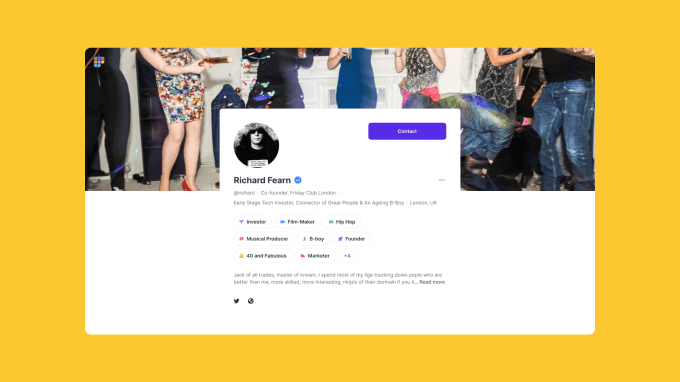
A Polywork profile (Image credits: Polywork)

In short, Polywork sums to a Twitter-style social feed where professionals can post updates about what they’re up to (in work and, if they like, in life too).

Users skills and interests (e.g. “UX design”, “founder”, “dinosaur enthusiast”); personality quirks (“introvert”); and achievements (“life partner”) — or indeed the opposite (“bad golfer”, “failure”) — can be displayed as custom badges at the top of their profile — again with the chance to blend personal and professional to offer a fuller portrait of who you are and what you offer.

In the feed itself, individual posts can be given related tags (e.g. “conducted user research”, which files under “UX Design”) — to illustrate relevant activity. (Clicking on a specific badge shows the sliced view of that user’s related tagged content.)

The result is an interface that feels gamified and informal — where you’re actively encouraged to inject your own personality — but which is simultaneously intended for showing off work activity and achievements.

On the professional networking side, the approach allows users to get a quick visual overview of an individual — perhaps fleshing out some of the dry details they already saw on their LinkedIn account — and quickly navigate to individual examples of specific activity. Recruiters or others looking for professional ice-breakers will probably relish the chance to find more up-to-date material to work with, ahead of making a cold pitch.

Polywork also lets users send collaboration requests to others on the network — aka, its version of LinkedIn’s in-mail. But (thankfully) it looks like users have controls to set whether or not they’re open to receiving such requests or not.

It’s certainly true that home and work have never been so blended as now, given the pandemic-fuelled remote work boom.

At the same time professionals may well — out of necessity — be more focused on the range of skills and interests they have or can acquire, rather than viewing any single job title as defining them, as was true for earlier generations of workers. As the saying goes, there’s no such thing as a ‘job for life’ anymore. Careers paths are complicated, multi-faceted — and, for some, may be more a tapestry, than a linear trajectory.

Polywork’s Millennial-friendly premise is thus to offer a place where people can present a more personal and well-rounded flavor of themselves as professionals and individuals — encompassing not just their skills and work achievements but their passions, quirks and obsessions — showing off a lot more than feels possible (or sensible) in the staid environs of LinkedIn.

That said, LinkedIn isn’t the only place for professionals to express themselves of course; People are already doing that all the time over on social media sites like Twitter (or indeed Instagram for more visually minded professions). Either social network is basically already an informal professional network in its own right — without the need for badges or labels (hashtags do a fairly decent job).

So while Polywork’s product design may look inviting, trying to reinvent the networking wheel is undoubtedly a massive challenge.

It’s not only fighting for attention with boring professional networks like LinkedIn (which everyone loves to hate), it’s treading directly into highly contested social media territory. Er, good luck with that! 

Convincing people to duplicate their social networking activity — or indeed ditch their existing hard-won social media networks — looks like a big ask. So the risk is irrelevance, despite a pretty interface. (Sure LinkedIn is boring — but, guys, the whole point is that it’s low maintenance… )

Polywork’s name and philosophy suggests it might be okay with being added to the existing mix of professional and social networks, i.e. rather than replacing either. But, well, a supplementary professional network sounds like a bit of a sideline.

Polywork launched in April but isn’t disclosing user numbers yet — and is currently operating a wait list for sign ups.

Commenting on the seed funding in a statement Caffeinated Capital’s Tonsing said: “There’s a new generation that wants to work and live on their own terms, not destined for a single track identity. The pandemic accelerated this trend and humans are reevaluating who they are and what’s most important to them in life. Polywork will usher in and facilitate this permanent shift in human behavior. We’re excited to partner with Peter again!”

20 May 2021

Holoride deploys Elrond blockchain and NFTs in prep for 2022 market launch

Holoride, the Audi spinoff that’s creating an in-vehicle XR passenger entertainment experience, is deploying blockchain technology and NFTs as the next stage in its preparation for a 2022 market launch. 

The company, which closed a $12 million Series A in April, announced it would be integrating Elrond blockchain into its tech stack to bring transparency to its ecosystem of car manufacturers and content creators. Holoride hopes to use NFTs, or non-fungible tokens, to incentivize developers into creating more content on holoride’s platform for the promise of more money earned off token purchases, and to attract passengers who want to personalize their in-car experience. 

Blockchain… NFTs… is holoride just trying to be internet trendy? Maybe, but the blockchain integration at least has been in the works for the past year, says holoride CEO and founder Nils Wollny.

Holoride’s immersive in-vehicle media platform doesn’t need blockchain to function. Its passenger experiences sync to the real-time motion and location-based data of the vehicle, so content adjusts to vehicle motion (meaning no motion sickness!). Where blockchain plays a role is to help holoride fairly and transparently distribute content and compensate developers based on user engagement time and value distribution. 

“We said we want to connect all our ecosystem partners in a very fair and transparent manner from the beginning, and blockchain technology delivers exactly on that,” Wollny told TechCrunch. “Every transaction and engagement can be stored in the blockchain. For car manufacturers, they can see how much time was spent with holoride experiences in their cars, and for content creators it’s transparent on how much time was spent with their title they have created for our platform.”

NFTs are unique digital tokens that have a marked place on the blockchain and cannot be replaced with anything else. Most NFTs are part of Ethereum’s blockchain, but holoride’s will be supported by Elrond’s blockchain. 

Wollny hopes the enticement of buying or collecting NFTs while immersed in holoride’s experiences will lead to more engagement. He also anticipates the acceleration of what futurists and other tech nerds are calling the ‘metaverse’ or the concept of the digital and virtual world increasingly intertwining with physical and augmented reality.

Need help visualizing how this works while you’re strapped into a headset being driven to your next destination? For holoride, an NFT might start by connecting elements in the virtual world to locations or events in the real world. 

“Imagine people are traveling in their virtual vehicle, maybe it’s a spaceship or a submarine, as their physical body is in a car driving through the real world,” said Wollny. “They might pass by a certain location where a content creator decided to put something passengers can collect on their way.”

So it’s kind of like Pokémon GO, but you’re sitting in a car with a VR headset on rather than walking around outside holding your phone in front of you and following augmented reality anime pets like a lunatic. And when you catch the Pokémon, it’s unique and yours and no one else can have it unless you decide to trade it.

“Or maybe the user is really good at a game they’re playing and they earn rewards while playing,” Wollny continued. “You can maybe display them to other users or trade them in the future, bringing the real world and the virtual world closer together.”

The future of holoride’s NFTs really depends upon the extent to which passengers find themselves so immersed in their in-car experiences that they seek attachment and personalization in the form of digital tokens. Maybe Wollny has been spending too much time in virtual reality, or maybe he knows something we don’t about our inevitable reliance on extended reality. But as he told TechCrunch, this is only the genesis of the startup’s ecosystem, a step towards making holoride the “transportation company for the metaverse.”