Author: azeeadmin

19 May 2021

Bessemer’s Tess Hatch will join us as a judge at TechCrunch Disrupt 2021

Tess Hatch, vice president and partner at Bessemer Venture Partners, will join us at TechCrunch Disrupt 2021 as a judge for our Startup Battlefield competition. By the way startups, you can still apply now until May 27 to take part in the competition here!

At Bessemer, Tess spearheads frontier tech investments, including the scaling and commercialization of revolutionary technologies, including drones, space-based observation and launch, agritech and much more. She’s focused on sourcing and reproducing tech bets that have the potential to significantly improve society in fundamental ways.

Some of Tess’s investments and board positions include Rocket Lab, Spire, DroneDeploy, Iris and more. Before her time at Bessemer and work as an investor, she worked for both Boeing and SpaceX as a payload integrator and aerospace engineer, building on her aeronautics and astronautics education from the University of Michigan and Stanford. Tess was also recently named one of Forbes’ 30 under 30 in VC.

We’ve been lucky enough to have Tess onstage at prior Disrupt events, and our TC Sessions: Space event as well. She’s definitely one of the best people in the world to talk to about cutting-edge technologies, and companies looking to solve even the most ambitious technical challenges, so she’s sure to bring great perspective to the Startup Battlefield judging panel this year.

Make sure to book your pass to TC Disrupt on September 21-23 to watch 20+ startups compete for $100k in Startup Battlefield and enjoy over 100 hours of content and thousands of enthusiastic startup fans — all for under $99! Secure your seat today!

19 May 2021

Restrictions on acquisitions would stifle the US startup ecosystem, not rein in big tech

Bipartisanship has long been out of fashion, but one common pursuit among Democrats and Republicans in Washington has been placing Big Tech companies under a microscope.

Congressional committees have held scores of hearings, lawsuits have been filed and legislation has been introduced to regulate privacy and data collection. The knock-on effect of these reforms for young companies and their venture investors is unclear. But one aspect of increased antitrust scrutiny — restrictions on acquisitions — would have a significant negative effect on our entrepreneurial ecosystem, and policymakers should approach these changes with caution.

Acquisitions are an important element of the startup ecosystem

For VC-backed companies, there are effectively three outcomes: standalone company (often via an IPO), merger or acquisition, or bankruptcy. Despite best efforts, company failure is the most common outcome — more than 90% of startups fail. Fortunately, the success stories are often companies with a big impact, like Moderna and Zoom, which helped the world in the pandemic.

Acquisitions contribute to the health of the startup ecosystem, as entrepreneurs who realize liquidity through the sale of their company regularly go on to found innovative new companies and often invest in other startups as angel investors or venture capitalists.

Entrepreneurs are optimists by nature, and so when the company journey begins, there is great hope of one day creating a standalone public company. However, in most cases, an IPO is not possible. The reality is that entrepreneurship is incredibly hard, and the journey from infancy to public company is one that relatively few companies achieve.

Silicon Valley Bank’s 2020 Global Startup Outlook puts it this way: “[T]he fact is most entrepreneurs never expect to reach a public market exit.” Accordingly, 58% of startups expect to be acquired. NVCA-Pitchbook data on acquisitions and IPOs back up the sentiment of founders when it comes to likely exit opportunities. In 2020, there was an approximately 10:1 ratio of acquisitions of VC-backed companies to IPOs, with 1,042 venture-backed companies acquired and 103 entering the public markets.

Some might argue that acquisitions are more dominant today because of the anti-competitive motivations of current tech incumbents. But as Patricia Nakache of Trinity Ventures said in testimony before the Senate Judiciary Committee: “[Acquisitions have] been commonplace in the U.S. since before the dawn of the modern venture capital industry.” In fact, today we are witnessing fewer acquisitions relative to IPOs than in years past, as the average acquisition-to-IPO ratio since 2004 is approximately 15:1. This is happening against a backdrop of challenges in taking small-cap companies public that has reduced the number of companies in the public markets today.

Acquisitions contribute to the health of the startup ecosystem, as entrepreneurs who realize liquidity through the sale of their company regularly go on to found innovative new companies and often invest in other startups as angel investors or venture capitalists.

Furthermore, acquisitions help power the returns of VC funds, thereby allowing VCs to raise new funds and invest in the next generation of entrepreneurs. This “recycling effect” is one of the key drivers of dynamism in our economy and should not be slowed down.

Acquisition changes could impact entrepreneurship

Despite the importance of acquisitions, antitrust reform has included significant changes to how acquisitions are assessed by the federal government. The two most prominent examples in this space are Sen. Amy Klobuchar’s Competition and Antitrust Law Enforcement Reform Act (CALERA) and Sen. Josh Hawley’s Trust-Busting for the Twenty-First Century Act.

These bills are likely a reaction to findings that incumbents have acted like Pac-Man, gobbling up would-be competitors before they become a competitive problem. But both proposals would ultimately harm startup activity and competition rather than propel it.

A common thread between these proposals is to restrict acquisitions by companies valued at more than $100 billion. Hawley’s bill would impose an outright ban on acquisitions by companies of that market cap that “lessen competition in any way.”

Klobuchar’s bill would shift the burden of proof to parties to an acquisition, a major change because the U.S. government bears the burden currently. This means if the government challenges an acquisition in federal court, the parties to the acquisition must demonstrate it does not “create an appreciable risk of materially lessening competition.” If that standard is not met, the acquisition could be blocked.

Both proposals have negative ramifications for venture-backed companies.

First, consider the scope of the proposals: A $100 billion company is indeed a large one, but setting the threshold there captures far more than the large tech companies that have been hauled before Congress for antitrust hearings. Globally, about 150 companies are valued at $100 billion or more, and the U.S. is home to more than 80 of those companies. That exposes acquirers as wide-ranging as Estee Lauder, John Deere, Starbucks and Thermo Fisher Scientific. If you are struggling to recall those companies being under the antitrust spotlight, then you are not alone.

Second, the legal standards imposed by these new bills are daunting. Klobuchar’s proposal leaves startups scratching their heads on where the line is on which acquisitions are tolerated, while Hawley’s bill throws up a misguided red light for vast amounts of acquisitions. These two standards are particularly vexing since acquirers are generally looking for acquirees that complement their existing business. In addition, many of the most acquisitive companies are multifaceted ones that presumably compete with an array of other companies in some way.

Ultimately, the bills from Klobuchar and Hawley would disrupt an important part of our nation’s startup ecosystem. Acquisitions act like grease to help keep the wheels moving by injecting liquidity into the system so participants can move on to create new and hopefully better companies for our country. Those wheels should not be slowed down when the country needs all the entrepreneurship it can muster.


19 May 2021

Bitcoin crashes as investors fear crypto bull market could be nearing its end

Bitcoin, Ethereum and a host of Altcoins suffered massive drops Tuesday night and Wednesday morning, erasing months of gains and hundreds of billions in market cap. The overall crypto market shrunk more than 20% over the past 24 hours according to crypto tracker CoinMarketCap.

What’s behind the drop? Well, some may say the market was flying too close to the sun as investors piled into speculative and technically unremarkable projects like Dogecoin. Others may pin the blame on Elon Musk, who announced that Tesla would no longer be accepting bitcoin for Tesla purchases, which investors feared could trigger a broader backlash among corporate adopters who they hoped would be encouraged to put bitcoin on their balance sheets.

Not all cryptocurrencies are seeing the same fortune, while Bitcoin dropped to nearly $31k, more than half its all-time-high, Ethereum fell to prices it first reached last month. Some of the steepest losses were seen by Dfinity’s Internet Computer token which has shed nearly 60% of its value in the past week. Meanwhile, multi-chain development platform Polygon has surged throughout the broader crash, up 88% this week.

Public market investors got a taste for the crypto market’s volatility as Coinbase stock fell 5% Wednesday morning, down more than 47% from its briefly achieved all-time-high and 10% lower than its direct listing target price.

19 May 2021

Google revives RSS

Chrome, at least in its experimental Canary version on Android (and only for users in the U.S.), is getting an interesting update in the coming weeks that brings back RSS, the once-popular format for getting updates from all the sites you love in Google Reader and similar services.

In Chrome, users will soon see a ‘Follow’ feature for sites that support RSS and the browser’s New Tab page will get what is essentially a (very) basic RSS reader — I guess you could almost call it a “Google Reader.”

Now we’re not talking about a full-blown RSS reader here. The New Tab page will show you updates from the sites you follow in chronological order, but it doesn’t look like you can easily switch between feeds, for example. It’s a start, though.

Image Credits: Google

“Today, people have many ways to keep up with their favorite websites, including subscribing to mailing lists, notifications and RSS. It’s a lot for any one person to manage, so we’re exploring how to simplify the experience of getting the latest and greatest from your favorite sites directly in Chrome, building on the open RSS web standard,” Janice Wong, Product Manager, Google Chrome, writes in today’s update. “Our vision is to help people build a direct connection with their favorite publishers and creators on the web.”

A Google spokesperson told me that the way the company has implemented this is to have Google crawl RSS feeds “more frequently to ensure Chrome will be able to deliver the latest and greatest content to users in the Following section on the New Tab page.”

RSS was one of the fundamental technologies of the Web 2.0 era. Even today, it’s still the easiest way to get timely updates from your favorite sites (though some may not offer feeds anymore) without any recommendation algorithms getting in your way. Yet while RSS was always extremely useful, the user experience wasn’t always ideal, though services like Google Reader (RIP) and Feedly did a lot to make it simple enough to subscribe to feeds and get updates. But when Google offered Google Reader at the altar of Google+ back in 2013, that era came to an end, even as diehard news junkies kept holding on to their Feedly accounts and old copies of NetNewsWire.

I think a lot of people will be glad to see that Google is bringing it back as a core feature of its browser. If you prefer an open web, RSS, for all its occasional clumsiness, is the way to go.

For now, though, this is only an experiment. Google says it wants to gather feedback from ” publishers, bloggers, creators, and citizens of the open web” as it aims to build “deeper engagement between users and web publishers in Chrome.” Hopefully, it won’t stay this way.

19 May 2021

Netflify snags YC alum FeaturePeek to add design review capabilities

Netlify, the startup that’s bringing a micro services approach to building websites, announced today that it has acquired YC alum FeaturePeek. The two companies did not share the purchase price.

With FeaturePeek, the company gets a major upgrade in its design review capability. While Netlify has had a previewing capability called Deploy Previews in the platform since 2016, it lacked a good way for reviewers to discuss and comment on the design. The preview alone was useful as far as it goes, but having the ability to collaborate on the design remained a missing piece until today.

With FeaturePeek, the company can expand on Deploy Previews to not only preview the design, but also enable all the stakeholders in the design process to add their opinions, edits and changes as the design moves through the creation process instead of having to wait until the end or gather the comments in a separate document or communications channel.

As FeaturePeek co-founder Eric Silverman told me at the time of their seed funding last year, his product removed a lot of frustration when the web coders would get all their review comments at the last minute:

“Right now, there’s no dedicated place to give feedback on that new work until it hits their staging environment, and so we’ll spin up ad hoc deployment previews, either on commit or on pull requests and those fully running environments can be shared with the team. On top of that, we have our overlay where you can file bugs, you can annotate screenshots, record video or leave comments.”

Matt Biilmann, CEO and co-founder, Netlify says that when his company created Deploy Previews, it was in reaction to customers who were kloodging together their own solutions to the issue. They learned that even with their own preview feature, customers craved a communications capability.

In the classic build versus buy debate, the company began building its own, then it met the FeaturePeek team and decided to switch course. “We had a team working on a prototype when the founders of FeaturePeek, Eric and Jason, gave us a demo of their product. As the demo progressed, our jaws got increasingly closer to hitting the floor and we knew straight away that what we had just seen was miles away from both our internal prototypes and any of the other tools we had seen in the space,” Billman told TechCrunch.

He added, “It also quickly became apparent that fully building towards this vision as two different companies, without a deep end-to-end experience from initial Pull Request to a new feature release, would never really allow us to build what we were dreaming of, so we decided to join forces.”

The companies’ combined effort actually comes together today in a new release of Deploy Previews that includes the new FeaturePeek collaboration/commenting capabilities.

FeaturePeek was founded in 2019, went through Y Combinator Summer 2019 batch, and raised around $2 million. Netlify was founded in 2014 and has raised over $97 million, according to Crunchbase. Its last raise was a $53 million Series C in March 2020.

19 May 2021

Can Squarespace dodge the direct listing value trap?

It’s Squarespace direct listing day, and the SMB web hosting and design shop’s reference price has been set at $50 per share.

According to quick math from the IPO-watching group Renaissance Capital, Squarespace is worth $7.4 billion at that price, calculated using a fully diluted share count. The company’s new valuation is sharply under where Squarespace raised capital in March, when it added $300 million to its accounts at a $10.0 billion post-money valuation, according to Crunchbase data.


The Exchange explores startups, markets and money. 

Read it every morning on Extra Crunch or get The Exchange newsletter every Saturday.


The company’s reference price, however, is just that: a reference. It doesn’t mean that much. As we’ve seen from other notable direct listings, a company’s opening price does not necessarily align with its formal reference price. Until Squarespace opens, whether or not it will be valued at a discount to its final private price is unclear.

While the benefits of a direct listing are understood, the post-listing performance for well-known direct listings is less obvious. Indeed, Coinbase is currently under its reference price after starting its life as a public company at a far-richer figure, and Spotify’s share price is middling at best compared to its 2018-era direct listing reference price.

This morning, we’re going over Squarespace’s recently disclosed Q2 and full-2021 guidance. Then we’ll ask how its expectations compare to its reference price-defined pre-trading valuation. Finally, we’ll set some stakes in the ground regarding historical direct-listing results and what we might expect from the company as it adds a third set of data to our quiver.

This will be lots of fun, so let’s get into the numbers!

Squarespace’s Q2

Per Squarespace’s own reporting, it expects revenues between $186 million and $189 million in Q2 2021, which it calculates as a growth rate of between 24% and 26%. That pace of growth at its scale is perfectly acceptable for a company going public.

For all of 2021, Squarespace expects revenues of $764 million to $776 million, which works out to a very similar 23% to 25% growth rate.

In profit terms, Squarespace only shared its “non-GAAP unlevered free cash flow,” which is a technical thing I have no time to explain. But what matters is that the company expects some non-GAAP unlevered free cash flow in Q2 2021 ($10 million to $13 million), and lots more in all of 2021 ($100 million to $115 million).

19 May 2021

Women-led sports media startup The GIST raises $1M to challenge sports reporting norms

The three co-founders of The GIST are all themselves sports fans, but realized in 2018 that sports media in general left a lot to be desired when it comes to catering to audiences outside of the traditional, male-dominated stereoptyical sports audience. So they started a new kind of sports media enterprise, taking a risk on a very different kind of careers vs. their background in financial services in Toronto.

On the back of impressive 350% audience through 2020, c-founders Jacie DeHoop, Ellen Hyslop and Roslyn McLarty have now raises an initial $1 million round of seed funding, form investors including 3GP Capital, JDS Sports, August Group, Even Odds Investments, and Bettor Capital. The company also just got approved for a $350,000 loan from the Business Development Bank of Canada, bringing its total new funding across venture and state-backed credit incentives to $1.35 million.

“In the sports industry, as you probably are aware, less than 4% of coverage is on female athletes, and less than 14% of sports journalists are women,” explained McLarty, who is also The GIST’s head of finance, operations and growth. “It’s no wonder, as women, we don’t necessarily resonate with the the more traditional male-dominated sports media and the way that sports is represented. So we were finding it hard to be a part of that community sports can provide, and around the same time, we were seeing a trend of media companies developing these more authentic relationships with their audience, and building community and being built a little bit more ground up, and that being really effective.”

McLarty cites other media ventures including theSkimm, Morning Brew and The Hustle as examples of what her and her co-=foudners saw was working well in media. That approach, combined with what they saw as a massive potential untapped audience, led to the creation of The GIST, which because as a newsletter and has evolved into a news site, a podcast and more.

“We started with the purpose of making sports more accessible, inclusive, approachable and fun for a casual fan, or a female fan,” she said. “For anyone really, that hadn’t resonated with traditional sports media.”

I asked McLarty why her and her co-founders wanted to get into the media business specifically, given that their experience prior to that was on Bay Street, which is effectively Toronto’s equivalent of Wall Street. She admitted that it took the trio some time to find their footing, but that now the business has opened up a new and growing audience that basically wasn’t served previously, which is helping them win over advertisers and brand partnerships.

“I think we’ve discovered an audience that is really valuable, and there hasn’t really been a way for brand partners to engage with a female audience through sports,” she said. “So we’ve kind of found our niche, and have built really built things out and gotten to the point where we are today in a really lean lean way. The hard part was the initial investment in the audience to get it to the point where it is now, but once you hit that scale in the audience, the margins on the newsletter are obviously awesome for every additional person that we add on.”

The GIST’s partners include brands like the NBA, FanDuel, Red Bull and Adidas, to name a few, and it says its revenue is up over 1,000% this year vs. the year prior, on course to meet its goal of $1 million in total revenue for 2021. The company says it will be using the new funding to grow the team, including new hires on the content side, as well as additional headcount on the sales and operation teams, too.

19 May 2021

Ro acquires Modern Fertility in a reportedly $225 million deal

Ro, a digital elective care and telemedicine provider last valued at $5 billion, announced today that it has acquired Modern Fertility, a reproductive health company founded in 2017. While terms of the deal were not disclosed, Axios estimates it sold for $225 million in a majority-stock deal.

The company did not immediately respond to a request for comment, but this story will be updated with more information as it comes in.

Ro, also founded in 2017, has spent the past few years growing its business to be far more than its launched purpose: a solution for men with erectile dysfunction. It has since expanded into women’s health, smoking cessation, and treats over 20 conditions, including sexual health but also into weight loss and allergies. The acquisition of a business that focuses on women’s health will likely fit squarely into Rory, Ro’s women’s healthcare business that focuses on online visits, contact-free delivery and “healthcare without the waiting rooms.”

With the acquisition, Ro said that it is adding fertility testing and reproductive health to its women’s health suite of services. Plus, Modern Fertility co-founders Afton Vechery and Carly Leahy will lead that vertical for Ro.

Beyond the fact that this is one of the biggest exits for a women’s health company with a focus on reproductive disorders, today’s acquisition is important because it’s another step in a healthcare system that is built on an entirely “cash-pay, no insurance” model. Since inception, Ro has bet that the future of healthcare can be built on out-of-pocket expenses, and that consumers are willing to pay directly to access a doctor instead of going through the hurdles of traditional insurance. That, of course, comes with missing out on the currently insured, which is still a large subset of Americans.

However, if the deal goes as planned, Modern Fertility entering the Ro umbrella might make the overall business have yet another pitch to consumers to use its service. Consumers are lazy, and if you can give them one place to get all their services — maybe even starting with fertility — it becomes a stickier and stickier operation. Other companies such as Everlywell and Future Family have similarly proven the market out there for comprehensive fertility solutions.

Plus, you can see how today’s deal jibes well with Ro’s December 2020 acquisition of Workpath. Workpath is an in-home care API that allows Ro to create a vertically integrated primary care platform, so it can send professionals to a patient’s home or conduct diagnostic tests.

As far as acquisitions go for Ro, while last year was a broad bet on how to bring care services to others, this year is a new, niche bet on which care services will be most important to consumers going forward. Since Ro has raised nearly $900 million in venture capital raised to date, expect more in the M&A front as the months roll on by.

19 May 2021

Construction tech upstart Assignar adds a Fifth Wall with $20M Series B

Construction technology may not be the sexiest of industries, but it is one where tremendous opportunity lies — considering it has historically lagged in productivity. And, lags in productivity means project delays, which typically costs everyone involved more time and more money.

There are a number of larger players in the space (think Procore, PlanGrid and Autodesk) that are tackling the problems from the perspective of the general contractor. But when it comes to the subcontractors that are hired by the general contractor to do 95% of the work, the pickings are few and far between.

Enter Assignar, a cloud-based construction tech startup that was originally born in Australia and is now based in Denver, Colorado. Co-founder and CEO Sean McCreanor was a contractor himself for many years, and grew frustrated with the lack of offerings available to him. So, as in the case of many founders, he set out to create the technology he wished existed.

And today, Assignar has raised $20 million in a Series B funding round led by real estate tech-focused venture firm Fifth Wall. 

Existing backer Tola Capital and new investor Ironspring Ventures also put money in the round, which brings Assignar’s total raised since its 2014 inception to $31 million.

“I had 100 crews and workers out in the field, lots of heavy equipment and project work, and was running the entire business on spreadsheets and whiteboards,” McCreanor recalls. “With Assignar, we essentially help the office connect to the field and vice versa.”

In a nutshell, Assignar’s operations platform is designed for use by “self-perform general and subcontractors” on public and private infrastructure projects. The company’s goal is to make the whole process smoother for large general contractors, developers and real estate owner-operators by providing a “real-time snapshot of granular field activity.”

Specifically, Assignar aims to streamline operations and schedules, track crews and equipment, and improve quality and safety, as well as measure and monitor productivity and progress with data on all projects. For example, it claims to be able to help match up the best crews and equipment for a specific job “more efficiently.”

The startup says it has hundreds of international customers working on multibillion-dollar projects in infrastructure, road, rail, heavy civil, utilities and other construction disciplines. Those customers range from specialist contractors with as few as five crews to multi-national, multibillion-dollar companies. Projects include things such as bridges and roads, for example.

Image Credits: Assignar

Assignar historically has “more than doubled” its revenue every year since inception and in 2020, saw revenue increase by 75%.

“We could have grown faster but wanted to manage cash flow,” McCreanor told TechCrunch.

Assignar’s focus is particularly significant these days considering that the Biden administration’s Infrastructure Bill is nearing agreement, likely signaling an investment in infrastructure for communities across the U.S. 

The heavy civil and horizontal construction industry has long lacked a well-designed and ubiquitous operations platform, according to Fifth Wall Partner Vik Chawla.

“Assignar’s cloud-based software offers a detailed view on when and where different types of field activities are being performed,” he said. “It streamlines communications between headquarters and the field, allows for a reduction in paperwork, and brings time and cost savings to an industry where much of the planning, tracking and reporting are still done by hand, in Excel or on white boards.”

Assignar plans to use its new capital to grow its business in North America (which currently makes up about 25% of its revenue) and double its 65-person team by hiring for roles across all departments. The company also plans to invest in R&D and product development to further build out its core platform. Among the features it’s planning to develop is a contractor hub and a schedule recommendation engine that McCreanor says will leverage data, AI and machine learning “to support planning and execution processes.”

19 May 2021

Ampere prepares to launch its first custom data center chips

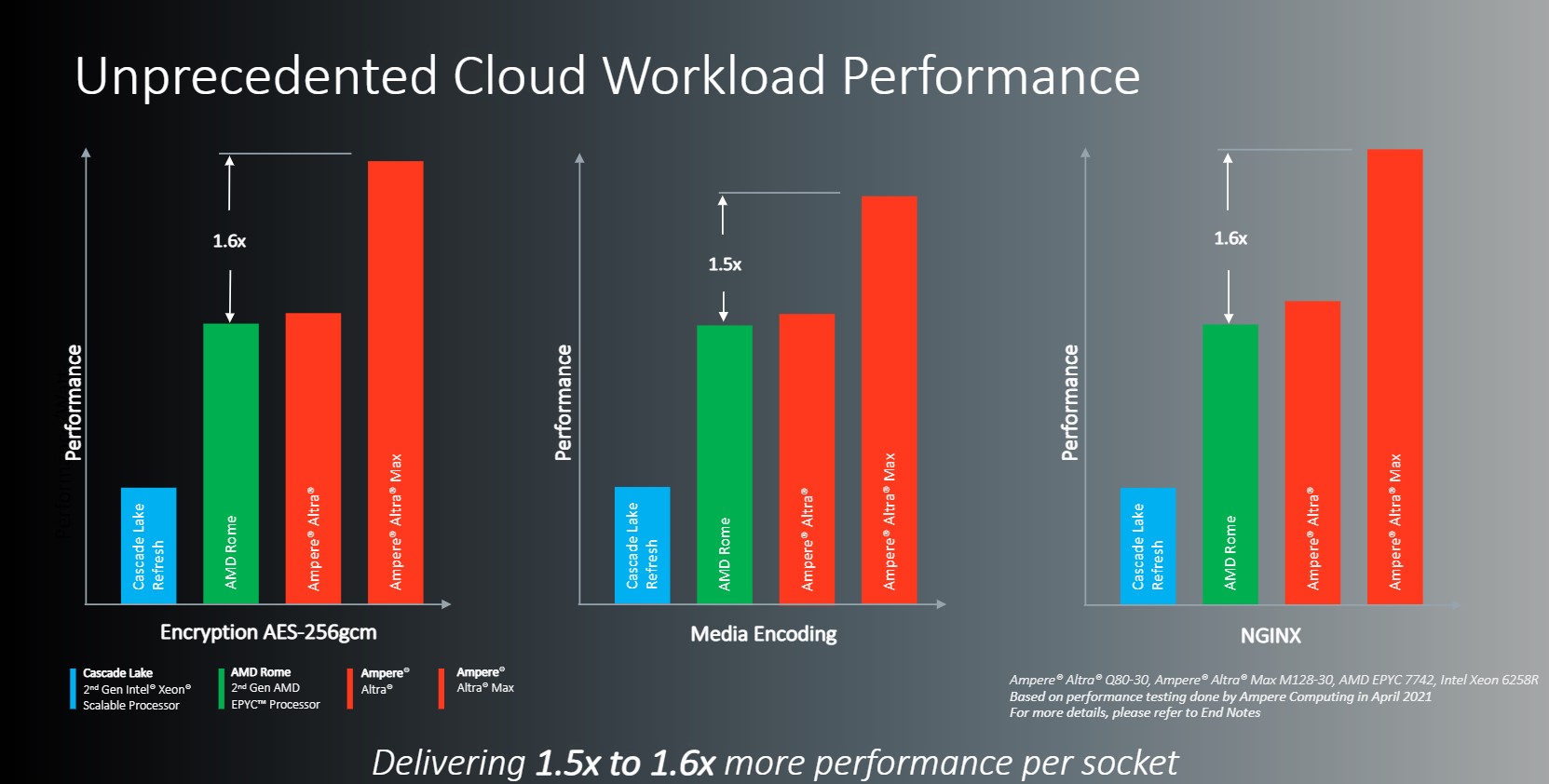
Ampere, the server startup that is betting on bringing Arm-based chips to the data center and edge, is hosting its annual media day today. With the 80-core Altara and 128-core Altra Max, the company already offers a platform that can rival and outperform those of competitors like Intel and AMD in many common scenarios — and Altra Max is now in production and shipping. Those chips are based on the standard ARM Neoverse N1 architecture, though. But now, it is about to launch its own custom  Ampere Cores, built on a 5nm process.

“Altra and Altra Max are based on the N1 core from Arm. We’re an architecture licensee as well as an IP licensee, so we’re going to talk about our own core [at our media day]: what we built, how we built it, why we built it,” Ampere CEO Renee James, who spent 26 years at Intel before founding Ampere, told me. “And what does a cloud-native processor look like? We like to think about it like you think about M1 for a PC from Apple, you would think about an Ampere Core for a cloud data center server.”

With the 128-core Altra Max, Ampere promises a chip that uses 50 percent less power per core compared to an AMD Rome CPU and performance gains of 1.6x for running the NGINX web server, for example. And all of those benchmarks look even better when compared to an Intel Cascade Lake Refresh CPU. AMD’s Rome launched in August 2019 and Intel’s Cascade Lake Scalable Performance Refresh CPU have been in the market since last Feburary.

“It’s all about developing that CPU that’s built for the cloud and making sure that we’re meeting the new — but not really not new anymore — but kind of the current and future needs of cloud-native workloads, that software development model, and that type of infrastructure deployment model,” Ampere’s CPO Jeff Wittich said. “Which for us really means developing a product that has high performance that’s very predictable across workloads across users and a very, very scalable platform for compute, memory, I/O, network, and that is very, very power efficient.”

Image Credits: Ampere

Wittich noted that Ampere had always planned to develop its own cores, in part because it offers a very specific product for a very specific use case. “We knew that from the start developing our own cores was going to be very, very important for us to innovate in the ways that we need to innovate,” he said. “I have to say the primary thing is that because we’re focused on cloud — and we’re not focused on a bunch of other markets, especially not client, and also not other markets, even within the server space — it means developing a core that’s specific to cloud is really important to us.”

Ampere’s cloud customers want certain built-in security features and manageability features for performance and power, for example. And as Wittich stressed, those have to be built in at the micro-architecture level to work properly (and this allows allow the company to optimize performance as well).

“We have to build our own cores to actually have a processor that does what the cloud wants,” he said. The Ampere Cores will, for example, feature high I/O memory bandwidth, for example, but optimized for cloud use cases, not high-performance computing use cases.

Image Credits: Ampere

James echoed this, noting that customers want these features and Ampere’s competitors will offer them. “The cloud business is pretty specific and the customers are very demanding,” she said. “So cadence is really important and we are competing against customers who have really very good products.”

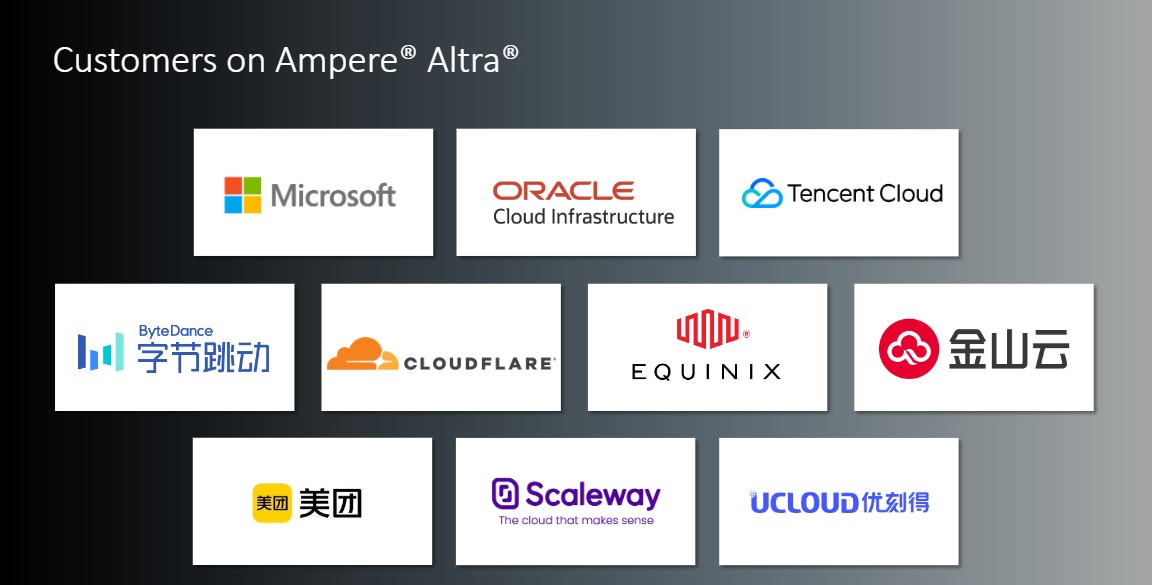
It seems like this strategy is working out well for Ampere, which will now counts the likes of Microsoft, Oracle and Tencent Cloud among its customers. Rumor has it that Microsoft is working on its own Arm-based chips as well, but interestingly, the company is also using Ampere’s media day to talk about how it is readying Azure for Altra.