Author: azeeadmin

19 May 2021

Forecast nabs $19M for its AI-based approach to project management and resource planning

Project management has long been a people-led aspect of the workplace, but that has slowly been changing. Trends in automation, big data, and AI have not only ushered in a new wave of project management applications, but they have led to a stronger culture of people willing to use them. Today, one of the startups building a platform for the next generation of project management is announcing some funding — a sign of the traction it’s getting in the market.

Forecast, a platform and startup of the same name that uses AI to help with project management and resource planning — put simply, it uses artificial intelligence to both “read” and integrate data from different enterprise applications in order to build a bigger picture of the project and potential outcomes — has raised $19 million to continue building out its business.

The company plans to use some of the funding to expand to the U.S., and some to continue building out its platform and business, headquartered in London with a development office also in Copenhagen.

This funding, a Series A, comes less than a year after the startup’s commercial launch, and it was led by Balderton Capital, with previous investors Crane Ventures Partners, SEED Capital and Heartcore also participating.

Forecast closed a seed round in November 2019 and then launched just as the pandemic was kicking off. It was a time when some projects were indeed put on ice, but others that went ahead did so with more caution on all sorts of fronts — financial, organizational, and technical. It turned out to be a “right place, right time” moment for Forecast, a tool that plays directly into providing a technical platform to manage all of that in a better way, and it tripled revenues during the year. Its customers include the likes of the NHS, the Red Cross, Etain and more. It says over 150,000 projects have been created and run through its platform to date.

Project management — the process of planning what you need to do, assigning resources to the task and tracking how well all of that actually goes to plan — has long been stuck between a rock and a hard place in the world of work.

It can be essential to getting things done, especially when there are multiple departments or stakeholders involved; yet it’s forever an inexact science that often does not reflect all the complexities of an actual project, and therefore may not be as useful as it could or should be.

This was a predicament that founder and CEO Dennis Kayser knew all too well, having been an engineer and technical lead on a number of big projects himself. His pedigree is an interesting one: one of his early jobs was as a developer at Varien, where he built the first version of Magento. (The company was eventually rebranded as Magento and then acquired by eBay, then spun out, then acquired again, this time by Adobe for nearly $1.7 billion, and now a huge player in the world of e-commerce tools.) He also spent years as a consultant at IBM, where among other things he helped build and formulate the first versions of ikea.com.

In those and other projects, he saw the pitfalls of project management not done right — not just in terms of having the right people on a project at the right time, but the resource planning needed, better calculations of financial outcomes in the event of a decision going one way or the other, and so on.

(He didn’t say this outright, but I’m sure one of the points of contention was the fact that the first ikea.com site didn’t actually have any e-commerce in it, just a virtual window display of sorts. That would have been because Ikea wanted to keep people shopping in its stores, away from the efficiency of just buying the one thing you actually need and not the 10 you do not. Yes, there are plenty of ways now of recirculating people to buy more when you select one item for a shopping cart — something the likes of Amazon has totally mastered — but this was years ago when there was still even more opportunities for innovation than there are now. All of this is to say that you might very reasonably argue that had there been better project managing and resource planning tools to give forecasts of potential outcomes of one or another route taken, people advocating for a different approach could have made their case better. And maybe Ikea would have jumped on board with digital commerce far sooner than it did.)

“Typically you get a lot of spreadsheets, people scattered across different tools that include accounting, CRM, Gitlab and more,” Kayser said.

That became the impetus for trying to build something that can take all of that into account and make a project management tool that — rather than just being a way of accounting to a higher-up, or reflecting only what someone can be bothered to update in the system — something that can help a team.

“Connecting everything into our engine, we leverage data to understand what they are working on and what is the right thing to be working on, what the finances are looking like,” he continued. “So if you work in product, you can plan out who is where, and what resourcing you need, what kind of people and skills you require.” This is a more dynamic progression of some of the other newer tools that are being used for project management today, targeting, in his words, “people who graduate from Monday and Asana who need something ore robust, either because they have too many people working on a project or because its too complicated, there is just too much stuff to handle.”

More legacy tools he said that are used include Oracle “to some degree” and Mavenlink, which he describes as possibly Forecast’s closest competitor, “but its platform is aging.”

Currently the Forecast platform has some 26 integrations of popular tools used for projects to produce its insights and intelligence, including Salesforce, Gitlab, Google Calendar, and, as it happens, Asana. But given how fragmented the market is, and the signals one might gain from any number of other resources and apps, I suspect that this list will grow as and when its customers need more supported, or Forecast works out what can be gleaned from different places to paint an even more accurate picture.

The result may not ever replace an actual human project manager, but certainly starts to then look like a “digital twin” (a phrase I have been hearing more and more these days) that will definitely help that person, and the rest of the team, work in a smarter way.

“We are really excited to be an early investor in Forecast,” said James Wise,  a partner at Balderton Capital, in a statement. “We share their belief that the next generation of SaaS products will be more than just collaboration tools, but use machine learning to actively solve problems for their users. The feedback we got from Forecast’s customers was quite incredible, both in their praise for the platform and in how much of a difference it had already made to their operations. We look forward to supporting the company to scale this impact going forward.”


19 May 2021

Forecast nabs $19M for its AI-based approach to project management and resource planning

Project management has long been a people-led aspect of the workplace, but that has slowly been changing. Trends in automation, big data, and AI have not only ushered in a new wave of project management applications, but they have led to a stronger culture of people willing to use them. Today, one of the startups building a platform for the next generation of project management is announcing some funding — a sign of the traction it’s getting in the market.

Forecast, a platform and startup of the same name that uses AI to help with project management and resource planning — put simply, it uses artificial intelligence to both “read” and integrate data from different enterprise applications in order to build a bigger picture of the project and potential outcomes — has raised $19 million to continue building out its business.

The company plans to use some of the funding to expand to the U.S., and some to continue building out its platform and business, headquartered in London with a development office also in Copenhagen.

This funding, a Series A, comes less than a year after the startup’s commercial launch, and it was led by Balderton Capital, with previous investors Crane Ventures Partners, SEED Capital and Heartcore also participating.

Forecast closed a seed round in November 2019 and then launched just as the pandemic was kicking off. It was a time when some projects were indeed put on ice, but others that went ahead did so with more caution on all sorts of fronts — financial, organizational, and technical. It turned out to be a “right place, right time” moment for Forecast, a tool that plays directly into providing a technical platform to manage all of that in a better way, and it tripled revenues during the year. Its customers include the likes of the NHS, the Red Cross, Etain and more. It says over 150,000 projects have been created and run through its platform to date.

Project management — the process of planning what you need to do, assigning resources to the task and tracking how well all of that actually goes to plan — has long been stuck between a rock and a hard place in the world of work.

It can be essential to getting things done, especially when there are multiple departments or stakeholders involved; yet it’s forever an inexact science that often does not reflect all the complexities of an actual project, and therefore may not be as useful as it could or should be.

This was a predicament that founder and CEO Dennis Kayser knew all too well, having been an engineer and technical lead on a number of big projects himself. His pedigree is an interesting one: one of his early jobs was as a developer at Varien, where he built the first version of Magento. (The company was eventually rebranded as Magento and then acquired by eBay, then spun out, then acquired again, this time by Adobe for nearly $1.7 billion, and now a huge player in the world of e-commerce tools.) He also spent years as a consultant at IBM, where among other things he helped build and formulate the first versions of ikea.com.

In those and other projects, he saw the pitfalls of project management not done right — not just in terms of having the right people on a project at the right time, but the resource planning needed, better calculations of financial outcomes in the event of a decision going one way or the other, and so on.

(He didn’t say this outright, but I’m sure one of the points of contention was the fact that the first ikea.com site didn’t actually have any e-commerce in it, just a virtual window display of sorts. That would have been because Ikea wanted to keep people shopping in its stores, away from the efficiency of just buying the one thing you actually need and not the 10 you do not. Yes, there are plenty of ways now of recirculating people to buy more when you select one item for a shopping cart — something the likes of Amazon has totally mastered — but this was years ago when there was still even more opportunities for innovation than there are now. All of this is to say that you might very reasonably argue that had there been better project managing and resource planning tools to give forecasts of potential outcomes of one or another route taken, people advocating for a different approach could have made their case better. And maybe Ikea would have jumped on board with digital commerce far sooner than it did.)

“Typically you get a lot of spreadsheets, people scattered across different tools that include accounting, CRM, Gitlab and more,” Kayser said.

That became the impetus for trying to build something that can take all of that into account and make a project management tool that — rather than just being a way of accounting to a higher-up, or reflecting only what someone can be bothered to update in the system — something that can help a team.

“Connecting everything into our engine, we leverage data to understand what they are working on and what is the right thing to be working on, what the finances are looking like,” he continued. “So if you work in product, you can plan out who is where, and what resourcing you need, what kind of people and skills you require.” This is a more dynamic progression of some of the other newer tools that are being used for project management today, targeting, in his words, “people who graduate from Monday and Asana who need something ore robust, either because they have too many people working on a project or because its too complicated, there is just too much stuff to handle.”

More legacy tools he said that are used include Oracle “to some degree” and Mavenlink, which he describes as possibly Forecast’s closest competitor, “but its platform is aging.”

Currently the Forecast platform has some 26 integrations of popular tools used for projects to produce its insights and intelligence, including Salesforce, Gitlab, Google Calendar, and, as it happens, Asana. But given how fragmented the market is, and the signals one might gain from any number of other resources and apps, I suspect that this list will grow as and when its customers need more supported, or Forecast works out what can be gleaned from different places to paint an even more accurate picture.

The result may not ever replace an actual human project manager, but certainly starts to then look like a “digital twin” (a phrase I have been hearing more and more these days) that will definitely help that person, and the rest of the team, work in a smarter way.

“We are really excited to be an early investor in Forecast,” said James Wise,  a partner at Balderton Capital, in a statement. “We share their belief that the next generation of SaaS products will be more than just collaboration tools, but use machine learning to actively solve problems for their users. The feedback we got from Forecast’s customers was quite incredible, both in their praise for the platform and in how much of a difference it had already made to their operations. We look forward to supporting the company to scale this impact going forward.”

19 May 2021

Payroll automation startup raises $15.6M Series A led by General Catalyst

Payroll automation is not exactly the sexiest of startup areas but it’s a pretty decent business. The larger startup in the space is Payfit which has raised upwards of $208.4M to do something that lots of companies find quite painful. But Payfit does a lot of other things as well, potentially leaving it exposed. Now a startup aims to come along and hone in on the thorny issue of payroll automation, alone.

Founded by Jonas Bøgh Larsen and Emil Hagbarth Rasmussen, Danish firm Pento has raised $15.6 million in a Series A funding led by General Catalyst. Also participating was Avid Ventures and the UK’s LocalGlobe. Existing investors Point Nine Capital, Moonfire Ventures, Hustle Fund, and Seedcamp also took part, alongside angels (see below). This latest funding takes the total raised by Pento to $18.4 million.

The startup claims 700 companies are using it including tech firms Pleo and Cuvva; large hospitality brands (Honest Burgers); and retail and e-commerce brands (Lacoste, Beauty Pie). Pento replaces spreadsheets etc and gives them cloud-based tools, real-time calculations, transparency, and online and telephone support.

Pento co-founder and CEO, Jonas Bøgh Larsen told me: “The biggest process we’re replacing is payroll outsourcing where companies are outsourcing payroll to an accountant, which the vast majority of companies do in Europe. We automate the entire process from reporting to tax calculations to payments. So, what most other platforms or payable products do is basically just helping you calculate the right taxes and National Insurance, and so on. We also take care of the reporting. We also do payments, and we integrate the product to other HR products.”

Adam Valkin, Managing Director at General Catalyst said: “Despite being so business-critical, payroll is one of the least digitally advanced services across the globe. It’s also one that has garnered a reputation for being too complex, too convoluted and too out of reach for those who aren’t payroll specialists, leading many to consider expensive outsourcing as the only route to go. Pento dispels this myth because it’s built purely with HR and finance teams in mind, by business leaders who truly understand the frustrations involved. It’s easy-to-use, transparent, flexible, secure and affordable. It’s what payroll should be in a modern company and it represents the future of employee compensation.”

Pento’s angel are from Stripe (Thairu and Diede van Lamoen), Monzo (Tom Blomfield), GoCardless (Matt Robinson), Zoom (Eric Yuan), Cuvva (Freddy Macnamara), Intercom (Des Traynor) and others.

19 May 2021

Payroll automation startup raises $15.6M Series A led by General Catalyst

Payroll automation is not exactly the sexiest of startup areas but it’s a pretty decent business. The larger startup in the space is Payfit which has raised upwards of $208.4M to do something that lots of companies find quite painful. But Payfit does a lot of other things as well, potentially leaving it exposed. Now a startup aims to come along and hone in on the thorny issue of payroll automation, alone.

Founded by Jonas Bøgh Larsen and Emil Hagbarth Rasmussen, Danish firm Pento has raised $15.6 million in a Series A funding led by General Catalyst. Also participating was Avid Ventures and the UK’s LocalGlobe. Existing investors Point Nine Capital, Moonfire Ventures, Hustle Fund, and Seedcamp also took part, alongside angels (see below). This latest funding takes the total raised by Pento to $18.4 million.

The startup claims 700 companies are using it including tech firms Pleo and Cuvva; large hospitality brands (Honest Burgers); and retail and e-commerce brands (Lacoste, Beauty Pie). Pento replaces spreadsheets etc and gives them cloud-based tools, real-time calculations, transparency, and online and telephone support.

Pento co-founder and CEO, Jonas Bøgh Larsen told me: “The biggest process we’re replacing is payroll outsourcing where companies are outsourcing payroll to an accountant, which the vast majority of companies do in Europe. We automate the entire process from reporting to tax calculations to payments. So, what most other platforms or payable products do is basically just helping you calculate the right taxes and National Insurance, and so on. We also take care of the reporting. We also do payments, and we integrate the product to other HR products.”

Adam Valkin, Managing Director at General Catalyst said: “Despite being so business-critical, payroll is one of the least digitally advanced services across the globe. It’s also one that has garnered a reputation for being too complex, too convoluted and too out of reach for those who aren’t payroll specialists, leading many to consider expensive outsourcing as the only route to go. Pento dispels this myth because it’s built purely with HR and finance teams in mind, by business leaders who truly understand the frustrations involved. It’s easy-to-use, transparent, flexible, secure and affordable. It’s what payroll should be in a modern company and it represents the future of employee compensation.”

Pento’s angel are from Stripe (Thairu and Diede van Lamoen), Monzo (Tom Blomfield), GoCardless (Matt Robinson), Zoom (Eric Yuan), Cuvva (Freddy Macnamara), Intercom (Des Traynor) and others.

19 May 2021

Otter.ai’s new assistant can automatically transcribe your Zoom meetings

A.I.-powered voice transcription service Otter.ai wants to make it even easier for its business users to record their meetings. The company is today introducing a new feature, Otter Assistant, which can automatically join the Zoom meetings on your calendar, transcribe the conversations, and share the notes with other participants. Though Otter.ai is already integrated with Zoom, the assistant is designed to make using transcription something you don’t have to constantly remember to enable at the meeting’s start or stop at the end, while also serving as a place where participants can collaborate by asking questions, sharing photos and more, as the meeting is underway.

The feature also works around the earlier limitation with Zoom, where only the meeting host could use the Otter.ai integration directly.

The idea to automate meeting transcription makes sense for the remote work environment created by the pandemic, where people have been splitting their time between work, parenting, homeschooling and other duties. This can often lead to meetings where users are pulled away and miss things that had been said. That’s one area where Otter.ai can help. But it can also help with issues like overlapping meetings, or larger meetings were only a few topics are directly relevant to your work — but where you’d like to be able to review the rest of the meeting discussion later, instead of in real-time.

To use the new Otter Assistant, users first synchronize their Google Calendar or Microsoft Calendar with Otter’s service. The assistant will then automatically join all Zoom meetings going forward, where it appears as an additional meeting participant, for transparency’s sake.

The assistant also posts a link to the transcription in the Zoom chat for everyone to access. In other words, this is not a feature to use to skip meetings without your boss knowing — it’s designed for those times when everyone has already agreed the meeting will be transcribed.

As the meeting continues, attendees can use Otter’s live transcript to highlight key parts, add photos, and make notes. They can also ask questions via the commenting feature, as opposed to speaking up — which may be helpful if you’re in a noisy place at the time of the meeting.

Once the assistant is enabled, you don’t have to remember to turn on Otter.ai for each meeting, and you can even use your headphones to listen to the meeting in progress. The Otter Assistant will still be able to record both sides of the conversation.

However, you are able to turn Otter Assistant off on a per-meeting basis via the “My Agenda” section on the Otter website, which will include new toggles next to each meeting you have scheduled.

When meetings wrap, you can also have Otter.ai configured to automatically share the meeting notes with all the attendees.

The Otter Assistant is available to Otter.ai Business users, which are upgraded plans that start at $20 per month, and include features like two-factor authentication, SOC2 compliance, advanced search, export, custom vocabulary, shared speaker identification, centralized data and billing, and more.

To date, Otter.ai says it has transcribed over 150 million meetings, up from 100 million in the beginning of 2021 . The company doesn’t provide details on its total subscriber base, but did note earlier it saw a sizable 8x increase in revenues in 2020, leading up to its $50 million Series B, announced in February.

19 May 2021

Gillmor Gang: Party Line

In the early days of social media, all things seemed possible. Twitter was this weird reboot of blogs, with a social layer atop an RSS feed that gave authority to last in/first out musings by providing data not just about read or unread but shared by who. You could take that authority data and rank posts by who shared them and who followed those people and what they in turn recommended. Although this was mostly ignored at the time by vendors and writers looking for a viral eyeball payoff, for those looking to support new talent there was something more valuable than reach.

Something like that could happen with Clubhouse and newsletters. On this week’s edition of the Gillmor Gang, recorded just over a week ago, we talk about Clubhouse, the Facebook advisory board and its siderstep of the Trump deplatforming, and early stuff I can never quite remember because the show always takes a bit too long to fully get up to speed. I’d apologize for this, but the apology would take too long to reach sincerity sufficient to not make things worse. This by the way is why newsletters exist — to save time scouring the Web and cable news for a sufficient return on investment, as in “well there’s another [duration] I’ll never get back.”

Temporal time displacement suffered a serious blow at the hands of HBO Max and its strategy of releasing theater-less blockbusters on the streaming network in 2021 but only intermittently moving forward. As the CDC noted in a confusing but welcome announcement this past Thursday, vaccines are making possible a safe return to theaters in the near future. Soon it will be possible to be confused about the movie Tenet on the big screen. It is not a spoiler to say that Tenet is all about moving through time in the normal forward but also the incomprehensible backward. Time travel stories are invariably brought to a complete standstill when how this works is explained. The only thing harder to do is find a way to end a Saturday Night Live sketch. The only rationale appears to be that the sketch is over, like a bad pun not even worthy of a groan.

Speaking as I was of Clubhouse, we tried it out last Wednesday with Keith Teare and a brief drive-by from Brent Leary. Somehow we were in Hallway mode, which actually captured the feel of the thing nicely. Being in experimental mood, I added anyone who showed up as a speaker whether they wanted to or not. The result felt like a remnant of my childhood in Woodstock, NY, where we were part of a party line with nearby neighbors. You’d be talking with someone and suddenly realize someone else was on the line, interrupting to basically say they needed to make a more important call. Awkward but oddly exhilarating, as you realized the potential of not only lurking but lurked. I’m not sure how this is useful or not, but remember that @mentions and retweets were invented not by Twitter but by users. And using Twitter like a party line turned out to be the true superpower of the social network. On Clubhouse, if no one had anything to say, they were quiet. It was very peaceful.

Another pleasant surprise was a listener/speaker from Manchester, England who professed to being a longtime listener to the Gang. He and Keith, also from Manchester, started talking about Manchester United, an important football team I know nothing about. An old friend from the conference circuit popped in and our producer/director Tina Chase Gillmor somehow started up a conversation about my alleged style as a writer. Talking about me is easily my least favorite thing to do, but having others do the job is high on my most list. It’s also acutely reminiscent of the tech conference hallway conversation stubbed out by the pandemic. I now started to understand why Hallway mode was so-called. It’s the grease of the wheel business rides on. Follow the Gillmor Gang club on Clubhouse and you’ll be notified about our next experiment.

from the Gillmor Gang Newsletter

__________________

The Gillmor Gang — Frank Radice, Michael Markman, Keith Teare, Denis Pombriant, Brent Leary and Steve Gillmor. Recorded live Friday, May 7, 2021.

Produced and directed by Tina Chase Gillmor @tinagillmor

@fradice, @mickeleh, @denispombriant, @kteare, @brentleary, @stevegillmor, @gillmorgang

Subscribe to the new Gillmor Gang Newsletter and join the backchannel here on Telegram.

The Gillmor Gang on Facebook … and here’s our sister show G3 on Facebook.

19 May 2021

Kia’s fast-charging EV6 electric crossover is coming to the U.S. in early 2022

The Kia EV6, an all-electric crossover that kicks off the automaker’s Plan S strategy to shift away from internal combustion engines and toward EVs, will come to the U.S. early next year, the company said Tuesday evening during a live streamed event in New York.

The EV6 is the first dedicated battery-electric vehicle to built on its new Electric-Global Modular Platform, a platform that is shared with Hyundai and Genesis as part of the Hyundai Motor Group. The EGM-platform is the underlying foundation of the new Hyundai Ioniq 5 compact crossover. And it’s one of 11 electric vehicles that Kia plans to deliver globally by 2026.

Kia said its new dedicated battery electric vehicles will all start with the “EV” prefix. A number will follow “EV” to indicate the vehicle’s position in the lineup. That puts the EV6 somewhere in the middle of its upcoming lineup.

While the global debut held earlier this year provided many of the details, a few new nuggets of information were shared, including that customers can make reservations for 1,500 first edition versions of the EV6 beginning June 3. The automaker has not revealed pricing for any of the vehicle trims.

The EV6 First Edition will be similar to the base model with lots of techie add-ons, including an augmented reality head-up display, remote smart parking assist feature, 14-speaker Meridian audio system and a two-year subscription to SiriusXM. There will be notable mechanical and exterior differences as well, including a wide sunroof, 20-inch wheels, dual-motor AWD and a 77.4 kWh battery.

2022 EV6 Image credit: Kia

Nuts and bolts

Kia designed the EV6 to look and perform like a roomy sports car. The four-door crossover has a low front end that moves up into a roofline, giving it coupe-like profile. The LED headlights have a segmented pattern and the traditional grille found on internal combustion engine vehicles is gone.

The EV6 has the same 114.2-inch wheelbase as the Kia Telluride, which gives some sense of its size.

The Kia EV6 will come with two Nickel-Cobalt-Manganese battery pack options — a 58 kWh or 77.4 kWh — with the larger one providing a targeted range of 300 miles. The vehicle is offered in both rear-wheel and AWD, which depending on the electric motor and battery configuration delivers between 167 and 313 horsepower. The EV6 GT, an AWD model that comes with the larger battery and powerful front and rear electric motors, delivers 567 horsepower. The GT model, which won’t be available until late 2022, can travel from 0 to 60 mph in less than 3.5 seconds.

Perhaps more importantly, is that the vehicle supports 400-volt and 800-volt DC charging. Kia claims that 800v DC fast charging from a 350-kW charger can add up to 210 miles to the battery in under 18 minutes.

Kia loaded up on various charging features. The EV6 has an onboard 11 kW charger for Level 2 charging that will power up the battery in about seven hours. There’s also what Kia calls vehicle-to-load functionality, which is jargony way of saying the EV6 can be a power source for appliances, tools and devices like a computer. It works by taking electricity from the battery to a charging control unit, which provides 1900 watts of power.

The user is able to plug into that power via a 100v outlet located in a socket on front of second row seat base. If the battery is fully charged, Kia says power  can be drawn from the vehicle for 36 or more consecutive hours. It can also be used to charge vehicle-to-vehicle, albeit at 1.1 kW, which is a glacial pace that is equivalent to a 110V charger.

Kia EV6

2022 Kia EV6 Image credit: Kia

There are numerous other driver assistance, safety and in-car tech features as well. Inside the vehicle, are two 12-inch screens that form a curved display and house the instrument cluster and infotainment center. There is Bluetooth functionality and wireless smartphone charging, which has become standard fare in modern vehicles.

For an extra fee, customers can add on a Wi-FI hotspot and the ability to update the maps and infotainment system software wirelessly. Other features include a in-car commerce feature called Kia Pay, a stolen vehicle recovery tracker, smartwatch accessibility that provides battery status, vehicle notifications and certain vehicle control through Apple and Android smartwatches and connected car functions for weather and routing.

Customers are also able to use Amazon Alexa or Google Assistant through a smart speaker integration to remotely control vehicle functions such as remote start.

Four cameras outside of the vehicle give a 360-degree view and help with to detect obstructions while parking along with several other safety features including a safe exit assist that alerts the driver or passengers opening the door to not exit if the system spots approaching traffic.

There is also 21 standard active advanced driver assistance systems including a feature that keeps a set distance from a car in front and centers the EV6 in the lane. A newer version of this feature will be able to assist with assist with lane changes and adjust the lateral position of the car within the lane, according to Kia.

19 May 2021

UTEC, one of Asia’s largest deep-tech investment firms, launches new $275M fund

The University of Tokyo Edge Capital Partners (UTEC), a deep-tech investment firm, announced the first close of its fifth fund, which is expected to total 30 billion JPY (or about $275 million USD) by June 2021. UTEC currently has about $780 million in total assets under management, and says this makes it one of the largest venture capital funds focused on science and tech in Japan, and one of the largest deep-tech funds in Asia.

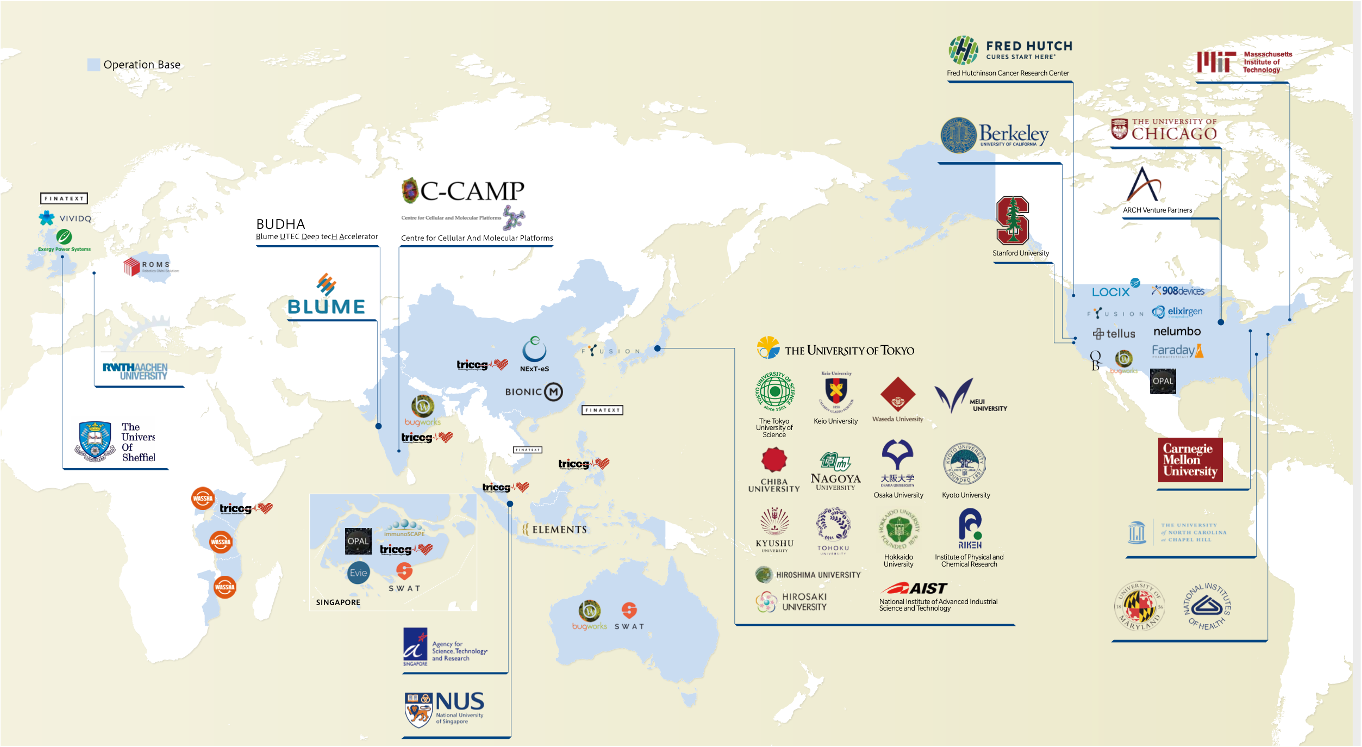
UTEC is an independent firm that works closely with universities. It is associated with The University of Tokyo (UTokyo), where it has a partnership with its Technology Licensing Office (TLO) to spin-off and invest in companies that originated as research projects. It has also worked with researchers from Waseda University, Kyoto University, Stanford, U.C. Berkeley, Carnegie Mellon, Cambridge University, the National University of Singapore and the Indian Institute of Technology, among other institutions.

A map showing UTEC's deep-tech investments around the world

UTEC’s deep-tech investments around the world

Broadly speaking, UTEC focuses on three areas: healthcare and life sciences, information technology and physical sciences and engineering. More specifically, it is looking for tech that addresses some of the most important issues in Japan, including an aging population; labor shortage; and the digitization of legacy industries.

“UTEC 5 will allow us to provide more funds from seed/early to pre-IPO/M&A stages in Japan and worldwide, on a wider scale and in a more consistent manner,” said managing partner and president Tomotaka Goji in a statement. “I believe this will further help our startups expand to address the global issues of humankind.”

The firm also partners with other funds, including Arch Venture Partners and Blume Ventures, to find investment opportunities around the world.

UTEC’s portfolio already includes more than 80 Japanese startups and 30 startups from other places, including the United States, India, Southeast Asia and Europe. So far, 25 of its investments have exited. Thirteen went public and now have an aggregated market cap of about $15 billion, and 12 were through mergers and acquisitions.

Some of its exits include 908 Devices, a mass spectrometry company that went public on Nasdaq last year; Fyusion, a computer vision startup acquired by Cox Automotive; and Phyzios, which was acquired by Google in 2013.

About half of UTEC’s portfolio are university spin-offs. For companies that originated in academic research, UTEC supports their commercialization by helping hire crucial talent, including executive positions, business development and go-to-market strategies. The firm’s first check size is about $500,000 to $5 million, and it also usually provides follow-on capital.

“We typically double-down on our investment in subsequent funding rounds of the company and can invest up to about $23 million per company over its lifecycle,” UTEC principal Kiran Mysore, who leads their global AI investments, told TechCrunch.

UTEC’s other investments include personal mobility robotics company BionicM, which started at UTokyo and spatial intelligence solution developer Locix, spun-off from U.C. Berkeley. The firm also helps startups collaborate with academic institutions. For example, Indian biotech Bugworks collaborates with the Tokyo Institute of Technology and Japanese industrial robotics startup Mujin now works with Carnegie Mellon.

18 May 2021

Financing for students startup StudentFinance raises $5.3M Seed from Giant and Armilar

Fintech startup StudentFinance – which allows educational institutions to offer success-based financing for students – has raised a $5.3m (€4.5m) seed round co-led by Giant Ventures and Armilar Venture Partners. It’s now raised $6.6m total, to date.

StudentFinance launched in Spain first, followed by Germany and Finland, with the UK planned this year. Existing investors Mustard Seed Maze and Seedcamp, along with Sabadell Venture Capital, also participated.

The startup, which launched at the beginning of 2020, provides the tech back end for institutions to offer flexible payment plans in the form of ISAs. It also provides data intelligence on the employment market to predict job demand.

It now has 35 education providers signed up managing over €5m worth of ISAs. It also works with upskilling platforms including Ironhack and Le Wagon. StudentFinance’s competitors include (in the USA) Blair, Leif, Vemo Education, Chancen (Germany-based) and EdAid (UK-based).

As for why StudentFinance stands out from those companies, Mariano Kostelec, co-founder & CEO of StudentFinance, said: “StudentFinance is the only platform in this space providing the full end-to-end, cross-border infrastructure to deliver ISAs for students whilst helping to plug the growing skills gap. Not only do we provide the infrastructure to support the ISA financing model, but we also provide data intelligence on the employment market and a career-as-a-service platform that focuses on placing students in the right job. We are creating an equilibrium between supply and demand.”

With an ISA, students only start paying back tuition once they are employed and earning above a minimum income threshold, with payments structured as a percentage of their earnings. This makes it a ‘success-based model’, says Student Finance, which shifts the risk away from the students. They are likely to be popular as workers need to resell with the onset of digitization and the pandemic’s effects.

The startup was founded in 2019 by Mariano Kostelec, Marta Palmeiro, Sergio Pereira and Miguel Santo Amaro. Kostelec and Santo Amaro previously built Uniplaces, which raised $30m as a student housing platform in Europe.

Cameron Mclain, Managing Partner of Giant Ventures, commented: “What StudentFinance has built empowers any educational institution to offer ISAs as an alternative to upfront tuition or student loans, broadening access to education and opportunity.”

Duarte Mineiro, Partner at Armilar Venture Partners, commented: “StudentFinance is a great opportunity to invest in because aside from its very compelling core purpose, this is a sound business where its economics are backed by a solid proprietary software technology.”

Sia Houchangnia, Partner at Seedcamp, commented: “The need for reskilling the workforce has never been as acute as it is today and we believe StudentFinance has an important role to play in tackling this societal challenge.”

Angel backers include investors, which includes: Victoria van Lennep (founder of Lendable); Martin Villig (founder of Bolt); Ed Vaizey (the UK’s longest-serving Culture & Digital Economy Minister); Firestartr (UK-based early-stage VC); Serge Chiaramonte (UK fintech investor); and more.

18 May 2021

Google is making it easier to bring Android apps to your car

By the end of the year, more than 10 car models from Volvo, GM, Renault and Polestar will be powered by the Android Automotive operating system — and all of the built-in Google apps and services that come with it. Now, the company is making it easier for third-party developers to bring their navigation, EV charging, parking and media apps directly to a car’s screen.

Google announced Tuesday at its annual developer conference that its extending its Android for Cars App Library, which is available as part of Jetpack, to support the Android Automotive operating system. This is good news for developers who can now create an app that is compatible with two different, but sometimes overlapping platforms: Android OS and Android Auto. It also means developers can create one app that should work seamlessly between various makes and models of vehicles.

Google said Tuesday it is already working with Early Access Partners, including Parkwhiz, Plugshare, Sygic, ChargePoint, Flitsmeister, SpotHero and others to bring apps in these categories to cars powered by Android Automotive OS.

PlugShare Google Android Automotive OS

Image Credits: Google

Android Automotive OS shouldn’t be confused with Android Auto, which is a secondary interface that lies on top of an operating system. Android Auto is an app that runs on the user’s phone and wirelessly communicates with the vehicle’s infotainment system. Meanwhile, Android Automotive OS is modeled after its open-source mobile operating system that runs on Linux. But instead of running smartphones and tablets, Google modified it so automakers could use in their cars.  Google has offered an open source version of this OS to automakers for sometime. But in recent years automakers have worked with the tech company to natively build in an Android OS that is embedded with all the Google apps and services such as Google Assistant, Google Maps and the Google Play Store.

Many third-party developers like Spotify have used the Android for Cars App Library to create and and publish their Android Auto apps to the Play Store. By extending the Cars App to the operating system, developers will only need to build once.

Two years ago, Google opened its Android Automotive operating system up to third-party developers to bring music and other entertainment apps into vehicle infotainment systems. Polestar 2, the all-electric vehicle developed by Volvo’s standalone electric performance brand, was the first. And more have followed, including the Volvo XC40 Recharge.

Companies interested in participating in the early access program will have to fill out this interest form, according to Google.