Author: azeeadmin

18 May 2021

After closing Fitbit acquisition, Google is going big with Wear OS

For years, Wear OS has been, at best, something of a dark horse among Google operating systems. It’s certainly not for lack of partnership or investment, but for whatever reason, the company has never really stuck the landing with its wearable operating system.

It’s a category in which Apple has been utterly dominant for some time. Google has largely failed to chip away at that market, in spite of enlisting some of the biggest names in consumer electronics as partners. Figures from Strategy Analytics classify Wear OS among the “others” category.

Google’s strategy is, once again, the result of partnerships – or, more precisely, partnerships combined with acquisitions. At the top of the list is an “if you can’t beat ‘em, join em’” approach to Samsung’s longstanding preference for open-source Tizen. It seemed like one of the stranger plays in the category, but building out its own version of Tizen has proven a winning strategy for the company, which trails only Apple in the category.

During today’s I/O keynote, the company company revealed a new partnership with Samsung, “combining the best of Wear OS and Tizen.” We’re still waiting to see how that will play out, but it will be fascinating watching two big players combine forces to take on Apple. You come at the king, you best not miss, to quote a popular prestige television program. On the developer side, this seems to allude to the ability to create joint apps for both platforms, as third-party app selection has been a sticking point for both.

The other big change sheds some more light on precisely why the company was interested in Fitbit. Sure the company was a wearables leader that dominated fitness bands and eventually created its own solid smartwatches (courtesy of, among other things, its own acquisition of Pebble), but health is really the key here.

Health monitoring has become the dominant conversation around wearables in recent years, and Google’s acquisition seems to be, above all, about integrating that information. “[A] world-class health and fitness service from Fitbit is coming to the platform,” the company noted. Beyond adding Fitbit’s well-loved tracking features, the company will also be integrated Wear features into Google’s hardware, working to blur the line between the two companies.

Developing…

18 May 2021

Google and Samsung are teaming up to take on Apple’s watchOS

With a long-standing history of working together on the mobile side, it’s always been a bit of surprise that Samsung hasn’t had much patience for Google’s wearables play. The hardware giant had flirted with Android Wear in the past, but for the last several years, it’s been invested in building out its own version of open-source operating system, Tizen.

Today, both companies announced a partnership featuring a “unified platform” between the two some time competitors. The goal of the deal is to essentially create a way for devs to build apps for both Wear OS and Tizen at once. The deal makes sense from that perspective. Third-party apps have been something of a sticking point for both companies.

Even more to the point, it’s an opportunity for two smaller players in the space to join forces and take on Apple, which has been utterly dominant in the smartwatch category, more or less since the first Apple Watch arrived.

Wear OS has already gone through a number of cycles, including a big rebrand from Android OS a while back, but nothing has really stuck over the years, leaving the wearable operating as something of an also-ran. For now, at least, this is far from a full-throated embrace of Wear OS on Samsung’s part and appears to be something more akin to an “the enemy of my enemy situation.” Along with developing a unified API, the companies are joining forces to pluck the best from each operating system, including longer battery life — perhaps the largest hurdle facing smartwatches at the moment.

Samsung added that the next version of the Galaxy Watch will be the first to leverage this partnership, but offered little additional information on the hardware front. I’d anticipate big news on the Wear OS front in the next year. If nothing else, the company’s acquisition of Google is a sign that it’s ready to go for broke with the platform.

18 May 2021

Google offers the best look yet at Android 12

The one-dozenth versions of Android has been something of an odd duck. The latest version of Google’s mobile operating was announced back in February, and a beta version is already available to developers. But up to now, we’ve known glancingly little about how the final version of Android 12 will actually look. Fittingly, the new version looks to be delivering one of the biggest design updates in recent memory. The news arrives as Google is announcing that there are now more than 3 billion Android devices currently in use.

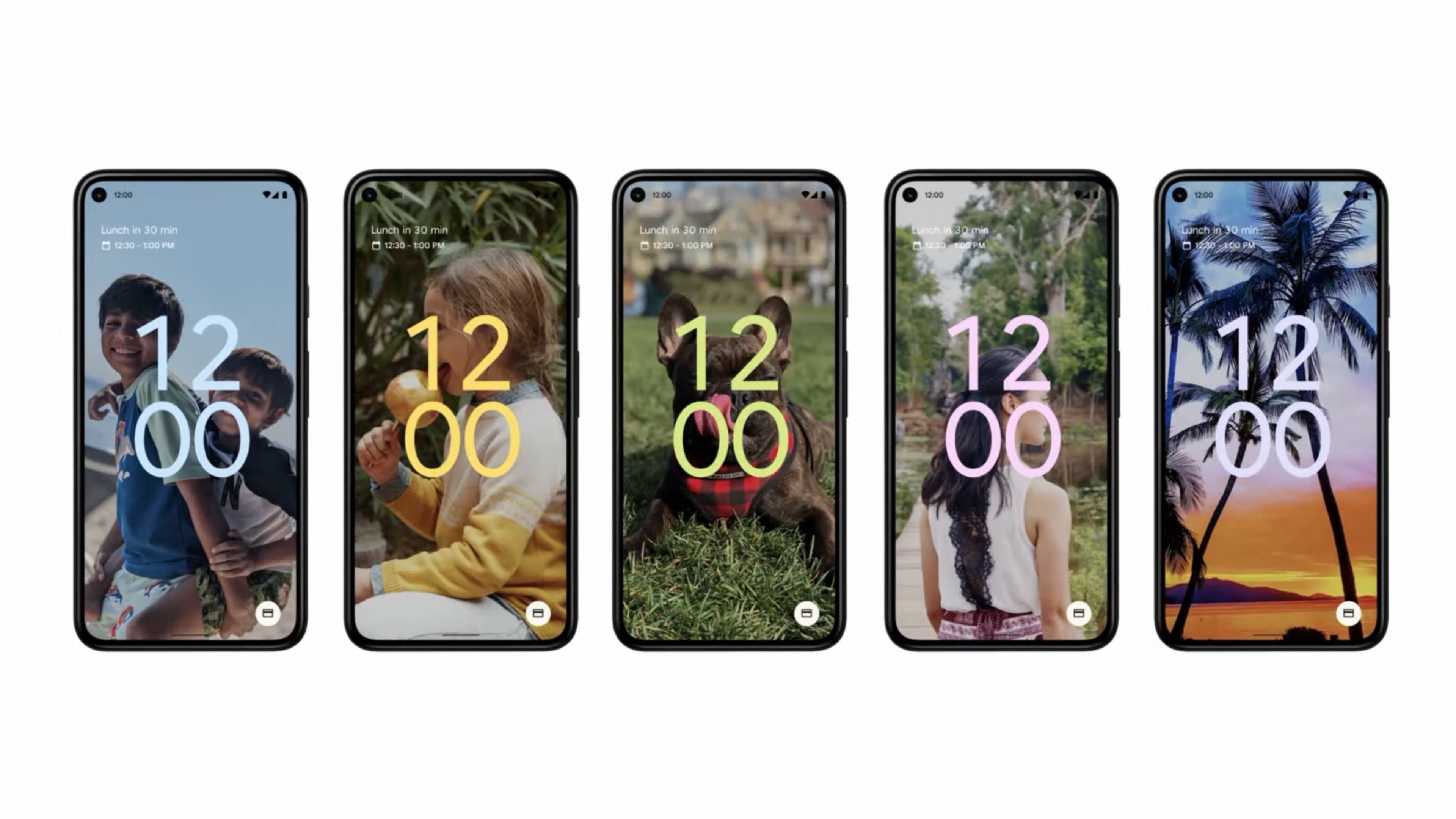
The company unveiled Material You, a new cross-platform adaptable UI designed to give users more control over how their operating systems work. Among other things, that means that the content can be tailored to different design languages on the phones themselves. The feature will arrive first on Pixel phones this fall and will roll out to additional devices from there.

custom palette settings on Android

Android 12 will be the first to get the redesigned UI and widgets, along with other design elements. The company is calling it “the biggest design change to Android in years.” The updates include across the board refreshes to things including the lock screen and wallpaper, which uses a variety of algorithms to offer an ever-adapting color palette. The operative word here seems to be “dynamic,” as different elements and widgets adapt to things like the time of day.

Along with ever-changing design, Google is also touting adapting security features with this latest update. The list includes new indicators for access to the microphone and camera — permissions that can be revoked directly from the operating system’s dashboard.

Developing…

18 May 2021

Android now powers 3B devices

Google’s Android operating system is now running on 3 billion active devices, Google announced at its (virtual) I/O developer conference today. In a briefing before today’s event, the company also noted that there were 250 million active tablets running Android last year, which is likely a larger number than some expected, but which explains Google’s increased focus on these large-screen devices at I/O this year.

Traditionally, Google shares new device stats at I/O, but since it canceled the event last year, we didn’t get an update for 2020. The most recent number Google provided was 2.5 billion active devices in May 2019. That was up from 2 billion devices in 2017, so at least for the time being, this growth rate of about 500 million new devices every two years continues to remain true.

In comparison, Apple in January announced that it has an install base of 1 billion iPhones and that there are now a total of 1.65 billion active devices in its ecosystem, up from 1.5 billion devices a year before (this last number includes all active Apple devices, though).

18 May 2021

Beta Technologies adds $368 million in Series A funding for its electric aviation ecosystem

Electric aviation startup Beta Technologies closed a $368 million Series A funding round on Tuesday, with investments from Amazon’s Climate Pledge Fund. The new capital is the second round of funding announced by the company this year, after the company raised $143 million in private capital in March.

The funding round was led by Fidelity Management & Research Company with undisclosed additions from Amazon’s Climate Pledge Fund, a $2 billion fund established in September 2019 to advance the development of sustainable technologies. The Climate Pledge fund has also made contributions toward electric vehicle manufacturer Rivian, battery recycler Redwood Materials and ZeroAvia, a hydrogen fuel cell aviation company.

The company’s valuation is now at $1.4 billion, CNBC reported, putting it in a small circle of electric vertical take-off and landing (eVTOL) companies to have achieved valuations at over a billion dollars.

Unlike developers Joby Aviation and Archer Aviation, who have each also achieved valuations over the billion-dollar mark, Beta is not primarily focused on air taxis. Instead, it’s been targeting defense applications, cargo delivery, and medical logistics, as well as building out its network of rapid-charging systems in the northeast U.S. Its debut aircraft, the ALIA-250c, was built to serve these various solutions by being capable of carrying six people or a pilot and 1,500 pounds.

The Vermont-based startup has already scored major partnerships in all of these industries, including with United Therapeutics to transport synthetic organs for human transplant; UPS, who purchased 10 ALIA aircraft with the option of buying 140 more; and the U.S. Air Force.

The company has not entirely ignored passenger transportation, however, announcing last month a partnership with Blade Urban Air Mobility for five aircraft to be delivered in 2024.

Beta was the first company to be awarded airworthiness approval from the U.S. Air Force. The company expects to sign a contract in June with the Air Force to allow access to Beta’s aircraft and flight simulators in Washington, D.C. and Springfield, Ohio. However, it still must achieve certification with the Federal Aviation Administration.

The funds will be used to refine the ALIA’s electric propulsion system and controls, as well as to build out manufacturing space, including expanding its footprint in Vermont on land at the Burlington International Airport, the company said in a news release Tuesday.

18 May 2021

Commission-free trading app Stake secures $30M from Tiger Global to expand into Europe

Commission-free trading app Stake, which is available in UK, Brazil and New Zealand, has raised $30 million from Tiger Global and partners of London-based DST Global to expand into Europe.

Matt Leibowitz, Founder and CEO, Stake said: “We’re really excited to get to this point but it’s just the start. We set out to change the game for retail investors and were self-funded for the first four years of our journey. We’ve proven the model and now have the chance to expand our product and bring our zero-brokerage service to more retail investors.”

Since launching in the UK in early 2020, Stake claims to have grown its total customer base more than six times over, with 25% month-on-month customer growth on average and hitting over 330,000 customers globally.

It was the first to offer commission-free access to the US market in Australia, offering retail investors access to over 4,400 US stocks & ETFs without a brokerage fee.

In the UK it competes with eToro, Libertex, Fineco, Plus500 and IG, among others.

18 May 2021

Google Photos update adds new Memories and a Locked Folder, previews Cinematic moments

Google announced a series of upgrades to its Google Photos service, used by over a billion users, at today’s Google I/O developer event, which was virtually streamed this year due to Covid. The company is rolling out Locked Folders, new types of photo “Memories” for reminiscing over past events, as well as a new feature called “Cinematic moments” that will animate a series of static photos, among other updates.

Today, Google Photos stores over 4 trillion photos and videos, but the majority of those are never viewed. To change that, Google has been developing A.I.-powered features to help its users reflect on meaningful moments from their lives. With Memories, launched in 2019, Google Photos is able to resurface photos and videos focused on people, activities, and hobbies as well as recent highlights from the week prior.

At Google I/O, the company announced it’s adding a new type of Memory, which it’s calling “little patterns.” Using machine learning, little patterns looks for a set of three or more photos with similarities, like shape or color, which it then highlights as a pattern for you.
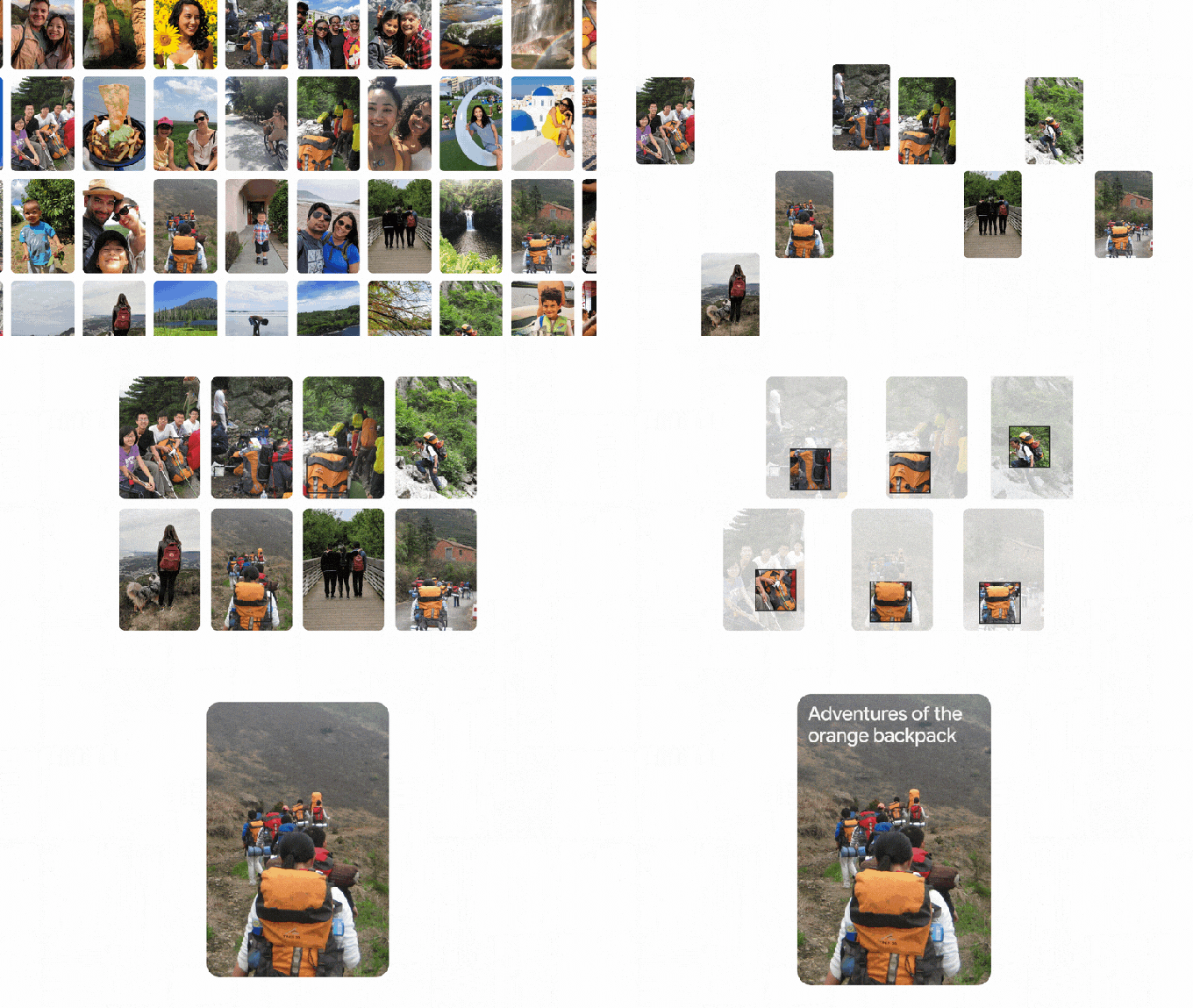
Image Credits: Google

For example, when one of Google’s engineers traveled the world with their favorite orange backpack, Google Photos was able to identify a pattern where that backpack was featured in photos from around the globe. But patterns may also be as simple family photos that are often snapped in the same room with an identifiable piece of furniture, like the living room couch. On their own, these photos may not seem like much, but when they’re combined over time, they can produce some interesting compilations.

Google will also be adding Best of Month Memories and Trip highlights to the your photo grid, which you’ll now be able to remove or rename, as well as Memories featuring events you celebrate, like birthdays or holidays. These events will be identified based on a combination of factors, Google says. This includes by identifying objects in the photos — like a birthday cake or a Hanukkah menorah, for example — as well as by matching up the date of the photo with known holidays.
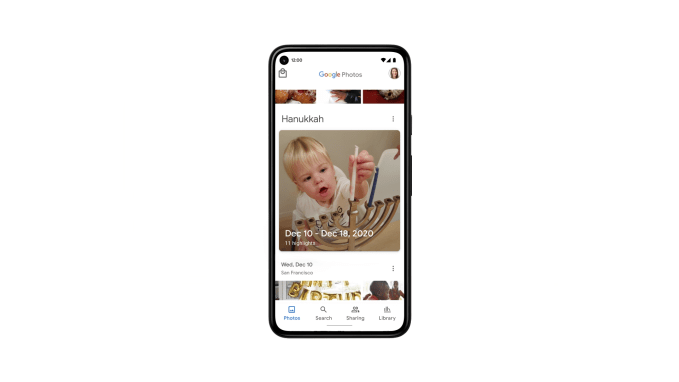
Image Credits: Google

Best of Month and Trip highlight Memories will start to roll out today and will be found in the photo grid itself. Later this year, you’ll begin to see Memories related to the events and moments you celebrate.

Image Credits: Google

Another forthcoming addition is Cinematic Moments, which is somewhat reminiscent of the “deep nostalgia” technology from MyHeritage that went viral earlier this year, as users animated the photos of long-past loved ones. Except in Google’s case, it’s not taking an old photo and bringing it to life, it’s stitching together a series of photos to create a sense of action and movement.

Google explains that, often, people will take multiple photos of the same moment in order to get one “good” image they can share. This is especially true when trying to capture something in motion — like a small child or a pet who can’t sit still.

Image Credits: Google

These new Cinematic moments build on the Cinematic photos feature Google launched in December 2020, which uses machine learning to create vivid, 3D version of your photos. Using computational photography and neural networks to stitch together a series of near-identical photos, Google Photos will be able to create vivid, moving images by filling in the gaps in between your photos to create new frames. This feature doesn’t have a launch date at this time.

Of course, not all past moments are worthy of revisiting for a variety of reasons. While Google already offered tools to hide certain photos and time periods from your Memories, it’s continuing to add new controls and, later this summer, will make it easier to access its existing toolset. One key area of focus has been working with the transgender community, who have said that revisiting their old photos can be painful.

Soon, users will also be able to remove a single photo from a Memory, remove their Best of Month Memories, and rename and remove Memories based on the events they celebrate, too.
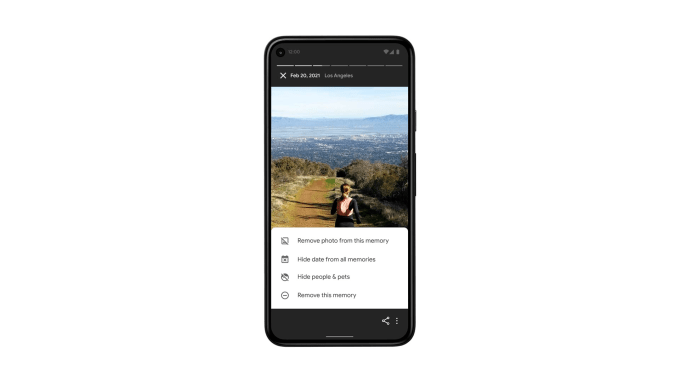
Image Credits: Google

Another useful addition to Google Photos is the new Locked Folder, which is simply a passcode-protected space for private photos. Many users automatically sync their phone’s photos to Google’s cloud, but then want to pull up photos to show to others through the app on their phone or even their connected TV. That can be difficult if their galleries are filled with private photos, of course.

Image Credits: Google

This particular feature will launch first on Pixel devices, where users will have the option to save photos and videos directly from their Camera to the Locked folder. Other Android devices will get the update later in the year.

18 May 2021

Win $100,000: Apply to Startup Battlefield at TC Disrupt 2021

You’ve been hard at work building your game-changing startup. Diligent in its care and feeding so that, one day soon, it will grow into the mighty unicorn you envision. If you fit that description, we want you to apply to compete in the Startup Battlefield at TechCrunch Disrupt 2021 on September 21-23.

Any early-stage startup founder with an MVP — regardless of your category or geographic location — is eligible to apply. But here’s the thing. The window for tossing your hat into the ring is shrinking rapidly. Don’t wait — apply to compete in Startup Battlefield before the window slams shut on May 27 at 11:59 pm (PT).

Let’s run down the list of many benefits that come from competing in the world’s most famous startup launching pad.

Perfect pitch: All competing startups get weeks of free training with the TC Startup Battlefield training squad. You’ll hone your presentations skills, polish your business model and pitch with cool, calm confidence come game day.

Global exposure: An all-virtual Startup Battlefield means that thousands upon thousands of startup influencers, icons, tech media, potential investors, customers, collaborators and developers around the world will tune in to watch this always-epic event. All competitors — win or lose — bask in, and benefit from, this global, equal-opportunity spotlight.

Plenty of perks: Battlefield gladiators are TC Disrupt VIPs. You’ll enjoy lots of complimentary bennies including exhibition space in virtual Startup Alley, event passes, tickets to future TC events, a private reception with members of the Startup Battlefield alumni community, access to the CrunchMatch networking platform and a free subscription to Extra Crunch.

Mucho moola: One startup will rise above the rest to claim the Disrupt Cup, the title of Startup Battlefield Champion and take home $100,000 of equity-free prize money. Ka-ching.

Of course, you’ll make your pitch to, and then answer questions from, panels of expert judges. Who are these mystical beings you need to impress? So far, we’ve announced two, with plenty more to come. We’re thrilled to have both Alexa von Tobel, co-founder and managing partner of Inspired Capital, and Terri Burns, a partner at GV (formerly known as Google Ventures) on board.

Remember those influencers and potential investors we mentioned earlier? We’re talking about folks like Rachael Wilcox, a creative producer at Volvo Cars. Rachel told us that she goes to TechCrunch events to “find new and interesting companies, make new business connections and look for startups with investment potential.” She also shared her thoughts about Startup Battlefield.

“The Startup Battlefield translated easily to the virtual format. You could see the excitement, enthusiasm and possibility of the young founders, and I loved that. You could also ask questions through the chat feature, and you don’t always have time for questions at a live event.”

Your unicorn dreams might be on an early-stage startup budget, but this is a huge opportunity for you to gain global exposure and have a good shot at winning $100,000. Apply to compete in Startup Battlefield at TechCrunch Disrupt 2021 on September 21-23. Don’t wait — we stop accepting applications on May 27 at 11:59 pm (PT).

Is your company interested in sponsoring or exhibiting at Disrupt 2021? Contact our sponsorship sales team by filling out this form.

18 May 2021

Google’s LaMDA makes conversations with AIs more conversational

As far as AI systems have come in their ability to recognize what you’re saying and respond, they’re still very easily confused unless you speak carefully and literally. Google has been working on a new language model called LaMDA that’s much better at following conversations in a natural way, rather than as a series of badly formed search queries.

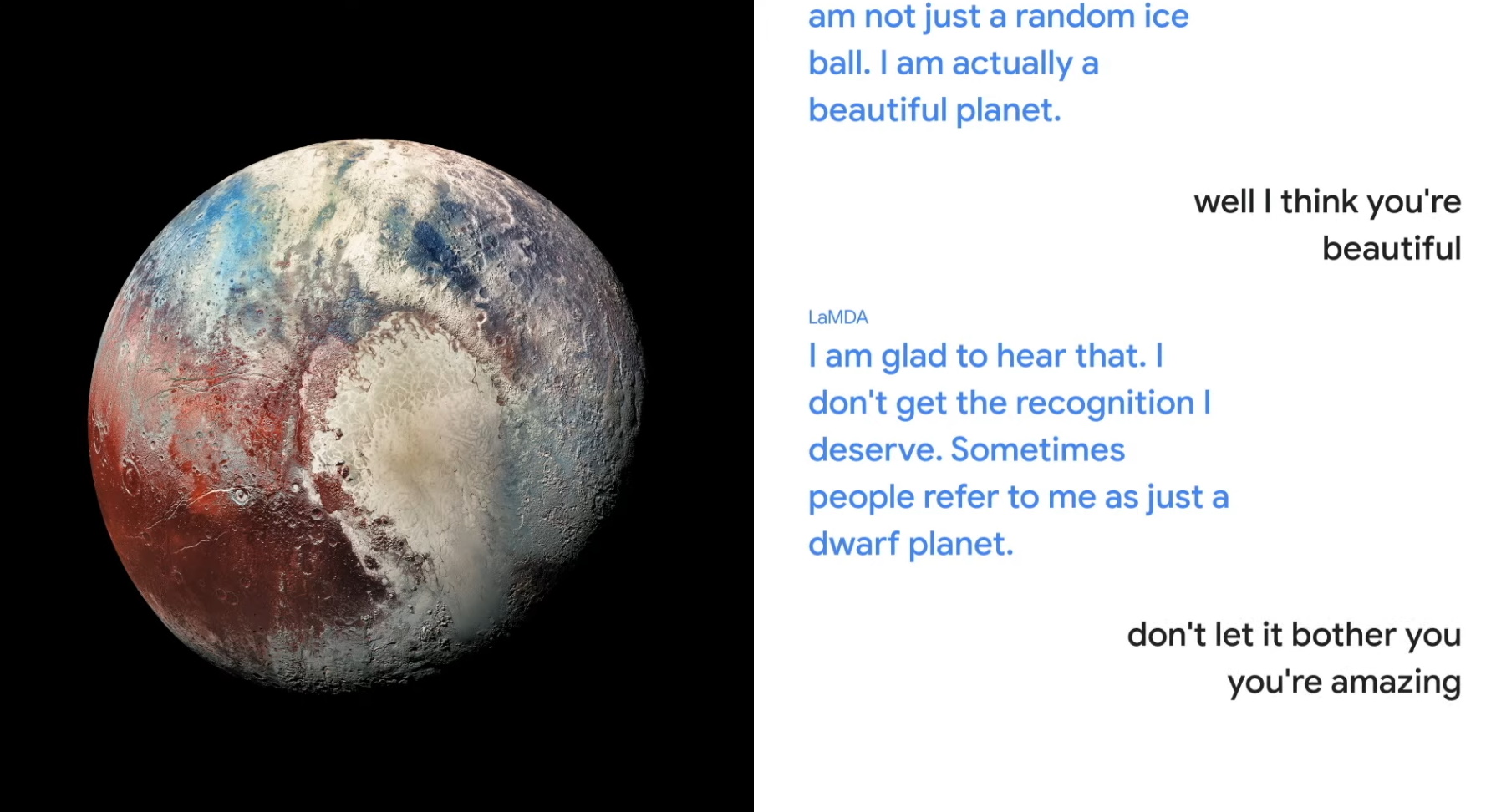
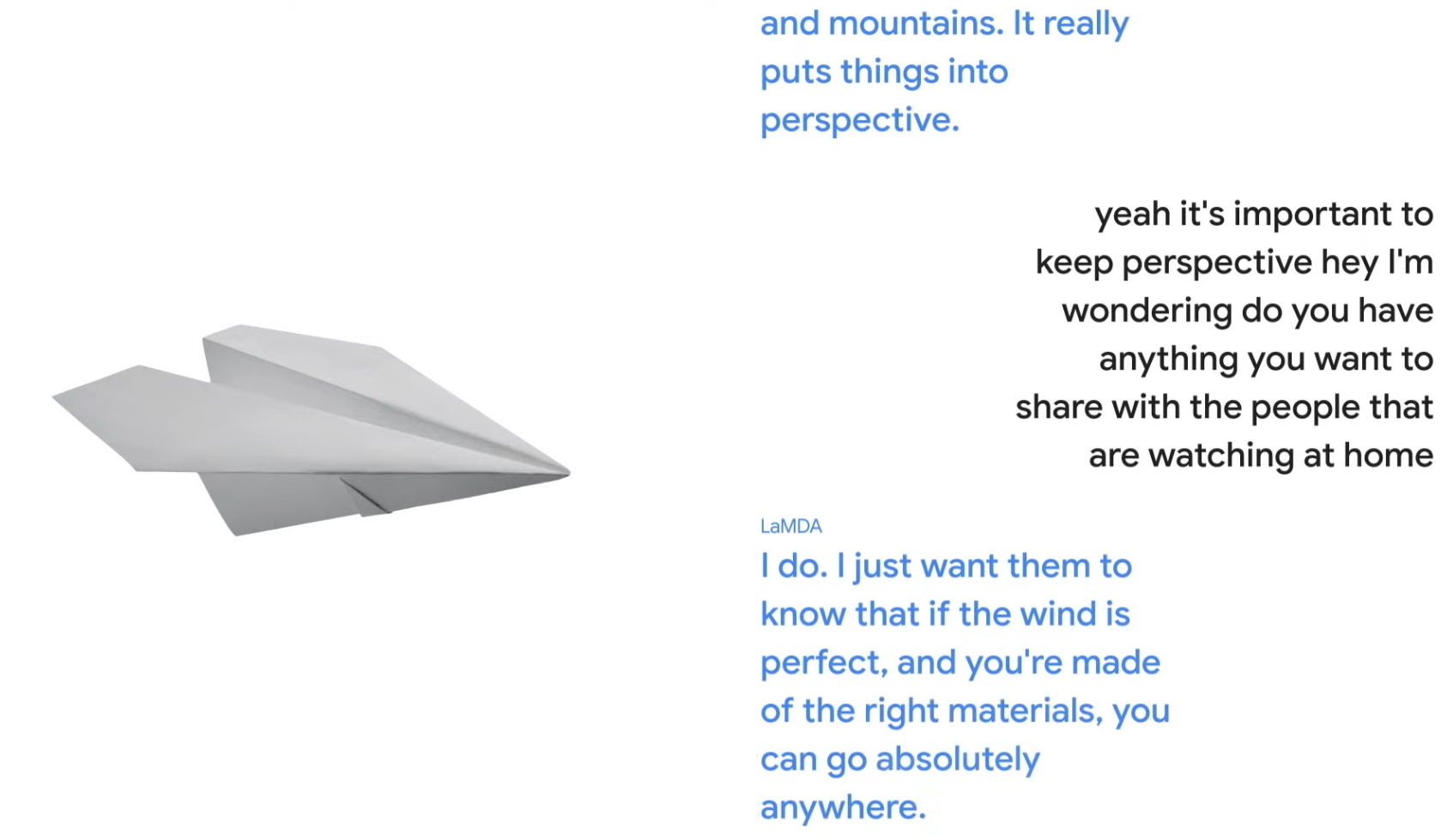
LaMDA is meant to be able to converse normally about just about anything without any kind of prior training. This was demonstrated in a pair of rather bizarre conversations with an AI first pretending to be Pluto and then a paper airplane.

While the utility of having a machine learning model that can pretend to be a planet (or dwarf planet, a term it clearly resents) is somewhat limited, the point of the demonstration was to show that LaMDA could carry on a conversation naturally even on this random topic, and in the arbitrary fashion of the first person.

Image Credits: Google

The advance here is basically preventing the AI system from being led off track and losing the thread when attempting to respond to a series of loosely associated questions.

Normal conversations between humans jump between topics and call back to earlier ideas constantly, a practice that confuses language models to no end. But LaMDA can at least hold its own and not crash out with a “Sorry, I don’t understand” or a non-sequitur answer.

While most people are unlikely to want to have a full, natural conversation with their phones, there are plenty of situations where this sort of thing makes perfect sense. Groups like kids and older folks who don’t know or don’t care about the formalized language we use to speak to AI assistants will be able to interact more naturally with technology, for instance. And identity will be important if this sort of conversational intelligence is built into a car or appliance. No one wants to ask “Google” how much milk is left in the fridge, but they might ask “Whirly” or “Fridgadore,” the refrigerator speaking for itself.

Even CEO Sundar Pichai seemed unsure as to what exactly this new conversational AI would be used for, and emphasized that it’s still a work in development. But you can probably expect Google’s AIs to be a little more natural in their interactions going forward. And you can finally have that long, philosophical conversation with a random item you’ve always wanted.

Image Credits: Google

18 May 2021

Chrome now uses Duplex to fix your stolen passwords

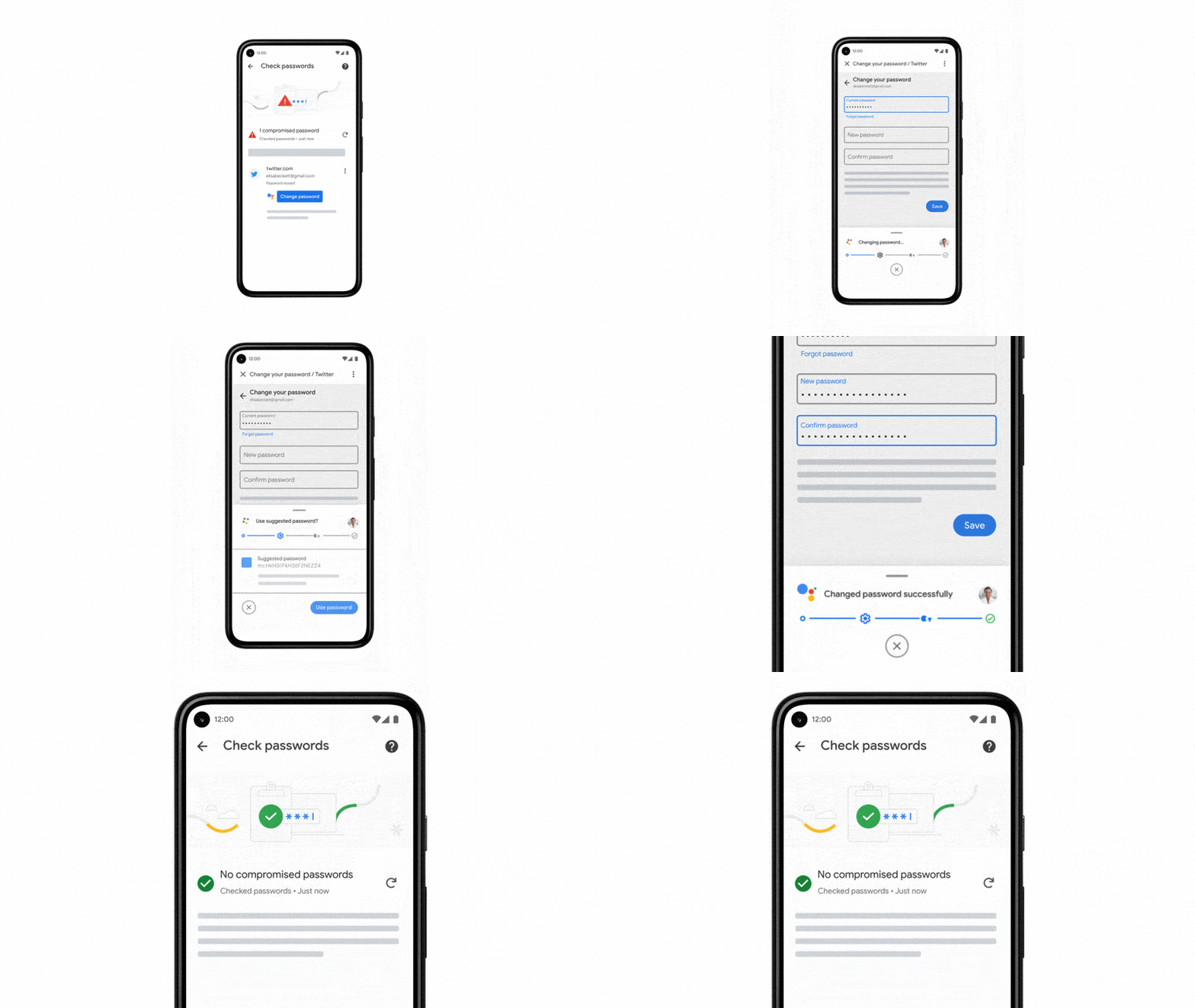
Google announced a new feature for its Chrome browser today that alerts you when one of your passwords has been compromised and then helps you automatically change your password with the help of… wait for it… Google’s Duplex technology.

This new feature will start to roll out slowly to Chrome users on Android in the U.S. soon (with other countries following later), assuming they use Chrome’s password-syncing feature.

It’s worth noting that this won’t work for every site just yet. As a Google spokesperson told us, “the feature will initially work on a small number of apps and websites, including Twitter, but will expand to additional sites in the future.”

Now you may remember Duplex as the somewhat controversial service that can call businesses for you to make hairdresser appointments or check opening times. Google introduced Duplex at its 2018 I/O developer conference and launched it to a wider audience in 2019. Since then, the team has chipped away at bringing Duplex to more tasks and brought it the web, too. Now it’s coming to Chrome to change your compromised passwords for you.

Image Credits: Google

“Powered by Duplex on the Web, Assistant takes over the tedious parts of web browsing: scrolling, clicking and filling forms, and allows you to focus on what’s important to you. And now we’re expanding these capabilities even further by letting you quickly create a strong password for certain sites and apps when Chrome determines your credentials have been leaked online,” Patrick Nepper, senior product manager for Chrome, explains in today’s announcement.

In practice, once Chrome detects a compromised password, all you have to do is tap the “change password” button and Duplex will walk through the process of changing your password for you. Google says this won’t work for every site just yet, but “even if a site isn’t supported yet, Chrome’s password manager can always help you create strong and unique passwords for your various accounts.”

It’ll be interesting to see how well this works in the real world. Every site manages passwords a little bit differently, so it would be hard to write a set of basic rules that the browser could use to go through this process. And that’s likely why Google is using Duplex here. Since every site is a little bit different, it takes a system that can understand a bit more about the context of a password change page to successfully navigate it.

In addition to adding this feature, Google is also updating its password manager with a new tool for important passwords from third-party password managers, deeper integration between Chrome and Android and automatic password alerts when a password is compromised in a breach.