Author: azeeadmin

18 May 2021

Google launches the next generation of its custom AI chips

At its I/O developer conference, Google today announced the next generation of its custom Tensor Processing Units (TPU) AI chips. This is the fourth generation of these chips, which Google says are twice as fast as the last version. As Google CEO Sundar Pichai noted, these chips are then combined in pods with 4,096 v4 TPUs. A single pod delivers over one exaflop of computing power.

Google, of course, uses the custom chips to power many of its own machine learning services, but it will also make this latest generation available to developers as part of its Google Cloud platform.

“This is the fastest system we’ve ever deployed at Google and the historic milestone for us,” Pichai said. “Previously to get an exaflop you needed to build a custom supercomputer, but we already have many of these deployed today and will soon have dozens of TPUv4 pods in our data centers, many of which will be operating at or near 90% carbon-free energy. And our TPUv4 pods will be available to our cloud customers later this year.”

The TPUs were among Google’s first custom chips. While others, including Microsoft, decided to go with more flexible FPGAs for its machine learning services, Google made an early bet on these custom chips. They take a bit longer to develop — and quickly become outdated as technologies change — but can deliver significantly better performance.

18 May 2021

Google interconnects its Workspace apps, adds a dozen new features

Google kicked off its Google I/O Developer event this afternoon with a set of new collaborative workspace tools, which it’s calling, as a group, “Smart Canvas.” The company demonstrated using how Smart Canvas works for brainstorming and project planning, showing how users could drop in ideas about an upcoming launch, share their thoughts, work on documents together, join Google Meet calls, and solve problems together.

The company says it’s enhancing its everyday collaborative documents, like Google Docs, Sheets and Slides, with a dozen some new features, as a part of its effort in the Smart Canvas new product experience.

Currently, when users @mention others in a document, a smart chip will pop up, displaying that person’s location, job title and contact information. Smart chips will also now appear for recommended files and meetings in Docs, and will soon roll out to Sheets.

Google’s assisted writing feature will now offer more inclusive language recommendations as you write — like that you use the word “chairperson” instead of “chairman,” for example.

Other updates include a pageless format in Docs to remove page boundaries, emoji reactions in Docs, the ability to import info from Calendar meeting invites, connected checklists in Docs that let you assign items to other people and see these action items in Google Tasks, Table templates in Docs, a timeline view in Sheets, more assisted analysis functionality in our Sheets, the ability to create Docs, Sheets and Slides from Google Chat rooms, and more.

One of the more interesting changes, however, was support for live captions and translations in Google Meet, and the ability to now present your content to a Google Meet call on the web directly from your Doc, Sheet or Slide. This puts Google in competition with other meeting transcription services, like Otter.ai.

The updates paint a picture of Google’s aim to make its workspace apps connect together more seamlessly, instead of being separate components — that helps to lock users inside Google’s walled garden, and makes it more difficult to swap out one of Google’s workspace apps for a competitor.

Today the Smart Canvas update is rolling out features that include the ability to insert smart chips for Docs, Sheets, or Slides files, other Google Drive files, and Calendar events; creating checklists; and inserting links more easily with intelligent suggestions in the insert link dialog box. other will come in the months ahead.

18 May 2021

Click-and-mortar is a better model for healthcare

Until COVID-19, healthcare was either all in-person or all virtual. Patients had to choose. Some patients chose both — an in-person health system for most things and perhaps Livongo for diabetes care or Hinge Health for back pain care.

The problem with this approach is that in-person all the time is inconvenient and a waste of time when all a clinician is doing is looking at a wound or responding to lab results. But all-virtual is not great when things are uncertain or patients need to be examined. While there are few silver linings to the horrendous COVID-19 pandemic, one is that nearly all providers and most patients have experienced virtual care and most have found it useful. This widespread adoption of virtual care, we believe, will lead to hybrid models that we call “click-and-mortar,” which combine the best elements of in-person and virtual care to deliver better outcomes more reliably and efficiently.

The uptake of virtual care in 2020 is stunning: 97% of primary care doctors provided some kind of telehealth care in 2020. Moreover, nearly 44% of Medicare beneficiaries’ primary care visits were provided by telemedicine in 2020, compared with a mere 0.1% the year before.

The notion of virtual care has become so common that Google searches for “doctor online” result in a specialized tool displaying widely available virtual care platforms, such as Teladoc, Amwell, Doctor On Demand and MDLive. Moreover, telemedicine providers like Doctor on Demand, MDLive, Galileo and Firefly have all launched “virtual primary care” services designed to deliver non-urgent longitudinal primary care virtually. While these services may meet the needs of healthier patients, the absence of a physical location for physical examinations, diagnostic tests and procedures may limit their utility.

This widespread adoption of virtual care, we believe, will lead to hybrid models that combine the best elements of in-person and virtual care to deliver better outcomes more reliably and efficiently.

Nonetheless, there are several potential advantages of virtual primary care. The ability to see patients in their homes can contribute new information about safety, social support and social determinants. In cases like behavioral health, they can decrease the stigma associated with accessing care. Virtual care platforms can more easily incorporate remote monitoring data, and virtual visits can occur as groups with teams of caregivers or other specialists simultaneously.

Furthermore, virtual visits may allow for more frequent “microvisits” to monitor how patients are progressing. They also facilitate more rapid treatment adjustments because they eliminate the need to travel to a doctor’s office. Virtual visits also have lower cost for physicians, avoiding brick-and-mortar overhead costs, and for some services offer 24/7 access, which may reduce the need to seek urgent care or emergency department care. Finally, patients may be able to gain expanded access to clinicians who match preferences based on things like ethnicity, LGBTQ orientation and gender, particularly in rural areas where options are limited.

For pure-play virtual care models to work, they need to rely on connected devices and patient cooperation. Using connected blood pressure cuffs, stethoscopes, oximeters, thermometers and scales, it is possible to replicate much of the physical exam. Just like for in-person care, a virtual provider can order lab tests, although it is impossible to do a quick urinalysis or strep test virtually without the supplies on hand.

Virtual providers who work closely with health plans may have more data on cost and quality to inform referrals but perhaps less local knowledge. A possible consequence is that virtual providers may have more transactional relationships with specialists and traditional local brick-and-mortar providers.

Data have shown virtual care delivers better clinical outcomes in certain cases. Virtual care has been shown to reduce emergency department visits and antibiotic overprescribing. Chronic conditions like Type 2 diabetes are examples where virtual care has outperformed in-person care. Virtual physical therapy has generated cost savings and resulted in fewer back surgeries.

Despite these benefits of purely virtual care, we believe that ultimately the most efficacious model of primary care is a hybrid one combining virtual and in-person interaction. We think that the mix of in-person and virtual is probably 80% virtual. We also think that most visits will be triggered by clinicians reaching out to patients in response to a change in remotely monitored data, perhaps a new fever, change in sleep patterns or weight change for a patient with heart failure.

The implications of visits being mostly virtual and largely triggered by changes in data are profound. It means that offices become places for problem-solving and procedures. It means clinicians spend their days responding to signals from patients and probably have their schedules largely unfilled until the night before. It means that patients will need to adopt passively collected and remotely monitored data.

We think this model ultimately will result in more frequent, shorter, virtual interactions that happen nearly continuously over text and be supplemented by email, phone and video. We also think this approach will deliver much better clinical outcomes and more rapid improvement since both the patient and clinician have much more data on how diseases are progressing.

There are risks with this model. It requires patients with mobile phones and devices to engage and respond to clinicians and ensure their remote monitoring devices stay online. Most importantly, patients need to follow the advice of virtual providers and prompts to get in-person labs, diagnostics or care when needed. Further, clinicians will need to be trained to conduct virtual clinical examinations and to incorporate as well as respond to remote monitoring data.

The COVID-19-fueled adoption of virtual care will hopefully create the demand on the part of patients and desire on the part of clinicians to embrace our “click-and-mortar” vision for care. These models have the potential to deliver more proactive, more engaging and, we think, far better care.


18 May 2021

Benchmark Space Systems and Starfish Space team up to advance orbital docking and refueling

Humans may not have totally mastered getting objects to space, but we’ve done a pretty good job so far. The hundreds of satellites that orbit the Earth are proof enough that ‘send stuff to space’ is firmly in humanity’s capacity. But what about refueling, repairing, or even adding capabilities to spacecraft or satellites once they’re up there?

In the past few years, a host of companies have started to turn what has long been seen as a pipe dream into a real possibility. Now, satellite servicing company Starfish Space and space mobility provider Benchmark Space Systems will be entering into a new partnership aimed at advancing these much-needed capabilities – and their first demonstration will take place next month, on space startup Orbit Fab’s Tanker 1 mission.

Orbit Fab, which was a finalist in our TechCrunch Disrupt Battlefield in 2019, will be sending up an operational fuel depot on a SpaceX Falcon 9 in June. The tanker is the first of what Orbit Fab is envisioning as a “gas station in space” – in-orbit propellant available to satellite customers who will no longer be limited in terms of their spacecraft’s active life by the amount of fuel they take up on launch.

Benchmark Space Systems and Orbit Fab already have an agreement to combine Benchmark’s Halcyon thruster system and the fuel depot startup’s fluid transfer interface (imagine a refueling apparatus) into an integrated propulsion package.

This is where Starfish Space comes in. It will be testing its CEPHALOPOD rendezvous, proximity operations and docking (RPOD) software with Benchmark’s Halcyon thruster system to make sure that the refueling demonstration is as accurate as possible. The RPOD software is entirely autonomous and can give small servicing vehicles up to 8 times more maneuvering capability, the company says.

Demonstration missions like the one in June are just the beginning. Refueling capacity could not only extend the mission length of satellites and other spacecraft, it could help open the door to new types of space missions and the emerging space economy.

18 May 2021

Dorothy is a startup that offers faster cash post-disaster

When disaster strikes, costs pile up quickly. Flood waters can wipe out the foundation of a home or building, just as much as wildfires can burn down the walls or the entire structure. For residents and business owners, rebuilding and rebuilding quickly is crucial: they ultimately need some place to live and offer services, and they often can’t afford to be shut out for extended periods of time.

Of course, the need for speed among consumers hits the brick wall that is the insurance industry and government’s timeline for dispersing post-disaster insurance claims and aid. It’s not uncommon for federal aid to take months or even years to arrive, and insurance companies can often take months as well to process claims, particularly after large disasters like hurricanes where thousands of claims arrive simultaneously.

Dorothy is a startup that is aiming to bridge the gap by offering, well, gap loans to users who already have existing private insurance or federal flood insurance policies. The idea is to extend cash as quickly as possible after qualification, and then Dorothy gets paid back when a claim is later processed. Much like other advance cash startups in other sectors, Dorothy takes a fee based on the size of the loan.

The company’s underwriting model assesses the likelihood that a claim will be approved given the details of a particular disaster and the user’s insurance policy.

Arianna Armelli and Claudio Angrigiani founded the company last year in the midst of the COVID-19 pandemic, naming it for the character from the Wizard of Oz who repeatedly said “there’s no place like home.” They met each other in graduate school at the University of Pennsylvania and explored different ways to solve the challenges of disaster finance.

Armelli, for her part, had experienced these challenges firsthand in the wake of Hurricane Sandy in 2012. She was an architect, and her office in Manhattan had to be evacuated. She returned a few days later, but over time, realized that many of her friends still couldn’t return to their homes even weeks after the hurricane had passed. She volunteered with recovery efforts, and I “went house to house in the Rockaways to remove drywall from their basements,” she said.

She continued her career, spending nearly six years as an architect and urban planner, and that training drove some of her early ideas about how to improve post-disaster recovery. “I thought the answer to these problems was designing better infrastructure and long-term sustainable solutions with planning,” she said. “After six years in planning, [I] realized these were 40-year projects.”

After meeting Angrigiani, the two explored ways to make the insurance system better for end users. They began by investigating how better flood data could help insurance companies underwrite better policies and process claims faster. They realized over time though that the insurance industry was quite sclerotic, and that a third-party provider of better flood predictive data wasn’t going to have a large impact on outcomes.

As COVID bared down on the world, they then explored business interruption insurance. Using their technology for disaster prediction, they saw an opportunity to offer “a financial supplementary product for businesses,” essentially a “credit line product that is offered to commercial business owners similar to a credit card,” Armelli said. That idea eventually morphed into the company’s current product offering targeting property owners, both businesses and individuals, with the same sort of gap loan to solve immediate cash-flow problems.

Dorothy participated in the latest cohort of Urban-X and closed a pre-seed round this past February. The company has raised a $250,000 debt facility to further test out its gap loan product, and it has 25 qualified customers in its pipeline. It’s early days, but an interesting new bet on how to make insurance actually useful when people face some of the toughest moments of their lives.

It’s just one of a new crop of startups that are building new offerings in a world increasingly filled with massive disasters.

18 May 2021

Finary wants to create the wealth management dashboard for the next generation

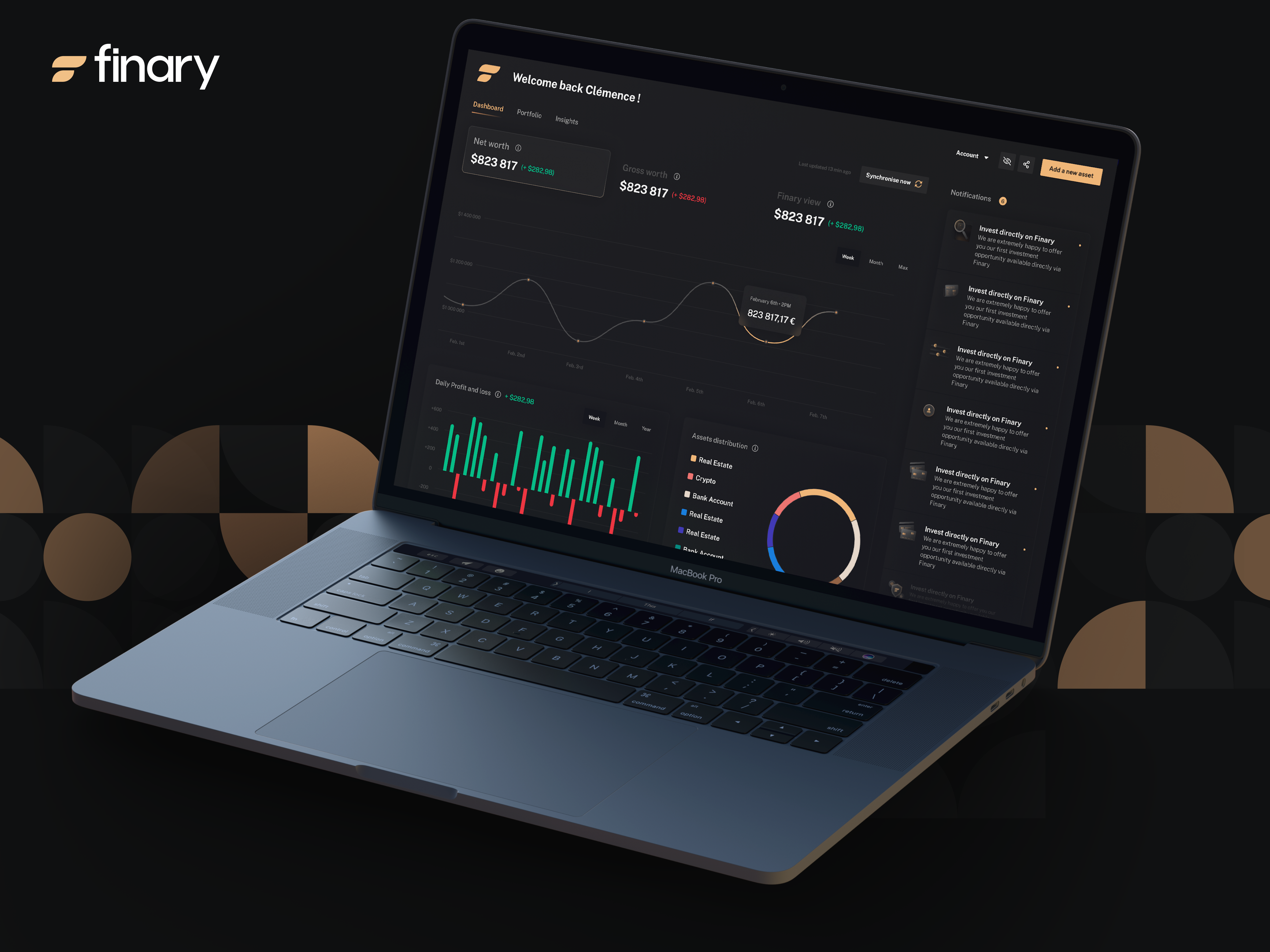
Meet Finary, a new French startup that wants to change how you manage your savings, investments, mortgage, real estate assets and cryptocurrencies. The company lets you aggregate all your accounts across various banks and financial institutions so that you can track your wealth comprehensively over time.

After attending Y Combinator, the startup has just closed a $2.7 million (€2.2 million) seed round led by Speedinvest with Kima Ventures and angel investors, such as Raphaël Vullierme also participating.

If you know people who have a ton of money, chances are they tend to be at least 40 or 50 years old — you don’t become rich overnight after all. And they tend to manage their investment portfolio through a wealth management service with tailor-made services.

“There’s very little tech in wealth management. Advisors are also incentivized to sell you some financial products in particular,” co-founder and CEO Mounir Laggoune told me. In that situation, the company in charge of the financial product is generating revenue for the advisor — not the client.

At the same time, a new generation of investors is starting to accumulate a lot of wealth. And yet, they don’t have the right tools to allocate it properly. Younger people want to see information directly. They want a way to track information in real-time, or near real-time. And they want to be able to take some actions based on that data.

Finary wants to build that service based on those principles. It starts with an API-based aggregator. When you create a Finary account, you can connect it with all your other accounts — bank accounts, brokerage accounts, mortgage and real estate, gold, cryptocurrencies, etc.

The startup leverages various open banking APIs to be as exhaustive as possible. For instance, “you can connect a Robinhood account and a Crédit Mutuel de Bretagne account,” Laggoune said. Behind the scenes, Finary uses Plaid and Budget Insight, runs its own bitcoin and Ethereum nodes to track wallet addresses, estimates the value of your home through public data and a proprietary algorithm.

After that, you can see how much money you have, how it is divided between your investment pools, the current value of your gold and cryptocurrency assets and more.

“Our long-term vision is that we want to build a virtual wealth manager for Europe,” Laggoune said.

That’s why Finary recently launched its premium subscription called Finary+. With a premium account, you can see how much you’re paying in fees and track your performance — more features will get added over time.

A few months after launching its platform, Finary already tracks €2 billion in assets across thousands of users. With today’s funding round, the startup will roll out its service to more countries and more financial institutions in France, Europe and the U.S. The company is also working on mobile apps.

This is an interesting take on wealth management as Finary doesn’t try to reinvent the wheel. Legacy players want you to use a single bank for all your financial needs. But you end up paying a lot of fees and you have to use old and clunky interfaces.

Finary isn’t yet another wealth management service. It’s a holistic service that lets you use multiple banks and services while remaining on top of your assets.

Image Credits: Finary

18 May 2021

Facebook VR exec Hugo Barra is leaving

Four years after joining as Facebook’s first VP of VR, ex-Xiaomi exec Hugo Barra has left the company, he said in a social media post Tuesday.

Barra led Facebook’s VR efforts during a particularly tumultuous time for Oculus, coming aboard to helm the division as the once independent arm was folded deeper into its parent company after the departure of co-founder and CEO Brendan Iribe. During Barra’s time at Facebook, the company pivoted from PC-based VR systems towards all-in-one designs, relying on a partnership with Barra’s previous employer Xiaomi to help the company scale its entry-level Oculus Go headset which has since been discontinued.

The executive was eventually replaced in his role leading AR/VR inside Zuck’s inner circle by long-time Facebook veteran Andrew Bosworth and subsequently moved to a role leading partnerships. Barra leaves months after the launch of Facebook’s $299 Quest 2 headset, which arrived to positive reviews, and on the cusp of the company’s first foray into AR-based smart glasses.

“When Mark Zuckerberg approached me 5 years ago to come to Facebook to lead the Oculus team and work on virtual reality, I knew I was jumping into an ambitious journey to help build the next computing platform but I couldn’t have imagined just how much this team would get done in just a few years,” Barra wrote in a public Facebook post.

Barra didn’t detail where he’ll be landing next, but said he’s joining an effort in the healthcare technology space.

18 May 2021

Aevum is building a modular autonomous drone for space and terrestrial deliveries

Logistics and delivery providers are territorially split between Earth and space, with companies like Amazon and FedEx working to master ground, air and drone transportation, and new entrants like SpaceX honing its expertise in space launch.

Autonomous transportation startup Aevum wants to do both. And it was just issued a patent that will help it move dexterously between space launch to low Earth orbit, and air cargo and drone deliveries here on Earth.

The key is Aevum’s unmanned aircraft system, which it calls Ravn X. So far, Aevum has only publicly discussed its plans for the Ravn X in the context of space launches. It works like this: the Ravn X uses conventional jet fuel and takes off from an airport runway, like a plane, but it has a rocket nested in its belly that deploys at high altitude to deliver payload to space. As the second stage detaches, the Ravn X returns to Earth using conventional touch-down techniques, ready for another delivery.

The new Aevum patent, which was issued on May 4, is for a unique modular payload design positioned in the belly of the drone. With the new system described in the patent, that rocket payload module can be switched out for a cargo bay to carry deliveries around the world, or a drone module that can carry up to 264 smaller drones for last-mile delivery services. Theoretically, the Ravn X could depart from an airport, deliver its payload to space, return back to the airport to be reloaded with a filled cargo module, then take off again for earthbound deliveries.

While the exact amount a Ravn X can carry depends on the distance it’s traveling, the Ravn X air cargo will be able to carry up to 15,000 lbs and the space delivery payload will be able to carry up to 330 lbs. As of now, the rockets are expendable, but the company has plans for 100% reusability across its space launch and air cargo operations.

Aevum’s business model includes operating autonomous transportation and logistics as a service and partnering with existing logistics providers. One interesting possibility for the company is partnerships with logistics giants that so far have been effectively cut-off from space deliveries due to the vertically integrated models of companies like SpaceX, which handles logistics and launch services in-house.

“We aim to enable FedEx, Amazon, UPS, DHL, and others to build upon the logistics infrastructure they have already mastered,” Aevum CEO Jay Skylus said. “Any or all of these respected giants could partner with Aevum or purchase a fleet of Ravn X for their own and add space launch to their offerings. Space logistics should no longer be separated from general logistics.”

Aevum founder and CEO Jay Skylus with Ravn X

Likewise, large companies that have struggled to establish drone delivery services could use the Ravn X’s drone module to deliver and deposit drones over a central area, like a city center, for last-mile deliveries.

“The patent is so significant because what the patent allows you to do is say – the existing FedEx and UPS logistics architecture that’s sorting 70,000 packages an hour right now could not service the needs of defense and space because fundamentally that logistics infrastructure was designed to go from Earth to Earth and not Earth to space,” Skylus explained. “But if you really look at the problem and study it in detail, you know the missing link to allow this existing infrastructure to now be able to service the space domain – that missing link is what we just patented.”

Skylus imagines Ravn X fleets operating around-the-clock. “In my company, what matters is asset utilization. For any reusable flying machine, it doesn’t generate revenue on the ground. My machines will fly around the clock, every day,” he said in a statement.

The company still has a ways to go before it still takes to the skies, however. Ravn X is still undergoing ground test operations and will begin flight testing this year at an FAA-licensed testing facility for unmanned aircraft systems. Aevum’s intention is to fly with the United States Air Force’s ASLON-45 mission this fall and to take its air cargo service live next year.

Because the Ravn X has so many different capabilities, it will need to pursue a few different FAA certifications: for space launches, a license from the FAA Commercial Space Transportation office; for cargo operations, an FAA aircraft type certification and standard airworthiness certification.

“What we’ve patented is the next layer and large batch of connections in the global logistics infrastructure,” Skylus said. “Space logistics shouldn’t be separated from logistics that already exist.”

18 May 2021

Spotify to add automatic transcripts for its own Exclusive and Original podcasts

Spotify is taking the first step towards making transcripts available for the podcasts on its service. The company announced this morning it’s soon launching a limited beta that will introduce automatic transcripts for its own Spotify Exclusive and Original shows, with the larger goal of enabling transcripts across all podcasts published to its platform in the future. The company also introduced a handful of other accessibility improvements alongside the announcement, including readability features and options for text resizing.

The new transcripts feature will automatically generate transcripts for Spotify’s own shows, allowing users to read the text of the podcast on their iOS or Android device, either with or without sound.

This can be useful from an accessibility standpoint, as it makes the audio programs available to a wider audience that includes those who are hard of hearing or deaf. However, it also makes it easier for any listener who wants to jump to a particular part of a conversation without having to fast-forward or rewind to trying to find the right spot.

Image Credits: Spotify

Users will be able to scroll and navigate the provided transcripts, then click on any paragraph to start streaming the show from that point, the company explains.

If Spotify makes good on its promise to make transcripts available across its full podcast library, it could save podcasters from having to do the extra work of transcribing shows and publishing those to their website. Instead, they could simply inform listeners that those who wanted a transcript could visit Spotify. Plus, the feature could steer users away from third-party apps offering transcripts, while competing with Apple’s podcasts transcription search. (And it could potentially signal that Apple is poised to release an update in this area in the near future, too, given its recent investment in its redesigned Apple Podcasts app, which will now include subscriptions.)

The transcripts feature will roll out in the “coming weeks,” Spotify said.

Alongside the news of the beta, Spotify introduced a handful of readability improvements to aid low-vision and visually impaired users better see various buttons in the app, like those to start listening or shuffle play, by adjusting the button’s color, text formatting and size.

And while Spotify already supports the system-wide text size changes known as Dynamic Type, it’s now allowing users to increase text sizes even more through a new feature under Settings on iOS. (Settings –> Accessibility –> Display & Text Size; tap “Larger Text” and drag the slider.)

18 May 2021

Father and son duo take on global logistics with Optimal Dynamics’ sequential decision AI platform

Like “innovation,” machine learning and artificial intelligence are commonplace terms that provide very little context for what they actually signify. AI/ML spans dozens of different fields of research, covering all kinds of different problems and alternative and often incompatible ways to solve them.

One robust area of research here that has antecedents going back to the mid-20th century is what is known as stochastic optimization — decision-making under uncertainty where an entity wants to optimize for a particular objective. A classic problem is how to optimize an airline’s schedule to maximize profit. Airlines need to commit to schedules months in advance without knowing what the weather will be like or what the specific demand for a route will be (or, whether a pandemic will wipe out travel demand entirely). It’s a vibrant field, and these days, basically runs most of modern life.

Warren B. Powell has been exploring this problem for decades as a researcher at Princeton, where he has operated the Castle Lab. He has researched how to bring disparate areas of stochastic optimization together under one framework that he has dubbed “sequential decision analytics” to optimize problems where each decision in a series places constraints on future decisions. Such problems are common in areas like logistics, scheduling and other key areas of business.

The Castle Lab has long had industry partners, and it has raised tens of millions of dollars in grants from industry over its history. But after decades of research, Powell teamed up with his son, Daniel Powell, to spin out his collective body of research and productize it into a startup called Optimal Dynamics. Father Powell has now retired full-time from Princeton to become Chief Analytics Officer, while son Powell became CEO.

The company raised $18.4 million in new funding last week from Bessemer led by Mike Droesch, who recently was promoted to partner earlier this year with the firm’s newest $3.3 billion fundraise. The company now has 25 employees and is centered in New York City.

So what does Optimal Dynamics actually do? CEO Powell said that it’s been a long road since the company’s founding in mid-2017 when it first raised a $450,000 pre-seed round. We were “drunkenly walking in finding product-market fit,” Powell said. This is “not an easy technology to get right.”

What the company ultimately zoomed in on was the trucking industry, which has precisely the kind of sequential decision-making that father Powell had been working on his entire career. “Within truckload, you have a whole series of uncertain variables,” CEO Powell described. “We are the first company that can learn and plan for an uncertain future.”

There’s been a lot of investment in logistics and trucking from VCs in recent years as more and more investors see the potential to completely disrupt the massive and fragmented market. Yet, rather than building a whole new trucking marketplace or approaching it as a vertically-integrated solution, Optimal Dynamics decided to go with the much simpler enterprise SaaS route to offer better optimization to existing companies.

One early customer, which owned 120 power units, saved $4 million using the company’s software, according to Powell. That was a result of better utilization of equipment and more efficient operations. They “sold off about 20 vehicles that they didn’t need anymore due to the underlying efficiency,” he said. In addition, the company was able to replace a team of ten who used to manage trucking logistics down to one, and “they are just managing exceptions” to the normal course of business. As an example of an exception, Powell said that “a guy drove half way and then decided he wanted to quit,” leaving a load stranded. “Trying to train a computer on weird edge events [like that] is hard,” he said.

Better efficiency for equipment usage and then saving money on employee costs by automating their work are the two main ways Optimal Dynamics saves money for customers. Powell says most of the savings come in the former rather than the latter, since utilization is often where the most impact can be felt.

On the technical front, the key improvement the company has devised is how to rapidly solve the ultra-complex optimization problems that logistics companies face. The company does that through value function approximation, which is a field of study where instead of actually computing the full range of stochastic optimization solutions, the program approximates the outcomes of decisions to reduce compute time. We “take in this extraordinary amount of detail while handling it in a computationally efficient way,” Powell said. That’s where we have really “wedged ourselves as a company.”

Early signs of success with customers led to a $4 million seed round led by Homan Yuen of Fusion Fund, which invests in technically-sophisticated startups (i.e. the kind of startups that take decades of optimization research at Princeton to get going). Powell said that raising the round was tough, transpiring during the first weeks of the pandemic last year. One corporate fund pulled out at the last minute, and it was “chaos ensuing with everyone,” he said. This Series A process meanwhile was the opposite. “This round was totally different — closed it in 17 days from round kickoff to closure,” he said.

With new capital in the bank, the company is looking to expand from 25 employees to 75 this year, who will be trickling back to the company’s office in the Flatiron neighborhood of Manhattan in the coming months. Optimal Dynamics targets customers with 75 trucks or more, either fleets for rent or private fleets owned by companies like Walmart who handle their own logistics.