Without good data, it’s impossible to build an accurate predictive machine learning model. Explorium, a company that has been building a solution over the last several years to help data pros find the best data for a given model, announced a $75 million Series C today — just 10 months after announcing a $31 million Series B.
Insight Partners led today’s investment with participation from existing investors Zeev Ventures, Emerge, F2 Capital Ventures, 01 Advisors and Dynamic Loop Capital. The company reports it has now raised a total of $127 million. George Mathew, managing partner at Insight, and former president and COO at Alteryx, will be joining the board, giving the company someone with solid operator experience to help guide them into the next phase.
Company co-founder and CEO Maor Shlomo, says that in spite of how horrible COVID has been from a human perspective, it has been a business accelerator for his company and he saw revenue quadruple last year (although he didn’t share specific numbers beyond that). “It’s related to the nature of our business. We’re helping enterprises and data practitioners find new data sources that can help them solve business challenges,” Sholmo explained.
He says that during the pandemic, a lot of companies had to find new data sources because the old data wasn’t especially helpful for predictive models. That meant that customers required new sources to give them visibility into the shifts and movements in the market to help them adjust and make decisions during pandemic. “And given that’s basically what our platform does in its essence, we’ve seen a lot of growth [over the past year],” he says.
With the revenue growth the company has been experiencing, it has been adding employees at rapid clip. When we spoke to Explorium last July, the company had 87 people. Today that number has grown to 130 with plans to get to 200 perhaps by the end of 2021 or early 2022, depending on how the business continues to grow.
The company has offices in Tel Aviv and San Mateo, California with plans to open a new office in New York City whenever it’s possible to do so. While Shlomo wants a flexible workplace, he’s not going fully remote with plans to allow people to work two days from home and three in the office as local rules allow.
Email marketing is decades old, but it’s a category that has surprising life in it. Multiple generations of email marketing companies have come through and sustained success, from Constant Contact to Mailchimp. These brands often become household names — after all, you probably have hundreds of emails with their logos attached to the email footer.
Klaviyo is not as much of a household name right now, but it is absolutely on its way to the paramount of the next-generation of email marketing startups.
The company announced today that it has raised $320 million in new capital in a Series D round, led by Sands Capital, a private and public equity investor that has, among many areas of focus, a thesis in ecommerce. That brings the company’s total fundraising to $675 million, following a $200 million Series C round from just six months ago.
There is nearly 10,000 words of analysis packed into that whole story, so read that or save it for the weekend if you really want to get into the nitty-gritty of Klaviyo’s story and how it is fitting in to the wider email marketing space. But suffice it to say that the company’s secret sauce is perhaps obvious: it’s a marketing company that’s pretty damn good at marketing. That’s allowed it to pull in gargantuan numbers of new customers as many retailers and brick-and-mortar businesses fled online in the wake of the COVID-19 pandemic.
In its press statement, the company wrote that “Klaviyo’s customer base doubled over the past 12 months and the company now serves over 70,000 paying customers, a more than 110% increase from 2019 — ranging from small businesses to Fortune 500 companies, in more than 120 countries.” It also said that it plans to increase its head count from 800 to 1,300 people this year.
The company is headquartered in Boston, and Klaviyo’s all-but decacorn valuation is a major win for the Boston enterprise ecosystem, which continues to percolate on high.
In addition to Sands, Counterpoint Global, Whale Rock Capital Management, ClearBridge Investments, Lone Pine Capital, Owl Rock Capital, and Glynn Capital also joined the round as new investors. Previous investors Accel and Summit Partners also participated.
Email marketing is decades old, but it’s a category that has surprising life in it. Multiple generations of email marketing companies have come through and sustained success, from Constant Contact to Mailchimp. These brands often become household names — after all, you probably have hundreds of emails with their logos attached to the email footer.
Klaviyo is not as much of a household name right now, but it is absolutely on its way to the paramount of the next-generation of email marketing startups.
The company announced today that it has raised $320 million in new capital in a Series D round, led by Sands Capital, a private and public equity investor that has, among many areas of focus, a thesis in ecommerce. That brings the company’s total fundraising to $675 million, following a $200 million Series C round from just six months ago.
There is nearly 10,000 words of analysis packed into that whole story, so read that or save it for the weekend if you really want to get into the nitty-gritty of Klaviyo’s story and how it is fitting in to the wider email marketing space. But suffice it to say that the company’s secret sauce is perhaps obvious: it’s a marketing company that’s pretty damn good at marketing. That’s allowed it to pull in gargantuan numbers of new customers as many retailers and brick-and-mortar businesses fled online in the wake of the COVID-19 pandemic.
In its press statement, the company wrote that “Klaviyo’s customer base doubled over the past 12 months and the company now serves over 70,000 paying customers, a more than 110% increase from 2019 — ranging from small businesses to Fortune 500 companies, in more than 120 countries.” It also said that it plans to increase its head count from 800 to 1,300 people this year.
The company is headquartered in Boston, and Klaviyo’s all-but decacorn valuation is a major win for the Boston enterprise ecosystem, which continues to percolate on high.
In addition to Sands, Counterpoint Global, Whale Rock Capital Management, ClearBridge Investments, Lone Pine Capital, Owl Rock Capital, and Glynn Capital also joined the round as new investors. Previous investors Accel and Summit Partners also participated.
As cloud-native apps continue to become increasingly central to how organizations operate, a startup founded by the creators of a popular open-source tool to manage authorization for cloud-native application environments is announcing some funding to expand its efforts at commercializing the opportunity.
Styra, the startup behind Open Policy Agent, has picked up $40 million in a Series B round of funding led by Battery Ventures. Also participating are previous backers A. Capital, Unusual Ventures and Accel; and new backers CapitalOne Ventures, Citi Ventures and Cisco Investments. Styra has disclosed CapitalOne is also one of its customers, along with e-commerce site Zalando and the European Patent Office.
Styra is sitting on the classic opportunity of open source technology: scale and demand.
OPA — which can be used across Kubernetes, containerized and other environments — now has racked up some 75 million downloads and is adding some 1 million downloads weekly, with Netflix, Capital One, Atlassian and Pinterest among those that are using OPA for internal authorization purposes. The fact that OPA is open source is also important:
“Developers are at the top of the food chain right now,” CEO Bill Mann said in an interview, “They choose which technology on which to build the framework, and they want what satisfies their requirements, and that is open source. It’s a foundational change: if it isn’t open source it won’t pass the test.”
But while some of those adopting OPA have hefty engineering teams of their own to customize how OPA is used, the sheer number of downloads (and potential active users stemming from that) speak to the opportunity for a company to build tools to help manage that and customize it for specific use cases in cases where those wanting to use OPA may lack the resources (or appetite) to build and scale custom implementations themselves.
As with many of the enterprise startups getting funded at the moment, Styra has proven itself in particular over the last year, with the switch to remote work, workloads being managed across a number of environments, and the ever-persistent need for better security around what people can and should not be using. Authorization is a particularly acute issue when considering the many access points that need to be monitored: as networks continue to grow across multiple hubs and applications, having a single authorization tool for the whole stack becomes even more important.
Styra said that some of the funding will be used to continue evolving its product, specifically by creating better and more efficient ways to apply authorization policies by way of code; and by bringing in more partners to expand the scope of what can be covered by its technology.
“We are extremely impressed with the Styra team and the progress they’ve made in this dynamic market to date,” said Dharmesh Thakker, a general partner at Battery Ventures. “Everyone who is moving to cloud, and adopting containerized applications, needs Styra for authorization—and in the light of today’s new, remote-first work environment, every enterprise is now moving to the cloud.” Thakker is joining the board with this round.
Email marketing has been with us for decades, but today it has been refined to a science and an art form.
If you’re an early-stage founder, it is one of the best ways to build and grow your direct relationship with your customer. You know how fickle the platforms can be. You can’t afford to mess this up.
So when and how should you think about doing email marketing, versus all of your other frantic priorities?
Here at Extra Crunch, we’re helping you find the answers. Today, we’re launching a survey of founders who want to recommend a great email marketer or agency they have worked with to the rest of the startup world.
If you have someone to recommend, make sure to let us know: We’ll use your answers to create a freely available public database of experts in this domain on TechCrunch. We’ll feature the most helpful responses (anonymously if requested) so other founders can find the right people for them to work with.
The next step might be even more useful: We’ll provide EC subscribers with our own coverage of email marketing how-to topics and issues in more detail, based on our ongoing conversations with these experts.
In the coming months, you’ll see us dig into topics from great content production to optimizing deliverability, flow, timing, and design. We’ll also examine how to use email together with other marketing funnels, to improve your ROI on paid advertising efforts.
We’ll cover ongoing changes to the technology that affect the space, including the state of the art in email tools, email service provider platform changes, privacy laws, and much more.
If you’re a founder and you respond to the survey, you’ll also receive a discount to a new Extra Crunch subscription.
We’re particularly interested in what the expert did in the early to middle stages of the startup’s journey. Usually before Series C, for venture-backed companies. Recommendations wanted for both individuals and agencies.
If you’re a growth marketing expert, you’re encouraged to share the survey with your founder clients.
Finally, for those who have been reading TechCrunch for at least a few years, you’ll remember a similar set of surveys we had begun around other categories of startup experts, including legal, brand and overall growth. After a hiatus to take care of a few other things, this survey marks the resumption of that initiative!
In the absence of a real baseball league, it is perhaps not surprising that a simulated one should grow popular during the troubled year 2020. But even so, the absurdist horror and minimalist aesthetic of Blaseball seem an unlikely success. The text-based fantasy fantasy league has attracted hundreds of thousands of players and now $3.4 million in funding to build up the game and go mobile.
If you’re unfamiliar with Blaseball, feel free to go check it out now and sign up — it’s free. You’ll probably get a better idea of what the game is from 30 seconds of browsing than the next couple paragraphs.
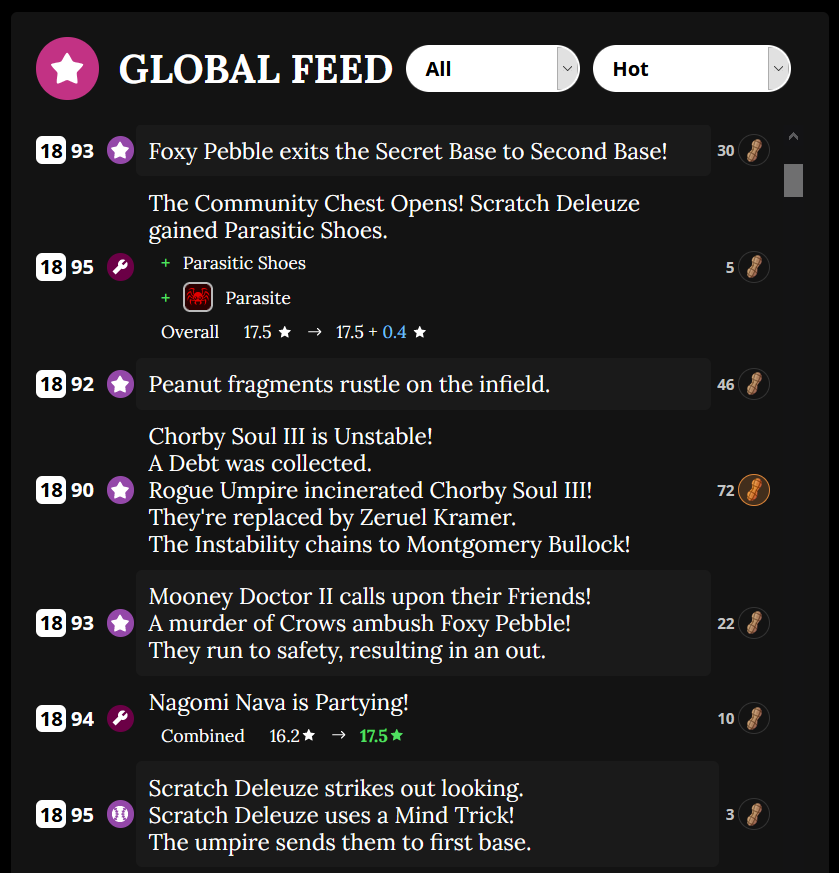
For those of you who’d rather read, however, Blaseball is a web-based fictional baseball-esque league where players can bet in-game currency on the outcomes. But this is where things get weird. The teams aren’t the Mariners or the Mets but the Moist Talkers and the Worms; players have names like Chorby Soul and Peanutiel Duffy; their stats include things like allergies, pregame rituals, and an inventory of RPG-like items.
Likewise, games — told through simple text summaries of the action like you might see in the corner of a sports site — involve hits, balls, and stealing, but also incineration, shaming, and secret bases. “Weather” might involve spontaneous blood transfusions between players, or birds that interfere with play.
In short, it’s totally ridiculous, utterly unpredictable, and very funny. This totally unique concoction of fantasy leagues, baseball satire, and cosmic horror has accrued a dedicated yet routinely puzzled fanbase over its 19 week-long seasons. And like so many hits, this one came as something of a shock to its creators.
Image Credits: The Game Band
“We’re as surprised as you are,” said Sam Rosenthal, founder and CEO of The Game Band, which developed (and is developing) the game. “Blaseball was an experimental side project for the studio — we were in the middle of a pandemic, publishers were in a spending freeze, it was a scary time. We wanted to make a game that brings people together in this really isolating time.”
The idea for it came from banter at a real baseball game, where Rosenthal and a friend speculated about a league where the rules were “different and more chaotic.” Of course the rules of real-life baseball are continually being revised, but so far there haven’t been any resurrections of players incinerated by rogue umpires, free runs for home teams, or shrink rays.
While the resulting game-like product bears some resemblance to baseball, betting, and fantasy leagues, it’s much too weird and random to really be considered the same thing. That’s led to some friction as players who expect a more traditional experience lose coins on a game decided by, say, a bird pecking their team’s star hitter inside an enormous peanut shell, or a guaranteed home run because the batter ate magma.
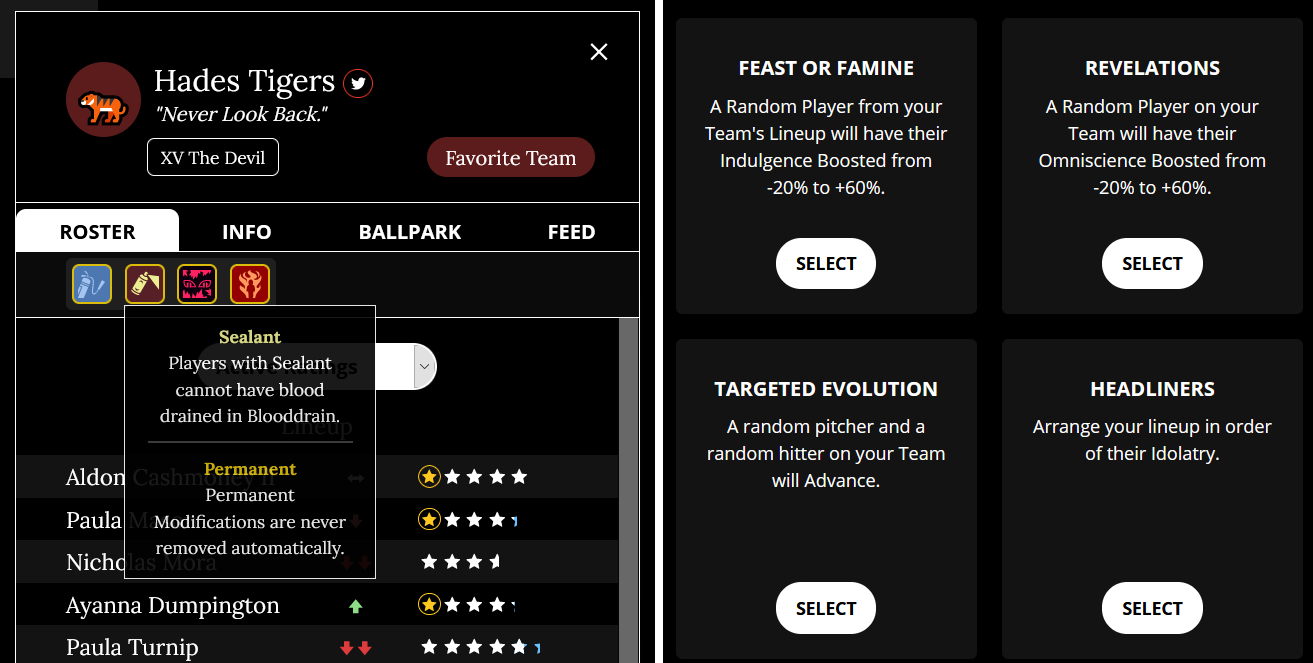
The Hades Tigers… so hot right now. The roster shows a team’s current and permanent attributes, while players can work together to create change by voting weekly.
“Sometimes we have to remind the fans that this is a horror game,” Rosenthal admitted. The gameplay, as players discover in time, consists more in cooperation and guiding the league itself than in precision oddsmaking. “This is not a game about individual success but collective success. The mechanics of the game reward organization, fans banding together with other fans of their team.”
Using those coins to buy votes to determine how the most-idolized players are treated at the end of a season, for instance, could have huge repercussions on the next season. Ultimately the players are really participating in a sort of long-term alternative-reality game rather than a zany baseball sim, as the ominous announcements and events drive home now and again.
Next to the outcome of a match and the news that a player was walked to second base, you might learn that “Reality flickered in the Feedback” or see disembodied dialogue about the league or disordered cosmos.
It can be disconcerting and one may rightly wonder whether the creators have a narrative or goal in mind, or whether they’re just winging it and being weird for weirdness’s sake. I guessed the latter, but Rosenthal set me straight.
Image Credits: The Game Band
“It is going somewhere,” he assured me. “There are a lot of plans, we have a ton of lore written. We literally have a writers’ room every day, usually about 3-4 hours long. But we need to stay flexible because there’s two other creators: the simulation, since we don’t know what will happen in the games themselves, and the fans. There are things we don’t know they’ll latch onto, emergent narratives like the reincarnation of Jaylen Hotdogs. We’re always learning, and we give ourselves a lot of room to backtrack or change things quickly if needed.”
What was never clear even to the developers, however, was whether the game would live long enough to see those plans come to fruition. Blaseball, being a side project built during strange days, was never envisioned as a big money maker. For a small game developer to have a runaway success on their hands but little ability to monetize that success, the stresses of continuing development and support can overtake the benefits of popularity.
“Since we didn’t really set it up from the get go to be profitable, we were just sort of slowly losing money,” said Rosenthal. “Fortunately our community has been really supportive through Patreon and sponsorships. But ultimately we wanted to make the game better and sustainable, and we wanted to pay our team what they deserve.”
Image Credits: The Game Band
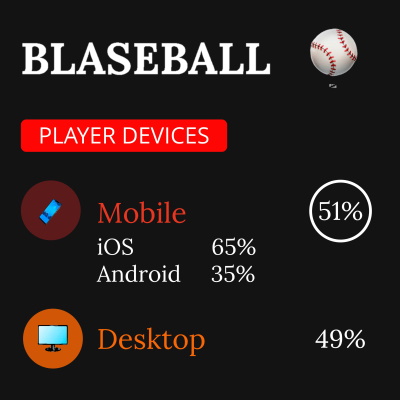
The $3M seed round keeps the lights on, to begin with, but also lets The Game Band staff up, so the writers don’t have to break up a meeting early because one of them is doubling as product support and the site is breaking. More importantly, however, the team plans to make a native mobile app. More than half of Blaseball’s players (that is, the real ones, not Baby Triumphant and Wyatt Mason IV) are on mobile and Rosenthal admitted the mobile experience is “not great.”
The company comes from a mobile development background, he noted, so they know what they’re doing, but saw the web as the easiest platform to deploy on during the pandemic. Now they want to get mobile up and running, since the live, constantly shifting nature of the game fits well with the kind of updates sports and fantasy aficionados tend to sign up for. Who wouldn’t want to know right away that their favorite team has entered Party Time, or that their idolized player found a new piece of armor, or that a new non-physical law has been ratified?
Rosenthal said they resisted seeking funding to begin with due to a desire for independence, but was enthused about their choice of investor, Makers Fund, saying they actually understand Blaseball and have been partners rather than parents when it comes to moving the operation towards making money.
“The know we can’t just copy monetization from another game and put it in Blaseball, that would ruin the experience right away. They have an amazing network of people in the games industry, and at the end of the day they’re not prescriptive,” he said.
(They also gamely did not object to a line in the press release by the fictional Commissioner asserting that “Blaseball has acquired Makers Fund,” which says a lot.)
“We’re very cognizant that there are ways that free games can monetize that are detrimental to the community,” he continued. “So it will always be free to play and it will never be pay to win. Like, the Crabs are never going to run away with it because they’re the richest team. When we think about monetization we think about how it can benefit the community as a whole, not individuals.”
In the meantime the league slouches on, morphing from week to week in a live dialogue between players and developers. Don’t expect it go get any less weird, because the creators know that constant disorientation is part of the game’s charm.
Amazingly, Rosenthal even managed to suggest that Blaseball was, in the parlance of game design tropes, the Dark Souls of baseball simulators — “it [Dark Souls] gives you so little, it asks you to interpret and put a thesis together, to go linger on forums and talk with others about it. We wanted to create that kind of experience, and see how people would interpret this sort of weird, unknowable entity.”
Nearly every social media experience today is built on the same premise: Humans identify with individuality. Users create a profile, upload an avatar picture, write a short biography and can then scream into the ether to other users on behalf of their digitally sculpted selves.
Naj Austin, the founder behind Ethel’s Club, built Somewhere Good last year on an entirely different premise. She believes that humans crave collectivism more than individualism in a post-COVID world. So she’s in the process of reinventing how social media looks and feels, and with community and people of color at the core.
Less than a year after launching, Somewhere Good announced this morning that it has raised $3.75 million in a seed round led by True Ventures. Existing investors Dream Machine, Debut Capital and Canvas Ventures participated in the round, along with new investors, including Slauson & Co., NextView Ventures and 2PM Inc. Notable angels include Ellen Pao of Project Include and actor Gabrielle Union. The money will be used for continued product innovation and expanding its nine-person team.
“I’m thinking about scale and trying to ensure that the most people have access to a safe and authentic community on their phones, and that means it has to be venture-backed in terms of being able to accomplish that in a way that also feels delightful,” Austin said. “To build a platform that allows for us to have consultants who are thinking about accessibility, safety and privacy, we have to pay them.”
Extracting the buzz from Community
Somewhere Good is a mobile app that connects people and then fosters that connection in a solely group setting, across a diversity of interests — such as a birdwatching collective for people of color or an anti-capitalist book club.
The platform arose from Austin’s other company, subscription-based community for people of color, Ethel’s Club. Members kept asking her for different things: a cooking club, a therapist recommendation, a wellness group. She said she became a de facto Google for members, and that Ethel’s Club began to “frankenstein” into different groups and needs.
“Which is, you know, not scalable,” she said. “We thought ‘Why don’t we build a technology layer that communities like Ethel’s club need?’” Somewhere Good is now a social search platform for people to join, chat and discover new communities.
Somewhere Good
Users can visit and drop into different “worlds” or communities that fit their interests, she explained. Once a user has entered a world, they can view and post content and have real-time audio conversations with others. People are encouraged to cite content in order to promote content and nuance.
“If I add an Angela Davis article in ‘Abolition World’ I can also see that you added it to ‘Black Feminists’ world and so on,” Austin explained. “This is likely to encourage you to look into the Black Feminists world and further your discovery.”
Austin stressed that no one person or host controls the experience, instead putting focus on the community as a whole to create a world that is living and breathing. It’s her response to the rise of community in every startup right now.
“Communities become a buzzword that everyone’s trying to tap into their platforms now,” she said. “Things I know about community and what I’ve learned over the last year-and-a-half is that you need intimacy, you need nuance, you need collaboration and you need this magical collision of people who have shared identities.”
How Somewhere Good actually executes this mission will rely heavily on its product, which is still in its infancy. Right now, Austin shared that they have made intentional choices to remove what she sees as the “empty noise” of other social media platforms. At this point, there are no advertisements on Somewhere Good, no user profiles, no friending, no following and no feed.
Notably, this differentiation is also one of Somewhere Good’s biggest challenges.
“When building something new, it potentially feels like we are taking it away from the users,” she said. “For example, taking profiles away may feel like it is a less than, versus that it is additive in the long run because you no longer have to have a perfect profile and worry about users.”
The startup is testing out user reaction to these sorts of fundamental structural changes over the next couple of weeks. Somewhere Good also launched SHIFT, a $50,000 year-long fellowship program, to invite people to join the team and create a feedback loop on product, team and community, as well as explore some of the ideas that Austin is experimenting with today.
“We still aren’t going to be able to make the most perfect platform for everyone on Earth to start, and we know that, but in doing so we’ve created a fellowship to help inform us, and kind of heads down and deploy that occurs when you’re building a product.”
Entering the Clubhouse
The app was meant to go into beta in January 2020 but that has now been pushed to the second half of 2021 so the team could continue to tweak the product. The beta will be invite-only to start, including 50 to 75 communities and their members that Somewhere Good has vetted beforehand and the some 5,000 people on its waitlist.
Somewhere Good’s monetization plan is also in the early innings, and the founder says it will focus on that more when the app reaches scale.
Clubhouse, an app valued at $1 billion that is similarly focused on community and spontaneity, could be seen as competition to Somewhere Good. Clubhouse has an exploration page that helps users discover different clubs, and it also built out a creator network to bring high-quality, recurring content to its platform.
“It’s a solid company,” Austin said. “But I think they’ve struggled with really big questions and I think that there are solutions and answers out there that Clubhouse has chosen not to embed to their platform, and that was simply a choice that they made.”
For now, she doesn’t seem fazed.
“I feel like most of the platforms that exist are taking what already exists and kind of putting a veneer on it,” she said. “There’s nothing wrong with repainting, but then it’s just repainting.” Reinventing feels like an outsized opportunity.
“I believe if we get Somewhere Good right, it can replace many of the apps on your phone,” she said. “When you think about it, where you receive the most value, outside of the calculator app, is with your friends and the people you know and trust.”
The events of the past year and a half could well mark the beginning of a sea change for the world of restaurant robotics. The essential industrial was slammed amid the pandemic, leaving many companies searching for a decent automated option that could both keep things running and potentially avoid transmission vectors.
Seattle-based Picnic is the latest to benefit from that interest, announcing a $16.3 raise this week. Led by Thursday Ventures — with participation from Creative Ventures, Flying Fish Partners and Vulcan Capital – the Series A includes a $3 million bridge filed last fall.
The company is one of a handful looking to automate the pizza-making process. It’s an obvious target for this technology, given both the food’s popularity and the relative uniformity, versus other meals. XRobotics debuted its own system late-late year, while Zume – possibly the best-known of the bunch – has long since exited the category.
Picnic, meanwhile, says interest in its own pizza system has ramped up of late, announcing a number of industry partnerships, including Orion Land Mark, Ethan Stowell Restaurants, National Service Cooperative and Baseline Hardware Financing. The plan is to roll the technology out to both restaurants and other public gathering spaces, including schools, stadiums and hospitals. The company says this latest round will go toward headcount and expanding operations.
The big open question mark here is what the future looks like for the iMac — and how long we’ll have to wait to see it. That is, of course, the perennial question for hardware upgrades, but it’s exacerbated by the knowledge of imminent ARM-based systems and rumors surrounding a redesign.
It was, as these things go, less than a full-throated endorsement of Apple’s latest all-in-one. We certainly weren’t alone in the assessment. It was a weird liminal zone for the computer — and Macs in general. At WWDC in June, the company had taken the unusual step of announcing its move from Intel to its own in-house chips without any hardware to show for it.
The reasoning was sound. The company was looking to help developers get out ahead of launch. It was going to be a heavy lift — the first time the Mac line had seen such a seismic shift since 2005. Fifteen years is a long time, and that’s a lot of legacy software to contend with. While the move wouldn’t outright break every piece of MacOS software, it was certainly in devs’ best interest to optimize for the new hardware, by way of the Mac Mini developer kit the company was offering. The full transition to the new silicon, Apple noted, would take two years.
Image Credits: Apple
In November, the company debuted the first M1 Macs: a new Mac Mini, MacBook Air and 13-inch MacBook Pro. We spent several thousand words reviewing all three systems, but ultimately Matthew put it pretty succinctly, “Apple’s new M1-powered MacBook shows impressive performance gains that make Intel’s chips obsolete overnight.”
Which is, you know, a rough look for an all-in-one launched a mere two months before. That goes double for a system that hadn’t seen a fundamental redesign in some time. Two months after launch, the 2020 iMac was already starting to feel old.
Image Credits: Brian Heater
Fast-forward to last month, when Apple announced the new iMac amid a flurry of hardware news. This, it seems, was the iMac we’d been waiting for. The new system brought the most fundamental redesign in a decade, with an ultra-compact new form factor, improvements to audio and video (a big sticking point in the remote work era) and, perhaps most importantly, the new M1 chip.
Image Credits: Brian Heater
The biggest thing the 2020 system has going for it is that it’s, well, big. Having used a 27-inch iMac for much of my day-to-day work throughout the pandemic, I’m honestly surprised by how much I miss those extra three inches. I’d initially assumed that added bit of screen real estate was going to be fairly negligible once you’ve passed the 20-inch threshold, but turns out, like anything else, it takes some getting used to.
There’s an immediate upside, too, of course. I was genuinely surprised by how compact the new design is, compared to past iMacs. In spite of adding 2.5 inches to the display size over the 21.5-inch, the new system is an extremely thin 11.5 mm (or 14.7 when the stand is factored in).
The overarching theme for the system is “cute.” This is not a word I often apply to technology. Words like “cool” or “sleek” are generally go-tos here. But I’m at a loss for a better word to describe what feels like a true spiritual successor to the iMac G3. The colorful line of all-in-ones ushered in Steve Jobs’ second triumphant stint with the company, arriving at the tail end of a decade in a year personified by the Volkswagen’s New Beetle.
Of course, the design language has evolved dramatically in the nearly quarter-century since the first iMac arrived, owing to changing styles and, of course, ever-reducing component sizes. The flat-panel design arrived early this century and settled into the most recent design around 2012. Sure, there have been plenty of updates since then, but nine years is a long time for an Apple design to go without a major refresh.
Image Credits: Brian Heater
It finds the company moving from what was ostensibly an industrial design to something more warm and welcoming. The color is the thing here. It was the most frequently discussed question around the TechCrunch (virtual) offices. Everyone wants to know which we’d be getting. Mine landed with a yellow hue — something nice, light and spring. Honestly, it’s more of a gold than I expected, with a bright and shiny glean to it. I will advise that anyone who plans to buy one of these systems visit an Apple Store if there’s one nearby if you’re comfortable doing so. It’s really the sort of thing that really benefits from being seen in person, if possible.
That goes double here — since, boy howdy, is Apple on theme. The keyboard matches, the cables match, the desktop wallpaper matches, the adorable packaging matches (it’s a fun unboxing experience, as those things go) and even little touches like the OS buttons match. The latter two, obviously, are something you’re able to futz around with a bit. But the system and even the keyboard is a bit more of a commitment, really. After all, this is probably the kind of thing you’re going to want to hold onto for a number of years, so lighting and interior decorating are both worth considering before you make your decision. I recognize this is an odd thing to think about when talking about a desktop computer, but, well, it’s the iMac.
The company is offering an AR iOS app for seeing how the new iMac will fit in with its surroundings, which is a clever — and probably useful — touch. The system also weighs in at less than 10 pounds. This is admittedly not something I’ve given much thought to with desktops. “Portable” is a weird way to describe the form factor, but particularly compared to other desktop systems, it kind of fits? At the very least, it’s not entirely out of the realm of possibility that you can occasionally move the thing from room to room, as needed.
Image Credits: Brian Heater
In broad strokes, the front of the system is similar to that of the past iMacs, though the bottom panel and its large Apple logo have been swapped out of a streak of color. The pane of glass lies flush with the screen and a not insignificant white bezel that frames it. The bezel, combined with the panel, comprises a not insignificant amount of real estate below the display, likely owing to the placement of components and the downward-firing speaker grille that runs the full length of the computer’s bottom. Up top is the newly upgraded 1080p HD Webcam — the first on any Mac.
As with past iMacs, the system sits atop a stand. In the case of the yellow model, at least, the stand is a notably darker hue than the front of the system. There’s a VESA mount option configurable upon purchase, but the stand itself is very much not designed to be user replaceable. The hinge’s action is smooth. I found myself pivoting the system up and down semi-regularly to better frame myself in the webcam, and did so with ease.
Image Credits: Brian Heater
There’s a 3.5 mm headphone jack on the left — hello, old friend. I much prefer this placement to the rear of the device, which requires the cable to wrap around the side or bottom.
Image Credits: Brian Heater
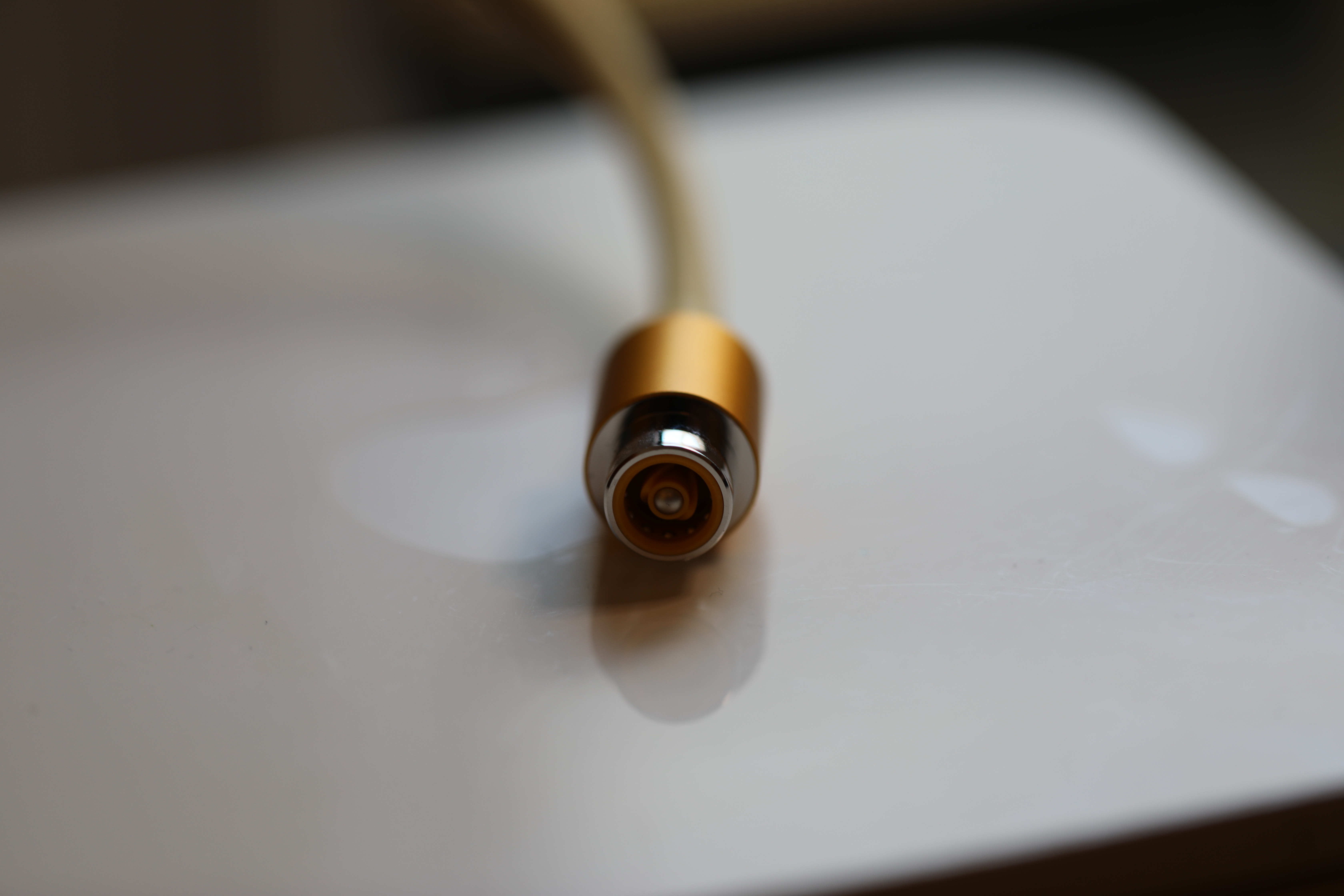
A hole inside the stand is designed for cables to be run through — specifically power. Magsafe — er, the magnetic charging connector — really popped up unexpectedly here. It’s less about the quick release that you would find on the old MacBooks and more about the ease of simply snapping the cable in place. I suspect that people are less likely to trip over a desktop cable that never (or at least rarely) moves.
Image Credits: Brian Heater
The big update to the power cable situation is, of course, the addition of ethernet to the brick. The brick is quite a bit larger — especially if you’re accustomed to dealing with MacBooks. But likely it will be out of the way. What it does bring is the removal of some additional clutter on the back of the system and helps keep the computer itself that much thinner. For most people in most cases that can access a hardwired connection, it’s a nice addition.
Image Credits: Brian Heater
The port situation, on the other hand, is decidedly less so. I like ports. I have lots of stuff that need plugging in to the back of the computer and ports are probably the best case to plug ’em. The entry-level system has two Thunderbolt/USB ports. You can upgrade that to four. Definitely do this. Seriously. You’re not going to regret it.
I’m someone who keeps the wireless keyboard and trackpad/mouse plugged in most of the time. I know, it kind of defeats the purpose, but worrying about charging accessories is not another stress I need in my life right now. So that’s two ports right there. I also have some AV accessories and suddenly, boom, you’re out of ports.
The $1,299 version of the system ships with the Magic Keyboard. It’s pretty much the same as other Magic Keyboards of recent vintage. It’s not for everyone, I know. Those who love mechanical keyboards will find something to be desired in the tactility, but it’s a step up from MacBooks and I’ve certainly grown accustomed to using it. There’s no number pad on the base model, but the coloring coordinates with the Mac.
Image Credits: Brian Heater
With the $1,699 model, you get upgraded to a version with Touch ID — something that’s been a long time coming on the desktop system. Like other Macs (and older iPhones), the fingerprint scanning login is nearly instantaneous. As has been the case for a while, if you’re an Apple Watch wearer, that will log you in as well, but the addition of Touch ID on the desktop is great. The base version comes with the Magic Mouse. It’s $50 to upgrade to a Trackpad and $129 for a combo. I’ve grown fond of the Trackpad, so that’s where I’d probably land here (I doubt many people will have a need for both).
Image Credits: Brian Heater
As ever, I understand the many reasons the company has pushed its line to USB-C — it’s especially obvious when you see how much room has been freed up on the rear of the device. But man, I miss having those legacy USB-A ports on the 2020 iMac. Meantime, you might want to toss a couple of A to C USB adapters into your basket before check out. That’s kind of just life with Apple, though. Courage, and all that.
I do wonder if this means the company is positioning the M1 line for the return of an iMac Pro. Stranger things have happened. For now, of course, the company is more focused on the Mac Pro at the much higher end.
Image Credits: Bryce Durbin/TechCrunch
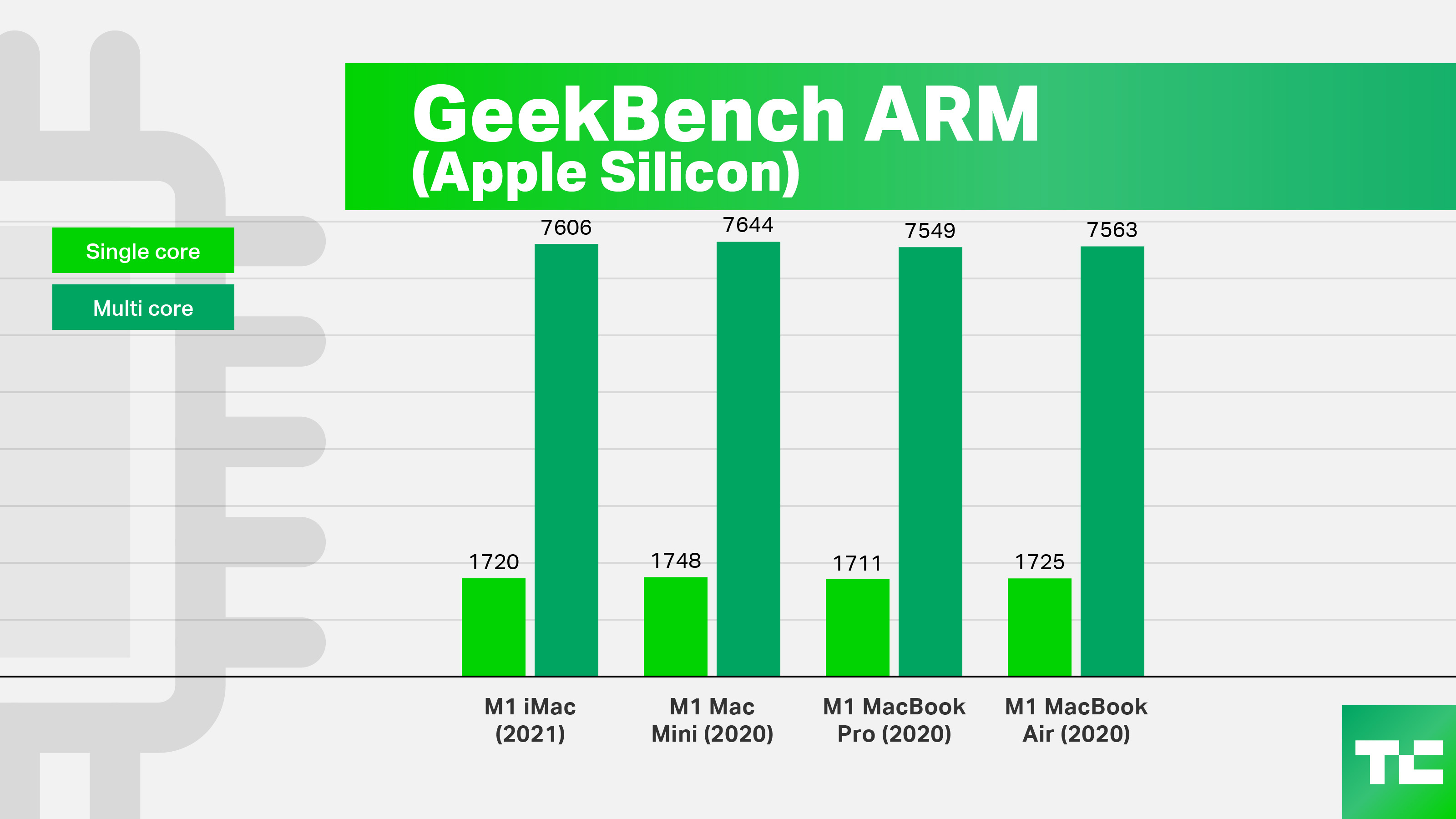
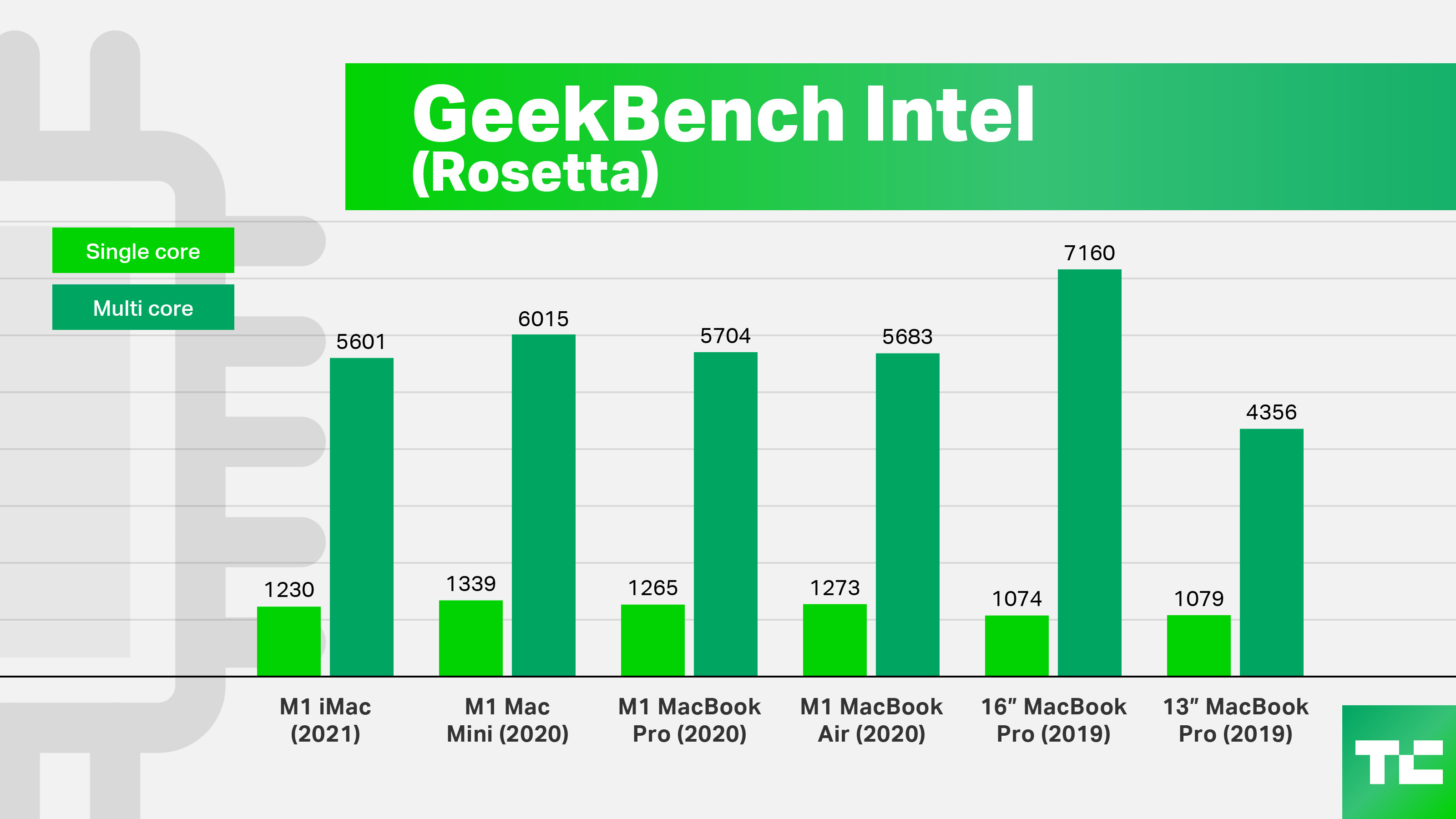
As expected, the new M1 chip breathes new life into the system. Take our Geekbench 5 scores: 1,720 Single and 7,606 multi-core. That blows the average of 1,200 and 6,400 for the 21.5-inch system out of the water. Things understandably take a dip with the Rosetta (Intel) version at 1,230 and 5,601, respectively, but it’s still solid performance running through a translation layer. But it also points to why Apple was so proactive about getting developers on-board with the new silicon. On the whole, the gains are in-line with the the other new M1 systems we’ve seen — which is to say a nice, healthy leap forward into the future of the Mac.
Image Credits: Bryce Durbin/TechCrunch
If you want to know how much of your workflow will be impacted, this resource is a good place to start. On the whole, I found that most of my day to day apps were fine. There are outliers, of course. Spotify and Audacity are right there. Performance is impacted in both case, but on a whole, they worked okay through Rosetta. Usage is more resource-intensive, though.
Image Credits: Bryce Durbin/TechCrunch
Spotify is probably a question of how many resources the Apple Music competitor wants to put into a new version, while Audacity is likely more of an issue of how many resources the organization has at its disposal. The further you move away from big names like Microsoft and Adobe, the more of a crapshoot it is. But there are some support issues with bigger names still, as well. For instance, I upgraded to the Apple silicon version of Zoom, but downgraded when I discovered it doesn’t work with the Intel-only version of the Canon EOS webcam software I use.
Image Credits: Bryce Durbin/TechCrunch
I recognize this is an extremely specific issue, but, then, workflows are extremely specific. As M1 systems become the mainstream of Macs, however, developers ultimately won’t really have much of a choice. Support Apple Silicon or risk becoming obsolete. Growing pains are essentially unavoidable with this sort of shift, but the results really speak for themselves. Apple Silicon is the future of Macs and it’s a fast-booting, smooth-moving future, indeed.
I can practically see the Apple team shouting at me when I mention the external mics and cameras I use to record video for work. After all, the new iMac sees the biggest upgrade to these things in some time. The best time for a new microphone system and the first 1080p HD camera on a Mac would have been last year, as the pandemic was beginning to transform the way we work and meet. The second best time, of course, is now.
Apple did tout an improved camera system on last year’s MacBook, but that was more to do with the image signal processing on the chips. That goes a ways toward improving things like white balance, but a truly meaningful improvement to imaging generally also requires new camera hardware. Take a look at the below images.
Image Credits: Brian Heater
That’s the 2020 iMac on the left and new M1 iMac on the right. Forgetting (hopefully) for a moment my droopy, partially paralyzed face (2020, am I right?), the image is night and day here — and not just because I’m slightly better put together all of these pandemic months later. The change that comes from upgrading from 720p to 1080p is just immediately apparent in term of image quality. I anticipate Apple upgrading its systems across the board, because teleconferencing is just life now.
iMac 2020:
iMac 2021:
Along with camera, the mic system got a nice upgrade. I’ve re-recorded the same audio that I did back in November on the old system. The three microphone array is crisper and much clearer, eliminating much of the background noise hiss. The six-speaker audio system is an improvement, as well. I found it worked well with music and movies, but could be less clear for teleconferencing, depending on the quality of the other attendee’s mic. The audio could be a bit bass-heavy for my taste.
On the whole, for most people, day to day, I think the audio and video upgrades are plenty. If you use your system for the occasional Zoom calls and some music listening, you should be fine. Depending on what you’re looking to get out of these things, though, a decent external camera, mic or speaker is never a bad investment.
The new iMac represents a nice leap forward for the desktop all-in-one in some key fundamental ways, breathing new life into one of the company’s most popular systems that’s long been in need need of a makeover. I miss some ports and now feel spoiled having had an SD reader on the 2020 model. I would also love to see a 27-inch version of the system on the market at some point (iMac Pro reboot, anyone?). On the whole the system is less targeted at creative pros than other models have been in the past — though the M1 and its on-board ML are still capable of impressive audio, video and still image editing.
But a cute, color coordinated design and some long overdue upgrades to teleconferencing elements aside, Apple Silicon is rightfully taking centerstage here as it did with the MacBooks and Mac Mini before it. The pricing on the systems was a source of some confusion around these parts when first announced. The very base-level version runs $1,299, while the tip-top level goes up to $2,628 with all the bells and whistles.
At the most basic level, there are three main configurations:
$1,299 gets you an 8-core CPU and 7-Core GPU, 8GB RAM, 256GB storage, two USB ports, standard Magic Keyboard
$1,499 upgrades the GPU to eight cores, adds ethernet and two USB ports and brings Touch ID to the keyboard
$1,699 upgrades storage to 512GB (Our configuration as tested)
The systems are available for pre-order now and will start arriving in customers’ homes this Friday.
As publishers face up to whatever might be their next existential crisis — there are so many options from which to choose, including Substack stealing all their writers; or Clubhouse pulling in people through audio-based conversations where news and analysis intermingle seamlessly with networking — a startup that’s helping them build more tools to keep their businesses and audiences intact, and hopefully grow, is announcing a growth round of its own.
Piano, which provides analytics and subscription services to publishers, has closed a round of $88 million, funding that it will be using to continue building out the technology that it provides to its customers, as well as forge into newer areas where it can better connect audiences online.
The funding comes on the heels of a strong period for Piano. The company works with around 1,000 customers — they include CNBC, Wall Street Journal, NBC Sports, Insider, The Economist, Gannett, Le Parisien, Nielsen, MIT Technology Review, The Telegraph, South China Morning Post and (disclaimer) TechCrunch; and it has seen revenues grow 400% since 2019.
Piano has an interesting new backer in this round that might point to what form those newer areas of development might take. LinkedIn, the Microsoft-owned social networking site aimed at the working world, is participating in this Series B, which is being led by previous backer Updata Partners. Rittenhouse Ventures, which is based in Piano’s hometown of Philadelphia, is also participating.
(Piano is not disclosing valuation with this round but I understand it’s operating on a $75 million annual run rate currently. It has now raised just over $241 million.)
Trevor Kaufman, Piano’s CEO, would not be drawn out on how it specifically will be working with LinkedIn, but it’s notable that the latter company has long held back from leveraging the profiles it holds on its 740 million users to do much outside of the core LinkedIn experience.
That could be applied in a number of ways, for example similar to Facebook and Google logins to third-party sites; or for providing an identity layer to comment on stories; or even building a way to manage logins via a LinkedIn profile, which could then potentially be used to help people manage and read/consume all the content they subscribe to. Or something totally different: LinkedIn has a lot of unrealised potential that Piano could help tap.
“Members are increasingly turning to LinkedIn to stay informed on the news and views that shape their respective industries – critical to this is the work we do with trusted publishers and journalists,” said Scott Roberts, VP and Head of Business Development at LinkedIn, in a statement. “The opportunity to collaborate with Piano to help unlock more value for publisher content on LinkedIn makes it a natural strategic investment opportunity.”
The last year has seen many of us spending significantly more time indoors, and for a number of us that has also meant more reading, especially of smaller and more digestible formats such as periodicals. In a way, it’s no surprise that models like Substack’s have emerged and apparently thrived in this period, where writers are looking for different approaches and ways of connecting with readers while publishers by and large are conserving costs and strategies to weather out the storm.
Piano’s rise in that context is especially interesting, as in many cases it’s not reinventing the wheel for publishers but providing them with the tools to better leverage the content production that they already have in place. What’s notable is that in the process, it’s been able to capitalize on changing sentiments in the publishing industry. Whereas paywalls and subscriptions have in the past been seen as a drag on traffic (and the ads that get sold against it) and only useful for those in the world of B2B, now they are increasingly becoming more commonplace in a much wider range of settings, Kaufman said.
Piano’s tools are notable not just as basic levers to manage subscriptions (free and paid) but a more sophisticated set of analytics that provide more insight into how content is being read, which can in turn be used to develop those subscription tiers and determine the likelihood of people subscribing (Nieman Lab has good article on how that works here).
To add to that, now another area where Piano is likely to develop more products is in the area of newsletters. No, not the Substack kind, but building tools for publishers to help them build out newsletter businesses that they can monetize if they choose. Indeed, the other kind of newsletter venture is far from Piano’s agenda.
“I can’t imagine a more damaging entity for journalism than Substack,” Kaufman told me. “I think it’s gotten a tremendous amount of attention from writers because it is a fantasy come true for journalists, this idea that you can make $500k a year for writing on occasion. But nothing can be farther from the truth.” He believes the model is so “pumped up venture funding” that it’s not a viable one for the long haul.
That remains to be seen, I suppose, and of course Piano has a strong vested interest in supporting its publisher customers. What it mainly says to me is that there are still some innings left in this game, and maybe some more games in a longer series.
The company may also be dipping into more M&A, given how fragmented the audience development, analytics and measurement space is. In March of this year, the company acquired AT Internet, a French company, to better manage and crunch analytics from across a number of silos, including traffic, advertising, subscriptions, engagement and more.
“Piano’s recent growth has been outstanding, and we continue to be impressed by the expanding set of capabilities they bring to both media companies and brands looking to drive more revenue from their audiences,” said Jon Seeber, general partner at Updata Partners and a member of Piano’s board, in a statement “They now have a true end-to-end platform that can power all aspects of the customer journey, allowing their clients to incorporate only the highest-quality data from across touchpoints to create the best experiences for users.”