Author: azeeadmin

17 May 2021

Reface now lets users face-swap into pics and GIFs they upload

Buzzy face-swapping video app Reface is expanding its reality-shifting potential beyond selfies by letting users upload more of their own content for its AI to bring to life.

Users of its iOS and Android apps still can’t upload their own user generated video but the latest feature — which it calls Swap Animation — lets them upload images of humanoid stuff (monuments, memes, fine art portraits, or — indeed — photos of other people) which they want animated, choosing from a selection of in-app song snippets and poems for the AI-incarnate version to appear to speak/sing etc.

Reface’s freemium app has, thus far, taken a tightly curated approach to the content users can animate, only letting you face swap a selfie into a pre-set selection of movie and music video snippets (plus memes, GIFs, red carpet celeb shots, salon hair-dos and more).

But the new feature — which similarly relies on GAN (generative adversarial network) algorithms to work its reality-bending effects — expands the expressive potential of the app by letting users supply their own source material to face swap/animate.

Some rival apps do already offer this kind of functionality — so there’s an element of Reface catching up to apps like Avatarify, Wombo and Deep Nostalgia.

But it’s also going further as users can also swap their own face into their chosen source content. So you could, for example, get to see yourself as a singing Venus de Milo, or watch your visage recite a poem from the middle of a pop-art painting like Andy Warhol’s Marilyn.

The Andreessen Horowitz-backed startup is still being cautious as it expands what users can do with its high tech face-shifting tool — saying it will be manually moderating all uploads from the new feature.

Rivals in the deepfake space are arguably pushing its hand to open up functionality faster, though, with apps like Avatarify already letting users animate their own snaps. And — notably — a Reface spokeswoman told us it’s planning to make user generated video uploads available “in the near future”.

Pro users are getting a little taster — as they can upload their own GIFs to face swap into with this latest feature release too.

“We’re really excited to see what Reface users do with swap-reenactment, which is a major technical milestone in terms of the machine learning technology inside of the app,” said CEO Dima Shvets in a statement. “Reface content creators have been clamoring for more tools for personalized content and self-expression – and this feature delivers, dramatically extending the opportunities for realizing their vision and creativity.” 

The still young app has proved popular over its short run, garnering viral buzz via social media shares as users were keen to show off their funny face swaps.

As of March 2021 Reface said it had 100M installs some 14 months since going live. 

17 May 2021

Fresh out of YC, Houm raises $8M to improve the home rental and sales market in LatAm

As a longtime real estate developer based in Chile, Benjamin Labra was able to spot gaps in the buying and renting markets in Latin America. To meet demands, he started Houm, an all-in-one platform that helps homeowners rent and sell their properties in the region.

Fresh out of Y Combinator’s W21 cohort, today Houm announced an $8 million seed round. 

If you think the concept sounds like Brazil’s unicorn, QuintoAndar, it’s because Houm is very similar. While QuintoAndar dominates the Brazilian market, Houm operates in Chile, Mexico and Colombia, and aims to capture the rest of Spanish-speaking LatAm.

Think of Houm as a homeowner-run Zillow meets TaskRabbit. The company offers a marketplace run by the property owners themselves and cuts out the realtor by employing 200 freelancers who prepare the property for sale or to manage it.

Houmers, as they are called, go to the owner’s home, take photos and then help possible buyers or renters view the property. For their work, Houmers are compensated each time a home they worked on sells or gets rented.

However, Houm’s selling proposition isn’t just the ease of use it provides; instead, it also serves as a guarantor in my ways, making the buying process more accessible.

“In Colombia and Mexico, for someone to be your guarantor, they have to have a property that’s free of mortgage so it can be used as collateral,” Labra told TechCrunch.

On the flip side, the company also guarantees that renters will get paid every month, and if a tenant falters, Houm covers the cost. “You really have nothing to lose if you use Houm,” Labra said.

You can imagine that a company like Houm now has all sorts of data on the real estate market, especially around sales and rental prices. As a result, Houm uses this data in an algorithm that helps the homeowner determine a fair price for their property, but the listed price remains up to the owner.

The company, which was founded in 2018 and is based in Chile, now has about 200 full-time employees, in addition to their freelance team. While Labra declined to say how many active users it has, he said Houm is now showing a property every eight minutes.

The current funding round had no lead investor but includes Y Combinator, Goodwater Ventures, OneVC, Vast VC, Liquid2 and Myelin. The company plans to use the money to expand within the region, perfect its algorithm and generally speed up growth.


17 May 2021

Sequoia leads $5M pre-seed in Egypt’s 1-month-old digital bank Telda

Egypt has a population of over 100 million people. The country has a high mobile and internet penetration vital to a young and tech-savvy population with 61% below 30. But despite its youthful population, two out of every three individuals are currently unbanked in Egypt. It’s the same situation in MENA, where only 40% of the population have access to a bank account.

Digital banks have enormous potential in the region. Today, a newly launched one, Telda is announcing a $5 million pre-seed round to digitize how Egyptians save, send, and spend money.

Two weeks ago, we reported that Egyptian e-commerce fulfillment startup Flextock had raised the largest pre-seed in MENA. But that has changed today with Telda’s fundraise surpassing that record with a considerable margin in both MENA and Africa (Autochek’s $3.4 million) for now.

Telda was launched last month by CEO Ahmed Sabbah and CTO Youssef Sholqamy. Before Telda, Sabbah was the co-founder and CTO of Egypt’s ride-hailing company Swvl, and Sholqamy, a former senior engineer in Uber’s infrastructure team. Sabbah said he and his co-founder had been looking at the fintech space at their former workplaces. However, after his experience using N26 while visiting a friend in Berlin in 2015, his eyes opened to the possibilities of digital banking in Egypt.

“I was fond of the idea, and it was coming from a huge pain of payments we had in Egypt and the region. And for me, I was kind of like waiting for this to happen in Egypt, or if not, I thought I’ll tap into the opportunity someday,” he told TechCrunch. “Youcef and I have been like watching out the space for a while when the first digital bank started like six years ago, and watching how they grew in markets where we think banking is more mature than this region. So imagine an opportunity in a region like Egypt where banking is even way, way less mature.”

The North African country is one of the highest consumer spending markets in Africa. Its private consumption accounts for nearly 85% of its nominal GDP, and only 4% of its overall GDP is cashless. In essence, Egypt is heavily cash reliant, and card usage in the country is very much in its infancy. Disheartened by the non-customer-centric banking experiences, Telda was launched to provide an alternative.
Telda

Image Credits: Telda

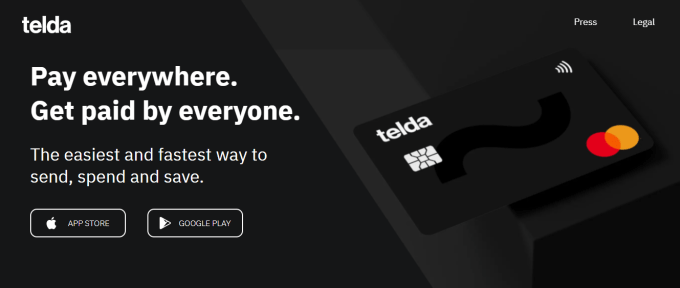
Like any digital bank globally, Telda enables customers to create a free account to send and receive money. And also a card to use online, in stores, make withdrawals and pay bills. But while the service is currently live, Telda cards are yet to be distributed to existing and new customers.

Telda affirmed that it is the first company to receive a license from the Central Bank of Egypt (CBE) under its new regulations to issue cards and onboard customers digitally. And by doing so, the one-month-old company has made major progress in a relatively short time, even though obtaining that license took lengthy dialogue with regulators.

“First movers will usually have to make all the effort with the regulators and with the bank and try to pave the way. So this was one of the hardest parts — convincing regulators to trust and regulate our banking business and to provide payment financial services to our consumers,” the CEO said. But because Telda’s proposition aligns with the CBE’s vision of digitizing payments in the country, it had little choice but to grant them the license.

A different issue the company has faced was finding a partner bank to provide these services. And to do that, Telda had to convince the bank that their services were complementary and wouldn’t entirely overlap.

“That means basically trying to be as much independent as possible from the infrastructure of the bank. This was quite crucial for us to be able to move right and as fast as a startup, not as slow and pretty much tied to the pace of the bank’s technology and operations,” he continued.

Due to the founders’ experience in Swvl and Uber, the importance of building a great team cannot be overemphasized. There’s barely any blueprint to look at in launching a digital bank in Egypt, so Telda is building how it knows best: hiring exceptional talent. According to the CEO, the team comprises Egyptians who returned to the North African country to build Telda after working for corporations like Facebook, Microsoft, Uber, Noon, and McKinsey.

MENA appears to be ripe for a digital banking experience. Per GSMA Intelligence, 280 million people in the region are mobile internet users, and growth is not slowing down. The frustration with traditional banks is particularly acute with the younger generation, who crave a simple, user-friendly, and transparent experience. Telda has been able to onboard an impressive list of investors, including Sequoia Capital, for this reason.

The giant US VC firm led the pre-seed round as Berlin-based Global Founders Capital (GFC) and emerging markets-focused fund Class 5 Global participated.

Although Sequoia has made a few Sub-Saharan African investments in startups like Healthlane and OPay, Telda is its first venture into North Africa and the wider GCC region. Eight years ago, the VC giant led an infamous seed investment in Latin American digital bank Nubank before it began to go full throttle. Now with more than 38 million customers, Nubank is the world’s largest digital bank with a valuation of $25 billion. Sequoia will be looking for a similar success story in Telda.

“There are many parallels between Brazil and Egypt. Both countries boast a large, young, talented, and tech-savvy population with a strong appetite to innovate,” said Sequoia Partner George Robson of the investment. “We are delighted to partner with Telda and earmark our first investment in the region.”

Telda intends to fast-track its card production and distribution with this new funding. The company said it currently has more than 30,000 signups already, with half of that already requesting cards. It also plans to capitalize on Sequoia’s name for hiring and expansion, the CEO continued.

I think hiring is key for us. We want to scale the team into a world-class team that’s willing to tap into the opportunity. What we aspire for is basically growing in Egypt, start to deliver cards for the early adopters, and we see ourselves reaching close to a million cards in our first year.”

Investments in Egypt have been growing in leaps and bounds over the past three years, accompanied by a growing, vibrant ecosystem. Egypt recorded the largest number of investment deals last year per Partech Africa. With 86 deals completed, the country contributed 24% to the total number of deals made on the continent

GFC partner Roel Janssen referring to the budding ecosystem in his statement, said: “We are highly impressed by Sabbah and Sholqamy and love their vision for building the region’s leading digital banking app, and we are proud to be part of their journey. It is GFC’s first investment in Egypt, and we see that Egypt has the potential to become an important hub in the global tech ecosystem.”

Class 5 global managing partner Youcef Oudjane said, Money has become a medium of self-expression — a form of identity — not solely a store of value. Telda has done a remarkable job of embedding their culture and values in the product, in both functionality and design.

17 May 2021

JD Logistics, China’s answer to Amazon’s logistics ambitions, to raise $3.4B from IPO

After operating in the red for 14 years, JD.com’s logistics subsidiary is getting ready for an initial public offering in Hong Kong. JD Logistics will price its share between HK$39.36 and HK$43.36 apiece, which could see the firm raise up to about HK$26.4 billion or $3.4 billion, according to its new filing.

JD.com, Alibaba’s e-commerce rival in China, began building its own logistics and transportation network from the ground up in 2007 and spun out the unit in 2017, following a pattern where major segments of the tech giant became independent, such as JD.com’s health and fintech units. JD.com is currently the largest shareholder of JD Logistics with an aggregate stake of 79%.

Unlike Alibaba, which relies on a network of third-party partners to fulfill orders, JD.com takes a heavy-asset approach like Amazon, building up warehouse centers and keeping its own army of courier staff. As of 2020, JD Logistics had over 246,800 employees working in delivery, warehouse operations among other customer services. Its total headcount was 258,700 last year.

A major strategic decision JD Logistics made once it became independent was opening its technologies to external customers beyond the scope of JD.com’s own demand, helping retailers like Skechers optimize their logistics operations. As a result, the share of its revenue from external customers rose from 29.9% in 2018 to 38.4% in 2019, and to 43.4% in the nine months ended September 2020.

“Our growth strategy is partially based on the assumption that the trend toward outsourcing of supply chain services will continue,” the firm said in its prospectus.

“Third-party service providers like us are generally able to provide such services more efficiently than otherwise could be provided ‘in-house,’ primarily as a result of our expertise, technology and lower and more flexible employee cost structure.”

But retailers may switch to in-house supply chain operations themselves if they see risks in relying on third-party providers, the company added.

The main selling point of JD Logistics is its same- or next-day delivery, thanks to warehouses it keeps close to end consumers. It said about 90% of the total orders it processed were delivered on the same or next day in 2020.

Such user experience comes at a substantial cost for JD Logistics, though losses are shrinking. The firm posted a net loss of 2.8 billion yuan, 2.2 billion yuan and 11.7 million yuan in 2018, 2019 and for the nine months ended September 30, 2020, respectively.

Its gross profit margin improved from 8.5% during the nine months ended September 30, 2019 to 10.9% for the same period in 2020, primarily due to economies of scale, better operational efficiency, and government subsidies for reductions in social security funds contributed by employers and waivers of toll charges during COVID-19.

JD Logistics reached into instant delivery by partnering with Dada, a Chinese last-mile delivery service, to form JDDJ, short for “JD Arrives Home” in Chinese. JDDJ has been Walmart’s on-demand delivery service provider in China since 2016.

17 May 2021

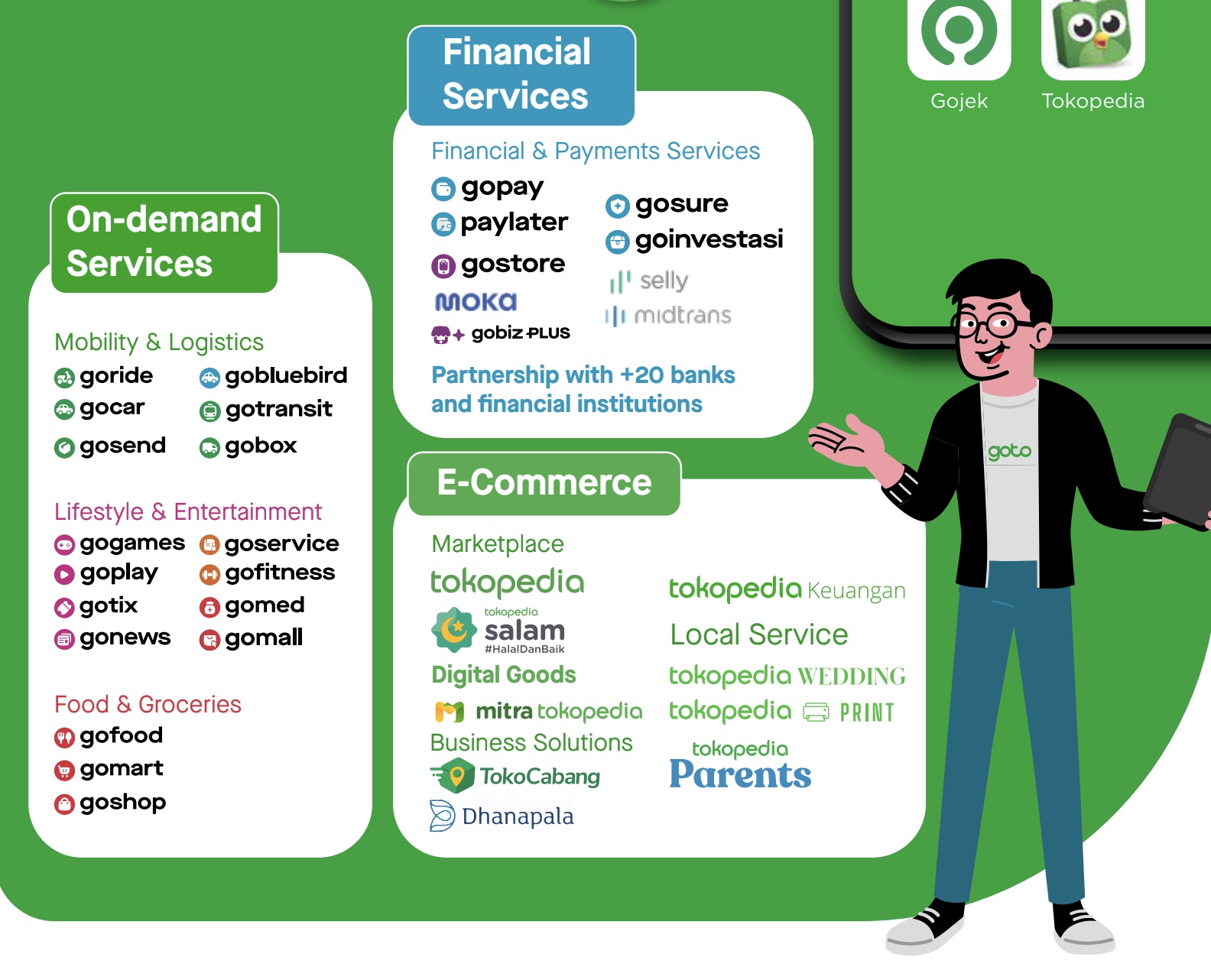
Gojek and Tokopedia merge to form GoTo Group

Ride-hailing giant Gojek and marketplace Tokopedia said on Monday they have combined their businesses to form GoTo Group, the largest technology group in Indonesia.

Gojek’s Andre Soelistyo will lead the combined business as GoTo Group CEO, with Tokopedia’s Patrick Cao serving as GoTo Group President. Kevin Aluwi will continue as CEO of Gojek and William Tanuwijaya will remain CEO of Tokopedia, the two firms said in a joint announcement.

The combined entity, valued at about $18 billion, is “a globally unique and highly complementary ecosystem,” the two firms said. It features:

  • Total Group Gross Transaction Value (GTV) of over US$22 billion in 2020
  • Over 1.8 billion transactions in 2020
  • Total registered driver fleet of over two million as of December 2020
  • Over 11 million merchant partners as of December 2020
  • Over 100 million monthly active users (MAU)
  • An ecosystem that encompasses 2% of Indonesia’s GDP

The deal, which has been in the works for several months, comes after Gokek spent several quarters exploring a merger with its chief Southeast Asian rival Grab.

“Today is a truly historic day as we mark the beginning of GoTo and the next phase of growth for Gojek, Tokopedia and GoTo Financial. Gojek drivers will deliver even more Tokopedia packages, merchant partners of all sizes will benefit from strengthened business solutions and we will use our combined scale to increase financial inclusion in an emerging region with untapped growth potential. For the consumer, GoTo Group will continue to reduce frictions and provide best in class delivery of goods and services. This is the next step of an exciting journey and I am humbled and proud to lead the GoTo movement,” said Andre Soelistyo, CEO of GoTo Group, in a statement.

Tokopedia’s Co-founder and CEO William Tanuwijaya said, “The establishment of GoTo Group proves that you can believe in an ‘Indonesian dream’ and make it a reality. Our goal has always been to build a company that creates social impact at scale, levelling the playing field for small businesses and giving consumers equal access to goods and services across the country. In addition to accelerating the growth of Indonesia’s digital economy, GoTo Group will make it easier for people from all walks of life to access quality products and services, anytime and anywhere. We still have a long way to go to achieve our goals, but today is about starting that journey together.”

This is a developing story. More to follow…

17 May 2021

Gojek and Tokopedia merge to form GoTo Group

Ride-hailing giant Gojek and marketplace Tokopedia said on Monday they have combined their businesses to form GoTo Group, the largest technology group in Indonesia.

Gojek’s Andre Soelistyo will lead the combined business as GoTo Group CEO, with Tokopedia’s Patrick Cao serving as GoTo Group President. Kevin Aluwi will continue as CEO of Gojek and William Tanuwijaya will remain CEO of Tokopedia, the two firms said in a joint announcement.

The combined entity, valued at about $18 billion, is “a globally unique and highly complementary ecosystem,” the two firms said. It features:

  • Total Group Gross Transaction Value (GTV) of over US$22 billion in 2020
  • Over 1.8 billion transactions in 2020
  • Total registered driver fleet of over two million as of December 2020
  • Over 11 million merchant partners as of December 2020
  • Over 100 million monthly active users (MAU)
  • An ecosystem that encompasses 2% of Indonesia’s GDP

The deal, which has been in the works for several months, comes after Gokek spent several quarters exploring a merger with its chief Southeast Asian rival Grab.

“Today is a truly historic day as we mark the beginning of GoTo and the next phase of growth for Gojek, Tokopedia and GoTo Financial. Gojek drivers will deliver even more Tokopedia packages, merchant partners of all sizes will benefit from strengthened business solutions and we will use our combined scale to increase financial inclusion in an emerging region with untapped growth potential. For the consumer, GoTo Group will continue to reduce frictions and provide best in class delivery of goods and services. This is the next step of an exciting journey and I am humbled and proud to lead the GoTo movement,” said Andre Soelistyo, CEO of GoTo Group, in a statement.

Tokopedia’s Co-founder and CEO William Tanuwijaya said, “The establishment of GoTo Group proves that you can believe in an ‘Indonesian dream’ and make it a reality. Our goal has always been to build a company that creates social impact at scale, levelling the playing field for small businesses and giving consumers equal access to goods and services across the country. In addition to accelerating the growth of Indonesia’s digital economy, GoTo Group will make it easier for people from all walks of life to access quality products and services, anytime and anywhere. We still have a long way to go to achieve our goals, but today is about starting that journey together.”

This is a developing story. More to follow…

17 May 2021

India’s Moglix valued at $1 billion in $120 million fundraise

Moglix, an industrial business-to-business marketplace, said on Monday it has raised $120 million in a new financing round at $1 billion valuation, becoming the 12th firm in the world’s second largest market to turn a unicorn.

The startup’s Series E financing round was led by Falcon Edge Capital and Harvard Management Company (HMC). Existing investors, Tiger Global, Sequoia Capital India and Venture Highway. TechCrunch reported earlier this year that Tiger Global was in talks to invest in Moglix at $1 billion valuation.

This is a developing story. More to follow…

17 May 2021

Merchant commerce platform Pine Labs valued at $3 billion in new fundraise

Pine Labs, a startup that offers merchants payments terminals, invoicing tools and working capital, said on Monday it is raising $285 million in a new financing round as the nearly two-decade-old firm looks to expand its business.

Baron Capital Group, Duro Capital, Marshall Wace, Moore Strategic Ventures and Ward Ferry Management financed the new funding round, while existing investors Temasek, Lone Pine Capital and Sunley House Capital also participated in it, the Indian startup said.

The new round valued Pine Labs at $3 billion, up from about $2 billion in a December round last year.

“We’re thrilled to welcome marquee investors like Marshall Wace, Baron Capital Group, Ward Ferry Management, Duro Capital and Moore Strategic Ventures to the already pristine cap table of Pine Labs. This is an exciting phase in our journey as we enter newer markets. We excel in enterprise merchant payments and now want to scale new frontiers in the online space as well, at the same time continue to power the credit and commerce needs of our offline merchant partners,” said B. Amrish Rau, CEO of Pine Labs, in a statement.

More to follow…

16 May 2021

Elon Musk giveth and taketh away

Hello friends, and welcome back to Week in Review!

Last week, I wrote about Facebook’s never-ending Trump problem. This week, I’m looking at Elon Musk’s wild week of whipping crypto markets.

If you’re reading this on the TechCrunch site, you can get this in your inbox from the newsletter page, and follow my tweets @lucasmtny.

The big thing

This week, Elon Musk may have crashed the crypto markets with a tweet.

Musk has always been anything but predictable but retail and institutional investors are also anything but dismissive of his ability to pump up markets — especially if there’s a good joke to tell in the meantime. A few days after he crashed Dogecoin because of his appearance on Saturday Night Live where he called the currency a “hustle,” he drove the price of Bitcoin — a cryptocurrency with a $1 trillion market cap –down as much as 17% with a tweet basically noting that he now believes Bitcoin is bad for the environment and that Tesla will not be accepting Bitcoin payments for its cars after all.

The impact was immediate. Crypto investors flooded into his mentions pleading for mercy and complaining to each other in public and private that he shouldn’t have been so rash. Unrelated coins across the cryptosphere dipped as investors worried whether the tweet, shipped at a tenuous moment for this bull run would drag the space down to earth. A later tweet that he was working with Dogecoin developers directly on improving its efficiency sent the joke coin (worth billions of dollars) surging and supplied crypto investors with a worrying insight that perhaps this is all just a joke to Musk.

Days later, Bitcoin has erased months of gains — though Dogecoin isn’t doing too poorly.

Musk has had his own dealings with the SEC in recent years, but his market moving tweets have seemed dubious at times but have generally seemed to be just another case of him trolling. Tesla’s investment in Bitcoin has complicated this somewhat, and while it’s not known whether he actually has holdings of Dogecoin, he’s certainly put himself in a less flexible legal arena when his company has a billion dollar stake in the fortunes of Bitcoin which he seems to lord control of over with his Twitter.

Retail investors aren’t used to blowing up a billionaire’s mentions and eliciting a response and there’s a certain irresistible power that comes with that especially for pumping nascent bets like Dogecoin, but I suspect that there’s going to be some reticence among a certain class of investor to invite Musk’s brand of randomized volatility into their wallets.

Other things

Jim Urquhart / Reuters

Here are the TechCrunch news stories that especially caught my eye this week:

Uber and Lyft supplying free rides to vaccine appointments
In an effort to get more Americans vaccinated, the Biden White House has partnered with Uber and Lyft allowing riders to get free rides to and from vaccination sites, covering up to $15 each way.

State attorneys tell Facebook to nix Instagram for Kids app
Attorneys General representing some 44 U.S. states and territories signed a letter pressuring Facebook to abandon its plans to create a version of Instagram designed specifically for kids.

Burning Man plans for a virtual year
The Covid-19 pandemic has taken yet another year of Burning Man away from attendees. The festival in the Nevada desert has been a favorite of high-profile tech executives, but this year they’ll have to settle for a wholly virtual experience.

Ethereum creator donates $1 billion to India Covid recovery
One of the wildest story of the weeks involves the creator of Ethereum dumping billions of dogecoin copy cats that were unceremoniously gifted to his account, donating them to a host of charities. He donated some $1.5 billion worth of cryptocurrencies in total.

Amazon nukes accounts of some major Chinese sellers
Alleging fake reviews and behaviors that violated its store policies, Amazon took the nuclear option on a number of massive Chinese sellers on its platform that were responsible for billions in merchandise value. Those account holders aren’t too happy and Amazon isn’t too repentant.

GasBuddy hits top of App Store 
In the wake of the Colonial Pipeline attack, several states in the eastern United States were left with gas shortages, pushing the gas-finding app GasBuddy to the top of the App Store for the first time ever.

Extra things

Illustration Expensify

Image Credits: Nigel Sussman

Some of my favorite reads from our Extra Crunch subscription service this week:

The Expensify EC-1
“Let’s make it clear from the outset that this story is about an expense management SaaS business called Expensify. As you’d expect, yes, this is about the expense management market and how Expensify has grown, its technology and all of that. Normally, that would make us change the channel. But this is also a story about pirates; peer-to-peer hackers who asked, “Why not work from Thailand and dozens of countries across the globe?” and actually did it using P2P hacker culture as a model for consensus-driven decision-making — all with pre-Uber Travis Kalanick in a guest-starring role..”

Is there a creed in venture capital
“Entrepreneurs and investors should recognize that contracts are worth very little without the ongoing relationship management that keeps all parties aligned. Enforcement is so unusual in the world of startups that I consider it a mostly dead-end path. In my experience, good communication is the only reliable remedy. This is the way.

5 ways to raise your startups PR game
“I get emails every week from companies coming out of stealth mode, wanting to make a splash. Or from a Series B company that’s been around for a while and hopes to improve their branding/messaging/positioning so that a new upstart doesn’t eat their lunch. How do you make a splash? How do you stay relevant?”


Again, if you’re reading this on the TechCrunch site, you can get this in your inbox from the newsletter page, and follow my tweets @lucasmtny.

16 May 2021

How one founder’s startup journey began with dropping out of school to work with Drake

This week’s episode of Found features Courtne Smith, founder of NewNew, a social app where people pay to vote on your decisions. The platform takes the concept of social polling to the next level, essentially allowing everyone to monetize their choices by turning them into a kind of social stock market where others can purchase shares to accumulate more or less decision power based on what they’re willing to spend.

Courtne’s path to NewNew was immediately preceded by the creation of Surprize, a social trivia and prize-giving app that leveraged crowdsourcing to pick and award its prizes. But long before that, the Toronto native made a bold decision — encouraged by, of all people, her pastor father — to drop out of school and go work for Drake the very outset of his career as his personal assistant.

We talked to Courtne about making that risky deviation from a relatively traditional and safe path, and about how she eventually moved on from many years of working with Drake during his rise to global success: Another counterintuitive decision to go from something that was already working out well, to pursue something unknown. Courtne tells us about her overall entrepreneurial drive, which has always stemmed from a desire to create something game-changing, and about how when it came time to attract investors for her ventures, she opted not to leverage her deep-pocketed connections and instead sought capital on the merits of her ideas alone.

We had a great time chatting with Courtne, and we hope you have just as much fun listening. And of course, we’d love if you can subscribe to Found in Apple Podcasts, on Spotify, on Google Podcasts or in your podcast app of choice. Please leave us a review and let us know what you think, or send us direct feedback either on Twitter or via email. And please join us again next week for our next featured founder.