Author: azeeadmin

13 May 2021

New Relic is bringing in a new CEO as founder Lew Cirne moves to executive chairman role

At the market close this afternoon ahead of its earnings report, New Relic, an applications performance monitoring company, announced that founder Lew Cirne would be stepping down as CEO and moving into the executive chairman role.

At the same time, the company announced that Bill Staples, a software industry vet, would be taking over as CEO. Staples joined the company last year as chief product officer before being quickly promoted to president and chief product officer in January. Today’s promotion marks a rapid rise through the ranks to lead the company.

Cirne said when he began thinking about stepping into that executive chairman role, he was looking for a trusted partner to take his place as CEO, and he found that in Staples. “Every founder’s dream is for the company to have a long lasting impact, and then when the time is right for them to step into a different role. To do that, you need a trusted partner that will lead with the right core values and bring to the table what the company needs as an active partner. And so I’m really excited to move to the executive chairman role [and to have Bill be that person],” Cirne told me.

For Staples, who has worked at large organizations throughout his career, this opportunity to lead the company as CEO is the pinnacle of his long career arc. He called the promotion humbling, but one he believes he is ready to take on.

“This is a new chapter for me, a new experience to be a CEO of a public company with a billion dollar plus value valuation, but I think the experience I have in the seat of our customers, as well as the experience I’ve had at Microsoft and Adobe, very large companies with very large stakes running large organizations has really prepared me well for this next phase,” Staples said.

Cirne says he plans to take some time off this summer to give Staples the space to grow as the leader of the company without being in the shadow of the founder and long-time CEO, but he plans to come back and work with him as the executive chairman moving forward come the fall.

As he step into this new role, Staples will be taking over. “Certainly I have a lot to learn about what it takes to be a great CEO, but I also come in with a lot of confidence that I’ve managed organizations at scale. You know I’ve been part of P&Ls that were many times larger than New Relic, and I have confidence that I can help New Relic grow as a company.”

Hope Cochran, managing director at Madrona Ventures, who is also the chairman of the New Relic Board said that the board fully backs of the decision to pass the CEO torch from Cirne to Staples. “With the foundation that Lew built and Bill’s leadership, New Relic has a very bright future ahead and a clear path to accelerate growth as the leader in observability,” she said in a statement.

The official transition is scheduled to take place on July 1st.

13 May 2021

Shopify helps customers build online shops, but it’s minting tech founders and investors, too

Last month, Jean-Michel Lemieux, the chief technology officer of Shopify, and chief talent officer Brittany Forsyth announced on Twitter that they are stepping down from their roles. Chief legal officer Joe Frasca is also set to step down, with all three ending their tenures next month.

In their new chapters, all seem keen to advise, invest in, or even launch startups, joining a growing number of former Shopify executives and employees to do the same.

For a company of Shopify’s size — the 15-year-old, 7,000-person, Ottawa-based outfit boasts a $130 billion market cap — that’s not a surprise. Still, because of the wealth that Shopify has helped create, its former employees look to have an impact on the Canadian entrepreneurial ecosystem like no other.

Meanwhile, Shopify’s focus in part on the climate and sustainability — it invests $5 million per year in startups that fight climate change, publishes sustainability reports, and earlier this year became the first customer to buy contract carbon removal units from a direct air capture company in order to reduce its greenhouse gas emissions — could also have meaningful ripple effects, suggest those who’ve moved on.

Take Craig Miller, for example, formerly the chief product officer, of Shopify, who left the company back in October. He’d already invested in several venture funds that are focused on clean tech and Canada while still working full time; now, he’s investing both his money and time in individual companies that he thinks “have a real shot at making a big social impact.”

Some of these include tools that enable people to run their own businesses, including Housecall Pro; and startups looking to reverse climate change, like the carbon capture startup Planetary Hydrogen.

Miller says the time investment is more compelling to the founders, which include former Shopify colleagues. “Raising money is important, but there’s already more than enough people willing to invest money in them. Most of my value comes in talking” with teams that need insights into how to scale up their startups, Miller says.

“There are so few people that know how to drive huge growth in a company, have seen a company [grow] from $100 million to $100 billion plus, that know how to think about scaling a product to millions of users. This is the case globally but especially so in Canada where there are basically no role models.”

Outsiders might be surprised by the extent to which Shopify actively educated its employees, suggests Miller, who says “one of the things that I loved most was how open we were. All employees knew the roadmap, could look at the code, they could access the data . . . we even shared our board presentation with the entire company. Doing so let people who were interested in how to build an incredible company take notes.”

Seemingly, plenty of people had their pens out. Among those who’ve left Shopify to spin up their own business are Michael Perry, who left Shopify last year to build an app that helps organize busy families called Maple; Helen Tran, who left Shopify in 2017 to start Jupiter, which makes software for beauty and personal care brands; Andrew Peek, who started the investment advisory Delphia; and Effie Anolik, whose startup, Afterword, help the bereaved to plan both virtual and offline memorial services.

Another founder and proud Shopify alum is former director of product marketing Arati Sharma, who calls Shopify a “special place” that taught a lot of people how to scale a business and to do it in a very Shopify-specific way. Because Shopify is the first company of its size in Canada,  it didn’t have a “fixed mindset” about “how companies of our size should be run” and it wasn’t “beholden to playbooks of the past,” she says.

She admits there are practical limits to how much the company could teach her about starting her own company, Ghlee, a ghee-based skincare brand based in Toronto that she launched in 2019. “Though I’ve had the opportunity to build from scratch inside of Shopify, being in the founder seat is a whole new ballgame,” she says.

But as with Miller, Sharma credits Shopify with many learnings, including “how culture and commerce intersect so deeply,” and says that “whether you join [Shopify] as a former founder or you catch the entrepreneurial bug while working there, it’s remarkable how many employees run their own businesses.”

Some are actually running them on the side of continuing to work at Shopify.  Atlee Clark, for example, runs a children’s clothing company called Pika Layers, while remaining a full-time director with the company.

Others have launched investment firms. Among these:  former VP of product, Andrew McNamara, today runs Ramen Ventures, an impact angel fund, with another former Shopify colleague, Joshua Tessier.

Very notably, Sharma is herself an active angel investor, even cofounding a collective of 10 investors earlier this year called Backbone Angels to “optimize for speed and to move quickly on a couple of deals that are coming our way.”

All the members of Backbone Angels are women. All are former Shopify employees, including outgoing chief talent officer Brittany Forsyth. All are focused on increasing the number of women and non-binary investors on cap tables, with the belief that doing so will change how boards will look going forward and how companies are built.

Thanks in part to Shopify, there is apparently no shortage of opportunities to fund. Though Sharma began investing earlier on with her husband, she says that of the more than 30 startups she has funded altogether, nine of those investments came together just this year.

13 May 2021

Pinterest to test live-streamed events this month with 21 creators

Pinterest is expanding into live events. The company is planning to host a three-day virtual event that will feature live-streamed sessions from top creators, including big names like Jonathan Van Ness and Rebecca Minkoff, among others. The virtual event will run inside the Pinterest app from May 24th through May 25th, and will serve as the company’s first public test of directly streaming creator content to its over 475 million global users.

The rise of the creator economy and a pandemic-fueled demand for virtual events led Pinterest to explore the idea of live streaming. Last fall, it began testing a “class communities” feature that allowed users to sign up for Zoom classes through Pinterest, while creators used Pinterest’s boards to organize materials, notes, and other resources. These communities also included a group chat option and shopping features.

The new live-streamed sessions will operate a bit differently.

For starters, they’re not directing users off-site to Zoom for the sessions. Instead, users will launch the live-streaming experience directly inside Pinterest mobile app and remain there during the sessions. Pinterest users can also comment to interact with the creator during their stream, but there is no longer any shopping functionality, Pinterest tells TechCrunch.

Image Credits: Pinterest

The live streams allow up to five “guests” and an unlimited number of viewers. Meanwhile, moderators — which may include Pinterest employees, during this test — will help to control the experience. They will also have the ability to remove people from the chat if they do not uphold Pinterest’s Community Standards.

The forthcoming event’s lineup will focus a variety of topics, including food, design, cooking, style, and more.

Jonathan Van Ness‘ session will discuss morning rituals and self-care routines. Fashion designer Rebecca Minkoff will teach Pinterest users how to style their summer wardrobe. Others featured during the event include food creators GrossyPelosi and Peter Som, who will showcase favorite recipes; Women’s Health magazine will talk about using vision boards to achieve your goals; Jennifer Alba will show how to communicate the Zodiac through sign language; and Hannah Bronfman will offer ideas for creating an at-home spa night.

In total, Pinterest will feature around 21 creators throughout the three-day event, with around 7 different session per day. Users will be directed to the live event via a new “Live” tab inside the Pinterest app for iOS and Android, where they can view the schedule and join sessions.

Image Credits: Pinterest

x”As a visual platform, people discover billions of ideas on Pinterest every day, and we’re always looking for new ways to help them bring those ideas to life,” says David Temple, Pinterest’s Head of Creators.

Temple notes Pinterest has integrated with third-party live-streaming technologies and built its own in-house messaging systems to power live interactions.

“We’re excited about the opportunity to respond to Pinner feedback for more dynamic and timely events as new interests like cooking have emerged for many in quarantine, and trends like beauty, fashion, and home renovation are on all-time highs as we move into a post-pandemic world,” Temple adds.

However, Pinterest isn’t discussing how it views the potential for live events longer-term. For the time being, it’s not offering tools that could woo creators away from other platforms where they can monetize their fans through features like donations, tips, virtual gifts, paid ticketing, subscriptions, or brand partnerships via a creator marketplace. Without such options, Pinterest could have a hard time competing for creators’ attention.

Image Credits: Pinterest

Nearly every big tech platform today is making a play for creators, and some are even willing to throw cash at them to win them over. Facebook, Instagram, YouTube, TikTok, and Twitter are all building out features that let creators do more than build an audience to monetize through ads or brand deals. Now, fans can send creators money during or after streams, subscribe for exclusive content, pay for access and more, depending on the platform.

New types of creator services are emerging, too, including the audio chat room experience pioneered by Clubhouse (and being cloned by everyone else), as well as dozens of virtual events startups hoping to win the market.

Pinterest’s attraction among such heavy competition isn’t clear, but the company will use this experiment to learn more about what works for its own community.

Pinterest tested its live streaming technology with employees a few weeks ago, but this will be the first time the feature will be available to the public.

While the event lineup can be viewed on the web, the live streams themselves will only run inside the Pinterest app for iOS and Android starting May 24th.

13 May 2021

Is there a creed in venture capital?

How should venture capitalists and corporate innovators assess Din Djarin, the protagonist of The Mandalorian? He’s introduced as a bounty hunter, a mercenary vocation in the Star Wars mythos that has been reserved primarily for villains.

One of the most interesting aspects of Jon Favreau’s show is how Din Djarin wrestles with the orthodoxy of his Mandalorian beliefs. His insistence on honor makes the character an appealing hero, and his character’s growth is demonstrated by when he chooses to be flexible versus when he holds fast to the rules he believes.

Although “This is the way” emerged as the show’s quotable soundbite, there is another line that’s more relevant to venture capital and corporate innovation: “You’re changing the deal.” Din Djarin uses this phrase to spar with adversaries who try to advance their objectives by disregarding clearly understood agreements.

Enforcement is so unusual in the world of startups that I consider it a mostly dead-end path.

Of course, terms change in venture capital and entrepreneurship all the time, with investors and entrepreneurs finding themselves in Din Djarin’s position.

This challenge is built into the very structure of venture capital fund raising, in which a Series A financing is usually followed by Series B, and then Series C, and each of these transactions frequently adds, subtracts, and modifies terms, changing the deal from the perspective of the startup and existing investors.

13 May 2021

PayPal acquires returns logistics business, Happy Returns

PayPal announced today it’s acquiring Happy Returns, a returns solution provider that offers online shoppers access to easier ways to send back unwanted merchandise to retailers without having to box it up and ship it themselves. The company today offers a network off over 2,600 drop-off returns locations in the U.S., including those in over 1,200 metros and in every U.S. state.

It also has relationships with hundreds of brands who have been using its returns software and reverse logistics services. The company says it will continue to offer its returns experience to online retailers and shoppers as a part of PayPal.

Founded in 2015, Santa Monica-based Happy Returns’ value proposition was to take some of the overhead and cost out of the returns process for online retailers. Because online shoppers can’t inspect items they buy directly, online retail tends to see higher return rates, especially in apparel. Happy Returns found that online items are 3 to 4 times as likely to be returned than those purchased in store, for example.

Meanwhile, today’s retailers have to compete with giants like Amazon and Walmart, both which enable returns more easily for their customers by way of their large brick-and-mortar footprints — Amazon with Whole Foods other locations, and Walmart with its own stores. In fact, the foot traffic that offering an Amazon returns desk or locker system in-store has led retailers like Kohl’s and Stein Mart to embrace the enemy by catering to shoppers with Amazon returns in their own stores.

Today, the Happy Returns solution offers a combination of software, services and logistics that allows retailers to manage their returns through their own retail stores, by carrier, as well as through Happy Returns’ “Return Bar” locations. These are found in physical retail stores like Paper Source, Sur La Table, Cost Plus World Market, and others. The service has been used by several digitally native brands, including Everlane, Rothy’s, and Parachute Home, among others.

Happy Returns has also been closely working with PayPal throughout its history, it notes. And notably, PayPal made a strategic investment in the business in 2019, as part of an $11 million financing round.

Following the deal’s close, Happy Returns will continue to work with retailers and shoppers both on and off PayPal’s platform, it says. The company’s co-founders, David Sobie and Mark Geller, and its full 120+ team will join PayPal, and will report to Frank Keller, VP Consumer In-Store and Digital Commerce at PayPal.

PayPal is not disclosing the deal terms. To date, Happy Returns had raised $25 million in funding.

“This is an incredibly exciting milestone for our company, and it would not have been possible without the hard work and dedication of our entire team,” an announcement on Happy Returns’ website reads. “We are so proud of what our team has accomplished and are grateful for the tenacity, creativity and empathy Happy Returns employees bring to work each day. We are confident that the best is yet to come, and are looking forward to our next chapter as part of the PayPal organization.”

13 May 2021

Software subscriptions are eating the world: Solving billing and cash flow woes simultaneously

Although recurring revenue businesses have been around for a long time, the trend toward a subscription economy has escalated rapidly in the last few years. IDC expects that by 2022, 53% of all software revenue will be purchased with a subscription model. Even the car subscription market is set to grow by 71% by 2022.

Many types of businesses are looking for ways to earn recurring revenue — and it has gone beyond business-to-consumer companies like Netflix and Dollar Shave Club. Business-to-business companies are also joining in, even those with products that last a long time. For instance, elevator-maker Otis offers Otis ONE, a subscription-connected elevator solution that offers predictive maintenance insights.

Subscription billing options should make it easy to manage all types of subscriptions, including integrating analytics to provide a more complete picture of the subscriptions landscape.

Promising, but there are pitfalls

Subscription business models are attractive, but there are two major pitfalls. At the top of the list is payment. Regardless of company size, there’s an ongoing need to convince customers to sign up long term.

Companies also need to accommodate new payment methods and ensure ongoing compliance with interstate and international tax laws. As a result, the payment process can quickly become painful.

As any company with recurring revenue scales, it becomes increasingly challenging to manage subscriptions, especially with homegrown systems, changing subscription offers and the complexities of converting customers from free trials to paid subscriptions. Subscription billing options should make it easy to manage all types of subscriptions, including integrating analytics to provide a more complete picture of the subscriptions landscape.

Businesses also have to keep in mind that every time they add more product categories or expand into new geographies, they need to tack on extra software code to change their operations and stay sales-tax-compliant. As they expand globally, this can become an obstacle to rapid growth and flexibility.

To keep the company focused and maintain growth without having to expend resources, subscription businesses need a specialized billing system so they can focus on customer acquisition and revenue growth rather than staying on top of billing complexity.

The CAC payback gap constrains growth

The second issue: How do businesses cover the funding gap between when customers sign up and when they pay? In the subscription economy, companies that would previously receive a customer’s payments all at once now earn revenue spread across a monthly or quarterly subscription fee.

13 May 2021

China’s autonomous vehicle startups AutoX, Momenta and WeRide are coming to TC Sessions: Mobility 2021

As the autonomous vehicle industry in the United States marches towards consolidation, a funding spree continues to exhilarate China’s robotaxi industry. Momenta, Pony.ai, WeRide, and Didi’s autonomous vehicle arm have all raised hundreds of millions of dollars over the past year. 21-year-old search engine giant Baidu competes alongside the startups with a $1.5 billion fund launched in 2017 to help cars go driverless.

Their strategies are similar in some regards and diverge elsewhere. The biggest players have deployed small fleets of robotaxis, manned with safety drivers, onto certain urban roads and are diligently testing driverless vehicles inside pilot zones. Some companies embrace lidars to detect the cars’ surroundings while others agree with Elon Musk on a vision-only future.

The industry is still years from being truly driverless and operational at scale, so some contestants are seeking easier cases to tackle and monetize first, putting self-driving software inside buses, trucks and tractors that roam inside industrial parks.

Will investors continue to back the lofty dreams and skyrocketing valuations of China’s robotaxi leaders? And how is China’s autonomous driving race playing out differently from that in the U.S.?

We hope to find out at the upcoming TC Sessions: Mobility 2021, where we speak to three female leaders from Chinese autonomous vehicle startups that have an overseas footprint: Jewel Li from AutoX, which is backed by Chinese state-owned automakers Dongfeng Motor and SAIC Motor; Huan Sun from Momenta, which attracted Bosch, Daimler and Toyota in its $500 million round closed in March; and Jennifer Li from WeRide, of which valuation jumped to $3 billion after a financing round in May.

We can’t wait to hear from this panel! Among the growing list of speakers at this year’s event are GM’s VP of Global Innovation Pam Fletcher, Scale AI CEO Alexandr Wang, Joby Aviation founder and CEO JoeBen Bevirt, investor and LinkedIn founder Reid Hoffman (whose special purpose acquisition company just merged with Joby), investors Clara Brenner of Urban Innovation Fund, Quin Garcia of Autotech Ventures and Rachel Holt of Construct Capital, Starship Technologies co-founder and CEO/CTO Ahti Heinla, Zoox co-founder and CTO Jesse Levinson, community organizer, transportation consultant and lawyer Tamika L. Butler, Remix co-founder and CEO Tiffany Chu and Revel co-founder and CEO Frank Reig.

Stay tuned for more announcements in these final weeks. Book your general admission pass for $125 today and join this year’s deep dive into the world of all things transportation at TC Sessions: Mobility.

13 May 2021

Google Analytics prepares for life after cookies

As consumer behavior and expectations around privacy have shifted — and operating systems and browsers have adapted to this — the age of cookies as a means of tracking user behavior is coming to an end. Few people will bemoan this, but advertisers and marketers rely on having insights into how their efforts translate into sales (and publishers like to know how their content performs as well). Google is obviously aware of this and it is now looking to machine learning to ready its tools like Google Analytics for this post-cookie future.

Last year, the company brought several machine learning tools to Google Analytics already. At the time, the focus was on alerting users to significant changes in their campaign performance, for example. Now, it is taking this a step further by using its machine learning systems to model user behavior when cookies are not available.

headshot of Vidhya Srinivasan, VP/GM, Advertising at Google

Vidhya Srinivasan, VP/GM, Advertising at Google

It’s hard to underestimate the importance of this shift, but according to Vidhya Srinivasan, Google’s VP and GM for Ads Buying, Analytics and Measurement who joined the company after a long stint at Amazon two years ago (and IBM before that), it’s also the only way to go.

“The principles we outlined to drive our measurement roadmap are based on shifting consumer expectations and ecosystem paradigms. Bottom line: the future is consented. It’s modeled. It’s first-party. So that’s what we’re using as our guide for the next gen of our products and solutions,” she said in her first media interview after joining Google.

It’s still early days and a lot of users may yet consent and opt in to tracking and sharing their data in some form or another. But the early indications are that this will be a minority of users. Unsurprisingly, first-party data and the data Google can gather from users who consent becomes increasingly valuable in this context.

Because of this, Google is now also making it easier to work with this so-called ‘consented data’ and to create better first-party data through improved integrations with tools like the Google Tag Manager.

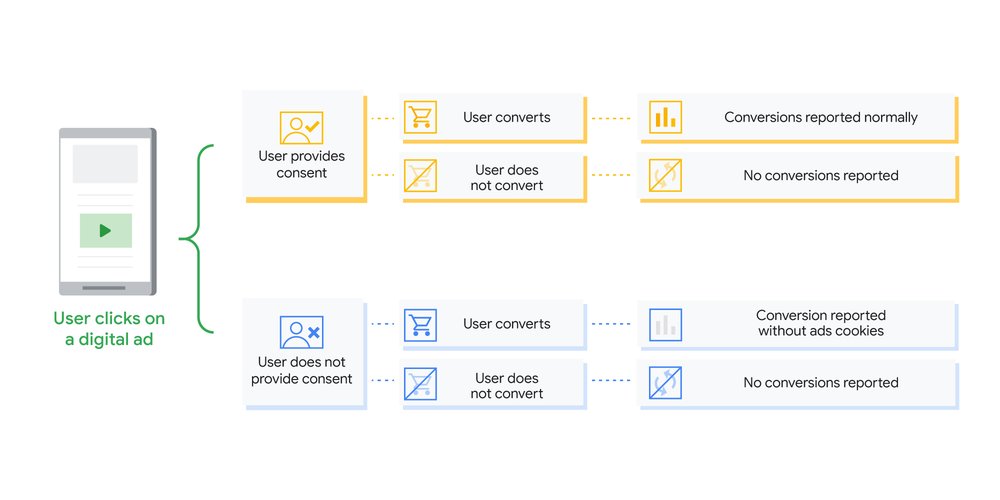
Last year, Google launched Consent Mode, which helps advertisers manage cookie behavior based on local data-protection laws and user preferences. For advertisers in the EU and in the U.K., Consent Mode allows them to adjust their Google tags based on a user’s choices and soon, Google will launch a direct integration with Tag Manager to make it easier to modify and customize these tags.

How Consent Mode works today.

What’s maybe more important, though, is that Consent Mode will now use conversion modeling for users who don’t consent to cookies. Google says this can recover about 70% of ad-click-to-conversion journeys that would otherwise be lost to advertisers.

In addition, Google is also making it easier for bring in first-party data (in a privacy-forward way) to Google Analytics to improve measurements and its models.

“Revamping a popular product with a long history is something people are going to have opinions about – we know that. But we felt strongly that we needed Google Analytics to be relevant to changing consumer behavior and ready for a cookie-less world – so that’s what we’re building,” Srinivasan said. “The machine learning that Google has invested in for years — that experience is what we’re putting in action to drive the modeling underlying this tech. We take having credible insights and reporting in the market seriously. We know that doing the work on measurement is critical to market trust. We don’t take the progress we’ve made for granted and we’re looking to continue iterating to ensure scale, but above all we’re prioritizing user trust.”


13 May 2021

These are the 25 companies presenting at Alchemist Accelerator’s 27th Demo Day today

Enterprise-focused Alchemist Accelerator is back with another one. Today marks its 27th Demo Day, with over two dozen companies expected to take the (virtual) stage.

Coming in at 25 companies, this is Alchemist’s largest cohort so far. Meanwhile, Alchemist Director Ravi Belani tells me that applications to the accelerator have grown by over 100%, and that their portfolio has raised a collective $1.4B to date.

In addition to debuting its Demo Day teams, Alchemist also shared some news: it has launched a new endeavor called “AlchemistX“, which will tap the tools/network of the accelerator to help corporations (beginning with Japan’s NEC) develop spinout companies from their in-house R&D. AlchemistX will be led by Rachel Chalmers, who was most recently a Director at Autodesk and a Venture Partner at Merian Ventures.

As with the last few Alchemist demo days, today’s event is entirely virtual; you can find a livestream of it here beginning at 10:30 AM Pacific.

Here are the companies that will debut today, in the order they’re expected to present:

  • Metabob: An AI tool meant to help you figure out where bugs could be in Python code. As a spinout of NEC, this is the first company to go through as part of the aforementioned AlchemistX program.
  • Laundris: A platform meant to help hotels better manage their linens, predict needs, and handle procurement.
  • Utrust: Helps businesses more easily accept and manage cryptocurrency payments
  • EVE: A dashboard to help companies take their vehicle fleets electric, outlining charging status and costs.
  • Measurecare: Building a dataset of radiology imaging meant for use with AI/Machine Learning. They’ve built a ReCaptcha-style system wherein their partner radiologists help to authenticate and label radiology images through “peer review” to further improve the data.
  • Eunimart Crossborder: Automated tools to help small-to-medium sized businesses expand into new regions, determine the right pricing, and identify popular competing products in a region.
  • Growfitter: An “incentivized wellness” platform for India. Growfitter works with local fitness centers to encourage users to become members, then gives them rewards/cashback incentives for physical activity.
  • Bitreel: Builds customizable 3D showrooms to showcase products, effectively aiming to turn that IKEA trip into a more video game-like experience. The company says its 3D viewer works in any modern browser.
  • Ahura AI: Ahura says it “recreates the one-to-one tutoring experience with machine learning”; more specifically, it aims to adapt employee training programs for each employee’s learning style in real time.
  • Ant Media: A low latency (~0.5 seconds) streaming platform meant to be easily deployed on AWS, Azure, etc.
  • In-Pipe Robot: As the name suggests, it’s a robot that goes in pipes. Focusing on industrial/utility/chemical companies, their robots are built to navigate complex pipe structures to more efficiently handle inspections, 3d mapping, etc.
  • Refactr: An automation platform meant to help a company’s cybersecurity and DevOps teams work together more easily.
  • Stargazr: AI-heavy tools meant to help finance teams with forecasting
  • Inanna Fertility: Applies machine learning algorithms to a patient’s data with the goal of improving the success rate in in vitro fertilization.
  • Chatalytic: Building AI to automatically gauge success in customer support conversations (voice/chat), and automatically identify “trending” support topics to potentially flag issues more quickly.
  • Bloom Behaviours: A platform meant to help teams work better together, and to help team leaders identify what team members see as each other’s strongest traits
  • Sif Homes: Combining the concept of Powerline adapters and mesh networking to build Wifi hotspots that communicate over your home’s existing electrical wiring.
  • Verdi: Platform and irrigation hardware to help farmers water/fertilize based on an individual plant’s needs, meant to reduce water waste and improve crop yield.
  • Geecko: Building “programming games” meant to be incorporated into the hiring process.
  • Delight: A platform meant to simplify the process of adding a referral program to your e-commerce shop.
  • VIPFicated: “Verification as a service”, aiming to handle product authentication for the increasing number of second-hand resale platforms.
  • Siro: A tool meant to help sales managers more actively and efficiently coach their sales reps by automatically identifying “coachable moments” in client conversations.
  • Stratodyne: Builds high-resolution aerial images from blimps; can help, for example, farmers identify issues that are more easily spotted from above.
  • Navvisa: A telehealth concierge, paid for as an employee benefit, meant specifically to help those diagnosed with cancer navigate the care process.
  • Neuronix AI: Aiming to reduced the cost and power consumption of computer vision-based AI.
13 May 2021

Busy day at VMware ended yesterday with Ragurham as CEO and COO Poonen exiting

They say for every door that opens another closes and the executive shuffle at VMware is certainly proving that old chestnut true. Four months after Pat Gelsinger stepped down as CEO to return to run Intel, the virtual machine pioneer announced yesterday that long-time exec Raghu Raghuram was taking over that role.

That set in motion another change when COO Sanjay Poonen, whom some had speculated might get the CEO job, announced yesterday afternoon on Twitter that he was leaving the company after 7 years.

Coincidence? We think not.

Holger Mueller, an analyst at Constellation Research says that he was surprised that Poonen didn’t get the job, but perhaps the VMware board valued Raghuram’s product focus more highly. “At 50, he [would have been] a long term solution, and he did a great job on the End User Computing (EUC) side of the product before becoming COO. I guess that it is still not VMware’s core business,” he said.

Regardless, Mueller still liked the choice of Raghuram as CEO, saying that he brought stability and reliability to the position, but he sees him likely as a solid interim solution for several years as the company spins out from Dell and becomes an fully independent organization again.

“Obviously the board wanted to have someone who knows product, and has been there a long time, and is associated with the VMware core success — so that creates relatability [and stability].” He added, “At 57 he is the transitional candidate, and a good choice, a veteran who is happy to run this 2-3 or maybe 5 years and won’t go anywhere [in the interim]. And the board has time to find a long-term solution,” Mueller told me.

Mark Lockwood, lead analyst on VMware at Gartner sees Raghuram as the right man for the job with no reservations, one who will continue to implement the current strategy while putting his own stamp on the position.

“That the VMware board chose someone in Raghu Raghuram who has been the technical strategy executive inside the company for years speaks volumes about the board’s comfort level with the existing strategy trajectory of the company. Mr. Raghuram will most certainly steer the company slightly differently than Mr. Gelsinger did, but at least from the outside, the CEO appointment appears to be a stamp of approval on the company’s broad portfolio,” Lockwood said.

As for Poonen, he says that the writing was on the wall when he didn’t get the promotion. “Although Sanjay Poonen has indeed been a valuable executive for VMware, it was always unlikely that he would remain if not chosen for the CEO role,” Lockwood said.

Stephen Elliot, an analyst at IDC, was also bullish on the Raghuram appointment, saying he brings a broad understanding of the company, and that’s important to VMware right now. “He understands VMware customers, the technologies, M&A, and the importance of execution and its impact on profitable growth. He has been central to almost every successful strategy the company has created, and been a leader for product strategy and execution. He has a very good balance of making tactical and strategic moves to anticipate the value VMware can deliver for customers in a 1-3 year horizon,” Elliot said.

Elliot thinks Poonen will be just fine and will find a landing spot pretty quickly. “He is another very talented executive; he will become a CEO elsewhere, and another company will be very lucky,” he said. He says that it will take time to see if there is any impact from that, but he believes that VMware shouldn’t have trouble attracting other executive talent to fill in any gaps.

For every every executive move, there are choices for replacements, and subsequent fall-out from those choices. We saw a full-fledged example of that yesterday on display at VMware. If these industry experts are right, the company chose stability and reliability and a deep understanding of product. That would seem to be solid enough reasoning on the part of the board, even though Poonen leaving seems to be collateral damage from the decision, and a big loss for the company.