Author: azeeadmin

13 May 2021

Google Cloud Run gets committed use discounts and new security features

Cloud Run, Google Cloud’s serverless platform for containerized applications, is getting committed use discounts. Users who commit to spending a given amount on using Cloud Run for a year will get a 17% discount on the money they commit. The company offers a similar pre-commitment discount scheme for VM-based Compute Engine instances, as well as automatic ‘sustained use‘ discounts for machines that run for more than 25% of a month.

In addition, Google Cloud is also introducing a number of new security features for Cloud Run, including the ability to mount secrets from the Google Cloud Secret Manager and binary authorization to help define and enforce policies about how containers are deployed on the service. Cloud Run users can now also now use and manage their own encryption keys (by default, Cloud Run uses Google-managed keys) and a new Recommendation Hub inside of Cloud Run will now offer users recommendations for how to better protect their Cloud Run services.

Aparna Sinha, who recently became the director of product management for Google Cloud’s serverless platform, noted that these updates are part of Google Cloud’s push to build what she calls the “next generation of serverless.’

“We’re really excited to introduce our new vision for serverless, which I think is going to help redefine this space,” she told me. “In the past, serverless has meant a certain narrower type of compute, which is focused on functions or a very specific kind of applications, web services, etc. — and what we are talking about with redefining serverless is focusing on the power of serverless, which is the developer experience and the ease of use, but broadening it into a much more versatile platform, where many different types of applications can be run, and building in the Google way of doing DevOps and security and a lot of integrations so that you have access to everything that’s the best of cloud.”

She noted that Cloud Run saw “tremendous adoption” during the pandemic, something she attributes to the fact that businesses were looking to speed up time-to-value from their applications. IKEA, for example, which famously had a hard time moving from in-store to online sales, bet on Google Cloud’s serverless platform to bring down the refresh time of its online store and inventory management system from three hours to less than three minutes after switching to this model.

“That’s kind of the power of serverless, I think, especially looking forward, the ability to build real-time applications that have data about the context, about the inventory, about the customer and can therefore be much more reactive and responsive,” Sinha said. “This is an expectation that customers will have going forward and serverless is an excellent way to deliver that as well as be responsive to demand patterns, especially when they’re changing so much in today’s uncertain environment.”

Since the container model gives businesses a lot of flexibility in what they want to run in these containers — and how they want to develop these applications since Cloud Run is language-agnostic — Google is now seeing a lot of other enterprises move to this platform as well, both for deploying completely new applications but also to modernize some of their existing services.

For the companies that have predictable usage patterns, the committed use discounts should be an attractive option and it’s likely the more sophisticated organizations that are asking for the kinds of new security features that Google Cloud is introducing today.

“The next generation of serverless combines the best of serverless with containers to run a broad spectrum of apps, with no language, networking or regional restrictions,” Sinha writes in today’s announcement. “The next generation of serverless will help developers build the modern applications of tomorrow—applications that adapt easily to change, scale as needed, respond to the needs of their customers faster and more efficiently, all while giving developers the best developer experience.”

13 May 2021

Chef Robotics raises $7.7M to help automate kitchens

A year and a half’s worth of global pandemic has had a profound impact on virtually every sector of the workforce. When it comes to future automation food prep isn’t quite at the top of the list (that distinction likely goes to warehouse fulfillment, for the time being), but it’s certainly up there. And it’s easy to see why the events of 2020 and beyond have left many kitchens looking for alternative sources of labor.

San Francisco-based Chef Robotics today announced that it has raised a combined $7.7 million pre-seed and seed round, with the goal of helping automate certain aspects of food preparation. The list of investors is pretty long on this one (with seed and pre-seed rolled up into one), including Kleiner Perkins, Promus Ventures, Construct, Bloomberg Beta, BOLD Capital Partners, Red and Blue Ventures, Gaingels, Schox VC, Stewart Alsop and Tau Ventures, among others.

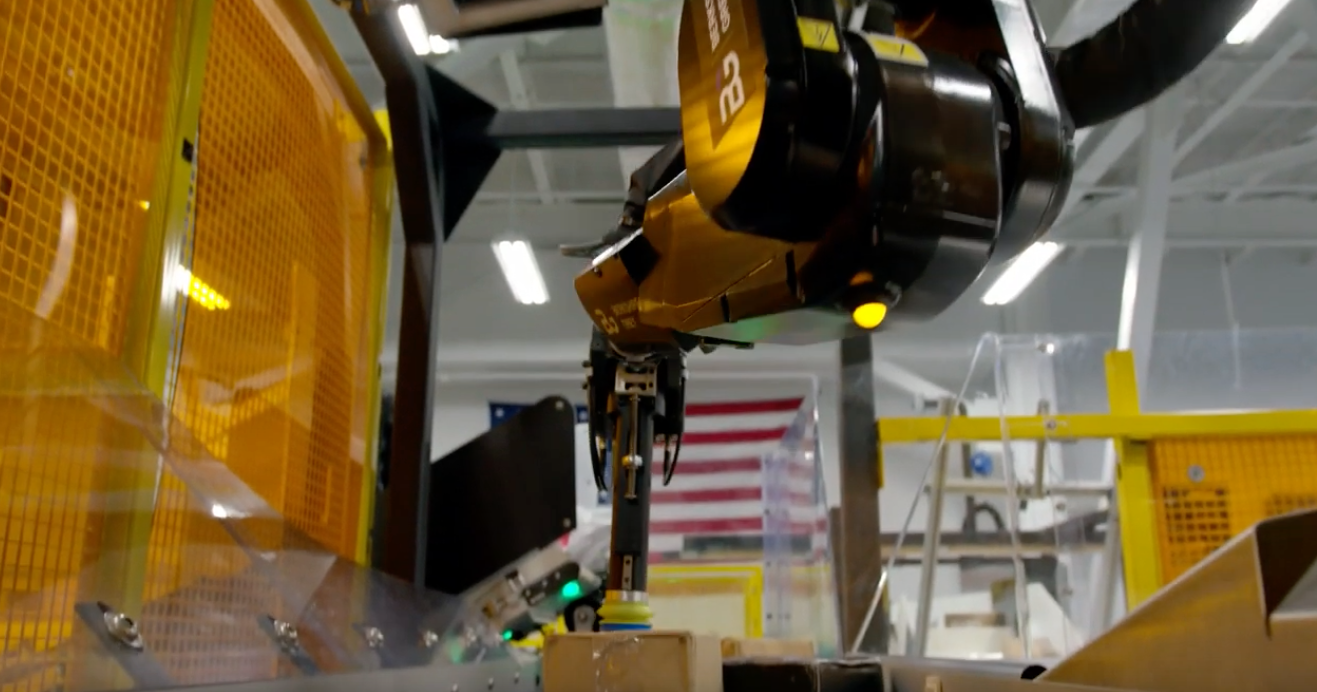
The product team includes ex-employees of Cruise, Google, Verb Surgical, Zoox, and Strateos. Chef’s team isn’t quite ready to show off its robot just yet (hence generic kitchen stock photo #8952 up top) – not entirely unusual for a robotics company still in the early stages. What it has outlined, thus far, is a robotics and vision system destined to increase production volume and enhance consistency, while removing some food waste from the process. Fast casual restaurants appear to be a key focus for this sort of tech.

The company describes it thusly,

Chef is designed to mimic the flexibility of humans, allowing customers to handle thousands of different kinds of food using minimal hardware changes. Chef does this using artificial intelligence that can learn how to handle more and more ingredients over time and that also improves. This allows customers to do things like change their menu often. Additionally, Chef’s modular architecture allows customers to quickly scale up just as they would by hiring more staff (but unlike humans, Chef always shows up on time and doesn’t need breaks).

More details on the underlying tech soon, no doubt.


13 May 2021

Legionfarm, pairing pro gamers with amateurs, raises $6 million Series A

Legionfarm, the gaming platform that lets gamers play with pro players in their favorite games, has today announced the close of a $6 million Series A round. Investors in the round include SVB, Y Combinator, Scrum VC, Kevin Lin, Altair Capital, Ankur Nagpal and more.

Legionfarm launched out of Y Combinator at the beginning of last year with a mission to give pro players a way to generate income and amateur players the chance to get better by playing with a pro coach. It started out with an a la carte business model but has since added a subscription product.

It either costs $12/hour to play on an individual session basis (one hour of play) or you can pay $25 or $50/month. That gives gamers access to discounted prices for pros and unlimited sessions with pros who are brand new to the platform, which Legionfarm calls ‘rookies’.

The company was founded by Alex Belyankin, who is a former pro gamer and was once in the top .01 percent of World of Warcraft players. There are many, many pro caliber players out in the world who can’t necessarily make a living off of gaming. They either have to be signed by an org (super limited supply) or play in as many tournaments as possible (unreliable) or stream on Twitch.

Legionfarm gives these pros the opportunity to earn a living playing the games they love.

Meanwhile, gamers are always looking to get better but don’t often have the environments in a game to do so, particularly in Battle Royale games. Legionfarm, which supports a couple of the biggest BRs (Call of Duty: Warzone and Apex Legends), allows these players to team up with pros and learn from them.

The startup is also running a hardware support program, which lets pros on the platform effectively rent gear by paying for it over time in installments that come directly out of their earnings each month.

“Recently, we’ve learned that one pro player can acquire seven or more new customers to the platform if we work with the pro properly,” said Belyankin. “That’s the biggest growth point for us and the biggest challenge. We don’t need to demand in the performance channels, but through existing supply. If we manage to build some sustainable processes here, I think we’re going to skyrocket because we see some huge potential here.”

13 May 2021

Short seller says Lemonade website bug exposed insurance customers’ account data

An activist short seller has written a letter to the chief executive of insurance giant Lemonade with details of an “accidentally discovered” security flaw that exposes customers’ account data.

Carson Block, founder of investment research firm Muddy Waters Research, sent the letter to Lemonade co-founder and chief executive Daniel Schreiber on Thursday, describing the bug that allowed anyone to inadvertently access personally identifiable data from customers’ accounts as “unforgivably negligent.”

Block’s letter said: “By clicking on search results from public search engines, we shockingly found ourselves logged in to and able to edit Lemonade customers’ accounts without having to provide any user credentials whatsoever.”

Lemonade launched in 2015 and offers renters’, homeowners’ and pet insurance policies across the U.S. and Europe. The company went public last year and saw its shares rocket by more than 130% on the day of its initial public offering. Lemonade this week reported a $49 million quarterly loss, deeper than what Wall Street was expecting.

The bug was co-discovered by Muddy Waters Research and Wolfpack Research, Block said. In a tweet, Wolfpack lead analyst Reed Sherman said one of Muddy Waters’ security experts “was able to send me a PDF of my renter’s insurance policy less than 15 minutes after this was first discovered.”

Block told TechCrunch that his firm is shorting the company’s stock, per his letter, “because it is clear Lemonade does not give a fuck about securing its customers’ sensitive personal information.” Block said in his letter that Lemonade should “shut down its website, APIs, and mobile application” until the issue is fixed, which he says may date back to July 2020.

Block published his letter to Lemonade with redactions as to not give away specific details of the bug. In a call, Block provided more details about the bug to TechCrunch in order to verify the vulnerability. One indexed search result let us log into a person’s Lemonade account and view their name, address, and quote details without ever asking for the user’s password.

A short time later, some of the indexed results stopped working. TechCrunch asked Lemonade for comment but did not hear back prior to publication. We’ll update when we do.

13 May 2021

Sylvera grabs seed backing from Index to help close the accountability gap around carbon offsetting

UK-based startup Sylvera is using satellite, radar and lidar data-fuelled machine learning to bolster transparency around carbon offsetting projects in a bid to boost accountability and credibility — applying independent ratings to carbon offsetting projects.

The ratings are based on proprietary data sets it’s developed in conjunction with scientists from research organisations including UCLA, the NASA Jet Propulsion Laboratory, and University College London.

It’s just grabbed $5.8M in seed funding led by VC firm Index Ventures. All its existing institutional investors also participated — namely: Seedcamp, Speedinvest and Revent. It also has backing from leading angels, including the existing and former CEOs of NYSE, Thomson Reuters, Citibank and IHS Markit. (It confirms it has committed not to receive any investment from traditional carbon-intensive companies when as ask.) And it’s just snagged a $2M research contract from Innovate UK.

The problem it’s targeting is that the carbon offsetting market suffers from a lack of transparency.

This fuels concerns that many offsetting projects aren’t living up to their claims of a net reduction in carbon emissions — and that ‘creative’ carbon accountancy is rather being used to generate a lot of hot air: In the form of positive sounding PR which sums to meaningless greenwashing and more pollution as polluters get to keep on pumping out climate changing emissions.

Nonetheless the carbon offset markets are poised for huge growth — of at least 15x by 2030 — as large corporates accelerate their net zero commitments. And Sylvera’s bet is that that will drive demand for reliable, independent data — to stand up the claimed impact.

How exactly is Sylvera benchmarking carbon offsets? Co-founder Sam Gill says its technology platform draws on multiple layers of satellite data to capture project performance data at scale and at a high frequency.

It applies machine learning to analyze and visualize the data, while also conducting what it bills as “deep analytical work to assess the underlying project quality”. Via that process it creates a standardised rating for a project, so that market participants are able to transact according to their preferences.

It makes its ratings and analysis data available to its customers via a web application and an API (for which it charges a subscription).

“We assess two critical areas of a project — its carbon performance, and its ‘quality’,” Gill tells TechCrunch. “We score a project against these criteria, and give them ratings — much like a Moody’s rating on a bond.”

Carbon performance is assessed by gathering “multi-layered data” from multiple sources to understand what is going on on the ground of these projects — such as via multiple satellite sources such as multispectral image, Radar, and Lidar data.

“We collate this data over time, ingest it into our proprietary machine learning algorithms, and analyse how the project has performed against its stated aims,” Gill explains.

Quality is assessed by considering the technical aspects of the project. This includes what Gill calls “additionality”; aka “does the project have a strong claim to delivering a better outcome than would have occurred but for the existence of the offset revenue?”.

There is a known problem with some carbon offsets claimed against forests where the landowner had no intention of logging, for example. So if there wasn’t going to be any deforestation the carbon credit is essentially bogus.

He also says it looks at factors like permanence (“how long will the project’s impacts last?”); co-benefits (“how well has the project incorporated the UN’s Sustainability Development Goals?); and risks (“how well is the project mitigating risks, in particular those from humans and those from natural causes?”).

Clearly it’s not an exact science — and Gill acknowledges risks, for example, are often interlinked.

“It is critical to assess these performance and quality in tandem,” he tells TechCrunch. “It’s not enough to simply say a project is achieving the carbon goals set out in its plan.

“If the additionality of a project is low (e.g. it was actually unlikely the project would have been deforested without the project) then the achievement of the carbon goals set out in the project does not generate the anticipated carbon goals, and the underlying offsets are therefore weaker than appreciated.”

Commenting on the seed funding in a statement, Carlos Gonzalez-Cadenas, partner at Index Ventures, said: “This is a phenomenally strong team with the vision to build the first carbon offset rating benchmark, providing comprehensive insights around the quality of offsets, enabling purchase decisions as well as post-purchase monitoring and reporting. Sylvera is  putting in place the building blocks that will be required to address climate change.”

13 May 2021

The fulfilling world of warehouse robotics

With the pandemic finish line in sight — at least for some — now is a good time to start assessing which segments have been most impacted by the events of the past year and a half. In terms of robotics, investments have been all over the place — and for good reasons. COVID-19 seems destined to have a profound and lasting impact on work, and more than ever, robots and automation are going to play a part in that.

Food has been a big target. Manufacturing and health, as well — all for pretty clear reasons. When we come out of this, however, we may end up seeing that the most immediate and profound impact was on warehouse and fulfillment. Not that it needed much help, but online retail had a huge moment — led, naturally, by Amazon.

As the company butted heads with workers and union organizers at one fulfillment center in Alabama, the company has been readying additional fulfillment centers. Shreveport, Louisiana is the latest, with Governor John Bel Edwards referring to the new warehouse as a “robotics fulfillment center.”

As with all of these, that means a combination of humans and robots. There are, of course, questions with regard to what the balance will be, going forward. And, of course, it’s no surprise that pro-union Amazon workers frequently cited being treated like a robot among their biggest workplace concerns.

Attempting to stay afloat in the world of Amazon is a big part of why so many warehouses are particularly interested in robotics at the moment. After all, the tech has not only given the retailer a competitive advantage, it’s helped keep them running amid a global pandemic.

Berkshire-Grey has been one of the bigger players in the category, thanks in no small part to some massive raises. To date, the Boston-area company has raised $263 million, before announcing a SPAC last year. Today, it announced that it’s using some of that money to further expand into markets including Canada and Japan.

Image Credits: Berkshire Grey

“2020 was a pivotal time for eCommerce companies, retailers, grocers and package handling logistics providers – and it continues into this year. The need to automate to meet consumer needs was already pronounced and the pandemic accelerated the changes and increased the need,” founder and CEO Tom Wagner said in a release. “Many of these changes in consumer behaviors are here to stay and that means, businesses need to adapt and improve operations with robotic automation to fulfill those needs. We’re honored to work with companies who have enlisted our AI-enabled robotic solutions to help meet business goals and consumer expectations.”

The already-hot China market continues to gain momentum, as well. Youibot this week announced a $15 million raise, led by Softbank Ventures. The Shenzhen company is a HAX grad that produces manufacturing robots.

Image Credits:

Here’s Rita on the company:

Founded by a group of PhDs from China’s prestigious Xi’an Jiaotong University, Youibot develops solutions for factory automation and logistics management, as well as inspection and maintenance for various industries. For example, its robots can navigate around a yard of buses, inspect every tire of the vehicles and provide a detailed report for maintenance, a feature that helped it rack up Michelin’s contract.

13 May 2021

Framework’s repairable laptop is up for preorder, starting at $999

Repairability has been a big sticking point for consumer electronics over the past several years. As devices have gotten thinner — and companies have pushed to maintain control over proprietary systems — many devices have become near impossible for an every-day person to repair.

It’s an issue for a number of reasons — not the least of which is an inability to upgrade a system instead of scrapping it altogether. In a world where human impact on the environment is increasingly top of mind, forced obsolescence is an understandably important issue for many.

Framework is one of an increasing number of companies working to address these issues. It’s a list that also includes products like Fairphone on the mobile side. It’s a niche versus the overall market, to be sure, but it’s one that could well be growing. Announced in January, the Framework Laptop is up for preorder today. The 13.5-inch notebook starts at $999 and will start shipping at the end of July.

The SF-based company had initially targeted spring shipping, but ongoing chip supply problems have delayed the product. The system actually doesn’t look half-bad for a product and company that are clearly repair/upgrade-first.

There are three basic configurations — Base, Performance and Professional, ranging from $999 to $1,999, upgrading from an Intel Core i5, 8GB of Ram and 256GB of storage to a Core i7 and 32GB/1TB. Windows also gets upgraded from Home to Pro at the top level. At $749, the company offers a barebones shell, where users can plug in their own internals.

Image Credits: Framework

Other upgrades include:

On top of that, the Framework Laptop is deeply customizable in unique ways. Our Expansion Card system lets you choose the ports you want and which side you want them on, selecting from four at a time of USB-C, USB-A, HDMI, DisplayPort, MicroSD, ultra-fast 250GB and 1TB storage, and more. Magnetic-attach bezels are color-customizable to match your style, and the keyboard language can be swapped too.


13 May 2021

SpecTrust raises millions to fight cybercrime with its no-code platform

Risk defense startup SpecTrust is emerging from stealth today with a $4.3 million seed raise and a public launch.

Cyber Mentor Fund led the round, which also included participation from Rally Ventures, SignalFire, Dreamit Ventures and Legion Capital.

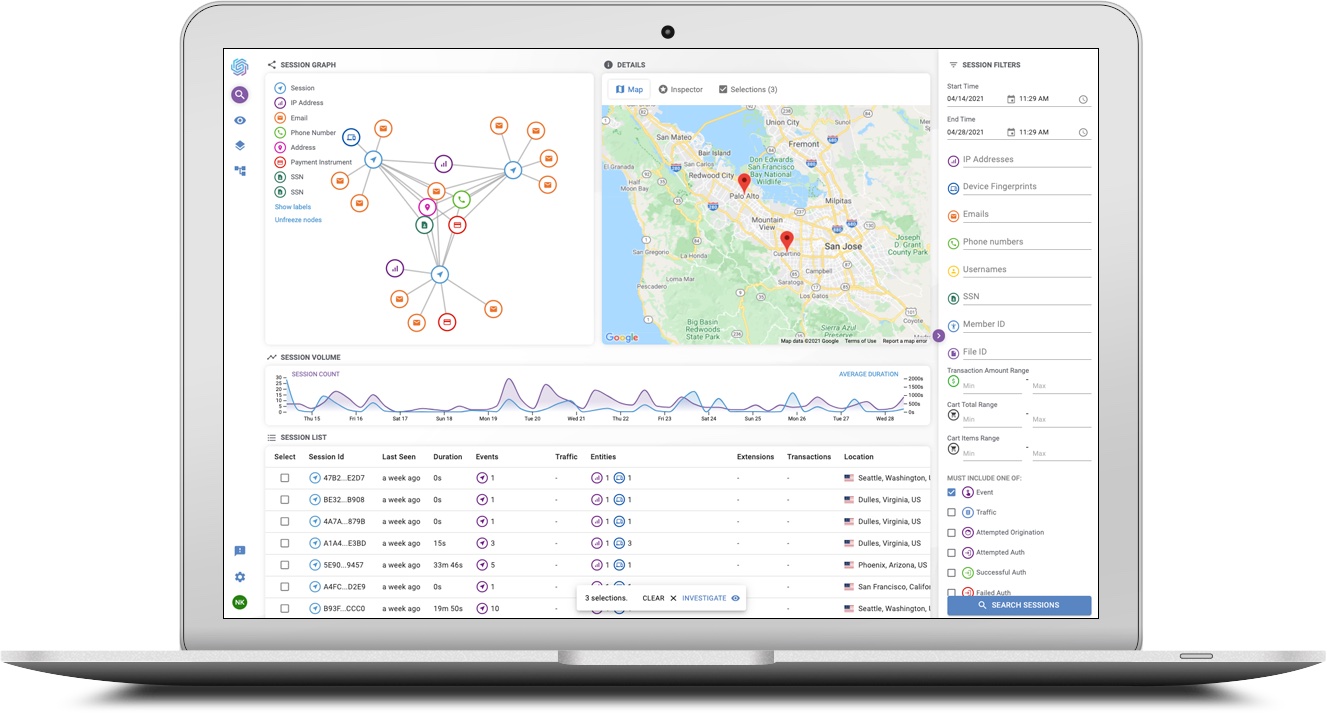
SpecTrust aims to “fix the economics of fighting fraud” with a no-code platform that it says cuts 90% of a business’ risk infrastructure spend that responds to threats in “minutes instead of months.” 

“In January of 2020, I got a bug in my ear to, instead of an API, build a cloud-based service that handles all this complex orchestration and unifies all this data,” said CEO Nate Kharrl, who co-founded the company with Bryce Verdier and Patrick Chen. “And, it worked. And it worked fast enough that you can’t even tell it’s there doing its work.”

For example, he says, SpecTrust even in its early days was able to pull identity behavior information in seconds.

“Today, it’s more like five and seven milliseconds,” he said. “And, engineers don’t have to lift anything or adjust data models.”

Since the San Jose, California-based startup’s offering is deployed on the internet, between a website or app and its users, an organization gets fraud protection without draining the resources of its engineers, the company says. Founded by a team that ran risk management divisions at eBay and ThreatMetrix, SpecTrust is banking on the fact that companies — especially financial institutions — will be drawn to the flexibility afforded by a no-code offering.

Much of the industry is split up between compliance and onboarding, authenticating risk and payments, and user trust and safety, Kharrl said.

“We put all the tools together to address all things combined, to make sure the person an institution is talking to is who they say they are, and not acting with malicious intent,” he told TechCrunch. “We sit in between them and their traffic to make sure the risk and fraud teams have what they need to spot bad guys.”

Image Credit: SpecTrust

Online businesses spend billions on risk defense yet still lose a lot of money to fraudsters, scammers and identity thieves, Kharrl said. And, the COVID-19 pandemic led to a global shift in the digital economy as more people came to rely on the internet to meet day-to-day needs. 

“With these new trends in commerce and banking came more opportunities for fraudsters, scammers and identity thieves to target people and businesses,” he added. For example, an alarming number of cybercriminals employed no-code attack tools and click-to-deploy infrastructure to launch sophisticated attacks.

Fintech and crypto companies are feeling the biggest impacts, as legacy software designed for big banks, for example, can be slow and expensive, said Kharrl. 

We built SpecTrust to instantly put complete assessment, automation and enforcement capabilities in the hands of teams charged with fighting modern cybercrime threats,” he said.

Using its platform, the company says an organization’s risk team can review and investigate everything a customer does “from its first page view to its last click with unified behavior, identity, history and risk data.” 

Even non-technical staffers can do things like identify attack behavior, verify customer identity information, validate payment details and work to mitigate threats before they become losses, according to Kharrl.

Jon Lim of SignalFire says that SpecTrust has built an end-to-end risk protection platform that enables customers of all sizes and risk profiles “to access the latest innovative risk protection solutions, quickly respond to the evolving threat landscape and share the best practices and learnings across the entire customer base.”

And of course, it was drawn to the startup’s no-code platform and ability to provide visibility over every user interaction versus treating each interaction as an independent event.

“This not only delivers stronger protection to customers but also a smoother experience to the end user,” Lim said.

The fraud prevention space is hot these days. Sift, which also aims to predict and prevent fraud, in April raised $50 million in a funding round that valued the company at over $1 billion.

13 May 2021

Discord announces Stage Discovery, a portal that connects events with communities

If you’re new to Discord, you might be thrown off by the lack of an endless feed peppered with ads. On Discord, all of the action happens in interest-specific servers, and the company wants to make it easier for anyone to stumble across and plunge into those communities.

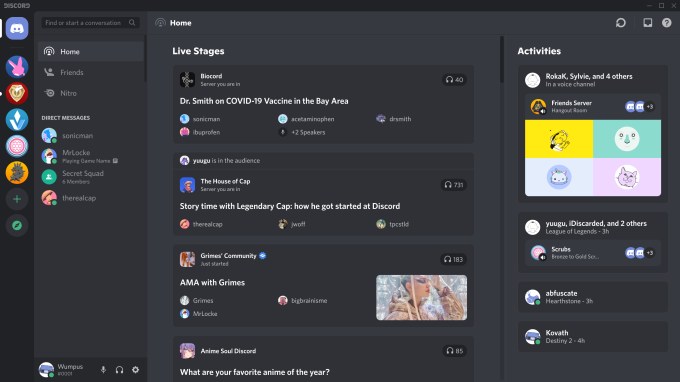
The company launched Stage Channels, its own Clubhouse-like voice event rooms, in late March. With those building blocks in place, in June Discord will start surfacing events (think open mic nights, book clubs, etc.) through a new portal called Stage Discovery, adding a way for anybody to connect with the cool communities in the process.

Discord Product Manager Rick Ling says Stage Channels are a hit so far, and the company realized that events can be a gateway to introduce new users to the communities at the heart of the platform.

“For us, just dropping in and out of these audio conversations is not the end goal,” Ling said during a press event. Soon, servers will be able to list public events, inviting anybody to come check things out. Discord also says that its new discovery feature will launch with some noteworthy partners, hinting that “one rhymes with…… rhymes.” (It’s Grimes.)

Stage Discovery is a little bit of a departure for Discord. Previously, to check out a live event, you needed to pop into a server first. Because the platform is so community based, people interested in a topic, say a particular Twitch streamer, often hop directly into those servers from elsewhere.

Discord does have some discovery and search functionality — users can thumb through popular and featured public servers in its Discover tab — but historically it’s been relatively basic. But by expanding the “discovery surface,” Discord is likely to attract a lot of people who either haven’t heard of the app or think it’s just a voice chat utility for gamers.

The new feature will show up in the home tab, offering a directory of live voice events. While that much is Clubhouse-esque, the feature’s real promise is that those events can bring new users into the fold, connecting them to thriving communities that have a lot more going on beyond events. Users will be able to see voice events their friends are hanging, events that servers they belong to are hosting and other live events that they aren’t connected to.

“At the end of the day, this is still really a window into communities and how to join communities,” Discord Product Marketing spokesperson Jesse Wofford told TechCrunch. Wofford emphasized that Discord isn’t trying to lure anybody into an endless scrolling loop — instead the goal is connecting users with the vibrant communities the platform is known for.

Discord has a few other new features around the corner too. Threaded conversations are on the way this summer and the company is about to begin a pilot program to test paid, ticketed audio events. The latter could be a huge boon for creators, who haven’t been able to make money through the platform previously, and an important extra revenue stream for a platform that has no plans to get into the targeted advertising game.

Discord is also celebrating its 6th birthday by sprucing up its brand a little, brightening its color scheme and making a few tweaks to its apparently beloved anthropomorphized little purple controller dude, Clyde. (Discord insists that Clyde is “blurple.”) The company says it wants to keep things playful while making its visual identity “more inclusive and welcoming” to the kind of people who haven’t been using the app for years.

While a big boost to discovery is on the near horizon, Discord’s product philosophy hasn’t changed. “There are no feeds, no likes, no way for anything to go viral,” Discord Founder and CEO Jason Citron said, adding that Discord was designed with community building in mind from day one.

Discord wasn’t always such a welcoming place. The app has always served gamers, but it was also a haven for white supremacists, like the ones who organized the Charlottesville rally that left Heather Heyer dead. In a not-so-distant past life, dangerous far-right extremism thrived on Discord, even as the company largely avoided the bad headlines that slammed more mainstream social platforms for facilitating hate.

Discord rooted out neo-Nazis and other dangerous communities starting in 2017, and by 2021 the company was well-positioned to tell a different story. Now, 15 percent of the company works on its Trust and Safety team, a group dedicated to moderation, user privacy and other concerns.

Discord says it has 150 million monthly active users and most of them are Gen Z 18-24 year olds. The product was built for gamers from the get-go, but Discord has been broadening its horizons recently and started having conversations with users about how it’s helped them fight isolation during the pandemic.

Unlike Instagram’s ad-choked social feed or Twitter’s often brain-melting endless feed, Discord is often a joy to use. And all of that user-friendliness doesn’t appear to be a bait and switch either. Revenue from its Nitro premium product and other paid perks are growing fast and the company has no plans for targeted ads.

Discord’s savvy pandemic-era campaign to broaden Discord’s appeal to non-gaming communities — musicians, study groups, surrealist fantasy baseball leagues — appears to be paying off. Discord’s user numbers are explosive and the company is adding sensible new features at a healthy clip. The outlook is good for the company and its users alike — and what a rare convergence that is.

13 May 2021

The hamburger model is a winning go-to-market strategy

In the old software world — think Oracle and SAP — sales were the competitive advantage. Today, we live in a world of product-led growth, where engineers (and the software they have built) are the biggest differentiator. If your customers love what you’re building, you’re headed in the right direction. If they don’t, you’re not.

However, even the most successful product-led growth companies will reach a tipping point, because no matter how good their product is, they’ll need to figure out how to expand their customer base and grow from a startup into a $1 billion+ revenue enterprise.

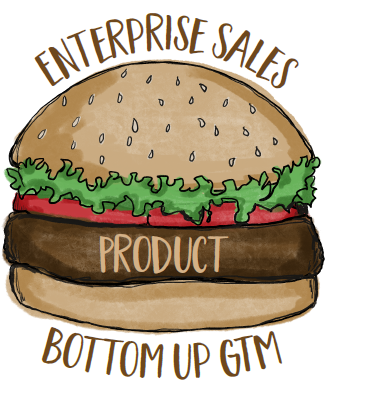
The answer is the hamburger model. Why call it that? Because the best go-to-market (GTM) strategies for startups are like hamburgers:

  • The bottom bun: Bottom-up GTM.
  • The burger: Your product.
  • The top bun: Enterprise sales.

In the hamburger GTM model, your product is the meat. We’ll go through each layer before talking about some of the best ways to implement the model successfully at your company.

The hamburger model

The meat — product at the center: The hamburger model starts with a great product. As a founder, this means you don’t need to think about revenue on Day One. You do, however, need to obsess over your customers, what they want and how to build it. Nothing is more important.

The bottom bun — users not leads: In a top-down sales model, marketing creates leads that are then converted into sales by enterprise reps. In a bottom-up model, marketing creates users, not leads, and those users are never touched by sales. For companies that have been customer-obsessed from the very beginning because they built something people love, this bottom-up model can feel far more natural and fuel a successful business.

The top bun — building enterprise sales: Even the best bottom-up sales models aren’t enough on their own, and every company eventually needs top-down sales. It may sound counterintuitive, but even the companies most famous for their bottom-up approaches now have enterprise sales teams. That’s because there are certain types of customers — for example, healthcare, insurance and government — that require salespeople to engage with due to compliance and security reasons.

The Hamburger go-to-market strategy

The hamburger go-to-market strategy. Image Credits: Coatue


These are the basic elements of the hamburger GTM model: A killer product that sets you apart, a bottom-up sales strategy to convert users into paying customers, and a sales team to go after bigger customers that require more attention.