Author: azeeadmin

13 May 2021

Walmart acquires virtual clothing try-on startup Zeekit

Retail giant Walmart announced this morning it’s acquiring the Tel Aviv-based startup Zeekit, which allows consumers to virtually “try on” clothing when shopping online. The company leverages a combination of real-time image processing, computer vision, deep learning and other A.I. technology to show shoppers how they would look in an item by way of a simulation that takes into account body dimensions, fit, size, and even the fabric of the garment itself.

Deal terms were not disclosed. According to data from Pitchbook, Zeekit had raised over $24 million in outside capital. (That may not be accurate. An article in May 2020 says it raised $15 million). The company had already been working with a range of retailers and brands at the time of its fundraise, including Walmart, as well Mary’s, Asos, Tommy Hilfiger, Adidas, and others.

Zeekit had been founded in 2013 by CEO Yael Vizel, VP of Research and Development Nir Appleboim and CTO Alon Kristal, with the premise that if online shoppers could see how clothing would look on their own bodies, the technology could reduce the rate of returns due to non-fitting, non-flattering items.

Image Credits:

Walmart says customers will be able to use the Zeekit technology to virtually try on items brands including Free People, Champion, Levi’s Strauss, ELOQUII Elements, Free Assembly, Scoop, Sofia Jeans by Sofia Vergara, plus its own private label brands, like Time and Tru, Terra & Sky, Wonder Nation and George.

When the technology goes live on Walmart.com, customers can choose to upload an image of their own or choose from a series of models that best represent their height, shape and skin tone in order to see themselves virtually in any item of clothing. The goal is to provide a similar experience to trying on clothing when shopping online as you would otherwise have had when in a retail store.

Shoppers will also be able to share their virtual outfits with friends for a second opinion, via the new integration, adding the social element back into online shopping.

In addition to the virtual try-on, Walmart says Zeekit’s technology may be used to build other fashion experiences over time, including a virtual closet experience where you could mix and match styles.

With the deal’s closure, Zeekit’s three co-founders will be joining Walmart.

“We’re confident that with the team’s expertise in bringing real-time image technologies, computer vision and artificial intelligence to the world of fashion, we’ll identify even more ways to innovate for our customers in our continued effort to be the first-choice destination for fashion,” said Denise Incandela, Walmart U.S. EVP of Apparel and Private Brands, in an announcement.

Walmart in years past had heavily invested in apparel, including by acquiring online brands like Bonobos, ModCloth, Eloquii, and others, and even tried offering some brands, like Nike, their own shop on Walmart. com. Not all of these efforts paid off. Walmart sold ModCloth only a couple of years after buying it, for example, after ModCloth customers balked at being owned by a retail giant, and the brand remained unprofitable.

In addition to the struggles around profitability, apparel more broadly been a harder area for online retail to get right, often because of the difficulties involved with picking out items that have to fit unique bodies and the non-standard sizing fashion designers use — meaning clothing can run smaller or larger, depending on given brand, even when shopping “your size.”

Another factor that may have impacted the acquisition was the pandemic, which pushed e-commerce years ahead, as retailers closed their doors and consumers stayed home to shop online due the circumstances of the health crisis.

Walmart didn’t say when Zeekit would go live on Walmart’s website, only that it would show up “soon.”

13 May 2021

BluBracket nabs $12M Series A to expand source code security platform

BluBracket, an early stage startup that focuses on keeping source code repositories secure, even in distributed environments, announced a $12 million Series A today.

Evolution Equity Partners led the round with help from existing investors Unusual Ventures, Point72 Ventures, SignalFire and Firebolt Ventures. When combined with the $6.5 million seed round we reported on last year, the company has raised $19.5 million so far.

As you might imagine, being able to secure code in distributed environments came in quite handy when much of the technology world moved to work from home last year. BluBracket co-founder and CEO Ajay Arora says that the pandemic forced many organizations to look carefully at how they secured their code base.

“So the anxiety organizations had about making sure their source code was secure and that it wasn’t leaking, from that standpoint that was a big tailwind for us. [With companies moving to a] completely remote development workforce, and with code being so important to their business as intellectual property, they needed to get that visibility into what vulnerabilities were there,” Arora explained.

Even prior to the pandemic, the company was finding they were gaining traction with developers and security pros by using a bottom up approach offering a free community version of the software. Having that free version as a top of the funnel for their sales motion was also helpful once COVID hit full force.

Today, Arora says the company has multiple thousands of developers, DevOps and SecOps users across dozens of organizations using the company’s suite of products. The big reference company right now is Priceline, but he says there are other big names that would prefer not to be public about it.

The company currently has 30 employees with plans to double that by the end of the year, and he says that building diversity and inclusion into the hiring process is part of the company’s core values, and part of how the executive team gets measured.

“We’re big believers in putting our money where our mouth is and one of the OKRs for me and my co-founder [CTO Prakash Linga], or one of the things that we’re actually compensated for is how well we are doing in building diversity and inclusion on the team,” he said. He adds that the recruiters that they are using are also being held to the same standard when it comes to providing a diverse set of candidates for open positions.

The company launched in 2018 and the founding team came from Vera, a startup that helped secure documents in motion. That company was sold to HelpSystems in December 2020 after Arora and Linga had left to start BluBracket.

13 May 2021

Don’t wait for legislation banning NDAs: Write ethical policies now

Companies across the United States should be closely following the California State Legislature hearings on the “Silenced No More Act,” which would prevent the use of nondisclosure agreements (NDAs) to silence employees from speaking up about all forms of discrimination and harassment.

The legislation was introduced in response to the stunning claims brought forward by former Pinterest employees alleging a pattern of racial and gender discrimination, harassment and retaliation. They courageously called attention to the hypocrisy of Pinterest’s aspirational comments on social issues even though the company had required them to sign NDAs.

As attorneys who work with shareholders to hold companies accountable for this misconduct, these allegations have deeply impacted our work. They formed the basis of an ongoing shareholder derivative lawsuit that a state pension fund we represent brought against Pinterest’s board of directors and top executives for participating in and otherwise protecting powerful executives who are alleged to have discriminated against Pinterest employees.

Failure to recognize this necessity will lead to future corporate scandals as multiple accounts of the same type of misconduct in the workplace come to light.

The Silenced No More Act would extend existing laws that limit the use of NDAs. Such laws are important because NDAs are intended to protect executives by keeping their harassment, discrimination and retaliation under wraps. That NDAs chill the voices of employees who have already been victimized makes them even more toxic. NDAs cause women to fear reprisal from the company, sometimes even incorporating financial penalty clauses, long after their individual claims have been resolved.

The Silenced No More Act should pass swiftly and be a model for other states, but this is what all companies throughout the country should be doing on their own, rather than waiting for legislation to drag an ethical NDA policy out of them.

Failure to recognize this necessity will lead to future corporate scandals as multiple accounts of the same type of misconduct in the workplace come to light. It will continue to uphold an unsustainable corporate system where executives in positions of power assume they will be protected no matter how unlawful their behavior toward others in the workplace.

We have seen from our investigations the compounding impacts of NDAs and how they allow problems to fester over years.

The two of us, working with others and on behalf of Alphabet shareholders, were part of the team that led a groundbreaking $310 million settlement with the tech company that led to historic diversity, equity and inclusion (DEI) reforms at the company. That settlement was the result of a shareholder derivative lawsuit where stockholders alleged that executives and board members violated their fiduciary duties by enabling a double standard that allowed executives to sexually harass and discriminate against women without consequence.

In that case, we believe Alphabet’s “culture of concealment” was driven in large part by the silencing effects of NDAs.

The duration of misconduct, enabled by NDAs, goes far beyond Alphabet and Pinterest. There is no shortage of #MeToo scandals at powerful companies, many with presences in California, that were exacerbated by muzzling NDAs. Weinstein Company, Wynn Resorts, NBC and 21st Century Fox are prominent examples of companies that first tried to keep allegations quiet through the use of NDAs and later faced a firestorm of allegations from former employees.

Fortunately, the landscape surrounding discrimination and harassment in the workplace is changing. Shareholders, workers, customers and other key business stakeholders are becoming more active in demanding that companies stop protecting harassers.

All of this should send a message to boards and C-suite executives that they must set the tone from the top and they are far better off being proactive than reactive. That means actively creating a company culture where DEI is a foundational component — not an afterthought. It also means intentionally prioritizing transparency and proactively doing away with policies that are antithetical to that goal, like NDAs that are intentionally designed to suppress the voices of employees.

The public and shareholders want to be associated with companies that do right by their employees. Business should recognize this change from a culture of compliance to one of equity and inclusion and embrace this new reality by stopping the practice of requiring complainants to enter into NDAs and fostering a culture of inclusion and accountability.

13 May 2021

Worksome pulls $13M into its high skill freelancer talent platform

More money for the now very buzzy business of reshaping how people work: Worksome is announcing it recently closed a $13 million Series A funding round for its “freelance talent platform” — after racking up 10x growth in revenue since January 2020, just before the COVID-19 pandemic sparked a remote working boom.

The 2017 founded startup, which has a couple of ex-Googlers in its leadership team, has built a platform to connect freelancers looking for professional roles with employers needing tools to find and manage freelancer talent.

It says it’s seeing traction with large enterprise customers that have traditionally used Managed Service Providers (MSPs) to manage and pay external workforces — and views employment agency giants like Randstad, Adecco and Manpower as ripe targets for disruption.

“Most multinational enterprises manage flexible workers using legacy MSPs,” says CEO and co-founder Morten Petersen (one of the Xooglers). “These largely analogue businesses manage complex compliance and processes around hiring and managing freelance workforces with handheld processes and outdated technology that is not built for managing fluid workforces. Worksome tackles this industry head on with a better, faster and simpler solution to manage large freelancer and contractor workforces.”

Worksome focuses on helping medium/large companies — who are working with at least 20+ freelancers at a time — fill vacancies within teams rather than helping companies outsource projects, per Petersen, who suggests the latter is the focus for the majority of freelancer platforms.

“Worksome helps [companies] onboard people who will provide necessary skills and will be integral to longer-term business operations. It makes matches between companies and skilled freelancers, which the businesses go on to trust, form relationships with and come back to time and time again,” he goes on.

“When companies hire dozens or hundreds of freelancers at one time, processes can get very complicated,” he adds, arguing that on compliance and payments Worksome “takes on a much greater responsibility than other freelancing platforms to make big hires easier”.

The startup also says it’s concerned with looking out for (and looking after) its freelancer talent pool — saying it wants to create “a world of meaningful work” on its platform, and ensure freelancers are paid fairly and competitively. (And also that they are paid faster than they otherwise might be, given it takes care of their payroll so they don’t have to chase payments from employers.)

The business started life in Copenhagen — and its Series A has a distinctly Nordic flavor, with investment coming from the Danish business angel and investor on the local version of the Dragons’ Den TV program Løvens Hule; the former Minister for Higher Education and Science, Tommy Ahlers; and family home manufacturer Lind & Risør.

It had raised just under $6M prior to thus round, per Crunchbase, and also counts some (unnamed) Google executives among its earlier investors.

Freelancer platforms (and marketplaces) aren’t new, of course. There are also an increasing number of players in this space — buoyed by a new flush of VC dollars chasing the ‘future of work’, whatever hybrid home-office flexible shape that might take. So Worksome is by no means alone in offering tech tools to streamline the interface between freelancers and businesses.

A few others that spring to mind include Lystable (now Kalo), Malt, Fiverr — or, for techie job matching specifically, the likes of HackerRank — plus, on the blue collar work side, Jobandtalent. There’s also a growing number of startups focusing on helping freelancer teams specifically (e.g. Collective), so there’s a trend towards increasing specialism.

Worksome says it differentiates vs other players (legacy and startups) by combining services like tax compliance, background and ID checks and handling payroll and other admin with an AI powered platform that matches talent to projects.

Although it’s not the only startup offering to do the back-office admin/payroll piece, either, nor the only one using AI to match skilled professionals to projects. But it claims it’s going further than rival ‘freelancer-as-a-service’ platforms — saying it wants to “address the entire value chain” (aka: “everything from the hiring of freelance talent to onboarding and payment”).

Worksome has 550 active clients (i.e. employers in the market for freelancer talent) at this stage; and has accepted 30,000 freelancers into its marketplace so far.

Its current talent pool can take on work across 12 categories, and collectively offers more than 39,000 unique skills, per Petersen.

The biggest categories of freelancer talent on the platform are in Software and IT; Design and Creative Work; Finance and Management Consulting; plus “a long tail of niche skills” within engineering and pharmaceuticals.

While its largest customers are found in the creative industries, tech and IT, pharma and consumer goods. And its biggest markets are the U.K. and U.S.

“We are currently trailing at +20,000 yearly placements,” says Petersen, adding: “The average yearly spend per client is $300,000.”

Worksome says the Series A funding will go on stoking growth by investing in marketing. It also plans to spend on product dev and on building out its team globally (it also has offices in London and New York).

Over the past 12 months the startup doubled the size of its team to 50 — and wants to do so again within 12 months so it can ramp up its enterprise client base in the U.S., U.K. and euro-zone.

“Yes, there are a lot of freelancer platforms out there but a lot of these don’t appreciate that hiring is only the tip of the iceberg when it comes to reducing the friction in working with freelancers,” argues Petersen. “Of the time that goes into hiring, managing and paying freelancers, 75% is currently spent on admin such as timesheet approvals, invoicing and compliance checks, leaving only a tiny fraction of time to actually finding talent.”

Worksome woos employers with a “one-click-hire” offer — touting its ability to find and hire freelancers “within seconds”.

If hiring a stranger in seconds sounds ill-advised, Worksome greases this external employment transaction by taking care of vetting the freelancers itself (including carrying out background checks; and using proprietary technology to asses freelancers’ skills and suitability for its marketplace).

“We have a two-step vetting process to ensure that we only allow the best freelance talent onto the Worksome platform,” Petersen tells TechCrunch. “For step one, an inhouse-built robot assesses our freelancer applicants. It analyses their skillset, social media profiles, profile completeness and hourly or daily rate, as well as their CV and work history, to decide whether each person is a good fit for Worksome.

“For step two, our team of talent specialists manually review and decline or approve the freelancers that pass through step one with a score of 85% or more. We have just approved our 30,000th freelancer and will be able to both scale and improve our vetting procedure as we grow.”

A majority of freelancer applicants fail Worksome’s proprietary vetting processes. This is clear because it says it has received 80,000 applicants so far — but only approved 30,000.

That raises interesting questions about how it’s making decisions on who is (and isn’t) an ‘appropriate fit’ for its talent marketplace.

It says its candidate assessing “robot” looks at “whether freelancers can demonstrate the skillset, matching work history, industry experience and profile depth” deemed necessary to meet its quality criteria — giving the example that it would not accept a freelancer who says they can lead complex IT infrastructure projects if they do not have evidence of relevant work, education and skills.

On the AI freelancer-to-project matching side, Worksome says its technology aims to match freelancers “who have the highest likelihood of completing a job with high satisfaction, based on their work-history, and performance and skills used on previous jobs”.

“This creates a feedback loop that… ensure that both clients and freelancers are matched with great people and great work,” is its circular suggestion when we ask about this.

But it also emphasizes that its AI is not making hiring decisions on its own — and is only ever supporting humans in making a choice. (An interesting caveat since existing EU data protection rules, under Article 22 of the GDPR, provide for a right for individuals to object to automated decision making if significant decisions are being taken without meaningful human interaction.) 

Using automation technologies (like AI) to make assessments that determine whether a person gains access to employment opportunities or doesn’t can certainly risk scaled discrimination. So the devil really is in the detail of how these algorithmic assessments are done.

That’s why such uses of technology are set to face close regulatory scrutiny in the European Union — under incoming rules on ‘high risk’ users of artificial intelligence — including the use of AI to match candidates to jobs.

The EU’s current legislative proposals in this area specifically categorize “employment, workers management and access to self-employment” as a high risk use of AI, meaning applications like Worksome are likely to face some of the highest levels of regulatory supervision in the future.

Nonetheless, Worksome is bullish when we ask about the risks associated with using AI as an intermediary for employment opportunities.

“We utilise fairly advanced matching algorithms to very effectively shortlist candidates for a role based solely on objective criteria, rinsed from human bias,” claims Petersen. “Our algorithms don’t take into account gender, ethnicity, name of educational institutions or other aspects that are usually connected to human bias.”

“AI has immense potential in solving major industry challenges such as recruitment bias, low worker mobility and low access to digital skills among small to medium sized businesses. We are firm believers that technology should be utilized to remove human bias’ from any hiring process,” he goes on, adding: “Our tech was built to this very purpose from the beginning, and the new proposed legislation has the potential to serve as a validator for the hard work we’ve put into this.

“The obvious potential downside would be if new legislation would limit innovation by making it harder for startups to experiment with new technologies. As always, legislation like this will impact the Davids more than the Goliaths, even though the intentions may have been the opposite.”

Zooming back out to consider the pandemic-fuelled remote working boom, Worksome confirms that most of the projects for which it supplied freelancers last year were conducted remotely.

“We are currently seeing a slow shift back towards a combination of remote and onsite work and expect this combination to stick amongst most of our clients,” Petersen goes on. “Whenever we are in uncertain economic times, we see a rise in the number of freelancers that companies are using. However, this trend is dwarfed by a much larger overall trend towards flexible work, which drives the real shift in the market. This shift has been accelerated by COVID-19 but has been underway for many years.

“While remote work has unlocked an enormous potential for accessing talent everywhere, 70% of the executives expect to use more temporary workers and contractors onsite than they did before COVID-19, according to a recent McKinsey study. This shows that businesses really value the flexibility in using an on-demand workforce of highly skilled specialists that can interact directly with their own teams.”

Asked whether it’s expecting growth in freelancing to sustain even after we (hopefully) move beyond the pandemic — including if there’s a return to physical offices — Petersen suggests the underlying trend is for businesses to need increased flexibility, regardless of the exact blend of full-time and freelancer staff. So platforms like Worksome are confidently poised to keep growing.

“When you ask business leaders, 90% believe that shifting their talent model to a blend of full-time and freelancers can give a future competitive advantage (Source: BCG),” he says. “We see two major trends driving this sentiment; access to talent, and building an agile and flexible organization. This has become all the more true during the pandemic — a high degree of flexibility is allowing organisations to better navigate both the initial phase of the pandemic as well the current pick up of business activity.

“With the amount of change that we’re currently seeing in the world, and with businesses are constantly re-inventing themselves, the access to highly skilled and flexible talent is absolutely essential — now, in the next 5 years, and beyond.”


13 May 2021

Google Cloud teams up with SpaceX’s Starlink for enterprise connectivity at network’s edge

SpaceX’s bourgeoning Starlink satellite-based broadband internet service just got a big boost from a significant new partner: Google Cloud. Thanks to a new partnership between the two, SpaceX will now be locating Starlink ground stations right within Google’s existing data centers, providing the Starlink network with direct access to ground-based network infrastructure to help facilitate network connections for customers who are on the edges of the footprint of existing network access.

Starlink’s entire aim is to provide reliable, broadband-quality connections to areas that have typically be hard or impossible to reach with legacy ground-based network infrastructure, including cellular networks. The tie-up with Google means that not only will business and public sector customers taking advantage of that new network reach have access to internet connections, but also to cloud-based infrastructure and applications, including AI and machine learning capabilities, analytics and more.

This should not only bolster Starlink’s reliability in terms of its consumer clients, but also provide key capabilities for serving enterprise customers — another key target demographic for the growing Starlink business, though much of the public focus thus far for Starlink’s roll-out has been on residential access across its expanding beta.

Google and Starlink expect to begin to become available to enterprise customers soon — sometime pin the “second half of 2021” according to a press release issued by the companies.

SpaceX has been very aggressive in building out the Starlink network in the past few months, launching 480 in just around there months. All that in-space infrastructure build out could well have been pre-amble to this collaboration and enterprise-focused service launch, in addition to helping SpaceX expand Starlink consumer service quality and availability.

13 May 2021

With its newest round, Liquid Death will exclusively ‘murder your thirst’ at Live Nation events

Liquid Death, a  four-year-old, L.A.-based canned mountain water startup that has steadily garnered market share and press coverage by promising, amusingly, to “murder your thirst,” just raised $15 million in Series C funding. The round brings the company’s total backing to date to $50 million.

The new financing — it follows a $23 million Series B round last fall — was seemingly about getting more strategic partners involved with the brand. Most meaningfully, Live Nation, the giant concert promoter, just became an equity investor and, as part of the deal, will only sell Liquid Death across its venues and festivals across the United States for a period of time.

That’s a big deal. Though Liquid Death has done pretty well on its own in terms of its distribution — it says its water is now carried in 16,000 locations throughout the U.S. including bars, tattoo parlors, cafes, local liquor stores and “big box” stores like Whole Foods, Walmart and 7-Eleven — Live Nation connects the brand with a massive and captive audience. Specifically, Live Nation says that in a typical (not COVID) year, it brings in 100 million fans to events across more than 120 Live Nation-owned-and-operated venues and festivals across the U.S. (Because Liquid Death comes in recyclable aluminum cans versus far-less recyclable plastic bottles, the tie-up is a good look for Live Nation, too.)

Liquid Death cofounder and CEO Mike Cessario, a former creative director and copywriter, declined yesterday to say how much Live Nation plans to charge for his products. But he did confirm that because the now 60-person company has “seen a ton of growth in retail and online in the past year,” it “didn’t need to raise a ton of cash right now.” In fact, he noted that as a “maturing” startup, Liquid Death now has “more access to favorable debt terms for working capital” should it go that route at some point.

Other investors in the new round include Tony Hawk, Wiz Khalifa, Steve Aoki, Hulu president Kelly Campbell and Dollar Shave Club founder Michael Dubin.

Cessario says the new funding won’t be used to expand internationally — not yet. Though Liquid Death is available in Canada and receives “tons of requests on social for international expansion,” the company is “focused on conquering the U.S. and Canada for the time being,” he tells us. As for branching out into new products, he says the team is “exploring some ideas like limited-release flavors for later this year.”

13 May 2021

Morressier wants academic conferences to feel cutting edge

While a unicorn named Hopin tends to dominate the virtual conferencing space, a new startup just raised millions of dollars by focusing on what it believes is an untapped niche in the same universe: academic conferences.

Morressier, a virtual conference and publishing platform specifically for the scientific community, announced today that it has raised $18 million in a Series A round led by Owl Ventures. Existing investors Cherry Ventures and Redalpine Venture Partners also participated in the round.

Founder Sami Benchekroun spent a lot of time at medical and scientific conferences while growing up thanks to his parents, who were both pursuing careers in medicine. Eventually, he began recognizing a pattern between all of the conferences.

“People from around the world would come together and literally bring physical content like printed out posters [or] a presentation on USB keys, to these conferences, but after the three days, all that content is lost,” he said. “All the people [who] are working on cancer research and HIV research are coming to these conferences completely offline, sharing the ideas, and then everything is lost.”

The irony of it was distracting so, in 2014, he began trying to digitize the early exchange of knowledge at a conference.

“Democratizing sounds cheesy but it’s really that,” he said. “People from Africa or Asia have no chance to really get access to these really high profile conferences that are mainly happening in the States or Europe, so by actually making everything digital, we can give back.”

The company began with a focus on content ephemerality, and nearly 7 years later, Morressier has built an end-to-end software layer that it hopes makes the academic conference experience as cutting edge as the research within it.

First, Morressier works with a society to create a landing page for an upcoming conference. Researchers can apply there to present their research at said conference. Morressier then aggregates all the research submissions and begins conducting a peer review process, with academics from the society validating the research and deciding if its relevant. The peer review process can often happen offline on excel sheets and word documents, so Morressier helps move the entire operations online. Once the peer review is done, the startup creates a content library to go along with a virtual or in-person conference where it can live indefinitely.

Finally, it gets to hosting the dissemination of that content to giving post-event analytics to event hosts to understand how research is being consumed.

“In order to make a compelling, end to end solution for every society out there, we added that live stream video component only in the beginning of 2020,” he said.

Morressier has over 700,000 accounts on its service, and has held conferences with the American Chemical Society, Institute of Packaging Professionals, and the Society of Photo-optical Instrumentation Engineers. The company makes money by working directly with the societies and charging them a flat fee for using the platform conference organization and managing their peer review process. It also has a per document-based fee structure so as more research is uploaded to its database, Morressier makes more money.

Image Credits: Morressier

While growth is the obvious next step for the freshly-funded company, Morressier hasn’t been exactly sluggish in the meantime. The company had 6x growth in number of authors and 13x growth in number of documents on its platform, bringing on $4.5 million in sales in 2020. The early-stage startup began 2020 with a 28-person staff, and plans to grow to 100 people by the end of 2021.

The founder, of course, accounts part of this growth to the pandemic, which took down some of the natural red tape that exists in education.

“I always try to play this down but quite frankly, in research and education, unfortunately things take longer [because of] government structures,” he said, of adoption speed. Indeed, the company took four years to raise its first check due to development. Now, three years after that, Morressier has closed another tranche of capital, thanks to a global understanding that virtual events are the future. Now, it’s just time for Morressier to prove its pandemic bump has paved a way for it to become a high-growth business.

13 May 2021

Roku will launch original programming fueled by Quibi’s content on May 20

Roku today announced the launch of its own original programming, which will initially become available to viewers in the U.S., U.K., and Canada through the media platform’s free streaming hub, The Roku Channel, starting on May 20th. The debut lineup will include 30 titles, including both the scripted and reality programming Roku had acquired from the short-form streaming service Quibi earlier this year, following its shutdown.

Quibi, of course, had launched at an inopportune time for a service that was designed for on-the-go viewing, when it arrived in the middle of a pandemic. But some have argued that much of Quibi’s content wasn’t compelling enough to pull in the number of subscribers to make the service a success. It will be interesting to see how well that same content now fares on Roku where it will no longer be “mobile-first,” but will more likely be streamed on a big-screen TV.

Among the better-known Quibi shows that will now be joining Roku are Chrissy Teigen’s “Chrissy’s Court,” Comedy Central’s “Reno 911!,” Kevin Hart’s “Die Hart” action series, Emmy-winning “FreeRayshawn,” documentaries “Blackballed” and “Big Rad Wolf,” and reality show reboot “Punk’d.”

These and others will become Roku’s first original programs, joining the over 40,000 other free movies and TV shows on The Roku Channel. This free streaming hub has been growing rapidly, in part due to the pandemic which forced people to stay at home, but also because of broader demand for free streaming content.

In the fourth quarter of 2020, The Roku Channel reached 63 million people in U.S. households, up more than 100% year-over-year. Streaming hours also doubled year-over-year — growth that’s twice as fast as the overall Roku platform itself, the company notes. In the first quarter of 2021, The Roku Channel grew to reach an estimated 70 million people.

The full list of Roku Originals includes available for the May 20th launch include: #FreeRayshawn,” “About Face,” “Bad Ideas with Adam Devine,” “Barkitechture,” “Big Rad Wolf,” “Blackballed,” “Centerpiece,” “Chrissy’s Court,” “Cup of Joe,” “Die Hart,” “Dishmantled,”Dummy,” “Fight Like a Girl,” “Flipped, “The Fugitive,” “Gayme Show, “Iron Sharpens Iron,” “Last Looks, “Let’s Roll with Tony Greenhand,” “Most Dangerous Game,” Murder House Flip,” “Murder Unboxed,” “Nightgowns,” “Prodigy,” “Punk’d,” “Reno 911!,” “Royalties,” “Shape of Pasta,” “Thanks a Million,” and “You Ain’t Got These.”

Roku will market the shows to viewers inside The Roku Channel, through an ad unit below the left-side navigation on the Roku home screen, and even through a coveted slot in the navigation menu itself.

In addition to the 30 new programs launching in May, more Roku Originals will roll out over the course of 2021. In total, Roku acquired more than 75 titles from Quibi, in a deal that reportedly valued the content at “significantly less” than $100 million. That means Roku users will eventually gain access to the Quibi shows that had been in the pipeline, but never got a chance to debut.

Quibi’s content made sense for Roku because it was designed for ad-supported viewing and not because of Quibi’s mobile gimmicks — like “turnstyle” which made both portrait and landscape orientations look great, or horror shows that only stream after dark, for instance.

“There’s always unique ‘stunt-y’ ways to bring shows to life, and we will explore those for shows that make sense,” noted Roku VP Sweta Patel, who leads the company’s Engagement and Growth Marketing. “But it’s going to have to make sense for how our viewers view — which is primarily on a [Roku] device,” she says.

In other words, Roku viewers won’t care about all the Quibi tricks, just the content itself. However, the shows will stream through The Roku Channel mobile app, for the subset of viewers who do watch on the go.

Roku will also leverage the existing ad breaks Quibi had built into its content, it says. That means after every 8 to 10-minute long “episode,” a one-minute ad will play. That’s still a lighter ad load than traditional TV, Patel notes. The same ad-selling structure that The Roku Channel uses today will also apply to Originals, including the potential for brand sponsorships.

While Roku believes the Originals can help to bring in a younger, 18-34 year-old demographic, it’s not necessarily signaling a plan to increase investments in exclusive, original programming like this. Instead, Roku will watch to see how the new content performs and then use those insights to add more content to The Roku Channel’s library over time.

“This really It was a unique opportunity for us to get some incredible content for our growing base. We are always sourcing content and — whether that’s producing it or acquiring it — it has to make sense for our AVOD business model,” says Patel. However, now that Roku has its own programming to offer, it will make sense for the company to roll out The Roku Channel to its global markets outside the U.S., U.K., and Canada.

The company wouldn’t comment on those plans.

Alongside the launch of Roku Originals, Roku also announced a partnership with Laugh Out Loud, the comedy brand founded by Kevin Hart. It will now bring the linear channel LOL! Network to The Roku Channel, joining the now over 190 live, linear channels featured on the service.

13 May 2021

BRD’s Blockset unveils its white-label cryptocurrency wallet for banks and other enterprise clients

Blockset, the blockchain infrastructure platform for enterprises by BRD, announced early access to its Wallet-as-a-Service today. The white-label solution gives clients, like financial institutions, the ability to launch wallets that have the same features as BRD’s own mobile cryptocurrency wallet, which now has about 7 million users with over $20 billion assets under protection.

Blockset’s clients include some of the largest ATM networks and Japanese investment bank (and BRD investor) SBI Holdings, CoinFlip, Welthee, CoinSwitch, Coinsquare and Wyre. BRD’s other investors include Ripple and it has raised $56 million in funding so far.

One of Blockset’s selling points is access to real-time data about several kinds of cryptocurrencies. This not only allows users to see how their assets are performing, but also enables institutions to perform compliance tasks, fraud detection, anti-money laundering and other important services. Blockset also claims that its multi-chain API has up to 99.999% uptime.

The platform currently supports Bitcoin, Ethereum, Ripple, Tezos, Hedera, Bitcoin Cash and Bitcoin SV, and will add more chains based on customer demand.

Blockset already offered a white-label solution called WalletKit, before launching its current Wallet-as-a-Service with more features. BRD co-founder and CEO Adam Traidman compares its Wallet-as-a-Service to Google Maps, because both aggregate large amounts of constantly-changing data and can connect to other apps, while remaining user-friendly.

“The concept is really a result of learnings from working with our customers, tier one financial institutions, who need a couple things,” Traidman told TechCrunch. “Generally they want to custody crypto on behalf of their customers. For example, if you’re running an ETF, like a Bitcoin ETF, or if you’re offering customers buying and selling, you need a way to store the crypto, and you need a way to access the blockchain.”

“The Wallet-as-a-Service is the nomenclature we use to talk about the challenge that customers are facing, whereby blockchain is really complex,” he added. “There are three V’s that I talk about: variety, a lot of velocity because there’s a lot of transactions per second, and volume because there’s a lot of total aggregate data.”

Blockset also enables clients to add features like trading crypto or fiat or lending Bitcoin or Stablecoins to take advantage of high interest rates. Enterprises can develop and integrate their own solutions or work with Blockset’s partners.

Other companies that offer enterprise blockchain infrastructure include Bison Trails, which was recently acquired by Coinbase, and Galaxy Digital.

Blockset differentiates by focusing on real-time data. It looks at a smaller number of mainstream blockchains in order to ensure depth of information and speed.

“If you’re a financial institution, you can’t accept anything other than instant, accurate and highly-scalable kinds of data. Right down to the millisecond of latency is really important because it can give traders an advantage,” said Traidman.

In a press statement, Wyre chief executive officer Ioannis Giannaros said “Blockset is the clear industry leader in offering enterprise-grade SLAs [service-level agreements] that we require to guarantee high scalability, uptime and data integrity across multiple blockchains.”

13 May 2021

Amazon’s new Echo Buds are a nice upgrade

It’s hard to recall a consumer electronics category that matured quite as quickly as the fully wireless earbuds. Things went from a handful of plucky startups to virtually every hardware manufacturer over the course of a year or two. When Amazon entered the category, it did so in an already arguably overcrowded field.

The first question you have to answer when you’re late to the party is what you’re bringing to the table. Ultimately, the original Echo Buds didn’t have a particularly compelling answer to the question in a world where you can pick up a pair of Ankers for $40. There were a smattering of other issues, as well, that ultimately ended in a pretty lukewarm write-up from me.

A little over a year later, the Buds are back. And to its credit, Amazon has both addressed some of the concerns with the original and offered a pretty solid upgrade over the original models. What’s more, the company added some features that other companies have saved for Pro models, while keeping the price at a reasonable $129.

I’ve been using the Echo Buds as my go-to headphones for several days now and can say, overall, I’ve enjoyed the experience. The product inhabits a kind of middle ground — I would still recommend a number of other products in the “Price Is No Object” category, and the Buds are not cheap enough to qualify for the low end.

Image Credits: Brian Heater

The new Echo Buds occupy a similar price point as Samsung Galaxy Buds Plus — and in a number of ways compare favorably. Most notable is the inclusion of active noise canceling, which has thus far mostly been the domain of more premium models. Amazon’s latest don’t offer the best ANC — nor really the best of anything — but they do form a well-rounded offering for the price point.

As Amazon has experienced with Alexa, the company’s at a disadvantage when competing directly with the likes of Apple, Google and Samsung, which can build devices that tie directly into their handsets. Amazon’s attempts at creating its own handsets have thus far failed, so the company has been forced to find another way to differentiate itself.

That has largely meant Alexa — and frankly, at the end of the day, the Echo Buds are really another way for the company to serve up its smart assistant. Built-in Alexa is mostly a selling point if you’re already invested in that ecosystem. I tend to prefer Assistant — especially given all of the other Google software offerings it integrates with, but for many intents and purposes, the personal assistants are often interchangeable.

Image Credits: Brian Heater

The new Buds are a fair bit smaller than their predecessors — but they’re not small exactly. They’re still a bit on the bulky side, and while they stayed put when using them indoors, I found they came loose a few times on a five-mile walk I did over the weekend. In that case, you’ll probably want to opt for the silicone cover, which sports small wings to better keep them in place. Probably the best option as well, if you’re planning to exercise with them in.

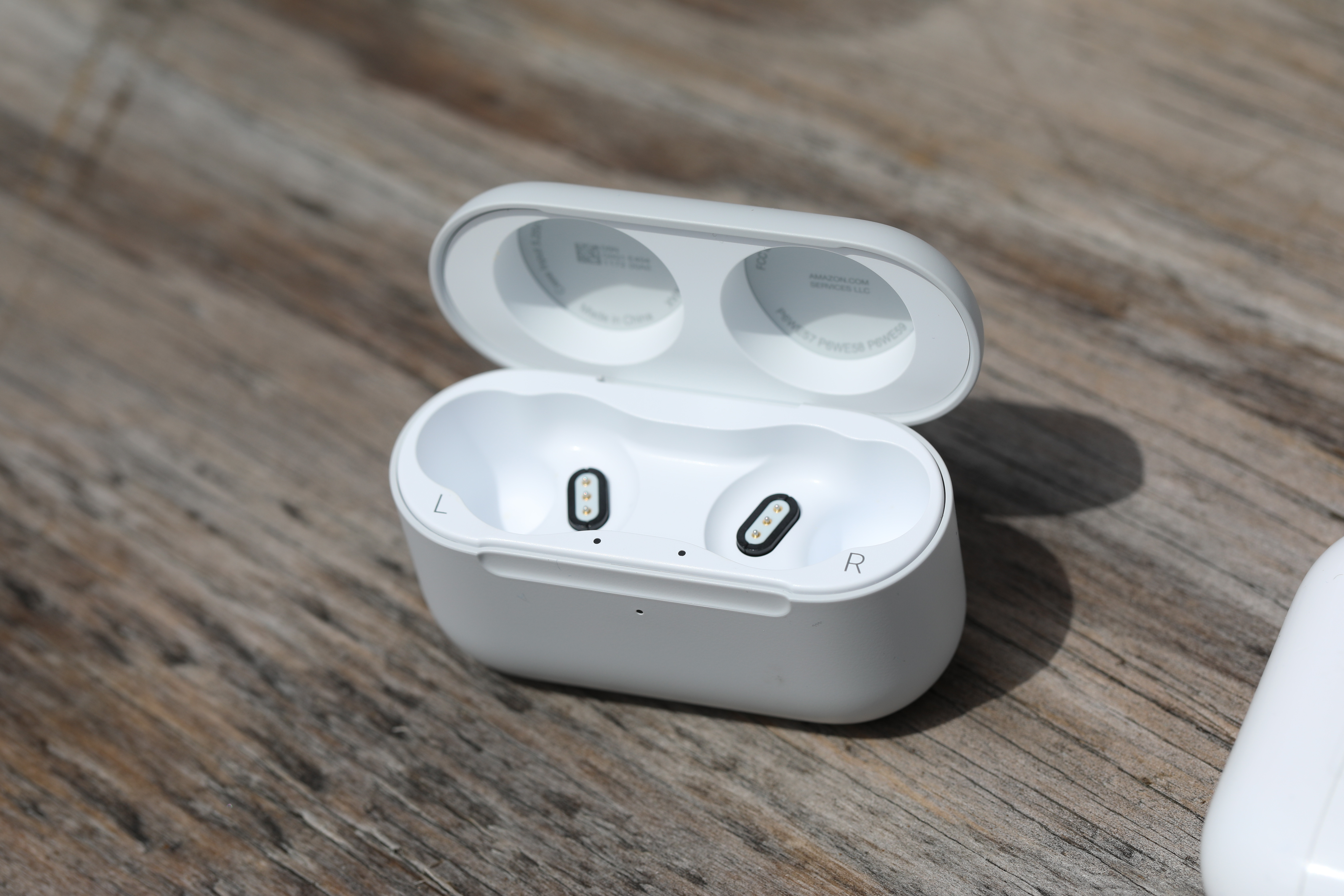
A weird design oversight here, however: I found the charging case doesn’t close all the way when the covers are on. The case doesn’t fully snap shut, and I learned the hard way last night that charging can be a bit tricky (in fact, I just got a “battery below 10%” warning in the right ear, while the left if currently in the high 90s. If you do end up using the wings, it’s best to pull them off after your workout — they’re also a bit on the snug side for too much extended use.

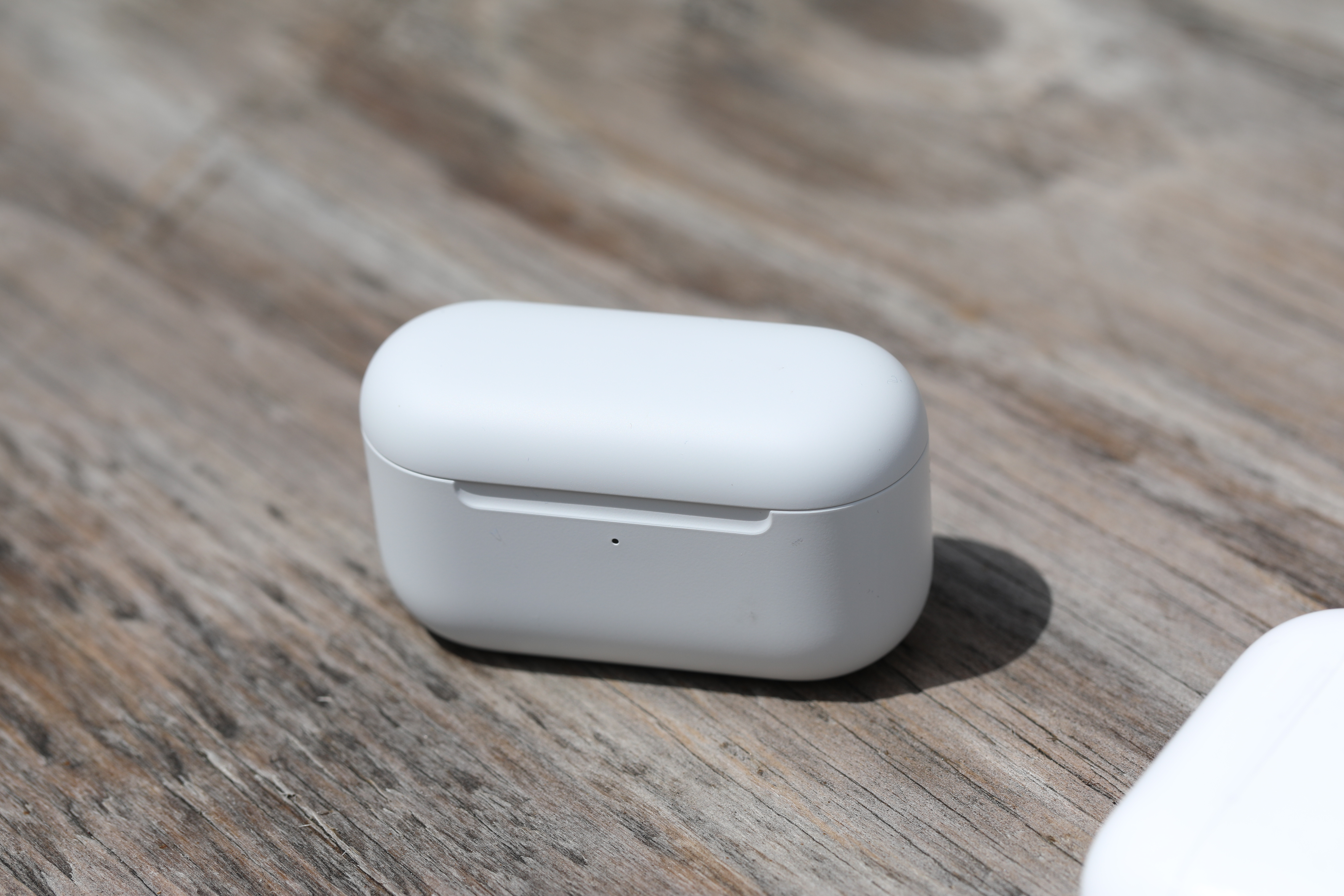
As Matt recently noted, the case is strongly…inspired by Apple. The differences are more pronounced when the two are next to one another, but the similarity is pretty undeniable:

Image Credits: Brian Heater

The case is longer and a little cheaper to the touch. Though the different shape does have the added bonus of being able to sit upright. For this reason, the charging port (USB-C) is on the rear of the case, rather than the bottom. There’s also a wireless charging case option, though that’s going to run you an added $20 — but probably worth it if you’ve got a Qi charger handy. There’s an Amazon arrow logo on the case (the company can’t help itself with the branding), but it’s subtle and located on the bottom. You’ll also find a light arrow on one of the earbuds.

The pair Amazon sent are “glacier white,” which is really more of a light gray. Again, it’s that much more pronounced when compared to the AirPods. Perhaps it’s a subtle way to further distinguish the design from Apple’s? Who knows.

Pairing is fairly easy. It’s not quite like using AirPods on an iPhone or Galaxy Buds on a Samsung, but it’s a couple of quick taps in the Alexa app. The company made the app the focal point of the Echo Buds for good reason. It serves as ground zero for everything you do on all of your Alexa-enabled devices. At a certain point, however, it may be time to consider breaking the app up a bit. It’s a bit of a double-edged sword — nobody needs more apps, but the thing is extremely noisy at this point.

Image Credits: Brian Heater

The upshot is that when the Buds are opened and paired, it surfaces the devices to the front. Tapping in lets you toggle between ANC and Pass Through modes (to my annoyance, I found that it would often default to the mode I wasn’t using when I put the Buds on for the first time in a while), turn the mic on and off and start Workout mode, which is opt-in. For people looking for more consistent workout tracking, an always-on wearable like a band or watch is a better choice.

The sound is a nice upgrade over the previous models. As with noise canceling, you can get better audio on more expensive systems, but for where this sits on the price spectrum, you’re getting solid sound for music, podcasting or calls. By default, it leans too heavily on bass for my preferences, but a few taps will take you to some equalizer sliders, where you can futz around with that.

The Bluetooth connection is pretty solid. I found I was able to walk around my apartment while leaving the iPhone in one place — a test failed by a number of the earbuds I’ve tested. I did, however, encounter some sync issues from time to time between the left and right bud when I was walking outside for long distances, creating an echoing effect. They can also send a sharp bit of feedback when held next to one another, owing to the fact that they don’t always instantly switch off when pulled out of the ear.

Image Credits: Brian Heater

The stated battery is up to five hours on the Buds (6.5 with ANC off), and 15 total hours with the case. Compare that to the listed 4.5 and five hours on the AirPods and AirPods Pro and 24 hours with case. I certainly found I was able to get through a full day of use by dipping into the case once or twice.

The new Echo Buds present on upgrade over their predecessors on just about every level, making for a solid pair of mid-price earbuds. They don’t really address the “why” that their predecessor failed to. For Amazon, it’s about getting Alexa on more products. For consumers, the answer isn’t quite so easy.