
Author: azeeadmin

13 May 2021

Upsie’s direct-to-consumer swing at the warranty space nets $18.2M

Upsie, a consumer warranty startup, has raised $18.2 million in a Series A round led by True Ventures. 

The financing brings the total raised for the St. Paul, Minnesota-based startup to $25 million since its 2015 inception.

A large group of investors participated in the round, including Concrete Rose VC, Avanta Ventures, Kapor Capital, Samsung Next, Massive, Backstage Capital, Awesome People Ventures, Draft Ventures, Matchstick Ventures, M25, Silicon Valley Bank and Uncommon VC, among others. A number of angels also put money in the round. 

Clarence Bethea (pictured below) founded Upsie after realizing the significant markup that retailers were placing on warranties.

His goal was to focus not on the retailer, but rather the end user and making the process more transparent, more affordable and simpler. For example, Upsie claims that it saves its customers anywhere from 50% to 90% compared to competitor warranty plans. Most other companies in the space, such as SquareTrade, offer warranties at the point of sale via retailers.
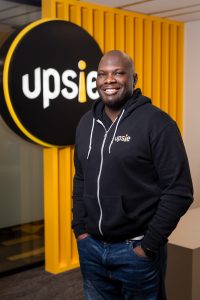
Image Credits: Upsie

“I’m sure you’ve walked into a Best Buy or a Target, and when you’re checking out somebody at the register is offering you a warranty. But what most customers don’t know is that you’re paying as much as 900% more for that warranty than you should,” Bethea said. “There’s no transparency at the register and you never get to ask what’s covered and what’s not covered, or what should you do if you need to make a claim.”

Just like many other companies, Upsie saw a bump in business last year thanks to the COVID-pandemic and resulting increase in consumer electronics sales (17%, according to the NPD Group Retail Tracking Service). In particular, there was a spike in demand for laptops, desktops and tablets for distance learning and remote work. As a result, Upsie’s revenue surged by 2.5x over the past 12 months, although Bethea declined to reveal hard revenue figures.

“With people working from home, devices were no longer a luxury but a necessity,” he told TechCrunch.

Rather than at the point of sale, Upsie gives consumers an opportunity to purchase a warranty for a product via its website or mobile app after the transaction has taken place. The company offers protection for thousands of devices — from smartphones to appliances to gaming consoles to lawn and garden tools — or about 60% of the warranty market, according to Bethea.

Consumers have up to 120 days to purchase smartphone protection, 11 months to purchase appliance, TV and fitness equipment protection and up to 60 days for other consumer electronics. All warranty information, including a copy of the product receipt, is stored and accessible on demand. Upsie says it also aims to offer same-day repairs on many devices.

The process, according to Bethea, is straightforward. Consumers need only upload an image of their receipt and provide purchase price and serial/IMEA numbers. When they need to file a claim, it’s a matter of pressing a button. And to make the process even easier, it will give consumers the ability to say, take their items directly to the Apple store for repair, and then get reimbursed afterwards by Upsie.

“We want more people to be able to protect what they buy with their hard-earned money,” Bethea said. “Removing the worry around paying out of pocket to repair, say, your kid’s laptop is huge for families who have had to go with remote learning when the system doesn’t make this easy for everyone.”

Upsie plans to use its new capital to increase customer awareness and continue building out its warranty product offerings and verticals, as well as to double its current headcount of 15.

“We want to continue to grow our presence online through digital channels such as Facebook and Google, for one thing,” Bethea told TechCrunch.

Puneet Agarwal, partner at True Ventures, says his firm doubled down on its investment in Upsie after witnessing its solid growth over the years. (True Ventures led the startup’s $5 million seed round in April of 2019.)

True Ventures was initially attracted to the sheer size of the warranty industry (estimated at $100 billion globally) and “how broken it was from the consumer experience perspective.” The firm also viewed Bethea as a “very special entrepreneur” who “exudes authenticity,” which must be refreshing to VCs who get inundated with pitches.

“We love to invest in old, staid industries where companies can disrupt from a business model and product perspective,” Agarwal said. “Upsie has done that in a big way.”

He went on to describe Bethea’s move to go direct to consumer in the warranty space as “bold.”

“Upsie is the only one doing that, and it’s the biggest swing to take in this type of industry,” Agarwal said. “We believe he’s cracked the code and that’s why we doubled down.”

Bethea’s background is not the same as a “typical” startup founder, which also was viewed as an advantage by True Ventures.

“He came from the streets of Atlanta, Georgia, and had to overcome so much in his life,” Agarwal told TechCrunch. “Clarence is the type of person that when we started True, we wanted to fund. We admire his perseverance and grit to come to this point.”

13 May 2021

Ford is bringing significant wireless software updates to its vehicles

The Internet of Things just got bigger. Four years after Ford Motor Company introduced an integration with Amazon’s suite of smart home devices, the automaker is beefing up its in-vehicle software offerings with built-in Alexa voice assistant and a wireless software update ecosystem.

Ford’s over-the-air software updates, which it has branded Power-Up, will have the capability of updating “virtually all” of the computer modules in new Ford vehicles, not just the ones that focus on infotainment, the company said in a statement Thursday. Ford estimates that Power-Up will be able to update more than 110 computer modules on higher-end models. The automaker aims to manufacture 33 million vehicles equipped with this service and Alexa by 2028.

Ford is clearly hoping shareholders and customers see the integration as a sign that the company can be a tech-forward automaker. One company executive in a media briefing Tuesday even referred to Ford as a “technology company.”

“We believe that data is the new oil, since it’s essential to our electric future and enables us to have an always-on relationship with our customer,” Alex Purdy, head of Ford’s business operations for enterprise connectivity, said.

That ‘data is the new oil’ line is nothing new. Former Intel CEO Brian Krzanich made that very declaration back in 2016. New or not, data is seen as an increasingly valuable resource to automakers.

Purdy said the new software may reduce the need for repair trips and free up dealers to focus on more profitable services, like hardware repairs and maintenance. Many of the software updates will require little to no action from the driver, and they can schedule those updates that require a system reboot.

Using the built-in Alexa assistant, drivers will be able to use voice control to start or stop their engine, lock or unlock doors, defrost their windows, make a call or play music. Customers who have Alexa smart home devices will be able to connect the two systems so that they can, for example, turn on the lights in their home from their driveways. Ford aims to build Alexa software into 700,000 vehicles across the U.S. and Canada this year, though the company did not discuss rollouts in other countries.

Gone are the days of the customer survey – the new software ecosystem will give Ford data on how vehicle owners use their cars. “We can double down on the features people love, get rid of the ones people don’t,” Purdy said. Ford is giving all drivers complimentary access to Alexa for three years, suggesting that the automaker will likely receive mountains of very valuable information on the behavior of its customers from its use.

Ford and Amazon will work together on new features and commercial services for the next six years. It will be delivered via a Power-Up software update this fall beginning with F-150, Mach-E, Bronco, Edge, and Super Duty customers. The company will “work its way through” the remaining models until it’s available in Ford’s entire fleet of new vehicles, though Purdy acknowledged it will take many years to reach that goal.

The Power-Up system will also deliver BlueCruise, Ford’s Level 2 hands-free highway driving technology, though customers must purchase this upgrade. Drivers will be able to activate the technology on prequalified sections of divided highway. In the future Ford said it hopes to add more highway sections, lane change assist, and predictive speed assist that will adjust speed for road curves and other driving situations, similar to Tesla’s Autopilot.

Ford in February also announced a separate six year partnership with Google to bring Android apps and services to drivers.

13 May 2021

Xbox teams up with Tencent’s Honor of Kings maker TiMi Studios

TiMi Studios, one of the world’s most lucrative game makers and is part of Tencent’s gargantuan digital entertainment empire, said Thursday that it has struck a strategic partnership with Xbox.

The succinct announcement did not mention whether the tie-up is for content development or Xbox’s console distribution in China but said more details will be unveiled for the “deep partnership” by the end of this year.

Established in 2008 within Tencent, TiMi is behind popular mobile titles such as Honor of Kings and Call of Duty Mobile. In 2020, Honor of Kings alone generated close to $2.5 billion in player spending, according to market research company SensorTower. In all, TiMi pocketed $10 billion in revenue last year, according to a report from Reuters citing people with knowledge.

The partnership could help TiMi build a name globally by converting its mobile titles into console plays for Microsoft’s Xbox. TiMi has been trying to strengthen its own brand and distinguish itself from other Tencent gaming clusters, such as its internal rival LightSpeed & Quantum Studio, which is known for PUBG Mobile.

TiMi operates a branch in Los Angeles and said in January 2020 that it planned to “triple” its headcount in North America, adding that building high-budget, high-quality AAA mobile games was core to its global strategy. There are clues in a recruitment notice posted recently by a TiMi employee: The unit is hiring developers for an upcoming AAA title that is benchmarked against the Oasis, a massively multiplayer online game that evolves into a virtual society in the fiction and film Ready Player One. Oasis is played via a virtual reality headset.

Xbox’s latest Series X and Series S are to debut in China imminently, though the launch doesn’t appear to be linked to the Tencent deal. Sony’s Playstation 5 just hit the shelves in China in late April. Nintendo Switch distributes in China through a partnership with Tencent sealed in 2019.

Chinese console players often resort to grey markets for foreign editions because the list of Chinese titles approved by local authorities is tiny compared to what’s available outside the country. But these grey markets, both online and offline, are susceptible to ongoing clampdown. Most recently in March, product listings by multiple top sellers of imported console games vanished from Alibaba’s Taobao marketplace.

13 May 2021

SpaceX’s inaugural Moon tour private astronaut is heading to the International Space Station first

SpaceX private spaceflight ambitions got a big boost in 2018 when Japanese entrepreneur and billionaire Yusaku Maezawa announced he’d be taking a trip aboard a SpaceX Crew Dragon on a round-trip flight passing the Moon. Maezawa is still on track to make that trip by 2023 according to current schedules, but he’s so eager to get to space that he just announced he’ll make a visit to the International Space Station as a private astronaut this December.

Maezawa will go as a client of Space Adventures, on a Russian Soyuz rocket set to take off from Kazakhstan on December 8, and he’ll be accompanied by his production assistant Yozo Hirano. Space Adventures is the same company behind prior Soyuz commercial spaceflight missions, including the trip made by Anousheh Ansari in 2006 and Guy Laliberté in 2009, among others. Laliberté’s trip was the most recent, with space tourism at the station officially on hold since the end of the Space Shuttle program in 2011 since Soyuz has been the only means to access the ISS. Now that SpaceX is flying regular astronaut shuttle missions, however, tourist trips are back on.

The trip that Maezawa plans to take will take place over the course of 12 days, and he’ll be doing three months of training prior to the mission in Russia to get ready for the experience. In addition to being the first private astronaut visit to the ISS in over 10 years, this is also the first time that two private astronauts will fly on board the same Soyuz at the same time. Maezawa and Hirano will also be the first Japanese citizens to make the journey as private individuals.

It may seem like overkill to get to visit space twice in a lifetime as a private astronaut, but Maezawa says he’s driven by a curiosity of “what’s life like in space?” which will of course be useful information to have on the planned Moon mission, which will spend three days getting there, make a loop around our natural satellite, and then spend three days coming back. He’s also planning to post the experience to YouTube, which is why Hirano is accompanying him to document.

13 May 2021

Google hit with $123M antitrust fine in Italy over Android Auto

Google has been fined just over €100 million (~$123M) by Italy’s antitrust watchdog for abuse of a dominant market position.

The case relates to Android Auto, a modified version of Google’s mobile OS intended for in-car use, and specifically to how Google restricted access to the platform to an electric car charging app, called JuicePass, made by energy company Enel X Italia.

Android Auto lets motorists directly access a selection of relevant apps (like maps and music streaming services) via a dash-mounted screen. But Enel X Italia’s JuicePass app was not one of the third party apps Google granted access to.

The app is accessible via the smartphone version of the Android platform — but of course a driver shouldn’t be reaching for their phone when at the wheel. So barring access through Android Auto puts a significant blocker on relevant usage.

Google’s market restriction of JuicePass has drawn the attention — and now the ire — of Italy’s competition watchdog.

The AGCM said today that Google has violated Article 102 of the Treaty on the Functioning of the European Union — and has ordered it to make the JuicePass available via the platform.

It also says Google must to provide the same interoperability with Android Auto to other third party app developers.

The authority points out that the Google Maps app, which offers some basic services for electric vehicle charging (such as finding and getting directions to charging points), is available via Android Auto — and could, in future, incorporate directly competitive features like payments.

“According to the Authority’s findings, Google did not allow Enel X Italia to develop a version of its JuicePass app compatible with Android Auto, a specific Android feature that allows apps to be used while the user is driving in compliance with safety, as well as distraction reduction, requirements,” the AGCM writes in a press release announcing the sanction [translated to English using Google Translate]. “JuicePass enables a wide range of services for recharging electric vehicles, ranging from finding a charging station to managing the charging session and reserving a place at the station; this latter function guarantees the actual availability of the infrastructure once the user reaches it.

“By refusing Enel X Italia interoperability with Android Auto, Google has unfairly limited the possibilities for end users to avail themselves of the Enel X Italia app when driving and recharging an electric vehicle. Google has consequently favored its own Google Maps app, which runs on Android Auto and enables functional services for electric vehicle charging, currently limited to finding and getting directions to reach charging points, but which in the future could include other functionalities such as reservation and payment.”

Google denies any wrongdoing and says it disagrees with the order. But it did not confirm whether or not it intends to appeal.

The tech giant claims the restrictions it places on apps’ access to Android Auto are necessary to ensure drivers are not distracted. It also told us that it has been opening up the platform to more apps over time — with “thousands” now compatible.

It added that its intention is to keep expanding availability.

Google did not comment on why Enel X Italia’s app for recharging electric vehicles was not among the “thousands” it has already granted access to, however.

Per the AGCM, Enel X Italia’s app has been excluded from Android Auto for more than two years.

Here’s Google’s statement:

“The number one priority for Android Auto is to ensure apps can be used safely while driving. That’s why we have strict guidelines on the types of apps which are currently supported and these are based on driver-distraction tests and regulatory and industry standards. Thousands of applications are already compatible with Android Auto, and our goal is to allow even more developers to make their apps available over time. For example, we have introduced templates for navigation, charging, and parking apps, open for any developer to use. We disagree with the Authority’s decision and we will review our options.”

Google has a dominant position in the market via the Android smartphone platform, with a marketshare in Italy of around three-quarters according to the competition watchdog.

Under European Union law, a finding of market dominance in one market puts a responsibility on a company not to restrict competition in any other markets where it operates — and the EU already found Google to be a dominant company in general Internet search in every market in the European Economic Area back in 2017.

The AGCM said it’s concerned about the impact of Google’s restrictions on app access to Android Auto on the growth of the electric mobility market.

“If it were to continue, [it] could permanently jeopardise Enel X Italia’s chances of building a solid user base at a time of significant growth in sales of electric vehicles,” it wrote, adding that Google’s action in excluding the JuicePass app meant it did not appear in the list of applications used by users — thereby reducing consumer choice and creating a barrier to innovation.

The authority suggests Google’s conduct could influence the development of electric mobility during a crucial phase — as recharging infrastructures for electric cars are being built out and can help fuel growth and demand for recharging services.

“Consequently, possible negative effects could occur to the diffusion of electric vehicles, to the use of ‘clean’ energy and to the transition towards a more environmentally sustainable mobility,” it warned, linking anti-competitive behavior to negative consequences for the environment.

The AGCM added that it will monitor Google’s compliance with its order to ensure it effectively and correctly implements the obligations to provide third party app developers with access to Android Auto.

The authority’s action could be a taster of what’s coming down the pipe for gatekeeper players like Google in Europe under the incoming Digital Markets Act (DMA).

The flagship legislative proposal is intended to supplement ex post competition law enforcement with ex ante rules on how dominant platforms which intermediate others’ market access can behave — including by imposing up front requirements that they support interoperability.

The idea with the DMA is to supplement the slow and painstaking work needed to bring competition investigations to fruition with proactive measures slapped on tech giants to prevent certain types of known market abuse in the first place.

In the meanwhile competition probes of big tech continue.

Italy’s AGCM opened one into Google’s ad display business last October, for example.

Google has already faced a number of EU antitrust decision in recent years — including a $5BN penalty over how it operates Android. Although search rivals continue to complain that the remedy Google devised for that 2018 decision still does not sum to fair competition.

13 May 2021

Vietnamese flexible pay startup Nano raises $3M seed round

Nano Technologies, a startup that lets workers in Vietnam access their earned wages immediately through an app called VUI, has raised $3 million in seed funding. The oversubscribed round was led by returning investors Golden Gate Ventures and Venturra Discovery, and included participation from FEBE Ventures, Openspace Ventures and Goodwater Capital.

Nano recently took part in Y Combinator’s accelerator program. Golden Gate Ventures and Venturra Discovery both participated in its pre-seed funding. The startup was founded at the beginning of 2020 by Dzung Dang, formerly a general manager at Uber and chief executive officer of ZaloPay, and Thang Nguyen, who previously served as chief technology officer at Focal Labs and SeeSpace.

VUI launched six months ago, and now serves more than 20,000 employees from companies like GS25, LanChi Mart and Annam Gourmet. Nano Technologies claims that about 50% to 60% of employees sign up for VUI as soon as their employers offer it, and use the service about three times every month to withdraw their earned wages.

Nano’s earned wage access features can be used by employers of all sizes, in all sectors, to offer flexible pay to their employees, but its focus is currently on retail, food and beverage, and manufacturing, especially for textiles, garments and shoes. The startup says companies in these sectors have seen recruitment costs increase, while worker retention drops. This is in part because many people are opting for gig economy jobs, like ride-sharing, where their earning are automatically deposited into their digital wallets or bank accounts.

Nano usually fronts wage advances, and then is paid back back by employers on their paydays through payroll deduction. Employers who have higher liquidity can also front wages through their own balance sheets. VUI is usually offered by employers as a benefit, and they can opt to cover fees, have their workers pay fees or use a co-pay model.

Nano is among a crop of companies across the world that offer earned wage access, meant to help companies retain workers by letting them withdraw earnings whenever they want, instead of waiting until payday. In Southeast Asia, this also includes GajiGesa in Indonesia. In the rest of the world, other companies that offer similar services include Square, London-based Wagestream and Gusto). Nano’s plan is to continue focusing on Vietnam, and develop new products for employers, including tools for managing staff and engagement.

In a press statement, Chi Phan, the CEO of LanChi Mart, a subsidiary of Central Retail with about 2,000 employees, said “On-demand salary via VUI is an obvious idea and practical HR initiative that LanChi team is pleased to roll out to our employees as a new voluntary benefit. VUI provides a much-needed financial lifeline from LanChi to our employees, keeping the employee morale up during the COVID-19 pandemic and reducing attrition rites post-Tet.”

13 May 2021

China’s WeRide secures more funding, pushing valuation to $3.3 billion

Only four months after securing Series B fundraising of $310 million, Chinese autonomous driving company WeRide says it has achieved its Series C funding round that brings its post-money valuation to $3 billion.

This is first time the company has disclosed its value. The company did not share how much it has raised this round, only noting that it’s in the “hundreds of millions,” according to a statement released by the company. WeRide intends to use this funding round to invest in R&D and commercialization as it works towards the next-generation of Level 4 driving, a term that means a vehicle can drive without human intervention in some environments and conditions. The company is also using the funds to prepare to commercialize its technology.

WeRide has scored a slew of large investments over the past year, including its $200 million strategic round in December from Chinese bus maker Yutong. The speed and scale of these investments signals that the company is burning through money and hungry for more, and that investors are banking on China’s tech. Rival Momenta has also received large sums this year, exceeding its $1 billion in valuation with recent investments of $500 million and total funding of more than $700 million.

“WeRide Master Platform (WMP), our core autonomous driving technology solution has helped to accelerate the company’s development,” Tony Han, founder and CEO of WeRide, said in a statement. “This drives the successful operation of our Robotaxi service in Guangzhou since 2019 and the introduction of the WeRide driverless Mini Robobus, a completely new product category to the autonomous industry.”

WeRide’s robotaxi pilot in Guangzhou began in 2019, but it began conducting test drives in the city’s Central Business District in January. Not long after, the company’s driverless Mini Robobus began road testing in Guangzhou and Nanjing. WeRide became the first autonomous driving company in China to secure an official license for online car-hailing operations in February, and in April, the California DMV issued WeRide a permit to test its driverless vehicles on public roads in San Jose, California.

Many investors participated in this most recent round, including IDG Capital, Homeric Capital, CoStone Capital, Cypress Star, Sky9 Capital and K3 Ventures, as well as existing investors CMC Capital Partners, Qiming Venture Partners and Alpview Capital.

12 May 2021

Elon Musk, Technoking of Tesla orders a halt to bitcoin car payments 

Tesla CEO and self-dubbed technoking is back peddling on the company’s stance about bitcoin and has suspended purchases of its electric vehicles with the cryptocurrency.

The change of stance, which was delivered via tweet, comes just weeks after Tesla CFO and dubbed “master of coin” Zach Kirkhorn said the company believes in the longevity of bitcoin, despite its volatility. The tweet from Musk sent the price of bitcoin down more than 4% and falling. The price of bitcoin is down more than 7% for the day, although some of that decrease occurred prior to Musk’s tweet.

Tesla has suspended vehicle purchases using Bitcoin. We are concerned about rapidly increasing use of fossil fuels for Bitcoin mining and transactions, especially coal, which has the worst emissions of any fuel.

Cryptocurrency is a good idea on many levels and we believe it has a promising future, but this cannot come at a great cost to the environment.

Tesla will not be selling any Bitcoin and we intend to use it for transactions as soon as mining transitions to more sustainable energy. We are also looking at other cryptocurrencies that use <1% of Bitcoin’s energy/transaction.

Tesla invested $1.5 billion in bitcoin this quarter and then trimmed its position by 10%, Kirkhorn said during the company’s quarterly earnings call in April. That sale made a $101 million “positive impact” to the company’s profitability in the first quarter.

Kirkhorn said Tesla turned to bitcoin as a place to store cash and still access it immediately, all while providing a better return on investment than more traditional central bank-backed safe havens. Of course, the higher yields provided by the volatile digital currency comes with higher risk.

If you’re getting whiplash from this announcement, you’re not alone. Tesla originally announced in March that it would accept bitcoin as a form of payment in the United States. But Elon Musk, the technoking of Tesla, is known for drastically affecting the crypto market with just a mere tweeting of his thumbs. Every time the man tweets an image of a Shiba Inu, the joke coin called Dogecoin sores in the stocks.

In anticipation for Musk’s appearance on Saturday Night Live, many anticipated that the coin would reach $1, but when the “Dogefather” admitted (as a joke) to the currency being a hustle, the price of the coin crashed 30%.

Energy sucker

When it first became public that Tesla had purchased $1.5 billion in Bitcoin, investors, analysts and money managers at some of the country’s largest banks noted that it presented risks for the company. Others noted it could damage its reputation.

Bitcoin functions using what is known as a “Proof of Work” consensus, which means the network relies on mining to continue operating. The bulk of bitcoin mining is conducted in Russia and China. Until the energy grid decarbonizes, as TechCrunch noted back in February, mining bitcoin will remain a dirty business though plenty of mining operations today do use renewable energies, in part. One investor told TechCrunch that the cost per transaction from an energy intensity standpoint has only gotten more intense.

Musk hinted that other cryptocurrencies are on the table. Those will likely be ones that use “Proof of Stake” consensus mechanisms, which networks like Ethereum have committed to transition to due to their energy efficiencies.

12 May 2021

Vitalik Buterin donates $1 billion worth of ‘meme coins’ to India Covid Relief Fund

Vitalik Buterin, the creator of Ethereum, on Wednesday donated Ethereum and “meme coins” worth $1.5 billion in one of the largest-ever individual philanthropy efforts.

Buterin transferred 500 ETH and over 50 trillion SHIB (Shiba Inu), a meme coin, worth around $1.14 billion at the time of transaction, to the India COVID-Crypto Relief Fund. The transaction sparked panic among some investors, with SHIB’s price dropping by over 35% in the past 24 hours.

The meme coin which courted retail investors in China and elsewhere following recent surges in the Dogecoin cryptocurrency, managed to garner billions (USD) worth of investment in recent days before today’s crash. Buterin’s donation of SHIB — which was sent to him without his consent in the first place — comes at a time when India is grappling with a surge in the coronavirus infections in the country.

Sandeep Nailwal, who put together the Indian relief fund and co-founded crypto organization Polygon, said in a tweet that he won’t do anything that hurts “any community specially the retail community involved with SHIB.”

Buterin also transferred Ethereum and Dogelon Mars (ELON) — another meme coin — worth $336 million to Methuselah Foundation, a non-profit that supports efforts in tissue engineering and regenerative medicine therapies; and over 13,000 ETH to Givewell, a non-profit organization that works to curate the best charities around the world. Buterin also donated to Gitcoin Community, MIRI, and Charter Cities Institute.


India has been reporting over 350,000 daily infections and over 3,500 fatalities for the last two weeks. The second wave of the coronavirus has overwhelmed the South Asian nation’s healthcare system, leaving countless of people to scramble for hospital beds, medical oxygen and other supplies.

12 May 2021

Daily Crunch: The early-stage tech talent crunch is real

To get a roundup of TechCrunch’s biggest and most important stories delivered to your inbox every day at 3 p.m. PDT, subscribe here.

By now everyone is familiar with the tech world’s talent crunch: Developers are scarce and expensive, while data scientists are maybe even scarcer and expensiver. Some folks I’ve spoken to think that rising acceptance of remote work may help reduce the supply-demand imbalance. Hell, every early-stage startup I’ve spoken to in weeks is remote-first. Many were born during COVID, but they all love the ability to hire anywhere in the world.

But if a more distributed workforce is not enough to lower the pain that many companies feel when it comes to attracting and then retaining technical talent, good news could be coming. The sibling product philosophies of no-code and low-code are not only attracting lots of venture attention, public companies that dabble with either are posting interesting results.

Perhaps the solution to needing lots more code is no code at all? — Alex

TechCrunch Top 3

Today’s TechCrunch Top 3 come from the three phases of startup life: Early stage, when startups are still getting their product and market in order. Late stage, when they are prepping for an eventual exit. And the exit stage, when a former startup is looking to spread its wings and fly the private markets.

  • The anti-venture movement is global: Today Mary Ann reported that Divibank, a Brazilian startup offering revenue-based financing to other startups, has raised $3.6 million in a seed round led by Better Tomorrow Ventures (BTV). TechCrunch thinks it could build something akin to the Clearbanc of Latin America.
  • London’s Lyst looks to list: When you raise a pre-IPO round, you’d best be heading toward the public markets. With fashion e-commerce app Lyst saying that its new $85 million funding round is pre-IPO money, well, we have big expectations.
  • Bird hopes to take flight: Bird is going public via a SPAC. TechCrunch has the big news here, and a more dorky financial analysis here. I helped write the latter. The short version is that a business-model shakeup is helping the scooter unicorn lose less money over time.

Startups and VC

Scootin’ into startup mode, TechCrunch covered a huge number of funding rounds in the last 24 hours, so what follows is a sampling of the most interesting. Enjoy!

For unicorns, how much does the route to going public really matter?

Natasha Mascarenhas and Alex Wilhelm recently hosted Yext CFO Steve Cakebread and Latch CFO Garth Mitchell on an episode of TechCrunch’s Equity podcast.

In their discussion, “The morality and efficacy of going public earlier,” the group discussed the myriad paths startups are taking to go public and assessed the pros and cons of each method, and, importantly, the potential impacts on employees and business operations.

“I think when money’s chasing money, you don’t want to be the last guy holding the money. You want to be the chase,” said Cakebread.

Since Latch is currently going public via a SPAC and Yext followed a traditional IPO route a few years ago, the discussion is heavily weighted toward experience, not opinion.

(Extra Crunch is our membership program, which helps founders and startup teams get ahead. You can sign up here.)

Big Tech Inc.

Turning to tech’s largest companies today, we have three things for you to chew on:

First, Waymo is losing key talent in a very public fashion. Kirsten reports that “Waymo’s chief financial officer Ger Dwyer and its head of automotive partnerships and corporate development Adam Frost,” both long-time execs, are “leaving this month.” The exits come after the company’s former CEO also departed.

I guess we’ll have to drive ourselves for a bit longer.

Next up is a story that came out yesterday, but we missed in the newsletter. But after burning up the TechCrunch analytics all day, I decided to make sure that you saw it. With the simply excellent headline Prime today, gone tomorrow: Chinese products get pulled from Amazon, Rita writes that several Chinese retailers have evaporated from the online megastore. “In total, the suspended accounts contribute over a billion dollars in gross merchandise value (GMV) to Amazon,” she reported.

Changes afoot at Amazon? We’ll have to see, but the news is driving mega-attention from, we presume, confused shoppers.

Finally, looping back to no-code for a hot second, Salesforce is only adding to its own efforts. It’s everywhere!