Author: azeeadmin

12 May 2021

Bessemer’s Kent Bennett and Toast’s Aman Narang to discuss how to become a unicorn on ECL

Toast has a reported valuation over $5 billion and has raised more than $900 million since launch. The restaurant POS service has clearly been on a rapid growth trajectory, but how has the company navigated the market during the pandemic, which has pushed and pulled the restaurant industry unlike ever before?

On an upcoming episode of Extra Crunch Live (May 26 at 3pm ET), we’ll find out. We’re sitting down with president and co-founder of Toast, Aman Narang, and one of the company’s investors, Bessemer Venture Partners’ Kent Bennett.

Bennett is a partner out of the Cambridge office, focusing on consumer products and services as well as consumer-facing software. Before venture, Bennett was a creative executive for an entertainment production company called Licht Entertainment.

His portfolio includes Bevi, Blue Apron, Xtime and, of course, Toast.

Narang spent seven years at Oracle, then Endeca, working on the development of the company’s business intelligence platform and mobile commerce platform.

He co-founded Toast in 2011 and has been growing the company ever since, adding new products and features to the restaurant POS system.

On Extra Crunch Live, we’ll sit down with Narang and Bennett to learn about how they came together for the company’s Series B deal, which Bessemer led. We’ll also talk about why Bennett wanted to bet on Toast, how they’ve worked together since and how they overcome challenges and disagreements. If we’re lucky, we may even get a peek at Toast’s original Series B pitch deck.

From there, we’ll head into the Extra Crunch Live Pitch-off. Members of the audience can raise their hand to pitch live on the show, and Bennett and Narang will offer their feedback. It’s always a good time, but the only way to participate is to show up live. Register here for free!

Extra Crunch Live is a free event and accessible to everyone, but only Extra Crunch members get access to the entire library of ECL episodes, all of which are packed with insights on how to raise and run a successful venture-backed company.

Register to hang out with myself, Narang and Bennett on Wednesday, May 26 at 3pm ET/noon PT.

12 May 2021

Gillmor Gang: When Doves Cry

Usually we wait a few days until a show has settled. While we stall, our producer and director Tina Chase Gillmor scours the recording for short clips that give a sense of the flavor and tenor of the conversation. This show, recorded a little more than 2 weeks ago, went deep on politics, government, anything but Trump, and eventually a pivot to the tech world and how it was grappling with the possible return to the office. I asked Brent Leary what he thought about the likelihood of working from anywhere, and discovered he was multitasking to the director’s cut of a famous Prince video.

Brian Solis had sent him this re-edit of George Harrison’s induction into the Rock and Roll Hall of Fame as a solo artist, featuring a wonderful version of his classic White Album track While My Guitar Gently Weeps. An all-star cast of friends of the late Beatle included Tom Petty, Steve Winwood, Jeff Lynne, and a surprise guitar solo by Prince that ended with him tossing his guitar to the heavens in triumph. While the new video doesn’t reveal what happened to the instrument, it does extend our views of Prince and particularly his interactions with the other players. Re-released 17 years later, it does the impossible, preserving the magic of the event while somehow extending the mechanics of how Prince captivated not just his audience but his peers.

It also reminds me of what magic we’ve come to expect from the technology industry and its band of stars. The success of the vaccines came not just from the miracle of new science and desperate nature of humanity’s need for rescue from the pandemic, but also from the growing hope that government and even politics can work. The jury has been and will continue to be out on how quickly we can recover, but there’s a question of recovering what. Is it a binary choice of office or mobile or something in between? Already some tech companies have moved toward the hybrid approach, where the office would reopen and workers would return for some but not all of the week.

As a parent of two girls, I’ve watched with fascination as they grew up with technology as a given not the revolution that it is. Our youngest has for many years structured her communication with us and her peers as a text-based, emotional video channel, and occasional authorization for face-to-face interaction. The pandemic made this mandatory, but as we get closer to a safer environment, the skills we’ve been mandated to learn are only going to solidify. Texting can be replied to in a while or treated as just information to be absorbed. Voice calls are optional, Facetime usually accepted as an opportunity to catch up but certainly not a daily proposition. Sneaking a peek at her Instagram feed is good for calming nerves but abstract in terms of any real details. That’s as it should be; I actually need more emotional buttressing than she does.

Prince was like that when he appeared early in his career, conversant in the history of his craft and matter-of-fact in his approach to the technology innovations unleashed by George Martin and the Beatles with Revolver and transformationally Sgt.Pepper. Prince took that studio process, the multitracking inventions of Stevie Wonder, the extra-worldly funk explorations of Hendrix, the cool mastery of Miles — and did it all. The record business pushed him, he pushed back, changed his name to a symbol, and eventually won control of his recordings. Nothing compares 2 U, he wrote.

The music business, like the movie and TV business, has changed everything about how we consume their products. Musicians have been homebound for more than a year with no way of touring to replace what used to be the major part of their income. Some are turning to the crazy world of packaging their work as crypto objects, the so-called non fungible tokens. Joke projects like Dogecoin have become intertwined with Saturday Night Live as Elon Musk plays a character in Weekend Update avoiding persistent questions about just what is going on here. As one Tweeter noted, they made a good choice watching Dogecoin dropping like a stone as funnier than the comedy broadcast.

Sooner or later the dust will settle and we can choose some Sneak Peeks to nudge the way forward. As much as we buy the idea that we need to return to some kind of normal, the sneaking suspicion is that we deserve some relief from the rigged deck that is our politics, our culture, devoid of empathy and based on power as the ultimate rationale for who can run the show. Like the filters in Zoom that let us change our backgrounds to where we choose to be coming from, it’s a reasonable choice to define our new office as a blend of the best of our new worlds.

from the Gillmor Gang Newsletter

__________________

The Gillmor Gang — Frank Radice, Michael Markman, Keith Teare, Denis Pombriant, Brent Leary and Steve Gillmor. Recorded live Friday, April 30, 2021.

Produced and directed by Tina Chase Gillmor @tinagillmor

@fradice, @mickeleh, @denispombriant, @kteare, @brentleary, @stevegillmor, @gillmorgang

Subscribe to the new Gillmor Gang Newsletter and join the backchannel here on Telegram.

The Gillmor Gang on Facebook … and here’s our sister show G3 on Facebook.

12 May 2021

AWS releases tool to open source that turns on-prem software into SaaS

AWS announced today that it’s releasing a tool called AWS SaaS Boost as open source distributed under the Apache 2.0 license. The tool, which was first announced at the AWS:re:Invent conference last year, is designed to help companies transform their on-prem software into cloud-based Software as a Service

In the charter for the software, the company describes its mission this way: “Our mission is to create a community-driven suite of extensible building blocks for Software-as-a-Service (SaaS) builders. Our goal is to foster an open environment for developing and sharing reusable code that accelerates the ability to deliver and operate multi-tenant SaaS solutions on AWS.”

What it effectively does is provide the tools to turn the application into one that lets you sign up users and let them use the app in a multi-tenant cloud context. Even though it’s open source, it is designed to get you to move your application into the AWS system where you can access a number of AWS services such as AWS CloudFormation, AWS Identity and Access Management (IAM), Amazon Route 53, Elastic Load Balancing, AWS Lambda (Amazon’s serverless tool), and Amazon Elastic Container Service (Amazon’s Kubernetes Service). Although presumably you could use alternative services if you were so inclined.

By making it open source, it gives companies who would need this kind of service access to the source code, giving them a comfort level and an ability to contribute to the project to expand upon the base product and give back to the community. That makes it a win for users who get flexibility and the benefit of a community behind the tool, and a win for AWS, which gets that community working on the tool to improve and enhance it over time.

“Our objective with AWS SaaS Boost is to get great quality software based on years of experience in the hands of as many developers and companies as possible. Because SaaS Boost is open source software, anyone can help improve it. Through a community of builders, our hope is to develop features faster, integrate with a wide range of SaaS software, and to provide a high quality solution for our customers regardless of company size or location,” Amazon’s Adrian De Lucan wrote in a blog post announcing the intent to open source SaaS Boost.

This announcement comes just a couple of weeks after the company open sourced its Deep Racer device software, which runs its machine-learning fueled mini race cars. That said, Amazon has had a complex relationship with the open source in the past couple of years, where companies like MongoDB, Elastic and CockroachDB have altered their open source licenses to prevent Amazon from making their own hosted versions of these software packages.

12 May 2021

GasBuddy tops the App Store for the first time due to Colonial Pipeline attack

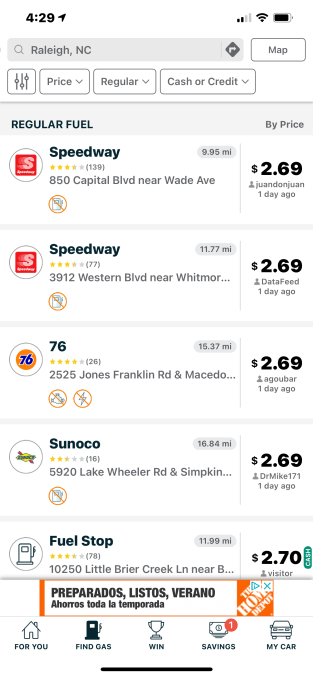
The GasBuddy mobile app, which typically helps consumers find the cheapest gas nearby, has now become the No. 1 app on the U.S. App Store for the first time ever, due to the fuel shortages in the U.S. that followed the cyberattack on the Colonial Pipeline. Americans, fearful that gas would become unavailable, began panic-buying in ways that haven’t been seen since the great toilet paper outage of 2020. As a result, thousands of gas stations ran out of fuel entirely. This dramatic situation has greatly benefitted the GasBuddy app, which includes a crowdsourced feature that helps users locate which local stations still have gas for sale.

As of Wednesday afternoon, GasBuddy says the effects of the Colonial Pipeline shutdown are being felt across 11 U.S. states, largely in the Southeast, and Washington D.C.. North Carolina had the highest number of gas stations with fuel outages, with 65% of stations reportedly out of gas as of 2:48 PM ET on Wednesday. Kentucky has the lowest at only 2%. Because this data is self-reported by GasBuddy users, it may not represent the most current information, we should note.

Image Credits: GasBuddy app screenshot

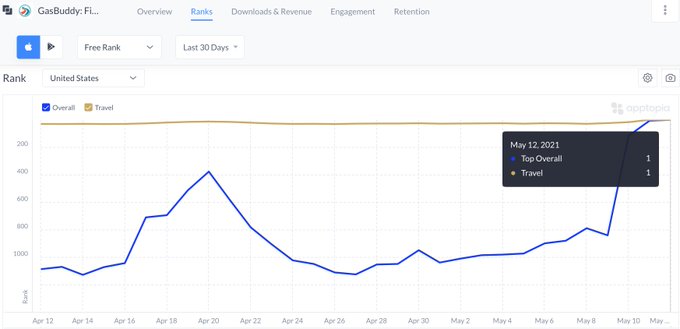
During the week, consumers have been turning to GasBuddy to help them find where they can fill up. Yesterday, the app hit No. 1 in the “Travel” category on the App Store, while it steadily climbed its way up the App Store’s Top Overall charts.

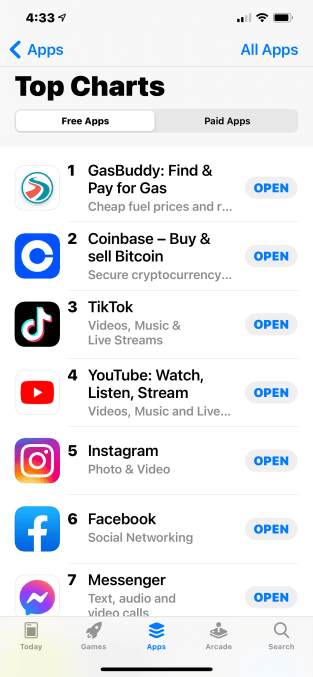
This afternoon, GasBuddy became both the No.1 app in the non-games category as well as the highest-ranked app Overall across the U.S. App Store.

According to data from app store intelligence firm Apptopia, GasBuddy yesterday saw 15,203 new downloads — a 59% increase from its average daily downloads, which were 9,560 for the past 30 days. However, third-party data isn’t always accurate for sudden shots in rank — it catches up in a few days after the fact.

Image Credits: Apptopia

Reached for comment, GasBuddy says its downloads were actually far higher than the third-party estimates. Across all platforms, including both iOS and Google Play, it saw 20x more downloads yesterday compared with an average day in 2021. The company told TechCrunch it counted 313,001 total downloads yesterday, compared with an average daily downloads for the previous 30 days of 15,339.

Broken down by platform, GasBuddy says it saw 104,735 downloads on Android and 208,266 downloads on iOS on Tuesday, May 11, 2021.

Apptopia had also noted that GasBuddy hadn’t been the No. 1 app on the App Store in all the time it’s been recording app store rankings, which goes back to Jan. 1, 2015. However, it noted the app itself launched back in 2010, making it possible (though not likely) that the app had reached No. 1 at some point.

GasBuddy confirmed that’s the not the case. Today is the first time it has ever topped the App Store, though it got close once before when it reached No. 2 behind a walkie-talkie app during Hurricane Irma in September 2017.

Image Credits: App Store screenshot on Wed., May 12, 2021

Consumers can continue to track statewide fuel outages here on GasBuddy’s website as well as where highest prices are being found. In the app, they can report whether gas stations have gas or diesel, as well as current prices.

The Colonial Pipeline, which runs 5,500 miles from the Gulf to the Northeast, shut down on Friday due to a ransomware attack from a criminal hacking network known as DarkSide, which is suspected to be based in Russia or Eastern Europe. The pipeline delivers about 45% of fuel used by the Eastern Seaboard. Reports of the shutdown sent Americans to stock up on gas, worsening the situation further. The U.S. Energy Secretary Jennifer Granholm said the Colonial Pipeline intends to restore operations by the end of the week.

12 May 2021

Waymo to lose its CFO and head of automotive partnerships

Waymo’s chief financial officer Ger Dwyer and its head of automotive partnerships and corporate development Adam Frost — two longtime executives at the autonomous vehicle company — are leaving this month, departures that comes amid some executive shuffling following CEO John Krafcik’s exit earlier this year.

Dwyer and Frost’s departure was shared internally this week, according to multiple sources. Waymo has confirmed to TechCrunch that Dwyer and Frost are leaving.

“We’re grateful to Ger and Adam for all they’ve done for Waymo and wish them all the best,” a spokesperson said in an emailed statement. “An executive search is underway for a new CFO to lead us into our next chapter as we continue to build, deploy and commercialize the Waymo Driver.”

Dwyer, who reported directly to parent company Alphabet’s executive leadership finance team, is among several executives who have left the company in the past five months. Krafcik announced in April that he was stepping down as CEO. Chief Safety Officer Deborah Hersman left in December and Tim Willis, who was head of manufacturing and global supply and general manager of Waymo’s Laser Bear lidar business, departed in February. Sherry House, who had been at Waymo since 2017 and was most recently treasurer and head of investor relations, left the company in April. She is now CFO at Lucid Motors.

Still, some of the critical leaders, and the people directly below them, have remained. Tekedra Mawakana, who was COO, and Dmitri Dolgov, the CTO, are now co-CEOs of Waymo and appear to have the support of Alphabet CEO Sundar Pichai, according to brief remarks he made during the company’s first-quarter earnings call. Department heads directly below Mawakana and Dolgov are still at Waymo with a few exceptions, according to LinkedIn profiles. In March, both David Twohig, who was director of Future Automotive at Waymo, and Qi Hommes, who was once head of system safety, left. Hommes is now director of system safety engineering and analysis at Zoox, according to LinkedIn.

Dwyer’s departure also comes at a time when the demand for CFOs has rocketed alongside the continuous string of public offerings, including those done via mergers with special purpose acquisition companies. House’s move to Lucid Motors, which is going public via a merger with a SPAC, is one example.

Dwyer is a longtime Google employee, who started at the company in 2006. He made the leap in August 2016 over to Waymo, just a few months before the former Google self-driving project officially announced it had spun out to become a business under parent company Alphabet.

During his tenure, Dwyer oversaw the financial side of the business in a period of explosive growth that took the company from a few hundred employees to more than 2,000 today.

Frost, who headed up automotive partnerships, has also been an important figure at Waymo. He came to Google’s self-driving project in 2013 after nearly 17 years at Ford Motor Co., according to LinkedIn records. He was initially hired as a chief engineer and then rose through the ranks to chief automotive programs and partnerships officer and eventually chief automotive and corporate development officer. Waymo has locked in a number of what it has described as exclusive partnerships with automakers over the past several years, including Volvo, Stellantis (formerly FCA), as well as one with Renault and Nissan to research how commercial autonomous vehicles might work for passengers and packages in France and Japan.

Waymo also expanded its geographic footprint beyond California during both Dwyer and Frost’s stints. The company brought its autonomous vehicles into cities like Austin and Kirkland, Washington for testing and established operations in the Phoenix suburb of Chandler, where it now operates a ride-hailing service called Waymo One using driverless vehicles as well as those with safety operators behind the wheel.

Last year, Waymo completed its first external round of fundraising, which was initially $2.25 billion and later expanded to $3 billion. The $2.25 billion round was led by Silver Lake with investments from Canada Pension Plan Investment Board, Mubadala Investment Company, Magna, Andreessen Horowitz and AutoNation and its parent company Alphabet. The extended capital came from new investors, including those managed by T. Rowe Price, Perry Creek Capital, Fidelity Management and Research Company and others.

The external raise followed a flurry of activity that suggested Waymo was ramping up its commercial enterprise, including expanding its core fleet in Mountain View, Calif., the Phoenix area and into Texas. Waymo also began to move beyond its robotaxi testing and began piloting new business applications for its autonomous vehicle technology such as delivery and trucking and even a plan to start selling its custom lidar sensors to companies in the robotics, security and agricultural technology industries.

It has also made numerous partners and at least one acquisition under Dwyer’s watch. Waymo acquired in December 2019 a U.K. company called Latent Logic that spun out of Oxford University’s computer science department. The company uses a form of machine learning called imitation learning that could beef up Waymo’s simulation efforts. The acquisition marked the launch of Waymo’s first European engineering hub in Oxford, U.K.


12 May 2021

TikTok removes 500k+ accounts in Italy after DPA order to block underage users

Video sharing social network TikTok has removed more than 500,000 accounts in Italy following an intervention by the country’s data protection watchdog earlier this year ordering it to recheck the age of all Italian users and block access to any under the age of 13.

Between February 9 and April 21 more than 12.5M Italian users were asked to confirm that they are over 13 years old, according to the regulator.

Online age verification remains a hard problem and it’s not clear how many of the removed accounts definitively belonged to under 13s. The regulator said today that TikTok removed over 500k users because they were “likely” to be under the age of 16; around 400,000 because they declared an age under 13 and 140,000 through what the DPA describes as “a combination of moderation and reporting tools” implemented within the app.

TikTok has also agreed to take a series of additional measures to strengthen its ability to detect and block underage users — including potentially developing AI tools to help it identify when children are using the service.

Reached for comment, TikTok sent us a statement confirming that it is trialling “additional measures to help ensure that only users aged 13 or over are able to use TikTok”.

Here’s the statement, which TikTok attributed to Alexandra Evans, its head of child safety in Europe:

“TikTok’s top priority is protecting the privacy and safety of our users, and in particular our younger users. Following continued engagement with the Garante, we will be trialling additional measures to help ensure that only users aged 13 or over are able to use TikTok.

“We already take industry-leading steps to promote youth safety on TikTok such as setting accounts to private by default for users aged under 16 and enabling parents to link their account to their teen’s through Family Pairing. There is no finish line when it comes to safety, and we continue to evaluate and improve our policies, processes and systems, and consult with external experts.”

Italy’s data protection regulator made an emergency intervention in January — ordering TikTok to recheck the age of all users and block any users whose age it could not verify. The action followed reports in local media about a 10-year-old girl from Palermo who died of asphyxiation after participating in a “blackout challenge” on the social network.

Among the beefed up measures TikTok has agreed to take is a commitment to act faster to remove underage users — with the Italian DPA saying the platform has guaranteed it will cancel reported accounts it verifies as belonging to under 13s within 48 hours.

The regulator said TikTok has also committed to “study and develop” solutions — which may include the use of artificial intelligence — to “minimize the risk of children under 13 using the service”.

TikTok has also agree to launch ad campaigns, both in app and through radio and newspapers in Italy, to raise awareness about safe use of the platform and get the message out that it is not suitable for under-12s — including targeting this messaging in a language and format that’s likely to engage underage minors themselves.

The social network has also agreed to share information with the regulator relating to the effectiveness of the various experimental measures — to work with the regulator to identify the best ways of keeping underage users off the service.

The DPA said it will continue to monitor TikTok’s compliance with its commitments.

Prior to the Garante’s action, TikTok’s age verification checks had been widely criticized as trivially easier for kids to circumvent — with children merely needing to input a false birth date that suggested they are older than 13 to circumvent the age gate and access the service.

A wider investigation that the DPA opened into TikTok’s handling and processing of children’s data last year remains ongoing.

The regulator announced it had begun proceedings against the platform in December 2020, following months of investigation, saying then that it believed TikTok was not complying with EU data protection rules which set stringent requirements for processing children’s data.

In January the Garante also called for the European Data Protection Board to set up an EU taskforce to investigate concerns about the risks of children’s use of the platform — highlighting similar concerns being raised by other agencies in Europe and the U.S.

In February the European consumer rights organization, BEUC, also filed a series of complaints against TikTok, including in relation to its handling of kids’ data.

Earlier this year TikTok announced plans to bring in outside experts in the region to help with content moderation and said it would open a ‘transparency’ center in Europe where outside experts could get information on its content, security and privacy policies.


12 May 2021

36 hours left to apply to Startup Battlefield at TC Disrupt 2021

Do you and your early-stage startup have what it takes to be a modern-day gladiator and compete in Startup Battlefield at TechCrunch Disrupt 2021? You won’t know unless you apply, and time is running out. You have only 48 hours left to throw your helmet into the ring.

If you want to compete for glory, global exposure and $100,000 in equity-free prize money, apply to Startup Battlefield here before May 13 at 11:59 pm (PT).

Not familiar with Startup Battlefield? It’s launched 922 companies — including the likes of Dropbox, Vurb, Mint and a bunch more — that have collectively raised $9.5 billion and produced 117 exits.

We can tell you what it’s like to compete in Startup Battlefield and about the benefits and opportunities that come from it. But Stacey Hronowski — co-founder and CEO of Canix, the winner of Startup Battlefield at Disrupt 2020 — describes it best.

“Our experience in Startup Battlefield was excellent. The rigorous training was specific and tailored to our individual business and presentation. I was particularly impressed with the Q&A training. I’ve fundraised numerous times and the practice questions were some of the most insightful and specific questions I’ve faced. I feel extremely well prepared for future fundraises.

Post Startup Battlefield, we received significant press coverage and reach outs from notable investors. The experience was one of the most special of my life; I never thought I’d get the chance to share the story of Canix with investors and media across the globe.”

And guess what?! It won’t cost you a thing to apply or to compete. You can be from anywhere in the world and in any industry — but you should have an MVP. Are you detail oriented? Read more about how Startup Battlefield works.

We’re tapping top VC talent to judge the Battlefield. Here are just a few of the experts you’ll need to impress.

TechCrunch Disrupt 2021 takes place on September 22-23, and if you want a shot at massive exposure and $100,000, you need to apply to Startup Battlefield before the deadline expires — in just 48 hours — on May 13 at 11:59 pm (PT). Go, gladiators, go!

Is your company interested in sponsoring or exhibiting at Disrupt 2021? Contact our sponsorship sales team by filling out this form.

12 May 2021

Dear Sophie: Does it make sense to sponsor immigrant talent to work remotely?

Here’s another edition of “Dear Sophie,” the advice column that answers immigration-related questions about working at technology companies.

“Your questions are vital to the spread of knowledge that allows people all over the world to rise above borders and pursue their dreams,” says Sophie Alcorn, a Silicon Valley immigration attorney. “Whether you’re in people ops, a founder or seeking a job in Silicon Valley, I would love to answer your questions in my next column.”

Extra Crunch members receive access to weekly “Dear Sophie” columns; use promo code ALCORN to purchase a one- or two-year subscription for 50% off.


Dear Sophie,

My startup is in big-time hiring mode. All of our employees are currently working remotely and will likely continue to do so for the foreseeable future — even after the pandemic ends. We are considering individuals who are living outside of the U.S. for a few of the positions we are looking to fill.

Does it make sense to sponsor them for a visa to work remotely from somewhere in the United States?

— Selective in Silicon Valley

Dear Selective,

Thanks for reaching out — I’m always happy to hear about another fast-growing startup! If some of your leadership team is also abroad, check out the recent announcement about the new International Entrepreneur Parole program for founders.

It can make great business sense to sponsor international talent for a visa even if the position involves working remotely from a location inside the U.S. With the right legal setup, your team can work from home in Silicon Valley, nearby in California, or in another state where the cost of living is not quite as high. We’ve received this question from many employers, and many of our clients are proceeding with sponsoring international talent with visas and green cards for work-from-home positions.

I discussed this and other issues related to recruiting and work trends with Katie Lampert for my podcast. Lampert leads the talent acquisition and infrastructure group at General Catalyst, a VC firm that invests in seed to growth-stage startups in the U.S. and abroad. She advises companies in the General Catalyst portfolio on all things talent-related, including establishing company culture, creating a company’s infrastructure for recruiting and retaining talent, and planning for the future.

“Recruiting is going to be more global, which is exciting,” Lampert said during our discussion. “This will have a really positive effect on cultural diversity in the workforce. Studies show that a more diverse workforce leads to greater financial success.”

In fact, the latest McKinsey & Co. report on diversity, “Diversity wins: How inclusion matters,” found that companies with ethnically and culturally diverse executive teams are 36% more likely to achieve above-average profitability than companies with less diverse teams. McKinsey has issued three reports on diversity, and with each subsequent report, the business case for ethnic and cultural diversity and gender diversity in corporate leadership has grown stronger.

In addition to boosting profitability, bringing international talent to the United States to join your startup offers a host of other benefits as well.

12 May 2021

Direct-to-consumer orthodontic startup Impress raises $50M to scale across Europe

As the famous phrase goes, ‘software is eating the world’ and now software is eating dentistry. Or, perhaps more accurately, the arena of orthodontics — the specialty of dentistry that deals with things like braces — is slowly but surely being digitalized.

To whit, Impress, a Southern European player in direct-to-consumer orthodontics, has raised a $50 million Series A funding round led by CareCapital (a dental division of Hillhouse Capital in Asia), along with Nickleby capital, UNIQA Ventures, and investors including Michael Linse, Valentin Pitarque, Peter Schiff, Elliot Dornbusch, and others. All existing shareholders, such as TA Ventures and Bynd VC, also participated. 

Impress is an homage to the direct-to-consumer startups in this area in the US such as SmileDirect< and now plans to scale across Europe from its existing bases in Spain, Italy, Portugal, UK, and France.

The company was founded in 2019 in Barcelona by orthodontist Dr. Khaled Kasem and serial entrepreneurs Diliara and Vladimir Lupenko.

Speaking from Barclenoa, Lupenko told me that the idea was to “combine the best orthodontic tradition with the most innovative technology in the sector.”

As things stand, most of the time, consumers can usually only access cosmetic teeth alignment treatments or orthodontic medical treatments in conventional clinics. The new wave of clinics employs 3D scans and panoramic X-rays to check nerve and bone health.

Impress’s model is to offer these high-quality medical treatments directly to consumers, by developing its own chain of orthodontic clinics, which also put an emphasis on design and a ‘modern’ patient experience, it says.

As Diliara Lupenko says: “We didn’t copy what other companies in the space were doing and approached the market from a different angle from the get-go. We doubled down on the doctor-led digital model which brought us way better conversion rates and treatment quality even though on paper it looked complex in the beginning. It’s still very complex but we were able to crack it and scale exponentially.”

Impress now has 75 clinics in Spain, Italy, the UK, France, and Portugal which optimize costs and automate key parts of the value chain.

It now says it’s approaching €50m in annual run-rate and is projected to grow to €150m of revenue in 12 months. 

Andreas Nemeth, managing partner of UNIQA Ventures GmbH commented: “Impress’s customer-centric focus, as well as its demonstrated ability to blitzscale, attracted us to the business. Vladimir and his team leverage technology to create a seamless customer journey for invisible orthodontics and optimized their cost structure in a unique way using software.”

12 May 2021

Bird Ride’s SPAC filing shows scooter-nomics just doesn’t fly

Scooter unicorn Bird Rides is going public, per an agreement to merge with a special purpose acquisition company, or SPAC. After rumors and reports circulated for months about an imminent deal, it has finally arrived.

First, a quick overview of the agreement and the players involved: Bird is merging with Switchback II at an implied valuation of $2.3 billion. Fidelity Management & Research Company will lead the deal’s $106 million in private investment in public equity, or PIPE. Apollo Investment Corp. and MidCap Financial Trust provided an additional $40 million in asset financing. (Disclosure: Apollo is buying TechCrunch’s parent company.)

Historically — and based on what we’re seeing in this fantastical filing — Bird proved to be a simply awful business. Its results from 2019 and 2020 describe a company with a huge cost structure and unprofitable revenue, per filings. After posting negative gross profit in both of the most recent full-year periods, Bird’s initial model appears to have been defeated by the market.

What drove the company’s hugely unprofitable revenues and resulting net losses? Unit economics that were nearly comically destructive.

Some of the numbers Bird shared in its investor deck show a business that is growing, in terms of users and geographic footprint. Bird is in 200 cities globally and reports more than 95 million rides to date, and 3 million new riders added during the pandemic. The investor deck also touts year-round positive economics during the COVID-19 era. That all looks positive. But looking into the line-item financials, a different story emerges.

The scooter shop managed to convert a $135.7 million gross loss in 2019 to a smaller gross deficit of $23.5 million in 2020, but it did not manage to shake up its upside-down economics during its full fiscal 2020.