Author: azeeadmin

12 May 2021

TikTok launches a Green Screen Duet feature, tests dedicated ‘Topics’ feeds

As competition with tech giants heats up, TikTok is rolling out a series of new features to help keep its short-form video app ahead of rivals. The company today announced the launch of a new Green Screen Duet feature, which combines two of TikTok’s most popular editing tools to allow creators to use another video from TikTok as the background in their new video. It also confirmed the test of a new way to discover videos called “Topics.” These are dedicated interest-based feeds featuring the top, trending videos in a given category.

Green Screen Duet joins an existing set of Duet tools that let creators lay out two videos side-by-side. Today, Duet layouts include “Left & Right,” “React,” and “Top & Bottom.” Creators currently use Duets to sing, dance, joke or act alongside another user’s video, react to a video’s content, or even just watch a video from another, sometimes smaller, creator to raise awareness or call attention to its content.

Editing tools like Duet and Stitch are key to what makes TikTok not just a passive video viewing app but, rather, a new type of video-first social network. It’s also proven so popular, it has since been adopted by Facebook’s TikTok clone, Instagram Reels, where its known as Remix.  Snapchat has been developing a Remix feature of its own, too.
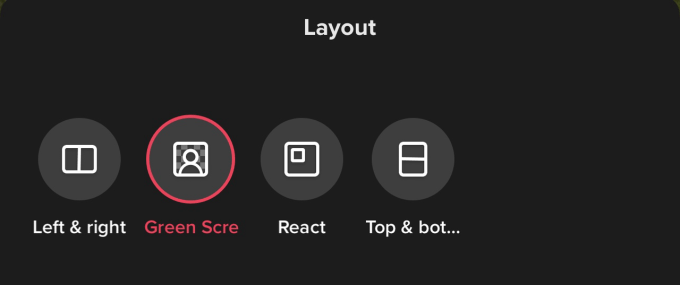
Image Credits: TikTok

TikTok’s new Green Screen Duet will now appear as another option alongside the existing layouts, offering users a way to more easily use another video in the background as they record their own video overlaid on top.

This sort of video experience is something TikTok creators already do in a variety of ways. For example, they may capture images or screen recordings, then use other editing tools to create a green screen effect like this. Or they may react to a video using a Stitch instead, as that can be easier. A built-in Green Screen Duet feature simply offers another way to record new videos that include existing videos.

When the feature is used, the Duetted video plays in the background over the new video being recorded. TikTok believes the launch will inspire new formats for creativity and expression, as a result.

TikTok has been busy upgrading its interface to improve recording and discovering new video content in its app in recent weeks, as Facebook, YouTube, and Snapchat have tried to reproduce TikTok’s feature set in their own apps. For instance, TikTok just launched interactive music features last month in an effort to get ahead.

In another leap, TikTok is also now testing a new Discover page in the app, where instead of only featuring the current trends, as before, it now organizes videos into categories.
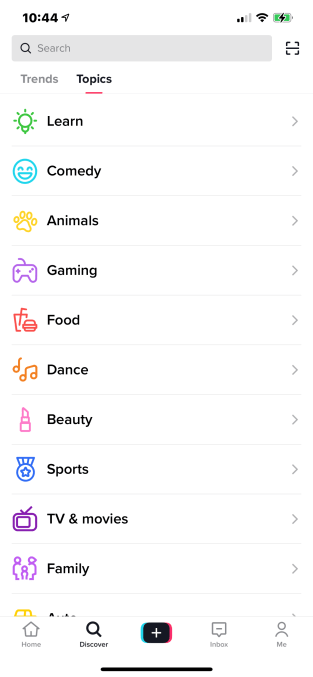
These categories represent the many areas of interest on TikTok, like gaming, beauty, dance, TV & movies, sports, family, learning, and much more. When you tap into any given category, you’re taken to a feed that includes the community’s top, trending content. The feeds will be affected by factors like relevance, timeliness, and interest, and can help users find new content and creators outside of what their personalized For You page shows.

TikTok confirmed the test has been rolling out in the U.S. over the past few weeks.

The company also currently testing e-commerce shopping features, where some brands like Hype and Walmart have been given a new “Shopping” tab on their TikTok profile where users can shop items, add to cart and then check out without leaving the app.

Image Credits: TikTok

The integration is less elegant than Instagram’s Shops, as there’s not a native, universal cart or integrated payment mechanism. Instead, users are visiting the retailer’s website directly.

The advances TikTok is making, however, has been paying off in terms of capturing a large Gen Z user base.

According to eMarketer, more Gen Z users in the U.S. now use TikTok than Instagram, or 37.3 million monthly active users compared with 33.3 million users, respectively. And by 2023, the firm predicts TikTok will surpass Snapchat in terms of total U.S. users, as well.

But TikTok’s global ambitions are impacted not only by its ban in India but also the possibility that creators will find more monetization opportunities on established platforms.

Yesterday, for example, YouTube announced a $100 million fund for top YouTube Shorts creators, and said it will soon testing ads on Shorts. That could help creators generate revenue from short-form content, while also converting casual viewers to channel subscribers where there are even more opportunities to monetize. Snapchat and Instagram have also been wooing creators with cash, and ultimately, if creators find they can make more money elsewhere they could shift some of their attention away from TikTok, no matter how many creative new features it adds.


12 May 2021

Planck, the insurance data analytics platform, raises $20M growth round

A group photo of Planck co-founders (from left to right): David Schapiro, CEO Elad Tsur and CTO Amir Cohen

Planck co-founders (from left to right): David Schapiro, CEO Elad Tsur and CTO Amir Cohen

Planck, the AI-based data platform for commercial insurance underwriting, announced today it has raised a $20 million growth round. The funding came from 3L Capital and Greenfield Partners, along with returning investors Team8, Viola Fintech, Arbor Ventures and Eight Roads.

This brings the New York-based startup’s total raised to $48 million, including a $16 million Series B it announced in June 2020. Planck said it currently works with “dozens of commercial insurance companies in the U.S.,” including more than half of the top-30 insurers. It will use its new funding to build its U.S. team, expand into global markets, and add products for new business segments. Ernie Feirer has also joined Planck as its head of U.S. business. He previously held leadership roles at LexisNexis Risk Solutions, building data analytics solutions for property and casualty insurance carriers.

Planck’s database, which includes online images, text, videos, reviews and public records, allows it to give insurance providers real-time information that helps them determine premiums, process claims and give SMEs faster quotes. It covers more than 50 business segments, including restaurants, construction, retail and manufacturing, and can deliver analytics by simply entering a business’ name and address.

For example, if a healthcare business is seeking to buy or renew an insurance policy, Planck can give underwriters information such as the type of equipment used, what kind of drugs it prescribes and the type of surgeries it performs.

In a statement, 3L Capital principal Paige Thacher said, “Commercial carriers and brokers can no longer afford to rely upon traditional data sources as they prospect, assess risk and monitor a small business insured’s changing exposure during the policy life cycle. The new imperative is to leverage AI and machine learning technologies to dynamically harvest business insights from the insured’s digital footprint.”

12 May 2021

Don’t hate on low-code and no-code

As far as I can tell, low-code and no-code services are rapidly proving that prior models for products as broad as enterprise app creation and AI-powered data analytics were lackluster. My evidence? A mix of public- and private-market low- and no-code companies are putting up impressive results.

The Exchange caught up with Appian CEO Matt Calkins after his enterprise app software company reported its first-quarter performance to discuss the low-code market and what he’s hearing in customer meetings. To round out our general thesis — and shore up our somewhat bratty headline — we’ve compiled a list of recent low-code and no-code venture capital rounds, of which there are many.

As we’ll show, the pace at which venture capitalists are putting funds into companies that fall into our two categories is pretty damn rapid, which implies that they are doing well as a cohort. We can infer as much because it has become clear in recent quarters that while today’s private capital market is stupendous for some startups, it’s harder than you’d think for others.


The Exchange explores startups, markets and money. 

Read it every morning on Extra Crunch or get The Exchange newsletter every Saturday.


The dividing factor? Signs of impressive present-day traction: Startups that are growing very fast have nearly unlimited access to capital, while those that are growing at merely fast rates are often finding it difficult to find a dance partner.

So if we can show that a huge, diverse set of no-code and low-code startups are raising oodles of capital, we can infer something relatively sturdy about market demand for their products. (It also doesn’t hurt that no-code automation service Zapier is growing like a weed and has reached IPO scale. And, in other news, Appian just dropped a new version of its low-code automation platform, for whatever that is worth.)

First Appian’s CEO, then a venture capital roundup. This should be fun.

Public performance

Briefly, Appian reported $88.9 million in Q1 2021 revenue, of which $39.1 million came from its cloud subscription business. The latter figure rose 38% in the quarter compared to the year-ago period. Appian also swung to adjusted EBITDA profit in the period. Investors responded by hammering the company’s stock in the wake of the results. From an April share-price range in the mid-$130s, Appian is now trading in the mid $80s, though only some of those declines came post-earnings.

But the company’s stock price is only so important. Precisely how conservative any one public company’s guidance is for the current year and how those forecasts play with investor expectations during a period of generally excessive valuations is not our game. What does matter is what the company’s CEO had to say about the low-code space itself.

12 May 2021

India offers $2.46B incentive to boost domestic production of batteries

India’s Union Cabinet on Wednesday approved Department of Heavy Industry’s proposal to provide incentives to boost domestic production of batteries with advanced energy storage, the latest in a series of efforts by New Delhi to make the world’s second largest internet market less reliant on other nations for various electronics goods and shrink its trade deficit.

The government’s new $2.46 billion plan, dubbed “National Programme on Advanced Chemistry Cell (ACC) Battery Storage,” is aimed at cutting the nation’s import volume, said Prakash Javadekar, India’s Minister of Heavy Industry and Public Enterprises, in a news conference.

“All the demand of the ACCs is currently being met through imports in India. The National Programme on Advanced Chemistry Cell (ACC) Battery Storage will reduce import dependence,” the ministry said in a statement.

The government, which said it will conduct a transparent competitive bidding process and disburse incentives over a course of five years, aims to achieve the manufacturing capacity of 50GWh of ACC and 5GWh of “Niche” ACC, it said.

The ministry said the firms that win the incentive will be expected to set up manufacturing facilities in India, conduct research and development to achieve “higher energy sensitive and cycles,” invest around $6.1 billion in ACC battery storage manufacturing projects, and facilitate demand creation for battery storage in the country.

The initiative will also help bring down the “oil import bill and help in earning green energy credentials. Besides powering electric vehicles, it will also generate clean energy for domestic consumption,” said Manish Sharma, Chair FICCI Energy Storage Committee and CEO of Panasonic India, in a statement.

“The manufacturing of ACCs will facilitate demand for EVs [Electric Vehicles], which are proven to be significantly less polluting. As India pursues an ambitious renewable energy agenda, the ACC program will be a key contributing factor to reduce India’s GreenHouse Gas (GHG) emissions which will be in line with India’s commitment to combat climate change,” the ministry said.

Wednesday’s announcement follows similar incentives New Delhi has approved in recent quarters. In February, India approved $1 billion plan to boost local manufacturing and exports of laptops, tablets, and PCs. In October, India offered smartphone manufacturers incentives of 4% to 6% over five years on sales of some products made in India. Reuters reported earlier this year that India was also considering giving cash incentives of more than $1 billion to each firm that sets up chip fabrication unit in the country.

The nation, whose economy has been hit hard by the pandemic, has in recent years tried a combination of tariffs and perks to persuade companies to produce more in India, which also creates local jobs.

12 May 2021

Ahead of Dell’s spin out, VMware appoints longtime exec Raghu Raghuram as its new CEO

Five months after it was announced that Pal Gelsinger would be stepping down as CEO of VMware to take the top job at Intel, the virtualization giant has finally appointed a permanent successor. Raghu Raghuram — a longtime employee of the company — has been appointed the new CEO. He will be taking on the new role on June 1. Until then, CFO Zane Rowe will continue in the role in the interim.

Raghuram has been with the company for 17 years in a variety of roles, most recently COO of products and cloud services. He’s also held positions at the company overseeing areas like datacenters and VMware’s server business. Putting a veteran in at the helm sends a clear message that VMware has picked someone clearly dedicated to the company and its culture. No drama here.

Indeed, the move is coming at a time when there is already a lot of other change underway and speaks to the company looking for stability and continuity to lead it through that. About a month ago, Dell confirmed long-anticipated news that it would be spinning out its stake in VMware in a deal that’s expected to bring Dell at least $9 billion — putting to an end a financial partnership that initially kicked off with an eye-watering acquisition of EMC in 2016. That partnership will not end the strategic relationship, however, which is set to continue and now Raghuram will be in charge of building and leading.

For that reason, you might look at this as a deal nodded through significantly by Dell.

“I am thrilled to have Raghu step into the role of CEO at VMware. Throughout his career, he has led with integrity and conviction, playing an instrumental role in the success of VMware,” said Michael Dell, chairman of the VMware Board of Directors, in a statement. “Raghu is now in position to architect VMware’s future, helping customers and partners accelerate their digital businesses in this multi-cloud world.”

Raghuram has not only been the person overseeing some of VMware’s biggest divisions and newer areas like software-defined networking and cloud computing, but he’s had a central role in building and driving strategy for the company’s core virtualization business, been involved with M&A and, as VMware points out, “key in driving partnerships with Dell Technologies,” among other partners.

“VMware is uniquely poised to lead the multi-cloud computing era with an end-to-end software platform spanning clouds, the data center and the edge, helping to accelerate our customers’ digital transformations,” said Raghuram in a statement. “I am honored, humbled and excited to have been chosen to lead this company to a new phase of growth. We have enormous opportunity, we have the right solutions, the right team, and we will continue to execute with focus, passion, and agility.”

The company also took the moment to update on guidance for its Q1 results, which will be coming out on May 27. Revenues are expected to come in at $2.994 billion, up 9.5% versus the same quarter a year ago. Subscription and SaaS and license revenue, meanwhile, is expected to be $1.387 billion, up 12.5%. GAAP net income per diluted share is expected to be $1.01 per diluted share, and non-GAAP net income per diluted share is expected to be $1.76 per diluted share, it said.

12 May 2021

Cisco to acquire Indy startup Socio to bring hybrid events to Webex

Cisco announced this morning that it intends to acquire Indianapolis-based startup Socio, which helps plan hybrid in-person and virtual events. The two companies did not share the purchase price.

Socio provides a missing hybrid event management component for the company to add to its Webex platform. The goal appears to be to combine this with the recent purchase of Slido and transform Webex from an application mostly for video meetings into a more comprehensive event platform.

“As part of Cisco Webex’s vision to deliver inclusive, engaging and intelligent meeting and event experiences, the acquisition of Socio Labs complements Cisco’s recent acquisition of Slido, an industry-leading audience engagement tool, which together will create a comprehensive, cost-effective and easy-to-use event management solution […],” the company explained in a statement.

The impact of the pandemic was not lost on Cisco, and it’s clear that as we can foresee going back to go back to live events, having the ability to combine it with a virtual experience means that you can open up your event to a much wider audience beyond those who can attend in person. That’s likely not something that’s going away, even after we get past COVID.

Jeetu Patel, SVP and GM for security and collaboration at Cisco says that the future of work is going to be hybrid, whether it’s for work meetings or larger events and Cisco is making this acquisition to expand the use cases for the Webex platform.

“Whether it’s a 1:1 call, a small team huddle, a group meeting or a large external event, we want to remove friction and help people engage with each other in an inclusive manner. Slido allows for every voice to be heard — even when you’re not talking. Socio allows for getting your voice heard by a large number of people,” Patel said.

And the company believes that Webex provides the platform to make it all happen. “It’s a really potent combination of technology to make human interactions more engaging, no matter the type of conversation,” he added.

Brent Leary, founder and principal analyst at CRM Essentials, says that it’s a smart move to take advantage of the changing events landscape and that this acquisition helps make Cisco a serious player in this space.

“As we get closer to a post-pandemic world, the need to create hybrid event experiences is going to quickly accelerate as people start venturing out to attend physical events. So having an event stack that combines local event support/participation with tools to integrate a broader virtual audience will be the future of event management,” Leary told me.

Socio was founded in 2016 and raised around $7 million in investment capital, according to Crunchbase data. It has a prestigious list of enterprise customers that includes Microsoft, Google, Jet Blue, Greenpeace, PepsiCo and Hyundai

The deal is expected to close in Q4 of FY2021. When it does close, Socio’s 135 employees will be joining Cisco. The plan is to incorporate Socio’s tooling into the Webex platform while allowing it to continue as a stand-alone product, according to a Cisco spokesperson.

12 May 2021

Fiveable makes first acquisition: a virtual study tool built by a 16-year old

Fiveable, an online learning community for high school students, made its first-ever acquisition earlier this week: Hours, a virtual study platform built by a 16-year old. The terms of the deal were not disclosed.

Fiveable is a free, online learning community for high school students with the focus of helping them pass Advanced Placement (AP) exams. It livestreams 5-hour “cram shops” focused on a specific subject, creates study guides, and manages a Discord with thousands of students.

“Students have Discord servers, they have subreddits, they have group chats and it’s happening informally on some of these different platforms,” founder Amanda DoMaral said in March. “But we need a central place where social learning happens, where students get support, where they can find each other, where they can build towards their goals.”

She estimates that half a million students use Fiveable on a monthly basis – and it’s just so fitting that her company’s first acquisition came from paying attention to those same users.

She noticed students within the Fiveable community were using Hours a few months ago to host group study sessions. Hours allows students to create study sessions where each person has a task list and shared timer and playlist, which she describes as “a multiplayer experience “ that can increase motivation and accountability. There’s also a single-player experience version where students can pick “focus mode” and remove chat and highlight task lists.

Task display via Hours.

Put simply, Fiveable will be able to expand its community feel from an active Discord to a study-specific tool. In its 6 months as a product, Hours has been used by more than 17,000 students from schools including Stanford University, MIT, NYU, and over 120 countries.

“The experience of studying in Discord text or audio chats is similar to the Hours multi-player mode, but there isn’t a way in Discord to keep track of tasks or see everyone’s progress,” she said. “Hours is a better experience because it allows more flexibility within the group version of a study session and has the ability for students to study solo,” she said.

The startup decided to buy the platform rather than try to build the technology itself for two reasons: students already love the product, and it was built by a “very impressive 16-year old,” Calix Huang.

Huang, a high school junior in the Bay Area with previous tech acquisitions and startups under his belt, founded Hours in October 2020 in response to the siloed experience of studying during a pandemic. As part of Fiveable’s acquisition, Huang will join its team as a Lead Product Manager to work on Hours part-time.

“Calix will be a senior next year, so he will come on part-time until he graduates. Then he’ll have big decisions like the rest of his peers about what he will do next, which includes an offer to come on full-time,” DoMaral said. Employing young talent isn’t new for the startup: Over 118 paid students work on Fiveable staff right now across all teams, from social to product to content. Every student works 5-10 hours per week as a part-time job and Fiveable pays them $15-23 per hour.

Fiveable plans to keep Hours as a free service along with its guides, trivia, and Discord. The company makes money in two ways right now: $25 for a cram-pass or $5 for live events, such as a 5-hour review the night before an exam. The startup has raised more than $3.5 million in known venture capital to date, from investors including Matchstick Ventures, Cream City Venture Capital, Spero Ventures, and most recently, Tennis legend Serena Williams. 

12 May 2021

Qualcomm won’t be exhibiting in-person at MWC

Another major name in mobile has confirmed that it won’t be exhibiting at Mobile World Congress in Barcelona. Chip giant Qualcomm is joining a list that already includes Google, IBM, Nokia, Sony, Oracle, Ericsson and, most recently, Samsung and Lenovo.

In a statement offered to TechCrunch, a spokesperson for the company confirmed that it will be a taking a similar approach as many of the others, opting to “attend” virtually.

“While we appreciate the health and safety measures being put into place by the GSMA for MWC Barcelona, we have decided that it is in the best interest of our employees and customers for Qualcomm’s participation to be virtual this year,” the company said. “We look forward to engaging with the ecosystem through Cristiano Amon’s virtual keynote on June 28th and through our latest announcements and 5G demonstrations.”

There are shades of the lead up to last year’s event, which similarly found companies opting out, one by one. Ultimately the show’s governing body, the GSMA, pulled the plug. Of course, things are different in 2021. After nearly a year and a half, there are fewer unknowns and a vaccination roll out has begun in much of the world.

But there are still plenty of reasons for people and companies to take a cautious approach when it comes to flying around the world and attending an event in a potentially packed room. Ultimately, it’s probably not worth the perceived risk or discomfort of staff.

For these reasons and more, it’s hard to blame companies like Qualcomm. Given what we know, it seems unlikely that the organization would pull the plug entirely at this late stage, but things look increasingly dependent on the virtual aspect of the show’s hybrid approach. It also seems possible that the in-person trade will be forever changed after the events of the past two years.

12 May 2021

The truth about SDK integrations and their impact on developers

The digital media industry often talks about how much influence, dominance and power entities like Google and Facebook have. Generally, the focus is on the vast troves of data and audience reach these companies tout. However, there’s more beneath the surface that strengthens the grip these companies have on both app developers and publishers alike.

In reality, software development kit (SDK) integrations are a critical component of why these monolith companies have such a prominent presence. For reference, an SDK is a set of software development tools, libraries, code samples, processes and guides that help developers create or enhance the apps they’re building.

Through a digital marketing lens, SDKs provide in-app analytics, insights on campaign testing, attribution information, location details, monetization capabilities and more.

Through a digital marketing lens, SDKs provide in-app analytics, insights on campaign testing, attribution information, location details, monetization capabilities and more. In the case of companies like Google and Facebook, their ability to provide these insights dovetails with their data and reach.

While that does deliver useful capabilities to developers and publishers alike, it also perpetuates the factors contributing to their perceived monopolistic status — and the detriments a lack of competition fosters.

Almost all (90%) ad-monetized Android apps have Google’s Admob SDK integrated, data from Statista showed. Additionally, the Facebook Audience Network SDK is present in 19% of all global Android apps utilizing mobile ads. It’s worth noting that the large majority of alternative “leading” advertising SDKs outside these two players are used less than 13% of the time in Android apps.

As the app ecosystem rapidly expands beyond the borders of mobile, app developers and publishers would benefit immensely from identifying economical and secure ways of adopting more SDKs.

The state of SDK adoption

While there are many SDKs available in the market today, a few key factors contribute to Google and Facebook’s overall dominance. The most basic is around the respective organizations’ reach and industry notoriety. However, a larger component here is the lack of resources and time app developers have.

12 May 2021

Atomized lands $500K pre-seed to help developers deploy infrastructure faster

Atomized, an early stage startup that wants to create a modern tool to help developers deploy infrastructure faster, announced the first step of its funding journey today, a $500,000 pre-seed round from Zing Capital, Y Combinator and several unnamed angels.

Company co-founder and CEO Nik Kotov says developers are spending over 20% of their time on setting up the necessary infrastructure just to run their applications, and he and his co-founder and CTO Eddie Herbert believed there had to be a better way, so like all good entrepreneurs, they built one.

“With Atomized our goal is to provide a platform that allows developers to deploy their applications really quickly. And the way it literally works is that we plug into where your code lives in GitHub, and also plug into your cloud provider, so currently it’s AWS, and we automatically spin up all the necessary infrastructure for you” Kotov told me.

For now, that means spinning up containers, databases and static sites on AWS, but there are plans to expand that to work across multiple clouds over time as the company develops. “Our [goal] is actually to abstract away all those choices, all those nitty gritty details of Amazon, Azure and GCP and essentially provide you the easiest most straightforward solution,” he said.

Kotov actually went through Y Combinator last summer as a solo founder, but he was trying to build a different product at that time dealing with compliance infrastructure. He ended up pivoting to this solution and joining forces with Herbert after Demo Day, but says the experience was well worth his time, even if he ended up with a different approach after all was said and done.

“YC opened up a huge door for me as someone who does not have any connections to Silicon Valley whatsoever. […] Being an immigrant and not coming from a rich family […], all of a sudden I got access to a bunch of people that I previously had no access to,” he said.

Both founders are immigrants with Kotov hailing from Russia and Herbert from Estonia. They are both based in Charlotte, North Carolina, which Kotov says is a hidden gem for diverse technical talent.

“I think Charlotte is kind of the best place to [build a startup] because in general Charlotte is very diverse, which a lot people don’t know. It’s 50% white and the rest are Black or Latino. It’s kind of awesome because we can hire the best people and then have diversity also built into into the company as well,” he said.

The product is in Beta right now with 60 customers running on the platform. The plan is to use the money judiciously to begin to hire some more people. Right now in addition to the two founders, they have two full time engineers.