Author: azeeadmin

02 Apr 2021

Backflip offers an easier way to turn used electronics into cold, hard cash

Mike Barile spent two years and racked up nearly $20,000 in credit card debt to bring his first startup, Backflip, to life.

The former management consultant had spent years toiling in the startup grind, first at Uber, then, after taking a coding academy bootcamp through AppAcademy (where Barile met his co-founder, Adam Foosaner), at Google and at a failed cryptocurrency startup.

Burned by the crypto experience, Barile was casting about for his next thing, and trying to find a way to scrape up some rent money, when he hit on the idea for Backflip. The experience of selling electronics online was still shady and Barile and Foosaner thought there had to be a better way.

That way became Backflip. It offers customers cash on delivery for their used electronics — anything from Androids to Xboxes and Apple devices to Gameboys.

When I first started working on backflip back in March 2019, I met this kid named Chris and he wanted to buy some of my old iPhones. He had been a student at USF and as a side hustle he started buying used devices and would refurbish them and then either sell them himself or sell them to an official reseller,” said Barile. “Chris started making so much money he dropped out of school. That was a holy shit moment. He can make a lot of money doing this and he’s doing a really good thing.”

The problem, said Barile, was safety. “He’s got all these devices he’s acquiring paying cash for and he’s driving all around town… Everyone who works in the [refurbish and resell] industry has at least one story about getting robbed at gunpoint.”

Backflip solved that problem by being the intermediary between buyers and sellers and taking a small commission for managing the transaction.

The company raised its first money at the end of 2019, but before that, Foosaner and Barile lived off of credit and used electronics.

So far, Backflip has facilitated the exchange of roughly 3,000 devices. The company handles everything from wiping a device and ensuring its quality to finding a buyer for the electronics. The company pays out roughly $150 per device and has deposited a little over $500,000 with users of the service, according to data provided by the company.

“We did all sorts of stuff to get our first few users,” said Barile. We posted ads on Facebook Marketplace and Craiglist. We started experimenting at the end of the summer with the most bare bones mobile app kind of thing. At that point it was just Adam and I,” Barile said.

Starting now, Backflip is working with UPS stores to provide in-person drop-off and packaging centers for the used electronics. Over time, Barile sees those services expanding to offer cash on delivery. “The experience will be similar to an Amazon return,” he said. “Except we’ll be paying you.”

Currently about half of the company’s inventory is used handsets and mobile devices, but Barile said that could drop to a third of inventory as word spreads about the hundred-odd pieces of electronics that Backflip is willing to

“Unlike other resale options, Backflip prioritizes the user’s time and convenience,” said Foosaner in a statement. “Forget the back-and-forth of negotiating over price and scheduling a meetup. We’re here to do all the work for the seller and make sure they get paid fairly and quickly. Backflip users can know that they’re getting the most for their devices without having to do anything other than bring them to The UPS Store or box them up at home.”

The connection to the refurbishing community started early for Barile, whose mother had a side business called “Stone Cottage Workshop” where she was flipping refurbished furniture on eBay and at local thrift stores near Barile’s bucolic New Jersey hometown.

“We want to build the Amazon of making things disappear from your apartment,” Barile said. 
02 Apr 2021

Backflip offers an easier way to turn used electronics into cold, hard cash

Mike Barile spent two years and racked up nearly $20,000 in credit card debt to bring his first startup, Backflip, to life.

The former management consultant had spent years toiling in the startup grind, first at Uber, then, after taking a coding academy bootcamp through AppAcademy (where Barile met his co-founder, Adam Foosaner), at Google and at a failed cryptocurrency startup.

Burned by the crypto experience, Barile was casting about for his next thing, and trying to find a way to scrape up some rent money, when he hit on the idea for Backflip. The experience of selling electronics online was still shady and Barile and Foosaner thought there had to be a better way.

That way became Backflip. It offers customers cash on delivery for their used electronics — anything from Androids to Xboxes and Apple devices to Gameboys.

When I first started working on backflip back in March 2019, I met this kid named Chris and he wanted to buy some of my old iPhones. He had been a student at USF and as a side hustle he started buying used devices and would refurbish them and then either sell them himself or sell them to an official reseller,” said Barile. “Chris started making so much money he dropped out of school. That was a holy shit moment. He can make a lot of money doing this and he’s doing a really good thing.”

The problem, said Barile, was safety. “He’s got all these devices he’s acquiring paying cash for and he’s driving all around town… Everyone who works in the [refurbish and resell] industry has at least one story about getting robbed at gunpoint.”

Backflip solved that problem by being the intermediary between buyers and sellers and taking a small commission for managing the transaction.

The company raised its first money at the end of 2019, but before that, Foosaner and Barile lived off of credit and used electronics.

So far, Backflip has facilitated the exchange of roughly 3,000 devices. The company handles everything from wiping a device and ensuring its quality to finding a buyer for the electronics. The company pays out roughly $150 per device and has deposited a little over $500,000 with users of the service, according to data provided by the company.

“We did all sorts of stuff to get our first few users,” said Barile. We posted ads on Facebook Marketplace and Craiglist. We started experimenting at the end of the summer with the most bare bones mobile app kind of thing. At that point it was just Adam and I,” Barile said.

Starting now, Backflip is working with UPS stores to provide in-person drop-off and packaging centers for the used electronics. Over time, Barile sees those services expanding to offer cash on delivery. “The experience will be similar to an Amazon return,” he said. “Except we’ll be paying you.”

Currently about half of the company’s inventory is used handsets and mobile devices, but Barile said that could drop to a third of inventory as word spreads about the hundred-odd pieces of electronics that Backflip is willing to

“Unlike other resale options, Backflip prioritizes the user’s time and convenience,” said Foosaner in a statement. “Forget the back-and-forth of negotiating over price and scheduling a meetup. We’re here to do all the work for the seller and make sure they get paid fairly and quickly. Backflip users can know that they’re getting the most for their devices without having to do anything other than bring them to The UPS Store or box them up at home.”

The connection to the refurbishing community started early for Barile, whose mother had a side business called “Stone Cottage Workshop” where she was flipping refurbished furniture on eBay and at local thrift stores near Barile’s bucolic New Jersey hometown.

“We want to build the Amazon of making things disappear from your apartment,” Barile said. 

02 Apr 2021

Don’t miss the Pitch Off today at TC Early Stage 2021

Ten global startups, three rounds of pitching, nine expert judges. It’s not the 12 Days of Startups (no robotic partridge in a pear tree here), it’s the TC Early Stage Pitch Off — otherwise known as day two of TC Early Stage 2021: Operations & Fundraising.

Yesterday on day one, TC Early Stage was all about invaluable how-tos. Today, it moves into a full day of action. TechCrunch vetted hundreds of applications to pitch at Early Stage 2021. Now it’s finally time for the epic battle, as these 10 exceptional startups throw down their best pitch — streamed live to a global audience including investors, press and tech industry leaders.

Each startup gets 5 minutes to pitch followed by a Q&A with their judges. The action kicks off at 9am PT with five startups participating in round one — Clocr, Pivot Market, hi.health and Fitted.

They’ll have to bring the heat to impress their panel of VC judges: Marlon Nichols (co-founder and managing general partner at MaC Venture Capital), Sarah Smith (partner at Bain Capital Ventures) and Leah Solivan (general partner at Fuel Capital).

Round two begins at 10 am PT and features FLX Solutions, Nalagenetics, The Last Gameboard, Attention Quotient and Soon. They’ll present their pitches to Lucy Deland (partner at Inspired Capital Partners), Eghosa Omoigui (founder and managing general partner at EchoVC Partners) and Neal Sáles-Griffin (managing director at Techstars).

Only three startups will make it into the final round, which starts at 11 am PT. The finalists pitch yet again — facing a new panel of judges and a more extended Q&A. Who’s judging that final round? We tapped Wen Hsieh (partner at Kleiner Perkins), Natalie Sandman (partner at Spark Capital) and Stephanie Zahn (partner at Sequoia Capital).

Then it all comes down to one standout startup. Along with global exposure, the ultimate winner receives a feature article on TechCrunch.com, a free, one-year membership to ExtraCrunch and a free Founder Pass to TechCrunch Disrupt 2021 in September.

Don’t forget the value of watching other startups pitch — and hearing the questions the judges ask them. Expert pitch feedback is invaluable, and you might just hear a few tips you can roll into your own presentation.

Ashley Barrington, founder of MarketPearl, experienced a variation on that theme at TC Early Stage 2020.

“The Pitch Deck Teardown was incredibly helpful. Hearing the investors give feedback based on their perceptions and what they look for is so valuable. And seeing the other pitch decks and how different founders presented information was both interesting and informative.”

Day two of TC Early Stage 2021 will be non-stop pitch action. Grab some popcorn, get comfy on the couch and tune in to the TC Early Stage Pitch-Off — the pitch you improve could be your own.

01 Apr 2021

Tech in Mexico: A confluence of Latin America, the US and Asia

Mexico has been known as an up-and-coming tech hub and a gateway to the Latin American market. As an investor focused on developer-centered products, open-source startups and infrastructure technology companies with a particular interest in emerging market innovation, I have been wanting to do some firsthand learning there.

So, despite the ongoing pandemic, I took all the necessary precautions and spent roughly seven weeks in Mexico from January to March. I spent most of my time meeting founders to get a handle on what they are building, why they are pursuing those ideas, and how the entire ecosystem is evolving to support their ambitions.

Knowledge transfer is not the only trend flowing in the U.S.-Asia-LatAm nexus. Competition is afoot as well.

The U.S.-Asia-LatAm nexus

One fascinating, though not surprising, observation was how much LatAm entrepreneurs look to Asian tech giants for product inspiration and growth strategies. Companies like Tencent, DiDi and Grab are household names among founders. This makes sense because the market conditions in Mexico and other parts of LatAm resemble China, India and Southeast Asia more than the U.S.

What often happens is entrepreneurs first look to successful startups in the U.S. to emulate and localize. As they find product-market fit, they start to look to Asian tech companies for inspiration while morphing them to suit local needs.

One good example is Rappi, an app that started out as a grocery delivery service. Its future ambition is squarely to become the superapp of LatAm: It is expanding aggressively both geographically and productwise into delivery for restaurant orders, pharmacy and even COVID tests. It’s also introducing new payment, banking and financial-service products. Rappi Pay launched in Mexico just a few weeks ago, while I was still in the country.

Rappi now looks more like Meituan and Grab than any of its U.S. counterparts, and that’s not an accident. SoftBank, whose portfolio contains many of these Asian tech giants, invested heavily in Rappi’s previous two rounds and now has a $5 billion fund dedicated to the LatAm region. The knowledge and experience accumulated from Asian tech in the last 10 years is transferring to like-minded firms like Rappi, right under Silicon Valley’s proverbial nose.

U.S.-Asia-LatAm competition

Knowledge transfer is not the only trend flowing in the U.S.-Asia-LatAm nexus. Competition is afoot as well.

Because of similar market conditions, Asian tech giants are directly expanding into Mexico and other LatAm countries. The one I witnessed up close during my visit was DiDi.

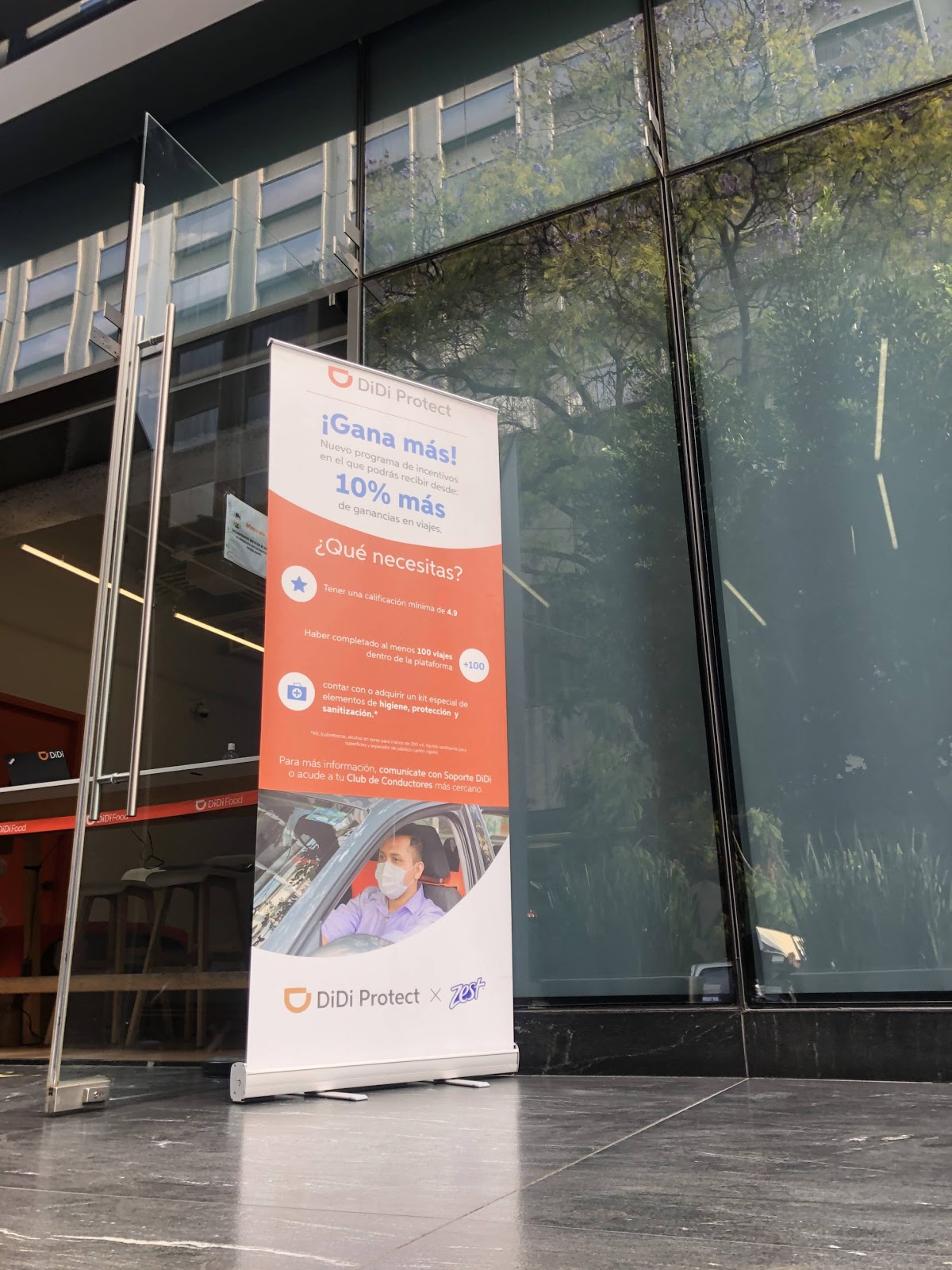
DiDi’s foray into LatAm started in January 2018 with its acquisition of 99, a Brazilian ride-sharing company. In April 2018, DiDi entered Mexico with its bread-and-butter ride-sharing service. It wasn’t until April 2019 that DiDi launched its food delivery service, DiDi Food, in Monterrey and Guadalajara — two of the largest cities in Mexico. Its expansion hasn’t slowed down since, with a 10% extra earnings incentive to lure delivery drivers.

DiDi delivery worker recruitment promotion banner outside venue

Image Credits: Kevin Xu

My Airbnb in Mexico City happened to be two blocks away from the large WeWork building where DiDi’s local office was located. Every day, I saw a long line of people responding to the earning incentives — waiting outside to get hired as DiDi delivery workers.

Meanwhile, the Uber office that’s literally one block away had hardly any foot traffic. As Uber and Rappi fight for more wealthy consumers, DiDi is working to attract lower-income users to grab market share, hoping that one day some of these people will reach the middle class and become profitable customers.

01 Apr 2021

How is edtech spending its extra capital?

Edtech unicorns have boatloads of cash to spend following the capital boost to the sector in 2020. As a result, edtech M&A activity has continued to swell. The idea of a well-capitalized startup buying competitors to complement its core business is nothing new, but exits in this sector are notable because the money used to buy startups can be seen as an effect of the pandemic’s impact on remote education.

In the past week, the consolidation environment is making a clear statement.

The data agrees. Per Crunchbase data, there were 45 edtech exits in 2019 and 24 edtech exits so far in 2021. The same database shows just 35 exits for all of 2020. As we discussed nearly six months ago, the ability to buy (and be bought) has changed.

In the past week, the consolidation environment is making a clear statement: Pandemic-proven startups are scooping up talent — and fast. Kahoot, which is set to list on the Oslo Stock Exchange within months, has bought three businesses within the past 12 months. Quizlet, which became a unicorn nearly one year ago, made its first acquisition ever last week.

To understand more about this activity, I caught up with Quizlet CEO Matthew Glotzbach and Kahoot CEO Eilert Giertsen Hanoa. We talked about trends in the space including lifelong learning, self-directed learning and more.

Q&A is a lucrative business

“To be successful students in the past decade or two, it has required self-direction,” Glotzbach said simply a few minutes into our chat. “Quizlet as a platform is helping to empower that self-directed learner and give them the tools they need to really be successful.”

To further this goal, Quizlet acquired problem-solving tool Slader last week. Unfortunately, the price of the deal was not disclosed (but don’t worry, we’ll have numbers in the next section). What we do know is that it’s the startup’s latest move to solidify its focus as a tech-powered tutoring tool rather than a simple flashcard app.

Currently, Quizlet uses its data around flashcard sets, questions and trained natural language processing tools to understand how students might respond to certain prompts. Artificial intelligence gives the company a little more flexibility to understand the different ways a student could correctly answer the same question.

01 Apr 2021

Daily Crunch: Tiger Global raises one of the biggest venture funds ever

Tiger Global closes a $6.65 billion fund, Facebook gives users more tools to encourage COVID vaccination and iPhone app spending continues to grow. This is your Daily Crunch for April 1, 2021.

The big story: Tiger Global raises one of the biggest venture funds ever

Investment giant Tiger Global had already announced that it was raising $3.75 billion for its thirteenth venture fund, but a new SEC filing showed that it ended up raising much more than that — $6.65 billion.

Perhaps that’s no surprise, given how active the firm has been. Just this week, it’s been announced as the lead or co-lead in a $300 million round for HighRadius, a $192 million round for Cityblock Health and a $125 million round for 6sense. Plus, portfolio company Stripe is now valued at $95 billion and Roblox just went public.

The tech giants

Facebook launches profile frames that help you encourage friends to get the COVID-19 vaccine — The effort follows a similar launch in the U.K., which has apparently resulted in a quarter of Facebook users in the U.K. having seen a Facebook friend with the profile frame.

US iPhone users spent an average of $138 on apps in 2020, will grow to $180 in 2021 — That’s an increase of 38% year over year, according to new data from Sensor Tower.

UK’s antitrust watchdog takes a closer look at Facebook-Giphy — Facebook’s $400 million purchase of Giphy is now facing an in-depth probe by the CMA after the regulator found the acquisition raises competition concerns related to digital advertising.

Startups, funding and venture capital

Thrasio raises $100M for its Amazon roll-up play, appoints retail CFO for its next steps — The company has acquired and consolidated over 100 brands (and 15,000 products) selling on Amazon.

Next Insurance raises $250M, doubling its valuation to $4B in under a year — Next sells small-business coverage across a number of categories (workers’ comp, commercial auto, general liability, etc.) for different classes of workers.

Holler raises $36M to power ‘conversational media’ in your favorite apps — You may not know what conversational media is, but there’s a decent chance you’ve used Holler’s technology.

Advice and analysis from Extra Crunch

Kaltura puts debut on hold. Is the tech IPO window closing? — It appears that Kaltura was surprised that it was not trending toward a higher IPO price.

Knowing when your startup should go all-in on business development — There’s a persistent fallacy swirling around that any startup growing pain or scaling problem can be solved with business development.

Bring CISOs into the C-suite to bake cybersecurity into company culture — The information age is shaking up the C-suite’s composition.

(Extra Crunch is our membership program, which helps founders and startup teams get ahead. You can sign up here.)

Everything else

For VC Hans Tung, the personal becomes public in a growing campaign to ‘stop Asian hate’ — Tung and his partners at GGV Capital decided to take action two weeks ago.

ILM shows off the new Stagecraft LED wall used for season 2 of ‘The Mandalorian’ — Stagecraft, the enormous LED-wall volume ILM used to shoot the first season has since been expanded and updated to be better, faster and easier to use.

Put your city on the TC map with TechCrunch’s European Cities Survey 2021 — TechCrunch is embarking on a major new project to survey European founders and investors in cities outside the larger European capitals.

The Daily Crunch is TechCrunch’s roundup of our biggest and most important stories. If you’d like to get this delivered to your inbox every day at around 3pm Pacific, you can subscribe here.

01 Apr 2021

Microsoft outage knocks sites and services offline

Microsoft is experiencing a major outage.

Besides its homepage, Microsoft services are down, log-in pages aren’t loading, and even the company’s status pages were down. Worse, Microsoft’s cloud service Azure appeared to also be offline, causing outages to any sites and services that rely on it.

It’s looking like a DNS networking issue, according to the status page — when it loaded.

We’ve reached out for comment, and we’ll follow up when we know more.


01 Apr 2021

Coinbase to direct list on April 14th, provide financial update on April 6th

Today Coinbase, an American cryptocurrency trading platform and software company, said that it will begin to trade via a direct listing on April 14th. In a separate release the company also said that it will provide a financial update on April 6th, after the close of trading.

Coinbase’s impending public debut comes at an interesting market moment. As some tech companies delay their offerings over demand concerns, Coinbase is pushing ahead with its flotation perhaps in part because it will not price its debut in the traditional sense; direct listings forgo raising capital at a specific price point, and instead merely begin to trade, albeit with a reference price attached.

That Coinbase will release new numbers before beginning to trade is at once interesting and pedestrian. It’s interesting as TechCrunch cannot recall a private company looking to go public holding a similar event. And, Coinbase deciding to share “first quarter 2021 estimated results” and “provide a financial outlook for 2021” is also in part a common move, as many companies provide updated financials in their S-1 documents if time passes from when they first file to when they actually trade.

We’ll be tuned into that call, as the numbers shared will impact not only how Coinbase trades when it does float, but will also provide insight into how active consumer trading is writ large, and particularly in the cryptocurrency space; more than one startup in the market today depends on trading incomes to generate top-line, so seeing new numbers from Coinbase will be welcome.

The company will trade under the ticker symbol “COIN.”

01 Apr 2021

Coinbase to direct list on April 14th, provide financial update on April 6th

Today Coinbase, an American cryptocurrency trading platform and software company, said that it will begin to trade via a direct listing on April 14th. In a separate release the company also said that it will provide a financial update on April 6th, after the close of trading.

Coinbase’s impending public debut comes at an interesting market moment. As some tech companies delay their offerings over demand concerns, Coinbase is pushing ahead with its flotation perhaps in part because it will not price its debut in the traditional sense; direct listings forgo raising capital at a specific price point, and instead merely begin to trade, albeit with a reference price attached.

That Coinbase will release new numbers before beginning to trade is at once interesting and pedestrian. It’s interesting as TechCrunch cannot recall a private company looking to go public holding a similar event. And, Coinbase deciding to share “first quarter 2021 estimated results” and “provide a financial outlook for 2021” is also in part a common move, as many companies provide updated financials in their S-1 documents if time passes from when they first file to when they actually trade.

We’ll be tuned into that call, as the numbers shared will impact not only how Coinbase trades when it does float, but will also provide insight into how active consumer trading is writ large, and particularly in the cryptocurrency space; more than one startup in the market today depends on trading incomes to generate top-line, so seeing new numbers from Coinbase will be welcome.

The company will trade under the ticker symbol “COIN.”

01 Apr 2021

Compass CEO hails IPO as a fundraising event amid ‘challenging’ market

While several tech companies are opting to delay their IPOs in the face of less-than-enthusiastic market demand for their shares, real estate tech company Compass forged ahead and went public today. After pricing its shares at $18 apiece last night, the low end of a lowered IPO price range, Compass shares closed the day up just under 12% at $20.15 apiece.

TechCrunch caught up with Compass CEO and founder Robert Reffkin to chat about his company’s debut in the market’s suddenly choppy waters for tech and tech-enabled debuts.

Regarding whether Compass is a tech company or a real estate brokerage, Reffkin — who raised the comparison himself — used the opportunity to note that companies like Amazon or Tesla aren’t only one thing. Amazon is a logistics company, an e-commerce company, a cloud-computing business and a media concern all at the same time. Price that.

The argument was good enough for Compass to sell 25 million shares — a lowered amount — at its IPO price for a gross worth $450 million. That, the CEO said, was his company’s goal for its public offering.

Sparing TechCrunch the usual CEO line about an IPO not being a destination but merely one stop on a longer journey at that juncture, Reffkin instead argued that putting nine figures of capital into his company was his objective, not a particular price or resulting valuation.

That might sound simple, but as Kaltura and Intermedia Cloud Communications have pushed their IPOs back, it’s a bit gutsy. Still, if financing was the key objective, Compass did succeed in its debut. And it was even rewarded with a neat little bump in value during its first day’s trading.

Reffkin did confirm to TechCrunch what we’ve been reporting lately, namely that the IPO market has changed for the worse in recent weeks. He described it as “challenging.”

So why go public now when there is so much capital available for private companies?

Reffkin cited a few numbers, but centered his view around having what he construes as the “right team” and the “right results.” We’ll get a bit more on the latter when Compass reports its first set of public earnings.

For now, it’s a company that braved stormier seas than we might have expected to see so soon after a blistering first few months of the year for IPOs.

And because I would also bring her along if I ever took a company public, here’s the company’s founder and CEO with his mother:

Via the company.