Category: UNCATEGORIZED

21 Nov 2019

Google employees will rally in protest of alleged worker retaliation

Google is under fire again for its treatment of employees. Tomorrow, a group of Google employees are holding a rally and press conference to speak out against the company’s decision to place two employees on indefinite administrative leave.

Earlier this month, Google fired one employee and put two, Laurence Berland and Rebecca Rivers, on leave for allegedly violating company policies. At the time, Google said one had searched for and shared confidential documents that were not pertinent to their job, and one had looked at the individual calendars of some staffers. Both Berland and Rivers are set to speak tomorrow at the rally.

This news was reported earlier by Forbes’ Jillian D’Onfro.

“The company is claiming that it is for looking up calendars and documents, which is something we all do  but we know that it is punishment for speaking up for themselves and others,” workers organizing at Google said in a press release. “We are demanding that Google bring these workers back to work immediately.”

They went on to say that the “attack” on Rivers and Berland “is an attack on all people who care about transparency and accountability for tech.” Organizers pointed to how Rivers helped create the petition to demand Google end its contract with U.S. Customs and Border Protection, and how Berland has participated in a number of worker-organized campaigns, including the one resisting YouTube’s role in facilitating hate speech.

“It’s a brute force intimidation attempt to silence workers and make it harder for us to fight back on issues of systemic racism, sexual harassment, harmful technologies, hate speech on our platforms, and business relationships with organizations that engage in human rights abuses,” organizers said.

Since the massive employee-led walkout last November, organizers say Google has tried to undermine further attempts to organize. In July, walkout co-organizer Meredith Whittaker left the company following reports of retaliation in April. Organizers of tomorrow’s rally also say Google has implemented new policies, like accessing need-to-know data a fireable offense. Organizers of the rally say both Rivers and Berland were put on leave for “simply looking at openly shared internal information.”

The rally will start at 11 a.m. at Google’s San Francisco office at 345 Spear Street. I’ve reached out to Google and will update this story if I hear back.

21 Nov 2019

Netgear’s Meural Canvas II is a better version of the best home gadget for photographers

Netgear has released the first updated Canvas digital art from from Meural since acquiring the company last September, and the next-generation connected frame comes with some decent quality-of-life improvements as well as a new, additional size. It’s not a dramatic change from the original Meural Canvas, but it means that a product that was already great is now even better.

The Meural Canvas II from Netgear comes in two sizes, including a smaller 16×24 frame that provides a 21.5-inch diagonal picture (starting at $399.95), and a 19×29-inch frame with a 27-inch diagonal display (starting at $599.95). Both screens are 1080P full HD resolution, and both feature ambient light sensors (which are relocated to a better location under the mat that surrounds the screen for improved light detection) that will automatically adjust the brightness of your image to make it appear more natural and less like a screen.

The Canvas II features built-in Wi-Fi, which is also upgraded with this generation (Netgear, which makes routers and other Wi-Fi products, seem to have brought their expertise to bear here) and they offer new Ethernet connectivity, as well as full-size SD ports. They can also hang either vertically or horizontally, and a new accessory mount for this generation (sold separately) allows for even easier switching between the two orientations via simple rotation.

For the virtual art collector

Meural is controlled primarily from the Meural companion app, though you can also access a web interface to accomplish much of the same thing from a desktop browser. The app features curated collections of artwork, which is available both via a paid monthly subscription, and via direct, one-time purchases. One of the changes that the Meural service has undergone is that the subscription membership now gets you some, but not all of the art available – some premium content is still and additional charge on top of that. It’s definitely not as good from the user’s perspective as when everything was free once you’d paid the subscription fee, but paying monthly still nets you 20GB of cloud storage for uploading your own art, discounts on the stuff that is available for purchase, and access to a much larger library than you get without any membership.

Subscriptions go for either $8.95 per month, or $69.95 per year, and they’re probably plenty to satisfy most casual art lovers who just want some recognizable or interesting works to adorn their walls, and want to be able to change that on a fairly regular basis. And when you use the art provided through Meural’s various collections, you can take a look at credits and descriptions right on the display – available quickly via a motion control swipe up gesture made possibly by the sensors built into the frame.

A note on those motion controls – they allow you to navigate between artwork, and even change playlists and access a menu of other options related to the frame. Basically you wave your hand near the bottom of the Meural to make this work, and it’s great when it does work, but it definitely takes some learning to figure out how and where to swipe to make it reliably respond. It’s convenient that it’s an option, but controlling the display with the iOS or Android app is a lot more pleasant generally speaking.

The built-in library that Meural provides is definitely a selling point, and Meural is regularly adding new art collections, both for paid purchases and to build out the library of those works available included in the subscription. It just added a bunch through a new partnership with Marvel, in fact, including movie posters from a long list of their cinematic universe releases.

For the amateur/enthusiast/pro photographer

The primary reason I think the Meural Canvas II is a fantastic product has very little to do with its subscription-based art collection, however. Instead, it’s all about the flexibility and convenience that the Canvas provides when it comes to displaying your own photos. It’s incredibly easy to upload your photos from your mobile device or your desktop, and you can organize them in playlists, add descriptions and titles, and crop them manually or have the frame crop them automatically to display in its 16×9 aspect ratio.

As a display for your own photos, the Meural Canvas II is hard to beat: It’s a lot more flexible and cost effective than getting high quality prints made, since you can rotate them out as often as you feel like, and the display’s color rendering and matte finish, while obviously not as good as a professional photo print, is nonetheless very pleasing to the eye. When you take as many photos as we collectively do now, but seldom have anywhere to show them off, the Canvas provides the perfect opportunity to ensure they have a great place to shine at home.

The included SD card reader means it’s easy to load up images and put them on the Canvas locally, but I also found that uploading from whatever WiFi-connected device I had access to around the house was easy and fast (again, seems like Netgear’s core expertise came into play here). The ability to quickly change the orientation, which is fast and simple even without the rotation mount accessory, is another big plus for your own photos since it means you can show off both portraits and landscapes.

Oh, and the ability to load your own artwork isn’t limited to just your photography, of course – any image in a standard format, including animated GIFs, can work on the Meural, which means it’s really only limited by the scope of what’s available on the internet.

Bottom line

Between the frame options, which you can swap out for different color options eventually when they’re sold separately, and the ability to upload your own content to the Canvas, it’s easily the most customizable piece of home decor you can find right now. For some, opting to move up to something like Samsung’s The Frame TV might be a better option, but that’s much larger, much more expensive, much heavier for mounting and not as flexible when it comes to playlists and your own curation of art to display.

The Meural Canvas II provides largely the same visual experience as the generation it replaces, but the other improvements make this a much better product overall, with faster, more reliable WiFi connectivity, improved motion controls, more flexible on-device storage and new mounting options. If you like some variety in your wall art, or you’ve just been trying to figure out to do something interesting with all those pictures you take, the Meural Canvas II is a great option.

21 Nov 2019

Morgan Stanley’s ‘Teflon banker’ talks direct listings (and much more)

After landing a seemingly endless string of coveted deals for his bank, Morgan Stanley, Michael Grimes has been dubbed “Wall Street’s Silicon Valley whisperer.”

Morgan Stanley has served as the lead underwriter for Facebook, Spotify and Slack. Grimes, a banker for 32 years — 25 of them with Morgan Stanley — has also played a role in the IPOs of Salesforce, LinkedIn, Workday and hundreds of other companies.

Because some of these offerings have gone better than others, buzzy startups and their investors are asking Morgan Stanley and other investment banks to embrace more direct listings, a maneuver pioneered by Spotify and copied by Slack — rather than sell a percentage of shares to the public in a fundraising event, companies essentially move all their stock from the private markets to public ones in one fell swoop.

In a rare public appearance last week, Grimes told us why he supports direct listings completely and answered questions about other offerings in which Morgan Stanley has been involved, including as a lead underwriter for both Uber and Google. (He was less talkative about WeWork, a company that Morgan Stanley managed to distance itself from at exactly the right time, in retrospect.) If you care about how the process of taking private companies public may be changing, it’s worth the time. Our conversation has been edited lightly for length.

TechCrunch: Tell us about yourself. You were born in East L.A.; you studied computer programming and electrical engineering at UC Berkeley, then you became a banker, and you’ve remained one. Did you always want to be a banker?

Michael Grimes: I’ve only ever done this since i was 20. I’d joined Solomon Brothers, which later became part of Citigroup. They had a tech group where they wanted somebody in tech. I didn’t know banking or business or finance, because I had studied engineering and that made me not well-suited, to some degree, [for a bank] other than for a tech bank. Mary Meeker also started in ’87 at Solomon and [we then worked together for 20 years at Morgan Stanley until she left].

The work you’ve done with a lot of these amazing companies that you’ve helped take public has earned you a lot of nicknames — the ‘Teflon banker,’ the ‘kingpin’ banker. How do you feel when you see yourself described in those terms?

It may sound boring but may be similar to the way venture capitalist serve founders. Besides capital, they’re giving advice. We think of it as giving advice: that decision to file, do you or don’t you, how will it be received. That decision may work out for the best. There’s a lot of volatility in the market and it may not. But we want to stick with clients through thick and thin and help them navigate really volatile markets.

When a company is [at an] emerging growth [phase] but hasn’t reached a mature business model, you can have a really wide variety of fair cases for, is this going to be worth $30 billion in five years? $3 billion? $200 billion? Those could are all possible if something is growing 100 percent per year and the margins are increasing and you can do the math. [Remember that] Google has gone from $30 billion when we took it public to $800 billion or $900 billion or whatever is it [now]. So is this going to be that, or is this going to grow and peak and recede? There’s a huge amount of volatility inherent in tech investing, and that kind of comes with the territory in our business.

People seem to speak in hushed tones about you the way they earlier spoke about [earlier Silicon Valley banker] Frank Quattrone, but Frank Quattrone had a reputation for taking on deals that others wouldn’t take; you have a reputation for saying no to deals when they don’t feel right. When is a company in shape to go public?

We try to predict the receptivity of the public markets, which does change. There were times in 1999, 2007, maybe 2015 until recently, where institutional investors were taking more risk, then there are other times when they’re taking less risk: 2001, 2002, maybe now to an extent; they’re taking less risk than they were a year ago.

The institutional investors are the price setters; if they’re eager to invest in a company, then we try to predict that and get behind the companies that we think will work well there, or [else] give the company advice that this maybe isn’t the right time or maybe this won’t be well-received. We aren’t perfect at this but we kind of obsess about it.

You’ve told me that you think the more established the company, the more observable its metrics, the less volatile the offering in all likelihood. But can a company stay private too long?

It depends on what you mean by “too long.” If they run out of capital because they aren’t financeable, you could argue that’s probably a good thing that they never went public, because investor protection matters. Healthy markets depend upon investors, on balance, earning a return — not just institutions but retail investors, the ordinary investor. So if it turns out it’s a company that thrives but went public later, there’s no real harm there… I haven’t really bought into the theory of companies waiting too long to go public. That’s their choice. They have to decide based on their capital. Going back to the late ’80s or ’90s, I’ve worked with companies that have gone out with $300 million, $400 million, $500 million valuations; I’ve worked with ones that have gone out at $30 billion, $40 billion, $100 billion valuations. In all cases, it really depends on the company’s fundamentals and performance as opposed to its stage.

You mention companies that aren’t financeable. It brings to mind WeWork. Obviously its S-1 was disaster, but it also really needed the money from an offering. Could things have gone another way for the company? Was there a way for it to go public?

We weren’t involved in that filing so I’m probably not the right guy to opine on that situation.

Do you think JPMorgan deserves all the heat it’s gotten for that situation?

21 Nov 2019

Camp Grounded Digital Detox returns after founder’s death

Summer camp for adults and beloved tech-free weekend getaway Camp Grounded ground to a halt in 2017. Its big-hearted founder Levi Felix who’d espoused the joys of trading screens for nature walks was tragically killed by brain cancer at just age 32. Left in his wake was mourning community who’d lost their digital detox rally just as everyone was realizing the importance of looking up from their phones.

As an attendee, I’d been impressed by how the founder (known as Professor Fidget Wigglesworth at camp) used playfulness and presence to transport us back to childhood, before we got hooked on the Internet. But he also broke people’s addiction to shame, mandating that anyone who screwed up in a sports game or talent show announce “I’m awesome”, and be met with a cheer from the crowd, “your awesome!”

Luckily, one of Felix’s elementary school friends Forest Bronzan wants to write a happier ending to this story. Almost three years after it went into hibernation follow its creator’s death, Bronzan has acquired Camp Grounded and its parent company Digital Detox .

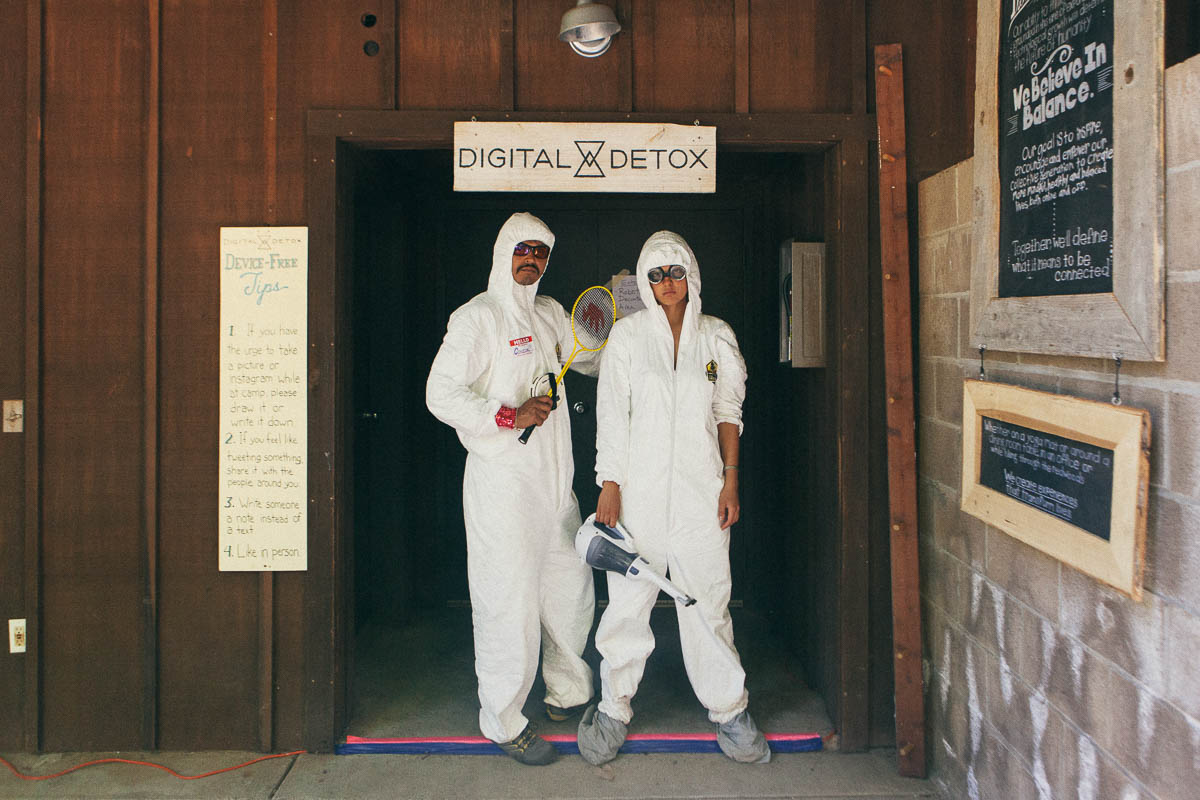
Camp Grounded will relaunch in May 2020 as two back-to-back weekend retreats at Northern California’s gorgeous Camp Mendocino. Attendees will again leave their devices in Tech Check lockers run by hazmat-suit wearing staffers, assume nicknames, and stop the work talk. They’ll get to play in the woods like technology never existed, indulging in Camp Grounded favorites from archery to arts & crafts to bonfire singalongs about enthusiastic consent. However, to simplify logistics, Camp Grounded won’t hold sessions in New York, North Carolina, or Texas any more.

The company will also organize more four-hour Unplugged Nights in cities around the country where partiers can switch off their phones and make new friends. The idea is to give a broader range of people a taste of the Grounded lifestyle in smaller doses. Those interested in early access to tickets for all of Digital Detox’s events can sign up here.

Camp Grounded’s Tech Check staffers confiscate attendees’ devices upon their arrival. Image Credit: Daniel N. Johnson

Meanwhile, Digital Detox will start a new business of education and certifications for K-12 schools, coaching teachers and parents on how to gently reduce students’ screentime. Schools will pay per student like a Software-As-A-Service model. Through research by a few PhDs, the company will recommend proper rules for using tech in and out of the classroom to minimize distraction, and empathetic penalties for violations.

The obvious question to ask, though, is if Bronzan is just some business guy coming to coin off the anti-tech trend and Felix’s legacy. “I’m not Apple coming in and buying the company. This isn’t a tech acquisition” Bronzan insists at a coffee shop in San Francisco. “I knew Levi before anyone else knew Levi. We went trick-or-treating and played in school band together. I want to the first Digital Detox summit, and brought my company year after year. I’ve been involved from the begginning, seeing Levi’s passion and inspiration.”

Levi Felix and Forest Bronzan (from left) in 1996

Fidget had an innately soothing camp counselor vibe to him that Bronzan doesn’t quite capture. He’d previously built and sold Email Aptitude, a CRM and email agency, not an event or education business. But he truly seems to mean well, and he’s earned the support of Digital Detox’s team.

“My mission was to find someone that was as excited and ferocious as Levi and I were when we started Digital Detox to further it as a movement” says Brooke Dean, Felix’s wife and co-founder. “It was imperative that the person running DD and CG had actually experienced the magic. This person had to be more than a lover of camp and nature, they also needed the hard skills and successful track record of running a company. Forest is stable, business-minded and also finds value in that very unique magic.”

Bronzan tells me the acquisition includes a cash component (“We’re not talking eight figures”) and a capital investment in the business, both funded by his email company’s exit. Two other individuals and one company had also expressed interest. Dean and Felix’s brother Zev will retain equity in the company, and she’ll stay on the board of directors. The trio are launching the Levi Felix Foundation that will donate money to brain cancer research.

While moving into education might seem like a left turn for Digital Detox after throwing events since 2012, Dean says “Levi was planning on going back to school and was deeply interested in being an academic in this field. We always believed that there needed to be evidence in order to convince the masses that being outside and connecting with other human beings ‘IRL’ is critical to our health and longevity.”

Some alarming stats the organization has already uncovered include:

  • 77% of people check or pretend to check their phone to avoid talking to others
  • 38% feel less connected to their partner or close friend due to cell phone use
  • Nearly 20% check their phone while having sex

“We want to eventually be the central source of tools on how tech is affecting lives and relationships at all age levels” Bronzan tells me. It’s zeroing in on how compulsive behaviors like endless scrolling increase anxiety and depression, and how parents glued to their devices train children to not be present. The father of two kids under age five, Bronzan knows a weekend at camp in your 20s or 30s is too little too late to seriously address the crisis of fractured attention.

Digital Detox’s new CEO says he’s heartened by the progression of some of Felix’s ideals, as with the Time Well Spent movement. The screentime dashboards launched by tech companies don’t do enough to actually change people’s actions, he says, though “They’re at least making some effort.” Digital Detox plans to launch a comprehensive quiz to determine how addicted you are to your phone, and Bronzan says he’d happily work with tech giants to integrate his company’s research.


On the camp for adults front, we’ve seen Burning Man go mainstream but lose some of what made it special including a lack of cell phone reception. It’s now common to see people on the playa staring at their phones, talking about work, and stressed about the clock — all of which are prohibited at Camp Grounded. Festivals like Coachella seem to get more corporate and less mindful each year. That leaves plenty of open space for Digital Detox to fill with purposeful breaks from the default world.

Bronzan also wants to introduce more surprise and serendipity to the event calendar. Camp Grounded will experiment with a “Mystery Trip” where eight to ten people sign up to be whisked away, only receiving a confidential briefing package the day before they show up. The point is to extract people from their routines where unhealthy habits manifest. Without connectivity, Camp Grounded hopes people will forge new connections in their minds, and with each other.

21 Nov 2019

The Flux Beamo is a $1500 laser cutter with simple but powerful software

Laser cutters are in a fun place right now. Gone are the days when the cheapest machines were tens of thousands of dollars, and when the “compact” models were roughly the size of a freezer. They’ve gotten affordable enough, and small enough, that a DIY home hobbyist can add it to their toolset without taking out a second mortgage or needing much more than some desk space… but they’re still a rare enough machine that saying “I’ve got a laser cutter!” makes people look at you like you’re a friggin’ wizard.

One of the latest entries into this space is beamo, a compact, 30W laser cutter and engraver built by Flux — a Taiwan-based team you might remember for raising $1.6M on Kickstarter with its Flux Delta 3D printer/scanner/engraver back in 2014.

As with Delta, Flux is turning to Kickstarter for the launch of beamo. They sprinted past their goal of $25,000 pretty quickly, currently sitting at roughly $350,000 raised with a little over a week to go. The early bird models are going for $849, with the company pinning the final MSRP at $1,500. Shipping/taxes aren’t included in those prices and can cost a couple hundred bucks, so factor that in to any purchasing decisions.

While I tend to be a bit hesitant when it comes to crowdfunded hardware (having been burned too many times by products that either never arrived or did arrive only to be total garbage), Flux has been down this road before; in addition to Delta, it also crowdfunded and shipped Beambox (a slightly bigger, pricier, but more powerful laser cutter) just a few months back. In the case of beamo, it seems like the Kickstarter is primarily meant to help get the word out, rather than literally “kickstarting” the process. Production is already underway, and units are already rolling off the line.

Flux sent me one of those early units to check out for a few weeks. I haven’t had it long enough to do what I’d call a “review”; with things like laser cutters with their myriad moving parts and… you know, lasers, new issues can pop up months after you open the box as components wear and maintenance is required. So consider this more of a “first impressions” kind of thing.

My first impressions, though, are good.

For reference, I’d classify myself laser experience as… moderate. More than most people you’d randomly ask, I’d wager, but less than if it were my job. I’ve put a hundred hours or so into training/creating with those aforementioned freezer-sized pro lasers, making everything from custom etched pint glasses, to bespoke Christmas ornaments, to personalized rubber stamps over the years. I tend to look for excuses to shoot lasers at things.

Getting it running

My beamo unit came ready to go right out of the box, mirrors aligned, moving parts all lubed up. I plugged it in, set up some basic ventilation, ran through about 10 minutes of software installation and configuration, and started firing away. It all just worked on the first shot.

Speaking of ventilation: you’ll need it. Laser cutting is basically a tiny, super controlled fire… and that means smoke. Depending on what you’re cutting, that smoke can be super noxious. Cutting wood? It won’t smell too bad, but its still not something you want in your lungs on the regular. Etching a logo into felt? It’ll smell like you’re burning a trash can full of hair. beamo uses a 200CFM exhaust fan to pull smoky air out of the machine, dumping it out through a 4″ exhaust hose that you’ll need to run through a window (or, if you’re feeling extra fancy, a dryer exhaust-style vent through a wall.) Expect to need about 8″ of clearance between the machine and any wall behind it for the exhaust hose and its bends, unless the path to the window is a straight shot.

The exhaust system is decent, but you’ll probably need to fiddle with how the hose runs to get it just right. If you’re venting through a window, you’ll want to figure out a way of sealing up the open gaps around the hose to limit any fumes that might float back into the room. Put time into getting it right. If the room still smells smokey hours after you’ve cut, you’ll want to keep working on your ventilation. You don’t want to breath that stuff in, especially if you’re running the laser more than occasionally.

Beamo’s built-in touchscreen. You’ll mostly control it over WiFi, but you can access some basic functionality and monitor job progress here.

If you’re new to laser cutting, you should also put the time into learning what you shouldn’t put in these machines. Some materials are safe to laser cut, but tend to catch on fire easily. Some materials will just melt and screw up your machine. Other things (PVC!) will straight up emit chlorine gas when you hit them with a laser. If you’re moving beyond the basics of cutting thin wood/acrylic/cardboard or engraving glass, research it.

So what SHOULD you cut? Woods are a good go-to (though you’ll want to limit it to less oily stuff — because, again, fire.) Cardboard is fun to cut for things like spray paint stencils. Leather is good, with practice, and you can do all sorts of really neat stuff with acrylic. You can’t cut glass, but you can engrave it; same goes for rubber, though that’s one you’ll want to source from a place that sells materials known to be laser safe.

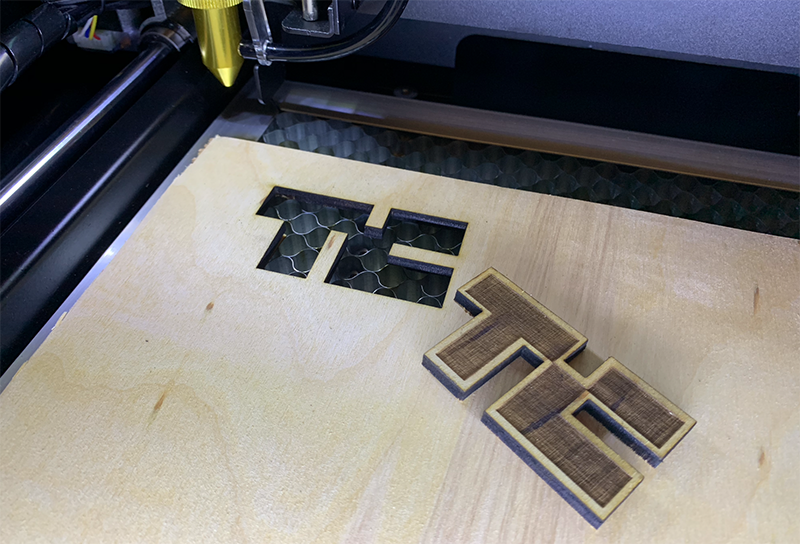
The thickness of the material you can cut tends to be limited by a laser’s wattage, while height/width is generally limited by the size of the work area. At 30W, beamo’s laser can slice its way through wood about 1/8″ thick; its work area, meanwhile, comes in at 11.81″ x 8.27″. You can make a lot of cool stuff within those bounds, but be aware of them — buying a bunch of material only to get it home and realize you’re a few watts short of a complete cut is a bummer. If you foresee needing deeper cuts or bigger pieces, beefier lasers exist without too massive a leap in price. As examples: Flux’s other laser cutter, the $2500 Beambox, bumps the laser up to 40W and the work area up to 15.7″ x 14.7; the $2500 base model from competitor Glowforge comes in at 40W with a work area of roughly 11″ x 19.5″.

(One potential advantage of beamo over the company’s previously released Beambox: whereas Beambox requires you to regularly fill up a water cooling reservoir to keep it running, beamo’s water cooling is closed-loop, so the same water just keeps circulating. I’m interested to see how this holds up over time.)

Fire the lasers!
Got everything plugged in, ventilation set up, and your materials purchased? Time to cut! Well, almost.

You’ll mostly be controlling beamo through Beam Studio, a free piece of software provided by Flux for Windows, macOS, and Ubuntu. As far as laser cutting software goes, I’m really quite pleased with it so far.

Beam Labs is super straight forward, but darn powerful for a free companion app. If you’re looking to cut out basic shapes, etch text, or lay down some bezier curves, it can do it. Want to etch a picture of your dog into some wood to make a keychain? Just drop an image onto the work area, scale as desired, then move a slider to tweak the black/white threshold until it looks right. You can work in layers, setting up a raster layer to be etched and then a vector layer to cut it out immediately after.

Beamo has a built-in camera system, allowing you to quickly scan the work bed before dragging and dropping your designs wherever you want them. The first time you connect to beamo, you’ll be asked to align the camera — a process that was considerably simpler than I expected. Put a piece of paper on the work bed, and beamo will fire a quick test pattern into it. Beam Studio will then snap a picture of what it just etched, projecting an overlay of where it thinks the test pattern is versus its scan. Nudge the overlay around until everything is perfectly stacked, and you’re set. You’ll want to re-run this alignment process every once in a while (it’s quick) if you need precise placement.
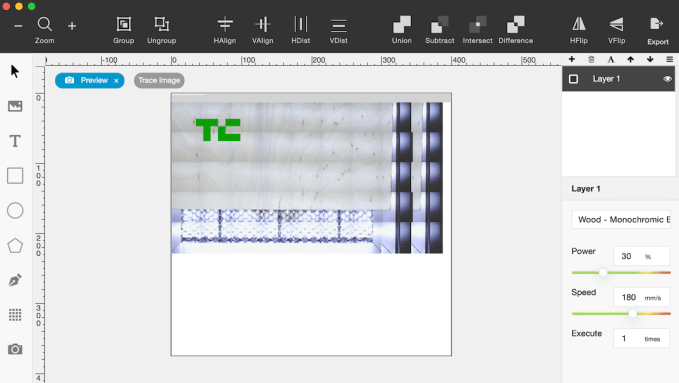
The camera system here really incredibly useful. After about 30 minutes with beamo, I was doing things that are at best annoying on camera-less cutters — things like etching a design, cutting it out, then immediately flipping the cut piece and etching on the other side without worrying about precarious placement. I just rescanned the work bed, dragged the image where I wanted it on the freshly-cut side B, and fired away.

The camera is quick, but not instant. Scanning the entire work area takes about 60 seconds. If you only need a certain area scanned (like, say, the top half of work area, or the rough area around something you’ve already cut), fortunately, that’s an option. Just drag the scanning boundary box accordingly.

If you need to do something beyond what the free software can handle (or if you just prefer working in apps like CorelDraw or Illustrator), Beam Labs can import JPGs, PNGs, and SVGs.

While more capable than I expected, the software isn’t without its quirks. Beam Labs will try to keep you updated with a progress ticker, but don’t rely on it too much for predicting timing. I’ve had projects shoot up to 40% in the first thirty seconds, only to take 5 minutes for the rest to complete. There was an occasion or two where the software threw out an error in Mandarin that I didn’t want to dismiss without a quick pass through Google Translate… but for the most part, it was solid, stable, and fun to use.

In its base configuration, beamo’s laser is manually focused, meaning you’ll need to focus things by hand each time you place new material inside the machine. Fortunately, focusing it is super straight forward: put material in, rotate a piece of acrylic attached to the laser head, lower the laser head until the acrylic is just barely touching the material, then lock the laser head back in place and lift the acrylic out of the way.

Flux says that it’ll ship a $250 add-on module that introduces autofocus to the mix, but I didn’t get to test that. They’re also working on a $499 rotary add-on which will let you etch designs onto cylindrical items (think shot/pint glasses), but out of the box, it’s flat stuff only.

As with every single laser I’ve ever worked with, working with a new material — or even, sometimes, the same material from a different source — requires some fiddling. You’ll be tweaking the speed at which the laser moves, the power of the laser, and how many passes it makes over the same path; you want to keep the power low enough to minimize scorching and maximize the life of the laser, while making sure you’ve done enough repeat passes to cut completely through. Beam Labs comes with a bunch of presets for different materials that can get you pretty close (and you can save your own favorites, once you’ve found them), but expect to experiment a little when you’re working with a new material for the first time. Buy extra material.

As for noise: operating with fans running full force, it’s not what I’d call “quiet,” but it’s not so loud that it’s uncomfortable to sit next to. The company’s specs pin it at around 65 db — louder than your average conversation, but a bit quieter than, say, a vacuum. The fans do whir endlessly when the machine is idling, so you’ll probably want to cut the power between cutting sessions.

If for some reason you need to open the lid while the laser is operating, beamo’s built-in automatic kill switch should instantly cut power to the laser to protect your eyes. While the company says that the acrylic lid provides sufficient eye protection for beamo’s 30W Class 1 laser (though they note that you shouldn’t stare right at the laser beam, lid or not), I absolutely recommend picking up and wearing a pair of CO2 laser safety goggles especially when it comes time to pop the machine open and adjust the laser. Speaking of…

Foreseeable Maintenance

Maintenance is an inevitable part of owning a laser cutter. As noted, I’ve only had the laser set up for a few weeks and everything came well configured, so I haven’t had to go digging under the hood yet. If something suddenly breaks on me during my time with the cutter, I’ll update this post accordingly. But either way, maintenance will be part of the process for owners.

Even if nothing breaks unexpectedly, some of the parts involved are “consumable” and thus expected to wear down with use. The lens, mirror, and laser tube, for example, are expected to last about a year with regular use, according to the company’s estimates. The team says those parts should cost about $19, $9, and $139 to replace, respectively, and you’ll be able to buy them through their online store. Plan ahead for those recurring costs, and make sure you’re comfortable with the idea of eventually tearing the machine apart before you dive in.

Overall, though, so far so good. The machine looks pretty great on a table; it’s not quite as shiny and Apple-y as a Glowforge, but it should blend into a home office or studio pretty easily. It’s light enough to be easily moved by two people, and took me all of a few minutes to get up and running. If you don’t mind the occasional software hiccup, can figure out sufficient ventilation, are mostly working on projects that fit within beamo’s wattage/work area capabilities, and are down to get under the hood for maintenance at least once a year, beamo seems like a solid machine so far.


21 Nov 2019

Keywee introduces a new Loyalty Score to help publishers reach the most valuable readers

I don’t want to hurt your feelings, but here’s the truth: Not all readers are created equal.

At least, that’s how things look from a user acquisition perspective, where publishers running ad campaigns to reach new readers might end up bringing in a whole bunch of random visitors who are unlikely to ever return their site again.

“It’s less about just getting eyeballs on the content,” said Jared Lansky, chief commercial officer at marketing startup Keywee. “Loyalty is just more valuable for publishers.”

Keywee (backed Eric Schmidt’s Innovation Endeavors and The New York Times) is trying to solve this problem with a new feature called the Loyalty Score. Lansky told me that the score does exactly what the name suggests – it measures reader loyalty, based on how many times someone returns to the site and how many pages they view.

This, in turn, can help publishers make smarter decisions about growth. They can see which of the Facebook ad campaigns run through Keywee are actually bringing in loyal readers and which aren’t. And they can tweak the campaigns accordingly, targeting audiences and highlighting articles in a way that’s most likely to attract loyal readers rather than random visitors.

The score can also shape the way that publishers interact with visitors on their own site. For example, if they’re trying to build a subscription business, they can target their subscription offers and paywalls at readers with a higher Loyalty Score.

Lansky also noted that the data used to calculate the score comes from the Keywee pixel and the Facebook pixel, with no additional data collection required.

“Loyalty Score has given us a whole new world of insights into our user acquisition campaigns,” said Kiplinger.com Director of Digital Operations & Advertising Andy Price in a statement. “For example, we’re seeing that promoting content that talks about planning for retirement drives more return visitors than posts about saving money on groceries.”

21 Nov 2019

Linear lines up $4.2M led by Sequoia to build a better platform for software developer collaboration

Software will eat the world, as the saying goes, but in doing so, some developers are likely to get a little indigestion. That is to say, building products requires working with disparate and distributed teams, and while developers may have an ever-growing array of algorithms, APIs and technology at their disposal to do this, ironically the platforms to track it all hasn’t evolved with the times. Now three developers have taken their own experience of that disconnect to create a new kind of platform, Linear, which they believe addresses the needs of software developers better by being faster and more intuitive.

Today, Linear is announcing a seed round of $4.2 million led by Sequoia, with participation also from Index Ventures and a number of investors, startup founders and others that will also advise Linear as it grows. They include Dylan Field (Founder and CEO, Figma), Emily Choi (COO, Coinbase), Charlie Cheever (Co-Founder of Expo & Quora), Gustaf Alströmer (Partner, Y Combinator), Tikhon Berstram (Co-Founder, Parse), Larry Gadea (CEO, Envoy), Jude Gomila (CEO, Golden), James Smith (CEO, Bugsnag), Fred Stevens-Smith (CEO, Rainforest), Bobby Goodlatte, Marc McGabe, Julia DeWahl and others.

Cofounders Karri Saarinen, Tuomas Artman, and Jori Lallo — all Finnish but now based in the Bay Area — know something first-hand about software development and the trials and tribulations of working with disparate and distributed teams. Saarinen was previously the principal designer of Airbnb, as well as the first designer of Coinbase; Artman had been staff engineer and architect at Uber; and Lallo also had been at Coinbase as a senior engineer building its API and front end.

“When we worked at many startups and growth companies we felt that the tools weren’t matching the way we’re thinking or operating,” Saarinen said in an email interview. “It also seemed that no-one had took a fresh look at this as a design problem. We believe there is a much better, modern workflow waiting to be discovered. We believe creators should focus on the work they create, not tracking or reporting what they are doing. Managers should spend their time prioritizing and giving direction, not bugging their teams for updates. Running the process shouldn’t sap your team’s energy and come in the way of creating.”

All of that translates to, first and foremost, speed and a platform whose main purpose is to help you work faster. “While some say speed is not really a feature, we believe it’s the core foundation for tools you use daily,” Saarinen noted.

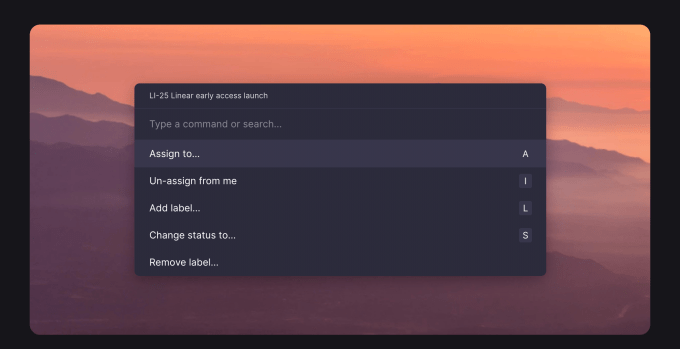
A ⌘K command calls up a menu of shortcuts to edit an issue’s status, assign a task, and more so that everything can be handled with keyboard shortcuts. Pages load quickly and synchronise in real time (and search updates alongside that). Users can work offline if they need to. And of course there is also a dark mode for night owls.

The platform is still very much in its early stages. It currently has three integrations based on some of the most common tools used by developers — GitHub (where you can link Pull Requests and close Linear issues on merge), Figma designs (where you can get image previews and embeds of Figma designs), and Slack (you can create issues from Slack and then get notifications on updates). There are plans to add more over time.

We started solving the problem from the end-user perspective, the contributor, like an engineer or a designer and starting to address things that are important for them, can help them and their teams,” Saarinen said. “We aim to also bring clarity for the teams by making the concepts simple, clear but powerful. For example, instead of talking about epics, we have Projects that help track larger feature work or tracks of work.”

Indeed, speed is not the only aim with Linear. Saarinen also said another area they hope to address is general work practices, with a take that seems to echo a turn away from time spent on manual management and more focus on automating that process.

“Right now many companies you have to manually move things around, schedule sprints all kinds other minor things,” he said. “We think that next generation tools should have built in automated workflows that help teams and companies operate much more effectively. Teams shouldn’t spend a third or more of their time a week just for running the process.”

The last objective Linear is hoping to tackle is one that we’re often sorely lacking in the wider world, too: context.

“Companies are setting their high-level goals, roadmaps and teams work on projects,” he said. “Often leadership doesn’t have good visibility of what is actually happening and how projects are tracking. Teams and contributors don’t always have the context or understanding why they are working on the things, since you cannot follow the chain from your task to the company goal. We think that there are ways to build Linear to be a real time picture what is happening in the company when it comes to building products, and give the necessary context for everyone.”

Linear is a late entrant in a world filled with collaboration apps, and specifically workflow and collaboration apps targeting the developer community. These include not just Slack and GitHub, but Atlassian’s Trello and Jira, as well as Asana, Basecamp and many more.

Saarinen would not be drawn out on which of these (or others) that it sees as direct competition, noting that none are addressing developer issues of speed, ease of use and context as well as it is.

“There are many tools in the market and many companies are talking about making ‘work better,'” he said. “And while there are many issue tracking and project management tools, they are not supporting the workflow of the individual and team. A lot of the value these tools sell is around tracking work that happens, not actually helping people to be more effective. Since our focus on the individual contributor and intelligent integration with their workflow, we can support them better and as a side effect makes the information in the system more up to date.”

Stephanie Zhan, the partner at Sequoia whose speciality is seed and Series A investments and who has led this round, said that Linear first came on her radar during when it first launched its private beta (it’s still in private beta and has been running a waitlist to bring on new users. In that time it’s picked up hundreds of companies, including Pitch, Render, Albert, Curology, Spoke, Compound and YC startups including Middesk, Catch and Visly). The company had also been flagged by one of Sequoia’s Scouts, who invested earlier this year

Although Linear is based out of San Francisco, it’s interesting that the three founders’ roots are in Finland (with Saarinen in Helsinki this week to speak at the Slush event), and brings up an interesting trend of Silicon Valley VCs looking at founders from further afield than just their own back yard.

“The interesting about Linear is that as they’re building a software company around the future of work, they’re also building a remote and distributed team themselves,” Zahn said. The company currently has only four employees.

In that vein, we (and others, it seems) had heard that Sequoia — which today invests in several Europe-based startups, including Tessian, Graphcore, Klarna, Tourlane, Evervault  and CEGX — has been eyeing up establishing a more permanent presence in this part of the world, specifically in London.

Sources familiar with the firm, however, tell us that while it has been sounding out VCs at other firms, saying a London office is on the horizon might be premature, as there are as yet no plans to set up shop here. However, with more companies and European founders entering its portfolio, and as more conversations with VCs turn into decisions to make the leap to help Sequoia source more startups, we could see this strategy turning around quickly.

21 Nov 2019

MIT researchers develop a much better way to optimize the control of soft robots

MIT researchers have developed a new way to optimize how soft robots perform specific tasks – a huge challenge when it comes to soft robotics in particular, because robots with flexible bodies can basically move in an infinite number of ways at any given moment, so programming them to do something in the best way possible is a monumental task.

To make the whole process easier and less computationally intensive, the research team has developed a way to take what is effectively a robot which can move in infinite possible dimensions and simplify it to a representative ‘low-dimensional’ model that can accurately be used to optimize movement, based on environmental physics and the natural ways that soft objects shaped like any individual soft robot is actually most likely to bend in a giving setting.

So far, the MIT team behind this has demonstrated it in simulation only, but in this simulated environment it’s seen significant improvements in terms of both speed and accuracy of programmed movement of robots vs. methods used today that are more complex. In fact, across a number of tests of simulated robots with both 2D and 3D designs, and two- and four-legged physical designs, the researchers were able to show that optimizations that would normally task as many as 30,000 simulations to achieve were instead possible in just 400.

Why is any of this even important? Because it basically shrinks drastically the amount of computational overhead required to get good movement results out of soft robots, which is a key ingredient in helping make them partial to actually use in real-life applications. If programming a soft robotic to do something genuinely useful like navigate and effect an underwater damage assessment and repair requires huge amounts of processing power, and significant actual time, it’s not really viable for anyone to actually deploy.

In the future, the research team hopes to bring their optimization method out of simulation and into real-world testing, as well as full-scale development of soft robots from start to finish.

21 Nov 2019

Define and manage growth on your own terms

Welcome to this edition of The Operators, a recurring Extra Crunch column, podcast, and YouTube show that brings you insights and information from inside top tech companies. Our guests are execs with operational experience at fast-rising startups, like Brex, Calm, DocSend, and Zeus Living, and more established companies, like AirBnB, Facebook, Google, and Uber. Here, they share strategies and tactics for building your first company and charting your career in tech.

In this episode, we’re talking about growth. Growth means different things at different companies, but correctly identifying avenues for sustainable and scalable growth is a priority for almost all companies. We’ll cover:

  1. Defining growth and being good at it
  2. Managing growth without losing sight of the big picture
  3. How companies should approach growth

To learn more, we spoke with two experts:

Isaac Silverman began his career as an entrepreneur before joining Zynga to work on growth development. At Zynga, he focused on some of the most cutting-edge approaches to growth and development. He then moved to Postmates, where he focused on growth product and is now the head of rider growth at Uber.

Matias Honorato is a senior manager on the growth team at Tally, a growth-stage tech company, and also brings his own entrepreneurial roots and experience at companies like Earnest and Tradecraft.

Below is a summary of our conversation; check out The Operators for the full episode.

Defining growth and being good at it

Growth as a concept and discipline originates from the term “growth hacking.” It can be hard to grasp as distinct from functions and goals that usually sit with the marketing team or product development team and may be best thought of as a combination of both. We think of it as the domain responsible for designing, implementing, and measuring approaches to acquiring and retaining customers. It’s a mix of marketing and product, but also sales and data analytics, and sometimes even operations.

Great growth professionals can be successful with a wide variety of work or educational backgrounds, and are most often curious, persistent, and adept at thinking holistically, creatively, quantitatively, and interdisciplinarily.

“There’s definitely a lot of deep analysis and how all the pieces fit together and there’s a lot of product work, and there’s a lot of marketing work,” said Silverman. “I think part of what I find so deeply interesting and engaging about it is it brings together everything. It’s really the exercise we go through, and I don’t want to overstate our role, but the exercise we go through is, ‘let’s imagine that we’re the CEO and what are the things that we think are really important. Let’s see the whole picture and then figure out what are the areas that we should ultimately focus on within it.’ So that is ultimately deeply, deeply, stimulating and dynamic and changes on a day to day basis. And sometimes it’s more product manager-y, sometimes it’s more something else.”

Honorato said that to be a great growth professional, “you have to have a really good understanding of your business, what are your goals, how the product works, how their financial side of the business works.”

The responsibilities of growth teams range from simple tasks like split-testing marketing copy and landing pages to more complex strategies like enabling the integration of a file storage and management solution into workflow applications and then subsequently partnering with those workflow applications to acquire users and become a default solution. Being cross-functional in nature, growth initiatives often require resources and contributions from other teams like marketing, design, and engineering. This can create conflict due to resource constraints and company politics, regardless of how small or large a company is. These are meaningful challenges before even evaluating the effectiveness of growth initiatives! Great growth teams must know how to navigate these types of issues as well, making effective growth teams hard to build, but very valuable if you can build an effective one.

“I tend to believe teams exist on spectrum,” said Silverman. “You got that sort of optimizer or specific functionality or specific parts of the funnel or whatever growth themes and then in the spectrum you have, the entire purpose of the company after you’ve achieved product market fit is to grow. I tend to believe that a lot of companies think they need the former and actually need the latter… One thing that I want to make sure is absolutely clear, the growth at Uber is the product of a very high number of very, very competent people, very diligently thinking about their part of the business, and [growth is] a portion of that much, much larger equation.”

Managing growth without losing sight of the big picture

21 Nov 2019

The top 1% of app store publishers drive 80% of new downloads

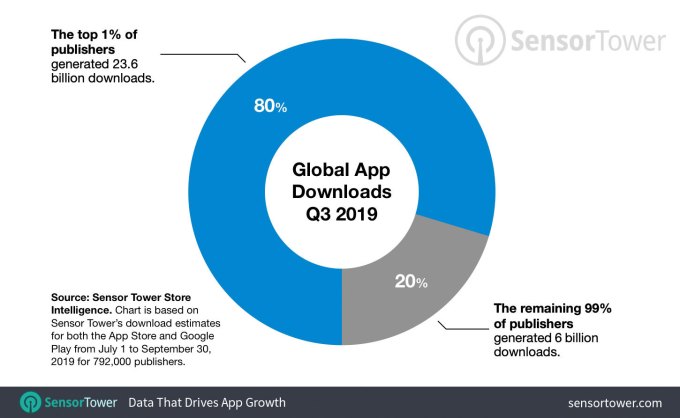
The current app store ecosystem doesn’t favor the indie developer. According to new data from Sensor Tower, the top 1% of publishers globally accounted for a whopping 80% of the total 29.6 billion app downloads in the third quarter of 2019. That means just 20%, or 6 billion, downloads are left for the rest of the publishers.

This bottom 99%, which equates to roughly 784,080 publishers, averaged approximately 7,650 downloads each during the quarter. To put that in context, that’s less than one-thousandth of a percent of the downloads Facebook generated in the quarter (682M).

The data should not be all that surprising, given that larger, social platforms like Facebook and YouTube already serve audiences of over a billion. But it is concerning how uneven the market for new apps remains, especially considering that the number of available apps continues to expand, which makes the competition even more difficult.

The report notes there were over 3.4 million apps available across the App Store and Google Play in 2018, up 65% from the 2.2 million apps available in 2014. But the number of apps that were able to achieve at least 1,000 installs has been declining over that same period — from 30% to 26%.

Focusing only on games, the top 1% of publishers — or 1,080 out of a total 108,000 publishers — saw 9.1 billion downloads out of the total 11.1 billion, or 82%. This averages out to more than 8.4 million installs each. The remaining 18% of downloads, or 2 billion, were shared among the remaining 106,920 publishers. That averages out to around 18,000 downloads each.

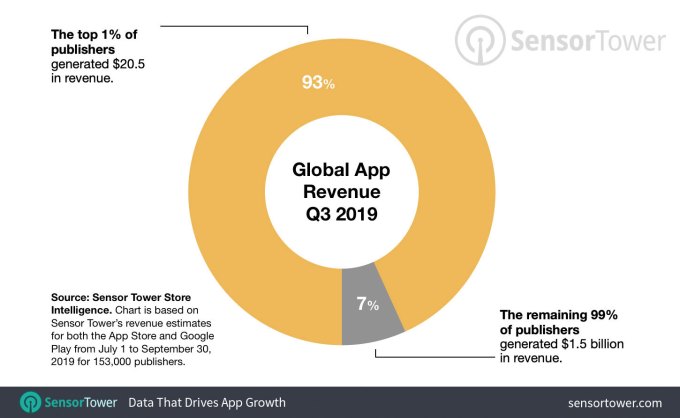
When apps were analyzed by revenue, the gap was wider. Just 1,526 publishers generated $20.5 billion out of the total $22 billion in revenue in the quarter. Meanwhile, the remaining $1.5 billion was split among 151,056 publishers, averaging out around $9,990 each.

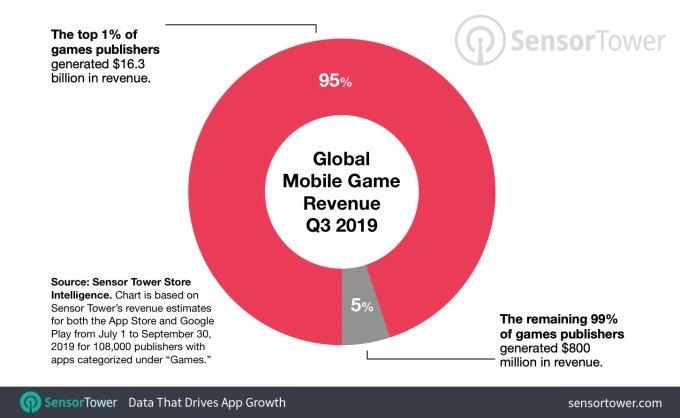
In terms of games revenue alone, the 445 publishers that make up the top 1 percent generated $15.5 billion in revenue, or 95% of all revenue, with the remaining $800 million split between the 44,029 publishers in the bottom 99%. This averages out to around $18,100 each.

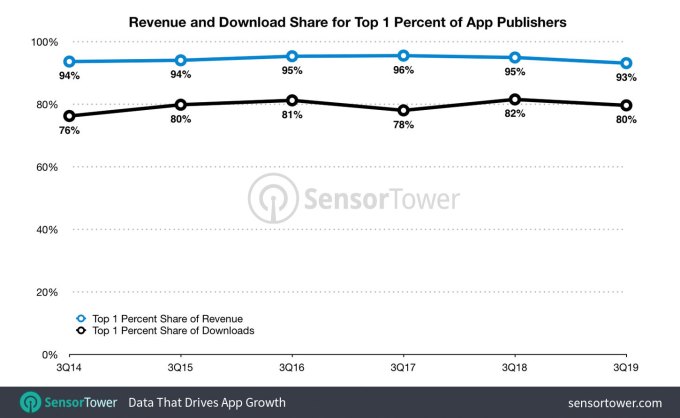
None of these are new trends, Sensor Tower also notes. There hasn’t been much fluctuation in the top 1% share of installs or revenue for years. That means the large majority of publishers will compete for a minority of new users and installs.

Image credits: Sensor Tower