Category: UNCATEGORIZED

21 Nov 2019

Facebook Dating now integrates with Instagram and Facebook Stories

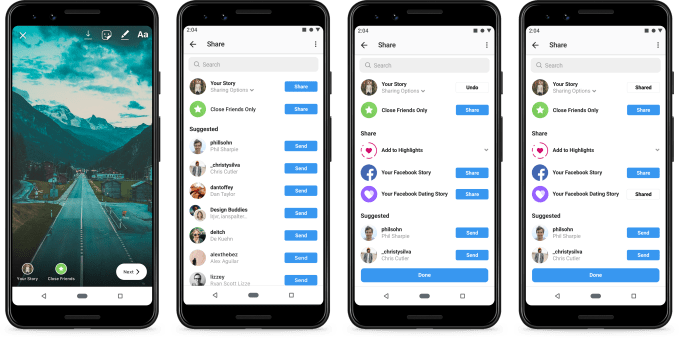
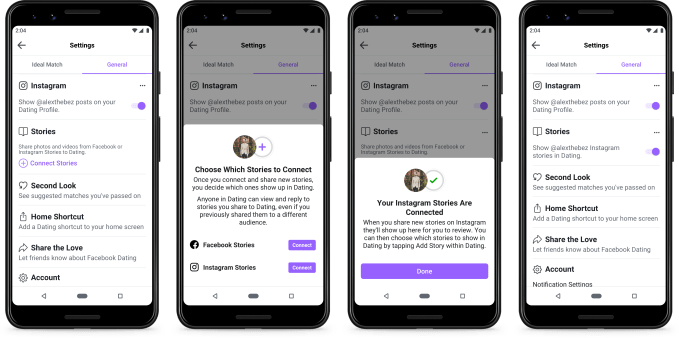
Facebook Dating, an opt-in feature of the main Facebook app, will begin to tap into the content users are already creating across both Facebook and Instagram to enhance its service. Today, Facebook Dating users will be able to add their Facebook or Instagram Stories to Facebook Dating, in order to share their everyday moments with daters.

As opposed to more polished profile photos, Stories can give someone better insight into what a person is like by showcasing what activities they like to engage in, their hobbies, their interests, their personality, and their humor, among other things. And if the daters themselves appear in a Story, it lets others see what they really look like, even if their online photos are out-of-date.

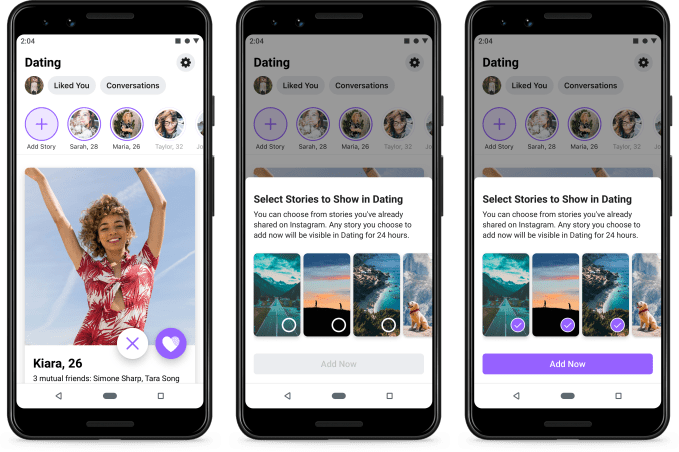
The way the feature is being implemented on Facebook Dating puts the user in control of what’s being shared. That is, your Facebook or Instagram Stories are not automatically copied over to Facebook Dating by default. Instead, users can select which of their Stories are shared and which are not.

In addition, people daters have blocked or passed on Facebook Dating won’t be able to see them.

If a Story is inappropriate, you can also block the user and report it, like you can with other content elsewhere on Facebook.

One thing to be aware of is that this feature is a way to share a Story to Facebook Dating, but the Story isn’t exclusively designed for Facebook Dating. That means, if you decide to use the Story feature as some sort of video dating intro, your Facebook and Instagram friends could see this, as well.

When browsing Facebook Dating, you’ll be able to view other people’s Stories along with their profiles. And if you match with someone, you can continue to view their Stories and then even use that to spark a conversation, which takes place in the app. This is similar to how you can respond to someone’s Facebook or Instagram Story today, which then appears in Messenger or Instagram’s Messages section, respectively.

The new Stories feature could be a potential competitive advantage for Facebook Dating, because it allows users a new way to express themselves without requiring them to create new content just for the dating service itself. Even if a rival dating app like Tinder or Bumble introduced their own version of Stories, many wouldn’t think to launch a dating app to capture their everyday moments.

Stories integration is rolling out starting today to Facebook Dating.

Dating, as a Facebook feature, is currently available in 20 countries, including Argentina, Bolivia, Brazil, Canada, Chile, Colombia, Ecuador, Guyana, Laos, Malaysia, Mexico, Paraguay, Peru, the Philippines, Singapore, Suriname, Thailand, United States, Uruguay, and Vietnam. It will be in Europe by early 2020, Facebook says.

The company has not disclosed how many people are using Facebook Dating at this time.

21 Nov 2019

Google will now pay up to $1.5 million for very specific Android exploits

When Google first introduced its bug bounty program for Android, the biggest reward you could get for finding and reporting a potential exploit was $38,000.

The cap grew over time, as Android grew in popularity, more security researchers got on board, and more vulnerabilities were unearthed. This morning, Google is bumping its top reward up to $1.5 million dollars.

They’re not going to pay out a million+ for just any bug, of course.

For this new reward category, Google is looking for “full chain remote code execution exploit with persistence which compromises the Titan M secure element on Pixel devices”. In other words, they’re looking for an exploit that, without the attacker having physical access to the device, can execute code even after a device is reset and breaks into the dedicated security chip built into the Pixels.

Reporting an exploit that fits that bill will get researchers up to $1M. If they can do it on “specific developer preview versions” of Android, meanwhile, there’s a 50% bonus reward, bumping the maximum prize up to $1.5M.

Google first introduced the Titan M security chip with the Pixel 3. As Google outlines here, the chip’s job is essentially to supervise; it double checks boot conditions, verifies firmware signatures, handles lock screen passcodes, and tries to keep malicious apps from forcing your device to roll back to “older, potentially vulnerable” builds of Android. The same chip can be found in the Pixel 4 line-up.

$1.5 million for a single exploit sounds like a lot… and it is. It’s roughly what Google paid out for all bug bounties in the last 12 months. The top reward this year, the company says, was $161,337 for a “1-click remote code execution exploit chain on the Pixel 3 device”. Average payout, meanwhile, was about $3,800 per finding. Given the potential severity of persistently busting through the security chip on what’s meant to be the flagship form of Android, though, a wild payout makes sense.

21 Nov 2019

YouTube to update harassment and gaming policies, clarify changes to kids content

In YouTube CEO Susan Wojcicki quarterly letter, released today, the exec addresses a number of changes to YouTube policies, including the recent FTC-mandated rules for kids content that have alternately confused and infuriated video creators, as well as forthcoming policies around harassment and gaming videos, among other things.

On the latter, Wojcicki said the company was now in the process of developing a new harassment policy and was talking to creators about what needed to be addressed. She did not give an ETA for the rollout, but said creators would be posted when the changes were finalized.

YouTube also responded to creator concerns over policies around gaming videos that include violence.

“We’ve heard loud and clear that our policies need to differentiate between real-world violence and gaming violence,” Wojcicki said. “We have a policy update coming soon that will do just that. The new policy will have fewer restrictions for violence in gaming, but maintain our high bar to protect audiences from real-world violence.”

This topic was recently discussed at YouTube’s Gaming Creator Summit, as well.

The company also said it’s now working to match edgier content with advertisers who may be interested in it –like a marketer who wants to promote an R-rated movie, for example.

The letter briefly addressed the creator uproar over kids’ content, with promises of more clarity.

In September, YouTube reached a settlement with the Federal Trade Commission over its violation of the Children’s Online Privacy Protection Act (COPPA), which required it to pay a $170 million fine and set into place a series of new rules for creators to comply with. These rules require creators to mark videos that are directed at kids (or entire channels, if need be.). This, in turn, will limit data collection, put an end to personalized ads on kids’ content, disable comments, and reduce their revenues, creators say.

Creators will also lose out on a number of key YouTube features, The Verge recently reported, including click-through info cards, end screens, notification functions, and the community tab.

YouTube creators say they don’t have enough clarity around where to draw the line between content that’s made for kids and content that may attract kids. For example, family vlog channels and some gaming videos may appeal to kids and adults alike. And if the FTC decides a creator is in violation, they can be held liable for future COPPA violations now that YouTube’s new policy and content labeling system is in place. YouTube’s advice to creators on how to proceed? Consult a lawyer, it has said.

In today’s letter, Wojcicki acknowledges the fallout of these changes, but doesn’t offer any further clarity — only promises of updates to come.

“We know there are still many questions about how this is going to affect creators and we’ll provide updates as possible along the way,” Wojcicki said.

She also points to a long thread on the YouTube Community forum where many questions about the system are being answered — like the policy’s reach, what’s changing, how and when to mark content as being for kids or not, and more. The forum’s Q&A also addressed some of the questions that keep coming up about all-ages content, including some example scenarios. Creators, of course, have read through these materials and say they still don’t understand how to figure out if their video is for kids or not. (And clearly, they don’t want to err on the side of caution at the risk of reduced income.)

The being said, the rise of a kid-friendly YouTube has had a range of negative consequences. YouTube had to shut down comments after finding a ring of child predators on videos with kids, for instance. Parents roped in their kids to the “family business” before the children even knew what being public on the internet meant. Some young stars have been put to work more than should be legal due to the lack of child labor laws for online content. There’s even been child abuse at the hands of the parents. Children watching the vides, meanwhile, were being marketed to without their understanding, addicted to consumerism by toy unboxings and playtime videos, and targeted with personalized ads. Kid YouTube was overdue for a reigning in.

The letter addresses a few other key issues, as well, including the launch of the new Creator Studio and the latest on the EU’s copyright directive Article 17, which is now being translated into local law. Wojcicki cheers some of the changes to the policy, including the one that secures liability protections when YouTube makes its best efforts to match copyright material with rights owners.

And Wojcicki addresses the growing concerns over creator burnout, by reminding video creators to take a break and practice self-care — adding that it won’t harm their business by doing so. In fact, YouTube scoured its data from the past 6 years and found that on average, channels both large and small had more views when they returned than they had right before they left.

“If you need to take some time off, your fans will understand,” she said.


21 Nov 2019

YouTube to update harassment and gaming policies, clarify changes to kids content

In YouTube CEO Susan Wojcicki quarterly letter, released today, the exec addresses a number of changes to YouTube policies, including the recent FTC-mandated rules for kids content that have alternately confused and infuriated video creators, as well as forthcoming policies around harassment and gaming videos, among other things.

On the latter, Wojcicki said the company was now in the process of developing a new harassment policy and was talking to creators about what needed to be addressed. She did not give an ETA for the rollout, but said creators would be posted when the changes were finalized.

YouTube also responded to creator concerns over policies around gaming videos that include violence.

“We’ve heard loud and clear that our policies need to differentiate between real-world violence and gaming violence,” Wojcicki said. “We have a policy update coming soon that will do just that. The new policy will have fewer restrictions for violence in gaming, but maintain our high bar to protect audiences from real-world violence.”

This topic was recently discussed at YouTube’s Gaming Creator Summit, as well.

The company also said it’s now working to match edgier content with advertisers who may be interested in it –like a marketer who wants to promote an R-rated movie, for example.

The letter briefly addressed the creator uproar over kids’ content, with promises of more clarity.

In September, YouTube reached a settlement with the Federal Trade Commission over its violation of the Children’s Online Privacy Protection Act (COPPA), which required it to pay a $170 million fine and set into place a series of new rules for creators to comply with. These rules require creators to mark videos that are directed at kids (or entire channels, if need be.). This, in turn, will limit data collection, put an end to personalized ads on kids’ content, disable comments, and reduce their revenues, creators say.

Creators will also lose out on a number of key YouTube features, The Verge recently reported, including click-through info cards, end screens, notification functions, and the community tab.

YouTube creators say they don’t have enough clarity around where to draw the line between content that’s made for kids and content that may attract kids. For example, family vlog channels and some gaming videos may appeal to kids and adults alike. And if the FTC decides a creator is in violation, they can be held liable for future COPPA violations now that YouTube’s new policy and content labeling system is in place. YouTube’s advice to creators on how to proceed? Consult a lawyer, it has said.

In today’s letter, Wojcicki acknowledges the fallout of these changes, but doesn’t offer any further clarity — only promises of updates to come.

“We know there are still many questions about how this is going to affect creators and we’ll provide updates as possible along the way,” Wojcicki said.

She also points to a long thread on the YouTube Community forum where many questions about the system are being answered — like the policy’s reach, what’s changing, how and when to mark content as being for kids or not, and more. The forum’s Q&A also addressed some of the questions that keep coming up about all-ages content, including some example scenarios. Creators, of course, have read through these materials and say they still don’t understand how to figure out if their video is for kids or not. (And clearly, they don’t want to err on the side of caution at the risk of reduced income.)

The being said, the rise of a kid-friendly YouTube has had a range of negative consequences. YouTube had to shut down comments after finding a ring of child predators on videos with kids, for instance. Parents roped in their kids to the “family business” before the children even knew what being public on the internet meant. Some young stars have been put to work more than should be legal due to the lack of child labor laws for online content. There’s even been child abuse at the hands of the parents. Children watching the vides, meanwhile, were being marketed to without their understanding, addicted to consumerism by toy unboxings and playtime videos, and targeted with personalized ads. Kid YouTube was overdue for a reigning in.

The letter addresses a few other key issues, as well, including the launch of the new Creator Studio and the latest on the EU’s copyright directive Article 17, which is now being translated into local law. Wojcicki cheers some of the changes to the policy, including the one that secures liability protections when YouTube makes its best efforts to match copyright material with rights owners.

And Wojcicki addresses the growing concerns over creator burnout, by reminding video creators to take a break and practice self-care — adding that it won’t harm their business by doing so. In fact, YouTube scoured its data from the past 6 years and found that on average, channels both large and small had more views when they returned than they had right before they left.

“If you need to take some time off, your fans will understand,” she said.


21 Nov 2019

Reserve your demo table at TC Sessions: Robotics & AI 2020

Robotics and AI is the hottest scientific mashup since The Big Bang Theory’s Sheldon Cooper met Amy Farrah Fowler. If you play a role in these world-changing technologies, join us at TC Sessions: Robotics & AI on March 3, 2020 at UC Berkeley’s Zellerbach Hall. What could be better than spending an entire day focused on melding minds with machines?

Well, how about exhibiting your early-stage startup to 1,500 of the world’s leading robotics and AI technologists, researchers, innovators and investors? It’s easy. Buy an Early-Stage Startup Exhibitor Package. The price includes four tickets, a 30-inch round highboy table, power, linen and a tabletop sign. Exhibitor space is limited, and we have only 11 tables left. Don’t miss this opportunity to showcase your work to people with the power to change the trajectory of your early-stage startup.

Want even more spotlight opportunity? Of course, you do. This year, in addition to interviews, panel discussions, speakers, breakout sessions and Q&As, we’re adding a pitch competition. Founders of any early-stage startup focused on robotics and AI can participate. It’s free, and all you need to do is apply here by February 1.

TechCrunch will review all applications and select 10 startups to pitch at a private event on March 2. You’ll pitch to TechCrunch editors, main-stage speakers and industry experts. We’ll have a panel of VC judges there to narrow the field to five finalists. The following day, those teams will take to the Main Stage at TC Sessions: Robotics + AI and pitch to the attending masses.

Whether you exhibit or pitch — why not do both? — you’ll expose your startup to the top leaders and investors in robotics and AI. Opportunity’s knocking and it’s up to you to kick down the door.

The next TC Sessions: Robotics & AI takes place on March 3, 2020 at UC Berkeley. Get your business in front of the people who can help you achieve your startup dreams. Buy your Early-Stage Startup Exhibitor Package today.

Is your company interested in sponsoring or exhibiting at TC Sessions: Robotics & AI 2020? Contact our sponsorship sales team by filling out this form.

21 Nov 2019

Reserve your demo table at TC Sessions: Robotics & AI 2020

Robotics and AI is the hottest scientific mashup since The Big Bang Theory’s Sheldon Cooper met Amy Farrah Fowler. If you play a role in these world-changing technologies, join us at TC Sessions: Robotics & AI on March 3, 2020 at UC Berkeley’s Zellerbach Hall. What could be better than spending an entire day focused on melding minds with machines?

Well, how about exhibiting your early-stage startup to 1,500 of the world’s leading robotics and AI technologists, researchers, innovators and investors? It’s easy. Buy an Early-Stage Startup Exhibitor Package. The price includes four tickets, a 30-inch round highboy table, power, linen and a tabletop sign. Exhibitor space is limited, and we have only 11 tables left. Don’t miss this opportunity to showcase your work to people with the power to change the trajectory of your early-stage startup.

Want even more spotlight opportunity? Of course, you do. This year, in addition to interviews, panel discussions, speakers, breakout sessions and Q&As, we’re adding a pitch competition. Founders of any early-stage startup focused on robotics and AI can participate. It’s free, and all you need to do is apply here by February 1.

TechCrunch will review all applications and select 10 startups to pitch at a private event on March 2. You’ll pitch to TechCrunch editors, main-stage speakers and industry experts. We’ll have a panel of VC judges there to narrow the field to five finalists. The following day, those teams will take to the Main Stage at TC Sessions: Robotics + AI and pitch to the attending masses.

Whether you exhibit or pitch — why not do both? — you’ll expose your startup to the top leaders and investors in robotics and AI. Opportunity’s knocking and it’s up to you to kick down the door.

The next TC Sessions: Robotics & AI takes place on March 3, 2020 at UC Berkeley. Get your business in front of the people who can help you achieve your startup dreams. Buy your Early-Stage Startup Exhibitor Package today.

Is your company interested in sponsoring or exhibiting at TC Sessions: Robotics & AI 2020? Contact our sponsorship sales team by filling out this form.

21 Nov 2019

MontyCloud raises $2.85 million for its cloud management platform

For enterprises that want to move to the cloud, that actual move is often hard enough, but in the long run, being able to manage the lifecycle of their cloud deployments is just as important. MontyCloud, which focuses on these kinds of Day-2 operations, today announced that it has raised a $2.85 million seed round led by Madrona Venture Group, which also included investments from Lytical Ventures and Bob Hammer, former CEO of CommVault.

In addition to the funding, the company also today announced the launch of its multi-cloud management platform in the AWS marketplace, which, among other things, uses some AI-smarts to make management and governance for modern cloud infrastructure — and the applications that run on it — easier. Currently, the service focuses on AWS and will soon add support for Azure and other platforms as well.

The company was co-founded by its CEO Venkat Krishnamachari, whose experience includes opening new Azure data center regions for Microsoft, as well as time at AWS and Commvault. Krishnamachari tells me that the co-founders first bootstrapped the service themselves, up to the point where they had their first paying customers. Currently, the company has about 15 employees in India, in addition to a smaller core team in Seattle.

MontyCloud CEO Venkat Krishnamachari

MontyCloud CEO Venkat Krishnamachari

“It’s been a lot of fun understanding how enterprises consume new services — how they can get the outcome that they desire,” Krishnamachari said. With the proliferation of cloud accounts and policies around them, the large cloud platforms are getting harder to operate for many companies, all while they are also trying to move to a devops model and move faster. To help them, MontyCloud ties all of the accounts together and exposes them in the context of the applications that run on them. All of this, of course, also generates plenty of telemetry, which the company can then use to help these customers monitor their deployments and automate their routine maintenance, but also to optimize their cloud spent and improve MontyCloud’s own AI automation models.

Now, with the new funding, the team plans to build out its technology and onboard more of the customers that it currently has in its pipeline. It also plans to expand its AI ops stack.

As Madrona venture partner Ted Kummert told me, he decided to invest in the company because of the team, which has some obvious experience in this area, but also because he sees the pain point MontyCloud is trying to address. “We see a lot of opportunity and a lot of customer pain for a standalone company to create value,” he said. “There is a lot of value to have a company that’s just completely focused on this problem and ride above the platform agenda others might have.”


21 Nov 2019

Adobe details feature roadmap for Photoshop on the iPad, subject selection coming in 2019

Adobe has taken quite a bit of heat for its release of Photoshop on the iPad, mostly because it’s not as feature-complete as a lot of users were hoping, given that this is meant to be a full version of Photoshop on par with the desktop edition on Apple’s tablet OS for the first time. Adobe has long cautioned that it would essentially be releasing an in-development version of Photoshop for iPad, and adding features as it goes, but now it’s adding some more clarity and specificity to its product roadmap, which might help allay customer criticism.

In the time remaining in 2019, which is not much, Adobe is planning to ship a couple of features that should improve the everyday experience of working with Photoshop on iPad. First, it’s going to offer ‘Select Subject,’ which will hopefully go a long way to address the omission of the so-called ‘Magic Wand’ selection tool. Demoed at Adobe MAX just a few weeks ago, the ‘Select Subject’ feature works with Adobe’s Sensei AI tech to automatically pick out the subject from a selection box. It’s live now in the desktop version of Photoshop and works surprisingly well, and allows you to quickly pick out objects and mask them or move them for manipulation in creating compositions. This single feature, provided it works well on iPad, would go a long way to making it a much more effective tool for creative pros.

The other feature that the team is aiming to ship this year is intruding a speedier, optimized version of the cloud documents system it introduced for Adobe Creative Cloud alongside Photoshop for iPad. These improvements will make upload and download fast for all PSD flies stored as cloud documents, which should make working on the across platforms even better.

Looking ahead to 2020, the list of features coming to the iPad grows longer, and includes key elements like the ‘Refine Edge’ brush that Han help improve selection of fine detailed textural elements like hair or fur. That’s another key feature for anyone looking to do the same kind of creative composition work on the iPad that they currently do on desktop. Also coming in 2020 are Curves for making tonal adjustments, as well as more features for layer-based, non-destructive adjustment tools. Photoshop on iPad will also gain brush sensitivity and canvas rotation, both currently on offer form the company on its Fresco digital painting app.

Another feature that is planned for 2020 that will bring better parity with Adobe’s desktop software is Lightroom integration for Photoshop. That will allow you to edit RAW files in Lightroom and then directly switch over to Photoshop to do further edits within the same workflow.

This probably isn’t an exhaustive list of everything Adobe plans to do with Photoshop on the iPad in the next year, and in fact the company is calling for users to provide feedback about feature additions and improvements via its official user feedback tool.

21 Nov 2019

Twitter rolls out its ‘Hide Replies’ feature to all users worldwide

Twitter’s radical “Hide Replies” feature, one of the biggest changes to how Twitter works since the invention of the Retweet, is now available to Twitter’s global user base. The company says the feature will roll out to all Twitter users across platforms by today, with only one slight tweak since earlier tests.

Designed to balance the conversation on Twitter by putting the original poster back in control of which replies to their tweets remain visible, Hide Replies has been one of Twitter’s more controversial features to date. While no replies are actually deleted from Twitter when a user chooses to hide them, they are placed behind an extra click. That means the trolling, irrelevant, insulting, or otherwise disagreeable comments don’t get to dominate the conversation.

Twitter’s thinking is that if people know that hateful remarks and inappropriate behavior could be hidden from view, it will encourage more online civility.

However, the flip side is that people could use the “Hide Replies” feature to silence their critics or stifle dissent, even when warranted — like someone offering a fact check, for example.

The feature was first tested in Canada in July, then in the U.S. and Japan this September, across both web and mobile platforms.

Since its launch, Twitter found that most people hide the replies they find irrelevant, off-topic, or annoying. It also found people were using this instead of harsher noise reduction controls, like block or mute. In Canada, 27% of surveyed users who had their tweets hidden said they would reconsider how they interacted with others in the future, which is a somewhat promising metric.

The feature is, however, getting a slight change with its global debut. Twitter says some people wanted to take further action after hiding a reply, so now it will check to see if they want to block the replier, too. It also heard from some users that they were afraid of retaliation because the icon remains visible. It’s not making a change on that front at this time, but is still considering how to address this.

Another concern that was often mentioned on Twitter as the new feature first rolled out was the large pop-up notification that appears when users encountered a tweet with hidden replies.

Some people found the notification was so large and disruptive that it actually encouraged people to pay more attention to the hidden replies than they would otherwise.

Twitter says this screen only displays the first time a Twitter user encounters a tweet with hidden replies, however. Afterward, an icon will show people replies are hidden — and those are hidden on another page, not below the tweet.

But even though that’s a one-time notification, the attention it demands from the user outweighs the information it’s trying to convey — essentially, that twitter has launched a new feature and here’s where to find it. And if someone is engaged in trolling, being told that this particular Twitter user is hiding replies could enrage them even more.

In addition to the global rollout, Twitter also says it will soon be launching a new hide replies endpoint in its API so developers can build additional conversation management tools.

And Twitter notes it will be testing other changes to conversations, including more options around who can reply or even see specific conversations, as well as engagement changes designed to encourage healthier conversations.

“Everyone should feel safe and comfortable while talking on Twitter,” writes Suzanne Xie, Twitter’s Director of Product Management, who recently joined by way of an acquisition. “To make this happen, we need to change how conversations work on our service,” she says.

Twitter’s development in this area is interesting because it’s actively experimenting with ways to encourage civility on a platform that’s known for hot takes, sarcasm, snark, and outrage. It’s willing to change and evolve its features over time as it learns what works and scrap changes that don’t. It’s even been running a beta product (twttr) in parallel with Twitter, to try new ideas. If Twitter is ever able to turn things around by way of its feature set, it would be a marvel of product management.

The option to hide replies is rolling out globally on iOS, Android, Twitter Lite, and twitter.com, starting today.


21 Nov 2019

Placement is the much-needed talent agent for jobseekers

“We’re giving away money to strangers on the internet” is a pretty cavalier pitch for a new startup. But the more I learned about Placement, the smarter it sounded. In exchange for 10% of your income for 18 to 36 months, Placement will find you a much higher paying job, prep you for the interview and help you move to your new city of employment.

Actors, athletes and musicians have talent agents. Why shouldn’t office workers? That’s co-founder and CEO Sean Linehan’s vision for Placement. The former VP of product at Flexport thinks he can consistently get people a 30% raise on their cost of living-adjusted income if they’re willing to relocate from either their sleepy hometown or an overpriced metropolis.

“We think you can transform your life without becoming an engineer. You just have to be in the right place,” says Linehan. Not everyone is going to learn to code, and Placement isn’t a school. “We’re not in the business of training people to do jobs. We’re in training people to get jobs.”

Placement sits at the lucrative center of a slew of megatrends. People switching jobs more often. The desperate need to pay off crushing student loan debt. The rise of mid-size cities as rent gets out of control in San Francisco and New York. Social apps keeping people in touch from afar. The search for deeper fulfillment going mainstream.

Placement co-founder and CEO Sean Linehan

Through the normalization of income sharing agreements, Placement has found a way to powerfully monetize these societal shifts. That potential has attracted a $3 million seed round led by Founders Fund and backed by Coatue’s new seed fund, XYZ Ventures, The House Fund, plus angels like Flexport CEO Ryan Petersen, Eventbrite founders Julia and Kevin Hartz, DoorDash CEO Tony Xu, 137 Ventures MD Elizabeth Weil and her husband Facebook Calibra VP of Product Kevin.

With the cash to build out its jobseeker’s software toolkit, Placement could grow far beyond the Jerry Maguire-style boutique talent agency into a scalable way to put millions on a better career track. “The number one problem that I see in the American economy right now is the lack of income mobility,” Linehan says. “There are so many services for making rich people get richer, but what about services to help low-income people to get to the middle, or help those in the middle to improve?”

“If I stayed home, there’s just no way”

The CEO’s own rise was “a tried and true American tale,” he tells me. “I grew up in a pretty low-income neighborhood in San Bernardino . . . below the poverty line.” But a chance to attend UC Berkeley brought him to Silicon Valley, and the economic powerhouse city of San Francisco (before the housing crisis made it so expensive). “I don’t think I could have been as successful if I went to another place. If I had stayed in my home town, there’s just no way.”

Yet after college, when friends moved away and he broke up with his girlfriend, Linehan found himself living in a bunkbed by himself with extra space. “I called a friend back home working a minimum wage job, still living at home, and said ‘Your life kinda sucks. Come crash with me!,’ ” Linehan recalls. “He was super smart — smarter than most of the people I went to Berkeley with, but he never got on the train out of town.”

In the following years, Linehan coached his friend through becoming a professional and navigating interviews. “Now he’s tripled his income on a cost of living adjusted basis. He went from minimum wage to $70,000 to $80,000.” That ignited the idea for Placement. “How do you take that process of tapping people who are special and just need economic opportunity, and bring it to more people?” But Linehan needed a co-founder who could execute on getting these up-and-comers jobs.

That’s where Katie Kent came in. Also from the product team at Flexport, Kent had helped start Zipfian Academy as the first data science bootcamp in America. The 12-week crash course had been placing 93% of graduates into full-time roles when Zipfian was acquired by Galvanize, where Kent became director of outcomes with the mandate to get students great jobs. The right idea, experience and the track record of turning Flexport into a $3.2 billion freight forwarding unicorn led investors to jump at the chance to fund Placement.

Share me the money

So how exactly do Placement’s income sharing agreements work? “They only pay us if they make more money on a cost of living adjusted basis” Linehan explains.

First, the startup recruits through targeted advertising and word of mouth referrals, which the company says 100% of clients have provided. Primarily, it’s seeking business professionals with a skill mismatched to their city, such as sales, human resources or operations in a place without companies competing to hire for those roles. They might have never left their hometown or returned after school at a mid-tier college, suppressing their earning potential. But lack of knowledge about jobseeking, fears of leaving their support network or a lack of funds to finance a move keep them stuck there.
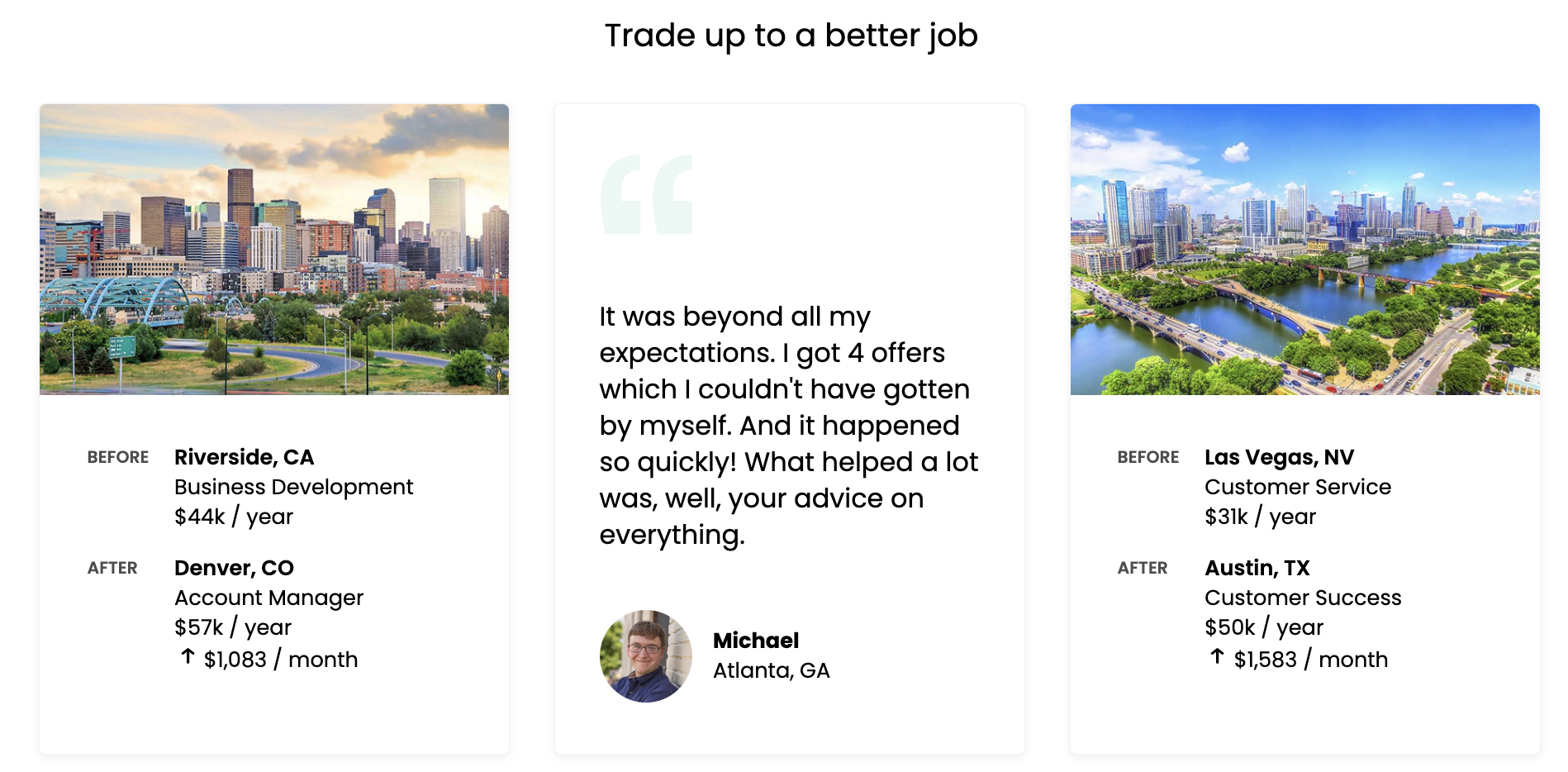
“There are two moments when society puts a gentle hand on your shoulder saying its okay to move away: when you go to college and when you graduate college,” says Linehan. “We’re trying to engineer a third moment. We give people the permission and space to have that conversation with their family by providing that forcing function.” Placement serves the same utility the CEO did for his friend, revealing that if they seize the opportunity of moving to a growing but still affordable city like Denver, Austin, Raleigh or Seattle, “people’s lives would be so much better.”

The other demographic Placement seeks is the 10 million-plus workers who’ve gotten in over their heads in some of the country’s priciest cities. “If you’re ambitious and talented but not an engineer in SF, this is a hard life. The costs are exceeding the benefits at this point.” Placement looks for cheaper cities where their skills are still relevant and they might even earn the same or a little less, but they can fetch a huge increase in income on a cost of living-adjusted basis and they have a path to buying a house. Linehan declares that “Our controversial opinion is that more important than reskilling people is getting them to the right place where the work is happening in the first place.”
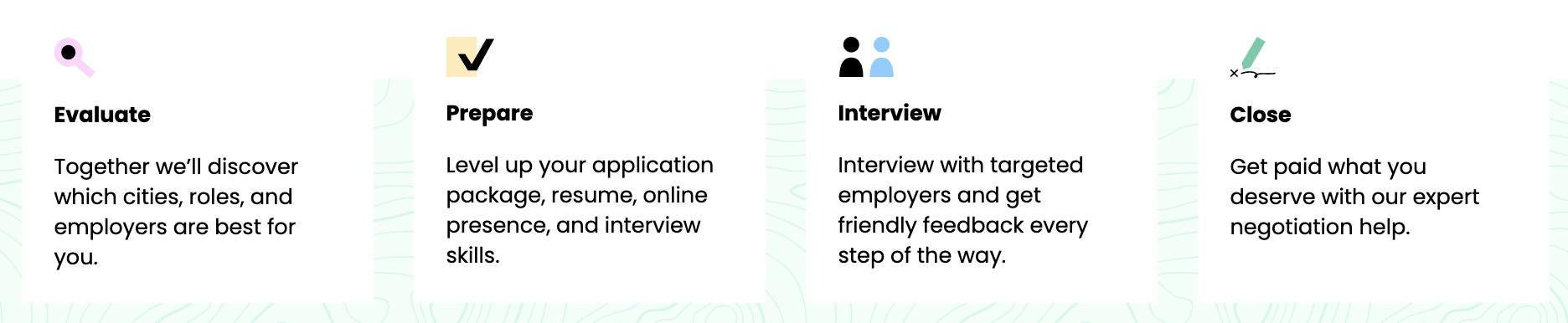
Placement then evaluates the prospective client in what is currently an extremely selective process to determine if they’re undervalued based on their skills, qualifications, shortfalls and redflags. If they’re already being adequately or overpaid, it won’t accept them. Those eligible are offered access to Placement’s research on all the optimal salary and location/hirer pairs for their role, which most people wouldn’t or couldn’t do themselves. Linehan says, “We run their job search for them. We’re kind of like a concierge.”

Once they’ve selected some targets, Placement quarterbacks their preparation process, helping them to improve their LinkedIn and resume, practice telling their story and offering mock interviews with experts in their field. As they progress through interviews Placement sets up and requires hirers offer remotely, it teaches clients to negotiate to get their best possible compensation.

“If you’re a normal person who didn’t go to an elite institution or are a couple years out of school, there’s no resources,” Linehan laments. While some top coding schools and other bootcamps place graduates, and some startups like Pathrise are also working on interview prep, most seeking a new employer end up relying on mediocre job hunting tips they find online. That’s in part because it was hard to get people to fork over significant cash in exchange for instruction that wasn’t guaranteed to help.
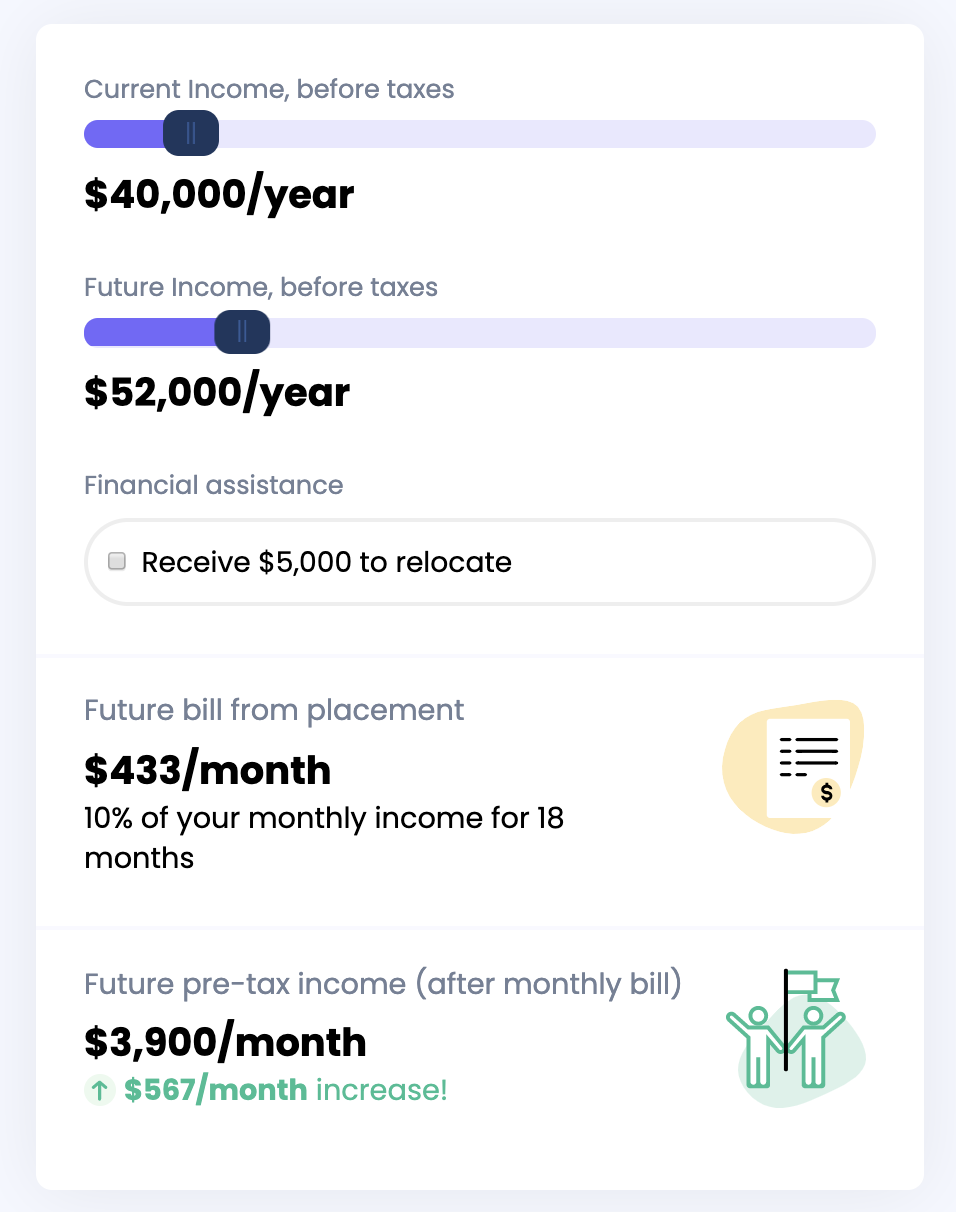
How Placement income sharing agreements work

The Placement income sharing agreement is designed to align incentives, though. It’s vested in getting clients not only the best job and salary, but one they’ll want to stick with. As long as the startup nets them a higher adjusted income, clients pay 10% of their earnings. That lasts for 18 months, or 36 months if they receive Placement’s $5,000 relocation stipend and human support. There are also caps on the total Placement can get paid back, and the agreement dissolves after five years so clients aren’t locked in if things don’t work out.

For example, Placement aims to help someone earning $40,000 per year pre-taxes reach $52,000 on a cost of living adjusted basis. They’d end up paying Placement $7,794 over the course of 18 months, or $433 per month. After the bill, they’d still be earning $3,900 per month, or $567 more than they used to. If they take the $5,000 relocation stipend and extra assistance, their ISA extends to 36 months and they’ll end up paying back $15,588 total, including the stipend.

Clients are likely to keep growing their compensation after their Placement ISA ends, so they’ll start reaping all the added proceeds. The startup has worked with fewer than 1,000 clients to date, but is supposedly growing quickly.

Eventually, Placement could move into working with programmers and designers, but it sees a big gap in assistance for business roles. Linehan notes that “We’re providing an option that will be available to a lot more people than a Lambda School or Galvanize coding bootcamp. Not everyone’s going to be software engineers.”

Making America anti-fragile

The biggest hurdle for Placement will be scaling what can be quite a hands-on, relationship-driven process of matching clients with the right hirers. “It’s one thing to get one person a job. It’s another to get 10,000 people a job,” Linehan admits. But he conquered the same problem at Flexport, which was moving 1,000 shipping containers across the ocean but had to figure out “how the hell do you move 1 million?”

Placement co-founders (from left): Katie Kent and Sean Linehan

That requires Placement to pour product know-how into building tools that equip clients to take more initiative to match themselves with hirers and teach themselves interview skills. It also must automate more of its marketing outreach, client screening and connections to recruiters while retaining a human element worth a four to five-figure price.

Right now, the startup’s team numbers just four, and though it will expand to seven soon, it may need to raise a bunch more to chase this dream. Some investors have been understandably skeptical about the whole “handing out $5,000” model without onerous ISAs.

For comparison, the one-year MissionU school for business and data jobs that was acquired and shut down by WeWork asked for 15% of income for three years without a relocation stipend, or $23,400 on a $52,000 per year job. ISAs for General Assembly’s tech job education cost 10% for 48 months, even if students don’t earn more than in their old job. Pathrise’s slimmer offering costs just 7% for one year. Colleges are jumping on the trend too, with some working with startup Leif to run their ISAs.

Placement has plans to cover prickly edge cases. If someone gets laid off from their new job, the startup will help them find another. “We’re on the hook to make sure they’re successful,” Linehan insists. It only won’t step in if an employee is fired for an ethical problem like sexual harassment or committing fraud. And if someone simply gets lonely in their unfamiliar city, they’re not required to stay, though moving home could hurt their earnings and Placement’s take. That’s why the startup is working to help its clients find community, even amongst each other, so they don’t feel isolated, and prefers sending workers to cities where they know someone.

Meanwhile, Placement must resist the temptation to become a hiring agency paid by employers and instead work fully on behalf of its clients. “When you’re aligned economically with the employer, you’re just chasing dollars from bigger and bigger whales of companies, and at one point you figure out you’re a recruiting firm for the Gap,” Linehan says with a shudder. The complexity of dealing with the U.S. Internal Revenue Service is enough hassle, so Placement doesn’t intend to work with jobseekers abroad or those that need visas, as “it’s not good for startups if you’re at the mercy of the government.”

Luckily, U.S. salaries total $8.6 trillion per year, Linehan claims, so it’s got enough of a domestic market. “The American economy is so huge that I don’t see other people tackling problems like that being competitive.” Placement does have potential to use its data to recommend and teach specific skills. “If you just make this change, if you learn Excel, you could totally get this job in a different industry that pays more and that you’ll like more,” Linehan says. He also dreams of one day improving urban planning by suggesting cities build music venues or parks that jobseekers say would soften the landing of moving there.

Zooming out, there’s also chance for Placement make the country more stable and resistant to strong-man populism promising financial security. “A two-tier society is fragile. I don’t want to live in a democracy where there’s a bunch of hay waiting for a matchstick to set it on fire,” Linehan concludes. “There doesn’t have to be a have and a have-not class, and you don’t need the government to do forced redistribituion to make everything fair. You just need people that care about getting on the right track, and that to me is a worthy cause to dedicate a life to.”