Category: UNCATEGORIZED

21 Nov 2019

Jeanette Manfra, senior DHS cybersecurity official, to leave government

Jeanette Manfra, one of the most senior and experienced U.S. cybersecurity officials, is leaving government after more than a decade in the public sector.

Manfra, who served as assistant director for cybersecurity at the Cybersecurity and Infrastructure Security Agency (CISA), will join the private sector in the New Year. CISA is Homeland Security’s dedicated civilian cybersecurity unit set up a year ago to respond to help protect against threats to U.S. critical infrastructure and foreign threats.

In an exclusive interview with TechCrunch, Manfra said it was a “really hard time to leave,” but the move will give her successor time to transition into the role ahead of the upcoming 2020 presidential election.

She did not say what her new job will be, only that she will take time off to be with her family in the meantime. She will leave her post at the end of the year.

Manfra’s departure from government will be seen as largely unexpected. At Homeland Security, she has served three presidents and worked on numerous projects to improve relations with the private sector, which are considered crucial partners in defending U.S. cyberspace. She also saw the agency double down on election security, threats to the supply chain, and efforts to protect U.S. critical infrastructure like the power grid and water networks from nefarious attempts by nation states.

At TechCrunch Disrupt SF this year, Manfra also talked candidly about the ongoing threats to U.S. cybersecurity, including a skills shortage and the risks posed by another global “WannaCry-style” cyberattack, which in 2017 saw thousands of computers infected by file-locking malware, causing billions of dollars worth of damage.

Manfra joined Homeland Security in 2007 under then-president George W. Bush, half a decade after the department was founded in the wake of the September 11 terrorist attacks. Manfra described the early years as a time when there weren’t “a lot of people talking about cybersecurity.”

“It definitely was not really on the national stage at the time. It was, you know, there was still a lot of debate as to whether ‘cybersecurity’ was one word or two words,” she said.

But in the years past and as internet access and tech companies continued to grow, she said the U.S. saw several “wake up” calls that brought cybersecurity into the public mainstream. The hack of Sony Pictures in 2016 and the WannaCry global ransomware attack in 2017 were two, and both were blamed on North Korea. Another, she said, was the 2015 data breach of the U.S. Office of Personnel Management (OPM), which saw suspected Chinese hackers steal more than 21 million sensitive background check files of government employees who had sought security clearance.

The department’s cybersecurity presence started out as a “very small, frankly relatively unknown group of people,” she said. A decade later it had become a major force in managing crises like the OPM attack, a breach that she said helped to push government to better prioritize cybersecurity.

“[The OPM breach] forced us to make some changes across the government that’ve been good,” she said.

In the aftermath, the government took steps to bolster its own systems and networks to lower its attack surface by removing Kaspersky from its networks citing fears about Russian intelligence, and taking the lead rolling out HTTPS website encryption and email security protections across the federal domains — an effort still to this day largely neglected by some of the world’s wealthiest companies.

Election security, she said, was another major wake-up call for the government. Russia waged a widescale disinformation — or “fake news” — campaign during the 2016 election to sow discord and exploit divisions in communities across the U.S. But there were also fears that hackers could break in and modify the tallies in voting machines, a concern that never came to fruition but one that security experts say remains a threat. Lawmakers have been pushing for the removal of paperless and electronic-only voting machines to reduce the risk of hackers manipulate the votes in favor of a particular candidate.

“In 2016, it was our best judgment that the Russians were looking to undermine confidence,” Manfra told TechCrunch. “The public confidence is important, and we need to be thinking within the government about the adversaries’ ability and willingness to use those against us,” she said.

Manfra said the department knew it had to work closer with state and local election boards to figure out their needs following the 2016 election. “We had a lot of honest conversations with [election boards] about what they need, what do we do, and how can we help,” she said. “It’s the fastest I’ve ever seen a sector come together.”

Those partnerships with local elections have given Homeland Security unprecedented visibility into the nation’s election infrastructure, she said, going from “some coverage” in 2016 to near-absolute insight across the country.

“If we ever did again get technical indicators that an adversary was trying to do something, we would be able to move more quickly and much more expansively across the country,” she said.

That effort paid off. Last year’s midterm election was remarkably quiet compared to 2016. Both the Justice Department and Homeland Security said there was “no evidence” to support foreign interference during the midterms.

It’s that running theme of public-private collaboration that Manfra looked back on with pride. “We don’t have all the answers and we can’t do it alone.” Those partnerships across the industry verticals — from elections to finance, energy and manufacturing — are “crucial to everything that we do,” she said.

“It’s really easy to say how important it is to have the government in the private sector working together,” she said. “But to do it well, it’s actually really hard.”

Manfra said the government had to be “willing to open itself” to build trust with its partners. “We now have some of the largest companies in the country that we built trusted relationships when they know that they can give us sensitive information — and we can take that and use it to protect other people, but we’re not going to abuse that trust,” she said.

Speaking of her time at Homeland Security, Manfra said she was most proud of her team. “A lot of them have been with me since we started,” she said. “They could be working out in the private sector making a ton of money, but they’re dedicating their lives here,” she said.

But she said she was “forcing” herself to have no regrets during her time in government.

It’s not yet known who will replace Manfra or will take on her responsibilities. But her advice for her eventual successor: “Trust your team, trust your partners, and stay focused,” she said. “It’s such a broad mission. It’s easy to lose focus.”

Related stories:

21 Nov 2019

Amazon launches a Dash Smart Shelf for businesses that automatically restocks supplies

Amazon may have stopped selling its Dash buttons for consumers, but it’s not done with dedicated Dash hardware: The company is launching its new Amazon Dash Smart Shelf today. Aimed at small businesses rather than individuals, the Dash Smart Shelf is also even more automated than the Dash buttons, as it uses a built-in scale to automatically place an order for re-stocking supplies based on weight.

Available in three different sizes (7″x7″, 12″x10″ and 18″x13″), the Dash Smart Shelf is just 1″ tall and can basically be placed under a pile of whatever stock of supplies you commonly run through while operating a business. That could mean printer paper, coffee cups, pens, paper clips, toilet paper, coffee or just about anything, really – and Amazon’s replenishment system can either be set to automatically place an order when it detects that on-hand supply has fallen below a certain weight, or you can just have it send someone in your organization a notification if you’d rather not have the order happen automatically.

The Dash Smart Shelf connects via built-in Wi-Fi, and can be powered either connected by cable to a power outlet, or via four AAA batteries, providing flexibility as to where you want to put it. Using the web or the Amazon app, you then sign in with your Amazon Business account and just pick what product you’re using on the scale that you want to top up. And if you find that your staff doesn’t like the coffee selection, for instance, you can easily change up the brand or product your’e re-ordering from your account, too.

Dash Smart Shelf isn’t available immediately for anyone to purchase directly, but instead Amazon is going to be working with select small businesses in a trial pilot this month, with the plan being to open up general availability to any Amazon Business customers that have a registered U.S. business license beginning next year. If people are keen on getting Smart Shelf into their business, they can sign up directly with Amazon to be noticed about availability.

21 Nov 2019

Alphabet’s Loon signs deal with Telefonica to provide internet to remote parts of the Amazon

Alphabet-owned Loon, the high-altitude balloon company that is using its stratospheric technology to provide internet connectivity on Earth, has signed a new commercial agreement with Telefonica-owned Internet para Todos (IpT). The IpT initiative, which is also backed in part by Facebook and the Development Bank of Latin America, aims to provide internet connectivity to users in remote locations across Latin America, and its deal with Loon will specifically connect users in remote parts fo the Amazon Rainforest in Peru.

Loon will begin providing service in 2020, provided the deal gets all the necessary regulatory approval it requires. This is a first in terms of a commercial deployment of high altitude gallons with the aim of offering connectivity over a continued, sustained period, so there’s some new ground to break in terms of working with the Peru Ministry of Transport and Communications prior to launch, but the partners involved are working with regulators to make sure everything’s signed off before launch.

This isn’t the first time Loon has worked with Telefonica – the two join forces to provide emergency internet connectivity following the 8.0 earthquake that hit Peru in May, and the’ve been collaborating on a number of projects for years. For Loon, this is now the third commercial contract it has secured, including one with Telkom Kenya which is also awaiting final regulatory sign-off, and an arrangement with Canadian company Telecast to develop a coordination system for a future planned low-Earth orbit satellite constellation.

The initial deployment plan for this partnership with IpT will provide connectivity to an area that makes up around 15 percent of the total area of the Loreto Region in Peru, which together accounts for a population of around 200,000 people. Of that 200,000, roughly a quarter have access to connectivity at least that 3G quality, according to Loon. The Loon balloons that will be deployed to provide service essentially act as very high altitude cell towers, receiving LTE connections and redistributing those directly to consumer devices on the ground.

21 Nov 2019

Celonis, a leader in big data process mining for enterprises, nabs $290M on a $2.5B valuation

More than $1 trillion is spent by enterprises annually on “digital transformation” — the investments that organizations make to update their IT systems to get more out of them and reduce costs — and today one of the bigger startups that’s built a platform to help get the ball rolling is announcing a huge round of funding.

Celonis, a leader in the area of process mining — which tracks data produced by a company’s software, as well as how the software works, in order to provide guidance on what a company could and should do to improve it — has raised $290 million in a Series C round of funding, giving the startup a post-money valuation of $2.5 billion.

Celonis was founded in 2011 in Munich — an industrial and economic center in Germany that you could say is a veritable petri dish when it comes to large business in need of digital transformation — and has been cash-flow positive from the start. In fact, Celonis waited until it was nearly six years old to take its first outside funding (prior to this Series C it had picked up less than $80 million, see here and here).

The size and timing of this latest equity injection is due to seizing the moment, and tapping networks of people to do so. It has already been growing at a triple-digit rate, with customers like Siemens, Cisco, L’Oreal, Deutsche Telekom and Vodafone among them. 

“Our tech has become its own category with a lot of successful customers,” Bastian Nominacher, the co-CEO who co-founded the company with Alexander Rinke and Martin Klenk, said in an interview. “It’s a key driver for sustainable business operations, and we felt that we needed to have the right network of people to keep momentum in this market.”

To that end, this latest round’s participants lines up with the company’s strategic goals. It is being led by Arena Holdings — an investment firm led by Feroz Dewan — with Ryan Smith, co-founder and CEO of Qualtrics; and Tooey Courtemanche, founder and CEO of Procore, also included, alongside previous investors 83North and Accel.

Celonis said Smith will be a special advisor, working alongside another strategic board member, Hybris founder Carsten Thoma. Dewan, meanwhile, used to run hedge funds for Tiger Global (among other roles) and currently sits on the board of directors of Kraft Heinz.

“Celonis is the clear market leader in a category with open-ended potential. It has demonstrated an enviable record of growth and value creation for its customers and partners,” said Dewan in a statement. “Celonis helps companies capitalise on two inexorable trends that cut across geography and industry: the use of data to enable faster, better decision-making and the desire for all businesses to operate at their full potential.”

The core of Celonis’ offering is to provide process mining around an organizations’ IT systems. Nominacher said that this could include anything from 5 to over 100 different pieces of software, with the main idea being that Celonis’s platform monitors a company’s whole solar system of apps, so to speak, in order to produce its insights — providing and “X-ray” view of the situation, in the words of Rinke.

Those insights, in turn, are used either by the company itself, or by consultants engaged by the organization, to make further suggestions, whether that’s to implement something like robotic process automation (RPA) to speed up a specific process, or use a different piece of software to crunch data better, or reconfigure how staff is deployed, and so on. This is not a one-off thing: the idea is continuous monitoring to pick up new patterns or problems.

In recent times, the company has started to expand the system into a wider set of use cases, by providing tools to monitor operations and customer experience, and to apply its process mining engine to a wider set of company sizes beyond large enterprises, and by bringing in more AI to its basic techniques.

Interestingly, Nominacher said that there are currently no plans to, say, extend into RPA or other “fixing” tools itself, pointing to a kind of laser strategy that is likely part of what has helped it grow so well up to now.

“It’s important to focus on the relevant parts of what you provide,” he said. “We one layer, one that can give the right guidance.”

21 Nov 2019

Route’s app auto-tracks all your packages, raises $12M

Between Amazon, FedEx, UPS, and indie merchants, it’s easy to lose track of when your online purchases will be delivered. And if you’re buying something pricey or important, a lack of shipping insurance can leave you anxious and constantly checking your porch.

But a fresh startup has found unprecedented growth by letting you monitor all your ecommerce orders in one app thanks to a Gmail extension. Plus, you can buy insurance for just 1% of an item’s cost. Meet Route, emerging from stealth today to become the Find My Friends for packages. By helping merchants handle post-purchase satisfaction while charging consumers for insurance, this year Route has grown to $8.85 million in revenue run rate and from 5 to 100 employees.

Now Route is announcing it’s raised $12 million in total through a quiet $500,00 January pre-seed round from Peak Venture Capital and a new seed round with the rest from Album VC and strategic partner in direct-to-consumer brands Pattern. The cash will help Route keep up with demand and add new features to its app. Route co-founder and CEO Evan Walker tells me consumers “no longer accept the unsatisfying status quo of not knowing exactly where their order is.”

Pizza Tracker But For Everything

Domino’s saw sales skyrocket thanks to its highly visual pizza tracker app that shows live updates as your pie goes in the oven, hits the road, and reaches your door. Route wants to bring that reassuring experience to all of ecommerce.

Route co-founder and CEO Evan Walker

Walker asks “How could I NOT build this company?” The 25-year ecommerce entrepreneur got his start selling video games online in 1994, and has founded seven companies since. The communications gap between customers and merchants always plagued his businesses.

“The big lightbulb moment happened when I was traveling in Italy a few years back” Walker recalls. Talking to a furniture shop owner, he heard about their troubles of shipping vintage trunks. “He mentioned he was having a lot of issues with these items breaking in transit and wished he had a solution for it.” Now there is one.

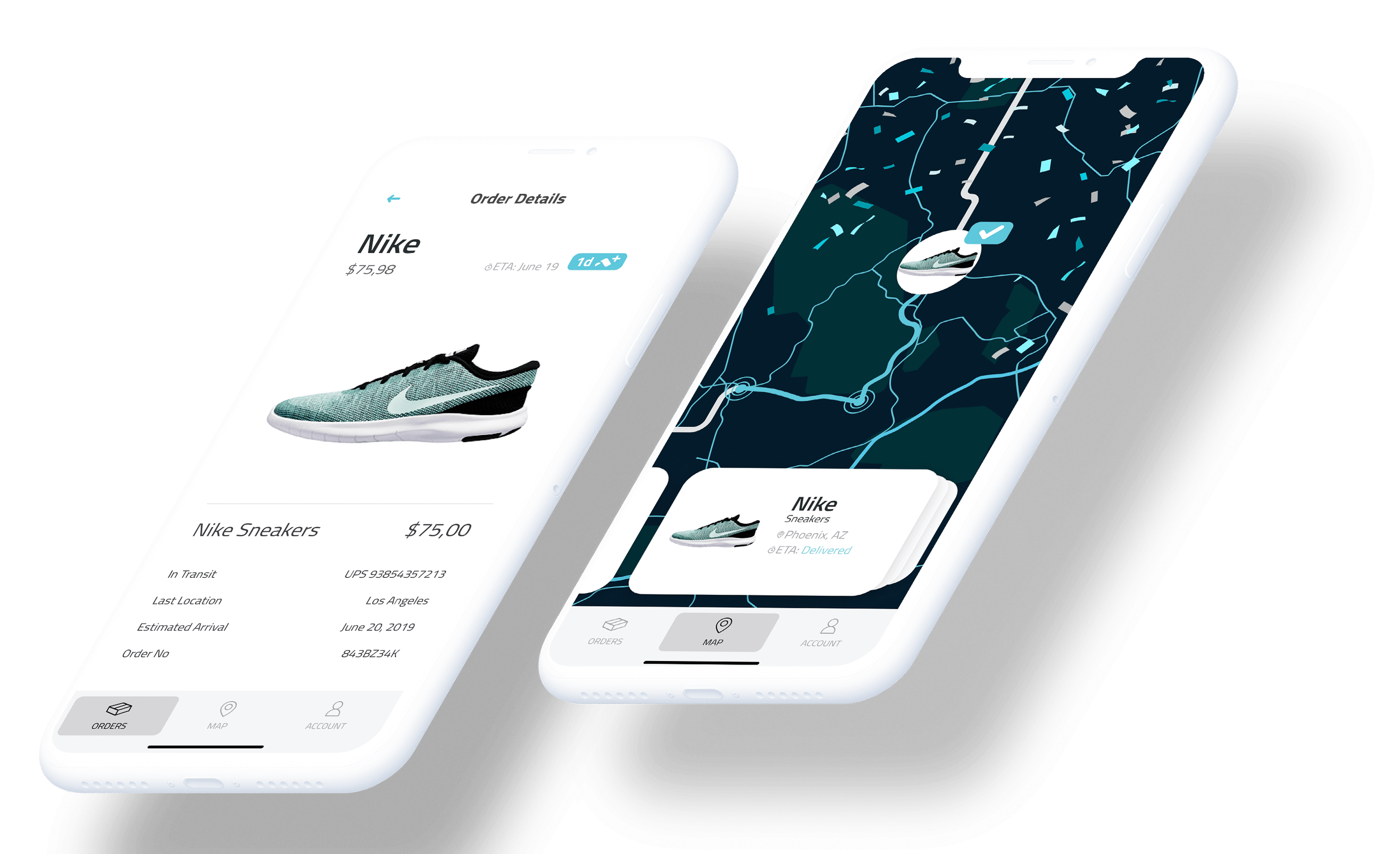
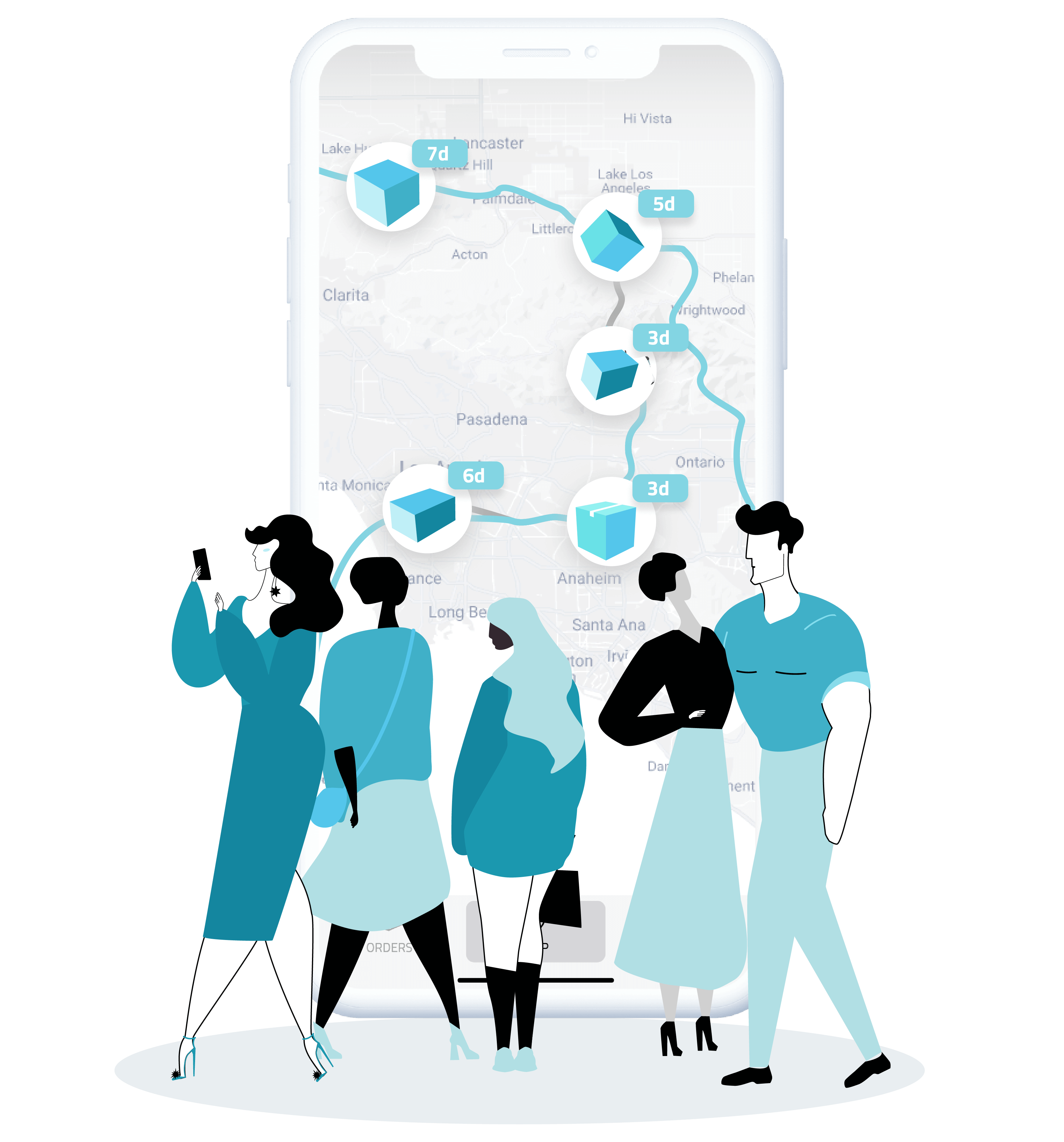
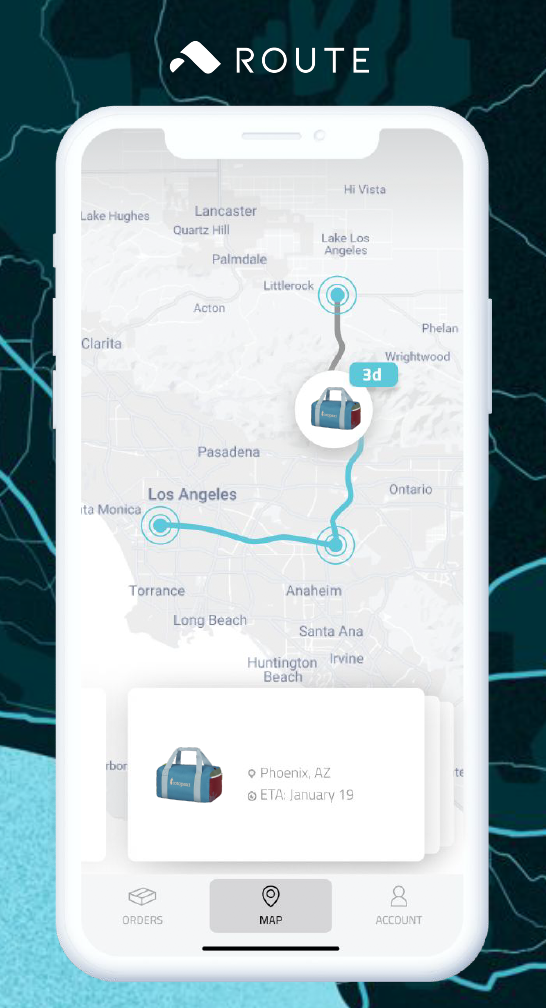
The Route iOS app for visually tracking orders officially launches today. Purchases from partnered merchants instantly show up in the app and its website via API, but all your other buys from Amazon etc can be automatically ingested by authorizing the Route Bot Gmail extension that scans for shipping updates. Route lays out all the orders on a map with immediate access to their latest status changes like when shipping info is received, an item goes out for last mile delivery, or there’s a problem. There’s no need to copy and paste tracking numbers across multiple websites.

The Route+ insurance program that lets customers pay for peace of mind is launching today too. Customers get the option to add it from partnered merchants, file claims for lost / damaged / stolen packages in one tap, and get reimbursement from respected Lloyd’s Of London.

Walker claims that merchants that offer Route+ (which is free for them) “have seen an increase in conversion, decreased spend on customer support teams, and an improved post-purchase customer experience due to Route’s ability to quickly handle customer claims.” Merchants can also opt to pay themselves for Route+ on every order

Route now works with 1600 merchants and 600 carriers and has overseen shipments to 1.3 million customers in 187 countries. John Mayfield from Peak Venture Capital says “Their phenomenal growth of acquiring over 600 clients in the first three months makes them one of the fastest growing companies we have ever seen.”

The Brown Box Wars

The biggest challenge for Route is overcoming the thick, thick crowd of competitors in the market. Rakuten’s Slice can pull orders from your email and also grabs you refunds if an item goes on sale after you buy it. 17Track lets you paste in big lists of tracking numbers in case they’re registered to someone else’s email. Parcel offers a barcode scanner. ‘Deliveries’ will set up calendar appointments for arrivals, and works on Mac and Apple Watch. ParcelTrack lets you forward it emails of purchases to monitor, and a $2.99 premium version offers live locations of your packages plus customizable push notifications.

Route’s strength is that it’s totally free for consumers unless they want to buy insurance, and does email tracking automatically, though it will lack manual tracking number input for a few more weeks. It’s managed a 90 percent customer satisfaction score. Still, the startup could be vulnerable to a major player in ecommerce like Amazon or Shopify barging into the space. There are also platform risks, such as if Gmail blocked its scanning for tracking numbers.

“The better that Amazon gets at providing similar services, the more other merchants need those tools in order to compete outside of Amazon” says Walker. “From the insurance side, we are pretty good at detecting risk before it becomes a major issue and we are insuring on an individual order basis so catastrophic incidences are minimized.” The company also has to keep a watchful eye out for fraudulent insurance claims.

The growing megatrend of purchase behavior shifting online means the once occasional activity of receiving a package has become a constant chore in need of streamlining. Plenty of merchants are meanwhile looking to offload the complexity of keeping impatient buyers happy. If Route conquers its first market, it could move into adjacent spaces ranging from merchant services like freight forwarding and financing to consumer features like physical mail scanning for electronic delivery.

“Ecommerce is in my blood. I feel like I’ve taken 25 years of experience and started to craft a really interesting product in this space” Walker concludes. “With commerce going more digital everyday, there is an opportunity to create a big dent.” Or in Route‘s case, an opportunity to insure your packages against big dents.

21 Nov 2019

Wonderbly launches Wonderbly Studios to let other brands use its personalisation API for printed books

Wonderbly, the personalised book publisher backed by Google Ventures and best known for the breakout hit “Lost My Name,” is unveiling Wonderbly Studios in a bid to make it easier for other brands to offer personalised and bespoke printed books on-demand.

Initially, Wonderfully Studios will work with select partners to provide access to its personalisation API and help create new books using its technology and expertise in the space. However, longer term Wonderbly co-founder and CEO Asi Sharabi tells me the plan is to continuing developing the platform and eventually open up the whole thing so that anybody can offer high-quality and data-infused personalised books via its API.

“Selling high quality personalised products – products that extend beyond the trivial “put my name on a mug” – is no easy task,” he says. “Meaningfully personalised products and businesses are still quite complex to operate at scale. You need a rendering stack, integration with a local print house, couriers, customer support and more. These technical and operational hurdles are a barrier to entry”.

Sharabi adds that although Wonderbly is aware of some “cool” personalised book ideas already on the market, he says that very few are reaching meaningful scale. “We hope to change all that with our personalisation platform and provide a fast, seamless experience with responsive previews and high fidelity physical products for multiple and complex personalisation logics,” he says.

The first project to come out of Wonderbly Studios is an interactive journal from Wizarding World (the Official Harry Potter Fan Club), which is a joint venture between Pottermore Ltd. and Warner Bros.

The “Keys and Curios” journal is described as full of interactive surprises and secrets that can be unlocked using the Wizarding World app. It incorporates a fan’s name, house traits and more to take them on a unique journey through the wizarding year.

The books contents were written and designed by the Wizarding World Digital team, and feature images from across the Wizarding World, artwork by illustrator Jim Kay and specially designed Hogwarts house covers by MinaLima (the graphic designer design team behind some of the visuals from the Harry Potter and Fantastic Beasts films).

Meanwhile, the personalisation technology, e-commerce integration and on-demand printing/logistics is powered by Wonderbly.

“The end customers interact via the partner’s e-commerce stack,” explains Sharabi. These stacks (e.g Shopify or Magento) were not built for personalised products and customisation. Adding this functionality is hard – we know, we’ve been doing it for 5 years. This is why we developed the Wonderbly Personalisation API”.

Products created on the Wonderbly platform can deliver “limitless amount of creativity, constrained only by imagination,” says the Wonderbly CEO. That’s because Wonderbly takes cares of a lot of the remaining heavy-lifting.

“Products are rendered in real-time at scale for customers as part of the shopping experience,” explains Sharabi. “The platform handles the complexities of integrating with e-commerce systems in a developer friendly way, making it a simple task to add a personalised product to a cart. When an order is completed a simple web hook ensures that the products are rendered, printed and shipped to the customer, while feeding into our partner’s systems for progress notification and customer support”.

With regards to what kind of personalised books we might see come to market as Wonderbly Studios opens up further, it is likely impossible to predict. That’s because the full range of potential experiences is likely something that no single person or team could ever imagine, which, of course is the whole point.

As Sharabi previously told TechCrunch, you can’t scale creativity in the same way as tech – you have to allow creativity to come from anywhere.

“What if you can create a customised art, poetry or recipes book at the same ease you make a Spotify playlist?” he asks rhetorically. “What would gaming printed yearbooks look like? What if travel guides and language acquisition become more personalised? What if you can order an ‘I was there’ personalised keepsake for live gigs and festivals? These and more are questions that get us very excited”.

21 Nov 2019

Annual Extra Crunch members get a discount on Aircall

We’re excited to announce a new Extra Crunch community perk from Aircall. Starting today, annual and two-year Extra Crunch members that are new to Aircall and located within the U.S. or Canada can receive two months of free service on an annual Aircall contract.

Aircall is a cloud-based phone system that can help satisfy the needs of your customer support and sales teams. It’s easy to set up and scale, intuitive for users, has proven high-quality calls and can connect to your existing CRM in a few clicks. You can learn more about Aircall here

You must meet the following criteria to qualify for the Aircall community perk from Extra Crunch:

  • Must be an annual or two-year Extra Crunch member. You can sign up here.
  • Must be located within the U.S. or Canada.
  • Cannot have existing account or past account with Aircall.

The two months free from Aircall is inclusive of subscription fees, but not inclusive of minutes on annual contracts.

Extra Crunch is a membership program from TechCrunch that features how-tos and interviews on company building, intelligence on the most disruptive opportunities for startups, an experience on TechCrunch.com that’s free of banner ads, discounts on TechCrunch events and several community perks like the one mentioned in this article. Our goal is to democratize information about startups, and we’d love to have you join our community.

You can sign up for Extra Crunch here.

After signing up for an annual or two-year Extra Crunch membership, you’ll receive a welcome email with a link to sign up for Aircall and special code to enter to claim the discount. Aircall offers a free seven-day trial, and if you are interested in purchasing an annual plan after the trial you can enter the code to get two months free. 

If you are already an annual or two-year Extra Crunch member, you will receive an email with the offer at some point today. If you are currently a monthly Extra Crunch subscriber and want to upgrade to annual in order to claim this deal, head over to the “my account” section on TechCrunch.com and click the “upgrade” button.

This is one of several community perks we’ve recently launched for Extra Crunch members. Other community perks include a 20% discount on TechCrunch events, 100,000 Brex rewards points upon credit card sign up and an opportunity to claim $1,000 in AWS credits.

If there are other community perks you want to see us add, please let us know by emailing travis@techcrunch.com.

Sign up for an annual Extra Crunch membership today to claim this community perk. You can purchase an annual Extra Crunch membership here.

21 Nov 2019

Amnesty International latest to slam surveillance giants Facebook and Google as “incompatible” with human rights

Human rights charity Amnesty International is the latest to call for reform of surveillance capitalism — blasting the business models of “surveillance giants” Facebook and Google in a new report which warns the pair’s market dominating platforms are “enabling human rights harm at a population scale”.

“[D]despite the real value of the services they provide, Google and Facebook’s platforms come at a systemic cost,” Amnesty warns. “The companies’ surveillance-based business model forces people to make a Faustian bargain, whereby they are only able to enjoy their human rights online by submitting to a system predicated on human rights abuse. Firstly, an assault on the right to privacy on an unprecedented scale, and then a series of knock-on effects that pose a serious risk to a range of other rights, from freedom of expression and opinion, to freedom of thought and the right to non-discrimination.”

“This isn’t the internet people signed up for,” it adds.

What’s most striking about the report is the familiarly of the arguments. There is now a huge weight of consensus criticism around surveillance-based decision-making — from Apple’s own Tim Cook through scholars such as Shoshana Zuboff and Zeynep Tufekci to the United Nations — that’s itself been fed by a steady stream of reportage of the individual and societal harms flowing from platforms’ pervasive and consentless capturing and hijacking of people’s information for ad-based manipulation and profit.

This core power asymmetry is maintained and topped off by self-serving policy positions which at best fiddle around the edges of an inherently anti-humanitarian system. While platforms have become practiced in dark arts PR — offering, at best, a pantomime ear to the latest data-enabled outrage that’s making headlines, without ever actually changing the underlying system. That surveillance capitalism’s abusive modus operandi is now inspiring governments to follow suit — aping the approach by developing their own data-driven control systems to straitjacket citizens — is exceptionally chilling.

But while the arguments against digital surveillance are now very familiar what’s still sorely lacking is an effective regulatory response to force reform of what is at base a moral failure — and one that’s been allowed to scale so big it’s attacking the democratic underpinnings of Western society.

“Google and Facebook have established policies and processes to address their impacts on privacy and freedom of expression – but evidently, given that their surveillance-based business model undermines the very essence of the right to privacy and poses a serious risk to a range of other rights, the companies are not taking a holistic approach, nor are they questioning whether their current business models themselves can be compliant with their responsibility to respect human rights,” Amnesty writes.

“The abuse of privacy that is core to Facebook and Google’s surveillance-based business model is starkly demonstrated by the companies’ long history of privacy scandals. Despite the companies’ assurances over their commitment to privacy, it is difficult not to see these numerous privacy infringements as part of the normal functioning of their business, rather than aberrations.”

Needless to say Facebook and Google do not agree with Amnesty’s assessment. But, well, they would say that wouldn’t they?

Amnesty’s report notes there is now a whole surveillance industry feeding this beast — from adtech players to data brokers — while pointing out that the dominance of Facebook and Google, aka the adtech duopoly, over “the primary channels that most of the world relies on to engage with the internet” is itself another harm, as it lends the pair of surveillance giants “unparalleled power over people’s lives online”.

“The power of Google and Facebook over the core platforms of the internet poses unique risks for human rights,” it warns. “For most people it is simply not feasible to use the internet while avoiding all Google and Facebook services. The dominant internet platforms are no longer ‘optional’ in many societies, and using them is a necessary part of participating in modern life.”

Amnesty concludes that it is “now evident that the era of self-regulation in the tech sector is coming to an end” — saying further state-based regulation will be necessary. Its call there is for legislators to follow a human rights-based approach to rein in surveillance giants.

You can read the report in full here (PDF).

21 Nov 2019

Omnius CEO Sofie Quidenus-Wahlforss is joining us at Disrupt Berlin

When you think about artificial intelligence, chances are you think about anthropomorphic robots that can make decisions on their own. But artificial intelligence already has huge impacts in the insurance space. That’s why I’m excited to announce that omni:us founder and CEO Sofie Quidenus-Wahlforss is joining us at TechCrunch Disrupt Berlin.

omni:us is an AI-driven service that can process a ton of documents (including documents with handwriting), classify them and extract relevant data. This way, omni:us customers can use the platform for automated claims handling.

The startup doesn’t want to disrupt existing insurance companies. Instead, it is working with some of the biggest insurance companies out there, such as Allianz, Baloise, AmTrust and Wefox.

Last year, omni:us raised a $22.5 million Series A funding round (€19.7 million) led by Berlin-headquartered VC firm Target Global, followed by MMC Ventures and Talis Capital. Existing investors Unbound and Anthemis, also participated. Up next, omni:us wants to expand to the U.S.

omni:us is well aware that relying more heavily on artificial intelligence can create some issues. Many AI-driven platform act as a sort of black box — you input data and get a result without really knowing why. omni:us says front and center that it wants to make fast, transparent and empathetic claims decisions.

Buy your ticket to Disrupt Berlin to listen to this discussion and many others. The conference will take place on December 11-12.

In addition to panels and fireside chats, like this one, new startups will participate in the Startup Battlefield to compete for the highly coveted Battlefield Cup.


Sofie Quidenus-Wahlforss is an experienced managing director with a strong entrepreneurial spirit. Her strategic skills coupled with a passion for AI led her to create omni:us with the goal of redefining the way people work and how companies are handling their business operations. omni:us is as an MI-based, SaaS solution to massively optimize workflows, and empower businesses to make comprehensive data-driven decisions.

Prior to omni:us, Sofie founded Qidenus Technologies which quickly became the leader in the market of robotics and digitization. Sofie is also the patent owner of the Vshape scanner Technology and winner of several awards including the Woman Technology. omni:us is an Artificial Intelligence as a Service (AIaaS) provider for cognitive claims management. Built on a fully data-driven approach, omni:us is transforming the way insurers interact with their insured parties. It provides all the necessary tools and information to make fast, transparent and empathetic claims decisions, whilst improving operational efficiency and reducing loss adjustment expenses. The company is headquartered in Berlin, with research partners in Barcelona and representations in the UK, France and the United States. For further information visit omnius.com.

21 Nov 2019

G Suite users get more AI writing help, Google Assistant calendar integration and more

Google is launching a number of updates to its G Suite tools today that, among other things, brings to Google Docs an AI grammar checker, smarter spellchecking and, soon, spelling autocorrect. The company is also launching the ability for G Suite users to use the Google Assistant to read out a calendar schedule and, maybe even more importantly, create, cancel and reschedule events. Google is also adding new accessibility features to the Assistant for use during meetings.

In addition, Google yesterday announced that Smart Compose would soon come to G Suite, too.

It’s maybe no surprise that Google is adding its new grammar suggestions to Docs. This feature, after all, is something Google has talked about quite a bit in recent months, after it first introduced it back in 2018. Unlike other grammar tools, Google’s version utilizes a neural network approach to detect potential grammar issues in your text, which is quite similar to the techniques used for building effective machine translation models.

Google is also bringing to Docs the same autocorrect feature it already uses in Gmail. This tool uses Google Search to learn new words over time, but in addition, Google today announced it’s also introducing a new system for offering users more customized spelling suggestions based on your documents. That includes commonly used acronyms that may be part of a company’s internal lingo.

The new Assistant calendaring features are now in beta and pretty self-explanatory. Indeed, it’s somewhat surprising that it took Google so long to offer these abilities. In addition to managing their calendar by voice, the company is now also making it possible to use the Assistant to send messages to meeting attendees and even join calls (“Hey Google, join my next meeting”). Surely that’s a handy feature when you’re once again running late to work and need to join an 8am call from your car while driving down the highway.