Category: UNCATEGORIZED

21 Nov 2019

Michael Grimes, “Wall Street’s Silicon Valley whisperer,” says direct listings are “absolutely” more efficient than IPOs

Michael Grimes has been called “Wall Street’s Silicon Valley whisperer” for landing a seemingly endless string of coveted deals for his bank, Morgan Stanley. In more recent years, it has served as the lead underwriter for Facebook, Uber, Spotify and Slack. Grimes, who has been a banker for 32 years — 25 of them at Morgan Stanley —  has also played a role in the IPOs of Google, Salesforce, LinkedIn, Workday and hundreds of other companies.

Because some of these offerings have gone better than others, Morgan Stanley and other investment banks are now being asked by buzzy startups and their investors to embrace more direct listings, a maneuver pioneered by Spotify and copied by Slack wherein rather than sell a percentage of shares to the public in a fundraising event, companies are essentially moving all their stock from the private markets to public ones in one fell swoop.

They cost the companies less money in banking fees. They also immediately free everyone on a company’s cap table to share their shares if they so choose, which has made the concept especially popular with VCs like BIll Gurley and Michael Moritz — though investors also cite the money that companies have been leaving on the table with traditional IPOs. Gurley specifically has talked publicly about underpriced offerings costing newly public outfits $170 billion over the last 30 years.

Grimes, in a rare public appearance last week at a StrictlyVC event, said he supports direct listings completely, calling the “pricing mechanism” more efficient, “absolutely.” He has reason to be a proponent of this new “product.” Both Spotify and Slack turned to Morgan Stanley to organize their direct listings — a process that involves running simultaneous auctions to determine the price at which demand and supply meet — and to ensure there would be enough liquidity for the listings to go smoothly.

Given the success of both, the bank is now better positioned than any to continue orchestrating direct listings for potential issuers, including, reportedly, Airbnb and DoorDash. (Grimes wouldn’t confirm the plans of any companies with which Morgan Stanley plans to work.)

Still, during last week’s sit-down, we wanted to know more about how they work and whether there’s a chance that banks will eventually try to thwart the process, given that they require just as much work, are potentially less lucrative, and keep banks from rewarding some of their best customers — meaning the institutions that are accustomed to being funneled IPO shares ahead of retail investors in traditional offerings.

Grimes patiently sat through roughly 40 minutes of questions, all of which you can read tomorrow if you’re a subscriber of Extra Crunch, where much more of the transcript is being published. In the meantime, here are some highlights from our conversation:

Morgan Stanley was the lead underwriter for Uber. You don’t think Uber went public too late? It seems like it was enjoying a lot of momentum last year, so much so that it was reportedly told by bankers that it could be valued at $120 billion in an IPO — which is nearly triple where it’s valued right now. Did you think it would go out at that number?

MG: If you look at how companies are valued, at any given point of time right now, public companies with growth prospects and margins that are not yet at their mature margin, I think you’ll find on average price targets by either analysts who work at banks or buy-side investors that can be 100%, 200%, and 300% different from low to high. That’s a typical spread. You can have somebody believe a company will be worth $30, $60 or $80 per share three years out. That’s a huge amount of variability.

So that variability isn’t based on different timelines?

MG: It’s based on penetration. Let’s say, what, 100 million people or so [worldwide] have have been monthly active users of Uber, somewhere in that range. So what percentage of the population is that? Less than 1% or something. Is that 1% going to be  2%, 3%, 6%, 10%, 20%? Half a percent, because people stop using it and turn instead to some flying [taxi]?

So if you take all those variable, possible outcomes, you get huge variability in outcome. So it’s easy to say that everything should trade the same every day, but [look at what happened with Google]. You have some people saying maybe that is an an outcome that can happen here for companies, or maybe it won’t. Maybe they’ll [hit their] saturation [point] or face new competitors.

It’s really easy to be a pundit and say, ‘It should be higher’ or ‘It should be lower,’ but investors are making decisions about that every day.

Is it your job to be as optimistic as possible about the pricing? How are you coming up with the number, given all these variables?

MG: We think our job is to be realistically optimistic. If tech stops changing everything and software stops eating the world, there probably would be less of an optimistic bias. But fundamentally — it sounds obvious but sometimes people forget — you can only lose 100 percent of your money, and you can make multiples of your money. I don’t think VCs are as risk-averse as they say, by the way. Some 80% or 90% of investments end up under water, and 5% or 10% produce 10 or 20 or 30x and so that’s the portfolio approach. It’s not as pronounced with institutional investors investing at IPOs, but it’s the same concept: you can only lose 100 percent of your money.

Let’s say you put five equal quantums of investment out to work in five different companies and one of them grows tenfold. Do I even need to tell you what happened with the other four to know you made money? Worst case, you’ve more than doubled your money, and therefore you’re probably going to lean into that again. So generally speaking, there’s an upward bias, but our job is to be realistic and to try to get that right. We view it as a sacred obligation. There’s variability and volatility within that. We try to give really good advice on receptivity. And when the process works as intended, we have predicted it as well as you can within a range of high variability.

StrictlyVC

This summer on CNBC, Bill Gurley told viewers that banks, including the top banks, have mispriced IPOs to the tune of $170 billion over the last three years, meaning that’s the amount of money that companies left on the table. Do you think we need direct listings and can you explain why they could potentially be better?

MG: Sure. We think Bill has done a great service by focusing a spotlight on the product, which we innovated with Spotify and then later with Slack . We do love the product, we’re bullish on it.

You’re asking how they work?

TC: Yes, as it relates to price discovery. So in a direct offering, you’re talking to people who own the stock and people who might want to buy the stock to figure out where they meet, which doesn’t sound that different than what goes on with a traditional IPO.

MG: It’s actually different in a technical way. In a traditional IPO, there’s a range, let’s say $8 to $10. And the orders we’re taking every day for two weeks, let’s say, while the prospectus is filed, we’re taking orders from institutions [regarding] how many shares they want to buy within that range. That means generally within that range, they’re buying. It’s not binding but generally speaking, they’re going to follow through. If it’s outside of that range, we have to go back and ask them again. So if there’s a whole lot of demand and the number of shares being sold is fixed so that supply is fixed . . . the company’s goal is for oversubscription because they want an upward bias. They don’t want to trade up too much [and leave] money on the table and they don’t want to trade down at all — even a little bit — and they don’t want to trade flat because that could be [perceived] to be down; they want to trade up modestly. An exception was the Google IPO, which was designed to trade flat and traded up modestly, 14% or something like that.

The range might be moved once, maybe twice — because there’s not a lot of time because there’s a regulatory review to turn it around — so [let’s say] it’s moved from $8 to 10 to $10 to $12 and there’s still much more demand than supply; it’s a judgment call as to, is that going to price at $14? $15? $12? Some investors might think it should trade at $25 while others think it should trade at $12. So there could be real variability there, and when trading opens, only the shares that were sold the night before in the IPO, some subset of them are trading and that’s it, everything else is locked up —  the whole cap table. So for six months, it’s those same shares trading over and over, other than maybe [a small sampling] or investors of former employees who weren’t locked up.

TC: Okay, so let’s switch now to a direct listing.

MG: So with a direct listing, the company is not issuing any shares. There is no underwriting where the banks buy the shares and sell them immediately to institutional and retail investors. But there is market making and the way the trading opens is similar but the size is totally flexible. There’s no lock-up. The whole cap table can essentially sell shares, versus the average IPO right now where I think it’s 16 percent of the cap table is sold in an IPO, and that’s down by half, by the way, from 15 years ago.
TC: So everyone can sell on day one, but are there handshake deals to ensure that not everyone dumps the shares on day one?

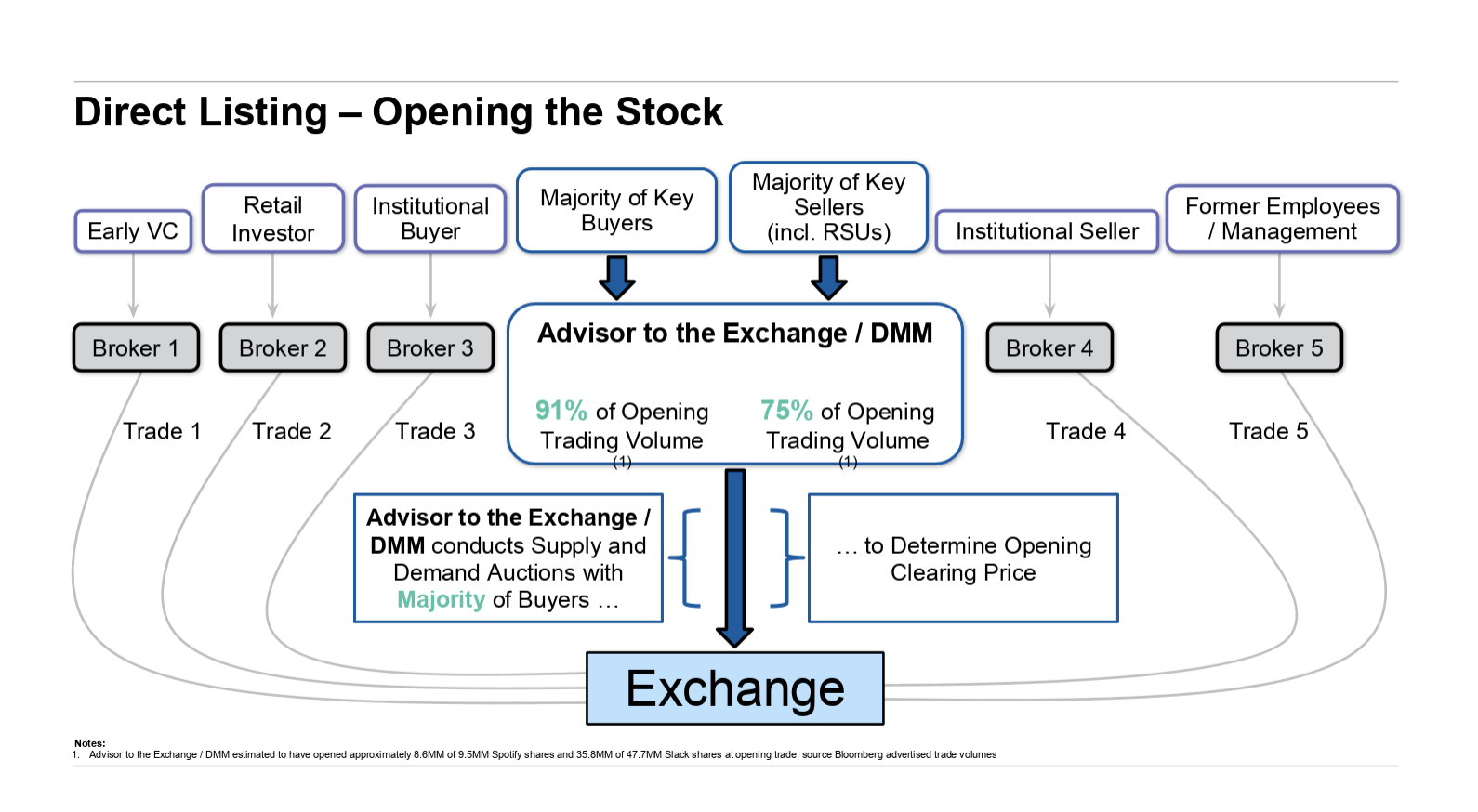
MG: No, there’s no hidden agreement. They can sell as many shares as they want, but it’s going to depend on the price. The way a direct listing opens trading is a critical function because there’s no order book. No one has been taking orders for two weeks. The company has met with investors and done investor education. We’ve helped them write a prospectus, etcetera, but there are no orders, there’s no price range, and off we go. With Slack and Spotify, we were the bank responsible for the trading. What that means is on our trading floor in Times Square, our head trader, John Paci, and his team are in touch with anyone on the cap table who might want to sell and institutional investors who might want to buy, and what’s happening are two auctions at the same time.

So in the traditional IPO, we were taking orders for size within a range that might move a little bit, [but] this is now any price. So take the buyers. [We’re trying to find out] who will pay $8 who will pay $12. Will anyone pay $16? So you’re taking that demand and sorting it by price. At the same time, you’re taking that supply, asking, ‘VC No. 1, is there a price at which you would sell shares?’ If this person says, ‘Yes, but at $20’ and we don’t have any demand at that price, then we figure out: who would sell at $18? Maybe VC No. 2 says they would sell 5 percent of their shares at $18. So we have some buyers, but it’s not enough to open trading with enough liquidity, which is key to all this. If you had one VC and one buyer, the buyer would go away. They’d say, ‘You didn’t tell me I was going to be trading with myself.’ So we have to figure out where a simultaneous demand auction for the highest price, and a supply reverse auction for the lowest price clears and meets. If you can move a billion dollars worth of stock at $14 and get demand for a billion worth of stock, then that’s the price.

That’s then sent to the exchange where the exchange can take and add any other market maker or bank that has another seller or a buyer — so they add in, call it, another 30 percent from other brokers — and that produces the opening transaction.

Stay tuned tomorrow for much more from that interview, where other discussion areas included whether lock-up periods might eventually be done away with in traditional IPOs, why VCs are suddenly so motivated to bang the drum on direct listings, and what really went wrong with Google’s auction-style offering back in 2004.

21 Nov 2019

Antarctic tests will prepare this rover for a possible trip to an icy ocean moon

Exploring a distant moon usually means trundling around its uniquely inhospitable surface, but on icy ocean moons like Saturn’s Enceladus, it might be better to come at things from the bottom up. This rover soon to be tested in Antarctica could one day roll along the underside of a miles-thick ice crust in the ocean of a strange world.

It is thought that these oceanic moons may be the most likely on which to find signs of life past or present. But exploring them is no easy task.

Little is known about these moons, and the missions we have planned are very much for surveying the surface, not penetrating their deepest secrets. But if we’re ever to know what’s going on under the miles of ice (water or other) we’ll need something that can survive and move around down there.

The Buoyant Rover for Under-Ice Exploration, or BRUIE, is a robotic exploration platform under development at the Jet Propulsion Laboratory in Pasadena. It looks a bit like an industrial-strength hoverboard (remember those?), and as you might guess from its name, it cruises around the ice upside-down by making itself sufficiently buoyant to give its wheels traction.

“We’ve found that life often lives at interfaces, both the sea bottom and the ice-water interface at the top. Most submersibles have a challenging time investigating this area, as ocean currents might cause them to crash, or they would waste too much power maintaining position,” explained BRUIE’s lead engineer, Andy Klesh, in a JPL blog post.

Unlike ordinary submersibles, though, this one would be able to stay in one place and even temporarily shut down while maintaining its position, waking only to take measurements. That could immensely extend its operational duration.

While the San Fernando Valley is a great analog for many dusty, sun-scorched extraterrestrial environments, it doesn’t really have anything like an ice-encrusted ocean to test in. So the team went to Antarctica.

The project has been in development since 2012, and has been tested in Alaska (pictured up top) and the Arctic. But the Antarctic is the ideal place to test extended deployment — ultimately for up to months at a time. Try that where the sea ice retreats to within a few miles of the pole.

Testing of the rover’s potential scientific instruments is also in order, since in a situation where we’re looking for signs of life, accuracy and precision are paramount.

JPL’s techs will be supported by the Australian Antarctic Program, which maintains Casey station, from which the mission will be based.

21 Nov 2019

Google limits political ad targeting and all ‘demonstrably false claims’

Google has joined Twitter in revising its political ad rules ahead of what promises to be a brutal election season. But while the latter chose to ban political advertising altogether, Google is mainly limiting the ability to target political demographics, and promises to take action against “demonstrably false claims.”

In a blog post Wednesday afternoon, the search giant explained the new rules in a way that is clearly intended to be understood by a broad audience, not the ad-buying elite.

“Given recent concerns and debates about political advertising, and the importance of shared trust in the democratic process, we want to improve voters’ confidence in the political ads they may see on our ad platforms,” wrote Scott Spencer, VP of product management at Google Ads.

The primary change, he explained, will be the limitation of targeting terms that can be used for political advertising buys that appear in search, on display ads, and on YouTube.

Google knows an immense amount about every one of its users, and as such can display ads to people who like certain products, are concerned with certain issues, and so on. But starting in December, if the ad is political in nature, it will only be able to be targeted to age, general, and postal code. (Notably, Twitter considers using zip codes “microtargeting” and will not allow it for political content.)

That’s nice, but it should be noted that such microtargeting may not be necessary for political issues, since advertisers can target search terms like “South San Jose city council candidates” and they’re off to the races. They just can’t send ads to people because they’re a Democrat, a Republican, support marriage equality, handgun restrictions, etc… but they can buy ads for the search terms “gay marriage,” “assault rifle ban,” and other items. That’s kind of fundamental to search-based ad buys.

At least it seems to be a step in the right direction — deep targeting for serious issues like that is not only unproven and controversial, but also fundamentally creepy. Better to do without it.

Google also said that it’s already “against our policies for any advertiser to make a false claim—whether it’s a claim about the price of a chair or a claim that you can vote by text message, that election day is postponed, or that a candidate has died.”

As further examples of what it would not allow, it cited “misleading claims about the census process, and ads or destinations making demonstrably false claims that could significantly undermine participation or trust in an electoral or democratic process.” That puts rather a fine point on it.

And as a warning to temper your expectations, Google noted that “no one can sensibly adjudicate every political claim, counterclaim, and insinuation,” so it plans to take “very limited” action, only for “clear violations.”

Funnily enough, of all the institutions on Earth, Google seems the one best suited to adjudicating content in that way. But “sensibly” is the key word here, and it is sensible for Google to avoid making promises it can’t keep.

Lastly Google will be expanding its election-related ad transparency reports to include “state-level candidates and officeholders, ballot measures, and ads that mention federal or state political parties.” These will be publicly searchable like those for national candidates, as shown above.

That the major platforms are moving at all on this question of money in politics is good, but it is hard to say how these restrictions — such as they are — will affect how things play out. It’s unlikely this is the last we’ll hear from Google, Twitter, or others on the topic.

20 Nov 2019

Bandit opens a ‘mobile-only’ coffee shop in New York

If you wander into the Bandit coffee shop in Midtown New York, you won’t be able to just walk up to the counter and order something. Instead, you’ll need to download a mobile app.

I experienced it for myself yesterday afternoon, when I — along with several other customers — pulled my phone out, downloaded the Bandit app, then used the app to create a profile, order and pay. A couple minutes later, a barista called me up to the counter and handed me my (pretty good) coffee.

In other words, while Starbucks has been experimenting with mobile ordering and payment, Bandit is betting entirely on what co-founder and CEO Max Crowley called a “mobile-only” store.

Obviously, this model can lead to some initial awkwardness, particularly if random passersby don’t understand it. But there are friendly Bandit staff members on-hand to help, and Crowley (who was previously the general manager of Uber for Business) said that this model offers an opportunity to create “a whole new type of experience.”

He pointed to the rapid growth of China’s Luckin Coffee as an inspiration, and he suggested that ultimately, Bandit should offer customers the most convenient way to satisfy their coffee cravings: Wherever they are, they open the app and order the drink they want. Then they’ll told when it will be ready, and where to pick it up.

Bandit can’t deliver that level of convenience for most customers quite yet, since it only has a single location. But Crowley said he’s also rethought other aspects of the coffee shop model.

For one thing, this first Bandit store is located in what’s essentially a raw retail space. Crowley said he’s team has developed an 11-by-11 foot countertop where all the coffee is prepared — it’s assembled elsewhere and just needs to be plugged in, eliminating the need for an extensive buildout.

“We can launch [a new location] in a few hours, and we can do it at about a tenth the cost of a traditional store,” he said.

So the plan is to launch four or five more New York stores in the coming months, and to expand beyond New York by the end of the first quarter of 2020.

Crowley added that by keeping costs down, Bandit can also keep its coffee affordable: “I don’t think an iced latte needs to be $6 or $7. Our goal is to be less expensive than Starbucks.” (My coffee yesterday, for example, cost me $2.) It’s also experimenting with other pricing models, starting with a $20 subscription that gets you an unlimited $1 drinks for a month.

And if this phone- and pop up-focused mentality sounds a little transactional — maybe even a little soulless — I will note that the actual coffee shop didn’t feel that way at all. While the space was a bit bare, it was eye-catching, with several large games like cornhole set for customers. Most importantly, people weren’t just rushing into pick up their coffee — they were actually hanging out.

“When we did some rudimentary scouting of coffee shop locations, we saw that about 80% of customers are grabbing their coffee and leaving,” Crowley said. “That is definitely core to us, making it super easy to grab it and leave, fulfilling drink orders in less than a minute. All of that said, in the future, we’re going to have this portfolio of different kinds of spaces, different kinds of experiences.”

20 Nov 2019

SpaceX’s Starship Mk1 fails during testing, next step will be to move to a newer design

SpaceX’s Starship Mk1 prototype encountered an explosive failure during early testing in Texas on Wednesday – you can see exactly what happened in the video below, but basically it blew its lid during cryogenic testing – a standard test that you use to see if the vehicle can hold up to extreme cold temperatures, like those it would encounter in actual use. The good news is that this is exactly why SpaceX (and anyone building rockets) does this kind of early-stage testing on the ground, in controlled, relatively safe conditions. The bad news is that this might delay the company’s optimistic timelines.

As for next steps, the plan appears to be to take what Starship Mk1 has taught SpaceX so far and proceed with the next iteration of the prototype spacecraft – Starship Mk3. ‘Wait, didn’t we skip a Mk?’ you might ask – no, because SpaceX is already building Mk2 in parallel with this now-destroyed Mk1 at its other facility in Florida.

SpaceX CEO Elon Musk was quick to answer a question on Twitter from YouTuber Everyday Astronaut regarding the next steps for Starship testing, saying it’ll move on to Mk3 design, and that Mk1’s value was primarily “as a manufacturing pathfinder,” noting that “flight design is quite different.”

This is still a different version of events and Starship development from what’s been discussed previously: Starship Mk1 and Mk2 were originally characterized as high-altitude test flight vehicles, to follow the success of the ‘Starhopper’ snub-nosed subscale demonstrator, which was used to test a single Raptor engine for a couple of low-altitude hops at SpaceX’s Texas site.

Timelines are always fluid in the space business, however, and in particular in the launch industry. SpaceX also sets incredibly optimistic timelines for most of its ambitious goals, by the open admission of both Musk and SpaceX President and COO Gwynne Shotwell. Still, the company has said it’ll look to achieve orbital flight with a Starship prototype vehicle as early as next year, so we’ll have to wait and see whether this inopportune test result affects that schedule.

20 Nov 2019

Sonos acquires voice assistant startup Snips, potentially to build out on-device voice control

Sonos revealed during its quarterly earnings report that it has acquired voice assistant startup Snips in a $37 million cash deal, Variety reported on Wednesday. Snips, which had been developing dedicated smart device assistants that can operate primarily locally, instead of relying on consistently round-tripping voice data to the cloud, could help Sonos set up a voice control option for its customers that has “privacy in mind” and is focused more narrowly on music control than on being a general-purpose smart assistant.

Sonos has worked with both Amazon and Google and their voice assistants, providing support for either on their more recent products, including the Sonos Beam and Sonos One smart speakers. Both of these require an active cloud connection to work, however, and have received scrutiny from consumers and consumer protection groups recently for how they handle the data they collect form users. They’ve introduced additional controls to help users navigate their own data sharing, but Sonos CEO Patrick Spence noted that one of the things the company can do in building its own voice features is developing them “with privacy in mind” in an interview with Variety.

Notably, Sonos has introduced a version of its Sonos One that leave out the microphone hardware altogether – the Sonos One SL introduced earlier this fall. The fact that they saw opportunity in a mic-less second version of the Sonos One suggests it’s likely there are a decent number of customers who like the option of a product that’s not round-tripping any information with a remote server. Spence also seemed quick to point out that Sonos wouldn’t seek to compete with its voice assistant partners, however, since anything they build will be focused much more specifically on music.

You can imagine how local machine learning would be able to handle commands like skipping, pausing playback and adjusting volume (and maybe even more advanced feature like playing back a saved playlist), without having to connect to any kind of cloud service. It seems like what Spence envisions is something like that which can provide basic controls, while still allowing the option for a customer to enable one of the more full-featured voice assistants depending on their preference.

Meanwhile, partnerships continue to prove lucrative for Sonos: Its team-up with Ikea resulted in 30,000 speakers sold on launch day, the company also shared alongside its earnings. That’s a lot to move in one day, especially in this category.

20 Nov 2019

Apple expands and updates its ‘Everyone Can Code’ program

Apple announced today an expansion of its program designed to get more students coding. The company says it has redesigned the “Everyone Can Code” curriculum with a focus on introducing more elementary and middle school students to coding, while also adding more resources for teachers, a new student guide, and refreshed Swift Coding Club materials. It’s also adding thousands of free coding sessions at Apple Stores in December, to celebrate Computer Science Education Week.

The updated curriculum is meant to make coding more approachable, Apple explains, by offering activities that are more closely connected to the students’ everyday lives. It also includes a new guide to Swift Playgrounds called Everyone Can Code Puzzles, where students can experiment with concepts and apply their understanding across over 40 hours of activities.

The guide comes with a teacher companion, which includes the solutions, assessment strategies, accessibility resources, and more.

The curriculum is also now optimized for VoiceOver, includes closed-captioned videos, and videos in American Sign Language.

In another expansion, Apple has integrated its Everyone Can Create project guides into the new curriculum. Launched last year on Apple Books, Everyone Can Create has served to get teachers to integrate things like drawing, music, filmmaking and photography into their classroom, by way of Apple technology.

Related this news, Apple says it’s increasing the number of Today at Apple coding sessions from December 1 through 15, 2019 in order to celebrate Computer Science Education Week.

The free, interactive sessions are meant to inspire young coders with block-based coding using robots, while more advanced coders use Swift Playgrounds to learn coding concepts or to code an AR project.

Some stores will also offer preschool-aged coding sessions in the new Coding Lab with Helpsters, the little monsters who star in the new Apple TV+ show, from the makers of Sesame Street. Other sessions will involve Apple Distinguished Educators, Apple Entrepreneur Camp innovators, developers, and artists. A Develop in Swift curriculum will continue to be available for high school and college students, Apple noted.

And for the seventh consecutive year, Apple will support the Hour of Code with a new Hour of Code Facilitator Guide that will help teachers and parents host sessions using Swift Playgrounds.

20 Nov 2019

PayPal to acquire shopping and rewards platform Honey for $4B

PayPal announced today it has agreed to acquire Honey Science Corporation, the makers of a deal-finding browser add-on and mobile application, for $4 billion, mostly cash. The acquisition, which is PayPal’s largest to date, will give the payments giant a foothold earlier in the customer’s shopping journey. Instead of only competing on the checkout page against credit cards or Apple Pay, for example, PayPal will leap ahead to become a part of the deal discovery process, as well.

Currently, Honey’s 17 million monthly active users take advantage of its suite of money-saving tools to track prices, get alerts, make lists, browse offers and participate in an Ebates-like rewards program called Honey Gold. Its users tend to be younger, millennial shoppers, both male and female.

PayPal aims to add Honey’s technology to its own product line, expanding its reach to PayPal’s 300 million users.

“What’s exciting is that we can take the functionality Honey now offers — which is product discovery, price tracking, offers and loyalty — and build that into the PayPal and Venmo experiences,” explains PayPal SVP of Global Consumer Products and Technology, and former Xoom CEO, John Kunze. “When Honey says they’re putting money in the pockets of their customers — that’s perfectly in line with what we want to do. We want to make digital commerce and financial services more affordable, easier to use, more fun and more accessible to people around the world,” he says.

In addition, PayPal’s network of 24 million merchant partners will gain the ability to offer targeted and more personalized promotions to consumers as a means of acquiring new business and driving increased sales. PayPal Credit may also be integrated into Honey to help finance larger purchases.

Honey has flown under the radar to some extent since its founding in 2012.

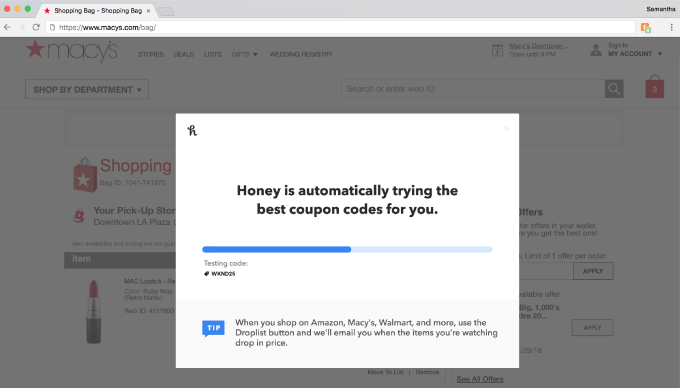
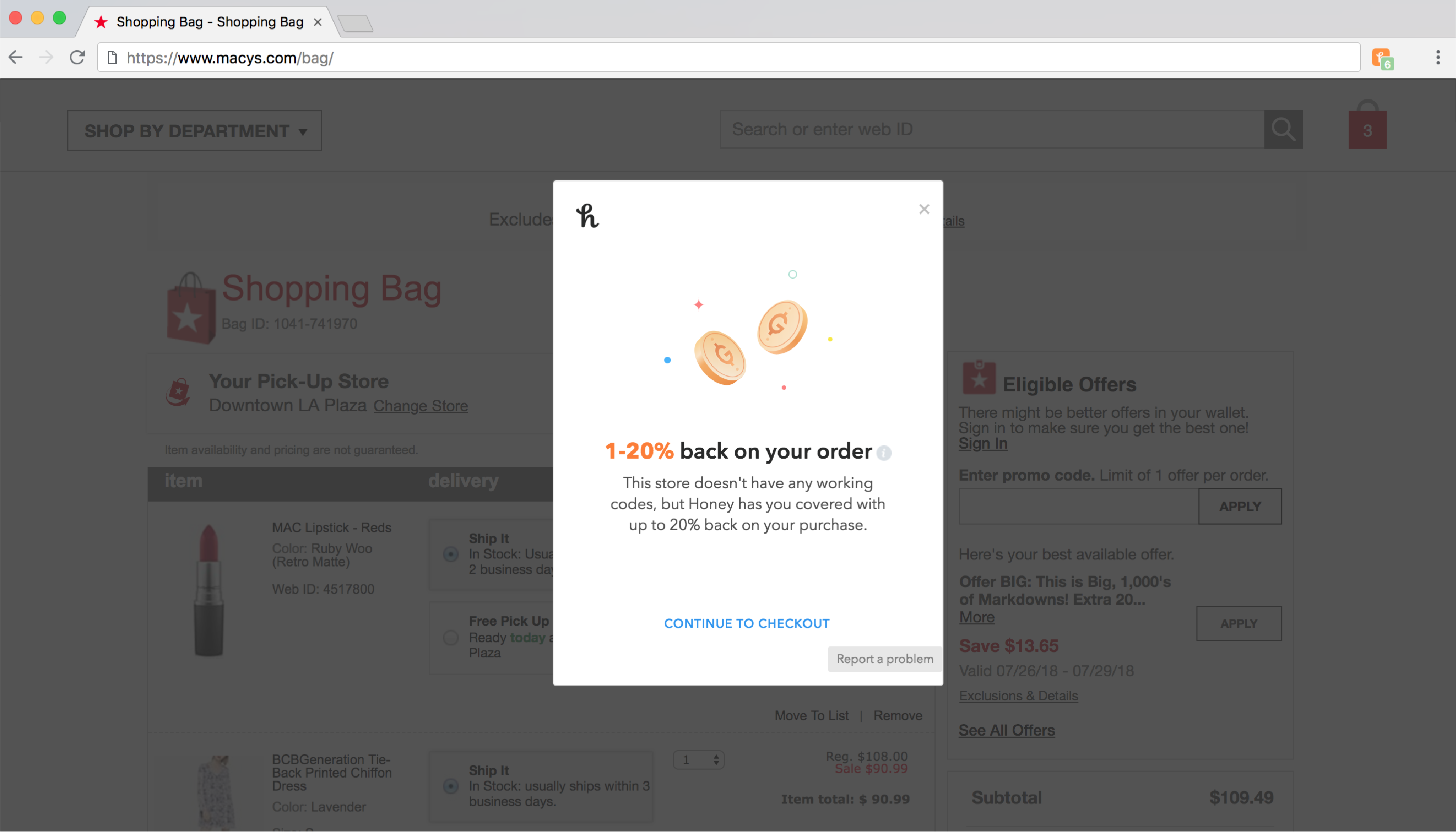
Originally only a web browser extension, Honey tracks sales and retailers’ promo codes, as a rival to RetailMeNot and others. What makes the extension so useful is that it automatically tries all the eligible promo codes for you during checkout then selects the one that provided the most savings and applies it on your behalf. This helps shoppers feel more comfortable with their purchases and reduces shopping cart abandonment.

The company also rolled out features to inform shoppers of an item’s price history, including the historical pricing of any product on Amazon’s marketplace. In 2017, Honey launched DropList, which would track and alert users to lower prices, as well as tools for finding travel deals.

As more consumers shifted their shopping to e-commerce merchants, Honey’s user base also rapidly grew.

Its browser extension now works across approximately 30,000 merchant websites, including fashion, technology, travel and even pizza delivery. Last year, Honey publicly shared that its 10 million members had saved over $800 million using its tools. As of today, Honey’s 17 million members have saved more than $2 billion to date.


“Honey is amongst the most transformative acquisitions in PayPal’s history. It provides a broad portfolio of services to simplify the consumer shopping experience, while at the same time making it more affordable and rewarding,” said Dan Schulman, president and CEO of PayPal, in a statement.

“The combination of Honey’s complementary consumer products with our platform will significantly enhance our ability to drive engagement and play a more meaningful role in the daily lives of our consumers. As a partner of choice for our merchants, this is another way that we can help them build and strengthen their customer relationships, provide personalized offers, and drive incremental sales. The combination of Honey and PayPal adds another significant and meaningful dimension to our two-sided platform,” Schulman added.

The acquisition also gives PayPal a way to fight back against the increased competition from Apple, Google, Facebook and other tech companies that have entered the payments market in recent years. On Apple’s Q4 2019 earnings call, for example, CEO Tim Cook noted that Apple Pay has now exceeded PayPal transaction volume with 3 billion transactions in the quarter. Meanwhile, analysts are predicting Facebook Pay has the potential to unseat both Apple Pay and PayPal alike.

Then there are PayPal’s original rivals — the world’s biggest card networks like Visa, Mastercard, American Express and Discover. These companies are also fighting to remain relevant online, with a new PayPal competitor of their own to simplify online checkout.

With Honey, PayPal immediately shifts the battle away from the checkout page itself to instead compete against all the places people go to discover, browse, get inspired and deal-hunt — whether that’s directly on retailers’ sites or through newer platforms, like Pinterest or Instagram Shopping.

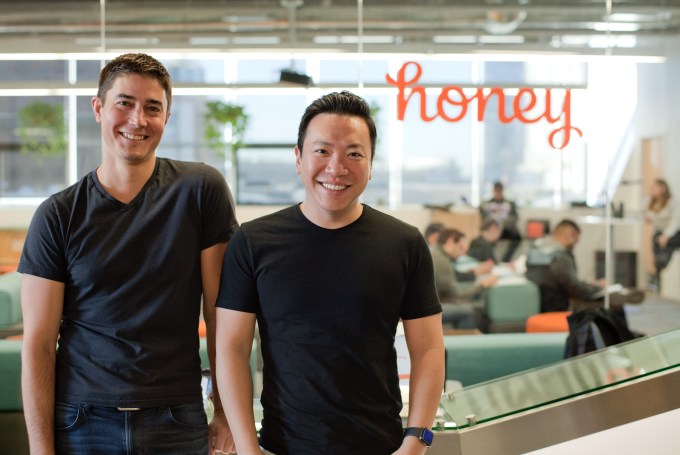
As a result of the acquisition, Honey co-founders George Ruan and Ryan Hudson will join PayPal where they’ll work on product integrations and scaling the technology to a much larger user base. Also joining is Honey’s predominantly L.A.-based team of 350 employees.

The Honey team and headquarters will remain in L.A., where they’ve just signed a lease on a new office space with expansion goals in mind.

“Combining PayPal’s assets and reach with our technology, we can build powerful new online shopping experiences for consumers and merchants,” said Hudson. “We’ll have the ability to help millions of retailers efficiently reach consumers with offers that deliver more and more value to Honey members.”

To date, Honey had raised $49 million from investors, including Ludlow Ventures, Zuma Partners, Mucker Capital, SXE Ventures, BAM Ventures, Plug and Play, Wonder Ventures, Cendana Capital, Anthos Capital and others, according to Crunchbase.

Honey was already profitable on a net income basis in 2018, PayPal notes. The acquisition is expected to close in the first quarter of 2020, subject to regulatory approval. It’s expected to be accretive to PayPal’s non-GAAP earnings per share in 2021.

PayPal will hold a conference call at 2 PM PST today to discuss the transaction further.

20 Nov 2019

Google Cloud launches Bare Metal Solution

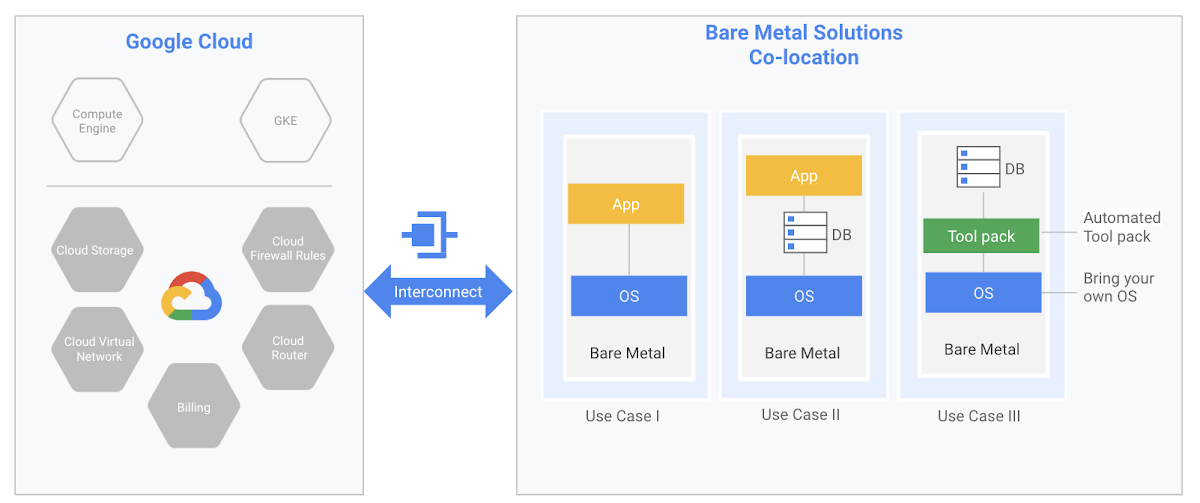
Google Cloud today announced the launch of a new bare metal service, dubbed the Bare Metal Solution. We aren’t talking about bare metal servers offered directly by Google Cloud here, though. Instead, we’re talking about a solution that enterprises can use to run their specialized workloads on certified hardware that’s co-located in the Google Cloud data centers and directly connect them to Google Cloud’s suite of other services. The main workload that makes sense for this kind of setup is databases, Google notes, and specifically Oracle Database.

Bare Metal Solution is, as the name implies, a fully integrated and fully managed solution for setting up this kind of infrastructure. It involves a completely managed hardware infrastructure that includes servers and the rest of the data center facilities like power and cooling, support contracts with Google Cloud and billing are handled through Google’s systems, as well as an SLA. The software that’s deployed on those machines is managed by the customer — not Google.

The overall idea, though, is clearly to make it easier for enterprises with specialized workloads that can’t easily be migrated to the cloud to still benefit from the cloud-based services that need access to the data from these systems. Machine learning is an obvious example, but Google also notes that this provides these companies with a bridge to slowly modernize their tech infrastructure in general (where ‘modernize’ tends to mean ‘move to the cloud’).

“These specialized workloads often require certified hardware and complicated licensing and support agreements,” Google writes. “This solution provides a path to modernize your application infrastructure landscape, while maintaining your existing investments and architecture. With Bare Metal Solution, you can bring your specialized workloads to Google Cloud, allowing you access and integration with GCP services with minimal latency.”

Since this service is co-located with Google Cloud, there are no separate ingress and egress charges for data that moves between Bare Metal Solution and Google Cloud in the same region.

The servers for this solution, which are certified to run a wide range of applications (including Oracle Database) range from dual-socket 16-core systems with 384 GB of RAM to quad-socket servers with 112 cores and 3072 GB of RAM. Pricing is on a monthly basis, with a preferred term length of 36 months.

Obviously, this isn’t the kind of solution that you self-provision, so the only way to get started — and get pricing information — is to talk to Google’s sales team. But this is clearly the kind of service that we should expect from Google Cloud, which is heavily focused on providing as many enterprise-ready services as possible.

20 Nov 2019

Reimagine inside sales to ramp up B2B customer acquisition

Slack makes customer acquisition look easy.

The day we acquired our first Highspot customer, it was raining hard in Seattle. I was on my way to a startup event when I answered my cell phone and our prospect said, “We’re going with Highspot.” Relief, then excitement, hit me harder than the downpour outside. It was a milestone moment – one that came after a long journey of establishing product-market fit, developing a sustainable competitive advantage, and iterating repeatedly based on prospect feedback. In other words, it was anything but easy.

User-first products are driving rapid company growth in an era where individuals discover, adopt, and share software they like throughout their organizations. This is great if you’re a Slack, Shopify, or Dropbox, but what if your company doesn’t fit that profile?

Product-led growth is a strategy that works for the right technologies, but it’s not the end-all, be-all for B2B customer acquisition. For sophisticated enterprise software platforms designed to drive company-wide value, such as Marketo, ServiceNow and Workday, that value is realized when the product is adopted en masse by one or more large segments.

If you’re selling broad account value, rather than individual user or team value, acquisition boils down to two things: elevating account based-selling and revolutionizing the inside sales model. Done correctly, you lay a foundation capable of doubling revenue growth year-over-year, 95 percent company-wide retention, and more than 100 percent growth in new customer logos annually. Here are the steps you can take to build a model that realizes on-par results.

Work the account, not the deal

Account-based selling is not a new concept, but the availability of data today changes the game. Advanced analytics enable teams to develop comprehensive and personalized approaches that meet modern customers’ heightened expectations. And when 77 percent of business buyers feel that technology has significantly changed how companies should interact with them, you have no choice but to deliver.

Despite the multitude of products created to help sellers be more productive and personal, billions of cookie-cutter emails are still flooding the inboxes of a few decision makers. The market is loud. Competition is cut throat. It’s no wonder 40 percent of sales reps say getting a response from a prospect is more difficult than ever before. Even pioneers of sales engagement are recognizing the need for evolution – yesterday’s one-size-fits-all approach to outreach only widens the gap between today’s sellers and buyers.

Companies must radically change their approach to account-based selling by building trusted relationships over time from the first-touch onward. This requires that your entire sales force – from account development representatives to your head of sales – adds tailored, tangible value at every stage of the journey. Modern buyers don’t want to be sold. They want to be advised. But the majority of companies are still missing the mark, favoring spray-and-pray tactics over personalized guidance.

One reason spamming remains prevalent, despite growing awareness of the need for quality over quantity, is that implementing a tailored approach is hard work. However, companies can make great strides by doing just three things:

  • Invest in personalization: Sales reps have quota, and sales leaders carry revenue targets. The pressure is as real as the numbers. But high velocity outreach tactics simply don’t work consistently. New research from Monetate and WBR Research found that 93% of businesses with advanced personalization strategies increased their revenue last year. And while scaling personalization may sound like an oxymoron, we now have artificial intelligence (AI) technology capable of doing just that. Of course, not all AI is created equal, so take the time to discern AI-powered platforms that deliver real value from the imposters. With a little research, you’ll find sales tools that discard  rinse-and-repeat prospecting methods in favor of intelligent guidance and actionable analytics.