Category: UNCATEGORIZED

20 Nov 2019

Sharding, scalability, decentralization – You name it, we’ve got it on the EC stage in Berlin

Sharding and scalability. Transactions per second.  Crypto-ecosystems. The decentralized web. These are the voyages of the Starship Blockchain, on it’s 5-year mission to seek out… Ok, you get the drift! But as you can tell, there remain many, many issues to tease out of this burgeoning new tech world, one we will be unpacking at Techcrunch Disrupt Berlin this December.

There are still a lot of issues to deal with. The current version of Ethereum can only handle a dozen transactions per second. “Sharding” or spreading the load via partitioning should lead to a drastic increase in performance, but the question is how to do it? Ethereum 2.0 still remains a moving target. There is even a growing “Ethereum killer” community. And while all this goes on, high-minded organizations like the Web3 Foundation are trying to foster the development of a user-friendly crypto-ecosystem and decentralized web.

Who on earth would take all this on? TechCrunch Disrupt Berlin of course, and in particular our Extra Crunch stage.

Since we launched Extra Crunch, our premium content service for those readers who like to hold TechCrunch close and cuddle it at night, we’ve been running a premium EC stage at our TechCrunch Disrupt conferences, and this will be no less true in Berlin.

Given Berlin is a hotbed of blockchain startups and development, it would be utterly remiss of us not to cover this subject, but the Extra Crunch stage gives us some extra (oh yeah!) bandwidth to do deep-dives for attendees to get under this skin of this rapidly expanding aspect of the tech industry.

We’re excited to be joined by three amazing speakers to pore over the latest development in the blockchain world.

Justin Drake (Ethereum)
Justin studied mathematics at Cambridge University. He was a Bitcoin entrepreneur from 2014 to 2017 and is now an Ethereum 2.0 researcher.

Justin is going to cover off where Ethereum 2.0 is at right now as someone who has been working on sharding and scalability and supporting the Ethereum ecosystem to enable these new use cases.

With the current version of Ethereum only able to handle a dozen transactions per second, sharding will be crucial, but Ethereum 2.0 is a moving target and remains a large-scale experiment of distributed development.

If the community gets it right, Ethereum 2.0 could transform the Ethereum blockchain into a sort of “world computer” that can execute instructions across a network of servers all around the world. On the EC stage Justin will also be talking about building a blockchain startup on the Extra Crunch Stage with other blockchain experts. If anyone know, he knows how important it is to build a community of developers and researchers around your blockchain project.

Ash Eagan (Accomplice VC)
A World Economic Forum Global Shaper and advisor at ConsenSys’ Tachyon Accelerator, Ash Eagan has backed a number of headline companies in the space including Bison Trails, Coda, CoinList, Dapper Labs, Near, Simplex, and Torus. Before Accomplice, he co-launched ConsenSys’ venture arm and started his career at Converge VC in Boston.

Egan has previously highlighted the ongoing innovations within the “Ethereum killer” community and how it “expands the sandbox” but he also believes that for mass adoption of crypto on social networks to take off, users will need to be monetized via advertisements and referrals.

Ashley Tyson (Web3 Foundation)
Ashley Tyson is the Director of Partnerships and Strategic Initiatives at Web3 Foundation. She spends her time aligning diverse teams working on decentralized systems and supporting blockchain ecosystem initiatives like Ethereum Community Fund and ETHPrize.

Prior to Web3 Foundation, Ashley co-founded DEFCAD, a censorship-resistant search engine for 3D printable files. She deeply understands the need for a decentralized web, beginning her career in NYC at one of the first social media-focused agencies, where she helped multinational corporations build Web 2.0 strategies around consumer data acquisition for use in marketing initiatives.

Disrupt Berlin runs December 11 and December 12. Tickets are available here!

20 Nov 2019

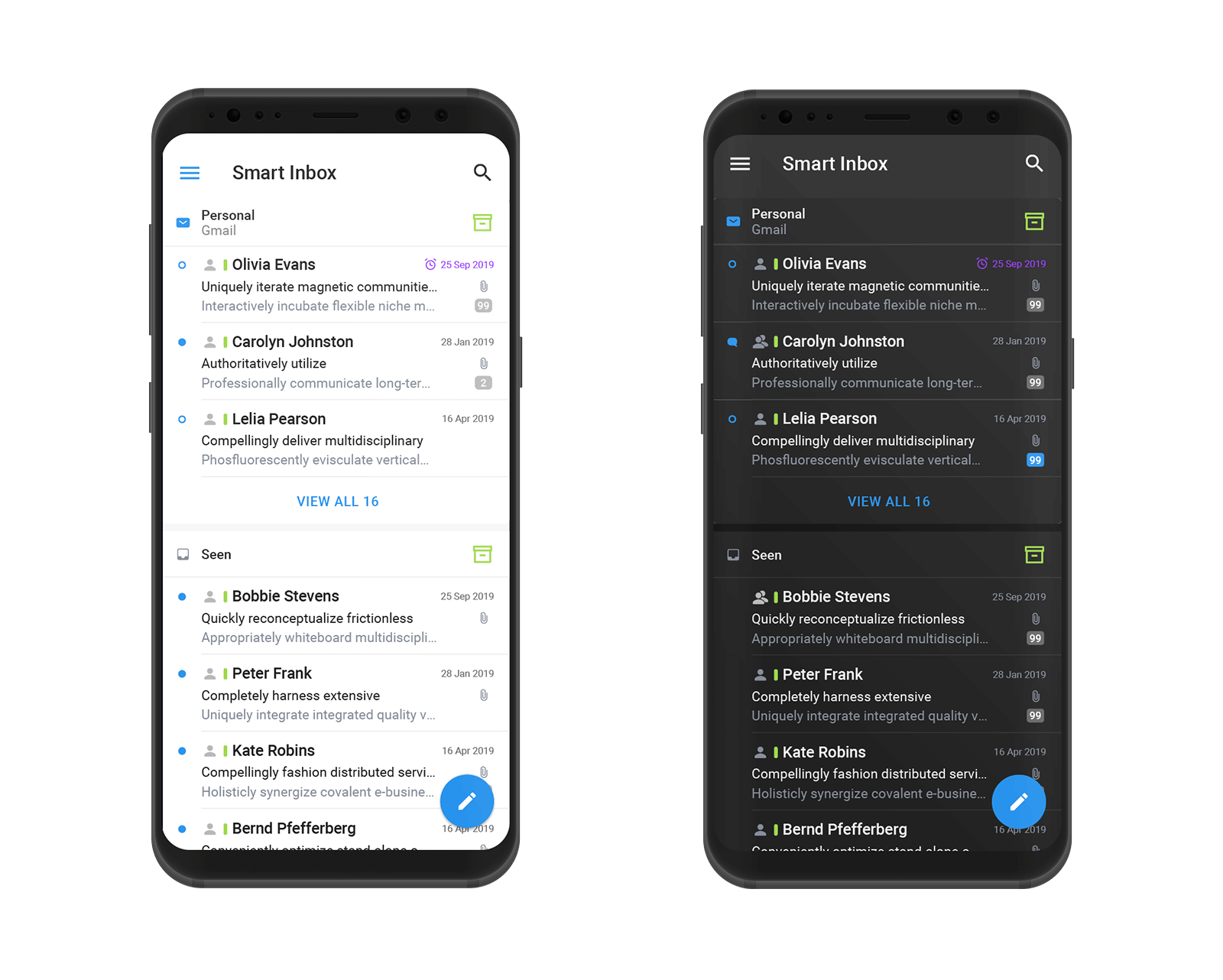
Email app Spark receives update with new design

Spark, the popular email app from Readdle, has been redesigned on iOS and Android. The interface has always been a bit busy in the mobile app. That’s why the updated app now features a cleaner design and a handful of new features.

On the design front, Spark now uses simple headers to separate smart sections, such as newsletters, notifications and personal emails. It looks better than the rounded boxes with a colorful background.

There’s a lot of whitespace now, but the company has also taken advantage of this update to add dark mode. When you tap on a thread, the thread view has been updated as well.

When it comes to new features, the app tries to autopopulate your inbox with profile pictures. Just like Vignette, it pulls images from popular web services. For instance, if somebody who emails you has a Twitter account under the same email address, Spark can add the Twitter profile picture to your inbox.

Everybody has their own way of dealing with their email inbox. That’s why Spark lets you choose the buttons that appear at the bottom of an email thread. For instance, if you use folders a lot, you can put a folder button. But if you want to replace that button with a snooze button, you can.

Spark is now a better citizen on iPadOS 13. You can open multiple instances of Spark. This way, you can work on a document with an email thread using Split View and you can open a second Spark window to check your inbox in a separate workspace. Spark on iPadOS also supports the floating keyboard and new iPadOS gestures.

20 Nov 2019

Tuesday Company acquires VoteWithMe as tech for politics looks to consolidate ahead of 2020

Tuesday Company, the organizational toolkit for political advocacy groups and candidates, has taken another step to consolidate its position in the growing market for tech-enabled political outreach with the acquisition of the voting mobilization service VoteWithMe.

Launched in the wake of the 2016 election by three former staffers from Hillary Clinton’s campaign for the presidency, Tuesday is one of the higher profile alumni from the progressive-focused technology accelerator, Higher Ground Labs.

Michael Luciani, Jordan Birnholtz, and Shola Farber, the co-founders of Tuesday Company, met working on mobilization and outreach for the Clinton campaign in 2016. Although Clinton lost, the work that the trio had done to encourage staffers and volunteers to send personalized outreach messages to their social network increased outreach in Michigan and other battleground states.

Now, coupled with VoteWithMe’s technology to encourage people to get to the polls on election day, the company believes it has a more complete platform to organize and mobilize for election day.

While Tuesday’s users were political campaigns, advocacy groups, and their professional staffers, VoteWithMe was a free-to-use app that went directly to voters to encourage them to get friends to voting booths. The company had over 250,000 downloads at the time of its acquisition.

“The opportunity to bring the B2B and B2C aspects together was really really really important,” says Farber, the Tuesday Co. chief operating officer.

“We did a really great job building for organizations and for staff and organizers because our team is so strongly rooted in the organizing practice… and, VoteWithMe, they did a great job of building that consumer experience and our goal is to blend the expertise there,” according to Birnholtz, the company’s chief product officer.

The size of the acquisition was not disclosed, but the all-cash transaction means that Tuesday Company now owns the VoteWithMe tech and the team developing the VoteWithMe product will continue to have a consulting relationship with Tuesday Company.

While national politics dominates the news, advocacy groups of all stripes are seeing the benefits in applying the same tools that well-funded political campaigns brought to bear on the electorate to promote particular issues.

Non-profits represent at least $13 billion of annual business, according to Farber, and Tuesday Company believes its services can provide value to all of them.

“The… political campaign world is really hard to build an innovative, sustainable business in, because it’s relatively small. Folks that don’t figure out how to become broadly relevant won’t survive,” says Birnholtz.

In the wake of the acquisition, investors can expect to see Tuesday Company out on the fundraising trail. The company is backed by Higher Ground Labs and individual investors like Chris Sacca and Reed Hoffman.

While Hoffman’s forays into the intersection of tech and politics have not always been without scandal, he has emerged as one of the most prolific backers of companies looking to apply technology to the political sphere.


20 Nov 2019

Brava, a smart oven maker with big names attached, just sold to an industrial equipment company

Brava had a lot of things working in its favor as startups go. It was founded in 2015 by serial executive John Pleasants, whose past stints have included as co-president of Disney Interactive Media Group, COO of Electronic Arts, and CEO of Ticketmaster.

His plans to create a suite of snazzy direct-to-consumer line of smart hardware and software products, beginning with the Brava oven, also attracted tens of millions of dollars from an impressive line-up of backers, including True Ventures, TPG Growth, and Lightspeed Venture Partners, among others. Indeed, though some sophisticated kitchen devices have come and gone (Juicero), some liked what Pleasants and his growing team in Redwood City, Ca., were trying to cook up, and one of these admirers, apparently, was the Middleby Corporation, a publicly traded commercial and residential cooking and industrial process equipment company in Illinois that just acquired Brava — though neither Brava nor Middleby is disclosing terms of the deal.

We were in touch via email yesterday with both Pleasants and the CEO of Middleby, Tim FitzGerald, to learn what they can share about the tie-up, as well as to ask what happens to Brava and its tens of employees now.

TC: This was a young company. Why turn around and sell it?

JP: The company itself is four years-old and we’ve had product available in market for one year. We’ve been venture funded to date and had the option to continue raising growth capital or merge with Middleby Corporation. Brava’s mission has always been to enable everyone to cook delicious, healthy home-cooked food with minimal time and effort, and we believe the fastest way to achieve this bold goal is through a strategic partnership with someone who can help make that happen.

TC: How did Brava and Middleby come together? Who brokered the first conversation? Was Brava talking with anyone else?

JP: We’ve been in talks with many people about financing, and a select group of strategics about a deeper partnership to achieve our objective. We had the assistance of City Capital in the process, and they made the introduction to Middleby in Chicago.

TC: How much is Middleby paying for the company? Also, is this an all-cash deal?

JP: While not disclosing the total amount, the consideration includes a mix of cash and stock

TC: So what’s next? Will Middleby retain the Brava name or will this be phased out over time?

JP: Brava as it’s known today will not only continue but see accelerated growth and expansion. We will continue to sell the product and support our customers under the Brava brand while further innovating new products and services for our customers.

TF: The Brava name will remain. The product and technology will enhance our existing residential and commercial kitchen appliance portfolio. In Middleby Residential, we manufacture and sell Viking Range and other well-known consumer brands.

TC:  How many people does Brava currently employ and how many if any are going to Middleby?

JP: Brava employs 38 people and all will be going to Middleby. I will remain as the CEO of Brava and will also work with other Middleby divisional leaders to leverage Brava’s light cooking platform and services for their existing brands. We’re excited by this because we currently have many ideas and plans for leveraging the Brava technology across new form factors, business segments (residential and commercial) and geographies. This all becomes more feasible with Middleby.

TC: We last talked before the Brava oven was out in the world. How many units did you wind up selling? 

JP: We’re closing in on 5,000 customers and expect to have a big holiday.

TC: What were some of the lessons learned with this experience?

JP: People love it. You can see this every day throughout our online communities. It’s not just about the quality of food and the ease in creating it . . . we hear comments all the time about how spouses who hardly ever cooked now do, how kids who never liked vegetables now ask for more . . .

In terms of what people want that doesn’t currently exist, [I’d say] more recipes and programs (we have thousands, but there are so many more we can do) and more flexibility; we can uniquely cook multiple ingredients simultaneously to perfection with our light-cooking technology and this enables lots of fun combinations [but] our customers would like even more flexibility in mixing and matching ingredients.

TC: Any business lessons?

JP: In terms of business lessons, it’s challenging to explain Brava’s full value proposition in a quick ad on social media. We have revolutionary technology that enables a new way of cooking that’s better, easier, faster — and that sounds almost too good to be true.

TC: Do you think the market for smart cooking appliance is big enough at this point? What do you think are the remaining hurdles and how do consumers get past them?

JP: The “smart cooking appliance” market is in its infancy. There are still very few pioneers in the space and household penetration is negligible. But this is all about to change. Once people know someone who can personally attest to the benefits, I fundamentally believe the adoption curve will bend exponentially.  People spend a lot of money on household appliances…once they can be “smart” and “chef powered” and deliver well against that promise, why would most people not want a “smart” one versus a “non-smart” one?

TF: We see this market growing significantly with the next generation [of home cooks] who currently rely on and demand a digital experience.

20 Nov 2019

Gravitational nabs $25M Series A to ease cloud deployment with Kubernetes

As we move into an increasingly multi-cloud world, there is a portability problem moving applications between clouds. Gravitational wants to fix that, and today it announced a $25 million Series A.

The round was led by Kleiner Perkins with help from S28 Capital and Y Combinator. Today’s investment brings the total raised to $31 million, according to the company.

Ev Kontsevoy, Gravitational co-founder and CEO, says his company is solving a couple of big problems around cloud portability. “There are just differences between all these different cloud providers because applications have dependencies. The application might depend on the cloud provider’s capabilities, and they use all this different middleware software that the cloud providers are bundling today with the infrastructure,” Kontsevoy explained. Those dependencies make it difficult to move an application to another cloud without additional coding.

He says that the other problem is related to on-going management of an application after you deploy it in the cloud, and that requires a large operations team. The problem with that is that there is a shortage of talent to fill these positions.

To solve these problems, Gravitational looked to Kubernetes . The company believes customers should build software using Kubernetes, open source software and standards, and instead of building in the cloud dependencies up front, make their programs completely vanilla.

“Start with your application and don’t worry about clouds at all, don’t even have a cloud account in the beginning. Make sure your application runs on top of Kubernetes, package all of your software dependencies into Kubernetes, use open source software and open standards as much as you possibly can,” he explained.

He says that Kubernetes gives you the ability to build software with very little administration, and then you can use Gravitational’s Gravity tool to package that solution into a single file, which you can then deploy on any cloud, private data center or even make available as download like you could with software back in the 1990s.

He sees organizations moving to container-driven software using Kubernetes, and as they do this, he believes they can break this dependency on the individual cloud providers using his company’s tools.

It’s certainly compelling if it works as described. Gravitational has 20 employees and around 100 paying customers. The company offers a couple of tools, Gravity and Gravitational Teleport as open source. It was a member of the Y Combinator 2015 cohort.

20 Nov 2019

Invasive scheme spotted that foxes tracker blockers

Online privacy is facing a new challenge: A first-party tracker that appears to be unblockable with standard privacy tools such as adblockers.

The tracker in question was spotted being deployed by French national newspaper, Liberation, which in October promised subscribers an entirely tracker-free experience.

That promise garnered it a bunch of attention from privacy experts who dug around and found a first-party tracker embedded on its site which uses a subdomain (that’s mostly random) in order to redirect to a third party — thereby making it difficult to block (i.e. without also blocking Liberation’s own domain).

“To participate in this rather invasive scheme, a website operator need to make a decision to delegate the domain name alias,” explains Dr Lukasz Olejnik, independent privacy researcher and advisor, and research associate Center for Technology and Global Affairs Oxford University.

“It’s a setting where the website the user visits delegates a domain name alias to a third-party script provider. So when the user visits example.com, the alias for the content might be Y.example.com, which in reality points to a site third-party.example.org, a third-party server.

“This setting can effectively bypass third-party trackers and adblockers, especially if the domain name part contains unpredictable strings. This is because the user is visiting a website where a tracker could work in context of the first party, the visited website.”

On Liberation’s site the tracker points to the domain of a French “marketing optimization” provider called Eulerian — which sells data-driven analytics to websites. Though Liberation claims its subscribers aren’t being tracked via this method for ad targeting purposes — but only so it can gather site analytics. (Non-subscribers will be tracked for ad targeting, however.)

The newspaper’s own fact check team have reported at length on the controversy here — covering both privacy and security implications of its use of the first-party tracker scheme, and noting that privacy researchers are working on methods to defeat the technique. 

Zooming out, while the unblockable (or at least tricky to block) tracking scheme does not appear to be being used very widely as yet, there’s a chance such a technique could be taken up more widely if sites look to replace third party tracking cookies with alternatives.

This is because web browsers have been taking an increasingly proactive approach to squeezing the operation range of tracking technologies. Mozilla recently switched on third-party cookie tracker blocking by default, for example. While, this summer, WebKit announced a new tracking prevention policy that put privacy on a par with security. Google has also announced changes to how its Chrome browser handles cookies.

“Exact prevalence is unknown but it is fair to say thousands of sites subscribe to this particular scheme from the provider now under discussion, among them some very popular sites,” says Olejnik. “The technical possibility of such as scheme is not entirely new, in fact I did see it in use in 2014. There may have been less motivation to use it until now, though.”

“Focusing on forward-outlook is sometimes useful, isn’t it?” he adds.

Asked about practical ways such tracking might be defeated, Olejnik suggests tracker blockers would need to devise a “custom mode of checks to detect these specific schemes” — as they work on “slightly different principles than other ways of including third-party content”.

Perhaps more effective at skewering such tricky schemes might be a recent ruling by Europe’s top court which clarified that user consent must be obtained prior to storing or accessing non-essential cookies, and cannot be implied or assumed.

20 Nov 2019

Samasource raises $14.8M for global AI data biz driven from Africa

AI training data provider Samasource has raised a $14.8 million Series A funding round led by Ridge Ventures.

The San Francisco headquartered company delivers Fortune 100 companies with the inputs they need for machine learning development in fields including autonomous transportation, e-commerce and robotics.

And it does so with a global work-force of data-specialists, a large number of whom are located in East Africa.

In addition to San Francisco, New York and the Hague, Samasource has offices and teams in Kenya and Uganda. The company has a global staff of 2900 and is the largest AI and data annotation employer in East Africa, according to CEO and founder Leila Janah.

As part of its Series A, Samasource opened an AI Development Center in Montreal, Canada and expanded its digital delivery center in Kampala, Uganda to serve its corporate client-base.

“Typically we’re working with very large companies for whom AI is a key part of their business strategy. So therefore they have to be really careful about…bias in the algorithms or bad data,” Janah explained on a call with TechCrunch.

Samasource works through a discovery phase with customers, to determine the problems their trying to solve, their sources of input data, and customizes an approach to providing what they need.

“In some cases we might refine elements of our software…then we go into deployment and…annotation work,” said Janah, referring to the company’s SamaHub training data platform.

Samasource clients include Google, Continental Tires, Walmart, and Ford. The company generates revenue primarily through its machine learning data annotation and validation services.


Samasource was originally founded by Janah as a non-profit in 2008. “I saw huge opportunity for tapping into the incredible depth of…talent in East Africa in the tech world,” she said of the firm’s origins.

She converted Samasource to for-profit status in 2019, making the previous non-profit organization a shareholder.

“As a CEO I need to make it clear to investors that this is an investible entity,” Jana said of the reason for Samasource becoming a private company.

Ridge Ventures Principal Ben Metcalfe confirmed the fund’s lead on Samasource’s $14.8 million Series A round and that he will take a board seat with the company. Other investors included, Social Impact Ventures, Bestseller Foundation, and Bluecrest Limited Capital.

Samasource’s founder believes that providing for-profit AI training data to global companies can be done while improving lives in East Africa.

“I strongly believe you can combine the highest quality of service with the core mission of altruism,” she said.

“A big part of our values is offering living wages and creating dignified technology work for people. We hire people from low-income backgrounds and offer them training in AI and machine learning. And our teams achieve above the industry standard.”

It’s not unusual for Samasource to hear comparisons to Andela, the well-funded tech talent accelerator that trains and connects African developers to global companies.

“We are very different in that our whole model is about delivering high-quality training data. I would call Samasource an AI company and Andela a software training company,” she said.

Janah does see some parallels, however, in both companies’ recognizing and building tech-talent in Africa, along with a number of blue-chip entrants.

“I think it’s telling that Facebook, IBM and Google have all opened tech hubs in Africa, some of them AI or machine-learning focused,” she said.

Some Samasource professionals are also taking their skills on to other endeavors in Africa’s innovation ecosystem.

“A lot of our alums go on to do entrepreneurial things [and] start businesses and I think you’re going to see a lot more of that as we grown,” said Janah.

For now she will be the one hiring and training new tech workers in East Africa.

As part of its Series A, Samasource increased employees in Kampala to 90 people and plans to grow that by 150 percent in 2020, its CEO said.

20 Nov 2019

Starburst raises $22M to modernize data analytics with Presto

Starburst, the company that’s looking to monetize the open-source Presto distributed query engine, today announced that it has raised a $22 million funding round led by Index Ventures, with the firm’s partner Mike Volpi joining the board. The general idea behind Presto is to allow anybody to use the standard SQL query language to run interactive queries against a vast amount of data that can sit in a variety of sources.

Like so many other open-source companies, Starburst plans to monetize Presto, which was originally developed at Facebook and open-sourced in 2013, by adding a number of enterprise-centric features on top, with the obvious focus being security features like role-based access control, as well as connectors to enterprise systems like Teradata, Snowflake and DB2, and a management console where users can configure the cluster to auto-scale, for example.

The Starburst co-founders, Justin Borgman and Matt Fuller previously sold their “SQL-on-Hadoop” company Hadapt to Teradata. After their tenure at Teradata, they decided to focus on turning Presto into an enterprise-grade service and after a few years, they succeeded in hiring Preso founders Brian Sundstrom, Martin Traverso and Dave Philips, as well.

“What makes Presto so interesting is that it allows you to do data warehouse analytics without the data warehouse,” Starburst CEO Borgman told me. “What I mean by that is that you can query data anywhere. You don’t have to load the data, you don’t have to transform the data, and you don’t have to prepare the data.”

With this, an analyst can then access data anywhere, using regular SQL queries, without having to worry about the underlying infrastructure that makes it all work.

Starburst CEO Justin Borgman

Starburst CEO Justin Borgman

Starburst’s overall mission to unify all of these data sources may sound a bit familiar, and I’ve heard somewhat similar pitches from other companies as well, including the likes of Databricks. Borgman, however, argues, that Starburst’s target audience is quite different from that of other projects, which tend to sit on top of the Spark engine. “We see Spark as very complementary to Presto,” he said. “What I mean by that is, we really think that Spark is best for the data scientist who is training machine learning models and working with Python notebooks, and writing code in Scala. Sort of the AI use cases. We’re focused exclusively on SQL — and SQL is a language that caters to a much broader audience. Maybe it’s not the data scientist PhD, but it’s the business analyst, the guy who went to business school and is trying to create some charts to show what’s going on with sales.”

The company says it will use the new funding to build out its salesforce and marketing team, which it doesn’t really have right now, and expand its engineering team. Like similar open-source companies, chances are Starburst will, sooner or later, offer Presto as a managed service, too, though Borgman wasn’t quite ready to talk about this yet.

“Index has a long history of backing open source companies and data infrastructure companies. Some of these have now become household name:  MySQL, Elastic, Confluent, Datadog and Kong to name a few,” Index Venture’s Volpi writes in a bog post today. That already made Starburst a good fit for a potential investment, though he also notes that bringing the Presto founders on board helped seal the deal and something he helped engineer.

“Our great fortune was that Justin and Matt are immensely wise and able to put aside ego’s and short term personal gain,” writes Volpi. “We were excited when they came to terms with Dain, Martin, and Dave. The end result was a reborn Starburst — a company constituted of the entrepreneurs that seized the commercial opportunity of Presto and the genius founders who invented it in the first place.”

20 Nov 2019

Submit a guest post to Extra Crunch

We’re ramping up the number of guest posts we publish on Extra Crunch so we can expand our coverage of fundraising, growth, hiring and emerging technology trends. This change is a direct response to our readers; many subscribers have been requesting additional how-to articles, and we hear you.

We also want to help recurring columnists improve their writing so they can reach more people on an ongoing basis. To this end, we’re offering additional editing support, publishing at least one-third of their columns on TechCrunch in front of the paywall and giving them extra consideration for stage time at Disrupt and other conferences. Going forward, the main way for contributors to publish on TechCrunch will be to also publish on Extra Crunch.

To submit a guest post or query, or if you have questions, email guestcolumns@techcrunch.com.

We’re still happy to run one-off columns on Extra Crunch if they are compelling to startup founders. And, we will still run one-off guest columns every so often on TechCrunch (in front of the paywall), but these are intended to be of a clear public-interest nature. While we’ve experimented with a wide range of approaches to columns over the years, the core value we provide is from our own work.

Why submit a guest post?

Authors have a lot of leeway to explore topics in depth. And because we’re writing for an informed audience, we encourage more length than may be normal on other sites, so 1000 to 2000 words is average.

If you have experience that might help someone else in your situation, consider turning it into a guest post — it’s good to share what you know, and it’s a solid way to establish yourself as a thought leader.

How to pitch a story

Email a complete draft of your guest post to guestcolumns@techcrunch.com, or send us a detailed summary that explains why your post would be of interest to our audience.

We receive a high volume of submissions, so it may take some time to respond; generally speaking, you can expect to receive a reply within a week.

It’s fine if you work with a PR agency or are submitting a post on someone else’s behalf, but the post’s author needs to be copied on our email communications.

Things to keep in mind when writing a guest post

Please link back to external sources to make it easier for us to fact-check. It’s okay to mention your work, but don’t make your guest post too self-promotional — talk about your experience, not your company.

For Extra Crunch articles, a paywall is placed after the first few hundred words of the article body, so give the reader a summary of the key information in the beginning of your post.

If we publish your article

Each post we accept goes is edited before publishing to bring it into our house style, but most changes are minimal. We’ll also ask you to update your Crunchbase profile (if you have one), and will request a one-sentence biography that will appear at the top of your post.

What happens after your story runs?

Authors are free to republish the full text of their guest post anywhere one week after we run it, as long as they link back to and mention the original story. Because photos and images are licensed by TechCrunch, only the text of your guest post can be redistributed unless you’ve supplied images you own the rights to.

After we’ve published your article, we’ll send you a link. If your post appeared on Extra Crunch, we’ll send you a PDF version with the full text.

Expect to hear “no”

Don’t be discouraged, but we’re very selective about what we publish, which means we turn down the overwhelming majority of submissions and queries.


To submit a guest post or query, or if you have questions, email guestcolumns@techcrunch.com.

20 Nov 2019

Remrise raises $8.2M to deliver tailored, plant-based sleep solutions

Sleep is big business. Casper, Leesa and a dozen other mattress companies have driven the point home in recent years. It’s something we all want, but none of us are getting enough of. In 2017, sleep aids generated $69.5 billion, globally. By 2023, that number is expected to blow past $101 billion.

Remrise is the latest startup in search of the Holy Grail of a better night’s sleep. The company’s already raised $8.2 million in seed funding led by Founders Fund to kickstart that effort. Fostered by Atomic, the same incubator that gave the world Hims/Hers, the startup delivers herbal sleep solutions, tailored to the user.

The goal of the service is to move users off medicated sleep aids, using a combination of traditional herbal supplements and improvements to sleep hygiene. “We’re creating an app that is tracking and analyzing data,” CEO and founder Veronica Lee tells TechCrunch. “So we’re going to connect to any existing trackers to understand your bedtime, wake time, REM cycles. We’re collecting that passive data, and we’re also working with the customer around collecting active data around choices. The goal is to help the consumer improve sleep hygiene over time.”

116 101019 RestWell

The company has already launched a pilot with 90 users and plans to expand it to a larger study of about 400 people, using both sleep trackers (like Fitbits or Apple Watches) and sleep clinics. In the meantime, however, it’s already launching for the public.

There’s a 14-point questionnaire on Remrise’s site aimed at getting users started. I filled it out and the startup suggested the “Rested Up” mix, featuring Spirit Poria (Fu Shen), Salvia Root (Dan Shen), Polygala (Yuan Zhi), Shi Chang Pu, GABA, Magnesium and Valerian Root. Results will vary.

“Each formation has about a dozen to 15 different ingredients. We’re tailoring it to the individual. When people go through the quiz, we’re basing the patterns off of traditional Chinese medicine patterns. Each profile type goes through four different patterns that rotate on a daily basis.”

The company is offering a “free trial” for a week, which requires the user to pay shipping. Those interested in the full service deal will be charged $55 a month.