Category: UNCATEGORIZED

19 Nov 2019

Build trust with remote users to get qualitative feedback

Over the past decade, software developers and growth marketers have automated most qualitative user feedback and testing. And yet, what about testing with communities like patients or senior citizens who may be more challenging to reach?

It was 2:00 a.m. at the Marriott Hotel in Singapore and I just wanted to get to bed after a 16-hour flight. As co-founder of a digital health company, I was in the process of building a community of test patients. Because of security and privacy concerns, I had to approach this process unconventionally; manually recruiting prospective testers online through administered groups and forums.

One of our test users had placed two urgent calls to me. I immediately called her back.

“One of our group members needs a new doctor. She is not doing well and needs a better specialist. I know you have a doctor on staff and I know it’s not his job but…umm, but…”

I interjected immediately.

“Don’t worry. You don’t need to say anything. We’ll do everything we can.”

Immediately, I dropped everything and called our company’s Chief Medical Officer to start a referral process. For the next few days, we fired off introductions to new doctors and assisted even though these tasks were not at all related to our company’s product. We were engaging with a non-conventional community which sometimes required going above and beyond the call of duty.

In recent years, product managers have fundamentally altered and automated usability testing for new products. Employing distributed labor marketplaces like Rainforest QA, Usabilia and Juicy Studio, growth-minded product managers have accelerated UI, UX, and backend product testing to ship faster and faster.

One of the most important subsets of usability testing, qualitative user feedback, has also faced an onslaught of automation.

And yet, there are numerous organizations who operate in spaces like healthcare, politics, or even eldercare where obtaining qualitative feedback is not that easily automated. Often, these are fields where security, privacy, and other restrictions necessitate a manual recruiting strategy focused on partnership and community development. A good example of this is a digital health company looking to test the first iteration of its product with patients where protected health information may be shared. Yet another example is an application focused on First Amendment violations targeting journalists or other at-risk groups where identity disclosure may be prohibitive. One needs to look no further than recent news of Google’s Nightingale project with Ascension Health to underscore the importance of the right policies and controls in these spaces.

I’ve learned the lessons in this space first-hand. Over the past two years, I have built a user community of patients who suffer from cardiovascular disease. For no monetary compensation, they are testing our company’s digital health application because they believe in its potential to make a difference in their lives and those of others. The most remarkable and fulfilling experience of my professional career, I have learned that to test your product with non-conventional users, you have to approach the process non-conventionally as well. In the words of Y Combinator Founder Paul Graham, you are going to have to “do things that don’t scale” and not be afraid of digging right in.

Specifically, you have to look for and recruit users in unexpected places; some of which resist automated growth marketing efforts. Second, you need to understand the value of partnership as these groups tend to resist more transactional relationships. And finally, you need to ask for permission and be honest and forthright with your intentions as to the testing process and the eventual product that you hope will hit the market.

Recruit in unexpected places

If recruiting test users in a challenging space like healthcare, law and order, or even eldercare, you need to seek them out in non-traditional and unexpected places. While you may think that online discussion forums like that are centered around user testing is the first place to go, there are other channels in which you can find more engaged and eager communities.

In medicine, community platforms including Patients Like Me and Care Opinion provide a key outlet to reach potential participants in a constructive and open way. In the political space, sites like Democratic Gain and Hill Zoo act similarly. Uniquely, these platforms have built-in security and approval features that protect users’ identities and allow them to only enter into conversations with their express and full consent. This is a key consideration for sensitive groups.

Facebook Groups allows for even more long tail recruiting but with the obvious and attendant risks that recruiting on an open platform like Facebook carries. Due to the closed nature of the Groups product as well as many built-in security features, Facebook Groups has escaped many of the information integrity issues and as a result, is one of the healthy components of the platform. Start by searching for a group in your space. Proceed by asking the group’s administrator for permission to engage with members by explaining your purpose and focus honestly. Often, in areas like medicine or politics, group members are eager to participate in testing new products where they can offer feedback in real-time and make an impact.

Even more fascinating is Quora . Quora’s platform emphasizes long tail discussions on a range of topics that even Facebook Groups cannot be narrow enough to encapsulate or cover. So, if you are looking for users with an extremely narrow focus, say those who are interested in testing a mobile app for tourism in the historic center of Hvar, Croatia, Quora may be your best opportunity to connect with like-minded individuals. Quora’s discussions can go quite deep, drive substantial value, and be generative of new product features.

It’s a partnership, not a transaction

19 Nov 2019

Karma Automotive unveils its faster next act, the Revero GTS

Karma Automotive’s second act is a gasoline-electric luxury vehicle that aims to deliver more performance and tech inside a sleek and sporty $149,950 package.

The 2020 Revero GTS unveiled Tuesday during AutoMobility LA, the press and trade days of LA Auto Show, shares some of the same bits as its sibling Revero GT. Both vehicles use a gasoline-electric powertrain — a BMW engine powers a generator that charges the 28 kilowatt-hour nickel manganese cobalt lithium-ion battery. Like the GT, the battery supplies the GTS with 80 miles of electric driving. Both vehicles have a total 360-mile range when they’re fully charged and fueled with gas.

And both have some of the same operational features, including three driving modes and launch control that allows drivers to unlock all the power and torque inside and “launch” the vehicle down the road. The three drive modes are “stealth,” for pure-electric driving, a range extender mode called “sustain,” and sport, which combines the output from the battery pack and the generator for maximum driving performance.

The specs

The GTS does have a lot of extra though and costs about $15,000 more than the GT. The GTS has a new body, including a redesigned hood, doors, deck lid, body sides and side mirrors. It’s also faster off the line and can travel from 0 to 60 miles per hour in an estimated 3.9 seconds compared to the 4.5 seconds in the GT. The GTS comes with electronic torque vectoring, refined power steering. It also has a higher electronically-limited top speed of 130 miles per hour versus the GT’s 125 mph.

The GTS’ twin electric motors and all-electric powertrain produce 536 horsepower and 635 pound-feet of torque, which should deliver a responsive and exciting enough drive. Although we’ll have to wait and experience it for ourselves.

Karma Automotive GTS Interior Detail

The new vehicle has advanced driver assistance features like blind spot and cross traffic detection as well as audio technology developed in house and active noise cancelling. The infotainment system has also been improved on the GTS and includes haptic tactile switches a new touchscreen and user interface processor as well as a center console with improved storage.

Karma Automotive says it will begin production of the GTS in first quarter of 2020. First deliveries of the Revero GT expected during the fourth quarter of 2019.

The new business plan

The Karma Revero GT was the first fully conceived product to come out of a company that launched from the remnants of Fisker Automotive, the startup led by Henrik Fisker that ended in bankruptcy in 2013. China’s Wanxiang Group purchased what was left of Fisker in 2014 and Karma Automotive was born.

It hasn’t been all smooth sailing though. The company’s first effort, known as the Revero, wasn’t received warmly. The Revero GT has been an improved effort. However, that hasn’t relieved the pressure.

The company laid off about 200 workers this month from its Irvine, Calif. headquarters following a restructuring that will focus on licensing its technology to other carmakers. The company’s assembly plant is in Moreno Valley, Calif.

Karma’s efforts to pack more tech and performance in the GTS makes sense considering the company’s new business strategy to open its engineering, design, customization and manufacturing resources to other companies. It also explains Karma’s other reveal Tuesday, an all-electric concept vehicle called the SC2 that delivers a stunning 1,100 horsepower and 10,500 lb.-ft. of torque and can achieve 0 to 60 mph in less than 1.9 seconds.

In other words, the GTS is a model of what Karma can do. And it explains some of Karma’s decisions to design and produce more of the vehicle’s components in house. Karma has developed its own inverters to maximize and maintain full software control for fast over-the-air updates as well as a proprietary 7.1-channel 570-watt Soloscape audio system, according to Todd George, the company’s VP of Engineering. The inverters convert DC current from the battery  pack to power the AC drive motors, and to also capture AC power from the regenerative braking system to recharge the battery pack.

It’s a business angle that Karma hopes will give it the immediate and long-term capital it needs to stay afloat. Karma is backed and owned by Wanxiang, the massive Chinese auto parts supplier. But it will eventually need to stand on its own.

19 Nov 2019

Linode launches its Kubernetes Engine into beta

Before the hyperclouds, there were Linode, Mediatemple, HostGator and seemingly a million other hosting services that let you rent affordable virtual private servers for your development needs. And while we don’t talk about them all that much these days, with maybe the exception of Digital Ocean, which disrupted that market a few years ago thanks to its low prices, these services are still doing quite well and are working to adapt their offerings to today’s developers. Unsurprisingly, that often means adding support for containers, which is exactly what Linode is doing with the beta launch of its Linode Kubernetes Engine (LKE) this week.

Like similar services, 16-year old Linode argues that its offering will help enable more developers to adopt containers, even if they are not experts in managing this kind of infrastructure.

“With the launch of Linode Kubernetes Engine, we’ve democratized Kubernetes for developers, regardless of their resources or expertise,” said Linode CEO and Founder Christopher Aker. “By automating the configuration, node provisioning and management of Kubernetes clusters, we’ve made it faster and easier to ship modern applications. And with realtime autoscaling, free master services, and our intuitive cloud manager interface and open API, developers can bypass the complexities of traditional container management and focus on innovating.”

The service is, of course, integrated with the rest of Linode’s tools, which these days include block and object storage, for example, as well as load balancing, in addition to the usual server options. There’s also support for autoscaling and while advanced users can use tools like Helm charts, Terraform and Rancher, there’s also one-click app support for deploying often-used applications.

Linode’s service is entering a market that already features plenty of other players. But it’s also a growing market with room for lots of different tools that cater to a variety of needs. Tools like Kubernetes now allow companies like Linode to reach beyond their current customer base and offer businesses a platform that allows them to easily develop and test new services on one platform and then put them into production somewhere else — or, of course, put them into production on Lindode, too.


19 Nov 2019

Clumio raises $135M Series C for its backup as a service platform

Clumio, a 100-people startup that offers a SaaS-like service for enterprise backup, today announced that it has raised a $135 million Series C round, led by existing investor Sutter Hill Ventures and new investor Altimeter Captial. The announcement comes shortly after the company’s disclosure in August that it had quietly raised a total of $51 million in Series A and B rounds in 2017 and 2018. The company says it plans to use this new funding to “accelerate its vision to deliver a globally consolidated data protection service in and for the public cloud.”

Given the amount of money invested in the company, chances are Clumio is getting close to a $1 billion valuation, but the company is not disclosing its valuation at this point.

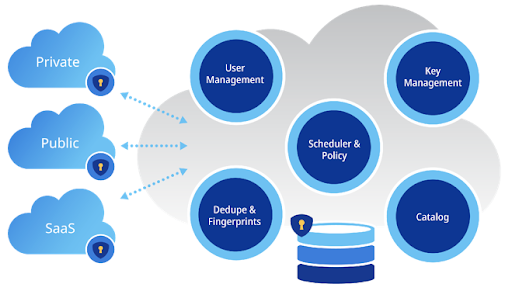
The overall mission of Clumio is to build a platform on public clouds that gives enterprises a single data protection service that can handle backups of their data in on-premises, cloud and SaaS applications. When it came out of stealth, the company’s focus was on VMware on premises. Since then, the team has expanded this to include VMware running on public clouds.

“When somebody moves to the cloud, they don’t want to be in the business of managing software or infrastructure and all that, because the whole reason to move to the cloud was essentially to get away from the mundane,” explained Clumio CEO and co-founder Poojan Kumar.

The next step in this process, as the company also announced today, is to make it easier for enterprises to protect the cloud-native applications they are building now. The company today launched this service for AWS and will likely expand it to other clouds like Microsoft Azure, soon.

The market for enterprise backup is only going to expand in the coming years. We’ve now reached a point, after all, where it’s not unheard of to talk about enterprises that run thousands of different applications. For them, Clumio wants to become the one-stop-shop for all things data protection — and its investors are obviously buying into the company’s vision and momentum.

“When there’s a foundational change, like the move to the cloud, which is as foundational a change, at least, as the move from mainframe to open systems in the 80s and 90s,” said Mike Speiser, Managing Director at Sutter Hill Ventures . “When there’s a change like that, you have to re-envision, you have to refactor and think of the world — the new world — in a new way and start from scratch. If you don’t, what’s gonna end up happening is people make decisions that are short term decisions that seem like they will work but end up being architectural dead ends. And those companies never ever end up winning. They just never end up winning and that’s the opportunity right now on this big transition across many markets, including the backup market for Clumio.”

Speiser also noted that SaaS allows for a dramatically larger market opportunity for companies like Clumio. “What SaaS is doing, is it’s not only allowing us to go after the traditional Silicon Valley, high end, direct selling, expensive markets that were previously buying high-end systems and data centers. But what we’re seeing — and we’re seeing this with Snowflake and […] we will see it with Clumio — is there’s an opportunity to go after a much broader market opportunity.”

Starting next year, Clumio will expand that market by adding support for data protection for a first SaaS app, with more to follow, as well as support for backup in more regions and clouds. Right now, the service’s public cloud tool focuses on AWS — and only in the United States. Next year, it plans to support international regions as well.

Kumar stressed that he wants to build Clumio for the long run, with an IPO as part of that roadmap. His investors probably wouldn’t mind that, either.

19 Nov 2019

Give InKind’s smarter giving platform brings in surprise $1.5 million in pre-seed funding

Helping out a friend in need online can be surprisingly difficult. While giving cash is easy enough, that’s often not what people need most — so Give InKind aims to be the platform where you can do a lot more than write a check. The idea is such a natural one that the company tripled its goal for a pre-seed round, raising $1.5 million from Seattle investors.

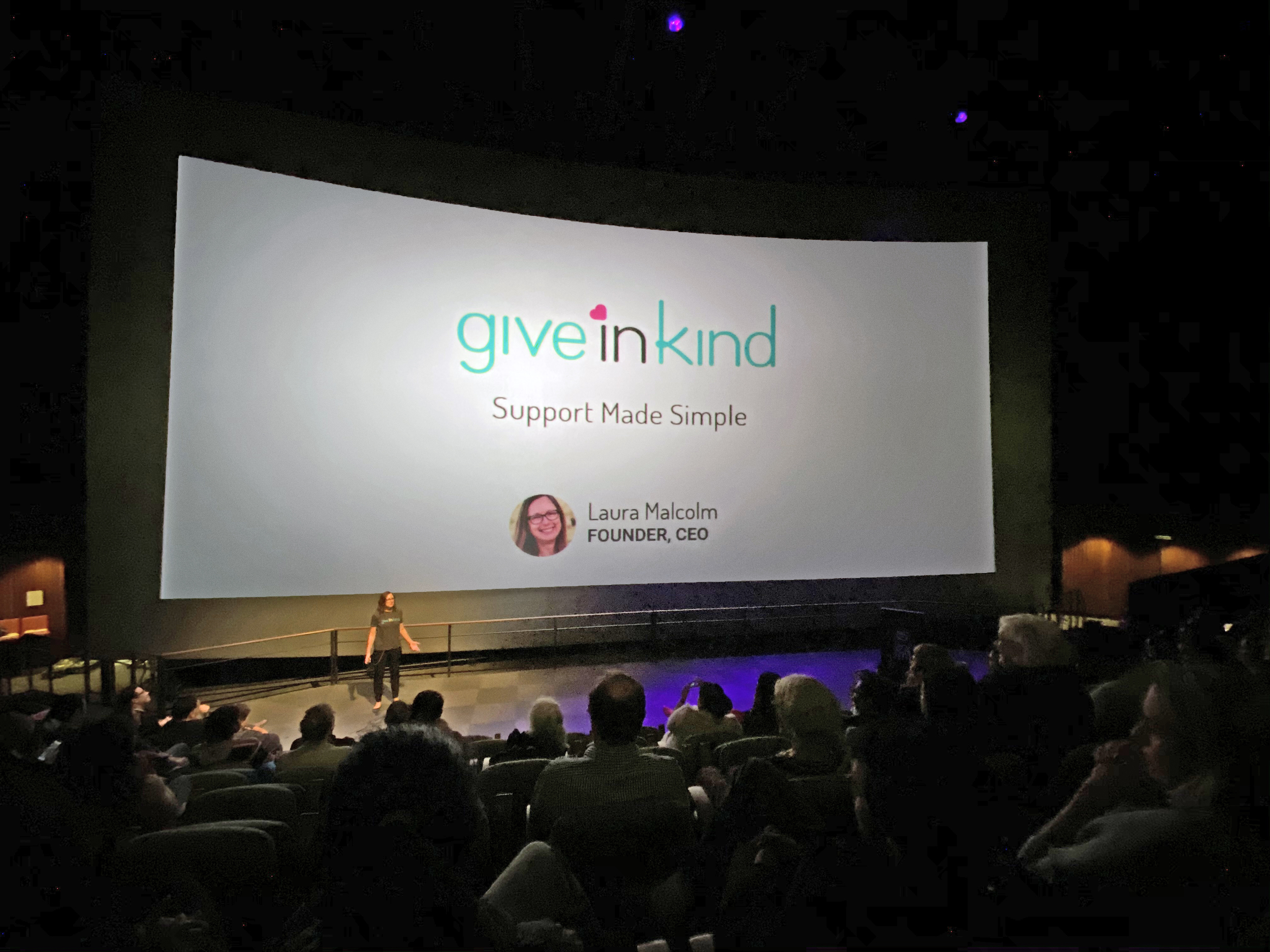
The company was selected for inclusion in the Female Founders Alliance’s Ready Set Raise accelerator, at the demo day for which I saw founder Laura Malcolm present.

The problem Malcolm is attempting to solve is simply that in times of hardship, not only do people not want to deal with setting up a fundraising site, but money isn’t even what they require to get through that period. Malcolm experienced this herself, when she experienced a personal tragedy and found that what was out there to let others help was simply inadequate.

“My friends and family were trying to support me from around the country, but the tools they had to do that were outdated and didn’t solve the problems for us,” she explained. “There just wasn’t one place to put all the help that’s needed, whether that’s meal drop-off, or rides to school for the kids, or a wishlist for Instacart, or Lyft credits. Every situation is unique, and no one has put it all together in one place where, when someone says ‘how can I help?’ you can just point there.”

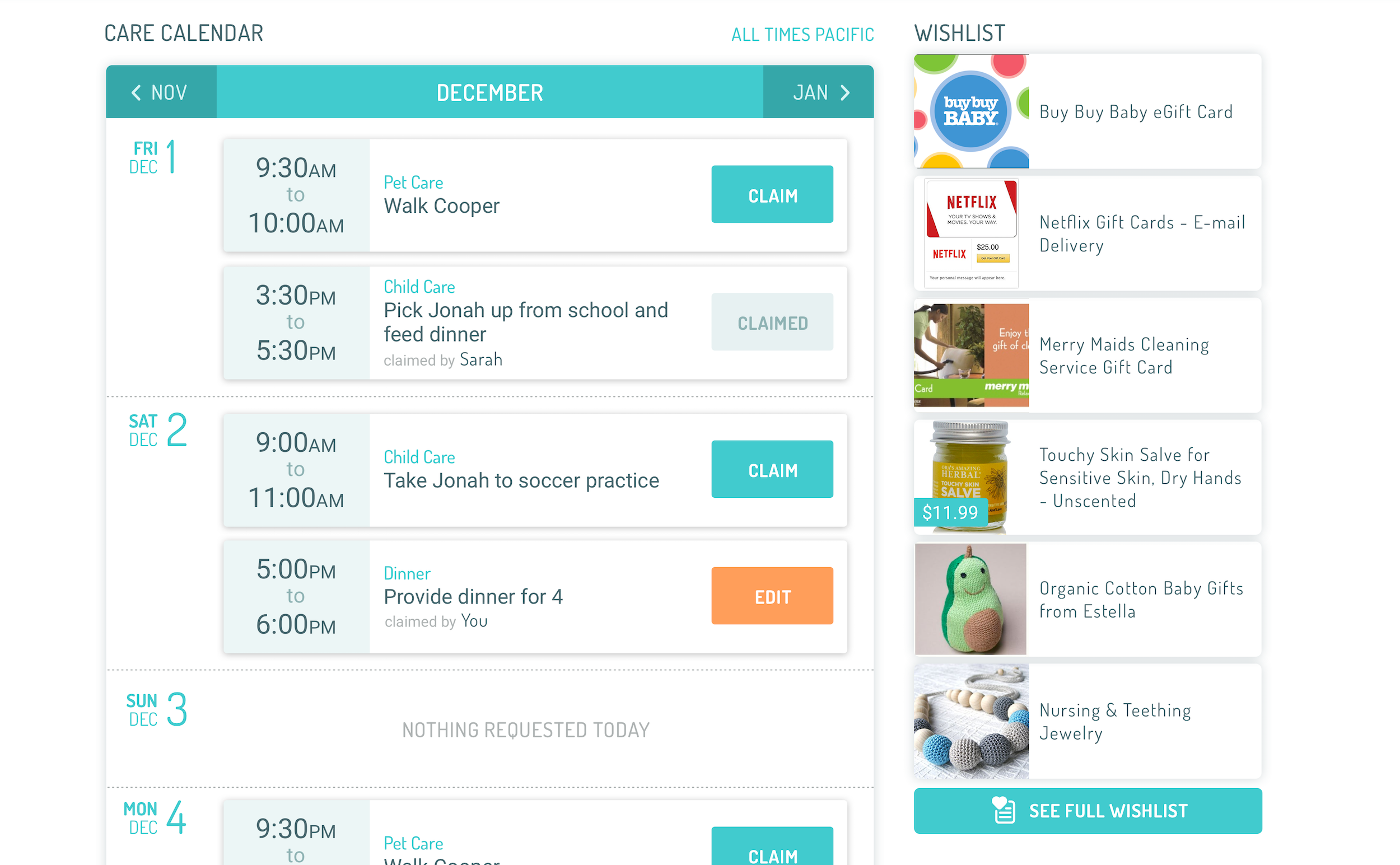
The idea with Give InKind is to provide a variety of options for helping someone out. Of course you can donate cash, but you can also buy specific items from wishlists, coordinate deliveries, set up recurring gifts (like diapers or gift boxes), or organize in-person help on a built-in calendar.

These all go on a central profile page that Malcolm noted is rarely set up by the beneficiary themselves.

“90 percent of pages are set up by someone else. Not everyone has been impacted by one of these situations, but I think almost everyone has known someone who has, and has wondered how they were supposed to respond or help,” she explained. “So this isn’t about capturing people during a time of need, but about solving the problem for people who want to know how to help.”

That certainly resonated with me, as I have always felt the cash donation option when someone is going through a tough time to be pretty impersonal and general. It’s nice to be able to help out in person, but what about a friend in another city who’s been taken out of action and needs someone else to figure out the dog walking situation? Give InKind is meant to surface specific needs like that and provide the links (to, for instance, Rover) and relevant information all in one place.

“The majority of actions on the site are people doing things themselves — signing up for meals, or to help. The calendar view is for coordination, and it’s the most used part of the site. About 70 percent is that, the rest is those national services [i.e. Instacart, Uber, etc.],” Malcolm said.

Locally run services (cleaners that aren’t on a national directory, for instance) are on the roadmap, but as you can imagine that takes a lot of footwork to put together, so it will have to wait.

Right now the site works almost entirely on an affiliate model; Helpers make accounts to do things like add themselves to the schedule or help edit the profile, then get sent out to the merchant site to complete the transaction there. The company is experimenting with on-site purchases for some things, but the idea isn’t to become host transactions except where that can really add value.

The plan for expansion is to double down on the existing organic growth patterns of the site. Every page that gets set up attracts multiple new users and visits, and those users are far more likely to start more pages even years down the line. Between improving that and some actual marketing work, Malcolm feels sure that they can grow quickly and could soon join other major giving services like GoFundMe in scale.

Ready, set, raise… a lot more than expected

Give InKind came to my attention through the Female Founder Alliance here in Seattle, which hosted a demo night a little while ago to highlight the companies and, naturally, their founders as well. Although some of the companies focused on female-forward issues, for instance the difficulty of acquiring workwear tailored to women’s bodies, the idea is more to find valuable companies that just happen to have female founders.

“Ready Set Raise was built to find high potential, dramatically undervalued investment opportunities, and translate them into something the VC community can understand,” said FFA founder Leslie Feinzaig. “Our last member survey results were consistent with findings that women founders raise less capital but make it go further. Give InKind is a perfect example. They bootstrapped for 3 years, found product market fit, grew 20% every month, and still struggled to resonate with investors.”

Yet after presenting, Malcolm’s company was honored at the event with a $100K investment from Trilogy Ventures. And having originally kicked off fundraising with a view to a $500K round, she soon found she had to cap it at an unexpected but very welcome $1.5M. The final list of participants in the round includes Madrona Venture Group, SeaChange Fund, Keeler Investments, FAM Fund, Grubstakes, and X Factor Ventures.

I suggested that this must have been something of a validating experience.

“It’s super validating,” she agreed. “The founder journey is long and hard, and the odds are not in favor of female founders or impact companies, necessarily, and consumer is not huge in Seattle, either. We really sort of defied the odds across the board raising this round so quickly… Seattle really showed up.”

She described the accelerator as being “incredibly unique. It’s entirely about creating access for female founders to investors, mentors, and experts.”

“We spent so much time turning my model upside down and shaking everything out of it. Turns out it was much more defensible than I thought. We didn’t change the business, and we didn’t change the product — we lightly changed the positioning,” she said. “This combination of access with coaching and mentorship, getting the ability to present the business in a way that’s compelling, you realize how much of this is held back from people who don’t have these opportunities. I’ve been carrying around Give InKind for three years in a paper bag, and they put a bell on it.”

Feinbaig cited the competitiveness of the application process and quality of their coaches, which give lots of 1 on 1 time, for the high quality of the companies emerging from the accelerator. You can check out the rest of the companies in the second cohort here — and of course Give InKind is live should you or anyone you know need a helping hand.

19 Nov 2019

CMU finds that even bad robot trash talk can throw you off your game

A commons tactic in both amateur and professional sports – and even in competitions as mundane as a casual board game night – is trash talk. But the negative effect of trash talk may have less to do with the skill of the repartee involved, and more with just the fact that it’s happening at all. A new study conducted by researchers at Carnegie Mellon University suggests that even robots spitting out pretty lame pre-programmed insults can have a negative impact on human players.

CMU’s study involved programming one of SoftBank’s Pepper humanoid robots to deliver scorchers like “I have to say you are a terrible player” to a group of 40 participants, who were playing the robot in a game called “Guards and Treasures,” which is a version of a strategy game often used for studying rationality. During the course of the experiment, participants played 35 times against the robot – some getting bolstering, positive comments form the robot, while others were laden with negative criticism.

Both groups of participants improved at the game over time – but the ones getting derided by the bots didn’t score as highly as the group that was praised.

It’s pretty well-established that people excel when they receive encouragement from other – but that’s generally meant other humans. This study provides early evidence that people could get similar benefits from robotic companions – even ones that don’t look particularly human-like. The researchers still want to do more investigation into whether Pepper’s humanoid appearance affected the outcome, vs. say a featureless box or an industrial robot acting as the automaton opponent and doling out the same kind of feedback.

The results of this and related research could be hugely applicable to areas like at-home care, something companies including Toyota are pursuing to address the needs of an aging population. It could also come into play in automated training applications, both at work and in other settings like professional sports.

19 Nov 2019

Vulog will power Hyundai’s new LA car-sharing service

The technology behind Hyundai’s new car-sharing service in Los Angeles is provided by a company that is largely unknown despite its ubiquity.

Vulog announced Tuesday during Automobility LA that Hyundai will use its technology platform for a car-sharing pilot that will launch in Los Angeles at the end of 2019 and will eventually grow to 300 vehicles.

Vulog might have a low profile, but it’s hardly a startup. The French-based company has been providing the underlying hardware and software needed for car-sharing services since 2006. Vulog’s product, which includes tools like fleet management and a consumer-facing app, is used in car-sharing services in more than 30 cities globally. The company says its turnkey product can get a large-scale car-sharing service up and running in about three months.

Today, its platform is used by Volkswagen’s WeShare, Kia Motor’s Wible and Groupe PSA’ Free2Move car-sharing service. Aimo, which is owned by Sumitomo Corporation, and a British Columbia Automobile Association company called Evo also uses the platform. And now, Hyundai.

Earlier this month, Hyundai Group launched MoceanLab, a mobility service venture based in Los Angeles and the latest effort by the automaker to diversify and modernize its core business of producing and selling vehicles. MoceanLab will focus on piloting autonomous ridesharing, shuttling, multimodal transportation, and personal mobility in Los Angeles.

One of the efforts under MoceanLab is Mocean Carshare, the car-sharing service that will use Vulog’s technology platform. The service is part of a permit pilot program offered by the Los Angeles Department of Transportation and Los Angeles County Metropolitan Transportation Authority.

The car-sharing service will use 20 Hyundai Ioniq plug-in hybrid electric vehicles. Mocean Carshare will eventually transition to a fleet of 300 fully electric vehicles from Hyundai and Kia Motors. 

MoceanLab, the umbrella mobility services venture, will do more than car-sharing. The Hyundai-owned company is eyeing the 2028 Olympics in Los Angeles as an event to offer a variety of services to alleviate congestion, including autonomous ridesharing and shuttling.

The creation of MoceanLab follows Hyundai’s joint venture with autonomous driving company Aptiv and the launch of BotRide, an autonomous ride-hailing service in nearby Irvine, California with Chinese autonomous startup Pony.ai  and Via.

Meanwhile, Vulog has its own ambitions. The company plans to double its footprint in the next year to hit 60 cities by the end of 2020.

19 Nov 2019

Facebook announces dates for its 2020 F8 developers conference

Facebook announced its plans for its F8 annual developer conference, which is where the company shows off its latest technology, apps and its vision for the future. The company says the next event will take place on May 5-6, 2020 at the McEnery Convention Center in San Jose, CA.

Interested attendees can sign up at www.f8.com to be notified when registration opens and receive updates.

Last year, the company used the F8 event to introduce a huge redesign of Facebook.com, plus upgrades, products, and expansions in areas like Messenger, WhatsApp, Dating, Marketplace and beyond. It also showed off how it’s putting new technology to work, including with VR, smart home, hardware, and other developer-facing technology, including Facebook’s Ax and BoTorch initiatives.

Facebook isn’t yet talking about what it will show off at F8 in 2020, but says it will feature: “product demos, deep-dive sessions that showcase how technology can enable you to come together and create your best work, and opportunities for you to network with our global developer community and learn from each other,” according to its announcement.

Beyond the news that comes from F8 in terms of individual products, the conference gives Facebook a platform to present its overarching vision.

Last year, for example, it was one of a network that’s trying to become more private and working to retain users. More recently, Facebook’s initiatives show a company that’s still trying to be disruptive, with new products like Libra. But some of its launches also demonstrate that the company is painfully aware of how much it’s ceding traction to other social apps, like Snapchat and TikTok. We’ll see if Facebook has any new responses to those challenges, or to the larger, more existential issues Facebook now faces with the rise of anti-trust investigations that put Facebook in their crosshairs.

19 Nov 2019

Google Assistant introduces personalized playlists of audio news

Starting today, when you say “Hey Google, play me the news” to a Google Assistant-enabled phone or smart speaker, you’ll get a tailored playlist of the day’s big headlines and stories.

That’s probably what many of us are hoping for when we listen to a news radio station or a daily news podcast during the morning commute. But those come from a single broadcaster, and may require you to hop around to get all the news you’re looking for.

In contrast, the feature that Google is calling Your News Update draws stories from a variety of publisher partners, focusing on the ones that seem relevant to your interests and your location.

“Audio has always been great,” said Audio News Product Manager Liz Gannes (a former tech journalist herself.) “It’s a tremendously evocative medium that conveys an immense amount of information.”

But she suggested that “the distribution technology has been slower [t evolve] than things like text and video,” which is why Google has been experimenting in this area. For example, it’s already added news stories to Google Assistant, as well as responses to news-related questions like “What’s the latest news about Brexit?”

Gannes added that behind the scenes, the company has been developing “an open specification for single topic audio stories.” So rather than dealing with an unwieldy hourlong broadcast or podcast, Google Assistant is working clips focused on a specific piece of news.

Your News Update usually starts with a few brief, general interest clips — namely, the big headlines of the day. Then it starts playing longer stories that are selected based on what Google knows about you.

For example, when I tried it out this morning, my update began with a 30-second update on the impeachment from Fox News (not one of my regular news sources) and ran through other then major stories of the day, then switched to longer (two- to three-minute) entertainment stories from sources like The Hollywood Reporter.

Gannes noted that “there’s a big emphasis on local news in this product — that don’t just mean where you live, but also other locations you care about.” And she said the average update will be around an hour and a half — so it can keep you occupied during a long commute, no dial-fiddling required.

John Ciancutti, Google’s director of engineering for search, added that the recommendations should get smarter over time: “If you want to skip a story … the more you listen, the better sense we get of your tastes and interests.” He also suggested that Your News Update could become more sensitive to context, offering different stories depending on whether (say) you’re in your car or in your kitchen.

“You can imagine in the future, you tune in and we know you’re in your car on Tuesday morning at 7:36, and we can predict based on other listening that you’ve got about a 28-minute commute,” Ciancutti said.

Your News Update is currently available in English in the United States, with plans for international expansion next year.

19 Nov 2019

Robotics startup Picnic, known for its automated pizza assembly system, raises $5 million

Picnic, a robotics startup that focuses on food production, announced today that it has raised $5 million in additional seed funding. The new round was led by Creative Ventures, with participation from Flying Fish Partners and Vulcan Capital.

The company also said it has hired Kennard Nielsen, a product engineer who worked on the first four Kindle Fire tablets, Nike Fuelband, Microsoft Xbox and Doppler Labs’ HereOne from Doppler Labs at previous positions, as its new vice president of engineering.

The new funding will be used for product development, hiring and marketing.

Picnic is known for an automated pizza assembly system that launched in October. The configurable, modular platform currently focuses on high-volume pizza production and can reach rates of up to 180 18-inch pizzas or 300 12-inch pizzas an hour. The system fits into existing kitchen layouts, including food trucks and kiosks, and integrates with Picnic’s software to provide backend data and cloud analytics that help with consistency, speed and reducing food waste.

Picnic operates on a “robotics-as-a-service” model, with users paying for the system on a subscription basis. The pizza assembly system’s first customers were Centerplate, a food and hospitality provider for large event venues, and Washington-based restaurant chain Zaucer Pizza.

In June, Picnic also hired Mike McLaughlin, a food and beverage industry veteran who previously held roles at BUNN, Concordia Coffee Systems and Starbucks, as its vice president of product.