Category: UNCATEGORIZED

19 Nov 2019

The Cerebras CS-1 computes deep learning AI problems by being bigger, bigger, and bigger than any other chip

Deep learning is all the rage these days in enterprise circles, and it isn’t hard to understand why. Whether it is optimizing ad spend, finding new drugs to cure cancer, or just offering better, more intelligent products to customers, machine learning — and particularly deep learning models — have the potential to massively improve a range of products and applications.

The key word though is ‘potential.’ While we have heard oodles of words sprayed across enterprise conferences the last few years about deep learning, there remain huge roadblocks to making these techniques widely available. Deep learning models are highly networked, with dense graphs of nodes that don’t “fit” well with the traditional ways computers process information. Plus, holding all of the information required for a deep learning model can take petabytes of storage and racks upon racks of processors in order to be usable.

There are lots of approaches underway right now to solve this next-generation compute problem, and Cerebras has to be among the most interesting.

As we talked about in August with the announcement of the company’s “Wafer Scale Engine” — the world’s largest silicon chip according to the company — Cerebras’ theory is that the way forward for deep learning is to essentially just get the entire machine learning model to fit on one massive chip. And so the company aimed to go big — really big.

Today, the company announced the launch of its end-user compute product, the Cerebras CS-1, and also announced its first customer of Argonne National Laboratory.

The CS-1 is a “complete solution” product designed to be added to a data center to handle AI workflows. It includes the Wafer Scale Engine (or WSE, i.e. the actual processing core) plus all the cooling, networking, storage, and other equipment required to operate and integrate the processor into the data center. It’s 26.25 inches tall (15 rack units), and includes 400,000 processing cores, 18 gigabytes of on-chip memory, 9 petabytes per second of on-die memory bandwidth, 12 gigabit ethernet connections to move data in and out of the CS-1 system, and sucks just 20 kilowatts of power.

A cross-section look at the CS-1. Photo via Cerebras

Cerebras claims that the CS-1 delivers the performance of more than 1,000 leading GPUs combined — a claim that TechCrunch hasn’t verified, although we are intently waiting for industry-standard benchmarks in the coming months when testers get their hands on these units.

In addition to the hardware itself, Cerebras also announced the release of a comprehensive software platform that allows developers to use popular ML libraries like TensorFlow and PyTorch to integrate their AI workflows with the CS-1 system.

In designing the system, CEO and co-founder Andrew Feldman said that “We’ve talked to more than 100 customers over the past year and a bit,“ in order to determine the needs for a new AI system and the software layer that should go on top of it. “What we’ve learned over the years is that you want to meet the software community where they are rather than asking them to move to you.”

I asked Feldman why the company was rebuilding so much of the hardware to power their system, rather than using already existing components. “If you were to build a Ferrari engine and put it in a Toyota, you cannot make a race car,” Feldman analogized. “Putting fast chips in Dell or [other] servers does not make fast compute. What it does is it moves the bottleneck.” Feldman explained that the CS-1 was meant to take the underlying WSE chip and give it the infrastructure required to allow it to perform to its full capability.
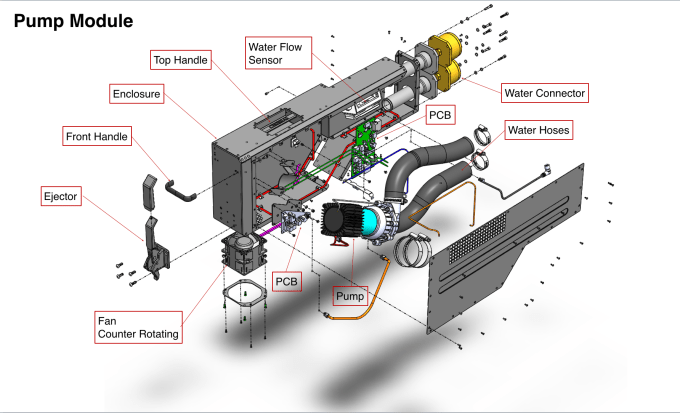
A diagram of the Cerebras CS-1 cooling system. Photo via Cerebras.

That infrastructure includes a high-performance water cooling system to keep this massive chip and platform operating at the right temperatures. I asked Feldman why Cerebras chose water, given that water cooling has traditionally been complicated in the data center. He said, “We looked at other technologies — freon. We looked at immersive solutions, we looked at phase-change solutions. And what we found was that water is extraordinary at moving heat.”
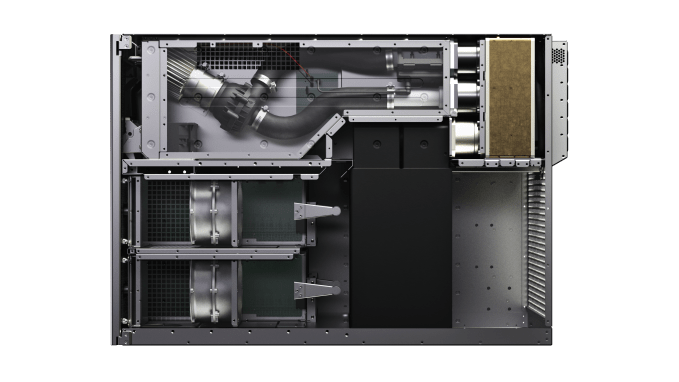
A side view of the CS-1 with its water and air cooling systems visible. Photo via Cerebras.

Why then make such a massive chip, which as we discussed back in August, has huge engineering requirements to operate compared to smaller chips that have better yield from wafers. Feldman said that “ it massively reduces communication time by using locality.”

In computer science, locality is placing data and compute in the right places within, let’s say a cloud, that minimizes delays and processing friction. By having a chip that can theoretically host an entire ML model on it, there’s no need for data to flow through multiple storage clusters or ethernet cables — everything that the chip needs to work with is available almost immediately.

According to a statement from Cerebras and Argonne National Laboratory, Cerebras is helping to power research in “cancer, traumatic brain injury and many other areas important to society today” at the lab. Feldman said that “It was very satisfying that right away customers were using this for things that are important and not for 17-year-old girls to find each other on Instagram or some shit like that.”

(Of course, one hopes that cancer research pays as well as influencer marketing when it comes to the value of deep learning models).

Cerebras itself has grown rapidly, reaching 181 engineers today according to the company. Feldman says that the company is hands down on customer sales and additional product development.

It has certainly been a busy time for startups in the next-generation artificial intelligence workflow space. Graphcore just announced this weekend that it was being installed in Microsoft’s Azure cloud, while I covered the funding of NUVIA, a startup led by the former lead chip designers from Apple who hope to apply their mobile backgrounds to solve the extreme power requirements these AI chips force on data centers.

Expect ever more announcements and activity in this space as deep learning continues to find new adherents in the enterprise.


19 Nov 2019

Salesforce wants to bring voice to the workplace

At its annual Dreamforce mega-conference in San Francisco, Salesforce today introduced the next steps in its Einstein Voice project, which it first announced last year. Einstein Voice is the company’s AI voice assistant. You can think of it as Salesforce’s Alexa or Google Assistant, but with a more focused mission.

During a briefing ahead of the event, Salesforce Chief Product Officer Bret Taylor showed off an Einstein and Alexa enabled Einstein speaker (Salesforce chairman and co-CEO Marc Benioff was supposed to be at the meeting, too, but for unknown reasons, he didn’t show) — and yes, it looked like Salesforce’s Einstein cartoon figure and its voluminous white hair lit up when it responded to queries. The company isn’t planning on making these devices available to the public, but it does show off the work the company has done with Amazon to integrate the service (though is by no means an Amazon -exclusive since the company is also working to bring Einstein to Google devices).

The theory here, as Taylor explained, is that having access to Salesforce data through voice will enable salespeople to quickly enter data into Salesforce when they are on the go and to ask the system questions about their data. The company argues that while voice assistants have found a place in the home, there are a lot of upsides to bringing it to businesses as well. That means a system has to account for the security needs of enterprises, too, as well as the fact that there is a wide range of different user personas it has to account for.

“We’re really excited about the idea of voice in businesses — the idea that every business can have an AI guide to their business decisions,” Taylor said. “I view it as part of this progression of technology. Computers and software started in the terminal with a keyboard, thanks to Xerox Parc moved to a mouse and graphic user interface, and then thanks to Steve Jobs, moved to a touchscreen, which I think is probably the dominant form factor for computers nowadays. And voice is really that next step.”

This next step, Taylor argues, will allow companies to rethink how people interact with software and data. With voice, Einstein, which is Salesforce’s catch-all name for its AI products, has a “seat at the table,” he noted because you can simply as the system a question if you need additional data during a conversation. But the real mission here is to bring these tools to every business — not just to Salesforce’s executive meetings.

To enable this, Salesforce is launching a tool that will allow anybody within a company to quickly build basic Einstein skills to pull up data from Salesforce. These skills focus on data input and relatively basic queries, for now. During a demo ahead of the event, the team showed off how easy it would be to enable a manager to ask about the current sales performance of his team, for example. By now means, though, is this tool as rich as products like Google’s DialogFlow or Microsoft’s Azure Bot Service. It’s nowhere near as flexible yet, but the team notes that it’s still early days and that it is working on enabling the ability to have more complex dialogs with Einstein in the future, for example.

To be honest, it’s hard not to look at this as a bit of a gimmick. There are probably real use cases here, that every company will have to define for itself. Maybe there are salespeople who indeed want to use a voice interface to update their CRM system after a customer meeting, for example. Or they may want to ask about the value of an account while they are in the car. In many ways, though, this feels like a technology looking for a problem, despite Salesforce’s protestations that customers are asking for this.

Some of the other uses cases here, which the company didn’t really highlight all that much in its briefing, seem far more compelling. It’s using Einstein Voice to coach call center agents by analyzing calls to pull out insights and trends from sales call transcripts. It’s also launching Service Cloud Voice, which integrates telephony inside the company’s Service Cloud. Using a built-in transcription service, Einstein can listen to the call in real time and proactively provide sales teams and call center agents with relevant information. Those use cases may not be quite as exciting, but in the end, they may generate for more value for companies than having yet another voice assistant for which they have to build their own skills, using what is, at least for the time being, a rather limited tool.

19 Nov 2019

Angell is a smart bike with an integrated display

Meet Angell, a new smart bike from a French startup led by Marc Simoncini who is mostly known for founding Meetic. The company is announcing its first electric-bike today. And the goal is to make an e-bike that is smarter than everything out there.

“We dedicate half of public space to cars even though cars only represent 12% of trips,” Angell founder and CEO Marc Simoncini told me. And according to the company’s data, only 2% of people use bikes to move around a city in France, compared to 31% in the Netherlands and 13% in Germany.

So there’s a market opportunity for a newcomer in the e-bike space in France, and eventually in other major cities around the world. “Our goal is to become the global leader in the smart bike space,” Simoncini said.

When it comes to hardware, the Angell e-bike is a 14kg bike with an aluminum frame, integrated lights and a removable battery. It has a 2.4-inch touch screen to control the bike. The battery should last 70km on a single charge. There are also turn signals that you can activate with a button.

The Angell e-bike comes with everything you’d expect from a connected bike and that you can already find on Cowboy and Vanmoof e-bikes. It connects with your phone using Bluetooth and has an integrated lock and alarm system. If somebody tries to steal your bike, the bike will play a loud sound. If somebody manages to steal your bike, you can track it using an integrated GPS chip and cellular modem.

But Angell wants to go one step further with its integrated display. First, you can select different levels of assistance directly on the bike itself. You can display information on the screen when you’re riding your bike, such as speed, calories, battery level and distance on the screen. You can also set an emergency contact so that they automatically receive a notification if your bike detects a fall.

More interestingly, you can set a destination on your phone and get turn-by-turn directions on your bike. In addition to arrows that tell you when you’re supposed to turn, your handlebar vibrates as well.

“70% of the Angell project is software,” Simoncini said.

The Angell e-bike will be available at some point during the summer of 2020. It’ll cost €2,690 ($2,966) with pre-orders starting a few months earlier. Customers can also choose to pay €74.90 per month for 36 months. Angell will also partner with an insurance company to offer a theft and damage insurance product for €9.90 per month.

The Angell e-bike is just the first step of the company. Eventually, Angell wants to dedicate 5% of its revenue to a smart city fund and incubator, the Angell Lab. The company wants to create an ecosystem of startups that want to reinvent city mobility. Angell is fully funded by Marc Simoncini for now.

19 Nov 2019

BlueVine raises $102.5M more for banking services that target small businesses

When it comes to fintech plays, small and medium businesses are not often the target audience: they’re too small and fragmented compared to big-spending corporates; and they’re too demanding compared to mass-market consumer users. But as a sector, they account for over 99% of all businesses in developed countries like the UK and USA, and that means they cannot be ignored. Today, BlueVine, one of the financial services startups that has built a business specifically catering to SMBs is announcing a big round of funding, underscoring the quiet opportunity and demand that is out there.

“We see a massive gap in the market, with most SMBs still using consumer plus accounts,” said Eyal Lifshitz, Bluevine’s CEO and co-founder. “That is the mission we are on.”

The startup, which offers financing and other banking services to SMBs, today is announcing that it has raised $102.5 million, a Series F round of equity funding that is coming from a mix of financial and notable strategic investors.

Led by ION Crossover Partners, the round also includes existing investors Lightspeed Venture Partners, Menlo Ventures, 83North, SVB Capital, Nationwide (a major financial services player in the UK), Citi Ventures, Microsoft’s venture fund M12, and private investors; as well as new investors MUFG Innovation Partners Co., Ltd, O.G. Tech (the VC connected to Israeli billionaire and property magnate Eyal Ofer), Vintage Investment Partners, ION Group, Maor Investments and additional private investors.

With this latest round, Silicon Valley-based BlueVine has raised between $240 million and $250 million in equity, with another half a billion dollars in debt financing to fuel its loans platform, Lifshitz said in an interview. The company has never disclosed valuation, and it’s not doing so today, but he added that BlueVine is “doing quite well”, with the valuation “up” compared to its Series E.

“We are not profitable yet, but we’ve grown 100% since last year and will do triple digit revenue this year,” Lifshitz said, noting that the company has now originated some $2.5 billions in loans to date to 20,000 small businesses.

While SMBs are not often the first target for fintech startups, that does not mean they are completely ignored. Others that have built big businesses around these users include Kabbage — the SoftBank-backed startup out of Atlanta that also started out with loans before diversifying also into a wider range of banking services. (Kabbage is currently valued at over $1 billion, as a point of comparison.) Another newer player in the space of SMB-focused banking is Mercury, which also recently raised money; its primary target is a narrower subset of the SMB world, startups.

BlueVine’s service is mainly based around its financing products, where it provides both lines of credit and term loans (both up to $250,000) and “factoring,” where customers can arrange for BlueVine to pay up front for invoices that they select to be paid, a service that translates into credit lines of up to $5 million and means that users don’t need to wait for money to come in before paying for bills.

As with Kabbage, BlueVine’s move into a wider array of banking services — sold as BlueVine Business Banking, which includes checking accounts and other services alongside financing — is a newer, still-growing and expanding business. The checking account, for example, only was announced in October this year.

For business customers, the idea is to give them a one-stop shop for all of their financial services, while for BlueVine, the idea is to create a more complete set of offerings to keep users on its platform and to make better margins on them across more services. Interestingly, this sets BlueVine up to compete not as much with startups — the majority of which still offer single-point services or a small collection of them, but with banks that still provide full suites of services, even if they are often more pricey and less efficient than startups.

My real competitors are the 4,600 banks in the US,” Lifshitz said. “It’s a very long tail in the US. But if you dive into that further, historically SMBs haven’t been serviced well by them.”

The fact that the company is attracting a range of financial services investors inevitably raises the question of how BlueVine might partner with them down the line or even become an acquisition target, but one thing that Lifshitz said that it will not be doing is white-label services (something that Kabbage has explored): “We don’t want to give our tech away,” he said. “We are focused on leveraging our tech to be the best in class.”

“BlueVine has demonstrated a track record of success with their multiple financing products and set themselves apart with their vision of a complete platform of innovative banking products for small businesses,” said Jonathan Kolodny, Partner at ION Crossover Partners, in a statement. “We’ve been following the company closely since its early days, and have witnessed the demand, and frankly the economic need, for BlueVine’s banking services. We believe the company is exceptionally well-positioned, thanks to its world-class management team, to change the way small businesses manage their financial needs today and in the future.”

19 Nov 2019

Heliogen’s new tech could unlock renewable energy for industrial manufacturing

Last Monday a group of millionaires and billionaires took a trip to an industrial site in Lancaster, Calif. to witness the achievement of what could represent a giant leap forward in the effort to decarbonize some of the world’s most carbon intensive industries.

For Bill Gross, the founder of Idealab and brains behind the excursion, the unveiling was simply the latest in a string of demonstrations for new technologies commercialized by his nearly three-decade old startup company incubator. However, it may be the most significant.

What Gross is pursuing with his new company, Heliogen, offers a way forward for renewable energy to be applied to manufacturing processes for cement, lime, coke, and steel — some of the most energy intensive and polluting industries that exist in the world today.

“Today, industrial processes like those used to make cement, steel, and other materials are responsible for more than a fifth of all emissions,” said Bill Gates, a Heliogen backer who has committed millions of dollars to the development of new renewable energy technologies. “These materials are everywhere in our lives but we don’t have any proven breakthroughs that will give us affordable, zero-carbon versions of them. If we’re going to get to zero carbon emissions overall, we have a lot of inventing to do. I’m pleased to have been an early backer of Bill Gross’s novel solar concentration technology. Its capacity to achieve the high temperatures required for these processes is a promising development in the quest to one day replace fossil fuel.”

According to Gross, Kittu Kollaru, an investor in Heliogen who is also backing another of Idealab’s incubated companies working on developing an energy storage technology, Energy Vault, said after seeing the demonstration, “Bill… this is even bigger.”

At its core, Heliogen is taking a well-known technology called concentrated solar power, and improving its ability to generate heat with new computer vision, sensing and control technologies, says Gross. \

Four high resolution cameras capture real time video of a field of mirrors that are controlled by sensors to focus the sun’s energy on a particular spot. That spot, either at a transmission pipe used to transport gas, or a tower, is heated to over 1,000 degrees Celsius. Previous commercial concentrating solar thermal systems could only reach temperatures of 565 degrees Celsius, the company said. That’s useful for generating power, but can’t meet the needs of industrial processes. 

Achieving temperatures above 1,000 degrees Celsius gives manufacturing facilities the opportunity to replace the use of fossil fuels in a significant portion of their operations.

A facility hoping to install Heliogen’s technology (Image courtesy of Heliogen)

“They already have a power source/burner that is variable, based on the flow rate of materials, and is servo controlled to have the correct air flow exit temperature,” says Gross of many existing industrial operations. “So when we add heat (when the sun is out) the fossil fuel burner just automatically gets scaled back like a thermostat on a room heater (albeit at much higher temperature).  So it’s a seamless control integration.”

A plant could still operate on a 24-hour production schedule, and could still use fossil fuels, says Gross. But by deploying the Heliogen system, companies could reduce their fossil fuel consumption by up to 60%, according to the serial entrepreneur and investor. Gross believes that Heliogen’s systems will pay for themselves in a two-to-three year timeframe if companies buy the system outright, or Heliogen could manage the installation for a manufacturer and just charge them for the cost of the power.

Gross has been testing smaller versions of Heliogen’s industrial heating technology at a field with an array of 70 mirrors to prove that the super-concentrating technology could work. A full scale facility covers roughly two acres of land with mirrors and a tower where the rays are concentrated. “It’s like a death ray,” Gross said of the concentrated solar beams.

While initial applications for Heliogen’s technology will concentrate on industrial applications, longer term, Gross sees an opportunity to drive down the cost of Hydrogen production at an industrial scale. Long believed to be one of the keys to global decarbonization, Hydrogen’s use as a fuel source has been limited because it’s difficult to make without using fossil fuels.

Hydrogen’s importance to a carbon-free energy future can’t be overstated, according to energy advocates and longtime renewable energy entrepreneurs and investors like Jigar Shah. The founder and former chief executive of solar installation company, SunRun, Shah now invests in renewabel energy projects.

“As we move closer to 100% clean electricity grids, it will be necessary to not just store excess electricity production from the spring and fall, but to turn all of this excess electricity to valuable commodities that can help decarbonize other sectors outside of electricity — transportation, industrial heat, and chemicals,” Shah wrote in an article on LinkedIn. “That’s where hydrogen comes into play.”

Investors in Heliogen include venture capital firm Neotribe and Dr. Patrick Soon-Shiong, the billionaire Los Angeles-based investor and entrepreneur, who owns the Los Angeles Times and an investment conglomerate. THe investmente was made through Dr. Soon-Shiong’s investment firm, Nant Capital.

“For the sake of our future generations we must address the existential danger of climate change with an extreme sense of urgency,” said Dr. Soon-Shiong, in a statement. “I am committed to using my resources to invest in innovative technologies that harness the power of nature and the sun. By significantly reducing greenhouse gas emissions and generating a pure source of energy, Heliogen’s brilliant technology will help us achieve this mission and also meaningfully improve the world we leave our children.”

19 Nov 2019

Cybersecurity startup CyCognito raises $23M in Series A funding

CyCognito, a cybersecurity platform that aims to give visibility into a company’s security weak spots, has raised $23 million in its Series A round of funding.

Lightspeed Partners led the fundraise, putting in $18 million, which included a personal investment from Lightspeed venture partner and former Microsoft chairperson John Thompson, and additional participation from Sorenson Ventures. Another $5 million was brought in from existing investors, including UpWest and Dan Scheinman, who participated during the company’s seed round.

CyCognito says its software-as-a-service platform can “autonomously discover, enumerate, and prioritize each organization’s security risks based upon a global analysis of all external attack surfaces.” In other words, it measures a company’s entire attack surface, looking for holes and flaws, which could be exploited by malicious actors. It does this by maintaining tens of thousands of bots which spiders out across the internet, looking for internet-connected and exposed devices. With that database of digital assets, the company looks for issues that could be used for attacks.

The startup says its platform already in use by “dozens” of corporate customers, across healthcare, hospitality and financial verticals.

With $23 million in the bank, CyCognito says it plans to expand its engineering and sales teams to reach more enterprise clients.

Two years since the company’s founding, its leadership page consisted of only men.

Chief executive Rob Gurzeev said the company was “actively seeking to hire more women and non-binary persons into senior roles” and “actively encourages growth of diversity in its workforce.”

After TechCrunch raised lack of diversity with CyCognito, the company quickly changed its leadership page to include one woman.

19 Nov 2019

A 10-point plan to reboot the data industrial complex for the common good

A posthumous manifesto by Giovanni Buttarelli, who until his death this summer was Europe’s chief data protection regulator, seeks to join the dots of surveillance capitalism’s rapacious colonization of human spaces, via increasingly pervasive and intrusive mapping and modelling of our data, with the existential threat posed to life on earth by manmade climate change.

In a dense document rich with insights and ideas around the notion that “data means power” — and therefore that the unequally distributed data-capture capabilities currently enjoyed by a handful of tech platforms sums to power asymmetries and drastic social inequalities — Buttarelli argues there is potential for AI and machine learning to “help monitor degradation and pollution, reduce waste and develop new low-carbon materials”. But only with the right regulatory steerage in place.

“Big data, AI and the internet of things should focus on enabling sustainable development, not on an endless quest to decode and recode the human mind,” he warns. “These technologies should — in a way that can be verified — pursue goals that have a democratic mandate. European champions can be supported to help the EU achieve digital strategic autonomy.”

“The EU’s core values are solidarity, democracy and freedom,” he goes on. “Its conception of data protection has always been the promotion of responsible technological development for the common good. With the growing realisation of the environmental and climatic emergency facing humanity, it is time to focus data processing on pressing social needs. Europe must be at the forefront of this endeavour, just as it has been with regard to individual rights.”

One of his key calls is for regulators to enforce transparency of dominant tech companies — so that “production processes and data flows are traceable and visible for independent scrutiny”.

“Use enforcement powers to prohibit harmful practices, including profiling and behavioural targeting of children and young people and for political purposes,” he also suggests.

Another point in the manifesto urges a moratorium on “dangerous technologies”, citing facial recognition and killer drones as examples, and calling generally for a pivot away from technologies designed for “human manipulation” and toward “European digital champions for sustainable development and the promotion of human rights”.

In an afterword penned by Shoshana Zuboff, the US author and scholar writes in support of the manifesto’s central tenet, warning pithily that: “Global warming is to the planet what surveillance capitalism is to society.”

There’s plenty of overlap between Buttarelli’s ideas and Zuboff’s — who has literally written the book on surveillance capitalism. Data concentration by powerful technology platforms is also resulting in algorithmic control structures that give rise to “a digital underclass… comprising low-wage workers, the unemployed, children, the sick, migrants and refugees who are required to follow the instructions of the machines”, he warns.

“This new instrumentarian power deprives us not only of the right to consent, but also of the right to combat, building a world of no exit in which ignorance is our only alternative to resigned helplessness, rebellion or madness,” she agrees.

There are no less than six afterwords attached to the manifesto — a testament to the store in which Buttarelli’s ideas are held among privacy, digital and human rights campaigners.

The manifesto “goes far beyond data protection”, says writer Maria Farrell in another contribution. “It connects the dots to show how data maximisation exploits power asymmetries to drive global inequality. It spells out how relentless data-processing actually drives climate change. Giovanni’s manifesto calls for us to connect the dots in how we respond, to start from the understanding that sociopathic data-extraction and mindless computation are the acts of a machine that needs to be radically reprogrammed.”

At the core of the document is a 10-point plan for what’s described as “sustainable privacy”, which includes the call for a dovetailing of the EU’s digital priorities with a Green New Deal — to “support a programme for green digital transformation, with explicit common objectives of reducing inequality and safeguarding human rights for all, especially displaced persons in an era of climate emergency”.

Buttarelli also suggests creating a forum for civil liberties advocates, environmental scientists and machine learning experts who can advise on EU funding for R&D to put the focus on technology that “empowers individuals and safeguards the environment”.

Another call is to build a “European digital commons” to support “open-source tools and interoperability between platforms, a right to one’s own identity or identities, unlimited use of digital infrastructure in the EU, encrypted communications, and prohibition of behaviour tracking and censorship by dominant platforms”.

“Digital technology and privacy regulation must become part of a coherent solution for both combating and adapting to climate change,” he suggests in a section dedicated to a digital Green New Deal — even while warning that current applications of powerful AI technologies appear to be contributing to the problem.

“AI’s carbon footprint is growing,” he points out, underlining the environmental wastage of surveillance capitalism. “Industry is investing based on the (flawed) assumption that AI models must be based on mass computation.

“Carbon released into the atmosphere by the accelerating increase in data processing and fossil fuel burning makes climatic events more likely. This will lead to further displacement of peoples and intensification of calls for ‘technological solutions’ of surveillance and border controls, through biometrics and AI systems, thus generating yet more data. Instead, we need to ‘greenjacket’ digital technologies and integrate them into the circular economy.”

Another key call — and one Buttarelli had been making presciently in recent years — is for more joint working between EU regulators towards common sustainable goals.

“All regulators will need to converge in their policy goals — for instance, collusion in safeguarding the environment should be viewed more as an ethical necessity than as a technical breach of cartel rules. In a crisis, we need to double down on our values, not compromise on them,” he argues, going on to voice support for antitrust and privacy regulators to co-operate to effectively tackle data-based power asymmetries.

“Antitrust, democracies’ tool for restraining excessive market power, therefore is becoming again critical. Competition and data protection authorities are realising the need to share information about their investigations and even cooperate in anticipating harmful behaviour and addressing ‘imbalances of power rather than efficiency and consent’.”

On the General Data Protection Regulation (GDPR) specifically — Europe’s current framework for data protection — Buttarelli gives a measured assessment, saying “first impressions indicate big investments in legal compliance but little visible change to data practices”.

He says Europe’s data protection authorities will need to use all the tools at their disposal — and find the necessary courage — to take on the dominant tracking and targeting digital business models fuelling so much exploitation and inequality.

He also warns that GDPR alone “will not change the structure of concentrated markets or in itself provide market incentives that will disrupt or overhaul the standard business model”.

“True privacy by design will not happen spontaneously without incentives in the market,” he adds. “The EU still has the chance to entrench the right to confidentiality of communications in the ePrivacy Regulation under negotiation, but more action will be necessary to prevent further concentration of control of the infrastructure of manipulation.”

Looking ahead, the manifesto paints a bleak picture of where market forces could be headed without regulatory intervention focused on defending human rights. “The next frontier is biometric data, DNA and brainwaves — our thoughts,” he suggests. “Data is routinely gathered in excess of what is needed to provide the service; standard tropes, like ‘improving our service’ and ‘enhancing your user  experience’ serve as decoys for the extraction of monopoly rents.”

There is optimism too, though — that technology in service of society can be part of the solution to existential crises like climate change; and that data, lawfully collected, can support public good and individual self-realization.

“Interference with the right to privacy and personal data can be lawful if it serves ‘pressing social needs’,” he suggests. “These objectives should have a clear basis in law, not in the marketing literature of large companies. There is no more pressing social need than combating environmental degradation” — adding that: “The EU should promote existing and future trusted institutions, professional bodies and ethical codes to govern this exercise.”

In instances where platforms are found to have systematically gathered personal data unlawfully Buttarelli trails the interesting idea of an amnesty for those responsible “to hand over their optimisation assets”– as a means of not only resetting power asymmetries and rebalancing the competitive playing field but enabling societies to reclaim these stolen assets and reapply them for a common good.

While his hope for Europe’s Data Protection Board — the body which offers guidance and coordinates interactions between EU Member States’ data watchdogs — is to be “the driving force supporting the Global Privacy Assembly in developing a common vision and agenda for sustainable privacy”.

The manifesto also calls for European regulators to better reflect the diversity of people whose rights they’re being tasked with safeguarding.

The document, which is entitled Privacy 2030: A vision for Europe, has been published on the website of the International Association of Privacy Professionals ahead of its annual conference this week.

Buttarelli had intended — but was finally unable — to publish his thoughts on the future of privacy this year, hoping to inspire discussion in Europe and beyond. In the event, the manifesto has been compiled posthumously by Christian D’Cunha, head of his private office, who writes that he has drawn on discussions with the data protection supervisor in his final months — with the aim of plotting “a plausible trajectory of his most passionate convictions”.

19 Nov 2019

Perlego raises $9M Series A for its textbook subscription service

Perlego, the textbook subscription service, has raised $9 million in Series A funding.

Backing the round is Charlie Songhurst, Dedicated VC, and Thomas Leysen (Chairman of Mediahuis and Umicore). Perlego’s existing investors including ADV, Simon Franks and Alex Chesterman also reinvested on a pro-rata basis.

London-based Perlego says the additional funding will be used to develop the next generation of Perlego’s “smarter learning platform,” including adding new features that simplify and enhance the learning experience, as well as content libraries in non-English languages to enable further expansion to “strategic” European markets beyond its U.K. roots.

Pitched as akin to a “Spotify for textbooks,” Perlego enables students, and also professionals, who now make up 30% of users, to access textbooks on a subscription basis.

It houses over 300,000 eBooks, from over 2,300 publishers, and the service is cross-device — via the web and iOS and Android apps — and available in multiple languages. Along with U.K. publishers, Perlego now also includes content from key publishers in Germany, the Nordics and Italy.

For the students, the draw is obvious: text books are increasingly expensive to purchase, and public libraries are under resourced. In the U.K., Perlego gives readers access to its entire digital library for £12 per month. As long as the needed text books are available on the service, that is infinitely more affordable.

For publishers, Perlego claims to offer a distribution method that stems revenue losses caused by piracy and the buoyant used text book market — hence the comparison to Spotify’s positioning.

Publishers such as Pearson, Cengage and McGraw Hill are already on board, Perlego says it is seeing a 116% increase in new subscribers month-on-month, though it isn’t breaking out subscriber numbers.

19 Nov 2019

Playbuzz becomes Ex.co and expands its content marketing platform

Playbuzz, a startup that helps publishers to add things like polls and galleries to their articles, has rebranded itself as Ex.co.

Co-founder and CEO Tom Pachys told me the name stands for “the experience company,” and he said it reflects the company’s broader content marketing ambitions. Ex.co will continue working with news publishers, but Pachys said there’s a bigger market for what the company has built.

“We’re seeing businesses wanting to become publishers in a way, to interact with their users in a way that’s very similar to what a publisher does,” Pachys said.

Playbuzz/Ex.co is hardly the first publishing startup realize that there may be more money in content marketing, but Pachys argued that this isn’t just a sudden pivot. After all, the company is already working with clients like Visa, Red Bull and Netflix (as well as our corporate siblings at The Huffington Post).

“The previous name does not reflect the values that we stand for today — not even future values,” he said.

Tom Pachys

Tom Pachys

Pachys also suggested that existing content marketing tools are largely focused on operations and workflow — things like hiring the right freelancer — while Ex.co aims at making it easier to actually create the content.

“We’re the ones innovate within the core — not around it, but the core itself,” he said. “And rather than trying to call them competition, we want to integrate with as much players in the ecosystem as possible.”

In addition to announcing the rebrand, Ex.co is also relaunching its platform as a broader content marketing tool, with new features like content templates, real-time analytics and lead generation.

Pachys, by the way, is new to the CEO role, having served as COO until recently, while previous Playbuzz CEO Shaul Olmert has become the company’s president. Pachys said the move wasn’t “directly correlated” with the other changes, and instead allows the two of them to focus on their strengths — Pachys oversees day-to-day operations, while Olmert focuses on investor relations and strategic deals.

“I co-founded the company with Shaul, who’s a very good friend of mine, we’ve known each other 20 years,” Pachys said. “Shaul is very much involved in the company.”

19 Nov 2019

New York State Attorney General reportedly investigating WeWork

WeWork is reportedly being investigated by the New York State Attorney General. According to Reuters, the NYAG’s questions include if WeWork founder and former CEO Adam Neumann engaged in self-dealing.

A WeWork spokesperson said in an email that “we have received an inquiry from the office of the New York State Attorney General and are cooperating in the matter.” TechCrunch also contacted the New York State Attorney General’s office for comment. WeWork is headquartered in New York City.

This comes less than a week after Bloomberg reported WeWork is the subject of a U.S. Securities and Exchange Commission inquiry into potential rule violations related to its cancelled IPO.

WeWork’s parent company, The We Company, announced on Sept. 30 that it was withdrawing its S-1 filing for an initial public offering, shortly after Neumann stepped down as CEO. In addition to questions about the company’s financial state, red flags for investors included that Neumann had borrowed against his WeWork shares and leased properties he owned back to the company.

An entity Neumann controlled also sold the company the right to use the word “We” for $5.9 million, though he later asked the company to unwind the agreement and returned the money after public criticism.

After receiving a lifeline from investor SoftBank worth up to $8 billion, WeWork is now engaging in major cost-cutting measures, including layoffs at Meetup, which it acquired for $200 million in 2017.