Category: UNCATEGORIZED

18 Nov 2019

Ford unveils the Mustang Mach-E, an all-electric crossover with muscle car roots

Ford unveiled Sunday ahead of the LA Auto Show the Mustang Mach-E, the highly anticipated all-electric crossover and the first vehicle to come out of Team Edison, the automaker’s dedicated electric vehicle organization.

In short: the Mustang Mach-E is different from any other Ford vehicle without ignoring its roots. It’s undeniably a Mustang with its short nose and front overhang, headlights and muscular stance. But it also has a design suited for an electric vehicle as well as an all-new infotainment system and connected vehicle technology, plus a few other interesting and new details.

The moment is an important one for Ford, which has historically backed hybrid technology. It not only represents the biggest change for the Mustang in its 55 year history, it’s the first product to come out of Ford’s $11 billion commitment to add 16 all-electric vehicles within its global portfolio of 40 electrified vehicles through 2022.

“We knew we had to do something different and something exciting and something only Ford could do,” Kumar Galhotra, president of Ford North America said at a press event prior to the Sunday unveiling.

This is not meant to be a compliance car — the types of vehicles produced only to meet stricter emissions rules in some states such as California, a key market for automakers. It’s meant to be a vehicle that people get excited about; it must be fun to drive and have the performance that Mustang diehards expect.

“I’ve driven it and it’s a rocket ship,” Ford Chairman Bill Ford said during the event Sunday. “This is a Mustang for a new generation, but I also think long-time Mustang fans like me will love it as well.”

And while there have been months of teasers and even one big leak, the unveiling Sunday provided fresh details of the vehicle.

Ford will offer five variants of the Mustang Mach-E, including a standard version called Select, a Premium trim, First Edition, California Route 1 and a GT Performance edition that is targeting a 0 to 60 miles per hour acceleration in the mid 3-second range and an estimated 342 kW (459 horsepower) and 830 Nm (612 pound-feet) of torque.

The limited first edition will start at $59,900 and be available in extended-range all-wheel drive, with red painted brake calipers, metallic pedal covers, contrasting seat stitching and a scuff plate marked “First Edition.”

The first edition and the premium trims will be the initial Mustang Mach-E vehicles available in fall 2020. The Premium version will start at $50,600.

The GT performance, which starts at $60,500, will be available in Spring 2021. Ford has opened up a reservations page, where customers can put a $500 deposit down for any of the versions. A configurator that allows customers to design the version is also live.

18 Nov 2019

Every angle of Ford’s all-electric Mustang Mach-E

Ford unveiled Sunday the newest Mustang in its lineup that marks a number of firsts for the automaker. Not only is this the first all-electric Mustang, it’s also an SUV and the first vehicle to come out of Team Edison, Ford’s dedicated electric vehicle organization.

Here’s a closer look at the vehicle inside and out.


[gallery ids="1912963,1912979,1912976,1912977,1912978,1912966,1912971,1912968,1912974,1912973,1912969,1912970,1912967,1912980,1912981,1912964,1912975"]

18 Nov 2019

Original Content podcast: Disney’s ‘Mandalorian’ is never boring

Disney’s shift to streaming is officially underway with this week’s launch of Disney+  along with its flagship show, the Star Wars series “The Mandalorian.”

On the latest episode of the Original Content podcast, we discuss our initial reactions to the new streaming service.

It turns out that we had fairly different responses: Anthony was impressed by the breadth of the content library (nearly every Disney, Pixar, Marvel and Star Wars film, along with 30 seasons of “The Simpsons”), while Darrell was more interested in the original content. Jordan, meanwhile, found herself initially excited about the library, only to wonder how much time she really needs to spend watching her childhood favorites.

As for that original content, we also have a spoiler-free review of “The Mandalorian.” Disney is releasing episodes on a weekly basis, with two episodes live as of publication — but only one available when we recorded. And even though we’re in the age of extra-long streaming episodes, “The Mandalorian”‘s chapters only run 30 or 40 minutes each so far.

Still, we found plenty to talk about. After all, one reason for that brevity may be the visual richness of what’s on-screen, with enough beautiful new worlds and spectacular battles to stand alongside any of the Star Wars feature films.

And the fast pace means we were never bored: The show introduces Pedro Pascal as a silent-but-deadly bounty hunter, along with Werner Herzog as a client who sends him after a mysterious target.

You can listen in the player below, subscribe using Apple Podcasts or find us in your podcast player of choice. If you like the show, please let us know by leaving a review on Apple. You can also send us feedback directly. (Or suggest shows and movies for us to review!)

And if you want to skip ahead, here’s how the episode breaks down:
0:00 Intro
0:38 “The Morning Show” listener response
9:24 Disney+ discussion
37:34 “The Mandalorian” review (spoiler free)

18 Nov 2019

Northzone raises new $500M fund to back startups in Europe (and the East Coast, US)

Northzone, the European VC firm that’s probably best-known for being an early backer of Spotify, has raised a new $500 million fund, which it claims was oversubscribed and will reach its final close imminently.

Dubbed “Northzone IX,” the new fund pretty much represents business as usual for Northzone and will be used to invest primarily at Series A and B, with “selective” Seed investments (as many Series A firms increasingly do).

Geographically, Northzone is targeting Europe and the East Coast of the U.S., and is eyeing up early-stage consumer and enterprise companies that are addressing “large and established industries saddled with legacy technology”. This includes financial services, healthcare, education, mobility and construction.

The VC firm is also announcing two promotions. Hello Fresh co-founder Jessica Schultz and Dots co-founder Paul Murphy have been promoted to General Partners, in addition to existing GPs Pär-Jörgen Pärson, Jeppe Zink, and Michiel Kotting.

“Tech businesses are becoming giants in new industries like construction, food, and finance,” says Murphy, during a telephone interview alongside Schultz and Kotting. “And these industries are 4 trillion to 10 trillion in size, so quite a bit bigger than media, which is where most of the focus has been in the past few decades. I think it’s exciting, we look at huge addressable markets, both in terms of existing incumbents, and consumers and users and businesses. But it’s also challenging because it means we do sort of become, you know, pretty deep on multiple industries, instead of just one”.

To manage this, Murphy explains that Northzone takes a “thematic approach” to investing, whereby themes cut across sectors. “So it could be a certain theme that leads us to a finTech investment or to a mobility investment,” he says. “We try to let the themes take us where they take us, instead of having to focus in on one particular sector”.

“I think our strategy is still looking for founders with huge ambition and conviction to build transformative businesses,” adds Schultz.

With an avalanche of new European VC funds being announced — I chalk this up as the fourth I’ve covered in the last week, I posit that we could be in a bubble or at least somewhat frothy times.

“I think that there’s always cycles,” says Murphy. “And I think where we are in this cycle, there’s a lot of people that are speculating. I think the broad macro climate indicates that we’re maybe at the high end of that cycle, and tech is core to many, many countries’ economy now. So I don’t want to claim that we’re immune to any sort of downturn that may come.

“That said, as I mentioned before, tech is now going after industries that are exponentially larger than what they’ve gone after in the past. There is a whole lot of opportunity out there. Yes, there’s more funds than ever, but if we want to fully capture all of the opportunities that exist around the world in tech, I think we need many more funds than exists today”.

“I think that’s where we have the benefit of history a little bit, as we’ve been in the business for 23 years now,” says Schultz. “We’ve seen a lot of the downturns from dot com boom to the financial crisis in 2008. And I think that also gives us a little bit of a perspective on the opportunities you get in the downturns and also the important areas to focus on during challenging market conditions. As Paul said, we think there will still be a lot of opportunities regardless of the economic cycles”.

The key to VC investing, regardless of cycle, is to stay disciplined “and look for the fundamentals of the businesses” that fit a long term view of how the world is changing.

Somewhat related to this, although Northzone isn’t able to disclose a list of its LPs — who are said to be a mixture of existing investors and new ones — General Partner Michiel Kotting says the majority are in Europe.

“We have always maintained that as a European product, we want predominantly European investors behind us. So it’s an awful lot of European but we’re not one of these EIF [European Investment Fund] dominated funds at all. And we also have systematically stepped up Asian and U.S. LPs in recent years. But the key thing for us is, we learned that lesson a decade ago, you can’t be a European product and be dominated by U.S. or Asian LPs. Because when a financial crisis comes around, they tend to drop those sort of products first. So we’ve always made sure that we have a natural alignment with our LP base”.

17 Nov 2019

Max Q: SpaceX starts building out its production Starlink constellation

There’s literally a lot more stuff in space than there was last week – or at least, the number of active human-made satellites in Earth’s orbit has gone up quite a bit, thanks to the launch of SpaceX’s first 60 production Starlink satellites. This week also saw movement in other key areas of commercial space, and some continued activity in early-stage space startup ecosystem encouragement.

Some of the ‘New Space’ companies are flexing the advantages that are helping them shake up an industry typically reserved for just a few deep-pocketed defence contractors, and NASA is getting ready for planetary space exploration in more ways than one.

1. SpaceX launches 60 Starlink satellites

The 60 Starlink satellites that SpaceX launched this week are the first that aren’t specifically designated as tester vehicles, even though it launched a batch of 60 earlier this year, too. These ones will form the cornerstone of between 300-400 or so that will provide the first commercial service to customers in the U.S. and Canada next year, if everything goes to SpaceX’s plan for its new global broadband service.

Aside from being the building blocks for the company’s first direct-to-consumer product, this launch was also an opportunity for SpaceX to show just how far its come with reusability. It flew the company’s first recovered rocket fairing, for instance, and also used a Falcon 9 booster for the fourth time – and landed it, so that it can potentially use it on yet another mission in the future.

2. Rocket Lab’s new room-sized robot can don in 12-hours what used to take ‘hundreds’

Rocket Lab is aiming to providing increasingly high-frequency launch capabilities, and the company has a new robot to help it achieve very quick turnaround on rocket production: Rosie. Rosie the Robot can produce a launch vehicle about once every 12 hours – handling the key task of processing the company’s Electron carbon composite stages in a way that cuts what used to take hundreds of manual work hours into something that can be done twice a day.

3. SpaceX completes Crew Dragon static fire test

This is big because the last time SpaceX fired up the Crew Dragon’s crucial SuperDraco thrust system, it exploded and took the capsule with it. Now, the crew spacecraft can move on to the next step of demonstrating an in-flight abort (the emergency ‘cancel’ procedure that will let astronauts on board get out with their lives in the case of a post-launch, mid-flight emergency) and then it’s on to crewed tests.

4. Virgin Galactic’s first paying customers are doing their astronaut training

It’s not like they’ll have to get out and fix something in zero gravity or anything, but the rich few who have paid Virgin Galactic $250,000 per seat for a trip to space will still need to train before they go up. They’ve now begun doing just that, as Virgin looks to the first half of next year for its first commercial space tourism flights.

5. TechStars launches another space tech accelerator

They have a couple now, and this new one is done in partnership with the U.S. Air Force, along with allied government agencies in The Netherlands and Norway. This one doesn’t require that participants relocated to a central hub for the duration of the program, which should mean more global appeal.

6. NASA funds new Stingray-inspired biomimetic spacecraft

Bespin’s cloud cars were cool, but a more realistic way to navigate the upper atmosphere of a gaseous planet might actually be with robotic stingrays that really flap their ‘fins.’ Yes, actually.

7. Blue Origin’s lunar lander partner Draper talks blending old and new space companies

Blue Origin’s Jeff Bezos announced a multi-partner team that will work on the company’s lunar lander, and its orbital delivery mechanism. A key ingredient there is longtime space industry experts Draper, which was born out of MIT and which is perhaps most famous for having developed the Apollo 11 guidance system. Draper will be developing the avionics and guidance systems for Blue Origin’s lunar lander, too, and Mike Butcher caught up with Draper CEO Ken Gabriel to discuss. (Extra Crunch subscription required)

17 Nov 2019

TriNet sent remote workers an email that some thought was a phishing attack

It was the one of the best phishing emails we’ve seen… that wasn’t.

Phishing remains one of the most popular attack choices for scammers. Phishing emails are designed to impersonate companies or executives to trick users into turning over sensitive information, typically usernames and passwords, so that scammers can log into online services and steal money or data. But detecting and preventing phishing isn’t just a user problem — it’s a corporate problem too, especially when companies don’t take basic cybersecurity precautions and best practices to hinder scammers from ever getting into a user’s inbox.

Enter TriNet, a human resources giant, which this week became the poster child for how how to make a genuine email to its customers look inadvertently as suspicious as it gets.

Remote employees at companies across the U.S. who rely on TriNet for access to outsourced human resources, like their healthcare benefits and workplace policies, were sent an email this week as part of an effort to keep employees “informed and up-to-date on the labor and employment laws that affect you.”

Workers at one Los Angeles-based health startup that manages its employee benefits through TriNet all got the email at the same time. But one employee wasn’t convinced it was a real email, and forwarded it — and its source code — to TechCrunch.

TriNet is one of the largest outsourced human resources providers in the United States, primarily for small-to-medium-sized businesses that may not have the funding to hire dedicated human resources staff. And this time of year is critical for companies that rely on TriNet, since health insurance plans are entering open enrollment and tax season is only a few weeks away. With benefit changes to consider, it’s not unusual for employees to receive a rash of TriNet-related emails towards the end of the year.

But this email didn’t look right. In fact when we looked under the hood of the email, everything about it looked suspicious.
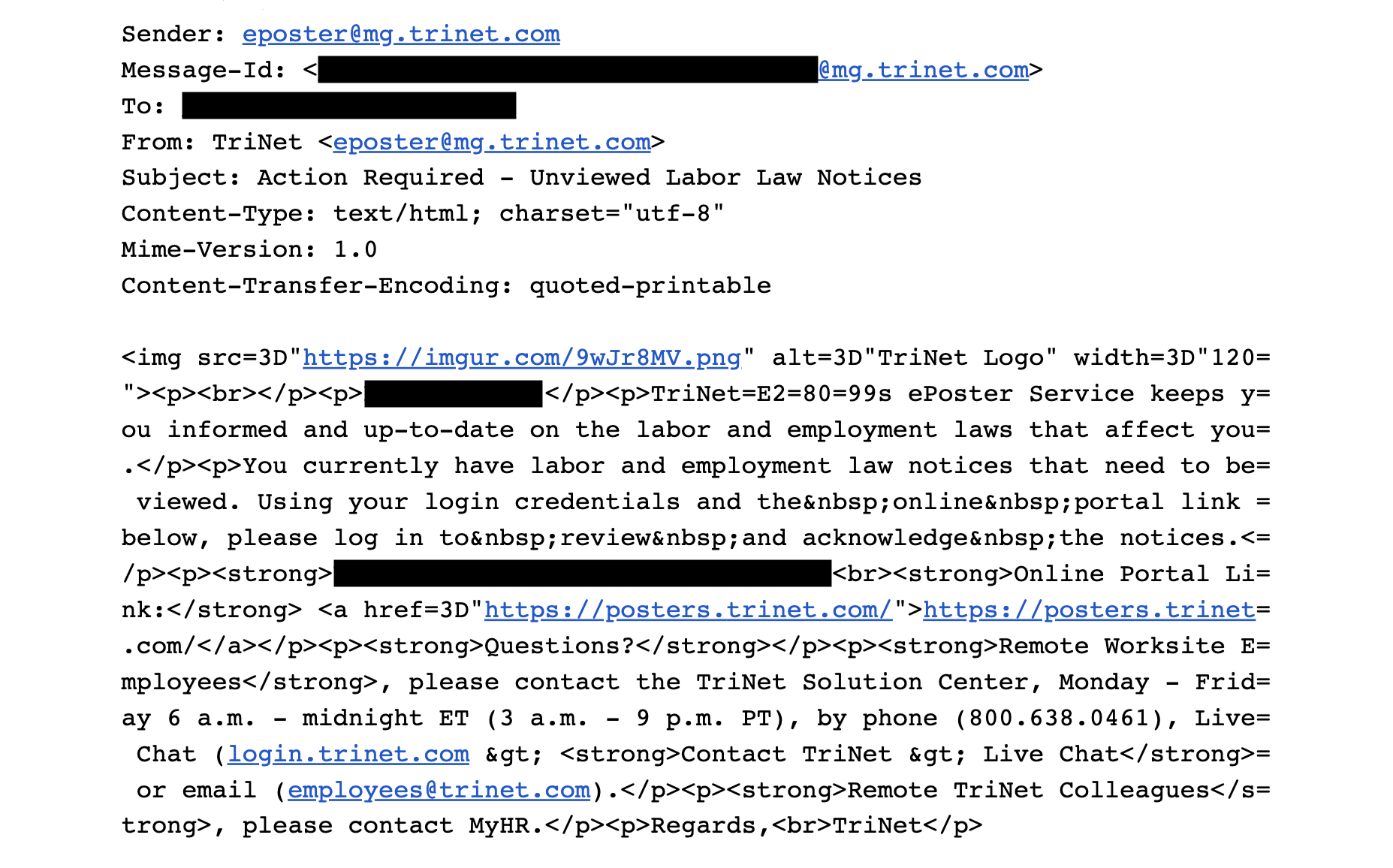
This is the email that remote workers received. TriNet said the use of an Imgur-hosted image in the email was “mistakenly” used. (Image: TechCrunch/supplied)

We looked at the source code of the email, including its headers. These email headers are like an envelope — they say where an email came from, who it’s addressed to, how it was routed, and if there were any complications along the way, such as being marked as spam.

There were more red flags than we could count.

Chief among the issues were that the TriNet logo in the email was hosted on Imgur, a free image-hosting and meme-sharing site, and not the company’s own website. That’s a common technique among phishing attackers — they use Imgur to host images they use in their spam emails to avoid detection. Since the image was uploaded in July, that logo was viewed more than 70,000 times until we reached out to TriNet, which removed the image, suggesting thousands of TriNet customers had received one of these emails. And, although the email contained a link to a TriNet website, the page that loaded had an entirely different domain with nothing on it to suggest it was a real TriNet-authorized site besides a logo, which if it were a phishing site could’ve been easily spoofed.

Fearing that somehow scammers had sent out a phishing email to potentially thousands of TriNet customers, we reached out to security researcher John Wethington, founder of security firm Condition:Black, to examine the email.

It turns out he was just as convinced as us that the email may have been fake.

“As hackers and self-proclaimed social engineers, we often think that spotting a phishing email is ‘easy’,” said Wethington. “The truth is it’s hard.”

“When we first examined the email every alarm bell was going off. The deeper we dug into it the more confusing things became. We looked at the domain name records, the site’s source code, and even the webpage hashes,” he said.

There was nothing, he said, that gave us “100% confidence” that the site was genuine until we contacted TriNet.

TriNet spokesperson Renee Brotherton confirmed to TechCrunch that the email campaign was legitimate, and that it uses the third-party site “for our compliance ePoster service offering. She added: “The Imgur image you reference is an image of the TriNet logo that Poster Elite mistakenly pointed to and it has since been removed.”

“The email you referenced was sent to all employees who do not go into an employer’s physical workspace to ensure their access to required notices,” said TriNet’s spokesperson.

When reached, Poster Elite also confirmed the email was legitimate.
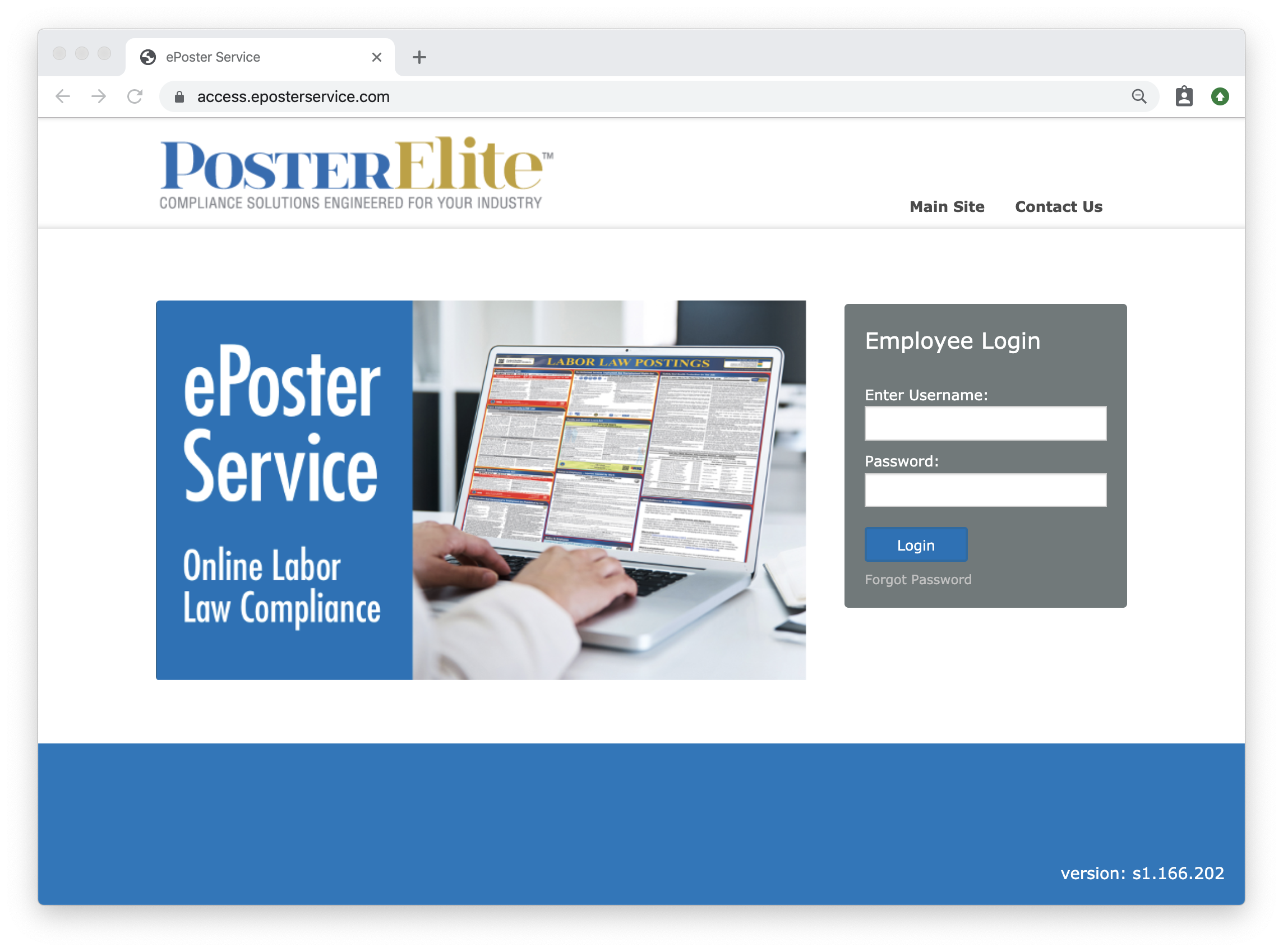
This is not a phishing site, but it sure looks like one. (Image: TechCrunch)

How did TriNet get this so wrong? This culmination of errors had some who received the email worried that their information might have been breached.

“When companies communicate with customers in ways that are similar to the way scammers communicate, it can weaken their customer’s ability over time to spot and shut down security threats in future communications,” said Rachel Tobac, a hacker, social engineer, and founder of SocialProof Security.

Tobac pointed to two examples of where TriNet got it wrong. First, it’s easy for hackers to send spoofed emails to TriNet’s workers because TriNet’s DMARC policy on its domain name is not enforced.

Second, the inconsistent use of domain names is confusing for the user. TriNet confirmed that it pointed the link in the email — posters.trinet.com — to eposterservice.com, which hosts the company’s compliance posters for remote workers. TriNet thought that forwarding the domain would suffice, but instead we thought someone had hijacked TriNet’s domain name settings — a type of attack that’s on the increase, though primarily carried out by state actors. TriNet is a huge target — it stores workers’ benefits, pay details, tax information and more. We had assumed the worst.

“This is similar to an issue we see with banking fraud phone communications,” said Tobac. “Spammers call bank customers, spoof the bank’s number, and pose as the bank to get customers to give account details to ‘verify their account’ before ‘hearing about the fraud the bank noticed on their account — which, of course, is an attack,” she said.

“This is surprisingly exactly what the legitimate phone call sounds like when the bank is truly calling to verify fraudulent transactions,” Tobac said.

Wethington noted that other suspicious indicators were all techniques used by scammers in phishing attacks. The posters.trinet.com subdomain used in the email was only set up a few weeks ago, and the eposterservice.com domain it pointed to used an HTTPS certificate that wasn’t associated with either TriNet or Poster Elite.

These all point to one overarching problem. TriNet may have sent out a legitimate email but everything about it looked problematic.

On one hand, being vigilant about incoming emails is a good thing. And while it’s a cat-and-mouse game to evade phishing attacks, there are things that companies can do to proactively protect themselves and their customers from scams and phishing attacks. And yet TriNet failed in almost every way by opening itself up to attacks by not employing these basic security measures.

“It’s hard to distinguish the good from the bad even with proper training, and when in doubt I recommend you throw it out,” said Wethington.


17 Nov 2019

Bored of the coins

Something strange is afoot in the world of cryptocurrencies. For the first time since Satoshi dropped Bitcoin on us like a benevolent bomb, this painfully new, highly bizarre field has become … well … boring. The true believers will tell you that great strides are being made, and the mainstream breakthrough is just around the corner, but they’ve been saying that for long enough that it’s beginning to seem reasonable to start wondering if these wolves were ever real.

I know, I know, it seems especially weird to be saying this at the same time that the President of China and CEO of Facebook have both become blockchain advocates. But China’s cryptocurrency, if it happens, will be a panopticoin, a tool to centralize monetary control even more firmly in the hands of the Communist Party, nothing like the decentralized censorship-resistant programmable money that the crypto community is theoretically all about; and Facebook’s, while making technical progress, keeps losing partners and gaining enemies.

The crypto community is currently all agog about “DeFi,” for decentralized finance, a movement which basically expands cryptocurrencies from “censorship-resistant money” to “censorship-resistant financial instruments,” such as collateralized loans and interest-bearing investments, along with “staking” (not really DeFi, but often treated as it.) Inside the crypto world, this seems like a revolution which will one day replace Wall Street. Outside the crypto world, it seems … a little like monks debating how many angels can dance on the end of a pin, one that no one is actually using and nobody outside the monastery cares about.

It’s easy to get the impression the cryptocurrency world has sacrificed technical engineering in favor of financial engineering. It’s easy to see them as having abandoned “banking the unbanked,” the alleged initial noble goal of many, to “offering sophisticated financial instruments to the unbanked,” long before any of those famous unbanked have actually been, you know, banked. And I’m sorry to report that you wouldn’t be entirely wrong.

But there are real technical advances being made. It’s just that they’re mostly slow and behind the scenes, and in the interim, the community’s “MOPs and sociopaths” have seized on DeFi.

There is some visible progress. ZCash is making apparent breakthroughs in important, foundational cryptographic research. Tezos continues to upgrade its governance algorithms — modify its code constitution, basically — successfully.

On the application layer, I’m interested in Vault12, which uses “friends and family to safeguard crypto assets” — basically, instead of entrusting the secret keys which control your cryptocurrencies to a third party like an exchange, something not particularly different from traditional banking, you protect them among people you trust, so that some number of them can collaborate with you to recover your keys if they’re lost, using a cryptographic protocol known as Shamir’s Secret Sharing. Luminaries such as Vitalik Buterin and Christopher Allen have argued for “social key recovery” for some time, and it’s interesting to see it offered by a slick new Valley startup.

But a lot of what’s happening is more fundamental, in search of the ability to support many more transactions than today’s blockchains. The entire foundation of today’s second-leading cryptocurrency, Ethereum, is being torn apart and replaced wholesale, in search of “Ethereum 2.0.” Bitcoin remains much more stable and conservative, but a whole new story is being added to its foundations, the Lightning Network. Both make me uneasy. A fundamental rewrite is always worrying. Lightning may scale, but it is if anything even more user-hostile than Bitcoin, basically the cryptocurrency equivalent of a hard-to-use prepaid credit card. Still, the permissionless equivalent of prepaid credit cards would be good for the unbanked that everyone’s clearly so worried about, right?

I’m also uneasy because almost all blockchain scaling solutions — Lightning, sharding, Plasma, optimistic rollup, etc. — turn fundamental blockchain security from something relatively passive (check the hashes and use the chain with the most computational power) to something active (“watchtowers,” “fraud proofs.”) This seems to me to increase the security attack surface a lot.

All these issues may yet be solved. Sure. But at the same time, it feels like dissonance between the attitude inside the crypto bubble and that of mundanes may never have been greater. Meanwhile, the dark spectre of Tether hangs over the entire industry. OK, circumstantial evidence is inadmissible for good reason … but there sure is a lot of it.

I’ve argued before that “ongoing associations with a cloud of crazy scandal and hangers-on snake-oil salespeople — all of which would be catastrophic signs for, say, a traditional new startup — can actually be indicators of the strength, not weakness” of the cryptocurrency movement …

…but at some point, your religion — or “brain virus,” as Naval Ravikant once called cryptocurrencies — has to begin to appeal to people who do not actually live on your compound, or else you are going to be remain a cult and wither out. When is that going to happen? Is that going to happen? The answer remains no clearer than it was five years ago.

17 Nov 2019

China Roundup: Alibaba’s Hong Kong listing and Tencent’s new fuel

Hello and welcome back to TechCrunch’s China Roundup, a digest of recent events shaping the Chinese tech landscape and what they mean to people in the rest of the world. The earnings season is here. This week, long-time archrivals in the Chinese internet battlefield — Alibaba and Tencent — made some big revelations about their future. First off, let’s look at Alibaba’s long-awaited secondary listing and annual shopping bonanza.

Forget about the number

It’s that time of year. On November 11, Alibaba announced it generated $38.4 billion worth of gross merchandise value during the annual Single’s Day shopping festival, otherwise known as Double 11. It smashed the record and grabbed local headlines again, but the event means little other than a big publicity win for the company and showcasing the art of drumming up sales.

GMV is often used interchangeably with sales in e-commerce. That’s problematic because the number takes into account all transactions, including refunded items, and it’s by no means reflective of a company’s actual revenue. There are numerous ways to juice the figure, too, as I wrote last year. Presales began days in advance, incentives were doled out to spur last-minute orders and no refunds could be processed until November 12.

Even Jiang Fan, the boss of Alibaba’s e-commerce business and the youngest among Alibaba’s 38 most important decision-makers, downplayed the number: “I never worry about transaction volumes. Numbers don’t matter. What’s most important is making Single’s Day fun and turning it into a real festival.”

Indeed, Alibaba put together another year of what’s equivalent to the Super Bowl halftime show. Taylor Swift and other international big names graced the stage as the evening gala was live-streamed and watched by millions across the globe.

Returning home

Alibaba is going ahead with its secondary listing in Hong Kong on the heels of reports that it could delay the sale due to ongoing political unrest in the city-state. The company is cash-rich, but listing closer to its customers can potentially ease some of the pressure arising from a new era of volatile U.S.-China relationships.

Alibaba is issuing 500 million new shares with an additional over-allotment option of 75 million shares for international underwriters, it said in a company blog. Reports have put the size of its offering between $10 billion and $15 billion, down from the earlier rumored $20 billion.

The giant has long expressed it intends to come home. In 2014, the e-commerce behemoth missed out on Hong Kong because the local exchange didn’t allow dual-class structures, a type of organization common in technology companies that grants different voting rights for different stocks. The giant instead went public in New York and raised the largest initial public offering in history at $25 billion.

“When Alibaba Group went public in 2014, we missed out on Hong Kong with regret. Hong Kong is one of the world’s most important financial centers. Over the last few years, there have been many encouraging reforms in Hong Kong’s capital market. During this time of ongoing change, we continue to believe that the future of Hong Kong remains bright. We hope we can contribute, in our small way, and participate in the future of Hong Kong,” said chairman and chief executive Daniel Zhang in a statement.

Missing out on Alibaba had also been a source of remorse for the Stock Exchange of Hong Kong. Charles Li, chief executive of the HKEX, admitted that losing Alibaba to New York had compelled the bourse to reform. The HKEX has since added dual-class shares and attracted Chinese tech upstarts such as smartphone maker Xiaomi and local services platform Meituan Dianping.

Tencent’s new fuel

Content and social networks have been the major revenue drivers for Tencent since its early years, but new initiatives are starting to gain ground. In the third quarter ended September 30, Tencent’s “fintech and business services” unit, which includes its payments and cloud services, became the firm’s second-largest sales avenue trailing the long-time cash cow of value-added services, essentially virtual items sold in games and social networks.

Payments, in particular, accounted for much of the quarterly growth thanks to increased daily active consumers and number of transactions per user. That’s good news for the company, which said back in 2016 that financial services would be its new focus (in Chinese) alongside content and social. The need to diversify became more salient in recent times as Tencent faces stricter government controls over the gaming sector and intense rivalry from ByteDance, the new darling of advertisers and owner of TikTok and Douyin.

Tencent also broke out revenue for cloud services for the first time. The unit grew 80% year-on-year to rake in 4.7 billion yuan ($670 million) and received a great push as the company pivoted to serve more industrial players and enterprises. Alibaba’s cloud business still leads the Chinese market by a huge margin, with revenue topping $1.3 billion during the September quarter.

Also worth your attention…

Luckin Coffee, the Chinese startup that began as a Starbucks challenger, is starting to look more like a convenient store chain with delivery capacities as it continues to increase store density (a combination of seated cafes, pickup stands and delivery kitchens) and widen product offerings to include a growing snack selection. Though bottom-line loss continued in the quarter, store-level operating profit swung to $26.1 million from a loss in the prior-year quarter. 30 million customers have purchased from Luckin, marking an increase of 413.4% from 6 million a year ago.

Minecraft is on the brink of 300 million registered users in China, its local publisher Netease announced at an event this week. That’s a lot of players, but not totally unreasonable given the game is free-to-play in the country with in-game purchases, so users can easily own multiple accounts. Outside China, the game has sold over 180 million paid copies, according to gaming analyst Daniel Ahmed from Niko Partners.

Xiaomi founder Lei Jun is returning a huge favor by backing a long-time friend. Xpeng Motors, the Chinese electric vehicle startup financed by Alibaba and Foxconn, has received $400 million in capital from a group of backers who weren’t identified except Xiaomi, which became its strategic investor. The marriage would allow Xpeng cars to tap Xiaomi’s growing ecosystem of smart devices, but the relationship dates further back. Lei was an early investor in UCWeb, a browser company founded by He and acquired by Alibaba in 2014. A day after Xiaomi’s began trading in Hong Kong in mid-2018, He wrote on his WeChat feed that he had bought $100 million worth of Xiaomi shares (in Chinese) in support of his old friend.

17 Nov 2019

The man behind Bezos’ next lunar guidance system talks future tech

Draper, the MIT spin-off engineering lab, is famed for developing the Apollo 11 Guidance Computer (not Draper Esprit, I hasten to add). Ken Gabriel, President and CEO, also recently made a major announcement. Blue Origin has now partnered with Lockheed Martin and Northrop Grumman to build elements of the company’s human-rated lunar lander, and Draper will lead the development of the lander’s avionics and guidance systems, with an aim to be ready to land a crew on the moon by 2024.

“While Blue Origin is the prime contractor, Lockheed Martin is building the ascent stage, Northrop Grumman is building the transfer element and Draper is doing the GNC (guidance, navigation and control),” Blue Origin CEO and founder Jeff Bezos said, announcing the move at the International Astronautical Congress in Washington. Blue Origin is competing for a NASA contract to develop a crewed lunar lander, or Human Landing System, for the Artemis program, which aims to return astronauts to the surface of the moon by the end of 2024.

TechCrunch sat down to chat with Gabriel, who previously he co-founded Google’s Advanced Technology and Projects (ATAP) group, to tlak about what he sees coming up in the future for the most advanced technologies. Prior to this, he was Deputy and Acting Director of the famed DARPA in the U.S. Department of Defense. During his tenure, DARPA advanced capabilities in hypersonics, offensive and defensive cyber, and big data analytics for intelligence and national security.

17 Nov 2019

Iran shuts down country’s internet in the wake of fuel protests

Iran, one of the countries most strongly identified with the rise cyber terrorism and malicious hacking, appears now to be using an iron fist to turn on its own. The country has reportedly shut down nearly all internet access in the country in retaliation to escalating protests that were originally ignited by a rise in fuel prices, according to readings taken by NetBlocks, an NGO that monitors cybersecurity and internet governance around the world.

The last reports of outages came from yesterday (Saturday) evening, so we have contacted NetBlocks to get a more updated picture.

So far, the picture looks pretty bleak. Babak Taghvaee, a defense analyst and historian who is not based in Iran who has been posting some videos of the protest skirmishes, confirms to me that his own internet communication lines with contacts have also been broken, with phones still working, albeit with monitoring from the State.

Internet is completely shut-down and I can’t communicate [with] anyone,” he said. “People just can call abroad (just certain countries) using telephone which is being monitored.”

Currently, using Twitter as one marker, it seems that there are at least some people sending out media and messages from the country, specifically related to the protests, although without specific “messaging” against the government attached to them. This one comes from Tehran, above one of the country’s main highways, showing how traffic has backed up due to streets getting closed down:

And here is another with video from the ground, showing people and police swarming.

And of course the government is still Tweeting, too:

The protests arose in response to a decision by the state to raise the price of gas in the country by 50%.

As this AP article points out, Iran has some of the cheapest gas in the world — in part because it has one of the world’s biggest crude oil reserves — and so residents in the country see cheap gas as a “birthright.”

Many use their cars not just to get around themselves but to provide informal taxi services to others, so — regardless your opinion on whether using fossil fuels is something to be defended or not — hiking up the prices cuts right to ordinary people’s daily lives, and has served as the spark for protest in the country over bigger frustrations with the government and economy, as Iran continues to struggle under the weight of US sanctions.

Clamping down on internet access as a way of trying to contain not just protesters’ communication with each other, but also the outside world, is not an unprecedented move; it is part and parcel of how un-democratic regimes control their people and situations. Alarmingly, its use seems to be growing.

Pakistan in September cut off internet access in specific regions response to protests over conflicts with India. And Russia — which has now approved a bill to be able to shut down internet access should it decide to — is now going to start running a series of drills to ensure its blocks work when they are being used in live responses.

We’ll update this post as we learn more.