Category: UNCATEGORIZED

13 Nov 2019

After selling enterprise biz, Docker lands $35M investment and new CEO

In what’s proving to be an interesting day for Docker, it announced it has received a $35 million investment from existing investors Benchmark Capital and Insight Partners.

It also announced the company has named long-time Chief Product Officer Scott Johnston as CEO. Johnston is the third CEO at Docker this year, replacing Rob Bearden, who replaced Steve Singh after he stepped down in May.

The news came shortly after Mirantis had announced it had purchased Docker’s enterprise business. The moves are curious to say the least, but Johnston says that he still sees an opportunity for the company helping developers use Docker, the popular containerization engine that has struggled to find a business model.

“Specifically, we are investing in expanding our cloud services to enable developers to quickly discover technologies for use when building applications, to easily share these apps with teammates and the community, and to run apps frictionlessly on any Kubernetes endpoint, whether locally or in the cloud,” Johnston said in a statement.

Bearden said that the company decided to go in this direction after carefully studying its existing business models. “After conducting thorough analysis with the management team and the Board of Directors, we determined that Docker had two very distinct and different businesses: one an active developer business, and the other a growing enterprise business. We also found that the product and the financial models were vastly different. This led to the decision to restructure the company and separate the two businesses, which is the best thing for customers and to enable Docker’s industry-leading technology to thrive,” he said in a statement.

Prior to today’s announcement, the company had raised more than $272 million, according to Crunchbase data. Now Benchmark and Insight are throwing it a $35 million lifeline to try one more time to build a successful business on top of the open-source Docker project.

13 Nov 2019

Facebook says government demands for user data are at a record high

Facebook’s latest transparency report is out.

The social media giant said the number of government demands for user data increased by 16% to 128,617 demands during the first half of this year compared to the second half of last year.

That’s the highest number of government demands it has received in any reporting period since it published its first transparency report in 2013.

The U.S. government led the way with the most number of requests — 50,741 demands for user data resulting in some account or user data given to authorities in 88% of cases. Facebook said two-thirds of all the U.S. government’s requests came with a gag order, preventing the company from telling the user about the request for their data.

But Facebook said it was able to release details of 11 so-called national security letters (NSLs) for the first time after their gag provisions were lifted during the period. National security letters can compel companies to turn over non-content data at the request of the FBI. These letters are not approved by a judge, and often come with a gag order preventing their disclosure. But since the Freedom Act passed in 2015, companies have been allowed to request the lifting of those gag orders.

The report also said the social media giant had detected 67 disruptions of its services in 15 countries, compared to 53 disruptions in nine countries during the second half of last year.

And, the report said Facebook also pulled 11.6 million pieces of content, up from 5.8 million in the same period a year earlier, which Facebook said violated its policies on child nudity and sexual exploitation of children.

The social media giant also included Instagram in its report for the first time, including removing 1.68 million pieces of content during the second and third quarter of the year.

Read more:

13 Nov 2019

Facebook says government demands for user data are at a record high

Facebook’s latest transparency report is out.

The social media giant said the number of government demands for user data increased by 16% to 128,617 demands during the first half of this year compared to the second half of last year.

That’s the highest number of government demands it has received in any reporting period since it published its first transparency report in 2013.

The U.S. government led the way with the most number of requests — 50,741 demands for user data resulting in some account or user data given to authorities in 88% of cases. Facebook said two-thirds of all the U.S. government’s requests came with a gag order, preventing the company from telling the user about the request for their data.

But Facebook said it was able to release details of 11 so-called national security letters (NSLs) for the first time after their gag provisions were lifted during the period. National security letters can compel companies to turn over non-content data at the request of the FBI. These letters are not approved by a judge, and often come with a gag order preventing their disclosure. But since the Freedom Act passed in 2015, companies have been allowed to request the lifting of those gag orders.

The report also said the social media giant had detected 67 disruptions of its services in 15 countries, compared to 53 disruptions in nine countries during the second half of last year.

And, the report said Facebook also pulled 11.6 million pieces of content, up from 5.8 million in the same period a year earlier, which Facebook said violated its policies on child nudity and sexual exploitation of children.

The social media giant also included Instagram in its report for the first time, including removing 1.68 million pieces of content during the second and third quarter of the year.

Read more:

13 Nov 2019

Mirantis acquires Docker Enterprise

Mirantis today announced that it has acquired Docker’s Enterprise business and team. Docker Enterprise was very much the heart of Docker’s product lineup, so this sale leaves Docker as a shell of its former, high-flying unicorn self. Docker itself, which installed a new CEO earlier this year, says it will continue to focus on tools that will advance developers’ workflows. Mirantis will keep the Docker Enterprise brand alive, though, which will surely not create any confusion.

With this deal, Mirantis is acquiring Docker Enterprise Technology Platform and all associated IP: Docker Enterprise Engine, Docker Trusted Registry, Docker Unified Control Plane and Docker CLI. It will also inherit all Docker Enterprise customers and contracts, as well as its strategic technology alliances and partner programs. Docker and Mirantis say they will both continue to work on the Docker platform’s open-source pieces.

The companies did not disclose the price of the acquisition, but it’s surely nowhere near Docker’s valuation during any of its last funding rounds. Indeed, it’s no secret that Docker’s fortunes changed quite a bit over the years, from leading the container revolution to becoming somewhat of an afterthought after Google open-sourced Kubernetes and the rest of the industry coalesced around it. It still had a healthy enterprise business, though, with plenty of large customers among the large enterprises. The company says about a third of Fortune 100 and a fifth of Global 500 companies use Docker Enterprise, which is a statistic most companies would love to be able to highlight — and which makes this sale a bit puzzling from Docker’s side, unless the company assumed that few of these customers were going to continue to bet on its technology.

Here is what Docker itself had to say. “Docker is ushering in a new era with a return to our roots by focusing on advancing developers’ workflows when building, sharing and running modern applications. As part of this refocus, Mirantis announced it has acquired the Docker Enterprise platform business,” Docker said in a statement when asked about this change. “Moving forward, we will expand Docker Desktop and Docker Hub’s roles in the developer workflow for modern apps. Specifically, we are investing in expanding our cloud services to enable developers to quickly discover technologies for use when building applications, to easily share these apps with teammates and the community, and to run apps frictionlessly on any Kubernetes endpoint, whether locally or in the cloud.”

Mirantis itself, too, went through its ups and downs. While it started as a well-funded OpenStack distribution, today’s Mirantis focuses on offering a Kubernetes-centric on-premises cloud platform and application delivery. As the company’s CEO Adrian Ionel told me ahead of today’s announcement, today is possibly the most important day for the company.

So what will Mirantis do with Docker Enterprise? “Docker Enterprise is absolutely aligned and an accelerator of the direction that we were already on,” Ionel told me. “We were very much moving towards Kubernetes and containers aimed at multi-cloud and hybrid and edge use cases, with these goals to deliver a consistent experience to developers on any infrastructure anywhere — public clouds, hybrid clouds, multi-cloud and edge use cases — and make it very easy, on-demand, and remove any operational concerns or burdens for developers or infrastructure owners.”
Mirantis previously had about 450 employees. With this acquisition, it gains another 300 former Docker employees that it needs to integrate into its organization. Docker’s field marketing and sales teams will remain separate for some time, though, Ionel said, before they will be integrated. “Our most important goal is to create no disruptions for customers,” he noted. “So we’ll maintain an excellent customer experience, while at the same time bringing the teams together.”

This also means that for current Docker Enterprise customers, nothing will change in the near future. Mirantis says that it will accelerate the development of the product and merge its Kubernetes and lifecycle management technology into it. Over time, it will also offer a managed services solutions for Docker Enterprise.

While there is already some overlap between Mirantis’ and Docker Enterprise’s customer base, Mirantis will pick up about 700 new enterprise customers with this acquisition.

With this, Ionel argues, Mirantis is positioned to go up against large players like VMware and IBM/Red Hat. “We are the one real cloud-native player with meaningful scale to provide an alternative to them without lock-in into a legacy or existing technology stack.”

While this is clearly a day the Mirantis team is celebrating, it’s hard not to look at this as the end of an era for Docker, too. The company says it will share more about its future plans today, but didn’t make any spokespeople available ahead of this announcement.


13 Nov 2019

Yahoo Japan and Line are reportedly going to merge

According to Nikkei, messaging app Line and Yahoo Japan are about to merge and form a single tech company. Despite the name, Yahoo Japan is currently 100% owned by Z Holdings, a company that is controlled by Japanese telecom company SoftBank (Yahoo Japan isn’t related with TechCrunch’s parent company Verizon Media). Line Corporation is owned by Naver Corporation, a South Korean internet giant.

The two companies are still discussing terms of the deal according to Nikkei. But you could imagine Z Holdings becoming a a 50-50 joint venture between SoftBank and Naver, with Z Holdings owning both Yahoo Japan and Line.

Line operates one of the most popular messaging apps in Japan. In addition to conversations, the company operates Line Pay, Line Taxi and other services. But competition has been fierce in the messaging space.

Yahoo Japan was originally formed by Yahoo and SoftBank in the later 1990s. When Verizon acquired Yahoo in 2017, Verizon didn’t acquire Yahoo’s stake in Alibaba and Yahoo Japan. Yahoo created a spin-out company called Altaba to hold those stakes.

Altaba first sold its stake in Yahoo Japan. In July 2018, SoftBank acquired part of Altaba’s stake in Yahoo Japan in order to increase its ownership of Yahoo Japan. Altaba later sold its remaining Yahoo Japan shares, its Alibaba shares and shut down. In 2019, SoftBank received additional shares to become Yahoo Japan’s parent company.

Yahoo Japan is a household name and a big internet conglomerate in Japan. It has an online advertising business, an e-commerce business, finance services and more. Yahoo Japan and Line probably hope to reach more users and boost engagement with the merger.

We’ve reached out to Line Corporation and Z Holdings and will update if we hear back.

13 Nov 2019

GitHub faces more resignations in light of ICE contract

Microsoft-owned GitHub has been under intense scrutiny as of late for its $200,000 contract with Immigration and Customs Enforcement. Now, another employee, engineer Alice Goldfuss, has resigned.

In a tweet, Goldfuss said GitHub has a number of problems to address and that “ICE is only the latest.”

Meanwhile, Vice reports at least five staffers quit today. These resignations come the same day as GitHub Universe, the company’s big product conference. Ahead of the conference, Tech Workers Coalition protested the event, setting up a cage to represent where ICE detains children.

Last month, GitHub staff engineer Sophie Haskins resigned, stating she was leaving because the company did not cancel its contract with ICE, The Los Angeles Times reported.

Last month, GitHub employees penned an open letter urging the company to stop working with ICE. That came following GitHub’s announcement of a $500,000 donation to nonprofit organizations in support of “immigrant communities targeted by the current administration.” In that announcement, GitHub CEO Nat Friedman said ICE’s purchase was made through one of GitHub’s reseller partners and said the deal is not “financially material” for the company. Friedman also pointed out that ICE is responsible for more than immigration and detention facilities.

“[…] We recognize that ICE is responsible for both enforcing the US immigration policies with which we passionately disagree, as well as policies that are critical to our society, such as fighting human trafficking,” Friedman wrote. “We do not know the specific projects that the on-premises GitHub Enterprise Server license is being used with, but recognize it could be used in projects that support policies we both agree and disagree with.”

But some employees were not persuaded by Friedman’s words.

“We are not satisfied with GitHub’s now-public stance on this issue,” GitHub employees wrote in an open letter. “GitHub has held a ‘seat at the table’ for over 2 years, as these illegal and dehumanizing policies have escalated, with little to show for it. Continuing to hold this contract does not improve our bargaining power with ICE. All it does is make us complicit in their widespread human rights abuses.”

In response to that open letter, GitHub COO Erica Brescia said preventing ICE from using GitHub could “hurt the very people we all want to help,” The Los Angeles Times reported last month. Still, employees are not letting up, as illustrated by the action this morning.

When reached for comment about GitHub’s stance on its contract with ICE, GitHub directed me to its blog post from last month. TechCrunch has sent a follow-up note to see if the company will comment on the resignation.

13 Nov 2019

Techstars launches a virtual space tech accelerator with USAF, the Netherlands and Norway

Techstars is following up the first class of their Starburst space-focused program with a new, virtual accelerator program that is being run in partnership with the U.S. Air Force, the Netherlands Ministry of Defence, the Norwegian Ministry of Defence and the Norwegian Space Agency. It’s called the Techstars Allied Space Accelerator, and its focus is specifically on startups operating in the commercial space industry.

Unlike most other Techstars programs, this one won’t require companies to work out of a centralized physical hub during the course of the program, which will span 13-weeks. It’ll be mostly remote, punctuated by three separate one-week visits on-site at the program’s government agency sponsors, which will supplement the virtual mentorship and guidance.

Techstars already has experience working with the U.S. Air Force, through the Techstars Air Force Accelerator, but this new program will give it a chance to work together both with the entrepreneurial organization, and also with some of its international partners. This kind of collaboration with industry could help pave the way to establishing more clear and widely accepted rules of the road when it comes to how the commercial space industry operates relative to national borders and international cooperation.

This inaugural program will run from June through September of 2020, and it’s open for applications as of today, with the cut-off for accepting new potential participants on March 3, 2020.

13 Nov 2019

Netflix and Nickelodeon partner on original programming, following Disney+ launch

Netflix is taking on the Disney+ threat by partnering up with kids entertainment giant Nickelodeon, which will produce original content, including films and TV shows, for its streaming service. The company announced this morning it has entered into a new, multi-year output deal that will produce animated feature films and shows that will include both Nickelodeon’s well-known library of characters as well as all-new IP.

The shows will be aimed at kids and families around the world, Netflix says.

The deal is an expansion of Nickelodeon’s existing relationship with Netflix. Already, Netflix streams a number of popular Nickelodeon’s titles, including animated specials s “Rocko’s Modern Life: Static Cling” and “Invader Zim: Enter the Florpus.” It’s also soon to add specials based on “The Loud House” and “Rise of the Teenage Mutant Ninja Turtles.”

The deal news comes only a day after the launch of Disney+ in the U.S., which will be one of its largest markets. Disney+ has been positioned as a potential rival for Netflix, with some forecasts even stating that Netflix could lose subscribers to the family-friendly streamer. One report from market research firm Audience Project out today, in fact, claims that 33% of U.S. consumers who are planning to sign up for Disney+ are considering canceling their Netflix subscriptions around the same time.

To retain customers, Netflix will need to have more kids’ content that will appeal to families — a powerful demographic that all streamers today target with investments in original programming and licensing deals.

“Nickelodeon’s next step forward is to keep expanding beyond linear platforms, and our broader content partnership with Netflix is a key path toward that goal,” said Brian Robbins, President, Nickelodeon, in a statement.

“The Nickelodeon Animation Studio is home to the world-class artists and storytellers behind some of the most iconic characters and shows ever made, and our head of Animation, Ramsey Naito, has been building on that legacy over the past year by ramping up development and production exponentially. The ideas and work at our Studio are flowing, and we can’t wait to work with Melissa and the Netflix team on a premium slate of original animated content for kids and families around the world,” he added.

Netflix didn’t offer any details on which iconic Nickelodeon IP would be involved in the new programming, or what sort of new characters may be under development. Nor did it speak to the number of titles it expects the multi-year deal to produce or when the first shows or movies would arrive. Instead, today’s announcement was more focused on taking the wind out of Disney’s sails following its big (and sometimes glitchy) U.S. launch.

Nickelodeon isn’t the only new partner in the children’s and family space that Netflix has brought in, as a means of challenging the Disney+ threat. As The New York Times recently reported, the streamer has been amassing a number of creators and executives as part of its counterattack strategy, including former Pixar and Disney animators. It also recently worked with the Jim Henson Company to produce “The Dark Crystal: Age of Resistance.”

Netflix has touted the value of kids’ programming to its service, noting that around 60% of Netflix’s global audience watches the service for children and family content on a monthly basis.

13 Nov 2019

Brave launches version 1.0 of its privacy-focused browser

Brave, the company co-founded by ex-Mozilla CEO Brendan Eich after his ouster from the organization in 2014, today launched version 1.0 of its browser for Windows, macOS, Linux, Android and iOS. In a browser market where users are spoiled for choice, Brave is positioning itself as a fast option that preserves users’ privacy with strong default settings, as well as a crypto currency-centric private ads and payment platform that allows users to reward content creators.

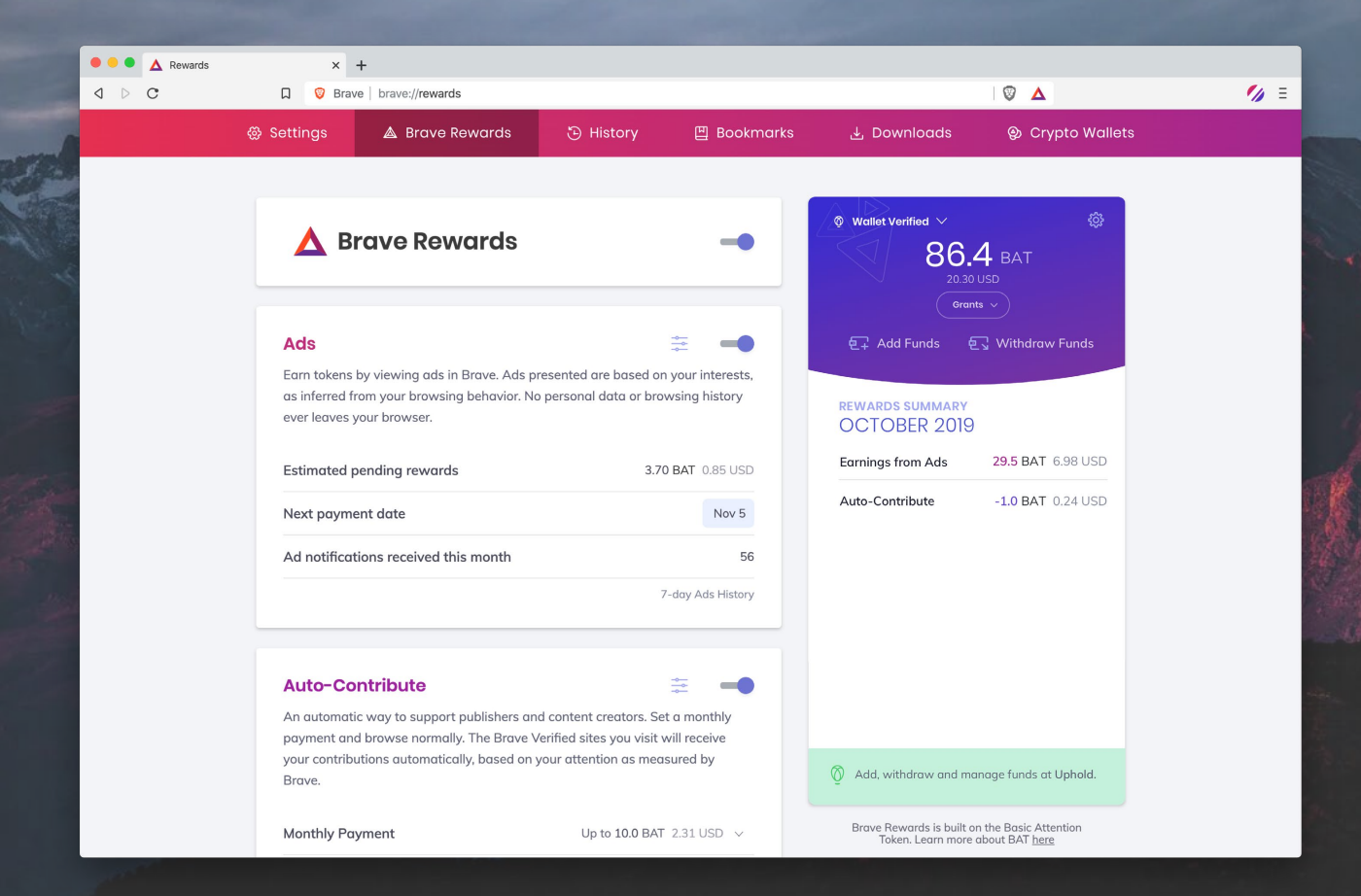
As the company announced last month, it now has about 8 million daily users. Its Brave Rewards program, which requires opt-in from users and publishers, currently has about 300,000 publishers on board. Most of these are users with small followings on YouTube and Twitter, but large publishers like Wikipedia, The Washington Post, The Guardian, Slate and the LA Times are also part of the ecosystem. Using this system, which not every publisher is going to like, the browser replaces the ads on a publisher’s site with its own, based on the user’s browsing habits. Users then receive 70 percent of what the advertisers spend on ads, while Brave keeps 30 percent.

As users view these ads, they start earning Basic Attention Tokens (BAT), Brave’s cryptocurrency, which they can keep or give to publishers. In its early days, Brave actually started with Bitcoin as the currency for this, but as Eich noted, that quickly became too expensive (and since the price was going up, users wanted to hold on to the Bitcoin instead of donating it).

Brave also comes with a built-in ad blocker that is probably among the most effective in the industry, as well as extensive anti-tracking features. “Everybody’s bothered by the sense of being tracked and bothered by bad ads,” Eich told me. “But I think ad aesthetics are not the problem. It’s the tracking and the cost of tracking which is multifarious. There’s page load time, running the radio to load the tracking scripts that load the other scripts that load the scripts that load the ads, that drains your battery, too.” Eich argues that with Brave, the team found a way to tie this all together with anti-tracking technology and an approach to ad blocking that goes beyond the industry-standard blocklists and also uses machine learning to identify additional rules for blocking.

For those users that really want to be anonymous on the web, Brave also features a private browsing mode, just like every other browser, but with the added twist that you can also open a private session through the Tor network, which will make it very hard for most companies to identify you.

At its core, Brave is simply a fast, extensible Chromium-based browser. That’s also what the company believes will sell it to users. “The way you get users, […] I think speed is the first one that works across the largest number of users. But you can’t just leave it at speed. You want to have all your benefits tied up in a pretty knot and that’s what we have done,” he said. For Brave, speed and ad/tracking protection are obviously interconnected, and all the other benefits accrue from that.

Looking beyond version 1.0, the Brave team plans to implement better sync, with support for tab and history syncing, for example. Brave also aims to make participating in Brave Rewards an experience with much lower friction for the user. In the early days, before it was on Android, the opt-in rate was around 40 percent, Eich told me, and the team wants to get it back to that.

If you want to give Brave a try, you can download it here.

13 Nov 2019

Wayfair’s app adds 3D visualization tools, including interactive photos & a room planner

Home furnishing retailer Wayfair was among the first to adopt AR technology as a means of helping people better visual furniture and accessories in their own home, ahead of purchase. Today, the company is expanding its feature set to allow for more visualization capabilities — even when you’re shopping out in the real world and aren’t able to take a photo of your room to use AR.

Instead, shoppers will be able to leverage a new feature called “Interactive Photo,” which lets shoppers take a photo of their room then visualize multiple products within it, even when they’re not home in their own space. The feature itself uses technology to understand the spatial information of the room in the image to give you an AR-like experience using your photo.

Alongside this addition, Wayfair has updated its app to put its camera tools more at the forefront of the app experience. Similar to how you can click a camera icon next to the Amazon app’s search bar, you can now do the same in Wayfair. You can also then toggle between the various camera-based features with swipe gestures, in order to move between Wayfair’s visual search and its “View in Room” AR feature, which is also where you’ll find the new “Interactive Photo.”

The retailer has also launched its room design tool, Room Planner 3D, on the mobile shopping app. This allows shoppers to create an interactive room 3D room that they can view from any angle, while testing out different layouts, styles, room dimensions and more.

The update follows Amazon’s launch earlier this year of its own visual shopping experience called Showroom, which let online and mobile shoppers try out furniture and other décor in a customizable virtual room where they pick the wall color, flooring, carpet and more.

“With the latest updates to the Wayfair app, we continue to push the limits of what’s possible by iterating on advanced AR and machine learning capabilities, and introducing new and innovative spatial awareness techniques to an e-commerce experience, bridging the gap between imagination and reality,” said Matt Zisow, Vice President of Product Management, Experience Design and Analytics at Wayfair, in a statement.

The new feature set comes shortly after Wayfair’s third-quarter earnings, where the company reported a wider-than-expected loss of $2.33 per share, adjusted, versus the expected $2.10 per share. Revenue was up 35% year-over-year to $2.3 billion, above the anticipated $2.27 billion, however. The company attributed the miss to “short-term headwinds from tariffs.”

However, as the holiday shopping season heats up, Wayfair still needs to unveil enticing features that will encourage consumers to redownload its app and shop — especially given that smartphones alone drove $2.1 billion in U.S. online sales last Black Friday.  

The new Wayfair app is out now on iOS and Android, but the new features — Interactive Photo, Integrated Camera and Room Planner 3D — are only on iOS.