Category: UNCATEGORIZED

12 Nov 2019

S’More is a new dating app that looks to suspend physical attraction for something more

According to former Chappy Managing Director Adam Cohen Aslatei, “something more” is one of the most common pieces of feedback that dating apps get from their users. That’s where S’More comes in.

S’More was founded by Aslatei to provide a dating app to users that goes beyond superficial looks.

Here’s how it works:

Rather than scrolling through a feed and swiping left and right, users are served five suggested profiles each day. Unlike other dating apps, user profiles on S’More consist of icons, rather than pictures and text, which reveal characteristics about the profile’s owner. For example, a user might put that they’re seeking romance, interested in hiking, and got an education from this or that university, all in the form of little tile icons.

When a user interacts with those icons — S’More calls this a ‘wink’ — more visual pieces of the profile start to unblur and unlock, revealing a profile photo and unlocking the person’s social media feeds, etc.

These interactions also unlock the ability to have a conversation, if they’re reciprocated, which creates a match.

As users continue to interact with others on the platform, S’More learns about what they’re looking for in a relationship and optimizes for those factors when suggesting other profiles.

“The greatest challenge is resetting expectations for consumers,” said Cohen Aslatei. “We know that the swiping mechanism largely doesn’t work, but we’re providing another option which is, if you truly want to get to know someone, suspend physical judgement before you decide if you like them.”

The company plans to generate revenue through a freemium model, charging users extra to access a Discover page on the app, allowing them to interact with and save more profiles than the allotted five per day.

Moreover, S’More asks all users to rank one another, not as prospective mates but as users of the platform. The hope is that the public-facing user rating promotes a healthy, safe environment for all users to meet and connect without the abuse that’s so common on dating apps. Ratings are also determined by a user’s activity on the platform and how complete their profile is.

The company also requires that users who register take a selfie for ID verification right at the point of signing up.

S’More is launching in beta to Boston and the D.C. area with plans to launch in New York soon.

12 Nov 2019

No one knows how effective digital therapies are, but a new tool from Elektra Labs aims to change that

Depending on which study you believe, the wearable and digital health market could be worth anywhere from $30 billion to nearly $90 billion in the next six years.

If the numbers around the size of the market are a moving target, just think about how to gauge the validity and efficacy of the products that are behind all of those billions of dollars in spending.

Andy Coravos, the co-founder of Elektra Labs, certainly has.

Coravos, whose parents were a dentist and a nurse practitioner, has been thinking about healthcare for a long time. After a stint in private equity and consulting, she took a coding bootcamp and returned to the world she was raised in by taking an internship with the digital therapeutics company, Akili Interactive.

Coravos always thought she wanted to be in healthcare, but there was one thing holding her back, she says. “I’m really bad with blood.”

That’s why digital therapeutics made sense. The stint at Akili led to a position at the U.S. Food and Drug Administration as an entrepreneur in residence, which led to the creation of Elektra Labs roughly two years ago.

Now the company is launching Atlas, which aims to catalog the biometric monitoring technologies that are flooding the consumer health market.

These monitoring technologies, and the applications layered on top of them, have profound implications for consumer health, but there’s been no single place to gauge how effective they are, or whether the suggestions they’re making about how their tools can be used are even valid. Atlas and Elektra are out to change that. 

The FDA has been accelerating its clearances for software-driven products like the atrial fibrillation detection algorithm on the Apple Watch and the ActiGraph activity monitors. And big pharma companies like Roche, Pfizer and Novartis have been investing in these technologies to collect digital biomarker data and improve clinical trials.

Connected technologies could provide better care, but the technologies aren’t without risks. Specifically the accuracy of data and the potential for bias inherent in algorithms which were created using flawed datasets mean that there’s a lot of oversight that still needs to be done, and consumers and pharmaceutical companies need to have a source of easily accessible data about the industry.

”The increase in FDA clearances for digital health products coupled with heavy investment in technology has led to accelerated adoption of connected tools in both clinical trials and routine care. However, this adoption has not come without controversy,” said Coravos, co-founder and CEO of Elektra Labs, in a statement. “During my time as an Entrepreneur in Residence in the FDA’s Digital Health Unit, it became clear to me that like pharmacies which review, prepare, and dispense drug components, our healthcare system needs infrastructure to review, prepare, and dispense connected technologies components.

The analogy to a pharmacy isn’t an exact fit, because Elektra Labs currently doesn’t prepare or dispense any of the treatments that it reviews. But Atlas is clearly the first pillar that the digital therapeutics industry needs as it looks to supplant pharmaceuticals as treatments for some of the largest and most expensive chronic conditions (like diabetes).

Coravos and here team interviewed more than 300 professionals as they built the Atlas toolkit for pharmaceutical companies and other healthcare stakeholders seeking a one-stop-shop for all of their digital healthcare data needs. Like a drug label, or nutrition label, Atlas publishes labels that highlight issues around the usability, validation, utility, security and data governance of a product.

In an article in Quartz earlier this year, Coravos made her pitch for Elektra Labs and the types of things it would monitor for the nascent digital therapeutics industry. It includes the ability to handle adverse events involving digital therapies by providing a single source where problems could be reported; a basic description for consumers of how the products work; an assessment of who should actually receive digital therapies, based on the assessment of how well certain digital products perform with certain users; a description of a digital therapy’s provenance and how it was developed; a database of the potential risks associated with the product; and a record of the product’s security and privacy features.

As the projections on market size show, the problem isn’t going to get any smaller. As Google’s recent acquisition bid for FitBit and the company’s reported partnership with Ascension on “Project Nightingale” to collect and digitize more patient data shows, the intersection of technology and healthcare is a huge opportunity for technology companies.

“Google is investing more. Apple is investing more… More and more of these devices are getting FDA cleared and they’re becoming not just wellness tools but healthcare tools,” says Coravos of the explosion of digital devices pitching potential health and wellness benefits.

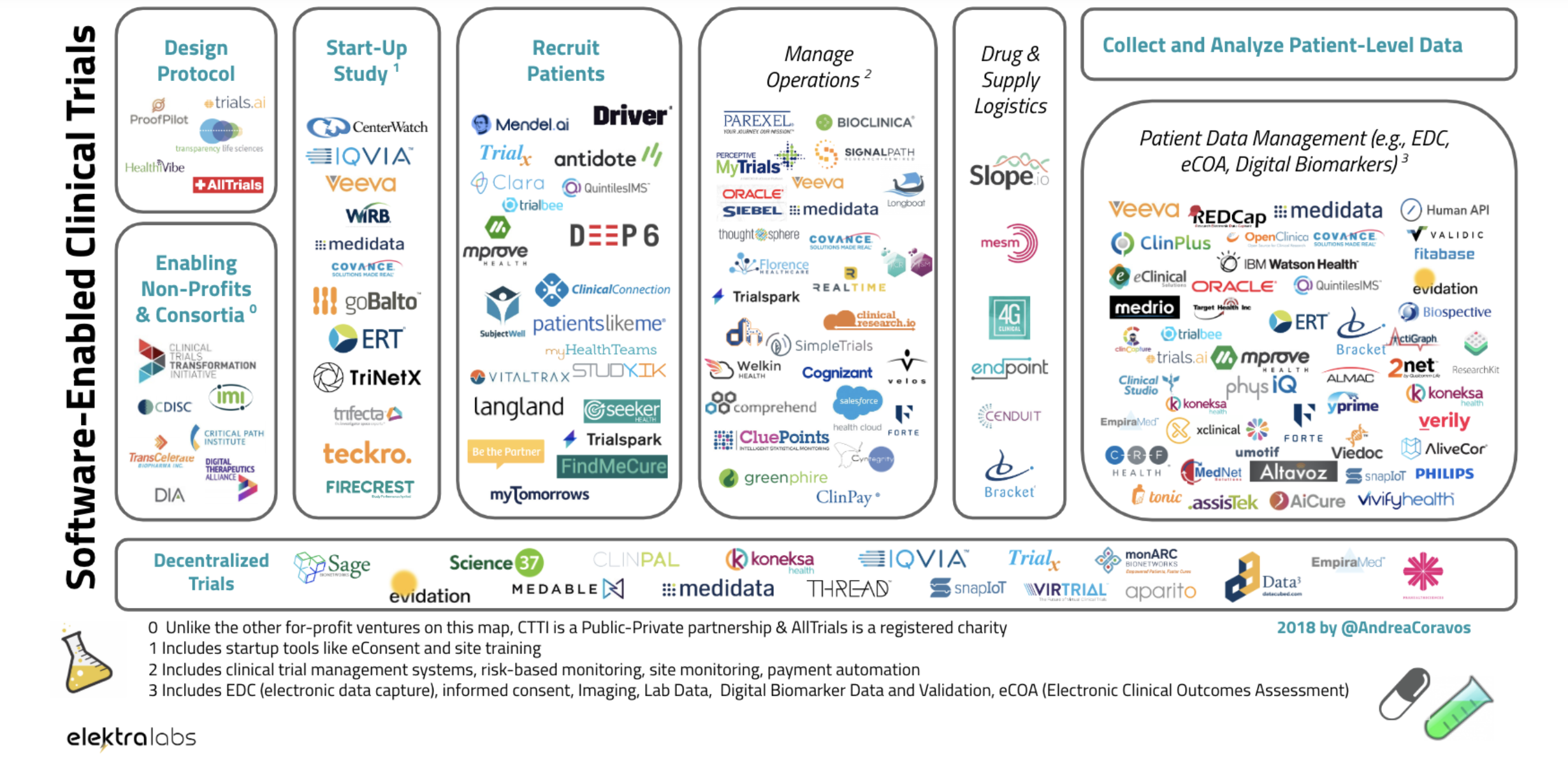
Elektra Labs is already working with undisclosed pharmaceutical companies to map out the digital therapeutic environment and identify companies that might be appropriate partners for clinical trials or acquisition targets in the digital market.

“The FDA is thinking about these digital technologies, but there were a lot of gaps,” says Coravos. And those gaps are what Elektra Labs is designed to fill. 

At its core, the company is developing a catalog of the digital biomarkers that modern sensing technologies can track and how effective different products are at providing those measurements. The company is also on the lookout for peer-reviewed published research or any clinical trial data about how effective various digital products are.

Backing Coravos and her vision for the digital pharmacy of the future are venture capital investors including Maverick Ventures, Arkitekt Ventures, Boost VC, Founder Collective, Lux Capital, SV Angel, and Village Global.

Alongside several angel investors, including the founders and chief executives from companies including: PillPack, Flatiron Health, National Vision, Shippo, Revel and Verge Genomics, the venture investors pitched in for a total of $2.9 million in seed funding for Coravos’ latest venture.

“Timing seems right for what Elektra is building,” wrote Brandon Reeves, an investor at Lux Capital, which was . one of the first institutional investors in the company. “We have seen the zeitgeist around privacy data in applications on mobile phones and now starting to have the convo in the public domain about our most sensitive data (health).” 

If the validation of efficacy is one key tenet of the Atlas platform, then security is the other big emphasis of the company’s digital therapeutic assessment.  Indeed, Coravos believes that the two go hand-in-hand. As privacy issues proliferate across the internet, Coravos believes that the same troubles are exponentially compounded by internet-connected devices that are monitoring the most sensitive information that a person has — their own health records.

In an article for Wired, Koravos wrote:

Our healthcare system has strong protections for patients’ biospecimens, like blood or genomic data, but what about our digital specimens? Due to an increase in biometric surveillance from digital tools—which can recognize our face, gait, speech, and behavioral patterns—data rights and governance become critical. Terms of service that gain user consent one time, upon sign-up, are no longer sufficient. We need better social contracts that have informed consent baked into the products themselves and can be adjusted as user preferences change over time.

We need to ensure that the industry has strong ethical underpinning as it brings these monitoring and surveillance tools into the mainstream. Inspired by the Hippocratic Oath—a symbolic promise to provide care in the best interest of patients—a number of security researchers have drafted a new version for Connected Medical Devices.

With more effective regulations, increased commercial activity, and strong governance, software-driven medical products are poised to change healthcare delivery. At this rate, apps and algorithms have the opportunity to augment doctors and complement—or even replace—drugs sooner than we think.


12 Nov 2019

No one knows how effective digital therapies are, but a new tool from Elektra Labs aims to change that

Depending on which study you believe, the wearable and digital health market could be worth anywhere from $30 billion to nearly $90 billion in the next six years.

If the numbers around the size of the market are a moving target, just think about how to gauge the validity and efficacy of the products that are behind all of those billions of dollars in spending.

Andy Coravos, the co-founder of Elektra Labs, certainly has.

Coravos, whose parents were a dentist and a nurse practitioner, has been thinking about healthcare for a long time. After a stint in private equity and consulting, she took a coding bootcamp and returned to the world she was raised in by taking an internship with the digital therapeutics company, Akili Interactive.

Coravos always thought she wanted to be in healthcare, but there was one thing holding her back, she says. “I’m really bad with blood.”

That’s why digital therapeutics made sense. The stint at Akili led to a position at the U.S. Food and Drug Administration as an entrepreneur in residence, which led to the creation of Elektra Labs roughly two years ago.

Now the company is launching Atlas, which aims to catalog the biometric monitoring technologies that are flooding the consumer health market.

These monitoring technologies, and the applications layered on top of them, have profound implications for consumer health, but there’s been no single place to gauge how effective they are, or whether the suggestions they’re making about how their tools can be used are even valid. Atlas and Elektra are out to change that. 

The FDA has been accelerating its clearances for software-driven products like the atrial fibrillation detection algorithm on the Apple Watch and the ActiGraph activity monitors. And big pharma companies like Roche, Pfizer and Novartis have been investing in these technologies to collect digital biomarker data and improve clinical trials.

Connected technologies could provide better care, but the technologies aren’t without risks. Specifically the accuracy of data and the potential for bias inherent in algorithms which were created using flawed datasets mean that there’s a lot of oversight that still needs to be done, and consumers and pharmaceutical companies need to have a source of easily accessible data about the industry.

”The increase in FDA clearances for digital health products coupled with heavy investment in technology has led to accelerated adoption of connected tools in both clinical trials and routine care. However, this adoption has not come without controversy,” said Coravos, co-founder and CEO of Elektra Labs, in a statement. “During my time as an Entrepreneur in Residence in the FDA’s Digital Health Unit, it became clear to me that like pharmacies which review, prepare, and dispense drug components, our healthcare system needs infrastructure to review, prepare, and dispense connected technologies components.

The analogy to a pharmacy isn’t an exact fit, because Elektra Labs currently doesn’t prepare or dispense any of the treatments that it reviews. But Atlas is clearly the first pillar that the digital therapeutics industry needs as it looks to supplant pharmaceuticals as treatments for some of the largest and most expensive chronic conditions (like diabetes).

Coravos and here team interviewed more than 300 professionals as they built the Atlas toolkit for pharmaceutical companies and other healthcare stakeholders seeking a one-stop-shop for all of their digital healthcare data needs. Like a drug label, or nutrition label, Atlas publishes labels that highlight issues around the usability, validation, utility, security and data governance of a product.

In an article in Quartz earlier this year, Coravos made her pitch for Elektra Labs and the types of things it would monitor for the nascent digital therapeutics industry. It includes the ability to handle adverse events involving digital therapies by providing a single source where problems could be reported; a basic description for consumers of how the products work; an assessment of who should actually receive digital therapies, based on the assessment of how well certain digital products perform with certain users; a description of a digital therapy’s provenance and how it was developed; a database of the potential risks associated with the product; and a record of the product’s security and privacy features.

As the projections on market size show, the problem isn’t going to get any smaller. As Google’s recent acquisition bid for FitBit and the company’s reported partnership with Ascension on “Project Nightingale” to collect and digitize more patient data shows, the intersection of technology and healthcare is a huge opportunity for technology companies.

“Google is investing more. Apple is investing more… More and more of these devices are getting FDA cleared and they’re becoming not just wellness tools but healthcare tools,” says Coravos of the explosion of digital devices pitching potential health and wellness benefits.

Elektra Labs is already working with undisclosed pharmaceutical companies to map out the digital therapeutic environment and identify companies that might be appropriate partners for clinical trials or acquisition targets in the digital market.

“The FDA is thinking about these digital technologies, but there were a lot of gaps,” says Coravos. And those gaps are what Elektra Labs is designed to fill. 

At its core, the company is developing a catalog of the digital biomarkers that modern sensing technologies can track and how effective different products are at providing those measurements. The company is also on the lookout for peer-reviewed published research or any clinical trial data about how effective various digital products are.

Backing Coravos and her vision for the digital pharmacy of the future are venture capital investors including Maverick Ventures, Arkitekt Ventures, Boost VC, Founder Collective, Lux Capital, SV Angel, and Village Global.

Alongside several angel investors, including the founders and chief executives from companies including: PillPack, Flatiron Health, National Vision, Shippo, Revel and Verge Genomics, the venture investors pitched in for a total of $2.9 million in seed funding for Coravos’ latest venture.

“Timing seems right for what Elektra is building,” wrote Brandon Reeves, an investor at Lux Capital, which was . one of the first institutional investors in the company. “We have seen the zeitgeist around privacy data in applications on mobile phones and now starting to have the convo in the public domain about our most sensitive data (health).” 

If the validation of efficacy is one key tenet of the Atlas platform, then security is the other big emphasis of the company’s digital therapeutic assessment.  Indeed, Coravos believes that the two go hand-in-hand. As privacy issues proliferate across the internet, Coravos believes that the same troubles are exponentially compounded by internet-connected devices that are monitoring the most sensitive information that a person has — their own health records.

In an article for Wired, Koravos wrote:

Our healthcare system has strong protections for patients’ biospecimens, like blood or genomic data, but what about our digital specimens? Due to an increase in biometric surveillance from digital tools—which can recognize our face, gait, speech, and behavioral patterns—data rights and governance become critical. Terms of service that gain user consent one time, upon sign-up, are no longer sufficient. We need better social contracts that have informed consent baked into the products themselves and can be adjusted as user preferences change over time.

We need to ensure that the industry has strong ethical underpinning as it brings these monitoring and surveillance tools into the mainstream. Inspired by the Hippocratic Oath—a symbolic promise to provide care in the best interest of patients—a number of security researchers have drafted a new version for Connected Medical Devices.

With more effective regulations, increased commercial activity, and strong governance, software-driven medical products are poised to change healthcare delivery. At this rate, apps and algorithms have the opportunity to augment doctors and complement—or even replace—drugs sooner than we think.
12 Nov 2019

Whoop, sports tech company that makes discreet wearables, raises $55M

On the heels of Google buying Fitbit for $2.1 billion, another player in wearables and health technology has picked up a big round of growth funding to continue expanding its business. Whoop, which makes a sensor-equipped (and screen-free) strap that continuously tracks your activities 24/7 and then provides a multitude of performance metrics and other data based on that activity, has closed a round of $55 million, a Series D that it will use to continue expanding its business into a wider range of wearables and analytics that can be gathered around them.

Today the devices measure things like how much strain a workout is causing you, how you are recovering afterwards, your sleep, whether training is having the desired effect; whether you are working at a level that will be less likely to cause injury, and how you are likely to perform. Looking ahead, the plan is to bring the sensors into more places than just the strap it currently makes. “You’ll see Whoop over time worn throughout your body,” CEO Will Ahmed said. “The tech can live in other areas of the body, people will not even know you are wearing a sensor. We like the idea of tech being invisible while still being there.”

The funding brings the total to over $100 million for the Boston-based company, and while Ahmed, who originally incubated the startup at Harvard with co-founders John Capodilupo and Aurelian Nicolae, said the valuation was not being disclosed, he did describe it as “healthy” — which I guess is appropriate for a health-tech company.

For some context, PitchBook notes that its last round of $25 million, in 2018, was at $125 million, post-money. That would mean a minimum of $180 million here, although the “healthy” implies it is actually higher. (We’ll continue to dig around and will update the number if we learn more.)

Whoop doesn’t disclose how many users it has currently, or anything about its financials, but its investor list is a good measure of the traction that Whoop has had to date, as a company pitching its product not just to the mass market, but to an elite group of sports people — who in turn are not just major athletes, but, in this day and age, major influencers when it comes to purchasing power.

This latest round was led by Foundry Group — coincidentally also an investor in Fitbit — with participation from Two Sigma Ventures, Accomplice, Thursday Ventures, Promus Ventures, Silicon Valley Bank. Individual investors included David Stern, the former NBA Commissioner; Ed Baker, former VP of product and growth at Uber, and former Head of International Growth at Facebook; Marc Randolph, co-founder and first CEO of Netflix; Nicholas Negroponte, MIT Media Lab.

And previous backers of the company include the Durant Company,  the National Football League Players Association, Twitter  chief executive Jack Dorsey, Los Angeles Chargers offensive tackle Russell Okung and Mike Novogratz, the chief executive of Galaxy Digital.

One notable shift Whoop has seen in the last year is that it has dropped the price of its wearable from an eye-watering $500 down to free. Instead, it bundles the strap into a wider membership program that you do pay for, starting at $30/month and increasing depending on what you would like to measure and use the data for.

Offering its devices for free is just one of the ways that Whoop diverges from the usual wearables story.

At a time when wearables have become part of the gadget pantheon, equipped with screens and acting as little computers in their own right, Whoop has taken a very different turn, opting to build a device that looks nothing like a piece of electronics, even if behind the scenes it’s using just as much AI and other powerful technology to crunch the data that its five sensors are continuously collecting.

“The dirty secret with wearables is that the more features you try to pack in to them, the less effective they are,” Ahmed said. “We have been deliberate about what we want our tech to do. We think about the context of what will make the experience better, and if it doesn’t we’re not doing it.”

He gave me a flat “no comment” on the subject of whether Whoop had ever been approached for acquisition, but it’s notable to watch what has been happening around big tech. Apple has been seeing sales growth of its Watch outpace its other iconic products. Amazon is building a massive health services business that will likely also have a hardware component. And Google’s acquisition of Fitbit (if it clears all regulatory and other hurdles) is a big sign of how the company also sees this area as one where it will want to have a seat at the table.

“Google buying Fitbit is a sign that health data will be a big piece of the future for tech companies,” Ahmed said, pointing out that the company’s lack of growth in device sales is a strong sign that Google bought it largely for its data capabilities. “It puts a big value on data and what it’s done there and suggests Google will use the data to create health products.”

12 Nov 2019

Whoop, sports tech company that makes discreet wearables, raises $55M

On the heels of Google buying Fitbit for $2.1 billion, another player in wearables and health technology has picked up a big round of growth funding to continue expanding its business. Whoop, which makes a sensor-equipped (and screen-free) strap that continuously tracks your activities 24/7 and then provides a multitude of performance metrics and other data based on that activity, has closed a round of $55 million, a Series D that it will use to continue expanding its business into a wider range of wearables and analytics that can be gathered around them.

Today the devices measure things like how much strain a workout is causing you, how you are recovering afterwards, your sleep, whether training is having the desired effect; whether you are working at a level that will be less likely to cause injury, and how you are likely to perform. Looking ahead, the plan is to bring the sensors into more places than just the strap it currently makes. “You’ll see Whoop over time worn throughout your body,” CEO Will Ahmed said. “The tech can live in other areas of the body, people will not even know you are wearing a sensor. We like the idea of tech being invisible while still being there.”

The funding brings the total to over $100 million for the Boston-based company, and while Ahmed, who originally incubated the startup at Harvard with co-founders John Capodilupo and Aurelian Nicolae, said the valuation was not being disclosed, he did describe it as “healthy” — which I guess is appropriate for a health-tech company.

For some context, PitchBook notes that its last round of $25 million, in 2018, was at $125 million, post-money. That would mean a minimum of $180 million here, although the “healthy” implies it is actually higher. (We’ll continue to dig around and will update the number if we learn more.)

Whoop doesn’t disclose how many users it has currently, or anything about its financials, but its investor list is a good measure of the traction that Whoop has had to date, as a company pitching its product not just to the mass market, but to an elite group of sports people — who in turn are not just major athletes, but, in this day and age, major influencers when it comes to purchasing power.

This latest round was led by Foundry Group — coincidentally also an investor in Fitbit — with participation from Two Sigma Ventures, Accomplice, Thursday Ventures, Promus Ventures, Silicon Valley Bank. Individual investors included David Stern, the former NBA Commissioner; Ed Baker, former VP of product and growth at Uber, and former Head of International Growth at Facebook; Marc Randolph, co-founder and first CEO of Netflix; Nicholas Negroponte, MIT Media Lab.

And previous backers of the company include the Durant Company,  the National Football League Players Association, Twitter  chief executive Jack Dorsey, Los Angeles Chargers offensive tackle Russell Okung and Mike Novogratz, the chief executive of Galaxy Digital.

One notable shift Whoop has seen in the last year is that it has dropped the price of its wearable from an eye-watering $500 down to free. Instead, it bundles the strap into a wider membership program that you do pay for, starting at $30/month and increasing depending on what you would like to measure and use the data for.

Offering its devices for free is just one of the ways that Whoop diverges from the usual wearables story.

At a time when wearables have become part of the gadget pantheon, equipped with screens and acting as little computers in their own right, Whoop has taken a very different turn, opting to build a device that looks nothing like a piece of electronics, even if behind the scenes it’s using just as much AI and other powerful technology to crunch the data that its five sensors are continuously collecting.

“The dirty secret with wearables is that the more features you try to pack in to them, the less effective they are,” Ahmed said. “We have been deliberate about what we want our tech to do. We think about the context of what will make the experience better, and if it doesn’t we’re not doing it.”

He gave me a flat “no comment” on the subject of whether Whoop had ever been approached for acquisition, but it’s notable to watch what has been happening around big tech. Apple has been seeing sales growth of its Watch outpace its other iconic products. Amazon is building a massive health services business that will likely also have a hardware component. And Google’s acquisition of Fitbit (if it clears all regulatory and other hurdles) is a big sign of how the company also sees this area as one where it will want to have a seat at the table.

“Google buying Fitbit is a sign that health data will be a big piece of the future for tech companies,” Ahmed said, pointing out that the company’s lack of growth in device sales is a strong sign that Google bought it largely for its data capabilities. “It puts a big value on data and what it’s done there and suggests Google will use the data to create health products.”

12 Nov 2019

Whoop, sports tech company that makes discreet wearables, raises $55M

On the heels of Google buying Fitbit for $2.1 billion, another player in wearables and health technology has picked up a big round of growth funding to continue expanding its business. Whoop, which makes a sensor-equipped (and screen-free) strap that continuously tracks your activities 24/7 and then provides a multitude of performance metrics and other data based on that activity, has closed a round of $55 million, a Series D that it will use to continue expanding its business into a wider range of wearables and analytics that can be gathered around them.

Today the devices measure things like how much strain a workout is causing you, how you are recovering afterwards, your sleep, whether training is having the desired effect; whether you are working at a level that will be less likely to cause injury, and how you are likely to perform. Looking ahead, the plan is to bring the sensors into more places than just the strap it currently makes. “You’ll see Whoop over time worn throughout your body,” CEO Will Ahmed said. “The tech can live in other areas of the body, people will not even know you are wearing a sensor. We like the idea of tech being invisible while still being there.”

The funding brings the total to over $100 million for the Boston-based company, and while Ahmed, who originally incubated the startup at Harvard with co-founders John Capodilupo and Aurelian Nicolae, said the valuation was not being disclosed, he did describe it as “healthy” — which I guess is appropriate for a health-tech company.

For some context, PitchBook notes that its last round of $25 million, in 2018, was at $125 million, post-money. That would mean a minimum of $180 million here, although the “healthy” implies it is actually higher. (We’ll continue to dig around and will update the number if we learn more.)

Whoop doesn’t disclose how many users it has currently, or anything about its financials, but its investor list is a good measure of the traction that Whoop has had to date, as a company pitching its product not just to the mass market, but to an elite group of sports people — who in turn are not just major athletes, but, in this day and age, major influencers when it comes to purchasing power.

This latest round was led by Foundry Group — coincidentally also an investor in Fitbit — with participation from Two Sigma Ventures, Accomplice, Thursday Ventures, Promus Ventures, Silicon Valley Bank. Individual investors included David Stern, the former NBA Commissioner; Ed Baker, former VP of product and growth at Uber, and former Head of International Growth at Facebook; Marc Randolph, co-founder and first CEO of Netflix; Nicholas Negroponte, MIT Media Lab.

And previous backers of the company include the Durant Company,  the National Football League Players Association, Twitter  chief executive Jack Dorsey, Los Angeles Chargers offensive tackle Russell Okung and Mike Novogratz, the chief executive of Galaxy Digital.

One notable shift Whoop has seen in the last year is that it has dropped the price of its wearable from an eye-watering $500 down to free. Instead, it bundles the strap into a wider membership program that you do pay for, starting at $30/month and increasing depending on what you would like to measure and use the data for.

Offering its devices for free is just one of the ways that Whoop diverges from the usual wearables story.

At a time when wearables have become part of the gadget pantheon, equipped with screens and acting as little computers in their own right, Whoop has taken a very different turn, opting to build a device that looks nothing like a piece of electronics, even if behind the scenes it’s using just as much AI and other powerful technology to crunch the data that its five sensors are continuously collecting.

“The dirty secret with wearables is that the more features you try to pack in to them, the less effective they are,” Ahmed said. “We have been deliberate about what we want our tech to do. We think about the context of what will make the experience better, and if it doesn’t we’re not doing it.”

He gave me a flat “no comment” on the subject of whether Whoop had ever been approached for acquisition, but it’s notable to watch what has been happening around big tech. Apple has been seeing sales growth of its Watch outpace its other iconic products. Amazon is building a massive health services business that will likely also have a hardware component. And Google’s acquisition of Fitbit (if it clears all regulatory and other hurdles) is a big sign of how the company also sees this area as one where it will want to have a seat at the table.

“Google buying Fitbit is a sign that health data will be a big piece of the future for tech companies,” Ahmed said, pointing out that the company’s lack of growth in device sales is a strong sign that Google bought it largely for its data capabilities. “It puts a big value on data and what it’s done there and suggests Google will use the data to create health products.”

12 Nov 2019

Inspired Capital, founded by Alexa von Tobel and Penny Pritzker, just closed its debut fund with $200 million

Exactly 10 years ago, on stage at a TechCrunch event, Alexa von Tobel launched her startup, LearnVest, an online financial planning company that aimed to give people access to more affordable financial planning services.

Much has happened in subsequent years. LearnVest went on to raise roughly $70 million from investors, then to sell for a reported $250 million to the insurance giant Northwestern Mutual in 2015. Four days later, von Tobel had her first child, then she headed back to Northwestern where she ran LearnVest as a separate unit, became Northwestern’s chief innovation officer, and ultimately headed up its venture arm, Northwest Mutual Future Ventures.

Fast forward a bit, and one gathers von Tobel has no plans to slow down. Days after it was announced in January that she was leaving Northwestern, she filed paperwork with the SEC for a new fund with a $200 million target called Inspired Capital. In April came another baby, followed by some recruiting, fundraising, and investing, and today, von Tobel is officially taking the wraps off that debut fund — it hit its $200 million target — along with Inspired’s small but growing portfolio of investments and its full team.


As part of the big reveal, Inspired Capital, based in New York, is being spearheaded by both von Tobel and Penny Pritzker, a former U.S. Secretary of Commerce under former President Barack Obama and serial entrepreneur who currently serves on the boards of Microsoft and Harvard, among others.

Pritzker and von Tobel have known each other for years and became better acquainted when Pritzker selected von Tobel as one of 11 “ambassadors” for a global entrepreneurship initiative launched by the Obama administration.

Penny Pritzker

They are joined by Lucy Grayson Deland, who spent 11 years with the online correspondence platform Paperless Post — nearly eight of them as its COO — and Mark Batsiyan, who helped von Tobel run Northwest’s venture arm as a partner.

As for what Inspired represents, von Tobel pitches it as a more modern seed- and early-stage venture firm. What that means, in her telling: It’s heavily driven by women but does not plan to fund women expressly. It’s based in New York where it sees a capital vaccum, but it plans to invest nationally. It is also has an an advantage in that it spans generations, notes von Tobel, who suggests, correctly, that not a lot of other investment firms can say as much at their outset.

More, despite von Tobel’s experience in fintech and Pritzker’s in real estate especially, Inspired Capital has no plans to limit itself to any sector, von Tobel says. Inspired Capital is just as interested in consumer, media, healthcare and enterprise SaaS startups as money or property management, she stresses.

One of Inspired’s first checks went to Chief, a private women’s network that offers C-suite execs and vice presidents mentorship opportunities, career coaching sessions, and networking events. (Inspired co-led the company’s $22 million Series A round with General Catalyst this past summer.) Another is Umbrella, a kind of TaskRabbit that’s more expressly focused on the aging population.

Other deals include Kindur and Rho. Kindur is a platform that aims to help users choose annuities, as well as optimize their other investments and Social Security options. Rho, like Brex, is aiming to offering fast and flexible digital banking services to entrepreneurs.

Generally, says von Tobel, Inspired Capital will be writing checks that range from $500,000 on the low end, all the way up to $10 million for companies that are starting to gain real traction. In exchange, it will seek ownership in the “low single digits all the way to double digits, depending on where the company is,” she says.

As for how soon is too soon to approach the firm, von Tobel says that, unlike a lot of seed-stage firms, Inspired isn’t necessarily looking for traction as much as it is founders who are, well, inspiring.

Says von Tobel, “We’re definitely not afraid of partnering with an exceptional person before they have an idea.”

12 Nov 2019

Inspired Capital, founded by Alexa von Tobel and Penny Pritzker, just closed its debut fund with $200 million

Exactly 10 years ago, on stage at a TechCrunch event, Alexa von Tobel launched her startup, LearnVest, an online financial planning company that aimed to give people access to more affordable financial planning services.

Much has happened in subsequent years. LearnVest went on to raise roughly $70 million from investors, then to sell for a reported $250 million to the insurance giant Northwestern Mutual in 2015. Four days later, von Tobel had her first child, then she headed back to Northwestern where she ran LearnVest as a separate unit, became Northwestern’s chief innovation officer, and ultimately headed up its venture arm, Northwest Mutual Future Ventures.

Fast forward a bit, and one gathers von Tobel has no plans to slow down. Days after it was announced in January that she was leaving Northwestern, she filed paperwork with the SEC for a new fund with a $200 million target called Inspired Capital. In April came another baby, followed by some recruiting, fundraising, and investing, and today, von Tobel is officially taking the wraps off that debut fund — it hit its $200 million target — along with Inspired’s small but growing portfolio of investments and its full team.

As part of the big reveal, Inspired Capital, based in New York, is being spearheaded by both von Tobel and Penny Pritzker, a former U.S. Secretary of Commerce under former President Barack Obama and serial entrepreneur who currently serves on the boards of Microsoft and Harvard, among others.

Pritzker and von Tobel have known each other for years and became better acquainted when Pritzker selected von Tobel as one of 11 “ambassadors” for a global entrepreneurship initiative launched by the Obama administration.

Penny Pritzker

They are joined by Lucy Grayson Deland, who spent 11 years with the online correspondence platform Paperless Post — nearly eight of them as its COO — and Mark Batsiyan, who helped von Tobel run Northwest’s venture arm as a partner.

As for what Inspired represents, von Tobel pitches it as a more modern seed- and early-stage venture firm. What that means, in her telling: It’s heavily driven by women but does not plan to fund women expressly. It’s based in New York where it sees a capital vaccum, but it plans to invest nationally. It is also has an an advantage in that it spans generations, notes von Tobel, who suggests, correctly, that not a lot of other investment firms can say as much at their outset.

More, despite von Tobel’s experience in fintech and Pritzker’s in real estate especially, Inspired Capital has no plans to limit itself to any sector, von Tobel says. Inspired Capital is just as interested in consumer, media, healthcare and enterprise SaaS startups as money or property management, she stresses.

One of Inspired’s first checks went to Chief, a private women’s network that offers C-suite execs and vice presidents mentorship opportunities, career coaching sessions, and networking events. (Inspired co-led the company’s $22 million Series A round with General Catalyst this past summer.) Another is Umbrella, a kind of TaskRabbit that’s more expressly focused on the aging population.

Other deals include Kindur and Rho. Kindur is a platform that aims to help users choose annuities, as well as optimize their other investments and Social Security options. Rho, like Brex, is aiming to offering fast and flexible digital banking services to entrepreneurs.

Generally, says von Tobel, Inspired Capital will be writing checks that range from $500,000 on the low end, all the way up to $10 million for companies that are starting to gain real traction. In exchange, it will seek ownership in the “low single digits all the way to double digits, depending on where the company is,” she says.

As for how soon is too soon to approach the firm, von Tobel says that, unlike a lot of seed-stage firms, Inspired isn’t necessarily looking for traction as much as it is founders who are, well, inspiring.

Says von Tobel, “We’re definitely not afraid of partnering with an exceptional person before they have an idea.”

12 Nov 2019

Uploadcare raises $1.7M for its CDN platform

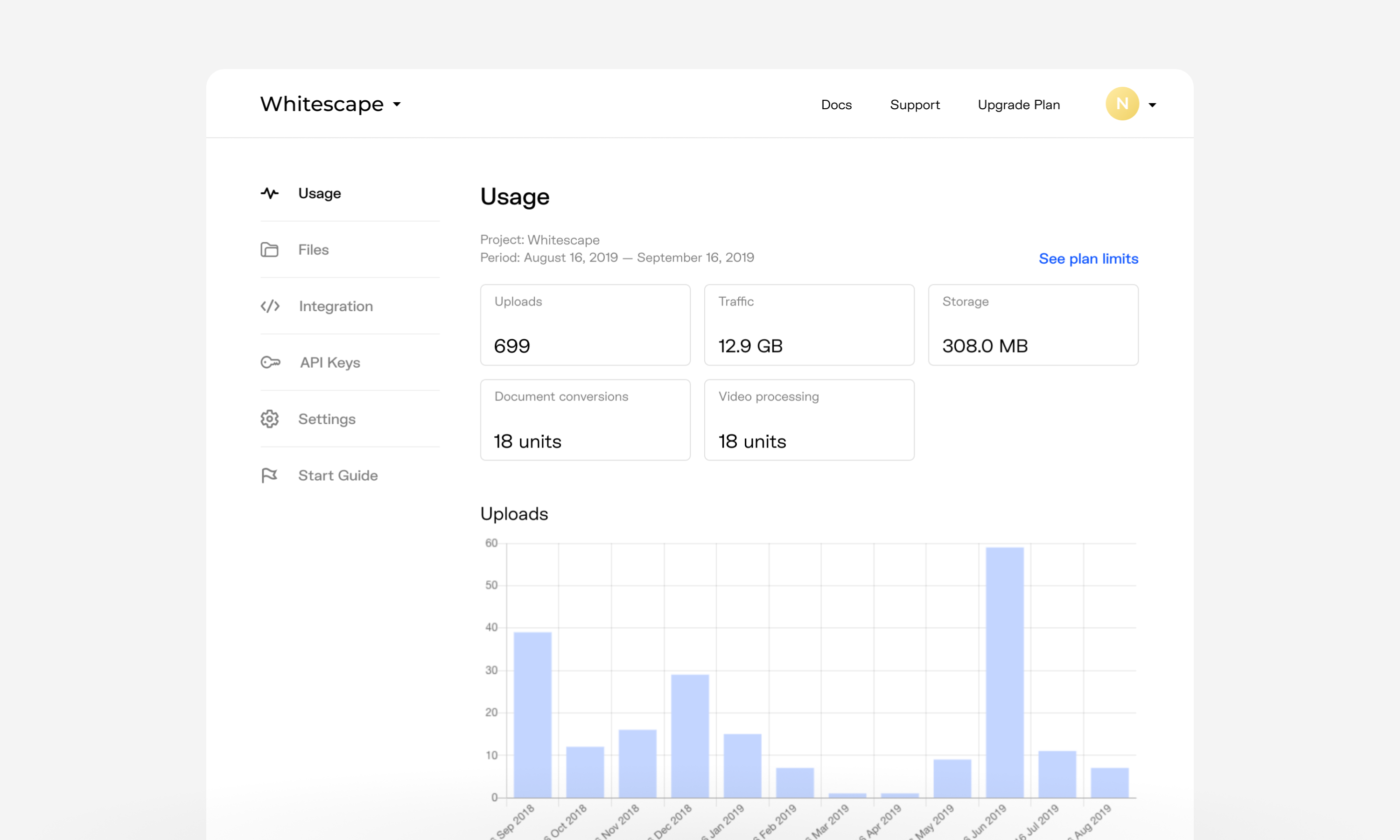
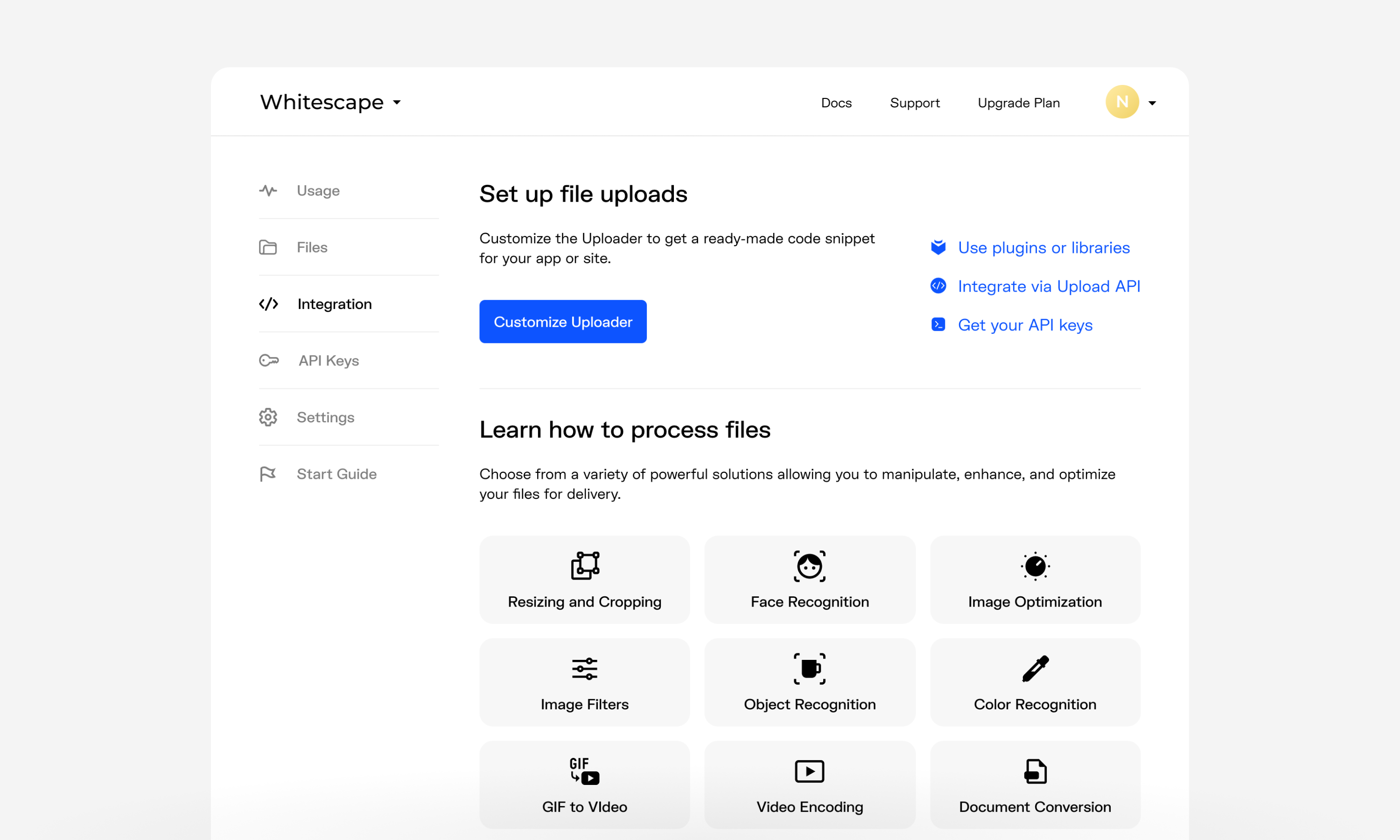
Uploadcare, a startup that aims to make using CDN platforms cheaper and easier for businesses, today announced that it has raised a $1.7 million seed round led by Runa Capital and Vendep Capital, with existing investors Vaizra Capital and LVL1 Group participating as well. Uploadcare promises to offer an end-to-end solution for businesses that automatically optimizes the files, images and videos of its clients and then delivers it over its CDN network or that of its partners.

Uploadcare founder and CEO Igor Debatur told me that the idea for the service started quite a few years ago, while he was running a web development agency. Gathering files in different formats and sizes and then making those available in a way that was secure and easily scalable, often turned out to be a challenge — and one that others in the industry faced as well. In the early days, Uploadcare was basically a file uploader for developers. Over time, Uploadcare added backend features, including the smart CDN that can modify content on the fly based on the client where it’s displayed.

For a while, the team developed Uploadcare as a side project, but by 2016, the project started getting traction and they decided to shut down the development agency and focus solely on building out a proper product. “We started to build out a team and right now, we have more than 1,000 paying customers from very different sizes, starting from SMB to large enterprises using the product,” said Debatur.

Having worked for clients, the team obviously knew how to build products, but it had to figure out sales and marketing on the fly. Unsurprisingly, a lot of today’s new funding will go to exactly that: building out a sales and marketing team. Debatur also argues that unlike some of its competitors, Uploadcare invests a lot in its own technology, though the company does partners with other CDN vendors as well, based on its users’ needs.

“The amount of data that’s created per day is rising at a breakneck rate,” said Dmitry Chikhachev, General Partner at Runa Capital . “With its robust infrastructure of delivery networks that span the globe, Uploadcare has quietly become a go-to solution for developers and engineers at some of the world’s largest companies. With differentiated technology and a strong leadership team, we believe that Uploadcare is well positioned to accelerate its growth and further solidify its leadership in the content delivery market.”

12 Nov 2019

Uploadcare raises $1.7M for its CDN platform

Uploadcare, a startup that aims to make using CDN platforms cheaper and easier for businesses, today announced that it has raised a $1.7 million seed round led by Runa Capital and Vendep Capital, with existing investors Vaizra Capital and LVL1 Group participating as well. Uploadcare promises to offer an end-to-end solution for businesses that automatically optimizes the files, images and videos of its clients and then delivers it over its CDN network or that of its partners.

Uploadcare founder and CEO Igor Debatur told me that the idea for the service started quite a few years ago, while he was running a web development agency. Gathering files in different formats and sizes and then making those available in a way that was secure and easily scalable, often turned out to be a challenge — and one that others in the industry faced as well. In the early days, Uploadcare was basically a file uploader for developers. Over time, Uploadcare added backend features, including the smart CDN that can modify content on the fly based on the client where it’s displayed.

For a while, the team developed Uploadcare as a side project, but by 2016, the project started getting traction and they decided to shut down the development agency and focus solely on building out a proper product. “We started to build out a team and right now, we have more than 1,000 paying customers from very different sizes, starting from SMB to large enterprises using the product,” said Debatur.

Having worked for clients, the team obviously knew how to build products, but it had to figure out sales and marketing on the fly. Unsurprisingly, a lot of today’s new funding will go to exactly that: building out a sales and marketing team. Debatur also argues that unlike some of its competitors, Uploadcare invests a lot in its own technology, though the company does partners with other CDN vendors as well, based on its users’ needs.

“The amount of data that’s created per day is rising at a breakneck rate,” said Dmitry Chikhachev, General Partner at Runa Capital . “With its robust infrastructure of delivery networks that span the globe, Uploadcare has quietly become a go-to solution for developers and engineers at some of the world’s largest companies. With differentiated technology and a strong leadership team, we believe that Uploadcare is well positioned to accelerate its growth and further solidify its leadership in the content delivery market.”