
Category: UNCATEGORIZED

11 Nov 2019

ViacomCBS shakes up its content leadership teams following merger

Following the merger of CBS and Viacom announced earlier this year, the combined company today confirmed its plans to restructure its content and digital leadership teams in order to streamline operations. Among the changes, which were first reported by The Wall St. Journal on Sunday, are the departures of Comedy Central Head Kent Alterman and Viacom Networks COO Sarah Levy. Meanwhile, CBS Chief Creative Officer David Nevins will add BET to his responsibilities, while President of MTV, VH1, CMT, and Logo Chris McCarthy, will now become President of Entertainment & Youth Brands, ViacomCBS Domestic Media Networks.

This will put McCarthy in charge of Comedy Central, Paramount Network, Smithsonian Channel and TV Land brands.

Nevins, in addition to BET, will also oversee CBS Television Studios, the CBS Television Network’s Entertainment division, the Showtime Networks and Pop, The CW, and the programming of streaming service CBS All Access.

In terms of children’s content, Nickelodeon President Brian Robbins will oversee kids and young adult-focused programming as President, Kids & Family Entertainment, ViacomCBS Domestic Media Networks. That puts him back in charge of Awesomeness, which he co-founded and sold to Viacom in 2018, in addition to Nickelodeon, Nick at Nite, Nick Jr., TeenNick, Nicktoons and Nickelodeon Studios.

ViacomCBS also said that Carolyn Kroll Reidy will continue her role as President and Chief Executive Officer of Simon & Schuster, Inc. And Jim Gianopulos will continue as Chairman and Chief Executive Officer of Paramount Pictures, a role that includes oversight of Paramount Animation, Paramount Features, Paramount Players and Paramount TV.

The exec shuffles follow other announcements about the combinations of the two companies’ advertising sales and content distribution teams.

In addition, the company had previously announced Joe Ianniello would serve as Chairman and CEO of CBS, which includes oversight of CBS Television Network (including CBS Entertainment, CBS News, and CBS Sports), CBS Television Studios, CBS Interactive (including CBS All Access) and CBS Television Stations. However, he lost oversight of Showtime and Pop TV to President and CEO of Viacom and ViacomCBS, Bob Bakish.

Also previously reported was that CBS Interactive chief Jim Lanzone had left for Benchmark Capital, to be replaced by Marc DeBevoise. This puts DeBovise in charge of digital operations and reporting to Bakish.

Viacom Digital Studios Kelly Day will continue in her role and report to DeBevoise, the company also said today. And CBS CTO Phil Wiser will become ViacomCBS CTO.

The free streaming service Pluto TV, headed by co-founder Tom Ryan, will report to Bakish. (In news unrelated to the exec changes, Pluto TV announced today it will start streaming music videos from Vevo across 10 new channels.)

These leadership changes are meant to consolidate operations while keeping the production arms of CBS Television Studios and Viacom’s counterpart, Paramount Television, separated, The WSJ said.

Beyond the exec shuffle itself, ViacomCBS also detailed how it plans to maximize its combined assets, on the content from. The company announced this morning it’s putting into place a new “Content Council” that will work to “maximize the use of IP and talent relationships” across the company. The council will be chaired by Nevins and include all the content leaders.

“ViacomCBS will be one of the largest premium content creators in the world, with the capacity to produce content for both our own platforms and for others,” said President and CEO of ViacomCBS Bob Bakish, in a statement. “This talented team of content leaders will work together to ensure we realize the full power of our brands, our deep relationships with the creative community and our intellectual property to drive our growth as a combined company,” he added.

The Viacom-CBS merger is expected to fully close in December.


11 Nov 2019

Stingray-inspired spacecraft could eventually probe the atmosphere of Venus

NASA’s next Venus probe could be an atmosphere-skimming robotic stingray designed by the University of Buffalo. UB’s CRASH Lab, which is the institution’s Crashworthinesss for Aerospace Structures and Hybrids laboratory, has been selected by NASA to get early stage funding as part of a program the agency devised to come up with new and innovative concept designs.

The stringray-style spacecraft design would have ‘wings’ that can flap in the high winds of the upper atmosphere of Venus, according to UB, which would allow controlled flight that’s possible with high efficiency. Using this design, the BREEZE design (as it’s called) would be able to make its way all the way around Venus every four to six days, while powering itself back up every two to three days while spending time on the sun-illuminated side of the planet.

Each ‘day’ on Venus is longer than a year on Earth, because of the way it orbits the Sun. That means that typical spacecraft design wouldn’t necessarily be able to stay afloat and powered in the planet’s atmosphere using existing strategies for propulsion and mobility.

BREEZE is still a long way away from actually dipping in and out of Venusian clouds, but this acknowledgment and award from NASA means it’s one step closer along the path to development.

11 Nov 2019

Alibaba’s Singles’ Day sales top $38 billion

After 24 hours of frenzied buying and selling, and weeks of advertising and promotions before it, the Alibaba Group said today its sales hit another record high on Singles’ Day, the biggest shopping day on the planet.

The Chinese e-commerce giant said its 11th Singles’ Day event sold goods worth 268 billion yuan, or $38.3 billion, easily exceeding last year’s record $30.7 billion haul. Electronics gadgets and fashion items were among the most sold goods this year, company executives said.

More than half a billion people from a number of countries participate in the event, which is China’s equivalent to Black Friday and Cyber Monday. Except, Singles’ Day is much larger. The five-day Black Friday clocked under $25 billion in sales last year. Alibaba Group said earlier today that it had netted its first $1 billion in sales this year in just 68 seconds.

The shopping glitz hosted a number of celebrities including Taylor Swift and Asian pop icon GEM to generate buzz. This year, the Hangzhou-headquartered firm has also focused on live-streaming via its platform, a phenomenon that has gained significant traction in China.

In a live stream, Kim Kardashian announced last week that her fragrance brand KKW will be sold on Tmall this Singles’ Day.

One figure who was missing from the action was Jack Ma, the founder of Alibaba Group, who retired in September this year. In previous years, Ma has not only just delivered speech but also put on performances for employees and customers.

At a press briefing an hour ago, Alibaba Chief Technology Officer Jeff Zhang described 11.11 as an “airplane flying at turbo speed,” adding that the company has been improving the supposed engine for years.

One such improvement is logistics network, which is still a laggard for the technology giant. Last week, Alibaba Group announced it was investing an additional $3.3 billion in logistics unit Cainiao, which it co-founded with a number of other companies six years ago.

11 Nov 2019

Twitter drafts a deepfake policy that would label and warn, but not always remove, manipulated media

Twitter last month said it was introducing a new policy to help fight deepfakes and other “manipulated media” that involve photos, videos, or audio that’s been significantly altered to change its original meaning or purpose, or those that make it seem like something happened that actually did not. Today, Twitter is sharing a draft of its new policy and opening it up for public input before it goes live.

The policy is meant to address the growing problem with deepfakes on today’s internet.

Deepfakes have proliferated thanks to advances made in artificial intelligence that have made it easier to produce convincing fake videos, audio, and other digital content. Anyone with a computer and internet connection can now create this sort of fake media. The technology can be dangerous when used as propaganda, or to make someone believe something is real which is not. In politics, deepfakes can be used to undermine a candidate’s reputation, by making them say and do things they never said or did.

A deepfake of Facebook CEO Mark Zuckerberg went viral earlier this year, after Facebook refused to pull down a doctored video that showed House Speaker Nancy Pelosi stumbling over her words was tweeted by Trump.

In early October, two members of the Senate Intelligence Committee, Mark Warner (D-VA) and Marco Rubio (R-FL), called on major tech companies to develop a plan to combat deepfakes on their platforms. The senators asked 11 tech companies — including Facebook, Twitter, YouTube, Reddit, and LinkedIn — to come up with a plan to develop industry standards for “sharing, removing, archiving, and confronting the sharing of synthetic content as soon as possible.”

Twitter later in the month announced its plans to seek public feedback on the policy. Meanwhile, Amazon joined up with Facebook, Microsoft to support the DeepFake Detection challenge (DFDC) which aims to develop new approaches to detect manipulated media.

Today, Twitter is detailing a draft of its deepfakes policy. The company says that when it sees synthetic or manipulated media that’s intentionally trying to mislead or confuse people it will:

  • place a notice next to Tweets that share synthetic or manipulated media;
  • warn people before they share or like Tweets with synthetic or manipulated media; or
  • add a link – for example, to a news article or Twitter Moment – so that people can read more about why various sources believe the media is synthetic or manipulated.

Twitter says if the deepfakes could also threaten someone’s physical safety or lead to serious harm, it may also remove it.

The company is accepting feedback by way of a survey as well as on Twitter itself, by way of the #TwitterPolicyFeedback hashtag.

The survey asks questions like whether altered photos and videos should be removed entirely, have warning labels, or not be removed at all. And it asks whether certain actions are acceptable, like hiding tweets or alerting people if they’re about to share a deepfake. It also asks when it should remove a tweet with misleading media. The policy Twitter created says tweets will be removed if the tweet if it threatens someone’s physical safety, but will otherwise be labeled. The survey suggests some other times a tweet could be pulled — like if it threatens someone’s mental health, privacy, dignity, property, and more.

The survey takes 5 minutes to complete and is available in English, Japanese, Portuguese, Arabic, Hindi, and Spanish.

What isn’t clear, however, is how Twitter will be able to detect the deepfakes published on its platform, given that detection techniques aren’t perfect and often lag behind the newer and more advanced creation methods. On this front, Twitter invites those who want to partner with it on detection solutions to fill out a form.

Twitter is accepting feedback on its deepfakes policy from now until Wednesday, Nov. 27 at 11:59 p.m. GMT. At that time, it will review the feedback received and make adjustments to the policy, as needed. The policy will then be incorporated into Twitter’s Rules with a 30-day notice before the change goes live.


11 Nov 2019

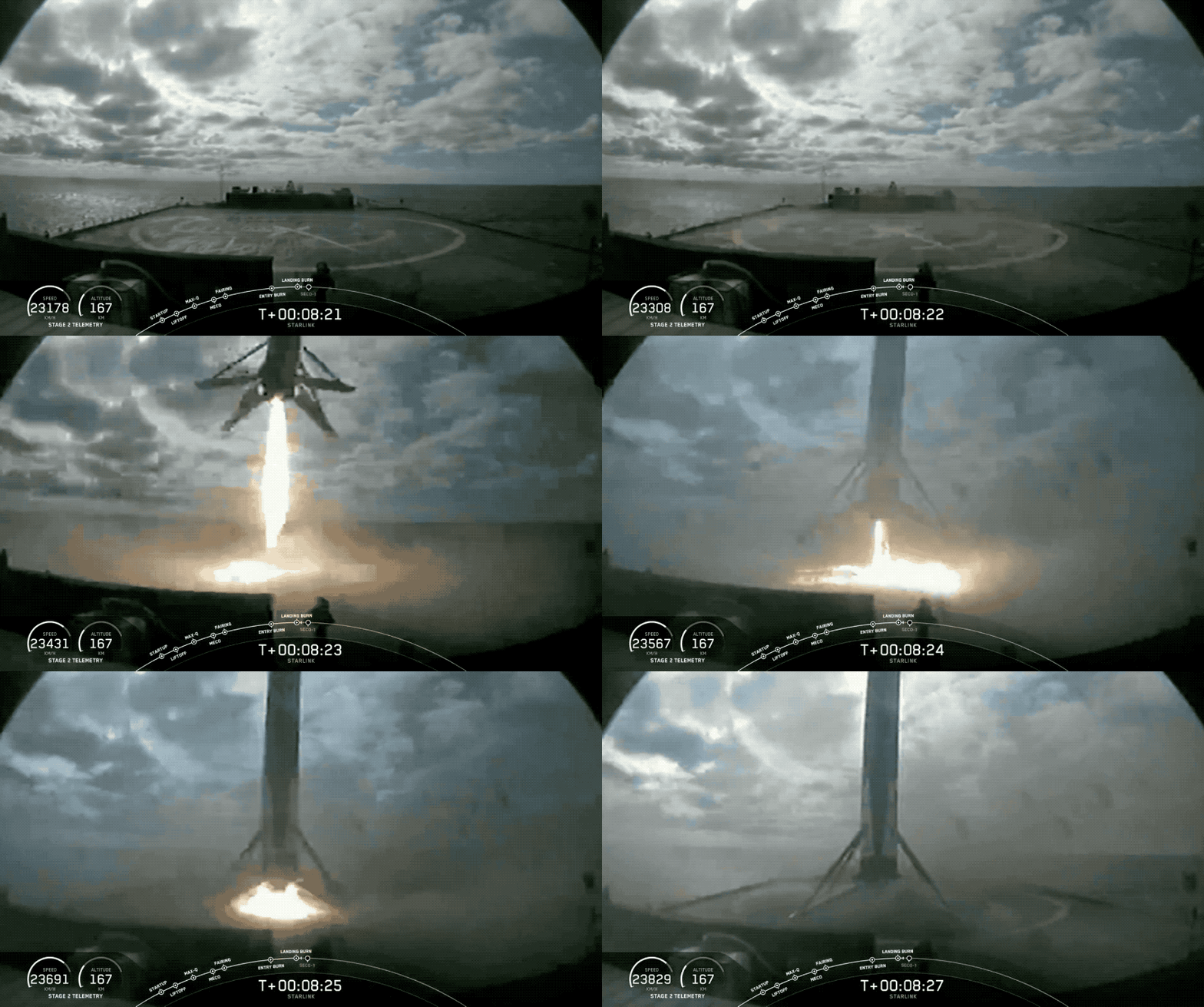
SpaceX launches re-flown fairing for the first time and breaks a Falcon 9 booster re-use record

SpaceX has successfully launched its first batch of production Starlink satellites today, sending 60 of the small satellites to their target orbit aboard a Falcon 9 rocket. These 60 satellites follow 60 launched in May, but whereas those, and two launched last year, were for testing purposes, this new batch is the first in a series of launches that will ready the constellation for providing internet service to consumers.

The launch took place at Cape Canaveral in Florida, and the Falcon 9 rocket used included a booster stage that has flown not once, not twice – but three times previously. This is its fourth use, which is a record for SpaceX . What’s more, SpaceX recovered the booster via controlled landing on its seafaring drone ship “Of Course I Still Love You” in the Atlantic Ocean, which means it’s possible the booster could be turned around and re-used still another time – they’re designed to support up to 10 flights in total.

That’s not the only record for this launch, and for SpaceX’s re-usable rocketry program in general: This flight used a previously flown fairing for the first time ever (for any rocket company) during this mission. This fairing was flown during the Falcon Heavy Arabsat-6A mission that happened in April. Re-flying the fairing could save SpaceX around $6 million per launch, per estimates CEO Elon Musk has previously shared.

SpaceX had also originally sought to recover the fairing, or protective covering used to shield the payload of Starlink satellites on its way out of Earth’s atmosphere.  The plan was to catch both halves using ocean-based catcher ships designed for the purpose, dubbed ‘Ms. Tree’ and ‘Ms. Chief,’ but conditions rendered that attempt impossible for this particular launch.

As for Starlink, SpaceX is looking to as many as tens of thousands of satellites to populate its broadband-beaming connectivity network. The goal is to operate a global constellation that provides connectivity via orbital satellites handing off connections to one another as they circle the globe – a different approach from current geostationary satellite connectivity, in which few large satellites essentially sit over one part of the Earth and provide connections just to that region.

Elon Musk tweeted earlier this year using a connection provided by a Starlink satellite for the first time, and the company aims to launch service for customers in the U.S. and Canada following six total launches of Starlink satellites like this one, with service expanding globally after a planned 24 similar launches.

Developing…


11 Nov 2019

OpenText buys data backup firm Carbonite for $1.42B

Carbonite has agreed to a $1.42 billion purchase by OpenText, an enterprise information management giant, ending weeks of speculation about the anticipated buyout.

The deal marks a 78% premium on Carbonite’s share price on September 5, when it was first rumored the company was preparing to buy the backup and data recovery company. Carbonite said the board “strongly believes” the deal will return “substantial” cash value to shareholders, said Steve Munford, chairman of Carbonite’s board.

It ends a busy couple of years for Carbonite as the company has moved away from a traditional data backup business to a more proactive, defensive security company.

In February, Carbonite bought endpoint security company Webroot for $618.5 million in an all-cash deal, as the company pushed to protect against emerging threats like ransomware. Only a year earlier, Carbonite bought Mozy for $145 million, a cloud backup service.

Carbonite said at the time of its acquisition by OpenText, the backup company had losses of $14 million on revenues of $125.6 billion, an increase by 62% year-over-year.

Wall Street was expecting average revenues of $131.5 million.

11 Nov 2019

Watch live as SpaceX launches 60 Starlink satellites with a thrice-flown Falcon 9 rocket

SpaceX has a big launch coming up this morning from Cape Canaveral in Florida – a Falcon 9 will carry a payload of 60 of its Starlink orbital communications satellites to space at 9:56 AM ET (6:56 AM PT). The Starlink satellites are the first non-test group of SpaceX’s new constellation heading up en masse, with the aim of helping set up a network that will eventually provide global high-speed Internet connectivity.

SpaceX has already sent up 62 Starlink satellites in total, across two test batch launches: Two launched in February 2018 from Vandenberg in California, aboard a rocket that was also transporting a satellite called ‘Paz’ for a client, and 60 launched in May of this year, a large test batch that was used to trial ground-based communications, as well as controlled de-orbiting mechanisms. Of those 60, 57 satellites are still in orbit while 3 became non-operational after launch.

This mission will set up this new batch of 60 Starlink satellites in orbit, which feature increase spectrum capacity and construction that features 100% “demisability,” which means that at the end of their operating life they’ll burn up completely upon controlled re-entry to ensure there’s nothing left behind once they’re no longer in use. This is one of six launches of Starlink satellites that SpaceX says will lead up to the launch of its service across the U.S. and Canada, and one of 24 launches that will enable global high-bandwidth broadband service.

Besides setting up the foundation for its global satellite internet network, this launch is noteworthy from the perspective of SpaceX’s focus on re-usability. The first stage for the Falcon 9 used here previously flew on three separate missions, a record for a Falcon 9 booster in terms of re-use, and the fairing used to protect the payload also flew before on the Falcon Heavy Arabsat-6A mission launched earlier this year. SpaceX also plans to land the booster again, and it will attempt to recover the fairing once again using its sea-borne catcher vessels in the Atlantic.

The launch window at 9:56 AM ET is instantaneous, and SpaceX should begin broadcasting the live stream above about 15 minutes prior to that.

11 Nov 2019

OLX Group invests up to $400M in used car marketplace Frontier Car Group at $700M valuation

Frontier Car Group, the Berlin-based startup building used-car marketplaces targeting high-growth, emerging markets, has picked up another significant round of funding from a strategic backer also focusing on the same geographical opportunity.

Today, OLX, the online classifieds division Prosus (the digital division of Naspers that listed earlier this year in Europe) announced that it would invest up to $400 million in Frontier, in a mix of equity, secondary share acquisitions and existing business shares. The deal will include a primary capital injection of an unspecified amount, which OLX has confirmed to me values Frontier Car Group at $700 million, post-money.

In terms of business shares: OLX also said that it will be contributing its shares in a JV it had in place with Frontier in India and Poland. Meanwhile, the secondary acquisitions — the shares are currently held by other investors, founders and management — are subject to a tender process. The markets that Frontier operates in now include Nigeria, Mexico, Chile, Pakistan, and Indonesia, and the USA (where it acquired WeBuyAnyCar last year) in addition to India and Poland.

Notably, even before the full $400 million amount is exercised (that is, after the tender process is completed), an OLX spokesperson confirmed that first capital injection will make it Frontier’s largest single shareholder (but not the majority shareholder), which essentially values the deal at less than $350 million (based on the $700 million valuation).

Today, Frontier Car Group offers buyers and sellers a range of services: in addition to basic inventory listings, there are inspection reports, financial, pricing guides, warranties and insurance. The plan will be to expand more services for one of the key players in the used-car space, dealers — via Frontier’s Dealer Management System — more resale services (via OLX), and more CarFax/Blue Book-style pricing guides and other products.

It’s not clear how big the business is today (we’re asking) but as a point of reference, in May of last year, when the company raised $58 million, it had sold 50,000 cars to date and was on track for $200 million in annualised revenues, and CEO and cofounder Sujay Tyle says the company has been on a growth tear.

“FCG has nearly tripled performance across every key metric since the first OLX Group investment less than 18 months ago and has expanded to four new countries in that time,” said Sujay Tyle, the co-founder and CEO, in a statement. “This is a testament to FCG’s team, the ripe market opportunity, and the results of early integration with OLX in our key markets. Together with OLX and Prosus, we are aiming to revolutionize the used car market in several emerging and developed economies by adding trust, transparency and a comprehensive suite of services to all participants in the ecosystem.”

“Together with FCG, we are aiming to build the leading global used car marketplace, offering a premium and convenient service to millions of car buyers, sellers and dealers,” said Martin Scheepbouwer, CEO of OLX Group. “We’re in a unique position to accelerate the expansion of this platform worldwide. Our experience in India is a great proof of concept, where within the space of a year, our joint venture has already increased the number of stores threefold, with car purchase volumes continuing to grow by 10% month-on-month.”

This is the second time that OLX has invested in Frontier: in May 2018, Naspers had invested $89 million in the business, an investment that came just weeks after Frontier had raised $58 million from Balderton, TPG and others.

The deal underscores the longtime trend of consolidation in e-commerce businesses — something Prosus is also seeing played out in a completely different arena, that of food delivery.

The basics of the economy-of-scale principle, as applied to used car sales, goes something like this: economies of scale makes a platform more useful (there will be more cars on it, and less on competitors’ sites); but it also potentially means that Frontier would be making more transactions, thereby more revenues overall; and building and running more sales on the same platform improves the margins on the investment that gets made in building and operating that platform.

Targeting P2P used car sales in emerging markets is a big potential business: in part because of the nature of those economies, car owners are more likely to sweat out assets rather than go for buying completely new vehicles. OLX notes that combining the operations in Frontier’s footprint with those of the JV businesses that it is now taking over, plus OLX’s own business in Latin America, Asia and Poland, results in a market where some 30 million used cars are sold annually, “more than double that of China.”

11 Nov 2019

Prosus makes $6.3B hostile bid for Just Eat; Just Eat rejects deal in favor of Takeaway merger

As Amazon-backed Deliveroo expands into click-and-collect and procurement services to grow its footprint with restaurants in Europe, a food fight among three other takeout and delivery players continues apace in an ongoing consolidation march to compete better against the likes not just of Deliveroo but also Uber Eats and more.

Today, Prosus — the recently-listed arm of Naspers comprising its extensive online assets (including a significant stake in Tencent) — said that it would be willing to pay £4.9 billion ($6.3 billion) in cash for Just Eat, one of the big players in the food takeout and delivery market in Europe. The bid is a hostile one: Just Eat has been in the middle of working on a combination with Takeaway.com, another large competitor in the market; and today Just Eat wasted no time in asking its shareholders to reject the Prosus offer.

“The Board believes that Just Eat is a leading strategic asset in the food delivery sector and the Prosus Offer fails to appropriately reflect the quality of Just Eat and its attractive assets and prospects, the benefits of first mover advantage in a consolidating sector, and the significant future upside available to Just Eat shareholders through remaining invested in Just Eat and the Takeaway.com Combination,” it noted in a statement. “The Board of Just Eat believes that the Takeaway.com Combination is based on a compelling strategic rationale that will deliver a number of strategic benefits and greater value creation to Just Eat shareholders than the terms of the Prosus Offer. Accordingly, the Board of Just Eat continues to unanimously recommend the Takeaway.com Combination to Just Eat shareholders.”

Prosus’ offer, which works out to 710 pence per Just Eat Share, is 20% higher than Takeaway.com’s offer of 594 pence (which itself was at a premium to Just Eat’s share price).

The Takeaway offer has been months in the making and has had a number of twists and turns. The first announcement for a $10 billion merger was made in July, but in the interim Prosus made its first hostile offer, and so the deal switched to a takeover this month in hopes of securing shareholder agreement faster.

At stake for all players is the fact that the delivery business continues to be a fast-growing but very crowded field, with a number of players operating unprofitably and hoping for consolidation in order to improve their economies of scale and margins. If economies of scale and better margins is the rock, the competition is the hard place: all three have a strong and very highly capitalised set of a pair of competitors in the form of Uber Eats and Amazon-backed Deliveroo, with a number of smaller but also fast growing startups continuing to crowd the field.

Just Eat and Takeaway.com have already done some consolidating of other operations. The latter two have gobbled up different parts of DeliveryHero’s European business in recent times. Prosus, meanwhile, has a 22% stake in the remaining DeliveryHero business (outside of Europe), alongside stakes in India’s Swiggy and iFood in Latin America. This would mean that Prosus taking over Just Eat would be less about consolidation of European holdings, which could be one reason why Just Eat is less keen on the idea.

Takeaway.com has also issued a response to the news, noting that it’s the only one of the three that has working on building profitability into the business: it’s currently profitable in the Netherlands, its home market, and is on track to getting there in Germany (a track it believes it can continue with more scale).

“Given the circumstances, I can fully understand that the current cash values of both our and the competing offer aren’t particularly appealing to the Just Eat shareholders, and seem to be quite far removed from the fair value of Just Eat. We do however believe that the agreed merger ratio between Just Eat and Takeaway.com is appropriate,” noted Jitse Groen, CEO of Takeaway.com, in a statement. “Takeaway.com now operates in two out of the world’s four major profit pools. Including the UK, the Just Eat Takeaway.com combination will therefore operate in three out of the four major profit pools globally available. This in stark contrast with most other food delivery websites, which are loss-making, and in our opinion, will likely never become profitable.”

It seems that Naspers’ Prosus says that this is its last and final offer for Just Eat, but this is unlikely to be the final word on how food delivery and takeout will play out in Europe (or globally).

The market is still largely operating in the red globally — and even the most established players, like GrubHub, are not seeing much stability. And with about half a dozen giant players operating in different markets, and lots of capital riding on each of them, we’ll be seeing a number of deals and product expansions — for example the emergence of more “virtual” kitchens other added services such as restaurant procurement — before it’s all gravy for this industry.

11 Nov 2019

Deliveroo launches food orders for pick up

Don’t Deliveroo . The UK-based on-demand food delivery service has expanded into not actually delivering orders by offering users a pick-up option, called ‘Pickup’, as an alternative to paying a delivery fee and waiting in for lunch to arrive.

The new ‘click & collection’ service is live for 700+ eateries in 13 UK cities at launch: Aberdeen, Birmingham, Cardiff, Glasgow, Leeds, Liverpool, London, Manchester, Milton Keynes, Newcastle, Norwich, Nottingham and Edinburgh (Old Town). Restaurant brands signed up in the first wave include Byron, Pizza Express, Pizza Hut, TGI Friday’s, Frankie & Benny’s, Chiquito, Coast to Coast and Giraffe.

Deliveroo says it expects the pick-up service to grow rapidly, reckoning more than 10,000 restaurants will be offering it within the next 12 months — and doing so across the 200 UK towns and cities in which it currently operates. Albeit that’s just a prediction at this stage.

It’s not clear whether it also plans to add the ‘Pickup’ option in its international markets. (We’ve asked and will update if we get more.)

Deliveroo says the pick-up option is intended to widen customer choice with a cheaper option for users willing to collect a meal, potentially helping it to take a bite out of lunch money that could otherwise be spent at a supermarket.

At the same time it’s a way for the company to expand the order pipeline for restaurants that are signed up to its service — and in this scenario it’s acting merely as an ordering layer (but still taking a commission).

While customers picking up their own meals provides an additional revenue stream for Deliveroo’s platform that’s free from any legal or ethical risk attached to the employment status (and/or working conditions) of delivery couriers operating on its platform.

The pick-up option launch is the latest addition to a suite of b2b offerings Deliveroo serves up for signed up eateries.

These include a food procurement service; savings (badged as ‘perks’) on everyday business costs such as energy; a data service to support restaurant expansion; and ‘virtual brands’ — using demand data to feed new or complementary cuisines being offered from a restaurant’s existing kitchen.

Deliveroo says it expects growth for its business to step up sharply — anticipating signing up another 10,000 restaurants in the UK over the next 6 months, which would take the total it’s working with to 30,000.

Right now it operates in 500+ towns and cities across 13 markets in all, including Australia, Belgium, France, Hong Kong, Italy, Ireland, Netherlands, Singapore, Spain, Taiwan, United Arab Emirates, Kuwait as well as its home market of the UK.

Despite Deliveroo’s bullish talk of scaling in the UK, the food delivery space remains highly competitive in many global markets. And this summer the company announced it was exiting the German market, saying it would refocus resources and investment to accelerate growth and expansion in other markets across Europe and APAC.

In Europe consolidation has been the name of the recent game — with dominant platforms under pressure to increase choice and service offering to try to maintain an edge in key markets. So fast scaling in one market may be at the expense of any business at all in another.

Expansion into adjacent delivery markets is another strategy we’re seeing from regional on-demand delivery startups. For example Spain’s Glovo, which focuses on Southern and Eastern Europe, is working on a ‘dark supermarkets’ model to fuel high speed local grocery deliveries, while also dabbling in regional expansion on the food delivery front, with a major push (via acquisition) into Poland.