Category: UNCATEGORIZED

07 Nov 2019

MIT develops a robot that can grow like a plant when it needs some extra reach

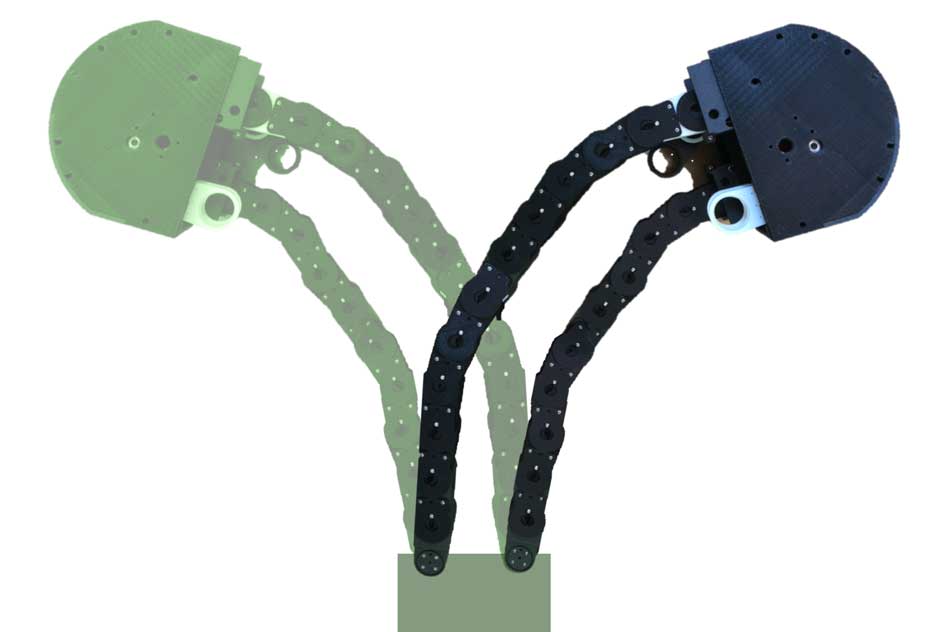
MIT has developed a new kind of robot that can essentially extend itself – ‘growing’ in a way that’s surprisingly similar to how a young plant grows upwards. The way researchers accomplished this uses a robot that is crucially not a soft robot, which means that it can both extend itself to reach up to a previously unreachable height, or through a gap to a hard-to-get-at area, while also retaining the rigidity and strength necessary to support a gripper or other mechanism on its tip and do work like tighten a bolt, or manipulate a handle.

This new robot solves a fairly common challenge for industrial and commercial robots, which is reaching into tight spaces or navigating cluttered parts of factories or warehouses. Most robots that are in service in industry today essentially need a wide open space to operate, and factory layouts are designed to provide these to accommodate them. They’re also essentially fixed in terms of their dimensions: It’s rare to find a robot that can truly morph to meet the needs of different tasks.

As mentioned, soft robotics has done some work in addressing the fixed nature of existing robots, but to date, not much that’s been done with soft robotics can also accommodate the need for robots to work with what are called in robotics “end effectors,” or at least the variety that includes grippers and heavy duty cameras or sensors, which tend to have a significant weight and require a stable platform from which to operate.

MIT’s robot solves this using a chain-like apparatus, not too different from a bicycle chain. The difference is that its links are interlocking blocks that can ‘lock’ into one another to form a rigid column, and then ‘unlock’ to return to a flexible state. This means a robot could pack this chain-like appendage, loose in a container, drive across a factory floor to a bit of machinery, and then extend a growing ‘arm’ inside the machinery where it otherwise wouldn’t be able to reach to manipulate a control, or to point a sensor to check for damage, for instance.

Roboticists have termed this the ‘last foot’ problem – similar in nature to the ‘last mile’ in transportation, since it involves going from a wide, relatively easy to access space to a more difficult to reach area. In autonomous vehicles, that might be getting from the curb to a person’s doorstep. In industrial robotics, it’s about going from working out in the open to working in tight, confined spaces.

Unlocking this kind of flexibility for industrial robotics could go a long way to opening up entirely new and more varied applications of robots on the job, so the development of these kinds of ‘grobots’ definitely has plenty of potential outside the lab.

07 Nov 2019

Capital One replaces security chief after data breach

Capital One has replaced its cybersecurity chief, four months after the company disclosed a massive data breach involving the theft of sensitive data on more than 100 million customers.

A spokesperson for Capital One confirmed the news in an email to TechCrunch.

“Michael Johnson is moving from his role as chief information security officer to serve as senior vice president and special advisor dedicated to cyber security,” said the spokesperson.

Mike Eason, who served as chief information officer for its commercial banking, has replaced Johnson as interim cybersecurity chief while a permanent replacement is found.

The Wall Street Journal first reported the news.

Capital One is continuing to assess the aftermath from its July data breach, which saw a hacker take millions of credit card application data between 2005 and 2019 from customers applying for credit cards. The data leaked also includes names, addresses, postal addresses, phone numbers, email addresses, dates of birth, and self-reported income, as well as credit scores, and credit limits.

Paige Thompson, a Seattle resident, was taken into custody by the FBI following the disclosure, accused of breaking into the banking giant’s cloud-based environment. Subsequent research showed that the alleged hacker and former Amazon Web Services employee, may have obtained sensitive corporate data on other companies, including Vodafone, Ford, and Ohio’s Department of Transportation.

It was reported this week that Thompson would be released from custody, pending trial.

07 Nov 2019

Capital One replaces security chief after data breach

Capital One has replaced its cybersecurity chief, four months after the company disclosed a massive data breach involving the theft of sensitive data on more than 100 million customers.

A spokesperson for Capital One confirmed the news in an email to TechCrunch.

“Michael Johnson is moving from his role as chief information security officer to serve as senior vice president and special advisor dedicated to cyber security,” said the spokesperson.

Mike Eason, who served as chief information officer for its commercial banking, has replaced Johnson as interim cybersecurity chief while a permanent replacement is found.

The Wall Street Journal first reported the news.

Capital One is continuing to assess the aftermath from its July data breach, which saw a hacker take millions of credit card application data between 2005 and 2019 from customers applying for credit cards. The data leaked also includes names, addresses, postal addresses, phone numbers, email addresses, dates of birth, and self-reported income, as well as credit scores, and credit limits.

Paige Thompson, a Seattle resident, was taken into custody by the FBI following the disclosure, accused of breaking into the banking giant’s cloud-based environment. Subsequent research showed that the alleged hacker and former Amazon Web Services employee, may have obtained sensitive corporate data on other companies, including Vodafone, Ford, and Ohio’s Department of Transportation.

It was reported this week that Thompson would be released from custody, pending trial.

07 Nov 2019

Spotify’s podcasting app Anchor now helps you make trailers

Spotify’s simple podcasting suite, Anchor, is today introducing a new feature designed to help creators promote their podcast: trailers. On the Anchor app for iOS and Android, podcasters will now be able to create a dedicated trailer for their podcast that combines an introduction and some background music, then turns it into an animated video that can be shared across social media and the wider web.

The trailer will also be made available within the podcast’s RSS feed, where it’s marked with the “trailer” episode type.

Anchor had already offered a way for users to mark episodes of their podcast as a trailer within the app, but the new feature makes it simpler to create a trailer through a more integrated experience.

For example, when you push the button to record, you have one minute to introduce your podcast — and a warning will flash when that minute is about to be up. When you’re satisfied with the recording, you can then browse through Anchor free library of background music, which is organized by mood — like adventurous, calm, dramatic, cheerful, energetic, funky, chill, etc. Or you can opt to go without music, if you prefer.

And if you already have a voice recording saved elsewhere, you can import it into Anchor to use as your trailer.

There are other options today for creating podcast trailers, like those from services like Wavve, Headliner, or Audiogram, for example. But Anchor’s goal is to be the one-stop-shop for everything a new podcaster needs to get started, and that includes promotional tools like this.

However, many professional podcasters still view Anchor as a sort of entry-level product and turn to more advanced audio editing suites to craft their shows. But over time, these extra, handy features could help Anchor to earn a place in podcaster’s workflow, even if it’s not their end-to-end solution.

Podcasting has become an important vertical for Anchor’s parent company Spotify, which led to it acquiring both Anchor and Gimlet earlier this year for $340 million. And its investments in podcasts, which have also included the acquisition of podcast network Parcast, have been starting to pay off.

The company reported in July its podcast audience had doubled in size since last year. In October, it said the number of podcast listeners on its service grew 40% from the prior quarter, and it now had 500,000 titles hosted on its platform.

Spotify can monetize podcasts in two ways, as with music — through ads and by pushing people into premium subscriptions. It now has 113 million paying customers and 248 million monthly actives. And once Spotify’s users are subscribed to a number of podcast shows, they’re more likely to stay with the service. In addition, podcasts don’t come with the licensing costs associated with record label deals, which Spotify also surely likes.

Anchor’s new trailers feature is live now on both iOS and Android.


07 Nov 2019

YouTube’s homepage redesign focuses on usability, giving you control over recommendations

YouTube’s homepage is getting a makeover. The company announced today an updated, cleaner design that does away with information density to instead give more room to the videos and their titles, plus other new features like an “Add to Queue” option on the desktop, a desktop version of YouTube’s stop suggesting feature, and more.

The design changes rolling out today are focused on the desktop and tablet versions of YouTube, not the YouTube mobile website or app, the company says.

Google, as of late, has been doing away with tighter, more compact displays of text and imagery in its products, allowing the content itself to have more room to breathe. For example, the makeover of the Google News in Search spread out news articles into cards, instead of more compressed groupings of headlines. These sorts of changes benefit readability, but they also mean there’s less content visible on the page before you have to scroll down.

The same now goes for YouTube.

In the updated design, there are fewer videos per row as YouTube is allowing for longer video titles and larger video thumbnails, which makes it easier to see what the video is about.

It’s also adding higher resolution previews and is giving more space to the channel icons beneath each video, so you can quickly identify those from your favorite creators.

These changes will impact the homepage’s layout, to some extent.

YouTube says it’s removing some of the content shelves — those areas where it organizes videos by channels and topics. The new homepage will still show some of these same videos, but they won’t be grouped into these shelves anymore. Instead, YouTube’s new design shows videos in shelves like Breaking News and Top News, when it makes sense.

Meanwhile, YouTube is bringing its “Add to queue” option to the desktop. Now, you’ll be able to click on a button on the video thumbnail to either add the video to your Watch Later list, as you can today, or now, to your queue.

You can also do this while still watching a video that’s been minimized to the corner of the page.

Queues are a useful way of quickly building out a playlist on the fly, but they aren’t meant to take the place of a proper playlist — that is, they’re not meant to be saved for later viewing once the queue is complete. YouTube says its desktop queue clears when you close your browser. That means if you want to save videos for viewing across devices, you’ll still want to use the “Watch Later” button as before.

Another new feature is one that’s making the jump from mobile to desktop.

Earlier this year, YouTube had rolled out a series of changes that allowed users to gain more control over what videos were appearing on their homepage and in their Up Next suggestions, which is powered by algorithms. It introduced a “stop suggesting” feature in the form of a button that would allow you to stop being shown videos from a particular channel.

Now that same “Don’t recommend channel” option will be available on the desktop.

You’ll find it on the three-dot menu next to a video on the homepage. Once clicked, that channel’s videos won’t hit your YouTube homepage again. However, this is not a full “block” button — the videos can still come up in search, the Trending tab, or if you visit the channel directly.

Also earlier this year, the YouTube Android app was updated with a new feature that allowed users to select their favorite topics and customize their Home feed with related videos.

This same feature will make its way to desktop and tablets in the near future, but isn’t ready in time for today’s launch.

All the changes today are a big boost for readability and usability, though for some creators they may also be a double-edged sword. On the one hand, creators’ videos are being given more real estate on the homepage and their own branding is larger. But on the other, the decreased homepage density means there are fewer spots available to showcase videos before viewers have to scroll down.

The latter changes focused on allowing users more direct input into what videos are shown to them arrive at a time when YouTube has come under pressure, along with other social media companies, for helping to spread hate speech and disinformation by way of algorithms that continually adapt to display more of people want, no matter how terrible.

To what extent YouTube is culpable is being heavily debated. Contrary to earlier reports, one newer study indicated that it’s not so much the algorithm that radicalizes people, but rather the active communities they find online. But it’s a complex issue. And those who have extricated themselves from dark YouTube rabbit holes point to a variety of factors that led them astray — feeling of isolation, depression, and not knowing one’s place in the world, for example, combined with video recommendations that invite them deeper into ever more extremist online communities.

YouTube’s response has so far been to stand by free speech (at least to some extent), while also giving users more tools to make decisions for themselves — like the changes mentioned above.

This sentiment of “if you don’t like it, just don’t watch it” (now by way of an algorithm-override button) isn’t unique to YouTube. These days, it’s common to see people respond to others who are getting angry on Facebook threads by telling them to “just keep scrolling.” In other words, there’s a growing sense that people will have to take personal responsibility to navigate today’s web, as filled as it is with things that a large majority doesn’t want to see.

YouTube says its updated design will begin rolling out today across desktops and YouTube apps on Android and iOS tablets, and will reach everyone soon.


07 Nov 2019

WhatsApp’s latest feature, Catalogs, caters to small businesses skipping the web for mobile

WhatsApp is expanding the capabilities of its dedicated app for business owners who want to reach their customers on smartphones. The Facebook-owned company is today introducing a new “catalogs” feature to the WhatsApp Business app that will allow the businesses to showcase and share their products and services to potential customers, who can browse photos, view prices, and read product descriptions to help inform their purchase decisions.

These catalogs effectively serve as a mobile storefront on WhatsApp — and one that can be operated without the need for a web page at all. Instead, the business owner simply visits the new Catalog option in their app’s settings and uploads photos of whatever is they’re selling and fill out the details which can optionally include a product or service code (e.g. a SKU), if need be.

These catalog items can then be sent to customers in a WhatsApp chat message. For example, if a customer asks about a particular item or for a recommendation, the business owner can tap to send a particular item from their catalog that includes all the information the customer wants to know.

The catalogs are particularly appealing to WhatsApp’s customer base in emerging markets, where much of users’ online activity is taking place inside apps instead of on the wider web. As new users come online in these regions, they’re often skipping the PC revolution entirely and going straight to smartphones instead.

Already, the WhatsApp Business app is claiming a portion of that market. Earlier this year, the company said the app had reached some 5 million business customers.

The Catalogs feature today joins several others designed with the needs of businesses in mind, including business profiles, quick replies for messages, chat labels, and automated messages.

WhatsApp says the new feature is available to businesses using the WhatsApp Business app on both Android and iPhone in Brazil, Germany, India, Indonesia, Mexico, the U.K., and the U.S., for the time being. It will roll out to other worldwide markets “soon,” but didn’t offer a more exact launch time frame.

07 Nov 2019

AWS announces new savings plans to reduce complexity of reserved instances

Reserved instances (RIs) have provided a mechanism for companies, who expect to use a certain level of AWS infrastructure resources, to get some cost certainty, but as AWS’s Jeff Barr points out they are on the complex side. To fix that, the company announced a new method called Savings Plans.

“Today we are launching Savings Plans, a new and flexible discount model that provides you with the same discounts as RIs, in exchange for a commitment to use a specific amount (measured in dollars per hour) of compute power over a one or three year period,” Barr wrote in a blog post announcing the new program.

Amazon charges customers in a couple of ways. First, there is an on-demand price, which is basically the equivalent of the rack rate at a hotel. You are going to pay more for this because you’re walking up and ordering it on the fly.

Most organizations know they are going to need a certain level of resources over a period of time, and in these cases, they can save some money by buying in bulk up front. This gives them cost certainty as an organization, and it helps Amazon because it knows it’s going to have a certain level of usage and can plan accordingly.

While Reserved Instances aren’t going away yet, it sounds like Amazon is trying to steer customers to the new savings plans. “We will continue to sell RIs, but Savings Plans are more flexible and I think many of you will prefer them,” Barr wrote.

The Savings Plans come in two flavors. Compute Savings Plans provide up to 66% savings and are similar to RIs in this regard. The aspect that customers should like is that the savings are broadly applicable across AWS products, and you can even move work loads between regions and maintain the same discounted rate.

The other is an EC2 Instance Savings Plan. With this one, also similarly to the reserved instance, you can save up to 72% over the on-demand price, but with this option you are limited to a single region.  It does offer a measure of flexibility though allowing you to select different sizes of the same instance type or even switch operating systems from Windows to Linux without affecting your discount with your region of choice.

You can sign up today through the AWS Cost Explorer.

07 Nov 2019

Plant-based dairy replacements are coming to ice cream pints in San Francisco and New York

Plant-based replacements are so hot right now, they’re even hitting the coolest thing in food — ice cream.

The new plant-based dairy replacement maker, Eclipse Foods, has just signed a deal with hipster ice cream brands Humphry Slocombe and Oddfellows to put its dairy replacements into their mixes.

Unlike other plant-based products which provide an alternative to dairy without mimicking its texture and taste, the folks at Eclipse Foods say their product is indistinguishable from milk from animals — and made using allergen-free ingredients.

Starting on Saturday, store shelves in New York and San Francisco will be stocked with the OddFellows and Humphry Slocombe artisanal ice cream brands made from plants.

The company has raised $3.5 million from investors including Alexis Ohanian and his Initialized Capital investment firm, Gmail creator Paul Buchheit and the former chairman of Daiya Foods, Eric Patel.

“I’m excited to be investing in more plant-based foods,” said Ohanian, in a statement. “Aylon and Thomas were immediately impressive as accomplished experts in food science and the quality of the ice cream is already near indistinguishable from its dairy counterpart and it’s only going to get better. This is filling a need in the surging plant-based food space that is competitively priced, sustainably produced, and — most importantly –delicious.”

Compared to some of its competitors, the Eclipse Foods path to market is relatively straightforward — since it’s not using any genetically modified ingredients to make its dairy replacements. It’s more like the Beyond Meat than the Impossible Foods of the dairy industry.

“We’re not using any expensive biotech to get to where we’re going,” says Aylon Steinhart, the company’s chief executive. “We take plants and we use our world class expertise in functional plant proteins and how they work to blend plants together in a quite simple way.”

Founded by Steinhart a former expert at the Good Food Institute, a non-profit focused on plant-based food innovation, and Thomas Bowman, the former director of product development at JUST, Eclipse Foods launched from Y Combinator’s famed accelerator in March of this year.

The low-cost inputs that the company says it uses, including corn and cassava, means that it won’t require as much capital to scale up, says Steinhart.

For now, the company is pursuing the roadmap laid out by Pat Brown’s Impossible Foods and replicated by dozens of other startups going after plant-based or lab-grown replacements to traditional proteins. That means partnering with famous chefs and artisanal brands whose products sell at a higher price point than your McDonalds or Burger King soft serve ice cream cones (or Wendys ultra-delicious Frosty).

Instead of plain vanilla, Eclipse Foods plant-based liquid ice cream base will be showing up in flavors like OddFellows‘ Miso Cherry and Olive Oil Plum ice creams or Humphry Slocombe‘s spiced Mexican Hot Chocolate.

Ultimately, the company has plans to go down market and sell into the same kinds of stores that are offering Beyond Meat and Impossible Foods burgers and patties.

If every Burger King has an Impossible Whopper and every Carls Jr. has a Beyond Famous Star, then every restaurant should have a dairy-free ice cream offering,” says Bowman. “It’s got no allergens. No GMOs … no gums no gels and no stabilizers.”

07 Nov 2019

Amazon Ring doorbells exposed home Wi-Fi passwords to hackers

Security researchers have discovered a vulnerability in Ring doorbells that exposed the password for the Wi-Fi network it was connected to.

Bitdefender said the Amazon-owned doorbell was sending its owner’s Wi-Fi password in cleartext over the internet, allowing for nearby hackers to intercept the Wi-Fi password and gain access to the network to launch larger attacks or conduct surveillance.

Amazon fixed the vulnerability in all Ring devices in September, but the vulnerability was only disclosed today.

It’s another example of smart home technology suffering from security issues. As much as smart home devices are designed to make our lives easier and homes more secure, researchers keep finding vulnerabilities that allow them to get access to the very thing they’re trying to protect.

Earlier this year, flaws in a popular smart home hub allowed researchers to break into a person’s home by triggering a smart lock to unbolt the door.

Amazon has faced intense scrutiny in recent months for Ring’s work with law enforcement. Several news outlets, including Gizmodo, have detailed the close relationship Ring has with police departments, including their Ring-related messaging.

It was reported this week that Ring had bragged on Instagram about tracking millions of trick-or-treaters this Halloween.

07 Nov 2019

Reonomy, a massive database of commercial property intel, raises $60M

The property industry — covering people and businesses that invest in, build, purchase or rent, and maintain property — is hugely fragmented when it comes both to data sources, and the companies that work within it. Today, a New York-based startup that is building a database that helps bring all of that together is raising a round of growth funding to help it expand outside of the US.

Reonomy — a startup that ingests some 100 sources of data, including multiple public and proprietary data feeds and crowdsourced information, and then uses artificial intelligence to crunch it to provide market intelligence that is used by developers, investors, acquirers and anyone else who works in the area of commercial property (otherwise known as commercial real estate, CRE, ranging from buildings zoned for business through to multi-dwelling units, but not single private homes) — has closed a Series D round of $60 million.

Today, the company has over 100,000 customers — with single customers sometimes covering multiple users — along with a database covering some 50 million properties, accounting for some 99% of the commercial inventory in the country. In all, the database also has 80 million companies, 300 million people (those affiliated with the properties), 38 million mortgages, and 68 million property sales.

It’s also continuing to add more data sources: along with this round, Reonomy is announcing new partnerships with CoreLogic, Black Knight and Dun & Bradstreet.

The money comes from a mix of financial and strategic backers — underscoring both the company’s potential, and also the calibre of its current customers. Led by Georgian Partners, the funding also included Wells Fargo Strategic Capital and Citi Ventures (both Reonomy users, as part of its property financing activities), Untitled Investments, and previous investors Sapphire Ventures, Bain Capital and Primary Venture Partners.

Reonomy is not disclosing its valuation, but Rich Sarkis, the founder and CEO, said that it is “definitely an up round.” The startup, founded in 2013, has raised $128 million to date, and according to PitchBook data, it was valued at $153 million post-money in its last round, in 2018. This likely means the valuation is well above $200 million now.

The expression “safe as houses” was borne out of the idea that property is a strong bet, since the price eventually always goes up. But the wider development of the market in modern times has shown that it can e a significantly more volatile area — where arcane algorithms created by quants, a lot of greed and a dose of corruption, and world economics can have much stronger impacts, resulting in huge booms and crushing busts of global proportions.

In that context, Reonomy positions itself both as a tool not just to get a better picture of what is going on now, but to better predict what might happen. Given the many disparate sources of information that are compiled into its bigger database, the pitch is that this is a must-have, but the alternative way to get it — building on your own — might otherwise require many man-hours and dollars of investment to achieve and understand.

While some database platforms require technical knowledge to shape and query, the idea here is to “lead users to the water” and make the proposition very non-technical.

The potential usefulness of Reonomy’s insights can have many endpoints, Sarkis said. While one obvious area is in sales, it’s also just as used in areas of research and more. Its customers include not just mortgage lenders and property acquirers, but those who work in the property industry in a more hands-on way, such as roofers who might want to get a list of buildings developed in a certain range of years, as a way of building a list of leads for properties that might need a roof replacement.

“What our customers have in common is that they are looking for solution to understand something about the property market,” he said. “We take the mess of data out there and make sense of it, whether the person using Reonomy is an investor or a roofer or someone that is underwriting loans.”

The company today, Sarkis said, covers about 99% of all commercial real estate in the US, and the plan is now to take that concept to international markets, including Canada, Asia, Australia and the UK and Europe, markets that are more similar to the US than they are different, he added.

“Reonomy has developed a powerful platform to integrate and resolve sources of commercial real estate data into a single, unique identifier for every CRE asset in the United States,” said Emily Walsh, Principal at Georgian Partners, in a statement. “This unique identifier is being leveraged by some of the largest enterprises in the world to tie together their public, proprietary and 3rd party data sources and to create a level of visibility into real estate assets that was previously unattainable.”