Category: UNCATEGORIZED

06 Nov 2019

Saudi Arabia reportedly recruited Twitter employees to steal personal data of activists

Saudi Arabian officials allegedly paid at least two employees of Twitter to access personal information on users the government there was interested in, according to recently unsealed court documents. Those users were warned of the attempt in 2015, but the full picture is only now emerging.

According to an AP report citing the federal complaint, Ahmad Abouammo and Ali Alzabarah were both approached by the Saudi government, which promised “a designer watch and tens of thousands of dollars” if they could retrieve personal information on certain users.

Abouammo worked for Twitter in media partnerships in the Middle East, and Alzabarah was an engineer; both are charged with acting as unregistered Saudi agents — spies.

Alzabarah reportedly met with a member of the Saudi royal family in Washington, D.C. in 2015, and within a week he had begun accessing data on thousands of users, including at least 33 that Saudi Arabia had officially contacted Twitter to request information on. These users included political activists and journalists critical of the royal family and Saudi government.

This did not go unnoticed and Alzabarah, when questioned by his supervisors, reportedly said he had only done it out of curiosity. But when he was forced to leave work, he flew to Saudi Arabia with his family literally the next day, and now works for the government there.

The attempt resulted in Twitter alerting thousands of users that they were the potential targets of a state-sponsored attack, but that there was no evidence their personal data had actually been exfiltrated. Last year, the New York Times reported that this event had been prompted by a Twitter employee groomed by Saudi officials for the purpose. And now we learn there was another employee engaged in similar activity.

The cases in question are still open and as such more information will likely come to light soon. I asked Twitter for comment on the events and what specifically it had done to prevent similar attacks in the future. It did not respond directly to these queries, instead providing the following statement:

We would like to thank the FBI and the U.S. Department of Justice for their support with this investigation. We recognize the lengths bad actors will go to try and undermine our service. Our company limits access to sensitive account information to a limited group of trained and vetted employees. We understand the incredible risks faced by many who use Twitter to share their perspectives with the world and to hold those in power accountable. We have tools in place to protect their privacy and their ability to do their vital work. We’re committed to protecting those who use our service to advocate for equality, individual freedoms, and human rights.

06 Nov 2019

There’s no ‘perfect time’ for giving employees feedback

As COO of a company with more than 350 employees from 40 different nationalities of all ages who speak 20+ languages, I’ve noticed that everyone likes to know where they stand when it comes to their job performance.

Yet, for many managers, giving feedback often falls to the bottom of their priority list. According to Gallup, less than half of employees surveyed said they received feedback even a few times a year. So, if 69% of employees say they would work harder if they felt their efforts were better recognized, implementing more regular feedback practices would seem like a no-brainer.

What’s stopping us?

Anyone who has experienced startup life knows there are times when it feels as though everything is moving at warp speed — that’s certainly the rate things have been moving at MessageBird for the last 18 months. After our Series A in late 2017, we hired aggressively to rapidly execute on our product roadmap and increased our employee base by more than 100% in a matter of months. For established companies, that would be a pretty aggressive hiring blitz, but for a younger business without all the necessary processes in place, the times occasionally bordered on chaotic.

It’s difficult to call that hiring frenzy a mistake, because we learned so much from it. Most notably, you can’t put performance feedback on hold until you have everything “ironed out.” The pace of business today is too quick to wait for the perfect time, because the “perfect time” may be too late or worse — it may never come at all.

What you lose in time, you’ll gain in dollars

It turns out that when the word “continuous” is added to the words “performance management,” you can almost hear the groans. Taking time to give feedback may feel like a luxury that managers don’t have when a startup is in hyper-growth mode, and giving employees feedback “continuously” sounds a bit obsessive, but the fact is, you can’t afford not to do it. Companies that implement regular performance feedback are reported to have nearly 15% less turnover, and with the staggering cost of rehiring estimated to be between 90 and 200% of an employee’s salary, keeping them engaged is a good investment.

Whether you put these strategies under the banner of continuous performance management, internal communications strategies or management 101, here are four learnings around giving regular feedback that have proven to be effective for us:

You don’t need to have everything figured out before setting short-term goals

It would certainly be easier if every road we headed down led directly to our intended destination, but that’s not always the case. Sometimes we’re faced with detours, roadblocks, or may even decide on another destination altogether. It’s the same with building a startup, where being customer-oriented means that priorities will often change to reflect the needs of your customer base.

06 Nov 2019

HP confirms it is having discussions with Xerox about being acquired

Rumors have been flying today about Xerox possibly buying HP, Inc, the printer and computer company. The company issued a public statement this afternoon confirming that there are talks ongoing, and that it will do whatever is in the best interest of shareholders.

The Wall Street Journal got things rolling earlier today when it published a report that Xerox was interested in the printer company, reporting the offer could be for over $27 billion. That’s a lot of money and the company has to at least consider it (assuming it’s accurate).

HP acknowledged there are ongoing discussions between the two companies and that it received an offer letter from Xerox yesterday. What’s odd about this particular deal is that HP is the company with a much larger market cap of $29 billion, while Xerox is just a tad over $8 billion. The canary is eating the cat here.

Here is HP’s complete statement on the situation:

“As reviewed at HP’s most recent Securities Analyst Meeting, we have great confidence in our multi-year strategy and our ability to position the company for continued success in an evolving industry, particularly given the multiple levers available to drive value creation.

Against this backdrop, we have had conversations with Xerox Holdings Corporation (NYSE: XRX) from time to time about a potential business combination. We have considered, among other things, what would be required to merit a transaction. Most recently, we received a proposal transmitted yesterday.

We have a record of taking action if there is a better path forward and will continue to act with deliberation, discipline and an eye towards what is in the best interest of all our shareholders.

Hewlett Packard, one of the early stalwarts of Silicon Valley, split into two companies in 2014. HP Inc got printers and PCs. HP Enterprise got servers and enterprise software.

HP stock was up 6.36% today as of publication. Xerox was up 3.55%.

06 Nov 2019

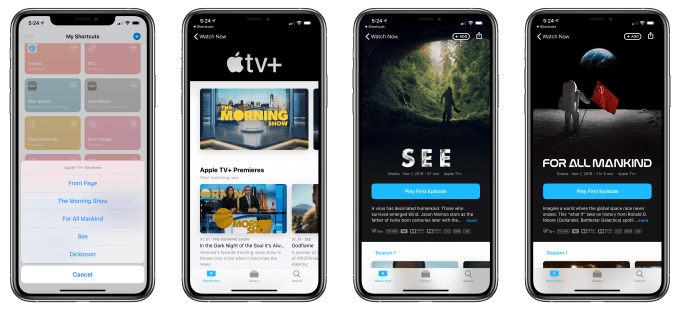
Can’t find the new Apple TV+ shows, like ‘Dickinson?’ This shortcut can help.

The Apple TV app is so bad, someone had to create a shortcut just to make it easier to navigate to the new Apple TV+ content. Apple may have invested billions in its Apple TV+ streaming service and hosted star-studded events to tout its new shows, but what it apparently didn’t do is give much thought to designing its TV app to help direct users to its exclusive content.

Instead, the Apple TV+ shows were mixed in with everything else at launch — forcing users to scroll past What to Watch recommendations and more from the larger iTunes catalog just to find the Apple TV+ section.

And even if and when you found that Apple TV+ section, each individual show page is poorly organized, too. Instead of following the standard format where a season’s episodes are listed in vertical order on an iPhone, Apple’s TV app opts for a horizontal scroll instead. It’s frustrating. It’s confusing. No one likes it.

Apple TV+ may only include a handful of shows at launch, but it still deserves its own, dedicated tab — like Apple’s very own Netflix within the larger construct of the TV app. Part of the problem, as detailed by 9to5Mac here, is that Apple’s TV app has been designed to be a jack-of-all-trades. It connects you to your iTunes library of rentals and purchases, to your add-on premium subscriptions, to your TV Everywhere-authenticated apps, and to some — but not all — of your favorite streaming services.

But the end result is an app that’s sort of a mess and one that failed to carve out a dedicated space for Apple TV+.

This problem also annoyed MacStories Editor-in-Chief Federico Viticci, who wanted an easier way to navigate directly to the Apple TV+ catalog content.

His solution? An iOS shortcut.

Viticci figured out a way to create URLs that will open any Apple TV+ section you want to get to in the TV app. Similar to how Apple Music web links can be edited to direct to content right in the Apple Music app, Apple TV+ web links can also be tweaked to launch the TV app — without redirecting you through Safari first. This is done by replacing the “https” part of the content URL with “com.apple.tv,” he explains.

With this discovery, Viticci was then able to create a shortcut that lets you go directly to any Apple TV+ page — including the “front page” for Apple TV+ or the individual show pages for shows like The Morning Show, For All Mankind, See, and Dickinson.

Apple TV+’s catalog is a bit larger than that, of course, and will continue to grow. But you can continue to edit the shortcut to meet your needs.

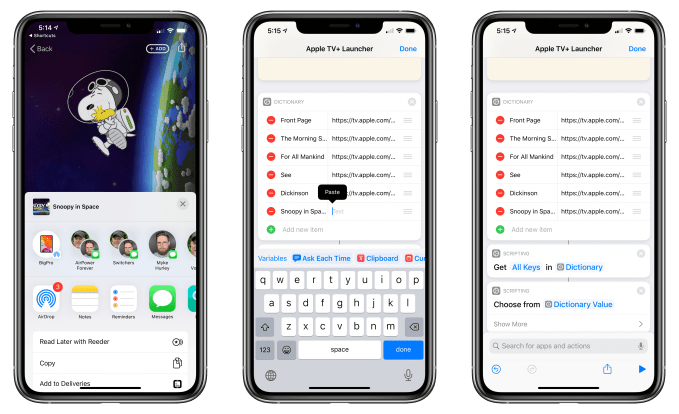
To add something new to the default list of shows, you’ll first have to locate the show in the TV+ app — good luck! You’ll then tap the “Share” button then choose “Copy” to copy the link to your clipboard. In the shortcut, you’ll add a new “Text” item to the action that’s at the beginning of the shortcut, and name it what you like. Finally, you’ll paste in the link you had copied into the “Value” field.

Ta-da! You updated the shortcut!

Or if you just want to use the iOS shortcut as is, so you can get right to Dickinson, you can add it by clicking here.

Viticci tells TechCrunch he expects to keep adding sections as well as links for more shows, as these become available. The shortcut, which is called simply “Apple TV+ Launcher,” will be updated in the MacStories Archive so people can re-download the latest version as needed, he says.

Of course, when people are building a shortcut to work around an app’s poor navigation, there’s a bigger problem that needs to be addressed.

Now, it’s possible that Apple intentionally mixed in Apple TV+ content in such a way to not make it look like it was using its platform power to give its own service a boost, in light of the recent antitrust and anticompetitive investigations into its business practices. But Apple usually doesn’t go so far as to offer a poor user experience — that’s just not in its ethos.

Besides, Apple certainly wasn’t shy about marketing the streaming service in other ways — as with the push notifications or the big Apple TV+ banner at the top of the Apple TV homescreen, for example.

Instead, this just looks like a case of needing to tweak the app’s design.

Until then, we can just use the shortcut to help.

(Image credits: MacStories)


06 Nov 2019

The first hires are the hardest

Welcome to this edition of The Operators, a recurring Extra Crunch column, podcast and YouTube show that brings you insights and information from inside of tech companies. Our guests are execs with operational experience at both fast-rising startups like Brex, Calm, DocSend and Zeus Living, along with more established companies like AirBnB, Facebook, Google and Uber. Here, they share strategies and tactics for building your first company and charting your career in tech.

In this episode, we’re talking about hiring and recruiting:

  1. Why people take the risk of working at early-stage startups
  2. When and how to work with recruiters
  3. How to make your first hires

A company’s first hires are often the hardest; money is usually too tight to pay competitive salaries, there’s no recognizable brand or reputation yet and most people would prefer to work at a company their friends and family have heard of before. There’s also fair presumption of risk and unviability — who wants to take a job that might not be around in a year?

Startup founders overcome these odds on a regular basis. To figure out how, we spoke with two experts:

Farah Sharghi-Dolatabadi began her career as a software developer and financial advisor before moving into recruiting. She’s been a recruiter at startups in addition to companies like Google and Lyft. She’s currently a senior technical recruiter at Uber and an active career coach at HireClub.

Kelly Kinnard is Vice President of Talent at Battery Ventures, where she’s worked with startups like Wag, Coupa, Fastly, and Gainsight. She also has experience at top recruiting firms and in executive search at Oracle.

Below is a synthesized summary of our conversation; check out The Operators for the full episode.

Why people take the risk of working at early-stage startups

Most early-stage startups fail. That shouldn’t be news to anyone. Still, however unlikely big outcomes are, the possibility of being a part of the next Facebook or Uber is tempting, and taking a job at a brand new company may even rational on an expected value basis.

Sometimes it’s not just the chance at a big financial outcome. We’ve heard early-stage employees say they made their choice based for more intangible reasons, like having more autonomy in their work, seeking a less structured environment, working with a certain type or set of colleagues, wanting a sense of adventure or purpose and the opportunity for more rapid career progression.

It may not be possible for an early-stage startup to offer market-rate compensation, but they can personalize the opportunity for early employees.

“Be creative and do things like cater to that individual and think about it on a case by case basis,” said Kinnard. “If that candidate really wants to work from home two days a week because they have a dog and you can’t allow dogs in the office, and they want to be able to walk their dog or go pick up their child from school after school, then try to customize things according to each individual.” But don’t forget that compensation still matters, as do market rates. According to Kinnard, “cash is still king, and I think sometimes I see founders and I see CEOs be unrealistic about what they expect to be able to pay people. A part of what I do is provide them with competitive comp data so they can look at the data and [see] here’s what 3000 companies that we’ve surveyed have suggested the compensation ranges.”

Creative problem-solving pays dividends in recruiting, just like in does with most other problems startups need to solve. Experienced recruiters can help companies figure out how to get creative, but how do you know if working a recruiter is right for you?


When and how to work with recruiters

06 Nov 2019

The first hires are the hardest

Welcome to this edition of The Operators, a recurring Extra Crunch column, podcast and YouTube show that brings you insights and information from inside of tech companies. Our guests are execs with operational experience at both fast-rising startups like Brex, Calm, DocSend and Zeus Living, along with more established companies like AirBnB, Facebook, Google and Uber. Here, they share strategies and tactics for building your first company and charting your career in tech.

In this episode, we’re talking about hiring and recruiting:

  1. Why people take the risk of working at early-stage startups
  2. When and how to work with recruiters
  3. How to make your first hires

A company’s first hires are often the hardest; money is usually too tight to pay competitive salaries, there’s no recognizable brand or reputation yet and most people would prefer to work at a company their friends and family have heard of before. There’s also fair presumption of risk and unviability — who wants to take a job that might not be around in a year?

Startup founders overcome these odds on a regular basis. To figure out how, we spoke with two experts:

Farah Sharghi-Dolatabadi began her career as a software developer and financial advisor before moving into recruiting. She’s been a recruiter at startups in addition to companies like Google and Lyft. She’s currently a senior technical recruiter at Uber and an active career coach at HireClub.

Kelly Kinnard is Vice President of Talent at Battery Ventures, where she’s worked with startups like Wag, Coupa, Fastly, and Gainsight. She also has experience at top recruiting firms and in executive search at Oracle.

Below is a synthesized summary of our conversation; check out The Operators for the full episode.

Why people take the risk of working at early-stage startups

Most early-stage startups fail. That shouldn’t be news to anyone. Still, however unlikely big outcomes are, the possibility of being a part of the next Facebook or Uber is tempting, and taking a job at a brand new company may even rational on an expected value basis.

Sometimes it’s not just the chance at a big financial outcome. We’ve heard early-stage employees say they made their choice based for more intangible reasons, like having more autonomy in their work, seeking a less structured environment, working with a certain type or set of colleagues, wanting a sense of adventure or purpose and the opportunity for more rapid career progression.

It may not be possible for an early-stage startup to offer market-rate compensation, but they can personalize the opportunity for early employees.

“Be creative and do things like cater to that individual and think about it on a case by case basis,” said Kinnard. “If that candidate really wants to work from home two days a week because they have a dog and you can’t allow dogs in the office, and they want to be able to walk their dog or go pick up their child from school after school, then try to customize things according to each individual.” But don’t forget that compensation still matters, as do market rates. According to Kinnard, “cash is still king, and I think sometimes I see founders and I see CEOs be unrealistic about what they expect to be able to pay people. A part of what I do is provide them with competitive comp data so they can look at the data and [see] here’s what 3000 companies that we’ve surveyed have suggested the compensation ranges.”

Creative problem-solving pays dividends in recruiting, just like in does with most other problems startups need to solve. Experienced recruiters can help companies figure out how to get creative, but how do you know if working a recruiter is right for you?


When and how to work with recruiters

06 Nov 2019

California accuses Facebook of ignoring subpoenas in state’s Cambridge Analytica investigation

California’s attorney general Xavier Becerra has accused Facebook of “continuing to drag its feet” by failing to provide documents to the state’s investigation into Facebook and Cambridge Analytica.

The attorney general said in a court filing Wednesday that Facebook had provided a “patently deficient” response to two sets of subpoenas for the previously undisclosed investigation started more than a year ago. “Facebook has provided no answers for nineteen interrogatories and produced no documents in response to six document requests,” the filing said.

Among the documents sought are communications by executives, including chief executive Mark Zuckerberg and chief operating officer Sheryl Sandberg, and documentation relating to the company’s privacy changes.

The filing said the social media giant was “failing to comply with lawfully issued subpoenas and interrogatories” for what the attorney general says involves “serious allegations of unlawful business practices by one of the richest companies in the world,” referring to Facebook.

Becerra is now asking a court to compel Facebook to produce the documents.

The now-defunct Cambridge Analytica scraped tens of millions of Facebook profiles as part of an effort to help the Trump presidential campaign decide which swing voters to target with election-related advertising. Facebook banned the analytics and voter data firm following the unauthorized scraping. Facebook was later fined $5 billion by the Federal Trade Commission for violating a privacy decree in 2012, which demanded that the company engaged in better privacy protections of its users’ data.

A Facebook spokesperson did not respond to a request for comment.

Developing… more soon.

06 Nov 2019

Airbnb to verify all of its listings

Following the death of five people at a Halloween party hosted at a California Airbnb rental, and a scathing Vice report outlining Airbnb’s failure to prevent nation-wide scams, the company says it will begin verifying all seven million of its listings.

Airbnb properties will soon be verified for accuracy of photos, addresses, listing details, cleanliness, safety and basic home amenities, according to a company-wide email sent by Airbnb co-founder and chief executive officer Brian Chesky on Wednesday. All rentals that meet the company’s new standards will be “clearly labeled” by December 15, 2020, he notes. Beginning next month, Airbnb will rebook or refund guests who check into rentals that do not meet the new accuracy standards.

The long-awaited updates to Airbnb’s security measures come months before the company plans to complete an initial public offering or direct listing and just days after Chesky announced the business would ban “party houses,” and work harder to combat unauthorized parties and abusive host and guest conduct.

“We believe that trust on the internet begins with verifying the accuracy of the information on internet platforms, and we believe that this is an important step for our industry,” Chesky said in the staff email.

Airbnb also will launch a 24/7 Neighbor Hotline, which will allow guests to reach a real Airbnb employee from any location at any time. The company will fully roll-out the service next year. Finally, Airbnb will expand its screening of potentially high-risk reservations globally next year.

The new efforts are led by Margaret Richardson, Airbnb’s vice president of trust, who Chesky tasked with rapidly formulating a response to the Halloween party massacre. The company has also tapped Charles Ramsey, former chief of the Philadelphia and Washington, D.C. police departments, and Ronald Davis, the former chief of the East Palo Alto police department, to advise the projects.

“More than eleven years after Joe, Nate, and I started Airbnb, I have been asked what has surprised me most about the world,” Chesky writes. “My answer is two things: that people are, in fact, fundamentally good, and that we are 99% the same. We still believe this, and with these changes, we hope to continue to demonstrate this to the world.”

06 Nov 2019

Exclusive: Tony Blair on regulating Big Tech, Facebook, Russia, China and Brexit

As history tells us, the break-up of ‘Big Oil’ and ‘Big Telco’ in the past, led to more competition and innovation. What to do in the era of ‘Big Tech’? Living in 2019, we know more than ever before about how Big Tech, particularly in the shape of Facebook, Twitter and Google – as the prime arbiters of information and social media online – have shaped and affected politics today. At the same time, we’re about to face several huge sea-changes in the global system, not least of which will be the next US election, Brexit, the rise of China and challenges of the climate crisis.

Speaking at Web Summit in Lisbon this week, former UK Prime Minister Tony Blair brought out a new report from the Institute which bears his name to address the turmoil of Western politics from the prism of the backlash against globalisation after the 2007–2008 financial crisis, the rise of populist movements and the effects technology is having on society, politicians and policymakers.

A policy framework designed for the offline world may well have served many people well for many decades, but in an age of exponential technology is it fit for purpose?

Platform companies like Facebook, aggregators like Google, Amazon and Uber have, says the Institute, stripped traditional gatekeepers of their power, delivered real progress for consumers and businesses, and increased many freedoms. But they have also brought significant economic upheaval and heightened cultural pressures, along with huge unknowns about the future. The tech wolf has also now concentrated power in the hands of a relatively small number of companies that “all too often wield it clumsily and without sufficient legitimacy.”

This comes at a time when the West’s lead on technology is “facing a clear and present challenge from determined Russian aggression and a concerted push from China to take a global lead in AI.”

Blair’s Institute makes it plain in it’s new report (“A New Deal for Big Tech: Next-Generation Regulation Fit for the Internet Age”) that the current set of regulations designed for legacy industries is “a poor fit for the pace and scale of the Internet” and a new approach, based on stronger accountability coupled with more freedom to innovate, might be the best way to align private incentives with the public interest.

Blair is calling for a “new generation of regulator” that can take an international outlook, have technical expertise comparable with the big tech companies and be fluent in the same fundamentals of ‘Big Tech’.

But how? How is all this going to operate? What are Blair’s view on Russia, disinformation on Facebook and Twitter, and whether tech will have an effect on the outcome of Brexit?

TechCrunch sat down with Mr Blair for the following, exclusive, interview:

 

Mike Butcher (MB): You’ve released this new report into regulating ‘Big Tech’. Do you want to outline it’s main thrust?

Tony Blair (TB): Essentially what we’re saying is: there’s no way ‘big tech’ is going to avoid regulation, and regulation that will treat them almost like public utilities because of their power, their reach, and their impact. But the question is about getting the right form of regulation. So what we’re trying to do is to make sure that it’s the kind of regulation of big tech that recognizes that [big tech has] actually brought enormous benefits to people, but at the same time protects people, whether it’s on issues around privacy, competition [and] making sure that consumers get adequate access – all of those types of things – and translate this into a set of proper principles. What I say to the big tech companies is that even though you may not want to have a lot to do with politics, as you can see – and I’ve been saying this for several years to them – it’s going to come your way. Because you’re just too powerful not to be under some system of objective regulation, and you can’t just regulate yourselves.

MB: On that note, many big tech companies have actually called for regulation, but do you think that’s a “sop” to governments in order to allow them to build even bigger monopolies? Because then everybody will have to be regulated, including smaller companies?

TB: I think the whole point about regulation is that it can be bad or it can be good. So you really want to make sure that the regulation you’re introducing is not an imposition on the companies for providing the service they do, but it is giving people proper protection and it’s recognizing, as I say, the power that these companies have. People won’t find it acceptable that things continue without proper regulation. The fact that Mark Zuckerberg comes out in favor of regulation… I mean, I think that’s good. But the question is what type of regulation. And there, obviously, he and Facebook should have an input. But they can’t decide that. That’s – in the end – got to be decided by policymakers. And one thing my institute – which Chris [Chris Yiu, Executive Director, Technology and Public Policy] heads up, which is based in London but has strong links in Silicon Valley and elsewhere in the world – is to say there needs to be a dialogue between what I call the ‘change-makers’ and the policymakers that leads to good policy.

MB: But national governments making policy on their own surely isn’t going to address the issue, given Big Tech is global? What institutions can address this? Some sort of supranational body?

TB: Well, I think, ultimately, on certain issues you’ll need a global agreement. For example cybersecurity, I think we’ll, for sure, need that.

MB: There’s no ‘United Nations Declaration’ for arms control on cybersecurity for instance.

TB: The one thing I’m noticing about cyber, even in the last year… the number of people I meet whose companies have been subject to actual attacks… In the end, if every country is going to want to protect its business and every country will recognize ultimately that if the big players don’t come together and agree some rules then… I mean, it’s just anarchy.

In regards to regulation, I would like to see Europe and America create a new transatlantic partnership around regulation. This is one of the reasons I’m so opposed to Brexit… You are taking Britain out of that conversation with Europe at the very time that it needs to be in it.

MB: The pace of change at this point is now exponential. The rise of AI, Quantum computing etc. Politicians have known about the rapid, changing nature of technology for a number of years. What do you think has been stopping them from grappling with the subject?

TB: It’s partly generational. It’s partly because politicians don’t often understand the technology. It is actually technical. It requires hard work. Some of it is like rocket science. It’s not easy. So that’s part of the problem. And the other problem is that I think the change-makers – the tech developers – their basic attitude, often, to government, is just to just ‘keep away from it’. And I completely get it. But it’s not sensible. They’ve got to engage with government today, and that’s why we’re trying, through the Institute, to establish that dialogue. And you know, if that doesn’t happen, you’ll find, as we did during the 19th-century industrial revolution, how long it took politics to catch up with the fact that the world was being revolutionized. It took decades to catch up. For a long time, society was subject to one change, and politics was still debating things that were from a different era. I mean, if you look at British politics today, with this debate where, on one side is Brexit, one on the other side is –  basically – who spends more money in the next Parliament… we could have had this debate at any point in the last 30 years. It’s got no relevance, really, to how the world’s changing.

MB: Are you concerned about how social media has enabled populism?

TB: Yes, I think social media is a revolutionary phenomenon and it’s revolutionized everything, including politics. And we’ve got to work out ways of dealing with that because it is rupturing politics in a serious way.

The problem is that political leaders are always trying to ‘step out in front’, but not so much that they lose touch with their people. So that’s a calibration, all the time, between leadership and listening. If the ‘listening’ part of it becomes ‘instrumentalized’ through social media, then the risk is that politicians just lose their compass. They don’t know where they’re going, they are just buffeted by waves of opinion. And then, if you’re not careful, what happens is that the people who rise to the top in those circumstances are the people who ride that.

MB: Should Twitter shut down Trump’s account?

TB: Well how’s that going to help? I mean, honestly, I don’t think that’s relevant.

MB: Facebook has said it’s going to be changing its policy on political advertising, and won’t be regulating disinformation on political ads. What’s your opinion on that?

TB: My opinion is that it’s very hard, if you’re Facebook, to stop people having political ads. But, to me, the the whole concept that Facebook is ‘self patrolling’ as to what should come on the Internet or not, is an indication of why you need proper regulation. The decision as to whether something’s fit for consumption or not, shouldn’t be left to a few thousand people employed by Facebook, you know, sitting and looking at crazy stuff on Facebook all day. I mean, this is to me just a further indication of why you’ve got to put everything within a proper system of regulation. Otherwise, it’s not actually fair to ask the company to do that. How can they decide what is a political ad or not? But someone should.

MB: What do you think of Twitter’s decision not to take any political advertising?

TB: In some ways I understand that, and in some ways I welcome that, but I think Facebook’s in a slightly different position just in terms of scale, right?

MB: China is deploying technology in its society at a huge, exponential rate, in terms of things like facial recognition and the surveillance of its population. Its ability to hoover-up all this data is effectively giving it enormous power to create, possibly, the next, powerful, AI, because the more data you have the more you can improve an AI. Do you think that the Western approach, with its tradition of more democratic institutions that have moved more slowly than a command-and-control system, means that we are effectively going to be left behind by political systems that err towards the more dictatorial?

TB: Well I think there’s a huge debate that’s going to go on about China, more generally, in the West which is what I call the debate about whether you ‘decouple’. Do you accept that there’s two systems that are going to remain very distinct, also in technology? This is part of what underpins the Huawei debate regarding 5G. Or do you try to get to what Henry Kissinger calls a form of ‘cooperative competition’? Now, I prefer the latter not the former course, because I think decoupling is very difficult. But, what that means, in my view, is that the West has got to get its act together, because otherwise China will achieve superiority in AI and, in some regards, it already is. If you think of all the devices that we use in the West that are Chinese… You can see this with [the rise of] Tik Tok, for instance.

MB: The UK general election is now on and people are using technology to ‘get out the vote’. There is a lot of talk about ‘tactical voting’ and lots of tactical voting recommendation websites appearing. Do you favour any particular approach?

TB: So, here’s where technology obviously has a beneficial purpose. If people decide that they want to vote tactically – and I completely understand that because of Brexit being mixed up [in the election], and frankly, dissatisfaction with both main parties – then web sites that tell you how to do that intelligently and provide the information, then… great. You’ve got ones from Best For Britain, People’s Vote, Gina Miller has one and there are others. Yeah, fine, people should look at them I think.

MB: Parliament’s Intelligence and Security Committee has been prevented by Number 10 from releasing its intelligence report and it allegedly contains information about how Russia affected British politics and society using technological means in the last few years. What are your concerns about Russia’s incursion into UK politics using technology?

TB: I think this is not just a Russian question, although there’s been a lot of focus on what Russia has done. You’ve got to put all of this out on the table and I think, again, Western governments should be cooperating together to say… if there is outside interference – and I don’t really know the scale of it because you’ve got to go into the detail –  how people are influencing media, how people are using techniques to try and influence voters, from the outside, trying to destabilize your politics… all of it should be out in the open. Because that’s the best way of stopping it, and then you can take action against people who are doing it. But this is another reason why I think this is a slightly different form of cybersecurity, if you like, but it’s somewhat akin to it. Because, in the end, if you’ve got people, for example, changing their votes – particularly in tight-run elections – changing their votes on the basis of misinformation that’s coming from a foreign government that’s deliberately trying to destabilize your politics, then at least you should know about it. Now, this is going to be a big big issue for the future.


06 Nov 2019

Microsoft has big plans for its new Edge browser

Microsoft is setting itself some high goals for its new Chromium-based Edge browser. As Chuck Friedman, the corporate vice president for Edge told me, he wants Edge to hit one billion users — a number that would start to rival Chrome’s numbers. First, though, Friedman’s team has to get version 1.0 of Edge out to users in January.

It’s no secret that Microsoft went to Chromium out of a bit of desperation. Indeed, Friedman, who joined the team about two years ago, called it an “existential crisis,” brought about by questions about why users would even want to use the old Edge. “When I got brought in, we almost had this existential crisis of, okay, what do we want to do? There was sort of this moment of like, why Edge? Why would users choose that? Were we delivering on meaningful problems?” At the time, he didn’t really have an answer to those questions, so the team went back to the basics to figure out what value Microsoft specifically could deliver in the browser space — and whether there was even a role for Edge going forward.

Microsoft's new Edge logoThe fact that Friedman ran the program management team for the Windows 10 user experience — trying to overcome the missteps of Windows 8 — before running the Edge product team also clearly shows how important a product this is for Microsoft.

Friedman argues that there’s plenty of work left to do in the browser space. “There’s an emerging new set of problems that felt like they had legs,” he told me. “And then it wasn’t about solving the problems of the last five years, it was about solving the problems of the next five.” To do so, the team had to move past the original Edge’s issues with compatibility — while still acknowledging that at least in the work environment, the browser still had to be compatible with the legacy web.

Clearly, privacy is top of mind for anybody in the web browser business, Microsoft included. Friedman noted that while people were generally aware of the privacy issues that come with surfing the web, they didn’t have the tools to protect themselves. “We sort of reached this point where we recognize the promise of the web, open access to all the world’s information, feels great, but the price of all of your information as part of that body wasn’t OK,” Friedman said. And so that, too, became a focus for the team, but looking at all of these issues together — combined with an additional focus on security — the Edge team then looked at how all of this fits in with the entire Microsoft suite. “It’s not just about the operating system. It’s not just about search. But it’s actually about the full M365, the combination of the operating system, plus security, plus the productivity tools.”

But Friedman also echoed something I’ve heard from Google’s Chrome team, and that is that the web today heavily depends on an advertising model that, at least for the time being, is the main income source for most of the companies that are publishing on the web. That can be a hard balance to strike. The way Microsoft is approaching this is by focusing on transparency. “The user should know where their data is and they don’t know what the data is and how it’s being used,” he explained. So users should have the ability to know how their data is being used and have control over it.

“There are those in our industry that think we absolutely should go to a point of extreme privacy and control. And I think there is a small set of users who prefer that. I also think that there’s a certain element of that that breaks the web. And I think that it has the potential to undermine the ability for publications to be able to monetize in a way that is reasonable.” He also argues that for users, about half prefer targeted ads versus non-targeted ads — but what makes them uncomfortable is to not have control over it.

In its browser, Microsoft defaults to blocking third-party cookies. To do so, it uses the same whitelist as Mozilla, but it also regularly updates this list when a site can demonstrate that it gives users the ability to delete their data — and with that, it hopes to encourage a wider range of players in the advertising industry to offer users these controls.

Edge, however is also very much a tool for business users, and so the team also started looking at how it could improve overall productivity in the browser for these users as well as consumers. That, for example, is where the idea of Collections came from, Microsoft’s take on what’s something of a hybrid between bookmarks, scratch pads and reading lists, which aren’t yet ready for a wider roll-out, but which are available behind a flag in the more experimental canary builds of Edge.

But the team also found that users often copy and paste content from Edge to Office products — so expect the company to do more in this area going forward. “We do a better job of integrating around collaboration with Microsoft Office properties who all have great web experiences. But, frankly, we need to meet them partway and help them do more. I’m excited for an opportunity of almost a relaunch of the Office web properties with the browser. There’s more innovative work we can do there.”

Another area the team is looking at is tab management. “Tab chaos is an interesting problem. It still exists. I don’t think anybody’s done a great job at solving it,” Friedman said. What exactly that will look like, though, remains to be seen.

One thing we won’t see right away, though, is an integration with Cortana. That’s part of the current pre-Chromium version of Edge, but it’s something Friedman doesn’t seem quite ready to bring to the new version yet. To be useful in the browser, he argues, a personal assistant has to be right most of the time. But what that will look like in the new Edge remains to be seen. He thinks there’s potential there, but what a real-world implementation would look like isn’t clear yet.

Once version 1.0 ships, the team plans to launch about two or three major new features in the browser every year, with Collections likely being the first.

Friedman also acknowledged that there are still lots of users who use Edge currently. There are about 150 million of those. And they use Edge because it’s the browser that comes with Windows. These “low-confidence users,” as Friedman described them, aren’t all that likely to download a different browser if the new Edge is too radical a departure. Instead, they’ll go out and buy a different device, like an iPad, that they view as a simpler experience.

But for more experienced users, Microsoft is obviously setting up Edge as an alternative to Chrome. The team is trying to provide them a relatively friction-less pathway to switch. Finding that balance is tricky, but Friedman thinks it’s possible, in part thanks to his work on Windows.

“My last gig was working on Win 10. I ran the product team for the core user experience for Windows 10. Sort of inherited the Windows 7 and 8 code base and said: Okay, how do we bring those users together in a way that ends up making both of them feel good about the product. It was a similarly interesting challenge, where you have […] to have true empathy for users that come from a lot of different spaces.”