
Category: UNCATEGORIZED

06 Nov 2019

Tinder’s interactive video series ‘Swipe Night’ is going international next year

Tinder’s big experiment with interactive content — the recently launched in-app series called Swipe Night — was a success. According to Tinder parent company Match during its Q3 earnings this week, “millions” of Tinder users tuned into to watch the show’s episodes during its run in October, and this drove double-digit increases in both matches and messages. As a result, Match confirmed its plans to launch Tinder’s new show outside the U.S. in early 2020. 

Swipe Night’s launch was something of a departure for the dating app, whose primary focus has been on connecting users for dating and other more casual affairs.

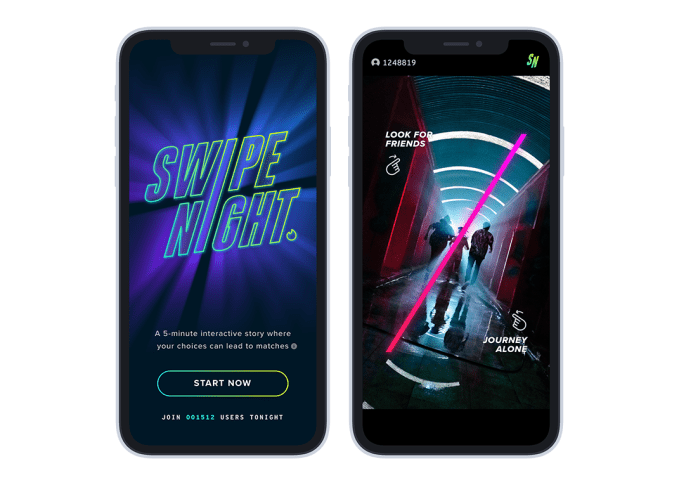
The new series presented users with something else to do in the Tinder app beyond just swiping on potential matches. Instead, you swiped on a story.

Presented in a “choose-your-own-adventure” style format that’s been popularized by Netflix, YouTube, and others, Swipe Night asked users to make decisions to advance a narrative that followed a group of friends in an “apocalyptic adventure.”
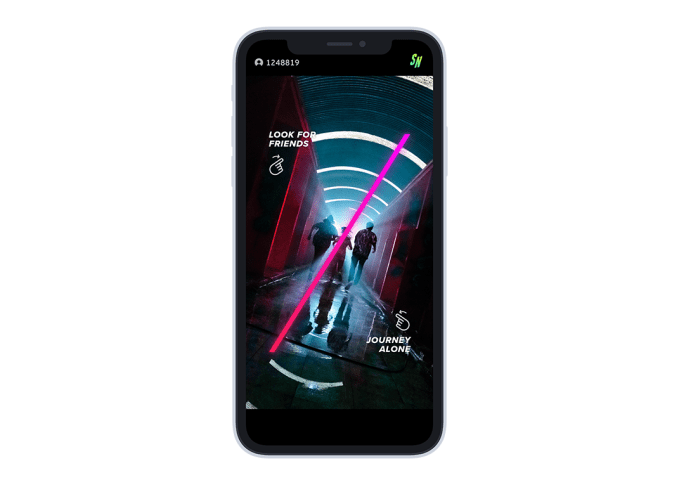
Swipe Night ChoiceThe moral and practical choices you made during Swipe Night would then be shown on your profile as a conversation starter, or as just another signal as to whether or not a match was right for you. After all, they say that the best relationships come from those who share common values, not necessarily common interests. And Swipe Night helped to uncover aspects to someone’s personality that a profile would not — like whether you’d cover for a friend who cheated, or tell your other friend who was the one being cheated on?

The 5-minute long episodes ran every Sunday night in October from 6 PM to midnight.

Though early reports on Tinder’s plans had somewhat dramatically described Swipe Night as Tinder’s launch into streaming video, it’s more accurate to call Swipe Night an engagement booster for an app that many people often find themselves needing a break from. Specifically, it could help Tinder to address issues around declines in open rates or sessions per user — metrics that often hide behind what otherwise looks like steady growth. (Tinder, for example, added another 437,000 subscribers in the quarter, leading to 5.7 million average subscribers in Q3).

Ahead of earnings, there were already signs that Swipe Night was succeeding in its efforts to boost engagement.

Tinder said in late October that matches on its app jumped 26% compared to a typical Sunday night, and messages increased 12%.

On Tinder’s earnings call with investors, Match presented some updated metrics. The company said Swipe Night led to a 20% to 25% increase in “likes” and a 30% increase in matches. And the elevated conversation levels that resulted from user participation continued for days after each episode aired. Also importantly, the series helped boost female engagement in the app.

“This really extended our appeal and resonated with Gen Z users,” said Match CEO Mandy Ginsberg. “This effort demonstrates the kind of creativity and team we have a tender and the kind of that we’re willing to make.”
Swipe Night

The company says it will make Season 1 of Swipe Night (a hint there’s more to come) available soon as an on-demand experience, and will roll out the product to international markets early next year.

Swipe Night isn’t the only video product Match Group has in the works. In other Match-owned dating apps, Plenty of Fish and Twoo, the company is starting to test live streaming broadcasts. But these are created by the app’s users, not as a polished, professional product from the company itself.

Match had reported better-than-expected earnings for the third quarter, with earnings of 51 cents per share — above analysts’ expectations for earnings of 42 cents per share. Match’s revenue was $541 million, in line with Wall St.’s expectations.

But its fourth-quarter guidance came in lower than expectations ($545M-$555M, below the projected $559.3M), sending the stock dropping. Match said it would have to take on about $10 million in expenses related to it being spun out from parent company IAC.


06 Nov 2019

Google enlists mobile security firms to rid Google Play of bad Android apps

Google has partnered with mobile security firms ESET, Lookout and Zimperium to combat the scourge of malicious Android apps that have snuck into the Google Play app store.

The announcement came Wednesday, with each company confirming their part in the newly created App Defense Alliance. Google said it’s working with the companies to “stop bad apps before they reach users’ devices.”

The search giant has struggled to fight against malicious apps in recent years. Although apps are screened for malware and other malicious components before apps are allowed into Google Play, the search and mobile giant has been accused of not doing enough to weed out malicious apps before they make it to users’ devices.

Google said earlier this year that just 0.04% of all Android apps downloaded from Google Play were considered potentially harmful apps — or about 30 million potentially malicious apps.

Yet, it remains an ongoing problem.

ESET, Lookout, and Zimperium have all contributed to the discovery — and eventual takedown — of hundreds of malicious apps on Google Play in recent years.

But each time Google takes down a suspicious or malicious app from Google Play, the thousands or millions of users with the app installed on their phone remain vulnerable. The apps are not removed from devices, continuing to put users at risk.

By integrating its Google Play Protect technology, which serves as Android’s built-in antimalware engine, with each of its partners’ scanning engines, the collective effort will help to better screen apps before they are approved for users to download.

Google said that knowledge sharing and industry collaboration are “important” to combat rising mobile app threats.

06 Nov 2019

Elon Musk will reveal Tesla’s ‘Cybertruck’ all-electric pickup on Nov. 21

Tesla CEO Elon Musk said Wednesday that the company will unveil its all-electric “cyber truck” Nov. 21 in Los Angeles near the serial entrepreneur’s other company SpaceX.

The date just so happens to coincide with the LA Auto Show. However, this is a Tesla event and not associated with the auto show in downtown Los Angeles.

Musk has talked about producing an all-electric pickup truck for years now. In December, Musk resurrected the idea saying that Tesla might have a prototype to unveil in 2019.

Musk mentioned on Twitter the desire to produce a pickup truck way back in April 2017, before the first Model 3 sedans had been handed over to customers and the CEO had entered production hell. At the time, Musk tweeted that a pickup truck would be unveiled in 18 to 24 months.

Musk had hoped to unveil the truck this summer, but it was pushed back to fall.

Little is known about what this cyber truck will look like, although there has been plenty of speculation. In an earnings call in January, Musk said it will be “unique.”

06 Nov 2019

Immigrants from China and India can accelerate the green card process

Securing a green card can feel overwhelming for people in Silicon Valley who were born in India and China. But with the right help and guidance from a skilled immigration attorney, the process can be simpler, smoother and more successful.

Limits written into existing immigration laws on both the number of green cards issued each year, as well as the number of green cards available based on country of origin, leave some waiting half a century or more for a green card, with people from India and China facing the longest wait times for employment-based green cards.

In this fiscal year, which ended on October 31, 226,000 family-sponsored green cards and 141,918 employment-based green cards were available. And the per-country cap, which is the maximum number of green cards available to individuals born in a particular country, was 25,754. 

Although these U.S. laws pose an extra challenge for people born in countries with the highest demand for green cards, if you were born in India or China, there are some things you can do to mitigate this wait.

Differentiate yourself

The EB-1 green card is considered the “first preference” for those who’ll receive offers for employment-based green cards. It offers three unique and accelerated sub-paths: 

  • EB-1A green card for individuals of extraordinary ability 
  • EB-1B green card for outstanding researchers and professors
  • EB-1C green card for multinational managers and executives

The EB-1A green card for extraordinary ability does not require an employer sponsor or even a job offer, which means it’s one of the few self-petition green cards. To demonstrate eligibility, you must be able to show you have extraordinary ability in the sciences, arts, education, business, or athletics and that you and your work have received national or international acclaim. 

Individuals who apply for the EB-1A do not need to obtain labor certification (as required of employers). That means the process is simpler and can be much faster than typical employment-based green cards. Also, an individual applicant may have more flexibility to change jobs than if an employer applied on their behalf.

The EB-1B green card for outstanding researchers and professors requires an employer to sponsor you. Candidates for the EB-1B green card must demonstrate great achievements in their academic field. 

And finally, the EB-1C green card for multinational managers and executives enables an employer to bring an executive or manager who has been working abroad over to the U.S. to live and work. The EB-1C candidate must have worked outside the U.S. for the employer for at least one year.

This Cato Institute analysis estimates individuals born in China and India face waiting eight and nine years, respectively, for an EB-1 green card. Despite the small and growing backlog for EB-1 green cards for individuals born in China and India, it still remains one of the quicker options.

Invest in a project that creates jobs

06 Nov 2019

Restaurants using the Odermark order management service now get special deals from Uber Eats

In a new deal tying Uber Eats closer to the Los Angeles-based delivery management service, Ordermark, the companies are offering special discounts to restaurants that use the service.

Uber Eats is giving all Ordermark restaurants a preferred fee rate, waiving the upfront set-up fee, and fully eliminating the need for the Uber eats tablet in the restaurant, the companies said.

It’s a perk that should expand the footprint of Ordermark’s tablet delivery service, the company said.

“Our top priority at Ordermark is deepening technical integrations and partnerships with forward-thinking industry leaders, such as Uber Eats,” says Alex Canter, CEO of Ordermark. “We’re pleased to partner with Uber Eats as this relationship will translate directly into greater efficiency, more orders, and higher value for our restaurant partners nationwide.”

06 Nov 2019

Amazon is planning a $40M robotics hub near Boston

Amazon announced a plan today to build a $40 million, 350,000 square foot robotics innovation hub in Westborough, MA. The new facility will bring 200 technology and advanced manufacturing jobs when it opens in 2021.

The new facilities will include corporate offices, research and development labs and a robotics manufacturing space. The company said that this new facility will be in addition to its existing Amazon Robotics site in North Reading, MA.

Tye Brady, chief technologist at Amazon Robotics says the new hub will allow Amazon to continue to build on its robotics research. “This will be a world-class facility, where our teams can design, build, program and ship our robots — all under the same roof. This expansion will allow us to continue to innovate quickly and improve delivery speed for customers around the world,” Brady said in a statement.

Amazon bought Kiva Systems, a company that was developing order fulfillment robots, in 2012 for $775 million in cash, and then renamed the company Amazon Robotics. A lot has changed since 2012, and today the company has deployed more than 100,000 robotic systems in more than 25 fulfillment centers across the U.S, and has more than double that in place worldwide including both Amazon and third-party usage, according to data supplied by the company.

Amazon is not new to Massachusetts. It has had a presence in the Bay State since 2011 has invested over $3 billion and created more than 4,000 full-time jobs in Massachusetts, according to data supplied by the company.

Westborough is a suburb located about 35 miles west of Boston.

06 Nov 2019

Stealth fintech startup Digits raises $10.5 million Series A from Benchmark and others

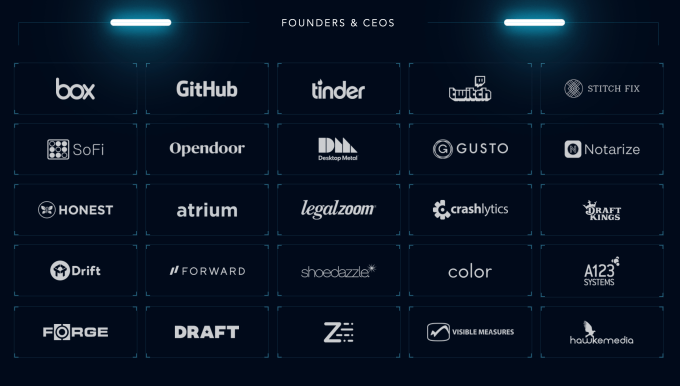
Stealth fintech startup Digits, from the same team that built Crashlytics to scale then sold to Twitter for over $100 million, has raised a $10.5 million round of Series A funding, the company is announcing today. The round was led by Benchmark and has the backing of 72 angels, including founders and CEOs from companies like Box, GitHub, Tinder, Twitch, StitchFix, SoFi, and several others.

With the round, Digits also gains a new board member, Peter Fenton, who has served on the boards at AirTable, Twitter, NewRelic, Yelp, and elsewhere.

The funding is a big bet on serial entrepreneurs Wayne Chang and Jeff Seibert who launched and sold their crash reporting service to Twitter, which itself later sold it to Google. At Twitter, the team remained to build out the product and launch new services, like Answers. After the sale to Google four years later, it was then folded into Google’s own developer platform to become the crash reporting tool for Android. Today, it’s still on nearly 5 billion monthly active devices and used inside millions of apps.

Now, the Crashlytics co-founders have returned with most of their original team to develop a new fintech startup, Digits, which describes itself vaguely as “a counting company.”

The company’s focus aims to solve a problem the founders had faced themselves when building Crashltyics.

“As builders, there is nothing more exciting than cracking the next engineering puzzle; than perfecting the next design; than delivering the next capability to customers. And there is nothing more mind-numbing than the paperwork, and spreadsheets, and financial reports, and inscrutable transaction records that are all required to actually operate the business,” a Digits blog post earlier this year explained.

“Globally, most entrepreneurs today have no formal training in business finance. We certainly didn’t. Today, you start a company to solve a real problem for real people, or to offer a service you’re skilled at, or to provide a living for you and your family. You don’t start a company because you want to operate a business—but you have to anyway,” the founders said.

While Digits isn’t talking about the specifics of its new product yet, its software is described as pairing design and machine learning in order to “democratize financial savvy.”

More specifically, it leverages APIs, classification algorithms, and machine learning techniques to provide a real-time view into a business’s finances, proactively alert you to what’s important, and allow you to deep dive into your data to better understand what’s driving your business.

The company believes its approach to visualizing a company’s finances is unique, and apparently a sizable number of investors agree.

Among the 70+ angels backing Digits are Box CEO Aaron Levie; Adam Bain and Dick Costolo (ex COO and CEO of Twitter); Ali Rowghani (partner Y Combinator, ex-COO Pixar); SoFi CEO Anthony Noto; Drift CEO David Cancel; AngelList board member Jeff Fagnan; Justin Kan (CEO Atrium, co-founder Twitch, partner YC); StitchFix CEO Katrina Lake; Github CEO Nat Friedman; First Republic Bank COO Mike Selfridge; Desktop Metal CEO Ric Fulop; Tinder co-founder Jonathan Badeen; DraftKings CEO Jason Robins; Legalzoom co-founder Brian Lee; Gusto CEO Josh Reeves; and Notazie CEO Pat Kinsel. 

Though Digits hasn’t publicly launched — the product is in invite-only status for now —  it already has live customers and is seeing more than $1.5 billion in transactions processing on its platform, the company says.

And unlike Crashltyics, which was based in Boston, Digits is a 100% remote operation. LinkedIn shows just 10 employees, including co-founders Chang and Seibert.

The team hasn’t said when Digits itself will be publicly unveiled or opened to sign-ups.

06 Nov 2019

Niantic will open Pokémon GO Pokéstop submissions to players worldwide next week


Pokémon GO and games like it can’t exist without waypoints — the in-game locations that correlate to real world points of interest, acting as the Poké Stops, gyms, etc. The more waypoints they have around the world, the better the game becomes.

But building up these databases of waypoints is tough. A company can’t do it alone; that just doesn’t scale. Even if they open it up to user submissions, verifying new locations (so as to avoid a bunch of false/bad locations being thrown into the mix) is tough for a company to do alone.

Niantic has spent the last few years figuring this process out, building a user-driven and peer-moderated system that got its start way back with the company’s first game.

Next week, at long last, they’re opening the submission process to Pokémon GO players around the world.

Called Niantic Wayfarer, the submission system will be largely user driven. One player nominates a location, submitting a photo of the location and answering a handful of questions to help determine eligibility. Other high-level players will review these submissions, helping to filter out the ones that are inaccurate, offensive, or just not right for the game.

Niantic had previously opened up location submissions in select regions, including much of Central and South America and parts of Asia. With the launch next week, the submission system goes worldwide.

If you’ve been following Niantic for a while, the Wayfarer system might seem familiar. It’s effectively a polished up, rebranded version of the “Portal Recon” system originally built into Niantic’s first game, Ingress. Niantic tells us that they’ve seen 27 million waypoint locations submitted by users so far, with 26 million having been reviewed, and 9.4 million approved and in game. Even in these early stages, the company says it’s seeing about 1 million nominations per week.

One catch: at least initially, you’ll need to be level 40 (the highest level in Pokémon GO) to submit or review potential new stops. The company tells me you’ll also have to take a little quiz to confirm that you’ve got a good understanding of what makes for a good Pokéstop.

A common (constant?) complaint from Pokémon GO fans has been that players in rural areas are at a massive disadvantage compared to players in major cities — a portion of which, at least, boils down to rural areas having considerably fewer stops, gyms, etc. Opening up the player submission system doesn’t completely fix the gameplay challenges in rural areas, but it should at least be a big step in the right direction.

06 Nov 2019

Wardrobe picks up $1.5 million for a new fashion rental marketplace

Wardrobe, a new peer-to-peer fashion rental marketplace, has today announced the close of a $1.5 million seed round and its public launch out of beta.

The funding was led by angel investor Cyan Banister and Ludlow Ventures, with participation from GroupUp Ventures, Airbnb cofounder Nate Blecharczyk and HQ Trivia founder Rus Yusupov, among others.

Wardrobe was founded by Adarsh Alphons after he had an epiphany about just how many items of clothes in his own house went mostly unused. In fact, the WSJ suggests that most people only wear around 20 percent of their wardrobe on a regular basis. Alphons says that the average woman has 57 items of clothes in her closet that she doesn’t even wear once a year.

So began Wardrobe.

Wardrobe is a peer-to-peer rental marketplace for vintage, designer, and luxury brand clothing. However, unlike Rent the Runway or other sharing economy fashion platforms, Wardrobe uses dry cleaners as hubs for the inventory. This not only allows the company to scale more quickly from geography to geography, but also to remain lean without taking on the risk of big warehouses and complicated logistics around shipping.

Here’s how it works:

Folks who want to rent their clothes on Wardrobe simply fill out a few answers to questions and receive a shipping label in the mail. Once their clothes are approved, they’re sent to a local dry cleaner where they wait to be rented for either 4, 10, or 20 days.

Wardrobe HQ handles everything from storage to shipping to photographing the pieces for the app.

The owner of the clothes makes between 70 and 75 percent of the rental cost after the cost of dry cleaning.

Interestingly, Alphons learned in beta that users want to not only browse the app for clothes, but follow specific users and closets that they particularly like. So the app is now tailored to let users follow one another and watch each other’s closets, creating an environment that may attract influencers to the platform.

Wardrobe currently has partnerships with more than 40 Manhattan dry cleaners, serving all of the island below 110th Street. Alphons says that each dry cleaner can hold between 100 and 1,000 items of clothing at a time.

06 Nov 2019

Niantic will soon open Pokémon GO’s ‘Sponsored Location’ system to small businesses


Sponsored locations aren’t new to Niantic games. Companies like Sprint, McDonalds, and AT&T have had sponsored locations in games like Pokémon GO and Harry Potter: Wizards Unite for a long while now. The idea: by turning your business into a big in-game beacon and giving players some reason to stop by, you increase foot traffic.

So far, though, the sponsorship system has really only been open to these mega chains. Starbucks got to turn all of its stores into sponsored Pokéstops at the height of the Pokémon GO craze, but the little mom-and-pop coffee shop down the street? No such luck.

That’ll change later this year, as the company opens a self-serve platform for small to medium sized businesses looking to light up sponsored locations in-game.

Details are still somewhat light, but Niantic says that they’ll start accepting applications tomorrow and roll out an “early access” beta program later this year. As with pretty much everything Niantic does, they’re rolling it out on a region-by-region basis; in this case, it’ll only be open to US businesses at first. The first new sponsored locations should start showing up in December.

“Sponsored” locations tend to have slight perks over their non-sponsored counterparts. Sponsored gyms in Pokémon GO, for example, are almost always “EX Raid” locations — which in GO speak just means that battling there might get you a ticket to a bigger, badder, invite-only boss battle in the weeks that follow. Sponsored fortresses in Harry Potter: Wizards Unite give out more XP and more of the spell energy required to play.

Beyond being able to pay to have a sponsored in-game location, these businesses will also be able to pay to schedule things like Pokémon GO raids (read: bigger, co-operative boss battles that often require 5-10 players working together to win) during time slots when foot traffic might be slow. And because getting foot traffic is only part of the equation, sponsored businesses will also be able to offer up deals and promotions in-game to (hopefully) turn those passing by into paying customers.

Niantic also says that businesses will be able to host other on site “mini-games” beyond GO raids in the future, but didn’t elaborate on what those might be.

Alas, no details yet on how much sponsorships will actually, you know, cost.

It’ll be interesting to see how this plays out, and how it impacts things in game. While Pokémon GO isn’t the overwhelmingly popular monster of a game that it was at launch, it can still cause crowds to pop up out of nowhere — particularly when new Pokémon appear as raid bosses, or when they’ve got some limited time event going on. Will sponsoring a raid cause fewer raids nearby (to maximize visibility of the sponsored spot), or will more of them pop up nearby to hook groups looking to do multiple raids in one swoop?