Category: UNCATEGORIZED

28 Oct 2019

FCC proposes rules requiring telcos remove Huawei, ZTE equipment

The Federal Communications Commission said it will move ahead with proposals to ban telecommunications giants from using Huawei and ZTE networking equipment, which the agency says poses a “national security threat.”

The two-part proposal revealed Monday would first bar telecoms giants from using funds it receives from the the FCC’s Universal Service Fund, used by the agency to subsidize service to low-income households, from buying equipment from the Chinese telecom equipment makers.

The second proposal would mandate certain telecom giants remove any banned equipment they may have already installed.

In a statement, the FCC said it would offer a reimbursement program to help carriers transition to “more trusted” suppliers.

“We need to make sure our networks won’t harm our national security, threaten our economic security, or undermine our values,” said FCC chairman Ajit Pai in remarks. “The Chinese government has shown repeatedly that it is willing to go to extraordinary lengths to do just that.”

The FCC said Huawei and ZTE were already on the list of companies that pose a threat, but that the draft order would “establish a process for designating other suppliers that pose a national security threat,” potentially opening the door for new additions.

It’s the latest move by the government to crack down on technology providers seen as a potential homeland security threat. Chief among the fears are that Huawei and ZTE are subject to Chinese laws, and could be told to secretly comply with demands from Chinese intelligence services, which could put Americans’ data at risk of surveillance or espionage.

The claims first arose in 2012 following a House inquiry, which labeled the company a national security threat.

Earlier this year, the Trump administration banned federal agencies from buying equipment from Huawei and ZTE, but also Hytera and Hikvision.

Both Huawei and ZTE have long denied the allegations.

Chairman Pai said in an op-ed in the Wall Street Journal: “When it comes to 5G and America’s security, we can’t afford to take a risk and hope for the best. We need to make sure our networks won’t harm our national security, threaten our economic security or undermine our values.”

The FCC’s proposals are expected to be voted on during a meeting on November 19.

28 Oct 2019

Revolution closes its second Rise of the Rest fund with $150 million

Revolution, the investment firm cofounded 14 years ago by entrepreneur-investor Steve Case, has closed its second Rise of the Rest seed fund with $150 million in capital commitments, just like the debut fund it announced two years ago.

Rise of the Rest — which fund startups outside of the biggest U.S. tech hubs in an effort to foster innovation and momentum elsewhere — has rounded up some of the funding from institutional investors, presumably, but also numerous very wealthy individuals.

According to Forbes, which is currently hosting a summit where Case announced the new fund, some of the new fund’s backers include Jeff Bezos of Amazon, Sara Blakely of Spanx, hedge fund manager Ray Dalio, Under Armour cofounder Kevin Plank, former Tennessee governor Bill Haslam, and Apollo Global Management cofounder Joshua Harris. Some of these investors backed the first fund, too, including Bezos and Dalio.

Very notably,  Hillbilly Elegy author J.D. Vance, who ran the first fund with Case, has stepped back, and longtime Revolution investor David Hall will manage the second fund instead, reports Forbes.

Certainly, that first fund kept its investors busy, with stakes in 125 companies. Barely a week passes without a startup announcing some funding from the Rise of the Rest team.

Just last week, for example, the outfit participated in the $18 million Series A round of Aurora Insight, a three-year-old, Washington, D.C.-based startup that provides a “dynamic” global map of wireless connectivity that it monitors in real time using AI and data from sensors on satellites, vehicles, buildings, and aircraft, among others  and other objects.

Other recent checks — all in September — have gone to Zylo, a three-year-old, Indianapolis-based enterprise SaaS management platform that just raised $22.5 million in Series B funding with participation from Rise of the Rest; ZenBusiness, a four-year-old, Austin, Tex.-based software platform that recommends services like banking, lending, tax preparation to those starting small businesses and which raised $10 million in Series A funding; and Replica, a Kansas City, Ks.-based data-gathering tool created within Sidewalk Labs that maps the movement of people in cities.

28 Oct 2019

Choco raises $33.5M to bring restaurants and suppliers a modern ingredient ordering platform

Sourcing ingredients in the restaurant industry is a dirty process that still relies heavily on voicemails and fax orders. More tech-forward solutions have been pushed but getting restaurants and suppliers to uniformly sign on to a platform has been a relatively daunting challenge.

Choco is a young startup with plenty of momentum that’s aiming to attract restaurants and suppliers to their mobile ordering platform, which gives restaurants their very own food delivery app for getting ingredients from suppliers, moving them away from daily voicemail orders.

“[Leaving voicemails] a very tedious process and one that’s very prone to error but [restaurants] are going to repeat it every day,” Choco CEO Daniel Khachab tells TechCrunch. “This ‘system’ is highly inefficient and wasteful, but it’s our main competitor.”

Choco’s mobile app has an interface reminiscent of popular consumers apps with a Messenger-like chat interface for communication between suppliers and restaurants and a Postmates-like ordering list that makes ordering as easy as tapping away on one’s commonly purchased ingredients.

5d7f741ebda9c63886cffe2d 3c p 1080

There’s a big opportunity here, and Khachab has been growing the Choco team at breackneck speeds to ensure that it is the solution to beat. The 18-month-old team has 100 employees already and is announcing that they’ve closed a big $33.5 million Series A led by Bessemer Venture Partners.

Choco is in 15 cities across Europe and the U.S. and says their early customers include everyone from Michelin-starred restaurants to burger chains. The company has now raised $41 million to date. Other investors include Atlantic Labs, Target Global, Visionaries Club and Greyhound.

As the company seeks to build up a user base among suppliers and restaurants keen to build out their networks, Choco currently isn’t monetizing its users. Khachab tells me the team is developing premium subscription features that will likely focus on monetizing suppliers’ abilities to reach restaurants and communicate with them about new offerings.

Khachab sees Choco’s solutions as one that makes restaurant/suppliers relationships better but also takes a step towards solving the broader problem of food waste in the restaurant industry. Better communications and analytics that aren’t on the back of a napkin mean more precise ordering that can prevent both sides from overstocking, increasing efficiency but also preserving resources. Khachab notes that estimates say that 30-40% of food produced each year is wasted and that nearly three-quarters of that waste happens in the supply chain before consumers are involved.

The company is raising a significant Series A and has significant plans for growth, Khachab tells me by the end of next year the company hopes to grow its business by 15x.

28 Oct 2019

MIT uses shadows to help autonomous vehicles see around corners

We’re still not at the point where autonomous vehicles systems can best human drivers in all scenarios, but the hope is that eventually, technology being incorporated into self-driving cars will be capable of things humans can’t even fathom – like seeing around corners. There’s been a lot of work and research put into this concept over the years, but MIT’s newest system uses relatively affordable and readily available technology to pull off this seeming magic trick.

MIT researchers (in a research project backed by Toyota Research Institute) created a system that uses minute changes in shadows to predict whether or not a vehicle can expect a moving object to come around a corner, which could be an effective system for use not only in self-driving cars, but also in robots that navigated shared spaces with humans – like autonomous hospital attendants, for instance.

This system employs standard optical cameras, and monitors changes in the strength and intensity of light using a series of computer vision techniques to arrive at a final determination of whether shadows are being projected by moving or stationary objects, and what the path of said object might be.

In testing so far, this method has actually been able to best similar systems already in use that employ LiDAR imaging in place of photographic cameras and that don’t work around corners. In fact, it beats the LiDAR method by over half a second, which is a long time in the world of self-driving vehicles, and could mean the difference between avoiding an accident and, well, not.

For now, though, the experiment is limited: It has only been tested in indoor lighting conditions, for instance, and the team has to do quite a bit of work before they can adapt it to higher speed movement and highly variable outdoor lighting conditions. Still, it’s a promising step and eventually might help autonomous vehicles better anticipate, as well as react to, the movement of pedestrians, cyclists and other cars on the road.

28 Oct 2019

Octopus Ventures’ investment strategy includes ‘taboo’ healthcare startups

With $1.3 billion in assets under management and a $280 million early-stage fund that closed in 2018, Octopus Ventures is carving out a niche for itself in healthcare investments in the U.S., the U.K. and Asia.

One of the key members of the Octopus team is Will Gibbs, an investor with the firm since 2013, who has been one of the architects of the firm’s “Future of Health” investment strategy.

Like many healthcare investors these days, Gibbs sees major opportunity sets for investors in the space that cut across a few different disciplines. Beyond that, there are a few specific categories where he and the team at Octopus are paying special attention.

For Gibbs, three areas of interest revolve around the increasing personalization and digitization of healthcare (with patients taking more control over their diagnoses and treatments); the mobilization of technology to address issues of antimicrobial resistance and the development of new treatments for humans and animals; and, finally, the application of artificial intelligence to the practice of healthcare.

We’ve broadened health to include animal health,” says Gibbs referring to opportunities around anti-microbial health and investments in animal health. In some instances, like the application of gene therapies to healthcare, opportunities in animal health are more near-term than consumer health, he says. It’s also where Gibbs believes that the anti-microbial tech will be felt first. 

These are all multi-billion dollar markets for companies that can successfully develop technologies to address the obstacles that patients, clinicians and healthcare systems are forced to overcome.

Within these thematic areas there’s another premise that undergirds how Gibbs and his colleagues are committing capital — what the firm calls “taboo” investment themes. It’s a label that Gibbs says his portfolio companies have embraced and it covers a range of healthcare subjects that were once deemed too sensitive to discuss but that have huge potential markets.

“Taboo areas are segments where there has been institutional bias around it, and where there have been low levels of innovation and high levels of demand,” says Gibbs.

Sadly, one segment of technology development in the healthcare industry that has remained taboo, according to Gibbs, is women’s health.

That’s an area where Octopus has already seen a significant amount of success for its nascent healthcare portfolio. The firm led the first big institutional investment round in Elvie, the women’s medical device technology developer behind a hands-free breast pump and a pelvic trainer and kegel exercise device.

28 Oct 2019

Revisiting Jumia’s JForce scandal and Citron’s short-sell claims

In advance of Jumia’s November financial reporting, it’s worth revisiting the company’s second quarter results, the downside of which included some negative news beyond losses.

The Africa focused e-commerce company — with online verticals in 14 countries — did post second-quarter revenue growth of 58% (≈$43 million) and increased its customer base to 4.8 million from 3.2 million over the same period a year ago.

But Jumia also posted greater losses for the period, €67.8 million, compared to €42.3 million in 2018.

What appears to have struck the market more than revenues or losses was Jumia offering greater detail on the fraud perpetrated by some employees and agents of its JForce sales program.

This was another knock for the firm on its up and down ride since becoming the first tech company operating in Africa to list on the NYSE in April. The online retailer gained investor confidence out of the gate, more than doubling its $14.95 opening share price after the IPO.

That lasted until May, when Jumia’s stock came under attack from short-seller Andrew Left, whose firm Citron Research, issued a report accusing the company of fraud. That prompted several securities related lawsuits against Jumia.

At quick glance, Citron’s primary claim — that Jumia’s SEC filing contained discrepancies in sales figures — shares some resemblance to Jumia’s own disclosures.

The company’s share-price has suffered due to both — falling to less than 50% of its opening in April.

This has all funneled into an ongoing debate across Africa’s tech ecosystem on Jumia’s legitimacy as an African startup, given its (primarily) European senior management. Some of the most critical voices have gone so far as to support Left’s claims on Jumia’s fraud — and accept Jumia’s August admission as validation.

Sound messy and confusing? We’ll, yes, it is. But so go some IPOs.

Jumia’s info vs. Citron’s claims

Evaluating Jumia’s J-Force scandal vs. Citron’s short-sell claims is really Chartered Financial Analyst stuff. Citibank Research issued a brief rebutting Left’s claims in May and then another in August — though the firm has not made either public.

Judging by Jumia’s share-price fluctuation and chatter that continues in Africa’s tech ecosystem, there’s still confusion around both matters.

A simple exercise is to lay out the core of what Jumia has released vs. the crux of Citron Research’s claims.

On the J-Force/improper sales matter, here are excerpts of Jumia’s statement. Note that GMV is Gross Merchandise Value — the total amount of goods sold over the period: 

As disclosed in our prospectus dated April 11, 2019, we received information alleging that some of our independent sales consultants, members of our JForce program in Nigeria, may have engaged in improper sales practices. In response, we launched a review of sales practices covering all our countries of operation and data from January 1, 2017 to June 30, 2019.

Jumia did disclose this in its IPO prospectus on page 34

In the course of this review, we identified several JForce agents and sellers who collaborated with employees in order to benefit from differences between commissions charged to sellers and higher commissions paid to JForce agents. The transactions in question generated approximately 1% of our GMV in each of 2018 and the first quarter of 2019 and had virtually no impact on our 2018 or 2019 financial statements. We have terminated the employees and JForce agents involved, removed the sellers implicated and implemented measures designed to prevent similar instances in the future. The review of this matter is closed.

And finally, Jumia noted this:

More recently, we have also identified instances where improper orders were placed, including through the JForce program, and subsequently cancelled. Based on our findings to date, we believe that the transactions in question generated approximately 2% of our GMV in 2018, concentrated in the fourth quarter of 2018, approximately 4% in the first quarter of 2019 and approximately 0.1% in the second quarter of 2019. These 0.1% have already been adjusted for in the reported GMV figure for the second quarter of 2019. These transactions had no impact on our financial statements. We have suspended the employees involved pending the outcome of our review and are implementing measures designed to prevent similar instances in the future. We continue our review of this matter.

That’s the gist of Jumia’s disclosure: a small number of employees cooked some sales numbers and commissions, it was negligible to our financials, we flagged the investigation in our IPO prospectus, we took action, we ended it.

The Citron Research report Andrew Left issued to support his short-sell position made several critical claims regarding Jumia, but labeled “the smoking gun” as alleged material inconsistencies between an October 2018, Jumia investor presentation and Jumia’s April SEC Form F-1.

For the year 2017, there’s a difference of 600,000 active customers and 10,000 merchants in Jumia’s reporting between the fall 2018 investor presentation and the recent 2019 F-1, according to Citron Research. Citron also goes on to press concerns with GMV:

In order to raise more money from investors, Jumia inflated its active consumers and active merchants figures by 20-30% (FRAUD).

The most disturbing disclosure that Jumia removed from its F-1 filing was that 41% of orders were returned, not delivered, or cancelled.

This was previously disclosed in the Company’s October 2018 confidential investor presentation. This number is so alarming that is screams fraudulent activities. Instead, Jumia disclosed that “orders accounting for 14.4% of our GMV were either failed deliveries or returned by our consumers” in 2018.

TechCrunch connected with Jumia’s CEO Sacha Poignonnec and Citron Research’s Andrew Left since the August earnings reporting and disclosures.

On whether Jumia’s revelation of improper sales practices validated the fraud claims in Citron’s Brief, “It’s not the same,” Poignnonec,” told me on a call last month.

“For every one of those allegations,” he said referring to Left’s research, “there is a clear and simple answer for each of them and we have provided those,” said Poignnonec.

Where is Andrew Left on the matter? “I’m no longer short the stock” he told TechCrunch in a mail this week.

“But that does not mean the stock is a buy whatsoever,” he added — sticking to the fundamentals of his May brief.

What to make of it all?

It appears that what Jumia disclosed in its April prospectus (and added more detail to in August) does not provide one-to-one validation of the claims in Citron Research’s May report.

But then again, the entire matter — the data, the similar terminology, the multiple docs and disclosures — is still all a bit confusing.

That was evident in an exchange between Sacha Poignonnec and CNBC contributor John Fortt after Jumia’s 2nd quarter earnings call (see 1:19). Fort pressed Poignonnec on Left’s claims vs. Jumia’s admissions and still came away a bit puzzled.

The market, too, appears to be impacted by the fuzziness around Jumia’s disclosure of improper sales practices and Andrew Left’s claims.

Jumia’s share price plummeted 43% the week Left released his short-sell claims, from $49 to $26.
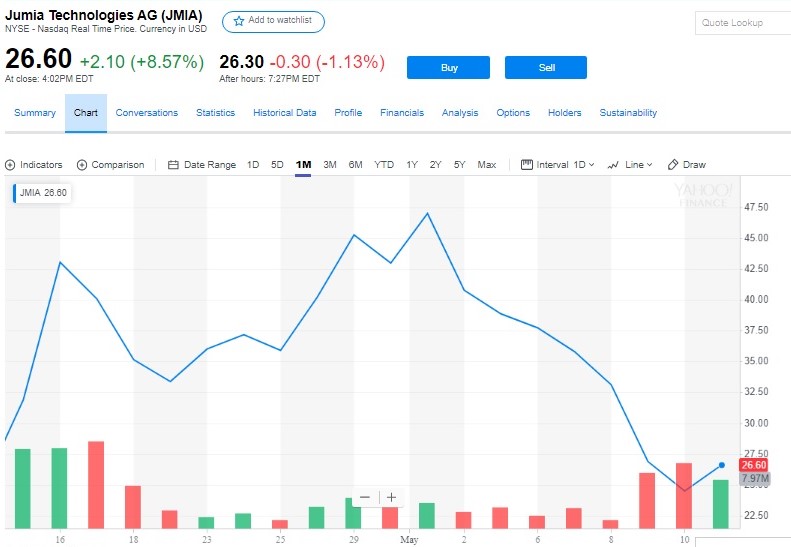
The company’s stock price has continued to decline since Jumia’s August earnings call (and sales-fraud disclosure) to $6.52 at close Monday.

That’s 50% below the company’s opening in April and 80% below its high before Citron’s Research brief and Andrew Left’s short-sell position.
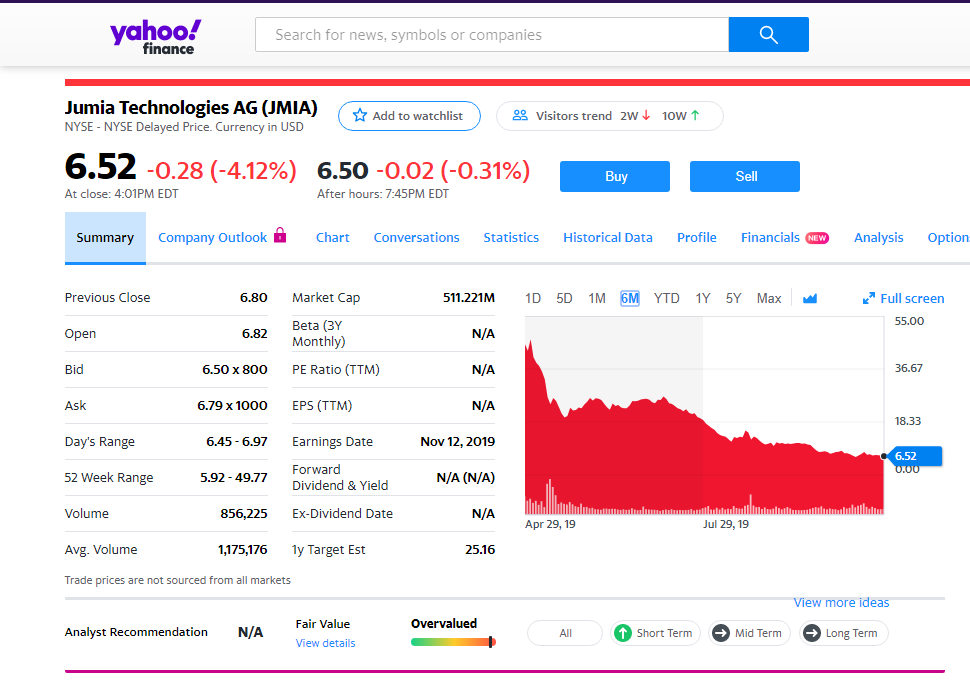
Jumia Stock Snapshot To October 28 2019

Jumia’s core investors appeared to show continued confidence in the company this month, when there wasn’t a big selloff after the IPO lockup period expired.

Even so, Jumia’s 3rd quarter earning’s call on November 12 could be a bit make or break for the company with investors given all the volatility the e-commerce venture has faced since listing and its rapid loss in value.

As a public company now, the most direct way for Jumia to revive its share-price (and investor confidence) would be demonstrating it has reduced losses while maintaining or boosting revenues.

Of course, that’s the prescription for just about any recently IPO’d tech venture.

What Jumia may want to evaluate pre-earnings call is the extent to which its own sales-fraud disclosure and Andrew Left’s allegations are still being mashed together and impacting brand-equity in Africa and investor confidence abroad.

From there it could be wise to address both head on and explain — in a way that is as easy as possible for people to understand — how the two are not the same and don’t have a bearing on Jumia’s brand or business model.


28 Oct 2019

Providing emergency and security services to employees, Base Operations raises $1 million

In 2017, when a destructive earthquake struck Puebla, Mexico, sending shockwaves to Mexico City and destroying buildings in the nation’s megalopolis and its surrounding suburbs, both public and private emergency services sprung into action.

For multinational corporations operating in the city it was a test of their internal support services, which were established to meet the “duty of care” requirements that multinationals have to their foreign employees. That’s a minimum threshold which companies have to meet to ensure the safety of their employees.

After the Mexico City earthquake, at least one Fortune 500 insurance company found its services lacking. It took two weeks for the company to contact all of its employees and account for everyone.

So the company turned to a new Washington-based startup called Base Operations to see if they could do a better job.

Founded by a former security and risk management consultant, Cory Siskind, Base Operations uses a suite of hosted software services and a mobile applications to provide security updates to corporate customers and their employees.

The insurance company tested Base Operations’ check-in feature to see how it would perform in a simulated natural disaster and Siskind said that Base Operations had identified the location of 80% of the company’s workforce in less than two days. Over half of the company’s employees checked in within the first 24 hours.

Base Operations offers a dashboard for corporate customers to monitor their employees’ locations and for staff traveling abroad, the company has an app that provides geo-tagged alerts on potential risks based on an individual’s location.

“This is a compliance situation for companies… They have to do it,” says Siskind. “We work with a company’s chief security officers and travel security. If you send people off into an emerging market with a risk .PDF… It’s not dynamic information and it just sits in a report and nobody reads it.”

Companies with a sales or marketing team traveling around need to have some sort of tool to meet their compliance regulations and duty of care standards, says Siskind.

“We have a whole set of features that nudge towards safer behaviors to that you don’t end up getting mugged and so that you don’t end up in a situation that would be damaging to you,” she says. 

Siskind recently raised $1 million for Base Operations from investors including Glasswing Ventures, Spiro Ventures, the Latin American early stage investment firm, Magma Partners, and Good Growth Capital. Base Operations graduated from Techstars Impact Accelerator in 2018.

The money from the company’s most recent round will be used to expand the company’s sales and marketing efforts and continue its research and development.

So far, the company has three customers including the undisclosed insurance provider, the energy company Enel, and another, yet unnamed, corporation.

Base Operations provides its services in 15 cities including: Mexico City, Sao Paulo, Rio de Janeiro, Buenos Aires, Bogota, Santiago, San Juan, Puerto Rico, and San Jose, Costa Rica.


28 Oct 2019

Apple releases iOS 13.2 with Deep Fusion

Apple has released iOS 13.2 and iPadOS 13.2 for the iPhone and iPad. This update features the usual bug fixes and security improvements. But Apple is also adding a handful of new features to its operating system.

First, iOS 13.2 brings a ton of new emojis. The company now officially supports Unicode 12.0. You can now create all possible combinations of handholding couple emojis regardless of gender or skin tone. There are new accessibility-focused emojis, such as a service dog, people using wheelchairs, prosthetic arms and legs, a person with a white cane and more. There are also new animals, a yawning face and new food options.

If you have an iPhone 11 or iPhone 11 Pro, iOS 13.2 enables Deep Fusion, an image processing feature that should make your photos look better thanks to machine learning-enabled processing.

It’s also worth mentioning that you can now change the resolution and framerate of your videos in the Camera app directly.

With iOS 13.2, you can opt out of sharing Siri recordings with Apple employees and delete your Siri and dictation history. Go to Settings > Privacy > Analytics and Improvements to opt out at any time.

Finally, iOS 13.2 enables HomeKit‌ Secure Video for HomeKit-enabled camera and adds support for the newly announced AirPods Pro.

Before updating to iOS 13.2, back up your device. Make sure your iCloud backup is up to date by opening the Settings app on your iPhone or iPad and tapping on your account information at the top and then on your device name. Additionally, you can also plug your iOS device into your computer to do a manual backup in iTunes.

Don’t forget to encrypt your backup in iTunes. It is much safer if somebody hacks your computer. And encrypted backups include saved passwords and health data. This way, you don’t have to reconnect to all your online accounts.

Once this is done, you should go to the Settings app as soon as possible to get in the queue. Navigate to ‘Settings,’ then ‘General’ and then ‘Software Update.’ Then you should see ‘Update Requested…’ It will then automatically start downloading once the download is available.

28 Oct 2019

Uber Money is Uber’s new team focused on financial products and services

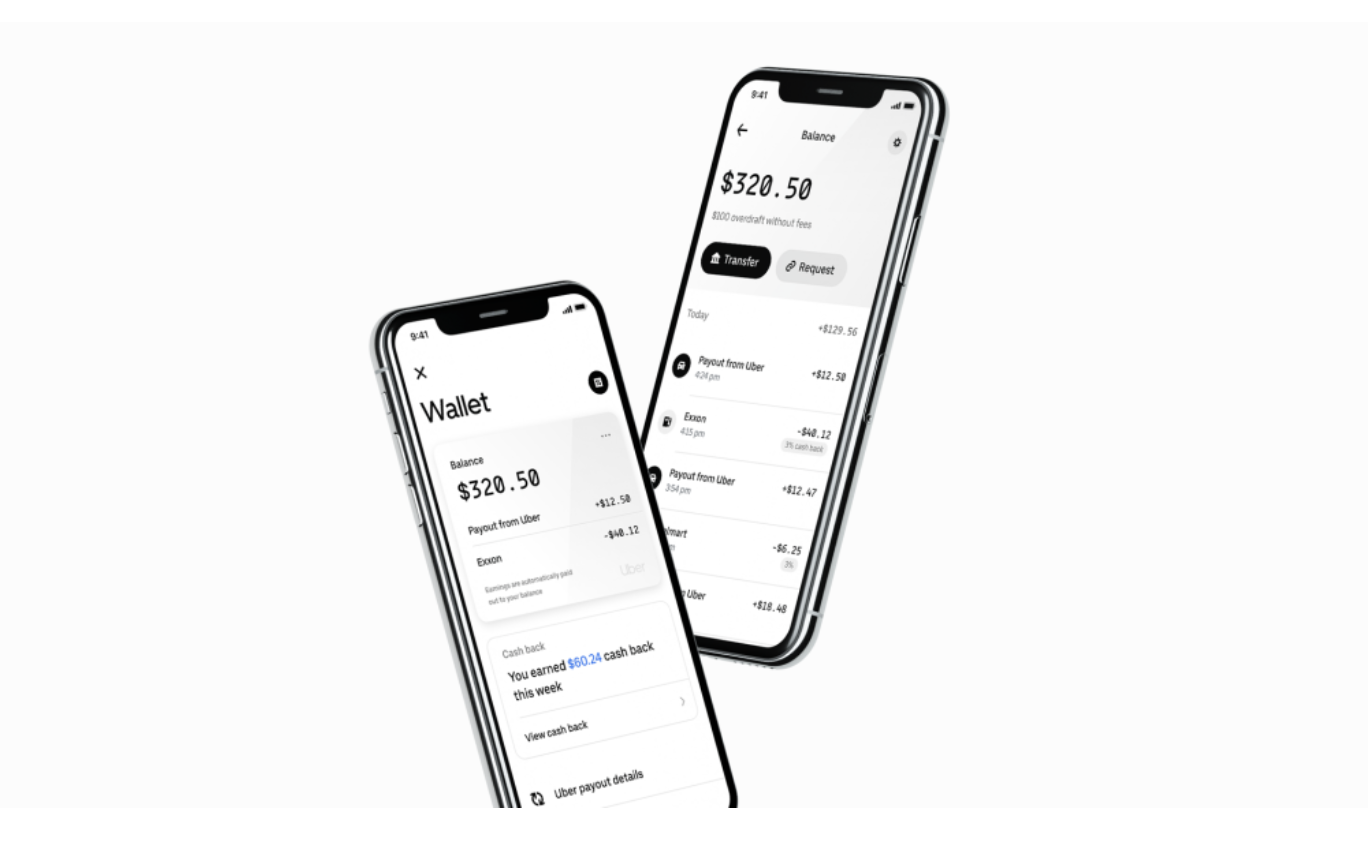
Uber is further exploring the financial services business with the creation of a new team, Uber Money. Uber Money is now responsible for all-things pertaining to financial products designed to support drivers, Uber Money Head Peter Hazlehurst wrote in a blog post today.

Within the driver app, drivers will soon have access to Uber Wallet so that they can more easily track their earnings and spending history, as well as manage and move their money. Wallet will start rolling out in the driver app in the coming weeks, and will later be available in the Uber and Uber Eats apps.

Screen Shot 2019 10 28 at 10.13.10 AM

In sum, Uber Money currently oversees Uber’s credit card, debit card, wallet for drivers, Uber Pay, Uber Cash and other financial products Uber may deploy down the road. This year, the team also plans to integrate the Uber debit account and debit card for drivers in the U.S. into the driver app. Down the road, Uber says it will make this available to drivers in other countries. Additionally, Uber will start offering cash back on gas starting at 3% and up to 6% for the highest tier of Uber Pro drivers.

Uber has long been at odds with its drivers when it comes to pay. The last several years have been filled with lawsuits, protests and a legislative win for workers in California regarding how Uber classifies its drivers. While financial tools may be helpful to drivers, it does not fix the core issue at hand for the many drivers who want to be treated as employees rather than 1099 independent contractors.

28 Oct 2019

NBCUniversal rolls out its ShoppableTV ads

NBCUniversal has been testing out a new ad unit that allows viewers to buy — directly from their phone — products featured on the show they’re watching.

We’ve written about other companies creating shoppable video technology, but that usually means adding links or other elements to online videos — very different from NBCU’s ShoppableTV, which connects the programming on your living room TV with a shopping experience on your phone.

The company is using QR codes to achieve this. An ad with the code will pop up at on the bottom of the screen during relevant moments of the show. If you’d like purchase the product, you can point your camera at the code and you’ll end up following an affiliate link to the sponsor’s e-commerce site.

So far, NBCU has tested this out with sponsors like Lacoste during the French Open, Walmart on Today, Roli on NBC’s “Songland” and Zwift during the Tour de France. In some cases, the announcers are explicitly pointing viewers towards the ad. In others, it just shows up in the bottom third of the screen.

Now NBCU is officially taking the ad unit out of beta testing, and plans to start using it across its unscripted programming, including Sunday Night Football.

Lumi21

The company also said it’s already been reaching tens of millions of viewers with the unit, resulting in an average conversion rate that’s nearly 30% higher than the e-commerce industry benchmark, and in 10% growth rates on social media.

When I discussed the format with NBCUniversal executives Josh Feldman and Collette Winn, they argued that not only are the ads performing for advertisers, but also delivering a better experience for viewers, too.

“You’re not searching for the item … what you’re seeing is what you’re able to buy,” Winn said. “It’s not in your face. It’s brought in really seamlessly.”

And if you’re worried about product ads suddenly flooding your favorite shows, Winn noted that it will be limited to one brand per program.

She also said NBCU is experimenting with how these formats might show up in different devices — for example on an internet-connected TV, where the ad might incorporate more interactions with the remote.