Category: UNCATEGORIZED

28 Oct 2019

Kandji announces $3.375M seed for sophisticated Apple MDM solution

Kandji, a new Apple MDM solution that promises to go far beyond Apple’s base MDM protocol and other solutions on the market, emerged from stealth today with a $3.375 million seed investment. The product is also publicly available for the first time starting today.

The round, which closed in March, was led by First Round Capital with help from Webb Investment Network, Lee Fixel, John Glynn and other unnamed investors.

Company co-founder and CEO Adam Pettit says the company’s founders have a deep knowledge in Apple. They all worked at Apple before leaving to run an Apple IT consultancy for more than 10 years.

He said that while they were at the consultancy, they developed a proprietary stack of tools to help with highly sophisticated Apple device deployments at large organizations, and it occurred to them that there was an unserved market opportunity to turn that knowledge into a new product.

Two years ago they sold the consultancy, took that knowledge and built Kandji from the ground up. Pettit says the new product gives customers access to a set of management tools that they would have charged six figures to implement at that their old firm.

One of the key differentiators between Kandji and other MDM solutions, or even Apple’s base MDM functionality, is a set of one-click compliance tools. “We’re the only product that has almost 200 of these one click policy frameworks we call parameters. So an organization can go in and browse by compliance framework, or we have pre built templates for companies that don’t necessarily have a specific compliance mandate in mind,” he said.

The parameters have all of the tools built in to automatically deploy a set of policies related to a given compliance framework without having to go through and manually set all of those different switches yourself. On the flip side, if you want to get granular and create your own parameters, you can do that too.

He says one of the reasons he and his partners were willing to give up the big dollar consultancy was because they saw a huge opportunity for firms that couldn’t afford those kind of services, but still had relatively large Apple device deployments. “I mean there’s a big need outside of just the specific kind of sophisticated compliance work we would do [at our previous firm]. We saw this big need in general for an Apple MDM solution like ours,” he said.

After selling their previous firm, the founders bootstrapped for a year while they developed the initial version of Kandji before seeking funding. Today, the company has 16 employees and a set of initial customers, who have been testing the product.

28 Oct 2019

Stealthy search startup, Searchable.ai snags $2M seed

Searchable.ai wants to solve an old problem around search in the enterprise. The stealthy startup announced a $2 million seed round.

Defy Partners led the round with a slew of other participants including Paul English, co-founder of Kayak; Wayne Chang, co-founder of Crashlytics; Brian Halligan, co-founder and CEO of HubSpot; Jonathan Kraft, president and COO of the Kraft Group and the New England Patriots; MIT Prof. Edward Roberts; Eric Dobkin, founder and chairman emeritus of Goldman Sachs Global Equity Capital Markets and Susquehanna International Group.

The prestigious group of investors saw that Searchable.ai is trying to solve a big problem around findability. Company co-founder Brian Shin says that knowledge workers have been struggling for years trying to find a way to better utilize all of the information that exists within an organization.

“The problem we’re really solving is that there are a trillion documents created every year in Microsoft Office, Google Docs, etc., and it’s really difficult if you’re a knowledge worker to find what you need in terms of either a document, an asset like a slide or worksheet within a document or the actual answer to a question that you have,” Shin said.

The questioning part could be particularly valuable because it lets you ask a natural language question and find a specific piece of information within a document, rather than just the document itself. “Let’s say you have a giant spreadsheet, you could actually ask a question of all your spreadsheets and find the atomic unit of knowledge that you’re actually looking for,” he said.

The product itself is not quite ready for the big reveal, but if it works as described, it will be a huge boost to knowledge workers who have continually struggled to find a nugget of information they know is out there across the myriad documents in an organization.

Shin is an experienced entrepreneur, who has helped launch and sell three companies. He reports he has raised $100 million in venture capital and most recently has worked as a venture capitalist himself, but he saw this opportunity and decided to jump back into the development side of things.

He admits he’s giving up a lot to go back to the startup lifestyle, but he and his co-founders decided this was worth it. “You know the draw, the compulsion to do another startup is is really what this is about. So my three other colleagues and I have have all started companies before and we’re all giving up big jobs to do this, and I’m so excited about the team and the massive opportunity.”

He promised more details about the company and the solution would be coming early next year.

28 Oct 2019

U.S. Air Force experimental test spaceship lands after a record 780 days in orbit

The X-37B, a test vehicle operated by the U.S. Air Force, has returned from orbit and landed successfully at NASA’s Kennedy Space Center in Florida, over two years after it originally launched on its latest mission aboard a SpaceX rocket.

The X-37B Orbital Test Vehicle, as its formally known, was on its fifth mission, which involved – well, we don’t really know. The whole point of X-37B is that its mission is mostly clandestine, so we likely won’t ever know the full particulars of what its been up to in its orbital jaunts. But we do know that it’s demonstrating technologies for USAF use, and specifically to help them develop a “reliable, reusable, unmanned space test platform.”

We know from the Air Fore that that means running a battery of test across systems including avionics, guidance, thermal shielding, propulsion, spacecraft re-entry systems and more. We also know that it’s around 30-feet long, like a kind of shrunk-down Space Shuttle, and we know that it’s built by Air Force contractor Boeing. And since this is the Air Force we’re talking about, we also know that the goals of any experiments run in the spaceplane are likely going to ramp up to defence and military use, which is a logical thing for the U.S. to pursue, given how quickly space is becoming a relative boom town, and how much money other states are spending on in-space defence and militarization.

The X-37B will spend some time on the ground after its record-breaking 780-day flight, and then will launch again sometime in 2020 from Cape Canaveral Air Force Station.

28 Oct 2019

NVIDIA’s new Shield TV wins the Android TV market with amazing 4K upscaling

NVIDIA has a new family of Android TV-based streaming devices, as tipped early via a couple of leaks from online stores. The new NVIDIA Shield TV ($149) and Shield TV Pro ($199) replace the existing Shield TV generation of hardware, which debuted in 2017. Both new Shields offer new Tegra X1+ processors, which outperform the predecessor chip by about 25 percent, and make possible one of this Shield’s new highlight features: AI-powered 3K up-conversion for HD content.

Both Shield TV and Shield TV Pro also support Dolby Vision HDR content, as well as Dolby Atmos surround sound. The differences between the two devices center mainly around physical design, with the Shield TV adopting a cylindrical tube design, and the Shield TV Pro looking more like its predecessor (basically a small set-top box form factor). The Shield TV Pro also gets more RAM (3GB vs. 2GB), more storage (16GB vs 8GB) the ability to transcode 1080p streams when acting as a Plex Media Server, support for the SmartThings Link to turn it into a SmartThings smart home hub and advanced Android gaming support, along with two USB 3.0 ports.

Shield TV Review
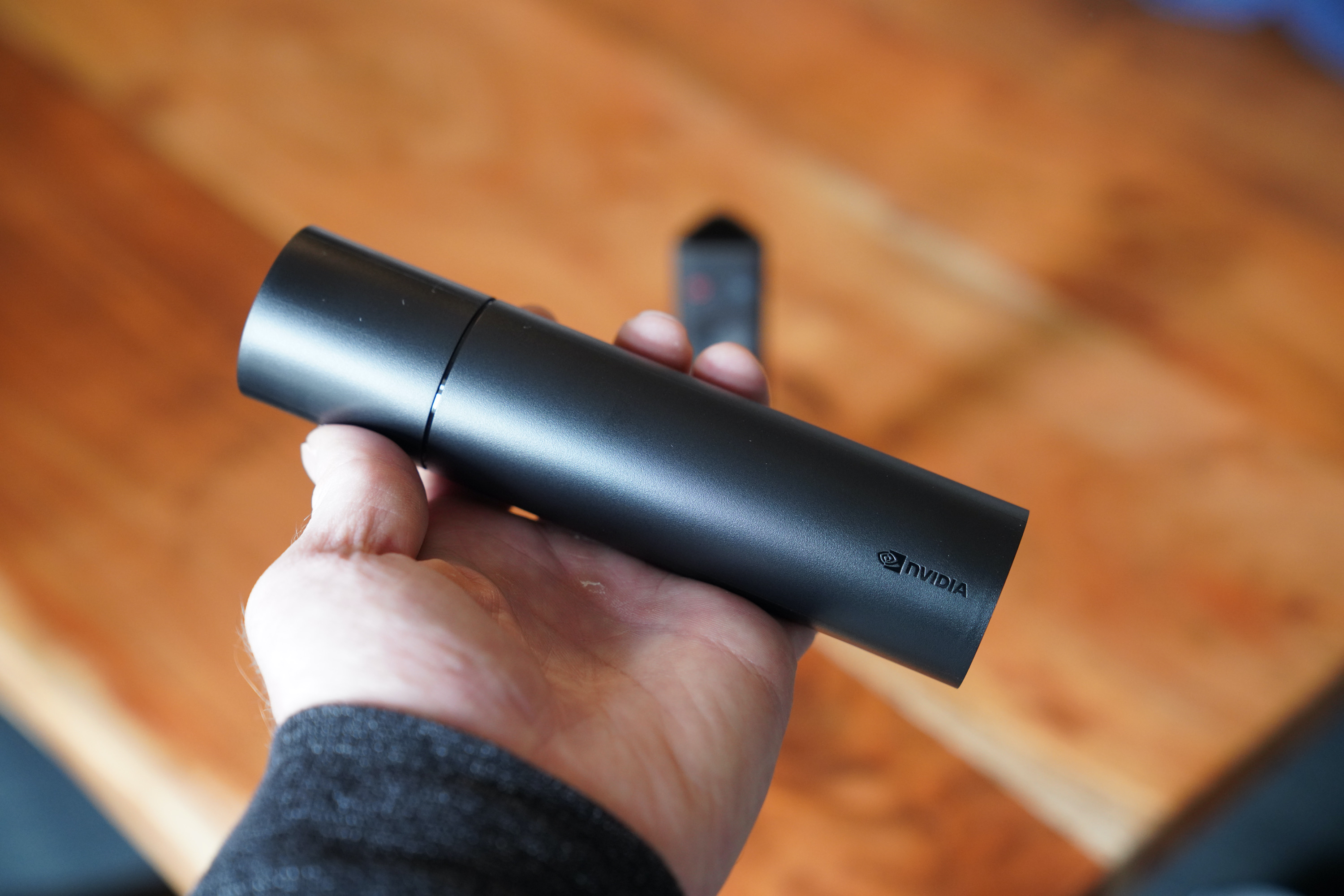
Nvidia Shield TV 4I’ve been using the Shield TV for around a week now, and this is definitely a worthwhile upgrade for anyone looking to get the best possible experience available in an Android TV home theater device. NVIDIA has clearly done a lot to survey the market, look at everything that’s come out in the two years since it last updated this hardware, and delivery generational improvements that help it stand out from the crowd in meaningful ways.

Android TV now ships on a lot of smart TVs, and there have been many generations of Roku and Amazon Fire TV devices introduced since we last saw a new Shield from NVIDIA – all of which adds up to needing to really do something special to ask for $149.99 from consumers to invest in a new dedicated streaming media box. NVIDIA has always delivered a lot of value for the upfront cost of their streaming hardware, with consistent updates over the life of the devices that add plenty of new features and improvements. But this new hardware packs in some excellent features not possible with software alone, and that are also unique when you look across the options available in this category.

AI Upscaling

Chief among the additions NVIDIA has made here is the AI upscaling made possible with the new Tegra X1+ chip. You might have heard of ‘upscaling’ before, and you might even think that your TV already handles that well. But what you probably don’t know is that often content from streaming media sources doesn’t actually get upscaled by your TV, which means if you have a 4K display but are often watching YouTube or other services with large quantities of non-4K content, you might not be getting the most out of your hardware.

NVIDIA has addressed this with on-device 4K upscaling, which is powered by on-device machine intelligence that has been trained on a deep neural network to turn both 720p and 1080p signals into much sharper, 4K-equivalent images. Having used this on a variety of content, including media streamed from YouTube, non-4K Netflix content and stuff from Plex, I can attest to its ability to produce visibly sharper images that look great, especially on my LG C8-series OLED 4K TV.

The Shield TV’s tech is trained on popular movies and TV shows, and so does a remarkably good job of guessing what the 4K version of the HD image it’s looking at should properly look like. Considering that there’s a ton of content out there that hasn’t been made available in 4K, despite now a lot of TVs supporting that resolution, this is a big advantage for NVIDIA, and again one that they uniquely offer among their peers.

Dolby Everything

These new Shields also support Dolby Vision and Dolby Atmos, across more services than anything else out there on the market right now. These HDR and surround sound modes really do offer the best audio-visual experience you can get, provided you have TVs and audio output equipment that supports them, but what you might not know is that even on other streaming hardware that technically support these standards, they might not be supported across all services.

Shield TV supports Dolby Vision and Dolby Atmos across Netflix, Amazon Prime Video, Disney+, Vudu and Movies Anywhere, so you should be getting the most out of these technologies, too. I asked about the forthcoming Apple TV+ service, which is rolling out to Roku devices, for instance, but NVIDIA didn’t have any news to share just yet – it does seem like it’s a good idea to stay tuned on that front, however.

Like AI Upscaling, Dolby support across everything might not seem like a big competitive advantage, but it’s absolutely a decision tipping factor for people who are looking for the best possible A/V experience in a home streaming device.

New and Improved Remote

Nvidia Shield TV 5NVIDIA is shipping the new Shield TVs with a brand new redesigned remote in the box. There’s a dedicated ‘Netflix’ button, which is a nice touch, but the remote overall is just an improvement over both Shield remotes past, and other competing remotes, in every way. It’s powered by AAA batteries (included) and it has a new pyramid-shaped body design that makes it easier and more pleasant to hold.

There are also lots of new buttons! Yes, NVIDIA actually put buttons on their remote control – what a novel concept! Whereas the remote from the last generation seemed to be adopting a lot of the questionable choices Apple has long been making on their remotes, this one feels like it’s made with humans in mind, with dedicated play/pause, back, forward, volume and other buttons. A wealth of buttons.

This remote also has automatic backlighting, which will serve you well when using it in a darkened room. Because of the bulkier body design, it also stands on its end, and there’s a lost remote finding function, too. Chalk up a win for human-centric design with this remote, it’s a joy to use.

Simple physical design

The design of the device is not flashy, but it is smart. There’s an Ethernet port, a power connector, an HDMI port and a micro SD card slot, dividing across both ends of the tube. This makes it perfect for placing behind a console or media bench, on the ground or next to your other power cables.

[gallery ids="1904249,1904250,1904246"]

It still provides hardwired connectivity options in case you do things like in-home game streaming or GeForce NOW cloud gaming, and it offers expandable storage via the microSD slot.

Bottom Line

NVIDIA’s new Shield is a great option for anyone looking for a versatile streaming device, with access to all of Google’s Play Store apps for Android TV, and support for the latest AV standards. It’s real bonus advantage is that AI upscaling, however, which is something that NVIDIA is uniquely poised to do well, and which goes a long way in making that $149.99 price point seem like a tremendous value.
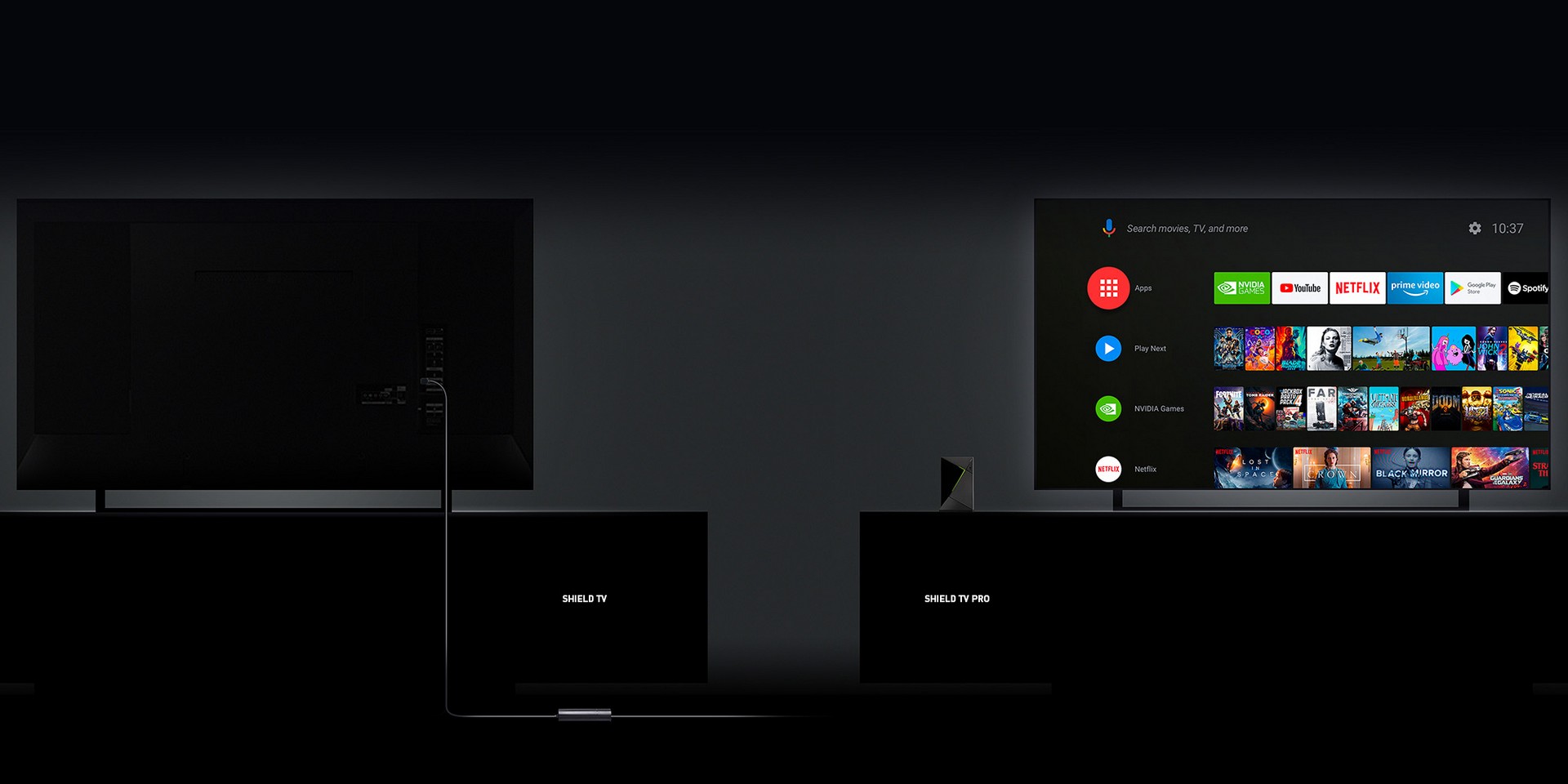
SHIELD TV Family

28 Oct 2019

Billionaire clothing dynasty heiress launches Everybody & Everyone to make fashion sustainable

Veronica Chou’s family has made its fortune at the forefront of the fast fashion business through investments in companies like Michael Kors and Tommy Hilfiger . But now, the heiress to an estimated $2.1 billion fortune is launching her own company, Everybody & Everyone, to prove that the fashion industry can be both environmentally sustainable and profitable.

There’s no argument about the negative impacts of the fashion industry on the environment.

The textiles industry primarily uses non-renewable resources — on the order of 98 million tons per year. That includes the oil to make synthetic fibers, fertilizers to grow cotton, and toxic chemicals to dye, treat, and produce the textiles used to make clothes. The greenhouse gas footprint from textiles production was roughly 1.2 billion tons of CO2 equivalent in 2015 — more than all international flights and maritime shipments combined (and a lot of those maritime shipments and international flights were hauling clothes).

The litany of catastrophes that can be attributed to the clothing industry extends to pollution as well. About 20% of industrial water pollution globally can be traced to the dyeing and treatment of textiles — and microplastics from polyester, acrylic and nylon are polluting the world’s oceans.

Meanwhile, the rise of fast fashion has encouraged consumers to accelerate waste. Roughly one garbage truck full of clothes is landfilled around the world every second, according to a 2017 report from the Ellen MacArthur Foundation. That means consumers are throwing away around $400 billion worth of valuable goods every year as low prices and more “seasons” create an illusion of disposability.

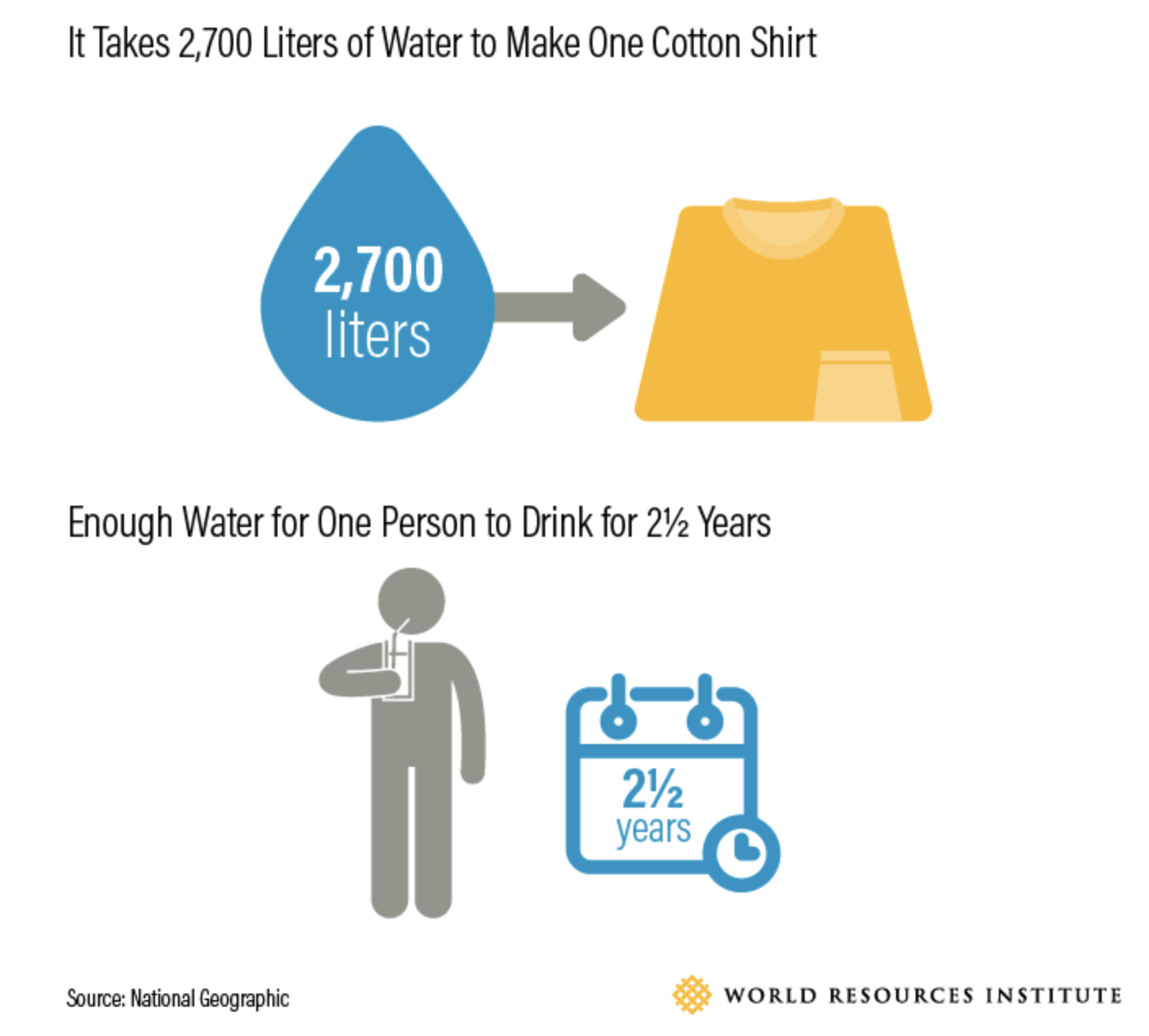
Screen Shot 2019 10 27 at 10.21.17 PM

Image courtesy of World Resources Institute

As the fashion business has expanded so has the wealth of the Chou family. South Ocean Knitters, the knitwear manufacturer started by Chou’s grandfather was responsible for one of the first foreign investments into mainland China in 1974. It is now one of the largest suppliers of knitwear in the world and together with the Hong Kong manufacturer Li & Fung, is behind the Cobalt Fashion Holding, conglomerate.

And her father, Silas Chou, made millions as an investor in Michael Kors and Tommy Hilfiger. As an executive at Iconix Brand Group China, Veronica Chou played a role in the acceleration of the industry — bringing American brands to Chinese consumers. Chou also served as the cofounder of the Beijing-based private equity fund China Consumer Capital and a director of Karl Lagerfeld Greater China.

For Chou, an understanding of the environmental toll that the family business was taking on the planet began six years ago — a few years before Iconix Brand Group acquired the China subsidiary she had co-founded with her father in a transaction reportedly worth $56 million.

It was around the time that Chou had her children, she says, that she realized the importance of making a brand that was both environmentally sustainable and inclusive.

“It was six years ago I started learning about sustainability and five years ago that I said that I needed to have a sustainable brand,” says Chou. 

Since that revelation Chou dove into the world of sustainable manufacturing head-first. Through her family’s investment vehicles she has worked with companies like Modern Meadow, which uses bio-engineering to make leather goods in a lab. Chou has also led investments in Thousand Fell, a soon-to-launch manufacturer of fully recyclable shoes; Dirty Labs, which is developing more sustainable laundry cleaning products; and Carbon Engineering, which is developing a direct air capture technology for carbon dioxide.

Everybody & Everyone applies the lessons that Chou has learned about sustainability to a new fashion brand that she hopes can serve as a model for how to weave sustainability into every facet of the industry.

The new brand, which sells women’s clothes for every size from 00 to 24 and at prices ranging from $18 to $288 (most fall in the $50 to $150 range, given a quick scroll through the company’s new website) partners with companies like Naadam and Ecoalf for sustainable cashmere and recycled fabrics made from plastic.

“For our brand, recycled is a big story for us,” says Chou. “Our t-shirts, our socks, our packaging, our mailers, our labels, our stickers are all made from recycled materials that can be recycled again.”

The company’s attention to its environmental impact also extends to its supply chain. “Most of our fabrics are knit close to where our garments are manufactured. That is definitely reducing our carbon footprint,” says Chou. “I put an emphasis on having factories in America… our denim is manufactured in America and in the future we’re looking at t-shirts and athletics to be manufactured in America.”

Some clothes are also made with fabrics that have recycled silver in them — so that the clothes can be worn multiple times without smelling or the need for a wash. 

Digital printing is used in place of screens to prevent tons of water waste, the company said, and several of the company’s fabrics are not dyed at all. instead, the company relies on an upcycling process by separating recycled fibers mechanically by color.

Everybody & Everyone has also partnered with the organization One Tree Planted to plant a tree for each purchase that’s made with the company. In addition, the company has calculated its carbon footprint from all of its pre-launch activities and has bought and retired offsets to balance its emissions, Chou says.

“I started building Everybody & Everyone from the ground-up, first by getting the best team in place then by finding the right vendors, manufacturers and partners who were already making strides in the sustainability space,” Chou said in a statement. “I wanted this brand to be for every woman, so body positivity, inclusivity and sustainability were going to be the backbone of everything we did. We then constructed the brands sustainable & technical pillars, which consist of activation, recycled, dyeing & printing, naturals done better, bio-based fibers and end use to ensure our products would minimize negative impacts. We are sustainable down to the labels sewn into each garment.”

28 Oct 2019

Attending Disrupt Berlin? Have top investors critique your pitchdeck on stage

Having trouble pitching your startup to investors? This year at Disrupt Berlin, we’re going to help you solve that problem. We’ve invited a panel of experts to tear down real pitchdecks live on stage, to help any founder in the room learn about the right way to tell a startup’s story.

If you’re attending, you can apply to have your pitchdeck chosen for the stage — just fill out this form.

We had a packed house for the first teardown we did, at Disrupt SF this year. We’re excited to bring it to you. Investors on stage will include Sitar Teli, a London-based cofounder and managing partner at Connect Ventures, who has helped make more than 40 investments across Europe including Fiit, Kheiron, Citymapper, Typeform, OurPath, and Soldo, and Karen Stafford, a Berlin-based director at Intel Capital who focuses on European startups and has invested in companies including iZettle, dataArtisans, Elmodis and Volocopter.

Also joining us will be Russ Heddleston, the founder and CEO of San Francisco-based Docsend, a document management company that helps thousands of founders in Silicon Valley and around the world track things like how investors are responding to their decks. By collaborating with his users, Heddleston and his company have gained new insights into major trends in what works (and what doesn’t) in venture funding pitches — like what time of year is actually best for pitching. Check out his articles on TechCrunch for more.

To have your deck considered, just fill out this form. If the panel picks yours to tear down, we’ll provide you with a free ticket to any TechCrunch event in 2020.

Disrupt Berlin runs December 11 and December 12. Tickets are available right here!

28 Oct 2019

Instagram expands ban on suicide content to cover cartoons and memes

Instagram has expanded a ban on graphical self-harm imagery to include a broader range of content depicting suicide, including fictional illustrations of self-harm and suicide methods such as drawings, cartoons and memes.

“This past month, we further expanded our policies to prohibit more types of self-harm and suicide content. We will no longer allow fictional depictions of self-harm or suicide on Instagram, such as drawings or memes or content from films or comics that use graphic imagery,” writes Instagram boss, Adam Mosseri, explaining the latest policy shift. “We will also remove other imagery that may not show self-harm or suicide, but does include associated materials or methods.”

Earlier this year Mosseri, met with the UK’s health secretary to discuss the platform’s policy towards self-harm content. The company has faced high level pressure in the country following a public outcry after the family of Molly Russell, a 14-year-old UK schoolgirl who killed herself after viewing suicide content on Instagram, went public with the tragedy by talking to the BBC.

In February the Facebook-owned social media platform announced that it would prohibit graphic images of self-harm, such as cutting, and restrict access to non-graphic self-harm content, such as images of healed scars — by not recommending it in searches.

At the time it also suggested it was toying with the idea of using sensitive screens to blur non-graphical suicide content, saying it was consulting with experts. In the event it appears to have decided to go further — by now saying it will also remove fictional content related to self-harm, as well as anything that depicts methods of suicide or self-harm.

Instagram says it’s doubled the amount of self-harm content it has acted on following the earlier policy change — with Mosseri writing that in the three months following the ban on graphic images of cutting it “removed, reduced the visibility of, or added sensitivity screens to more than 834,000 pieces of content”.

While more than 77% of this content was identified by the platform prior to it being reported, he adds.

A spokesperson for Instagram confirmed to us that the latest policy shift is in effect.

Although it’s not clear how long it could take for it to be effectively enforced. Mosseri told BBC News: “It will take time to fully implement,” adding that: “It’s not going to be the last step we take.”

In his blog post about the policy change, the Instagram boss writes that the new policy is “based on expert advice from academics and mental health organisations like the Samaritans in the UK and National Suicide Prevention Line in the US”, saying: “We aim to strike the difficult balance between allowing people to share their mental health experiences while also protecting others from being exposed to potentially harmful content.”

“Accounts sharing this type of content will also not be recommended in search or in our discovery surfaces, like Explore. And we’ll send more people more resources with localized helplines like the Samaritans and PAPYRUS in the UK or the National Suicide Prevention Lifeline and The Trevor Project in the United States,” he adds.

He goes on to argue that the issues involved are complex and “no single company or set of policies and practices alone can solve”, while defending continuing to allow some suicide and self-harm content on Instagram by saying “experts tell us that giving people a chance to share their most difficult moments and their stories of recovery can be a vital means of support” and that “preventing people from sharing this type of content could not only stigmatize these types of mental health issues, but might hinder loved ones from identifying and responding to a cry for help”.

“But getting our approach right requires more than a single change to our policies or a one-time update to our technology. Our work here is never done. Our policies and technology have to evolve as new trends emerge and behaviors change,” he adds.

28 Oct 2019

Duffel raises $30M led by Index Ventures to disintermediate legacy travel platforms

Huge travel platforms that run airline booking systems like Sabre and Amadeus were invented eons ago and are so large and cumbersome that innovating with them is no easy feat. In the same way that challenger banks have come along to re-invent the banking software Starck, UK startup Duffel has done the same in the travel market, linking up airlines directly with travel agents with a 21st Century platform.

Today it’s announced a $30m Series B funding round from investors Index Ventures, and they were joined by existing investors Benchmark Capital and Blossom Capital . Its airline partners already include American Airlines, British Airways, Lufthansa Group, Aegean Airlines, Vueling, and Iberia.

Duffel will use the new funds to hire more engineers and increase its broader team. It is focusing on expanding in North America and Europe, with its first customers drawn from the US, UK, Canada, France, Germany and Spain.

Duffel enables travel agencies to plug in directly to airlines’ reservation systems via an API so that they can pull real-time flight offers, make bookings, access live seat availability, and buy extra services. This means new digital and mobile app-based travel agencies – Duffel’s target market – can bypass the long lead times and high costs associated with the legacy flight booking systems. They are then able to see live seat availability from some of the world’s biggest airlines, as well as additional offers on in-flight meals or luggage allocations.

Steve Domin, co-founder and CEO of Duffel, said: “A new breed of online agencies want to access reservation systems quickly and seamlessly. By reinventing the underwiring between online agents and airlines we can transform the world of travel booking and reduce barriers to entry for innovative new companies that are offering travelers a whole new way of creating a holiday or trip.”

In the same way that banking systems have been opened up by deregulation, the International Air Transport Association (IATA) created a new industry standard, known as New Distribution Capability (NDC), which transformed the way air products are retailed through the use of modern XML technology. The problem was, the legacy platforms didn’t take much interest. Duffel has obviously come along to take advantage of that.

Jan Hammer, partner at Index Ventures, said: “We are incredibly impressed by the Duffel team, who we have supported since the days of their seed funding. There is an opportunity here to transform the booking experience for travelers and ease many of the pain points in the industry. From the launch of budget airlines to sharing economy businesses like Airbnb, travel has changed and Duffel will provide the tools, built from the ground up, that make the next wave of innovation possible.”

Speaking to TechCrunch, Domin said: “Historically it’s been very hard to sell travel products to agencies. Integrations are hard. There is too much complexity. We are bundling it all into a very simple API and 2 hours later you can have it running on a site or a mobile app.”

“We are connecting directly to airlines’ reservation systems. If you go on a site that uses Duffel, we will forward – to the airline – the right search request, and the airline generates the offer in real-time.”

“Airlines were trying to modernize their booking systems with Amadeus and Sabre but they have not moved quickly on adapting to what the airlines wanted. When the IATA came up with its new XML platform, no-one wanted to use it. So we did.”

Is Duffel a threat to the legacy platforms? “Potentially,” he says, “but I don’t think they see it that way. They don’t see the benefit of engineering and developer experience. In a way, I hope we will be a threat but I don’t think we are right now.”

He said Duffel has future plans to expand to other products like trains and hotels.

28 Oct 2019

Kenya’s Twiga Foods eyes West Africa after $30M raise led by Goldman

Kenya’s Twiga Foods has raised a total of $30 million from lenders and investors led by Goldman Sachs.

The B2B food distribution company financed $6.25 million of the funding in convertible debt and $23.75 million in equity, classified as a Series B round. IFC, TLcom Capital, and Creadev joined Goldman on the VC side.

Twiga will use the funds to set up a distribution center in Nairobi and deepen its conversion to offering supply chain services for both agricultural and FMCG products.

The Nairobi based company will invest in expanding into more cities in Kenya, including Mombasa. Twiga is also targeting Pan-African expansion by third quarter 2020.

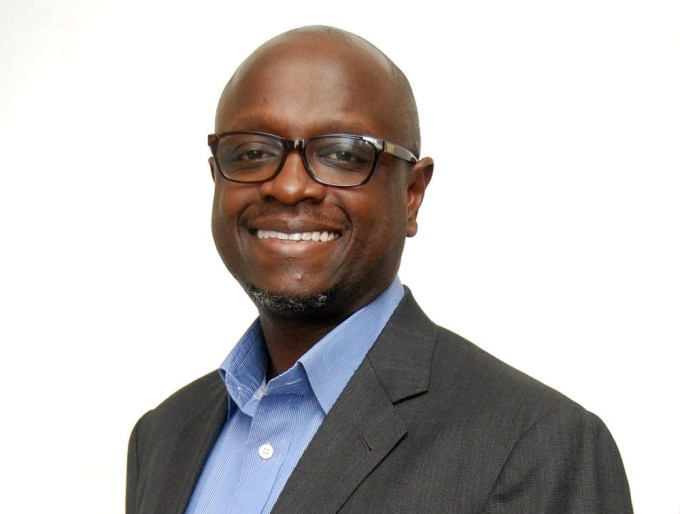
“We’re working on French West Africa…we see significant opportunity in those markets,” Twiga CEO Peter Njonjo told TechCrunch. The company will name the new country (or countries) in the following year, he added.Peter Njongo Twiga Foods CEO

Goldman Sachs confirmed to TechCrunch its lead on Twiga’s Series B funding. The U.S. based finance firm has backed several African startups, including e-commerce venture Jumia and South African fintech startup Jumo.

Twiga’s financing comes 11 months after a $10 million raise and announcement it would create additional revenue streams by moving into B2B supply chain for FMCG and other consumer products.

Prior to this, Twiga focused primarily on agricultural goods and connecting the product of farmers more efficiently to marketplaces.

The venture has moved quickly on diversifying its supply-chain product mix. “We’re not just doing fruits and vegetables…I’d say we’re at 50/50 now between FMCG and fresh,” said Njonjo.

“We’ve pivoted a bit as a company…we see our purpose as an organization around what I would call aggregating the informal retail, then using technology, and then using that buying power to essentially provide lower, better cost goods across cities,” he said.

Co-founded in Nairobi in 2014 by Njonjo and Grant Brooke, Twiga Foods serves around 3,000 outlets a day with produce through a network of 17,000 farmers and 8,000 vendors. Parties can coordinate goods exchanges via mobile app using M-Pesa mobile money for payment.

The company has reduced typical post-harvest losses in Kenya from 30% to 4% for produce brought to market on the Twiga network, according to Njonjo.

Transferring these gains from improved supply-chain to a wider variety of food products has upside for economies and and consumers, he believes.

“[If you] get farmers now producing at large scale and supplying into you, and manufacturers that don’t need to invest in distribution systems, it has huge benefit,” said Njonjo.

“Think about in some of these economies, if you’re spending 55% of disposable income on food, if that number were to go down to 40% — because of…gaining efficiency — what you’ve done is to release 15% for consumers to spend for other things.”

As TechCrunch reported in November, Twiga Foods’ consistent volume and revenue flow from agricultural goods provides a foundation to add other product categories to its B2B network.

“If we can build a business around fresh fruit and vegetables…It’s now much easier to lay things over that would have been very expensive to get to end retailers,” Twiga co-founder Grant Brooke said.

This could put the startup in a position to enter or supply B2C e-commerce with more favorable margins than existing players, i.e., online retailer Jumia — with high fulfillment expenses.

On that prospect, “It’s not something we”re thinking about from a strategic standpoint,” said CEO Njonjo.

But Twiga has factored for its advantages in the B2C e-commerce space. “Let me put it this way, if you’re able to serve Nairobi’s 180,000 retailers, it means that the furthest customer would be less than 2 kilometers away from any shop. That’s the power of building a B2C business on top of a B2B platform. So definitely, the potential is there,” said Njonjo.

That leaves some room for conjecture that Twiga Foods could pivot toward supplying or entering online retail in Africa.

For now the company will focus on performance metrics around its current model.

“We’re not sharing data around revenue and profitability. But…over the next 12 months as we scale, our unit economics is front and center to ensure we’re growing our margins faster than our costs,” said Njonjo.


28 Oct 2019

Koyo raises $4.9M in equity and debt to use open banking to offer loans to people with ‘thin’ credit files

Koyo, a fintech startup using open banking to offer loans to people with “thin” credit files and currently poorly served by the market, has closed $4.9 million in funding.

The round — a mixture of debt and equity funding — is led by Forward Partners, with participation from Seedcamp. Other investors include Christian Faes (founder and CEO of LendInvest), and Charlie Delingpole (founder and CEO of ComplyAdvantage).

Founded in late 2018 by ex-Frontline Ventures VC Thomas Olszewski, and launching later this year, Koyo is attempting to tackle the problem whereby people without much of a credit history, such as migrants or those who have never taken credit or aren’t the main bill payer, aren’t able to secure a loan.

And even if they are, the financial products they’ll typically get access to often charge excessive fees and have an extremely high interest rate.

By using open banking data to better assess risk based on a person’s up-to-date transaction history, the company thinks it can offer something a lot more competitive.

“If someone is new to the country or otherwise has a thin credit file it can be difficult for that person to access credit,” says Olszewski. “For example, if you’ve been in the country for a year or two and you’d like to get a personal loan, the types of loans that would be offered to you would be payday loans (1,000%+ APRs) or longer term loans in the 50-99% APR range that may require a guarantor”.

The reason is because these types of customer have little or no information in their credit file, and the vast majority of lenders rely on the three main bureaus (Equifax, Experian, Transunion) to make a credit decision.

“We estimate 15-20% of the population are not captured by bureau data,” explains Olszewski. “Koyo is unique in that we require all customers to connect their current account to our platform using open banking, and we make a lending decision based on the transactions in that customers account, rather than just looking at the credit score. So, if we see the customer has regular income, has a reasonable expenditure relative to the size of their income, that customer may be eligible for a loan from us”.

With regards to competitors, Olszewski says that if you have a thin credit file (or have no file at all) and are unable to get a loan from a bank, there are providers such as Amigo Loans, and 118 Money or Sunny. However, he claims that Koyo will usually work out 50-90% cheaper on an APR basis.

“We expect our representative APR to be in the c35% range. While this may be expensive to people who have access to high street bank loans, it is a really exciting proposition for this market segment,” he adds. In addition, Koyo won’t charge late fees, early repayment fees, loan originations fees “or fees of any sort other than interest”.

Meanwhile, I’m told that Koyo is currently a “nimble” team of just 6, with 4 people in the management team. Along with Olszewski, they are CTO Guy Evans (former CTO of LendInvest), Head of Risk Kevin Allen (former CRO of Ratesetter) and Head of Marketing Peter Kent.