Category: UNCATEGORIZED

25 Oct 2019

Workplace learning platform HowNow scores $3M funding

HowNow, the workforce learning platform, has raised $3 million (£2.4m) in a “pre-series A” funding round. The round is led by Mark Pearson’s Fuel Ventures and brings the total raised by the startup to $4.5 million.

Other investors include Andy Murray OBE; Michael Whitfield and Chris Bruce (founders of Thomsons Online Benefits); Bernie Sinniah (former managing director at Citi Bank); and Alwin Magimay (a former partner at McKinsey).

Designed for organisations that want to support teams with self-directed learning and the development of “business-critical” skills, HowNow is described as an integrated learning platform that autonomously curates learning resources, “business intelligence” and market insights that live in various internal and external sources.

The idea is to bring together these different learning resources — ranging from “nuggets” of knowledge shared by existing employees to internal data to external content libraries, blogs, podcasts — and match these to different job descriptions and employee skill-sets.

This is powered by a browser extension and integrations with Slack, Salesforce, Hubspot and over 300 other apps. Machine-learning is also employed to push the right content to the right employee.

“Employers can also use HowNow to identify skills gaps within the company based on job market data, via HowNow’s real-time analytics and built-in certification,” adds the company. To achieve this, the platform claims to monitor over 20,000 job specifications to understand the in-demand skills and requirements companies are searching for.

“Based on self-review, peer-review and real-time job market data we build the user’s skill profile as they onboard the platform,” explains HowNow co-founder and CEO Nelson Sivalingam. “Once in HowNow, they see learning recommendations based on assigned learning pathways, their role, skill requirements and internal benchmarks. This content is brought together from a variety of their internal sources (G Drive, Sharepoint, CRM, etc), external sources (content libraries, blogs, podcasts, etc) and the autonomously organised knowledge shared by their peers directly on HowNow”.

Employees can then access these learning resources directly within the applications they already work with and receive contextually relevant suggestions powered by HowNow’s “AI”. “For example, they can be in Slack and search all of their learning resources directly from their using the HowNow Slack app,” says Sivalingam. “They can also convert a message from a colleague into a nugget that will get stored and autonomously organised in HowNow”.

Similarly, Sivalingam says that, via HowNow, client facing teams are able to access up-to-date product knowledge, business intelligence and market insights directly within their inbox, CRM and helpdesk, which enables them to reduce customer response times.

“Fast-growing companies like GymShark are able to capture the knowledge in the heads of their internal subject matter experts by giving them a quick and easy way to share knowledge, build a glue between scattered content, avoid repeat questions and get everyone on the same page,” he adds.

To that end, I’m told that more than 500,000 users currently use HowNow within over 125 businesses. These range from SMEs to larger organisations, across 14 different countries. A classic SaaS play, the startup generates revenue through a licence fee per user.

25 Oct 2019

StepLadder, the collaborative deposit saving platform for first-time buyers, raises £1.5M

StepLadder, another London-based startup aiming to help so-called “generation rent” get onto the housing ladder, has raised £1.5 million in seed funding.

Backing the round is Spanish banking giant BBVA and fintech VC Anthemis via the London-based venture studio the pair have partnered on. Early investor Seedcamp also followed on, in addition to unnamed angel investors.

StepLadder says it will use the new capital and support provided by BBVA/Anthemis to further develop its “collaborative finance platform”. The startup is also eyeing up international expansion.

Founded in 2015 by Matthew Addison and joined by Lucy Mullins and Mihir Bhushan, StepLadder’s collaborative deposit saving platform is designed to incentive renters to save for a deposit so that they can purchase their first home.

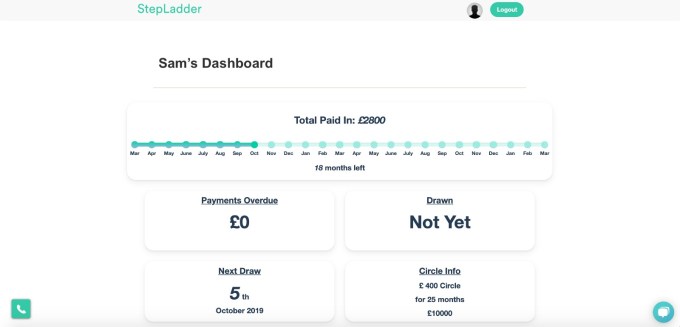
Using a financial model known as a “Rotating Credit and Savings Association” (ROSCA), StepLadder puts its members into “Circles,” whereby each individual member contributes an identical amount on a monthly basis — ranging from £25 to £1,000. A random draw then takes place each month and the winner is provided with that month’s full pot to use towards their deposit.

“For most first-time buyers, it’s really difficult to get on the property ladder,” says Addison. “Home ownership rates amongst 25-34 years olds have collapsed… [with around] 250,000 fewer first time buyers every year, for over a decade, in the U.K. alone. Raising the deposit is the biggest hurdle. At StepLadder we’re using something called a ROSCA, a form of collaborative finance where people work together in groups to help our members raise their property deposits, on average, 45% faster”.

As an example, StepLadder might match you to a £500 a month Circle for 20 months to raise £10,000. This would see it find 19 other members to be in the same Circle. “Each month the £10,000 is randomly allocated and you could be drawn at any point in that 20 months,” explains StepLadder’s Lucy Mullins. “You have to keep making your £500 a month payment for the full 20 months, so at the end everybody has paid in £10,000 and everybody has received £10,000”.

StepLadder Platform 1

To help protect the platform from being abused, Mullins says that while a member is still part of a Circle, the startup will only release the pot to their solicitor for use as a property deposit. “So, if somebody stops paying after they have been drawn then we wouldn’t release their payout until they had made catch-up payments”.

StepLadder also supports members along the house buying journey. The app lets members engage with a community of like-minded people and access group-buying discounts on services such as mortgages, solicitor fess and surveyors. The latter forms part of the company’s revenue stream.

“We introduce our members (at their request) to high quality service providers, such as mortgage brokers, lending banks, surveyors and insurance providers,” says Addison. “In return, these partners pay us fees or commissions. We offer discounts on these transaction services via the combined buying power of our members in their Circles”.

In addition, there is a small monthly fee (between 2-5%) to be part of a Circle, which Mullins says covers the cost of delivering the service.

This includes holding money securely in a client money account, a payment waiver if a member were to become sick or unemployed after buying a property with their StepLadder deposit, credit bureau costs, and the cost of a Circle host to support members on the journey”.

“We do not aim to profit from the monthly administration fees we charge members and would usually be able to save our members much more in discounts than they pay in fees,” says Mullins.

Meanwhile, StepLadder has plans to expand the use cases for Circles and evolve the platform to also cover general savings goals and targeted “big ticket items”.

Explains Addison: “In Brazil, ROSCAs are used by nine million consumers for everything from dishwashers to cars to homes. We have already begun to demonstrate this potential with both our First Step offering (smaller circles from £25 a month) and proposed partnered launches”.

25 Oct 2019

Pixelbook Go review: a Chromebook in search of meaning

Few, if any, saw coming the Chromebook’s utter dominance of the K-8 category. In hindsight, it’s easy to see why the systems have been such a success story, of course: low prices, coupled with ease of wide-scale deployment and lockdown make them a perfect fit for the classroom. Fifteen million Chromebooks were sold in 2018 alone, with schools serving as the major catalyst.

But manufacturers are looking beyond the classroom for the future of the category. Google’s facing increased competition from super-cheap PCs supported by Microsoft, and those schools that have purchased systems aren’t due for refreshes. It’s no surprise, then, that average Chromebook prices are expected to rise across the board as more companies target mainstream use.

Selling Chromebooks outside of the classroom, on the other hand, has been a bit of a tougher life. After all, finding a powerful, reasonably priced PC isn’t hard in 2019. That’s part of what made the original Pixelbook such an oddity. The $999 price point qualified the device as a premium laptop. And while ChromeOS has certainly made some major leaps in the last several years, it has never been entirely clear who the product is for.

Google Pixelbook Go

The same goes for the Pixel Slate. Both were nice enough pieces of hardware designed to communicate that there is a place for ChromeOS in the premium category. I don’t know that Google ever anticipated selling a lot of the things, so much as drawing a line in the sand — a kind of reference design mentality that gave birth to the Pixel line.

Google’s recent hardware event was, perhaps, something of a referendum on the play. The original Pixelbook, while not discontinued, has yet to get a refresh two years after launch. Heck, even the troubled Pixel Buds got a reprieve as the company previewed their successor. The Pixelbook, on the other hand, got the Go.

The new device isn’t a Pixelbook replacement — at the very least, Google’s looking to sell through its back stock, with some deep discounts earlier this year. Rather, the device seems to be more a tacit admission that the company was shooting a bit too high the first two times around.

With a $649 starting price, the Go is certainly more in line with what people are expecting from the category. Of course, I’ll admit that I got some pushback when I used the word “budget” to refer to the contrast between the Go and its predecessor. Certainly the standards for what qualifies as budget differ a great deal between the Chromebook category and the rest of the industry. As much as Google wants to push back against the notion, price has always been a key factor in adoption.
Google Pixelbook Go

With devices routinely priced less than $200, the Pixelbook Go is actually toward the high end of the spectrum. Click through the listing and you’ll discover that prices go up quite a bit from there. In fact, you can currently spec the device up to $1,399 on Google’s site, which crosses over well into the premium category for most users. It’s honestly a pretty far cry from the company’s mobile strategy, where pricing continues to be a key distinguisher from competing flagship manufacturers like Samsung and Apple.

All told, the Pixelbook Go is a more compelling proposition than the original Pixelbook, based on price alone. But there’s nothing about the device that signals a company that is confident of what it wants to do in the category. At most, the Go is Google’s way of demonstrating confidence that there exists a future for such mid-tier devices, as companies like Acer attempt to look toward a life beyond the classroom.

Google Pixelbook Go

The places where Google cut corners are almost immediately apparent. The device lacks the premium feel of the original product. Say what you will about the original Pixelbook, but it was a nice-looking device. At first glance, at least, the Go doesn’t distinguish itself much from other Chromebooks. The lovely glass and aluminum is gone, and in its place is a matte magnesium alloy that lends it a more plasticky finish.

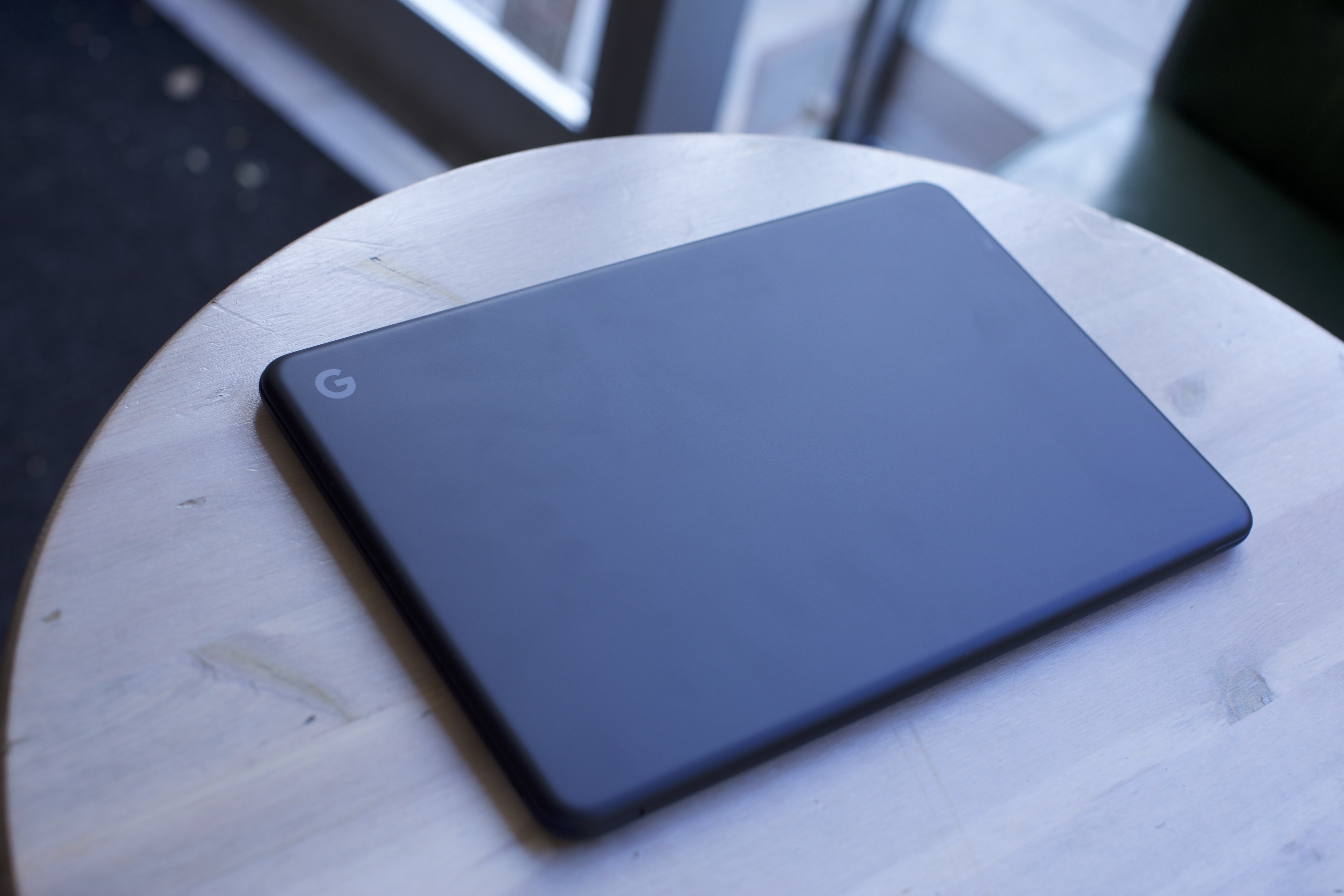
The laptop comes in two Googley-named colors: Just Black and Not Pink. Google sent me the former, which is, well, just black. Honestly, it could have benefited from a touch of color beyond the small, white “G” on the tip of the lid. The salmony Not Pink pops a bit more. Honestly, Google should have gone full old-school iBook and offered up a bunch of different colors.

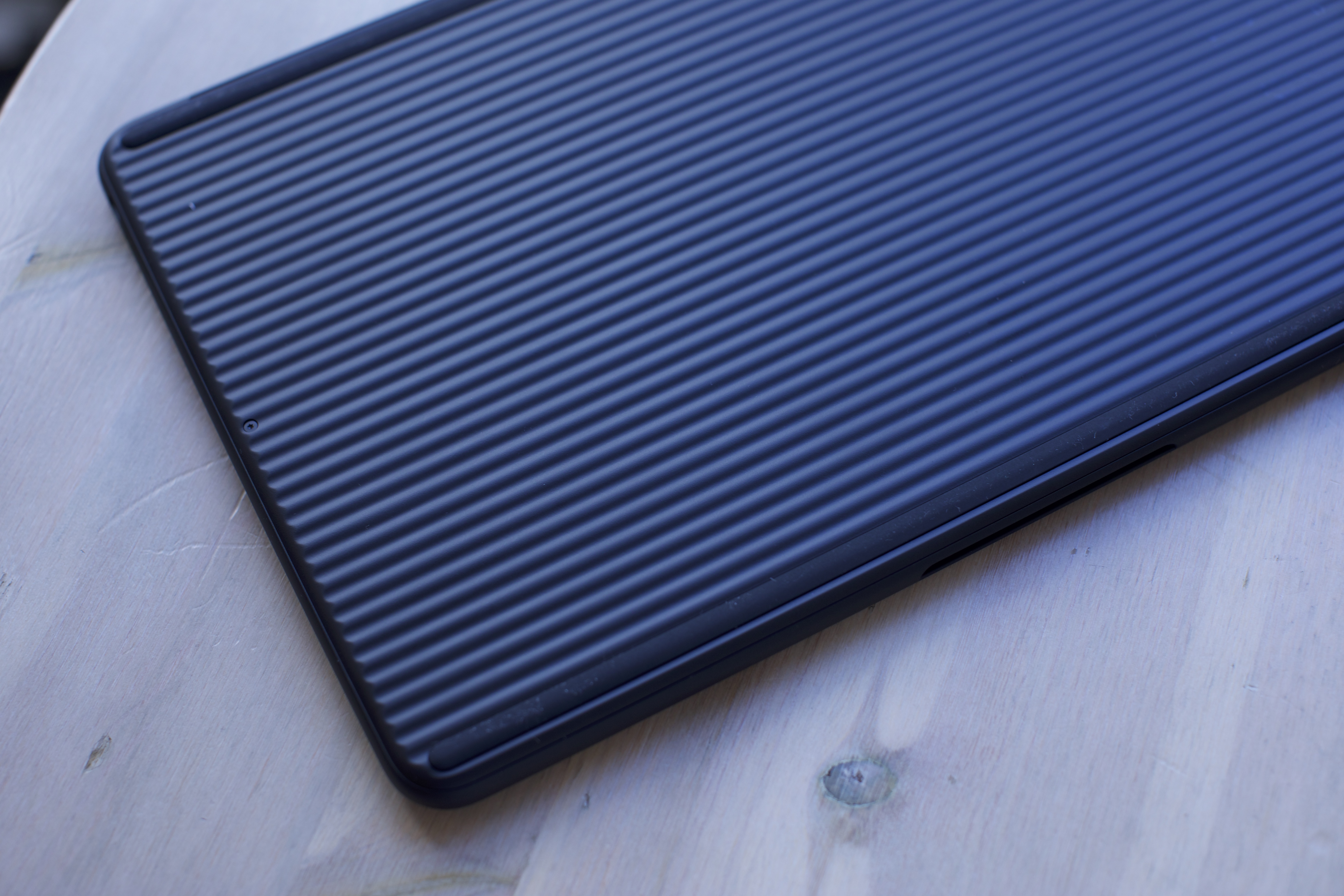
The device is portable, certainly. It’s a bit lighter than the original at 2.3 pounds to its 2.4 pounds. It’s a hair or two thicker, however, at 13.4mm to its 10.3. Carrying it around in my backpack for a few days certainly didn’t make my back miss my 15-inch MacBook Pro. The ridged bottom is a nice touch, too. It’s really easy to carry it with one hand.

Google Pixelbook Go

Beyond aesthetics, the lower price means cutting some other corners. The biggest difference is the lack of a 360 hinge. Turns out those are pretty expensive — and one of the primary things that drove up the price in the original Pixelbook. For my own uses, it’s honestly not a huge loss. Testing the original Pixelbook, I didn’t find too many instances that required something other than a standard laptop setup.

Those looking to purchase the device for creative applications may miss it, however, along with the loss of pen input. A smaller loss is the lack of the edge to edge track pad — turns out those are relatively expensive to manufacturer, as well. The keyboard has grown on me. It’s certainly quiet, as advertised. The keys are on the soft side, especially coming from over on the MacBook side of things, but they offer a nice bit of travel for a laptop.

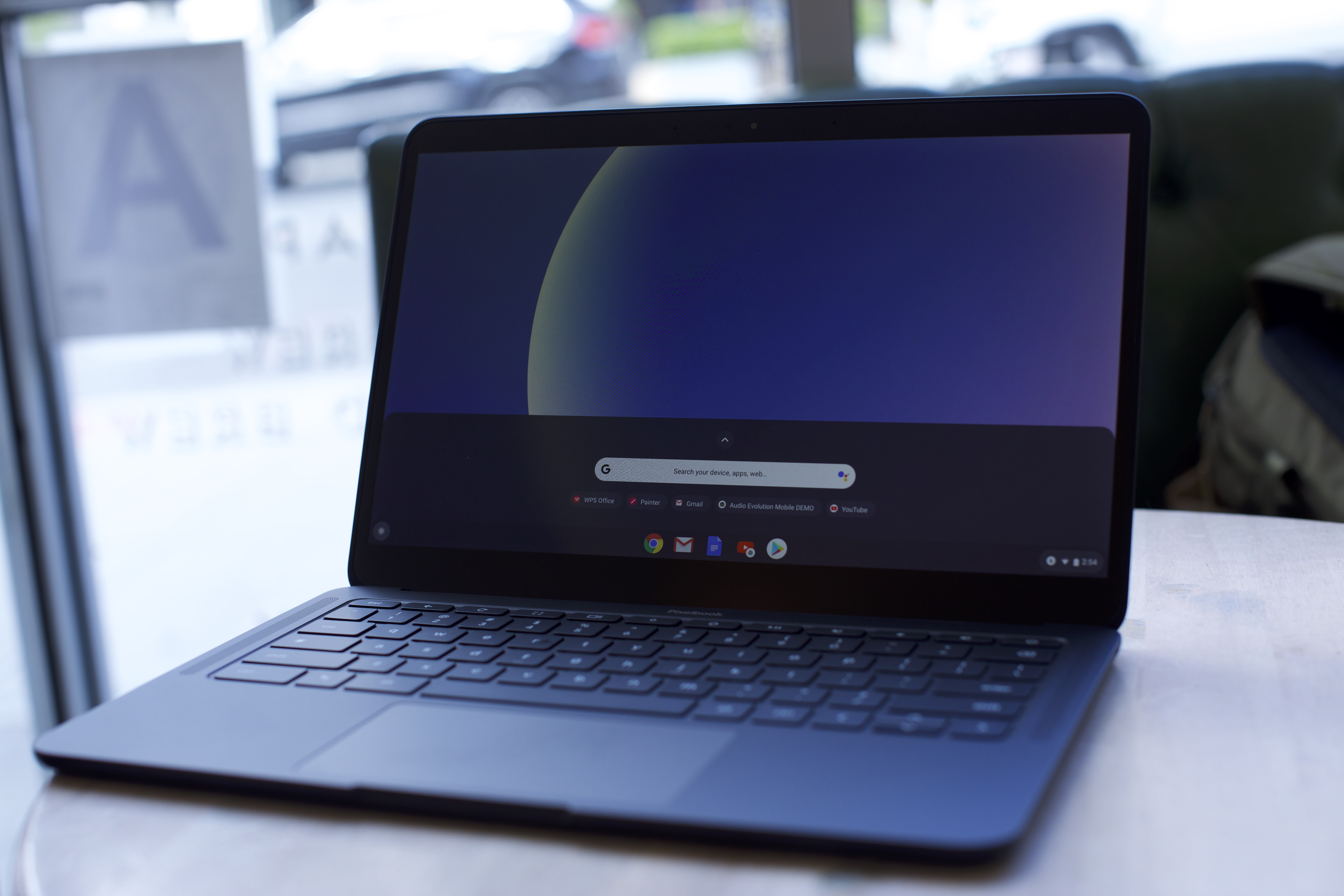
The screen is actually larger than on the original Pixelbook, jumping a full inch up to 13.3. That said, total resolution is down by default, at 1920×1080 (166 ppi) versus 2400×1600 (235 ppi). You can still upgrade to a 4K screen, for a price — $1,399, specifically. Again, one wonders precisely who that specific price point is for.

The Go retains the two USB-C port setup. That was one of the bigger critiques with the original system, but Google’s not standing down on this one. Perhaps I’m not the target demographic here, but four ports seems like a pretty good compromise, especially for those who like to dock their systems at work for external monitors and the like.
Google Pixelbook Go

The processor has been upgraded from a 7th-gen to 8th-gen Intel (as you’d hope after two years), though the  base level system starts at an m3, rather than i5. There are, however i5 and i7 options. As in everything, an upgrade. RAM is the same, at either 8 or 16GB, while storage has been shrunk down at the base level, starting at a paltry 64GB instead of 128. Given how much you rely on cloud storage, that may be moot.

ChromeOS is still limited. I’m looking forward to a day when I don’t have to stipulate that with every review, but this ain’t it, chief. It makes sense in an educational setting, but the transition from Windows or MacOS will continue to be rocky for many. The addition of Google Play opens up the app considerably, but a fraction of apps are built with a non-mobile form factor in mind.

Some apps, meanwhile, just aren’t here. I’ve been considering bringing the device with me on an upcoming trip to China. The security and stated 12-hour battery life are big wins for that trip, but I’m not sure how to replace Audacity for the podcast editing I usually do on the plane. I am, however, open to any suggestions you might have.
Google Pixelbook Go

Like the original Pixelbook, the Go seems to be a device in search of meaning. The $300 price drop is a step in the right direction, but Google’s competing with far cheaper offerings from third parties. I’m still struggling with reasons to recommend a Chromebook outside of the classroom, when there are so many affordable Windows options out there. Perhaps as a secondary, travel device. But even so, how many people need that specific use case?

The Go is clearly Google’s attempt to lead the way for manufacturers looking to explore Chromebook life outside the classroom. It has some nice hardware perks, but it’s not the revolution or revelation ChromeOS needs.


25 Oct 2019

The Station:

The Station is back for another week of insidery bits, news and analysis around transportation. That means more than planes, trains and cars these days. Luckily, we have our micromobbin’ specialist Megan Rose Dickey, plus insights from the rest of the TC crew.

As always, I’m your host Kirsten Korosec, senior reporter at TechCrunch.

This week, we’re looking at lidar, a Softbank-backed company pivots in the world of car subscriptions, space tourism goes public, NASCAR and xxxxx.

Portions of the newsletter will be published as an article on the main site after it has been emailed to subscribers (that’s what you’re reading now). To get everything, you have to sign up. And it’s free. To subscribe, go to our newsletters page and click on The Station.

Please reach out anytime with tips and feedback. Tell us what you love and don’t love so much. Email me at kirsten.korosec@techcrunch.com to share thoughts, opinions or tips or send a direct message to @kirstenkorosec.

A Softbank-backed company cuts back

fair cars

Less than a year ago, vehicle subscription startup Fair raised a huge Series B funding round of $385 million led by Softbank, to take its business global.

The company has picked up the unprofitable leasing business of Uber; and earlier this year it picked up Canvas, a car leasing business previously owned by Ford. It also made three high-profile hires just a few months ago to help drive Fair’s aggressive efforts around payment, infrastructure and financial planning as it scales its flexible car ownership model internationally and tries to make a name for itself on the global stage.

Now, the company that was founded by automotive, retail and banking executives, including Scott Painter, former founder and CEO of TrueCar, is cutting back. The company is laying off 40% of its staff and removing its CFO, Tyler Painter, the brother of Scott Painter. He’s being replaced in the interim by Kirk Shryoc.

Scott Painter told TechCrunch this is a proactive move and not made because SoftBank or any other investor has leaned on it to do so.

Micromobbin’

the station scooter1a

Welcome back to micromobbin’ — a weekly dive into the tiny but mighty chaotic world of micromobility, courtesy of Megan Rose Dickey.

Bird deployed its long-awaited cruiser in the form of the Scoot Moped. But there are a couple of caveats. It’s just a one-seater and is only currently available in Los Angeles.

Meanwhile, because congestion and scooters with dead batteries are two big problems plaguing the micromobility industry, Swiftmile convinced Austin to let the company deploy its parking and charging systems in the city.

Swiftmile’s move into Austin isn’t surprising (this is Kirsten weighing in). Austin mayor Steve Adler, and a few others, told me earlier this year during SXSW that when the scooters came to the city the bike share industry took a dive. Scooters were everywhere and it was clear that scooter management was the next big opportunity.

Swiftmile CEO Colin Roche, who I also met during SXSW, told me at the time that a number of cities were interested in deploying these systems. The key to Swiftmile’s system is that not only charges the scooters, it also can provide scooter companies with diagnostics and keep the device locked in the dock if it’s malfunctioning. Systems like these could help scooter companies like Bird and Lime extend the life of their scooters and prevent local governments from banning them altogether.

A NASCAR thing

the station electric vehicles1

Earlier this month, NASCAR’s SVP for Racing Development John Probst told TechCrunch that it could introduce hybrid-powered cars as early as 2022. NASCAR is still sorting how a race hybrid would come together, but it would have unique application. Rather than use hybrid technology to extend range, the race series plans to direct it towards improving performance.

This pursuit could end up affecting passenger vehicles. The race series will work directly with partner OEMs, such as Ford, to develop its hybrid program, according to NASCAR. While NASCAR stands for National Association of Stock Car Auto Racing, it’s been decades since anything on the series’ cars even remotely resembled a stock car you would buy at a dealership.

That will likely remain (mostly) the same, but with NASCAR going hybrid, technology on its competition vehicles could find application that transfers in some way to our daily drivers.

— Jake Bright

25 Oct 2019

The Station:

The Station is back for another week of insidery bits, news and analysis around transportation. That means more than planes, trains and cars these days. Luckily, we have our micromobbin’ specialist Megan Rose Dickey, plus insights from the rest of the TC crew.

As always, I’m your host Kirsten Korosec, senior reporter at TechCrunch.

This week, we’re looking at lidar, a Softbank-backed company pivots in the world of car subscriptions, space tourism goes public, NASCAR and xxxxx.

Portions of the newsletter will be published as an article on the main site after it has been emailed to subscribers (that’s what you’re reading now). To get everything, you have to sign up. And it’s free. To subscribe, go to our newsletters page and click on The Station.

Please reach out anytime with tips and feedback. Tell us what you love and don’t love so much. Email me at kirsten.korosec@techcrunch.com to share thoughts, opinions or tips or send a direct message to @kirstenkorosec.

A Softbank-backed company cuts back

fair cars

Less than a year ago, vehicle subscription startup Fair raised a huge Series B funding round of $385 million led by Softbank, to take its business global.

The company has picked up the unprofitable leasing business of Uber; and earlier this year it picked up Canvas, a car leasing business previously owned by Ford. It also made three high-profile hires just a few months ago to help drive Fair’s aggressive efforts around payment, infrastructure and financial planning as it scales its flexible car ownership model internationally and tries to make a name for itself on the global stage.

Now, the company that was founded by automotive, retail and banking executives, including Scott Painter, former founder and CEO of TrueCar, is cutting back. The company is laying off 40% of its staff and removing its CFO, Tyler Painter, the brother of Scott Painter. He’s being replaced in the interim by Kirk Shryoc.

Scott Painter told TechCrunch this is a proactive move and not made because SoftBank or any other investor has leaned on it to do so.

Micromobbin’

the station scooter1a

Welcome back to micromobbin’ — a weekly dive into the tiny but mighty chaotic world of micromobility, courtesy of Megan Rose Dickey.

Bird deployed its long-awaited cruiser in the form of the Scoot Moped. But there are a couple of caveats. It’s just a one-seater and is only currently available in Los Angeles.

Meanwhile, because congestion and scooters with dead batteries are two big problems plaguing the micromobility industry, Swiftmile convinced Austin to let the company deploy its parking and charging systems in the city.

Swiftmile’s move into Austin isn’t surprising (this is Kirsten weighing in). Austin mayor Steve Adler, and a few others, told me earlier this year during SXSW that when the scooters came to the city the bike share industry took a dive. Scooters were everywhere and it was clear that scooter management was the next big opportunity.

Swiftmile CEO Colin Roche, who I also met during SXSW, told me at the time that a number of cities were interested in deploying these systems. The key to Swiftmile’s system is that not only charges the scooters, it also can provide scooter companies with diagnostics and keep the device locked in the dock if it’s malfunctioning. Systems like these could help scooter companies like Bird and Lime extend the life of their scooters and prevent local governments from banning them altogether.

A NASCAR thing

the station electric vehicles1

Earlier this month, NASCAR’s SVP for Racing Development John Probst told TechCrunch that it could introduce hybrid-powered cars as early as 2022. NASCAR is still sorting how a race hybrid would come together, but it would have unique application. Rather than use hybrid technology to extend range, the race series plans to direct it towards improving performance.

This pursuit could end up affecting passenger vehicles. The race series will work directly with partner OEMs, such as Ford, to develop its hybrid program, according to NASCAR. While NASCAR stands for National Association of Stock Car Auto Racing, it’s been decades since anything on the series’ cars even remotely resembled a stock car you would buy at a dealership.

That will likely remain (mostly) the same, but with NASCAR going hybrid, technology on its competition vehicles could find application that transfers in some way to our daily drivers.

— Jake Bright

25 Oct 2019

Why publishers shouldn’t trust Facebook News

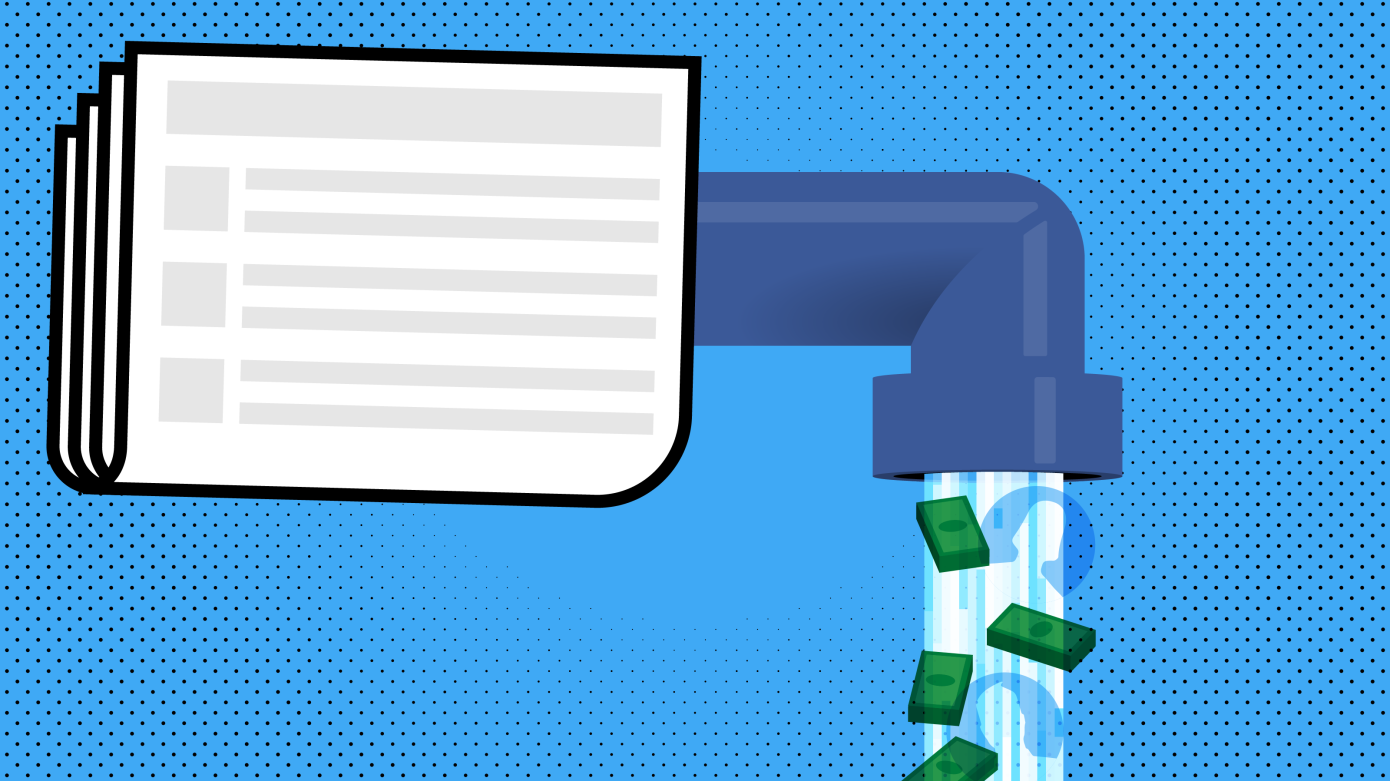
Are we really doing this again? After the pivot to video. After Instant Articles. After news was deleted from the News Feed. Once more, Facebook dangles extra traffic, and journalism outlets leap through its hoop and into its cage.

Tomorrow, Facebook will unveil its News tab. About 200 publishers are already aboard including the Wall Street Journal and BuzzFeed News, and some will be paid. None seem to have learned the lesson of platform risk.

facebook newspaper dollars

When you build on someone else’s land, don’t be surprised when you’re bulldozed. And really, given Facebook’s flawless track record of pulling the rug out from under publishers, no one should be surprised.

I could just re-run my 2015 piece on how “Facebook is turning publishers into ghost writers,” merely dumb content in its smart pipe. Or my 2018 piece on “how Facebook stole the news business” by retraining readers to abandon publishers’ sites and rely on its algorithmic feed.

Chronicling Facebook’s abuse of publishers

Let’s take a stroll back through time and check out Facebook’s past flip-flops on news that hurt everyone else:

-In 2007 before Facebook even got into news, it launches a developer platform with tons of free virality, leading to the build-up of companies like Zynga. Once that spam started drowning the News Feed, Facebook cut it and Zynga off, then largely abandoned gaming for half a decade as the company went mobile. Zynga never fully recovered.

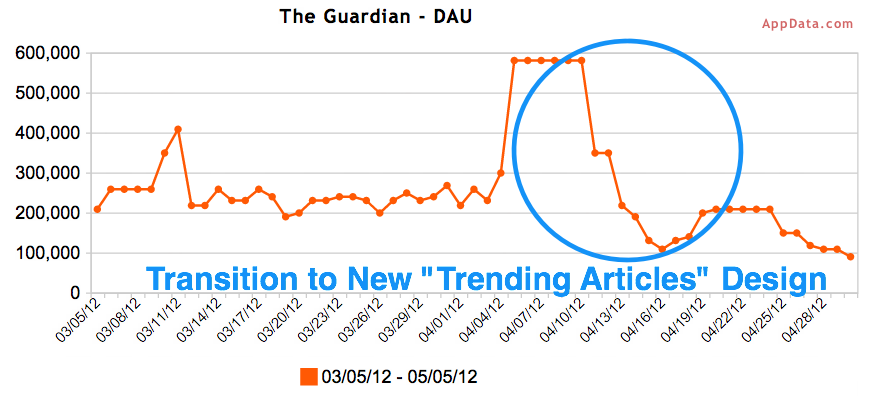
-In 2011, Facebook launches the open graph platform with Social Reader apps that auto-share to friends what news articles you’re reading. Publishers like The Guardian and Washington Post race to build these apps and score viral traffic. But in 2012, Facebook changes the feed post design and prominence of social reader apps, they lost most of their users, those and other outlets shut down their apps, and Facebook largely abandons the platform

guardian social reader dau done done done 1

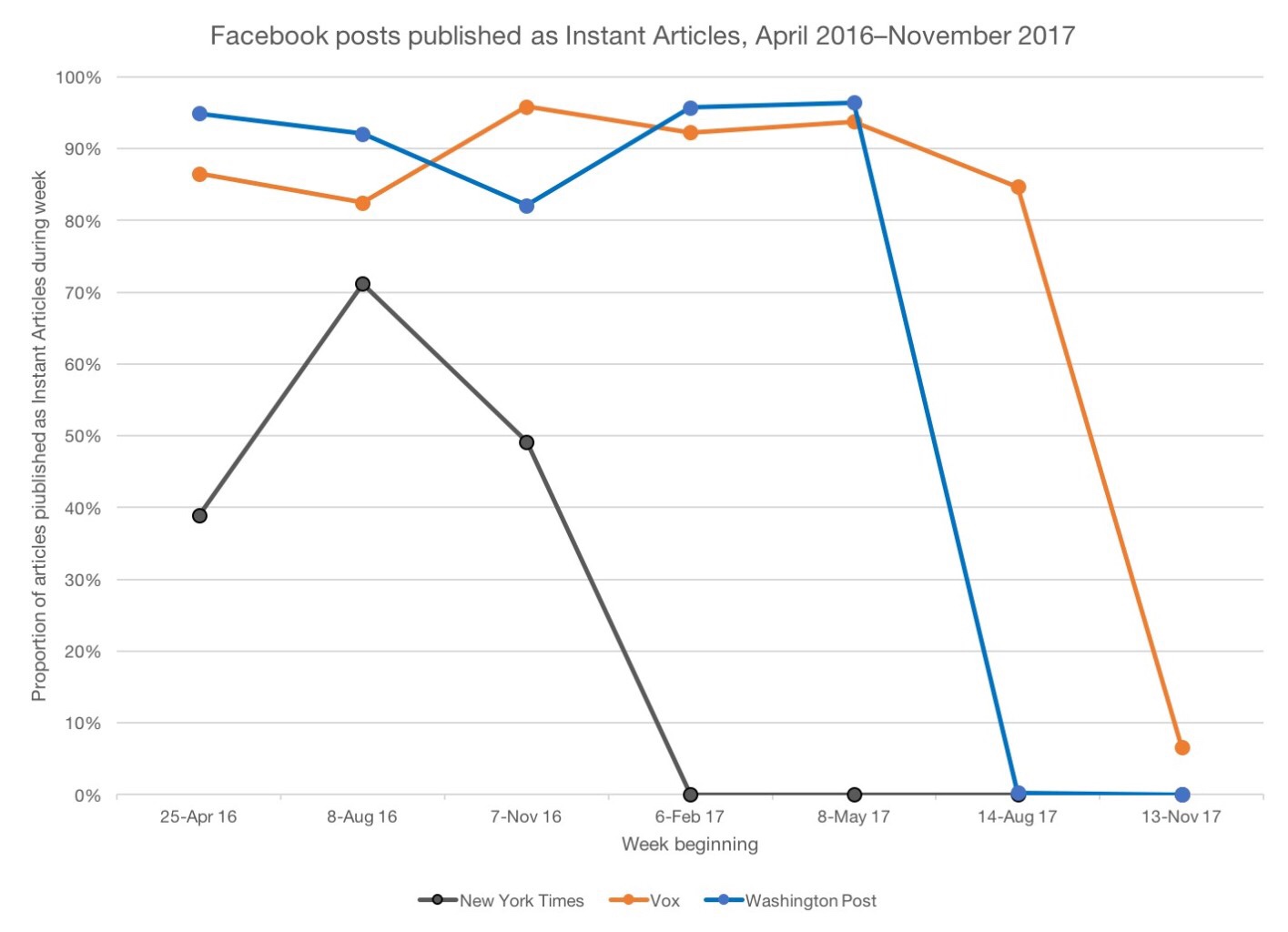
-In 2015, Facebook launches Instant Articles, hosting news content inside its app to make it load faster. But heavy-handed rules restricting advertising, subscription signup boxes, and recirculation modules lead publishers to get little out of Instant Articles. By late 2017, many publishers had largely abandoned the feature.

Facebook Instant Articles Usage

Decline of Instant Article use, via Columbia Journalism Review

-Also in 2015, Facebook started discussing “the shift to video,” citing 1 billion video views per day. As the News Feed algorithm prioritized video and daily views climbed to 8 billion within the year, newsrooms shifted headcount and resources from text to video. But a lawsuit later revealed Facebook already knew it was inflating view metrics by 150% to 900%. By the end of 2017 it had downranked viral videos, eliminated 50 million hours per day of viewing (over 2 minutes per user), and later pulled back on paying publishers for Live video as it largely abandoned publisher videos in favor of friend content.

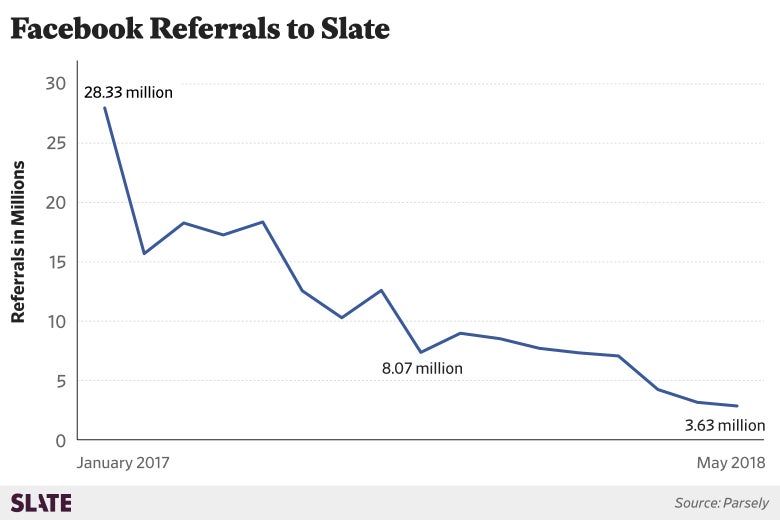
-In 2018, Facebook announced it would decrease the presence of news in the News Feed from 5% to 4% while prioritizing friends and family content. Referral shrank sharply, with Google overtaking it as the top referrer, while some outlets were hit hard like Slate which lost 87% of traffic from Facebook. You’d understand if some publishers felt…largely abandoned.

Slate Facebook Referral Traffic

Facebook referral traffic to slate plummeted 87% after a strategy change prioritized friends and family content over news

Are you sensing a trend? ?

Facebook typically defends the whiplash caused by its strategic about-faces by claiming it does what’s best for users, follows data on what they want, and tries to protect them. What it leaves out is how the rest of the stakeholders are prioritized.

Aggregated to death

I used to think of Facebook as being in a bizarre love quadrangle with its users, developers and advertisers. But increasingly it feels like the company is in an abusive love/hate relationship with users, catering to their attention while exploiting their privacy. Meanwhile, it dominates the advertisers thanks to its duopoly with Google that lets it survive metrics errors, and the developers as it alters their access and reach depending on if it needs their users or is backpedaling after a data fiasco.

Only recently after severe backlash does society seem to be getting any of Facebook’s affection. And perhaps even lower in the hierarchy would be news publishers. They’re not a huge chunk of Facebook’s content or, therefore, its revenue, they’re not part of the friends and family graph at the foundation of the social network, and given how hard the press goes on Facebook relative to Apple and Google, it’s hard to see that relationship getting much worse than it already is.

how news feed works copy 2

That’s not to say Facebook doesn’t philosophically care about news. It invests in its Journalism Project hand-outs, literacy and its local news feature Today In. Facebook has worked diligently in the wake of Instant Article backlash to help publishers build out paywalls. Given how centrally it’s featured, Facebook’s team surely reads plenty of it. And supporting the sector could win it some kudos between scandals.

But what’s not central to Facebook’s survival will never be central to its strategy. News is not going to pay the bills, and it probably won’t cause a major change in its hallowed growth rate. Remember that Twitter, which hinges much more on news, is 1/23rd of Facebook’s market cap.

So hopefully at this point we’ve established that Facebook is not an ally of news publishers.

At best it’s a fickle fair-weather friend. And even paying out millions of dollars, which can sound like a lot in journalism land, is a tiny fraction of the $22 billion in profit it earned in 2018.

Whatever Facebook offers publishers is conditional. It’s unlikely to pay subsidies forever if the News tab doesn’t become sustainable. For newsrooms, changing game plans or reallocating resources means putting faith in Facebook it hasn’t earned.

What should publishers do? Constantly double-down on the concept of owned audience.

They should court direct traffic to their sites where they have the flexibility to point users to subscriptions or newsletters or podcasts or original reporting that’s satisfying even if it’s not as sexy in a feed.

Meet users where they are, but pull them back to where you live. Build an app users download or get them to bookmark the publisher across their devices. Develop alternative revenue sources to traffic-focused ads, such as subscriptions, events, merchandise, data and research. Pay to retain and recruit top talent with differentiated voices.

What scoops, opinions, analysis, and media can’t be ripped off or reblogged? Make that. What will stand out when stories from every outlet are stacked atop each other? Because apparently that’s the future. Don’t become generic dumb content fed through someone else’s smart pipe.

Ben Thompson Stratechery Aggregation Theory

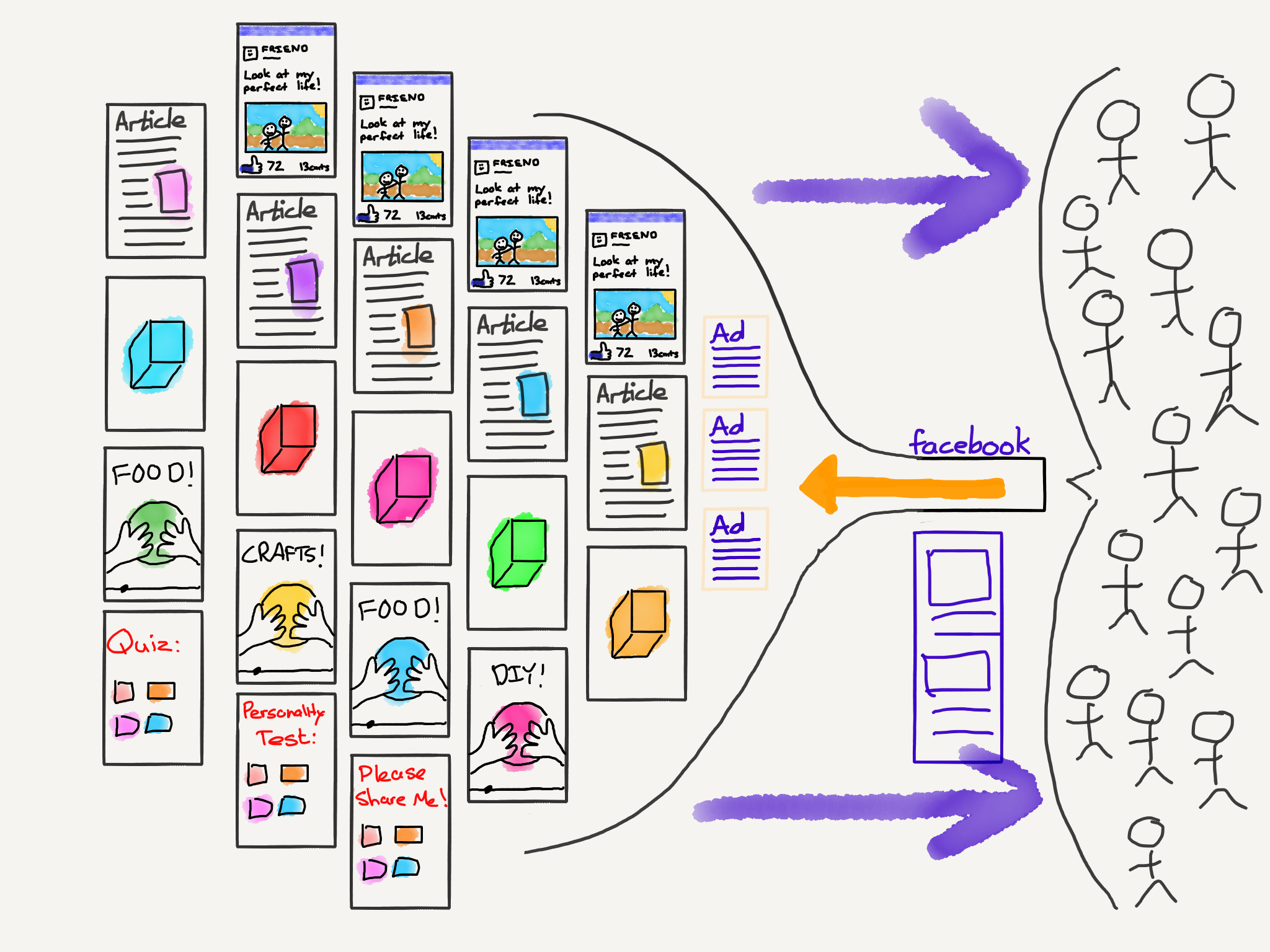
As Ben Thompson of Stratechery has proselytized, Facebook is the aggregator to which the spoils of attention and advertisers accrue as they’re sucked out of the aggregated content suppliers. To the aggregator, the suppliers are interchangeable and disposable. Publishers are essentially ghostwriters for the Facebook News destination. Becoming dependent upon the aggregator means forfeiting control of your destiny.

Surely, experimenting to become the breakout star of the News tab could pay dividends. Publishers can take what it offers if that doesn’t require uprooting their process. But with everything subject to Facebook’s shifting attitudes, it will be like publishers trying to play bocce during an earthquake.

[Featured Image: Russell Werges]

25 Oct 2019

Ford’s electric Mustang-inspired SUV will finally get its debut

Ford provided its first peek of a Mustang-inspired electric crossover nearly 14 months months. Now, it’s ready to show the world what “Mustang-inspired” means.

The automaker said Thursday it will debut the electric SUV on November 17 ahead of the LA Auto Show.

Not much is known about the electric SUV that is coming to market in 2020, despite dropping the occasional teaser image or hint. A new webpage launched recently, which provides few details, namely that Ford is targeting an EPA-estimated range of at least 300 miles. The look, specs and price will have to wait until at least the November 17 debut date.

What we do know is that Ford’s future (and certainly its CEO’s) is tied to the success of this shift to electrification. The Mustang-inspired SUV might not be the cornerstone to this strategy (an electric F150 probably deserves that designation), but it will be a critical piece.

Ford has historically backed hybrid technology. Back in 2016, Ford Chairman Bill Ford said at a Fortune event that he viewed plug-in hybrids as a transitional technology.

A lot has changed. Hybrids are still part of the mix. But in the past 18 months, Ford has put more emphasis on the development and production of all-electric vehicles.

In 2018, the company said it will invest $11 billion to add 16 all-electric vehicles within its global portfolio of 40 electrified vehicles through 2022.

Ford unveiled in September at the Frankfurt Motor Show a range of hybrid vehicles  as part of its plan to reach sales of 1 million electrified vehicles in Europe by the end of 2022.

It also invested in electric vehicle startup Rivian and locked in a deal with Volkswagen that covers a number of areas, including autonomy (via an investment by VW in Argo AI) and collaboration on development of electric vehicles. Ford will use Volkswagen’s MEB platform to develop “at least one” fully electric car for the European market that’s designed to be produced and sold at scale.


25 Oct 2019

SpaceX intends to offer Starlink satellite broadband service starting in 2020

SpaceX will look to launch its Starlink service for consumers sometime next year, SpaceX President and COO Gwynne Shotwell confirmed at a media roundtable meeting at the company’s offices in Washington during the International Astronautical Congress this week (via SpaceNews). Shotwell, who also appeared on stage at the event to share some updates around SpaceX’s recent progress across the company, told reporters present that in order to make the date, it’ll need to launch between six and eight different grouped payloads of Starlink satellites, a number that includes the batch that went up in May of this year.

All told, SpaceX has shared previously that it’ll need 24 launches in order to make the constellation global, and it also shared at that time that it intends to start with service in the Northern United States and parts of Canada beginning next year. Though 24 launches will provide full global coverage, Shotwell told media that it’ll still be doing additional launches after that in order to expand and improve coverage.

SpaceX President and COO Gwynne Shotwell

SpaceX President and COO Gwynne Shotwell

In fact, SpaceX recently filed paperwork to launch as many as 30,000 satellites in addition to the 12,000 it has already gotten permission to put up, for a total constellation size of up to 42,000. A SpaceX spokesperson previously described this as “taking steps to responsibility scale Starlink’s total network capacity and data density to meet the growth in users’ anticipated needs” in a statement provided to TechCrunch.

Owning and operating a global broadband satellite constellation could be a considerable revenue driver for SpaceX, and an important product pillar upon which the company can rely for recurring profit as it pursues its more ambitious programs, including eventual Mars launch services. Setting up the satellite constellation, especially at the scale intended, will definitely be a cost-intensive process on its own, but SpaceX is looking to its product developments like its Starship, which will be able to take much more cargo to orbit in terms of payload capacity, to reduce its own, and customer launch costs over time.

Shotwell also told reporters at the gathering that the company is already testing Starlink connectivity for U.S. Air Force Research Laboratory use, and while she didn’t reveal consumer pricing, did note that many in the U.S. pay $80 for service that is sub-par already, per SpaceNews.

24 Oct 2019

The SaaS gold rush will become the ‘Hunger Games’

SaaS has been the motherlode of enterprise software investing for two decades now. Venture investors, entrepreneurs, and Wall Street have all learned to pile on, leading to a shared consensus that cloud investing is “a sure thing.” Nothing is more destructive to investors over the long term than a sure thing, so I began to wonder, “what could cause the wonderful economics of cloud investing to unravel?”

My conclusion is that while the cloud is obviously here to stay, the next five years in cloud investing will neither be the same nor as easy as the last 10. My reason for writing this post is not to be a party pooper, but to provide a context for startups to navigate this potentially harsher environment. This post identifies three different startup strategies, all of which can work even in the more competitive cloud economy that I envisage. More on that below.

Big picture, the summary points are as follows:

First, cloud company valuations are at all-time highs which cannot be justified by improved company operating performance but can explained by 20 years of consistent 30% growth in the cloud software market. This has given investors the comfort to “pay up.”

Second, within the next two to three years, there will be a “growth crunch” as many cloud markets saturate. At that point the Gold Rush will become the Hunger Games, as cloud companies large and small compete against each other for survival.

Third, there will be three winning strategies for a startup when this happens: fight, or compete head on in an existing cloud market; focus, or find those parts of the cloud market where there is still low competition and good growth; fly, which is to build a company based on more than just the move to the cloud.

Fourth, “beyond the cloud” means “assume the cloud” and build on top of that stack using newer technologies and a design approach where instead of the user working for the software, the software works for (or instead of) the user. At Scale, we think of this as building the Intelligent Connected World (ICW).

Let’s walk through the details.

How did we get here?

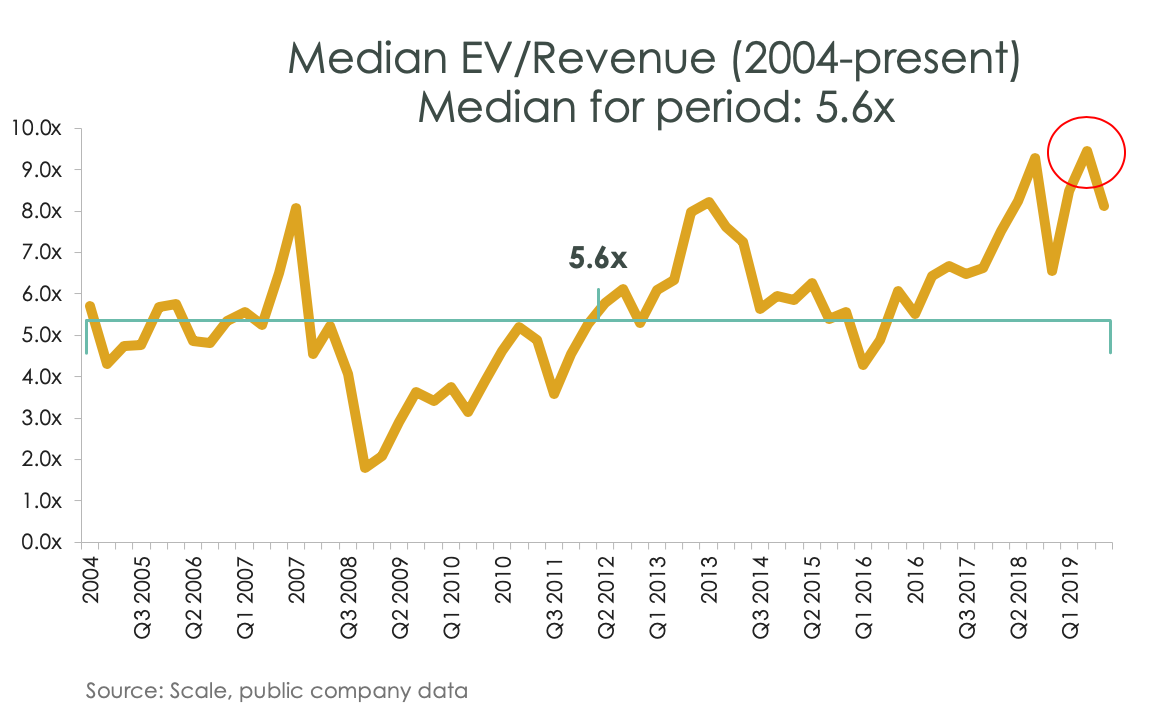
We got here because the cloud model works. It works as a computer architecture, and there is no clear replacement architecture on the horizon. It works for customers by aligning incentives with vendors to keep their software working. And it works – brilliantly – as a financial model. In a world of low growth and low interest rates, SaaS looks like a perpetual motion machine and the valuations show it. Today the median SaaS multiple is 8.5x run rate versus an all-time average of 5.6x. Higher growth companies trade at even loftier multiples of 20x and 30x.

image12

Are cloud companies performing better than ever?

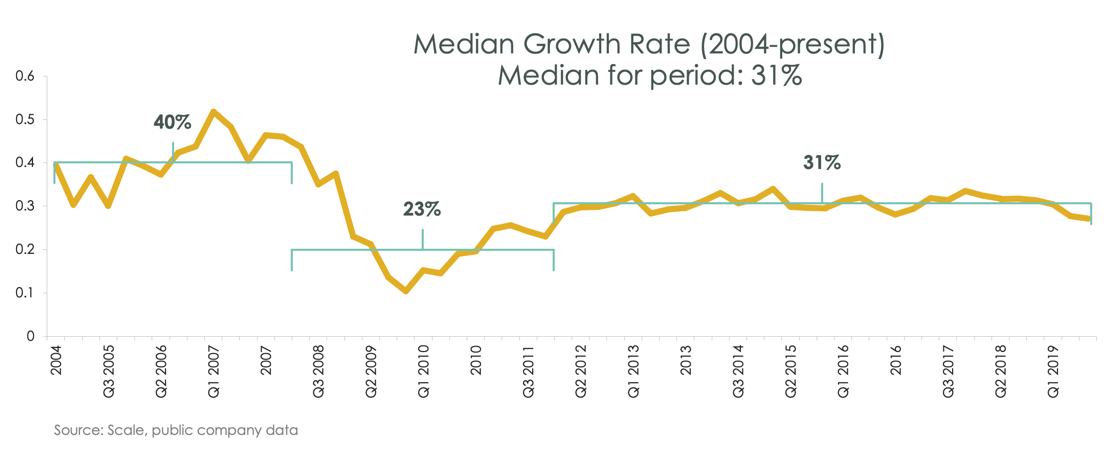
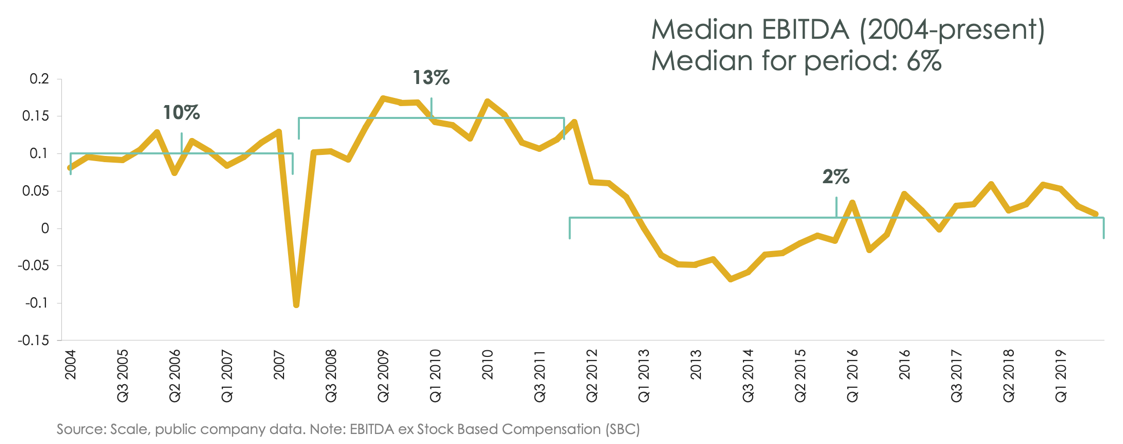
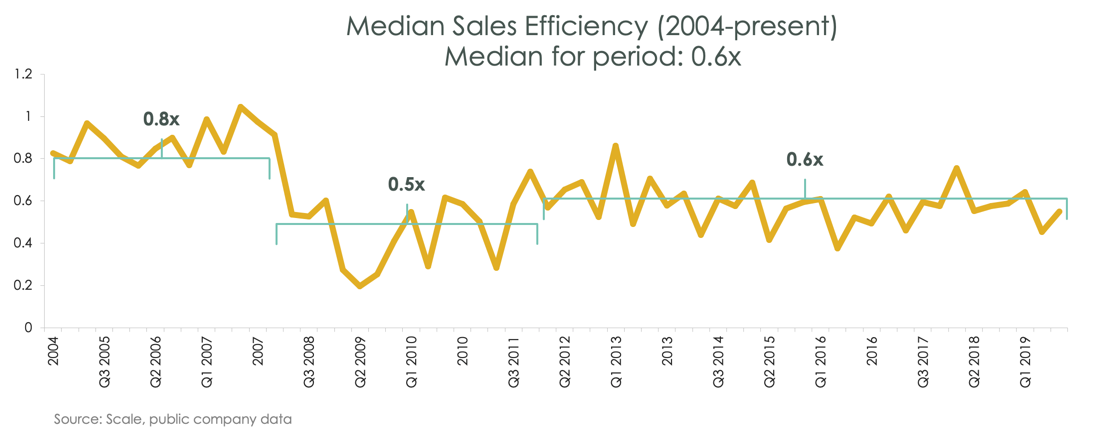
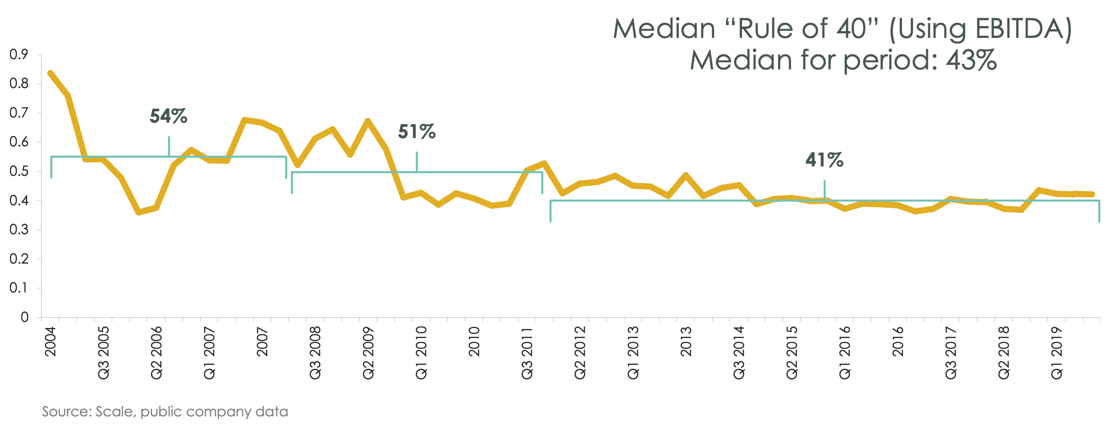
The short answer is no. The four charts below show growth rate, profitability, Sales Efficiency and the Rule of 40 (a combination of growth and profitability) for the entire public SaaS universe from 2004 to today. Each chart also shows separately the median for three sub-periods within this time period: pre-crash (2004 to 2008), the crash period (2009 to 2011), and post-crash (2011 to today).

The story is the same in every case. Pre-crash operating performance was stellar in what was then a new uncrowded market. The crash was brutal on growth and forced companies to get profitable fast. But since 2011, growth rates, EBITDA, Sales Efficiency and Rule of 40 measures have all been roughly flat and provide no justification for almost a doubling of valuations in the last two years.

image5

image6

image7

image4

So why are these companies trading so richly?

It’s all about the growth

Sometimes the answer is in plain sight. The big picture in all the above numbers is that public companies in this sector have been growing at 30% plus for 15 years now, since the Salesforce IPO in 2004. Growth has not gone up but, far more importantly, it has not gone down.

24 Oct 2019

After its first earnings miss in two years, Amazon shares get walloped in after-hours trading

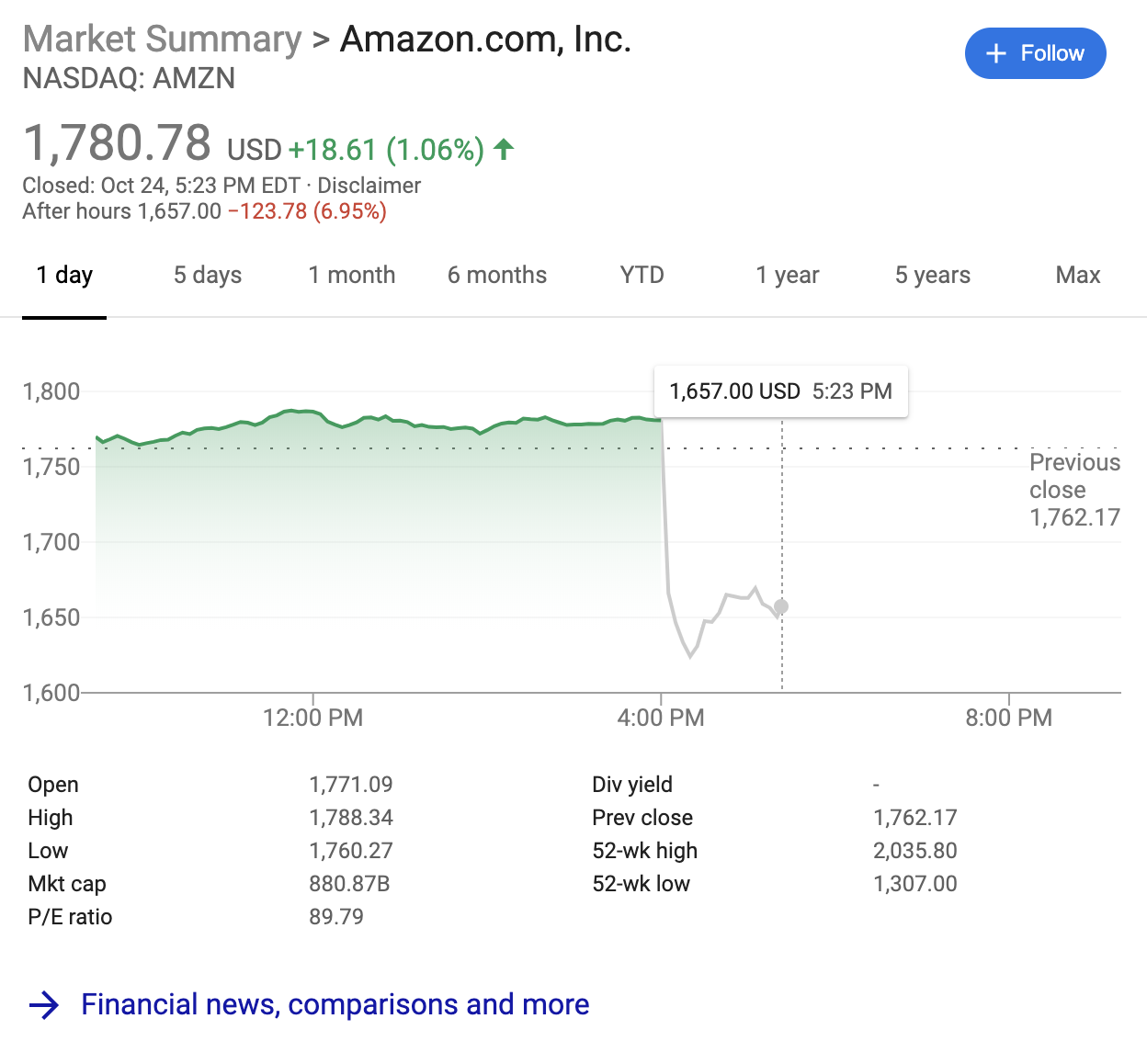
Amazon shares fell by nearly 7%, or $118.38, in after-hours trading on Thursday after the company reported its first earnings miss in two years.

Financial analysts had predicted that the launch of one-day shipping would eat into Amazon’s earnings, but even with the forewarning investors pummeled the stock after the market closed. It didn’t help that the company predicted revenues for the fourth quarter — including the all-important holiday season — also look soft.

The good news for Amazon amidst all the bad news was that revenue was actually up at the company. For the quarter Amazon raked in $70 billion, beating analysts’ expectations of $68.8 billion.

However, the company reported a profit of $2.1 billion, or $4.23 a share versus the $4.62 that analysts had projected. And even though sales were up this year, earnings per share were down from $5.75 in the year-ago period. As MarketWatch noted, it’s the first time earnings at the company have shrunk since 2017.

Screen Shot 2019 10 24 at 2.24.19 PM

Another potential warning sign for investors was the revenue from the company’s web services business, which came in at $9 billion. Analysts had predicted roughly $9.2 billion from the business line. If competition starts eating into the services business (which still grew at a healthy 35% over the year-ago period), that could spell problems for the company’s stock — which has used AWS revenues to buoy spending elsewhere.

The company has been spending heavily all year to offer new services. The expansion of its free one-day delivery program has cost Amazon more than $800 million in the second quarter.

Amazon founder and chief executive Jeff Bezos defended the move to one-day shipping in a statement.

“Customers love the transition of Prime from two days to one day — they’ve already ordered billions of items with free one-day delivery this year. It’s a big investment, and it’s the right long-term decision for customers,” Bezos said. “And although it’s counterintuitive, the fastest delivery speeds generate the least carbon emissions because these products ship from fulfillment centers very close to the customer — it simply becomes impractical to use air or long ground routes.”

Looking ahead to the holiday season Amazon predicted net sales of between $80 billion and $86.5 billion, with operating income between $1.2 billion and $2.9 billion, versus $3.8 billion from a year-ago period. Analysts were expecting to see revenue numbers more in the $87 billion range.