Category: UNCATEGORIZED

24 Oct 2019

Announcing the Disrupt Berlin 2019 agenda

Disrupt Berlin is right around the corner. And there is plenty to look forward to.

Join us December 11 and December 12 to hear from industry leaders, investors, and bright stars in the startup world. We’ll sit down with CEOs from big-name companies such as Away, UIPath, and Naspers, as well as leading investors from Atomico, SoftBank, and GV.

On the Extra Crunch stage, panelists will discuss important trends in the startup world, and deliver actionable insights to founders looking to scale their business, from product management to raising money to building a brand.

And, of course, we can never forget the legendary Startup Battlefield competition, where companies pitch their startups on stage for the first time in front of a panel of expert judges. Only one walks away victorious, with USD$50,000, the Disrupt Cup, and eternal glory.

We can’t wait to see you there! Tickets are available right here!

Wednesday, December 11

Morning


AI Chips with Everything? — Nigel Toon (Graphcore)

In this fireside chat with Nigel Toon, founder of Graphcore, we’ll discuss the race between chip giants and startups to build AI chips, how next-gen chipsets are pushing the boundaries of software innovation, and what happens once AI chips are everywhere. Main Stage

How Station F is Boosting the French Tech Ecosystem with Roxanne Varza (Station F)

Three years after unveiling Station F at Disrupt, its Director Roxanne Varza is back to give us an update on the world’s biggest startup campus. Station F has become a cornerstone of the French tech ecosystem and a signal for the international tech community. There are now 1,000 startups working from Station F in Paris. Station F’s director will join us to talk about what’s next for Station F and the French tech ecosystem. Main Stage

How to Build Sustainability as a Business with Benjamina Bollag (Higher Steaks) and speakers to be announced. 

As climate change and the impacts of a warming world become more important for the consumers who are exposed to it, hear from a developer of lab grown meat; a biodegradeable packaging technology developer; and one of the world’s largest  impact investment funds on how to build sustainability as a business. Extra Crunch Stage

Fireside Chat with Atomico with Sophia Bendz, Siraj Khaliq, Hiro Tamura and Niall Wass (Atomico)

From a single London base a few years ago, Atomico has now spread to the US and Asia. Hear from key partners about this global VC’s strategy going forward. Main Stage

What Does It Take to Raise a Series A with Suranga Chandratillake (Balderton Capital), Jessica Holzbach (Penta), and Lousie Dahlborn Samet (Blossom Capital

Venture capital funds have boomed this decade, but raising money is still hard for young companies. What are investors today looking for in teams, metrics and products? Extra Crunch Stage

Startup Battlefield Competition – Session 1 

TechCrunch’s iconic startup competition is back, as entrepreneurs from around the world pitch expert judges and vie for the Battlefield Cup and $50,000. Main Stage

How to Iterate Your Product with Andrew Bowell (Unity) and speakers to be announced

Building something that’s used by millions is an exhilarating feat, but the real challenge is understanding how to iterate your product so that it can scale to a bigger audience with a bigger impact. We’ve assembled the product chiefs from some of the most influential tech companies in the world to dive into the details of what every product manager and product chief needs to know. Extra Crunch Stage

Afternoon


Startup Battlefield Competition – Session 2 

TechCrunch’s iconic startup competition is back, as entrepreneurs from around the world pitch expert judges and vie for the Battlefield Cup and $50,000. Main Stage

How to Build a Billion Dollar SaaS Company with Laura Urquizu (Red Points) and speakers to be announced

Scaling a SaaS company is anything but easy. In this session, we’ll talk about everything from how (and when) to charge for your product, when to make crucial hires, how to sell into the enterprise and when it’s time to consider an exit. We’ll be joined by Red Points CEO Laura Urquizu, who is well on her way to building that billion dollar company herself, Max Wessel, who is charged with creating new companies inside enterprise giant SAP, as well as Sapphire Venture’s Andreas Weiskam, who invested in companies like DocuSign and Criteo. Extra Crunch Stage

Creating a Global Payment Network with Hiroki Takeuchi (GoCardless)

GoCardless has a shot at becoming a global leader when it comes to payments via direct debit. And now, all eyes are on the company’s next challenge — North America. The startup’s CEO will join us to talk about how GoCardless plans to replace cash, cheques and even card payments at a global scale. Main Stage

How to Scale Your Startup Globally with Sophie Alcorn (Alcorn Immigration Law), Karoli Hindriks (Jobbatical), Holger Seim (Blinkist)

Global expansion is critical to building the next unicorn, but what’s the right approach to maximize growth with limited resources? Join Holger Seim, founder and CEO of audio startup Blinkist, Karoli Hindriks, founder and CEO of Jobbatical, and prominent Silicon Valley immigration attorney Sophie Alcorn as we discuss the opportunities – and pitfalls – of expanding outside your local market. Extra Crunch Stage 

Fireside chat with Sebastian Siemiatkowski (Klarna)

Klarna was once a small Stockholm-based outfit looking to offer payment services for online shops. Today, is tackling physical stores and looking to storm the U.S. It has plenty of support, including that of early investor Sequoia Capital. In fact, it has amassed more funding and a higher valuation than almost any other privately held company in the world. Can it live up to expectations?  We’ll talk with cofounder and CEO Sebastian Siemiatkowski about the company’s ride so far, and where it goes next in this must-see sit-down. Main Stage

Investing and Operating in Growth Markets with Bob van Dijk (Prosus and Naspers)

Prosus is a global consumer internet company with interests in food delivery, payments and fintech, classifieds, travel, retail, media, social platforms and a dedicated ventures team, not to mention a huge stake in Tencent. Hear from CEO Bob van Dijk about what Prosus believes is around the corner in these growth markets and why Naspers listed Prosus on the Euronext Amsterdam stock exchange in September, creating Europe’s largest listed consumer internet company in 2019. Main Stage 

How To Win Customers and Influence Markets with Colette Ballou (Ballou PR), Joanna Kirk, (Joanna Kirk PR) and Katy Turner (Multiple

Every startup is a story and the best stories can change the world. Some of Europe’s finest alchemists of allusion will share their tips on how to be a signal in a world of noise. Extra Crunch Stage

Are We There Yet? Inside the Tech that Will Help AVs be Better Chauffeurs with Clare Jones (What3Words)

Clare Jones, chief commercial officer of what3words, will talk about the role of mapping and geolocation in autonomous vehicles and how this tech is already rolling out in human driven cars. Main Stage

How to Brexit as a Startup with Volker Hirsh (Amadeus Capital Partners), Bindi Karia (Bindi Karia) and Glenn Shoosmith (JRNI)

The turbulence of Brexit has left both UK and European startups alike wondering about the best path forward. Hear from from both the investor and entrepreneur perspective on how best to deal with this thorny subject. Extra Crunch Stage

Up, Up and Away with Jen Rubio (Away)

The D2C space is awfully crowded, but luggage brand Away has managed to rise above the noise to build one of the most successful consumer brands of this decade with a valuation of $1.4 billion as of earlier this year. Hear from CEO Jen Rubio about how the company got its start, grew, and became the household name it is today. Main Stage

Pitch Deck Teardown with Russ Heddleston (DocSend), Karen Stafford (Intel Capital), and Sitar Teli (Connect Ventures)

Talk through the nuts and bolts of what makes a great deck (or not) with investors Sitar Teli and Karen Stafford, plus insights from Docsend’s Russ Heddleston, as they go through submitted pitches live on stage. Extra Crunch Stage

Will We Pay For Social Media? with Hovhannes Avoyan (PicsArt)

PicsArt has reached 120 million users for its photo editor by asking people to pay for its creative tools. We’ll talk to CEO Hovhannes Avoyan about why free isn’t always the answer and how top social networks will embrace subscription pricing. Main Stage

Startup Battlefield Competition – Session 3 

TechCrunch’s iconic startup competition is back, as entrepreneurs from around the world pitch expert judges and vie for the Battlefield Cup and $50,000. Main Stage


Thursday, December 12

Morning


Succeeding in the Streaming Era with Efe Cakarel (MUBI)

MUBI has been in the streaming business since before Netflix, and has successfully built a service that caters to specific needs in a useful, novel way. The company’s CEO will join us to talk about the maturation of the streaming market, and what it takes to build a lasting business in an increasingly crowded space. Main Stage

Scaling Ethereum and Beyond with Justin Drake (Ethereum Foundation)

The Ethereum vision has always been to create a world computer. But its scalability remains an issue. Ethereum Researcher Justin Drake will discuss the road ahead. Main Stage

Lessons Learned from Serial Founders with Thibaud Elziere (eFounders), Christian Reber (Pitch) and speaker to be announced 

What would you do differently if you were crazy enough to start another company? Hear what these leaders learned from the first time(s) around — and why they’re back at it again. Extra Crunch Stage

Unnatural Language Processing with Emily Foges (Luminance) and Sofie Quidenus-Wahlforss (omni:us)

Legal contracts and insurance policies can be difficult even for experts to decipher – hear how the founders of Luminance and omni:us are using AI to take on jargon and save everyone some time. Main Stage

How to Raise Your First Euros with Nic Brisbourne (Forward Partners), Russ Heddleston (DocSend), and Malin Holmberg (Target Global)

The process of securing your very first check isn’t an easy one. To make it a little bit easier, we’ve invited DocSend founder Russ Heddleston, Forward Partners managing partner Nic Brisbourne, and Target Global partner Malin Holmberg to the stage to offer their best tips and tricks to aspiring or current founders. Extra Crunch Stage

Investing in 2020 with Carolina Brochado (Softbank Vision Fund) and Tom Hulme (GV)

Nothing changes quite as rapidly as investment trends. Brochado and Hulme will offer perspectives from their experience both on the ground in Europe and from 50,000 feet to talk about what 2020 has in store for startups. Main Stage 

How to Fit Blockchain into Your Startup Strategy with Justin Drake (Ethereum Foundation), Ashley Tyson (Web3 Foundation), and speaker to be announced

Chances are, you keep hearing about this ‘blockchain’ thing all the time — and maybe you’re ignoring it but deep down, you know you should probably think about how it could help your startup. To help you with that and maybe demystify blockchain a bit, too, we’ll be joined by three panelists who all have deep roots in the blockchain community: Ethereum Foundation Researcher Justin Drake, Web3 Foundation Director of Partnerships and Strategic Initiatives Ashley Tyson, and Protocol Labs founder and CEO Juan Benet. Extra Crunch Stage

TravelTech Opportunities with Andrew Reed (Sequoia Capital) and Julian Stiefel (Tourlane)

Berlin-based Tourlane has raised $81 million for multi-day travel booking. Co-founder Julian Stiefel and his investor Sequoia’s Andrew Reed will discuss what products still need to be built in travel, and how startups can do something unique enough to avoid getting steamrolled by tech giants. Main Stage

Afternoon


The New New Shop with Maria Raga (Depop)

As shopping has moved from the web to apps, Depop has caught the Gen-Z wave. We’ll hear from the CEO who is nurturing this ‘eBay for the 21st Century’. Main Stage

Investing in Africa’s Tech Talent with Jeremy Johnson (Andela) and Lila Wollman (Generation Investment Management

Generation Investment Management, the firm co-founded by former U.S Vice President Al Gore, was built on the premise of backing sustainable startups. The fund’s lead Lila Wollman brings their portfolio company Andela to discuss how they have harnessed the booming talent in Africa to solve global outsourcing issues and what’s next in building sustainable companies. Main Stage

Growth Marketing with Asher King Abramson (Demand Curve

Learn about the right ways and wrong ways to create great assets for paid channels, landing pages and more in this teardown workshop with Asher King-Abramson, a top growth marketer who works with dozens of successful startups. Extra Crunch Stage

Startup Battlefield Alumni Updates

Battlefield startups from the past return to the stage to tell us what they’ve been up to since they competed for the Disrupt Cup. Main Stage

Startup Battlefield Final Competition

TechCrunch’s iconic startup competition is back, as entrepreneurs from around the world pitch expert judges and vie for the Battlefield Cup and $50,000. Main Stage

Delivery-as-a-service with Oscar Pierre (Glovo) and speaker to be announced

On this panel we’ll sit down with Oscar Pierre, CEO of Glovo, to talk ops and logistics of scaling on-demand delivery, plus delve into what the model means for suppliers and partners, and consider regulatory headwinds. Main Stage

How to Radically Change Finance Through Fintech Startups with Yoni Assia (eToro) and Charlie Delingpole (ComplyAdvantage)

Few areas of investment have been as white hot as fintech these past few years, but how can startups radically transform the finance industry both for financial institutions but also for consumers? Join Charlie Delingpole, founder and CEO of ComplyAdvantage and Yoni Assia, founder and CEO of eToro, as we discuss how startups can compete in this fast-moving industry. Extra Crunch Stage

Democratizing Robots with Daniel Dines (UIPath)

Robotics is a hotbed of investment and activity, but how does the average person access the benefits of automation? UIPath CEO and founder Daniel Dines will explain how we can expand access to the benefits of robotics, for companies and individual workers alike. Main Stage

The Gig Economy for Guides with Johannes Reck (Getyourguide)

Travel is perhaps the last bastion of the on-demand economy to be colonised. Getyourguide founder Reck will unpack how, after raising a total of $654.5M, he plans to expand across the globe. Main Stage

Hackathon Finals 

Everybody loves a Hackathon! Hear from developers about what they built in 24 hours. Extra Crunch Stage

Startup Battlefield Closing Awards Ceremony

Watch the crowning of the latest winner of Startup Battlefield. Main Stage

Editor’s Note: Not all of our speakers are included on this agenda as we like to keep a couple tricks up our sleeves. 
24 Oct 2019

Twitter Q3 misses big on revenues of $824M and EPS of $0.05 on the back of adtech glitches

Twitter today reported its earnings for the quarter that ended September 30, and the numbers delivered a big surprise, falling on both sales and earnings per share. Revenues came in at $824 million, and EPS at $0.05. That represents sales up 9% year-over-year but far below what analysts had been expecting: (non-GAAP, diluted) EPS of 20 cents per share and revenues of $874.03 million (or higher, $883 million, depending on which group of analysts you’re following).

Twitter said the huge drop in performance “was impacted by revenue product issues, which we believe reduced year-over-year growth by approximately 3 or more percentage points, and greater-than-expected seasonality.” Specifically, it also noted that it discovered and took steps to fix bugs “that primarily affected our legacy Mobile Application Promotion (MAP) product, impacting our ability to target ads and share data with measurement and ad partners.” Also its adtech personalization was also not “operating as expected.” It also blamed the bad numbers on a slower summer for big events and launches compared to a year ago. 

Meanwhile, monetizable daily active users came in at 145 million, versus 124 million a year ago and 139 million in Q2. That actually exceeds the 14% growth analysts had been expecting (it’s up 17% year-on-year). Net income came in at $37 million.

“We drove strong growth in monetizable DAU (mDAU), up 17% year-over-year, driven by ongoing product improvements,” said Jack Dorsey in a statement. “We’re continuing to improve relevance while testing ways to make it easier for people to find what they are looking for on Twitter.  We also continue to make progress on health, improving our ability to proactively identify and remove abusive content, with more than 50% of the Tweets removed for abusive content in Q3 taken down without a bystander or first person report.”

Ned Segal, CFO, spoke more directly to the disappionting numbers:

“Despite its challenges, this quarter validates our strategy of investing to drive long-term growth. More work remains to deliver improved revenue products. We’ll continue to prioritize our ad products along with health and our investments to drive ongoing growth in mDAU. We remain confident that focusing on our most important priorities, and delivering higher performing, better ad formats will deliver better outcomes for all of our stakeholders for years to come.”

The company has made a significant shift in the last year to tracking a new user metric of its own making, monetizable daily active users, which tracks those who are being served ads.

Twitter’s argument is that these are the main users to watch, since their growth (or decline) is more closely linked to how Twitter’s business is doing. It helps also to take attention away from more established usage metrics such as daily and monthly active users, both of which had stagnated and even declined in recent years, a mark a longtime challenge for the company: Twitter is addictive and used almost regligiously by some people, but ultimately the company had not managed to grow traction with a mass market.

The US continues to be Twitter’s largest single market but still outweighed by business outside those borders. Average US mDAU was 30 million, compared to 26 million in the same period of the previous year and 29 million in the previous quarter, Twitter said, while average international mDAU was 115 million, compared to 98 million in the same period of the previous year and 110 million in the previous quarter.

Ad revenue was $702 million, up 8% year-over-year, with data licensing and other revenue coming in at $121 million, up 12%. US revenue continues to outpace international, at $465 million versus $358 million.

For some context: Last quarter the company reported EPS also of $0.20 on revenues of $841 million; and actually down by one cent on a year ago, when the company reported earnings of $0.21 on sales of $758 million. 

More to come.


24 Oct 2019

Alexa, where are the legal limits on what Amazon can do with my health data?

The contract between the UK’s National Health Service (NHS) and ecommerce giant Amazon — for a health information licensing partnership involving its Alexa voice AI — has been released following a Freedom of Information request.

The government announced the partnership this summer. But the date on the contract, which was published on the gov.uk contracts finder site months after the FOI was filed, shows the open-ended arrangement to funnel nipped-and-tucked health advice from the NHS’ website to Alexa users in audio form was inked back in December 2018.

The contract is between the UK government and Amazon US (Amazon Digital Services, Delaware) — rather than Amazon UK. 

Nor is it a standard NHS Choices content syndication contract. A spokeswoman for the Department of Health and Social Care (DHSC) confirmed the legal agreement uses an Amazon contract template. She told us the department had worked jointly with Amazon to adapt the template to fit the intended use — i.e. access to publicly funded healthcare information from the NHS’ website.

The NHS does make the same information freely available on its website, of course. As well as via API — to some 1,500 organizations. But Amazon is not just any organization; It’s a powerful US platform giant with a massive ecommerce business.

The contract reflects that power imbalance; not being a standard NHS content syndication agreement — but rather DHSC tweaking Amazon’s standard terms.

“It was drawn up between both Amazon UK and the Department for Health and Social Care,” a department spokeswoman told us. “Given that Amazon is in the business of holding standard agreements with content providers they provided the template that was used as the starting point for the discussions but it was drawn up in negotiation with the Department for Health and Social Care, and obviously it was altered to apply to UK law rather than US law.”

In July, when the government officially announced the Alexa-NHS partnership, its PR provided a few sample queries of how Amazon’s voice AI might respond to what it dubbed “NHS-verified” information — such as: “Alexa, how do I treat a migraine?”; “Alexa, what are the symptoms of flu?”; “Alexa, what are the symptoms of chickenpox?”.

But of course as anyone who’s ever googled a health symptom could tell you, the types of stuff people are actually likely to ask Alexa — once they realize they can treat it as an NHS-verified info-dispensing robot, and go down the symptom-querying rabbit hole — is likely to range very far beyond the common cold.

At the official launch of what the government couched as a ‘collaboration’ with Amazon, it explained its decision to allow NHS content to be freely piped through Alexa by suggesting that voice technology has “the potential to reduce the pressure on the NHS and GPs by providing information for common illnesses”.

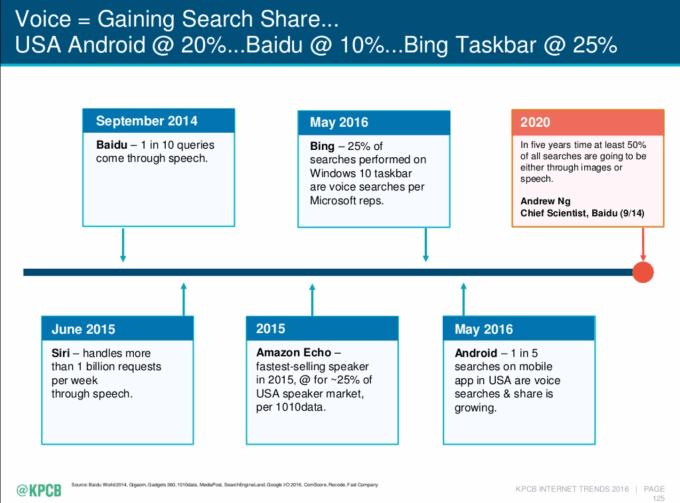
Its PR cited an unattributed claim that “by 2020, half of all searches are expected to be made through voice-assisted technology”.

This prediction is frequently attributed to ComScore, a media measurement firm that was last month charged with fraud by the SEC. However it actually appears to originate with computer scientist Andrew Ng, from when he was chief scientist at Chinese tech giant Baidu.

Econsultancy noted last year that Mary Meeker included Ng’s claim on a slide in her 2016 Internet Trends report — which is likely how the prediction got so widely amplified.

But on Meeker’s slide you can see that the prediction is in fact “images or speech”, not voice alone…

Screenshot 2019 10 24 at 10.04.40

So it turns out the UK government incorrectly cited a tech giant prediction to push a claim that “voice search has been increasing rapidly” — in turn its justification for funnelling NHS users towards Amazon.

“We want to empower every patient to take better control of their healthcare and technology like this is a great example of how people can access reliable, world-leading NHS advice from the comfort of their home, reducing the pressure on our hardworking GPs and pharmacists,” said health secretary Matt Hancock in a July statement.

Since landing at the health department, the app-loving former digital minister has been pushing a tech-first agenda for transforming the NHS — promising to plug in “healthtech” apps and services, and touting “preventative, predictive and personalised care”. He’s also announced an AI lab housed within a new unit that’s intended to oversee the digitization of the NHS.

Compared with all that, plugging the NHS’ website into Alexa probably seems like an easy ‘on-message’ win. But immediately the collaboration was announced concerns were raised that the government is recklessly mixing the streams of critical (and sensitive) national healthcare infrastructure with the rapacious data-appetite of a foreign tech giant with both an advertising and ecommerce business, plus major ambitions of its own in the healthcare space.

On the latter front, just yesterday news broke of Amazon’s second health-related acquisition: Health Navigator, a startup with an API platform for integrating with health services, such as telemedicine and medical call centers, which offers natural language processing tools for documenting health complaints and care recommendations.

Last year Amazon also picked up online pharmacy PillPack — for just under $1BN. While last month it launched a pilot of a healthcare service offering to its own employees in and around Seattle, called Amazon Care. That looks intended to be a road-test for addressing the broader U.S. market down the line. So the company’s commercial designs on healthcare are becoming increasingly clear.

Returning to the UK, in response to early critical feedback on the Alexa-NHS arrangement, the IT delivery arm of the service, NHS Digital, published a blog post going into more detail about the arrangement — following what it couched as “interesting discussion about the challenges for the NHS of working with large commercial organisations like Amazon”.

A core critical “discussion” point is the question of what Amazon will do with people’s medical voice query data, given the partnership is clearly encouraging people to get used to asking Alexa for health advice.

“We have stuck to the fundamental principle of not agreeing a way of working with Amazon that we would not be willing to consider with any single partner – large or small. We have been careful about data, commercialisation, privacy and liability, and we have spent months working with knowledgeable colleagues to get it right,” NHS Digital claimed in July.

In another section of the blog post, responding to questions about what Amazon will do with the data and “what about privacy”, it further asserted there would be no health profiling of customers — writing:

We have worked with the Amazon team to ensure that we can be totally confident that Amazon is not sharing any of this information with third parties. Amazon has been very clear that it is not selling products or making product recommendations based on this health information, nor is it building a health profile on customers. All information is treated with high confidentiality. Amazon restrict access through multi-factor authentication, services are all encrypted, and regular audits run on their control environment to protect it.

Yet it turns out the contract DHSC signed with Amazon is just a content licensing agreement. There are no terms contained in it concerning what can or can’t be done with the medical voice query data Alexa is collecting with the help of “NHS-verified” information.

Per the contract terms, Amazon is required to attribute content to the NHS when Alexa responds to a query with information from the service’s website. (Though the company says Alexa also makes use of medical content from the Mayo Clinic and Wikipedia.) So, from the user’s point of view, they will at times feel like they’re talking to an NHS-branded service.

But without any legally binding confidentiality clauses around what can be done with their medical voice queries it’s not clear how NHS Digital can confidently assert that Amazon isn’t creating health profiles.

The situation seems to sum to, er, trust Amazon. (NHS Digital wouldn’t comment; saying it’s only responsible for delivery not policy setting, and referring us to the DHSC.)

Asked what it does with medical voice query data generated as a result of the NHS collaboration an Amazon spokesperson told us: “We do not build customer health profiles based on interactions with nhs.uk content or use such requests for marketing purposes.”

But the spokesperson could not point to any legally binding contract clauses in the licensing agreement that restrict what Amazon can do with people’s medical queries.

We’ve also asked the company to confirm whether medical voice queries that return NHS content are being processed in the US.

“This collaboration only provides content already available on the NHS.UK website, and absolutely no personal data is being shared by NHS to Amazon or vice versa,” Amazon also told us, eliding the key point that it’s not NHS data being shared with Amazon but NHS users, reassured by the presence of a trusted public brand, being encouraged to feed Alexa sensitive personal data by asking about their ailments and health concerns.

Bizarrely, the Department of Health and Social Care went further. Its spokeswoman claimed in an email that “there will be no data shared, collected or processed by Amazon and this is just an alternative way of providing readily available information from NHS.UK.”

When we spoke to DHSC on the phone prior to this, to raise the issue of medical voice query data generated via the partnership and fed to Amazon — also asking where in the contract are clauses to protect people’s data — the spokeswoman said she would have to get back to us.

All of which suggests the government has a very vague idea (to put it generously) of how cloud-powered voice AIs function.

Presumably no one at DHSC bothered to read the information on Amazon’s own Alexa privacy page — although the department spokeswomen was at least aware this page existed (because she knew Amazon had pointed us to what she called its “privacy notice”, which she said “sets out how customers are in control of their data and utterances”).

If you do read the page you’ll find Amazon offers some broad-brush explanation there which tells you that after an Alexa device has been woken by its wake word, the AI will “begin recording and sending your request to Amazon’s secure cloud”.

Ergo data is collected and processed. And indeed stored on Amazon’s servers. So, yes, data is ‘shared’.

The more detailed Alexa Internet Privacy Notice, meanwhile, sets out broad-brush parameters to enable Amazon’s reuse of Alexa user data — stating that “the information we learn from users helps us personalize and continually improve your Alexa experience and provide information about Internet trends, website popularity and traffic, and related content”. [emphasis ours]

The DHSC sees the matter very differently, though.

With no contractual binds covering health-related queries UK users of Alexa are being encouraged to whisper into Amazon’s robotic ears — data that’s naturally linked to Alexa and Amazon account IDs (and which the Alexa Internet Privacy Notice also specifies can be accessed by “a limited number of employees”) — the government is accepting the tech giant’s standard data processing terms for a commercial, consumer product which is deeply integrated into its increasingly sprawling business empire.

Terms such as indefinite retention of audio recordings — unless users pro-actively request that they are deleted. And even then Amazon admitted this summer it doesn’t always delete the text transcripts of recordings. So even if you keep deleting all your audio snippets, traces of medical queries may well remain on Amazon’s servers.

Earlier this year it also emerged the company employs contractors around the world to listen in to Alexa recordings as part of internal efforts to improve the performance of the AI.

A number of tech giants recently admitted to the presence of such ‘speech grading’ programs, as they’re sometimes called — though none had been up front and transparent about the fact their shiny AIs needed an army of external human eavesdroppers to pull off a show of faux intelligence.

It’s been journalists highlighting the privacy risks for users of AI assistants; and media exposure leading to public pressure on tech giants to force changes to concealed internal processes that have, by default, treated people’s information as an owned commodity that exists to serve and reserve their own corporate interests.

Data protection? Only if you interpret the term as meaning your personal data is theirs to capture and that they’ll aggressively defend the IP they generate from it.

So, in other words, actual humans — both employed by Amazon directly and not — may be listening to the medical stuff you’re telling Alexa. Unless the user finds and activates a recently added ‘no human review’ option buried in Alexa settings.

Many of these arrangements remain under regulatory scrutiny in Europe. Amazon’s lead data protection regulator in Europe confirmed in August it’s in discussions with it over concerns related to its manual reviews of Alexa recordings. So UK citizens — whose taxes fund the NHS — might be forgiven for expecting more care from their own government around such a ‘collaboration’.

Rather than a wholesale swallowing of tech giant T&Cs in exchange for free access to the NHS brand and  “NHS-verified” information which helps Amazon burnish Alexa’s utility and credibility, allowing it to gather valuable insights for its commercial healthcare ambitions.

To date there has been no recognition from DHSC the government has a duty of care towards NHS users as regards potential risks its content partnership might generate as Alexa harvests their voice queries via a commercial conduit that only affords users very partial controls over what happens to their personal data.

Nor is DHSC considering the value being generously gifted by the state to Amazon — in exchange for a vague supposition that a few citizens might go to the doctor a bit less if a robot tells them what flu symptoms look like.

“The NHS logo is supposed to mean something,” says Sam Smith, coordinator at patient data privacy advocacy group, MedConfidential — one of the organizations that makes use of the NHS’ free APIs for health content (but which he points out did not write its own contract for the government to sign).

“When DHSC signed Amazon’s template contract to put the NHS logo on anything Amazon chooses to do, it left patients to fend for themselves against the business model of Amazon in America.”

In a related development this week, Europe’s data protection supervisor has warned of serious data protection concerns related to standard contracts EU institutions have inked with another tech giant, Microsoft, to use its software and services.

The watchdog recently created a strategic forum that’s intended to bring together the region’s public administrations to work on drawing up standard contracts with fairer terms for the public sector — to shrink the risk of institutions feeling outgunned and pressured into accepting T&Cs written by the same few powerful tech providers.

Such an effort is sorely needed — though it comes too late to hand-hold the UK government into striking more patient-sensitive terms with Amazon US.

24 Oct 2019

Millions downloaded dozens of Android apps on Google Play infected with adware

Security researchers have found dozens of Android apps in the Google Play store serving ads to unsuspecting victims as part of a money-making scheme.

ESET researchers found 42 apps containing adware, which they say have been downloaded over 8 million times since they first debuted in July 2018.

These apps look normal but act sneakily. Once an unsuspecting user installs an adware-infected app, the app will serve full-screen ads on the device’s display at semi-random intervals. Often the apps will delete their shortcut icon, making it more difficult to remove. The adware-infected apps will also mimic Facebook and Google’s apps to avoid suspicion, likely as a way to detract from the actual ad-serving app and to keep the app the device for as long as possible.

In the background, the apps were also sending back data about the user’s device — including if certain apps are installed and if the device allows apps from non-app store sources — which could be used to install more malicious software on a device.

“The adware functionality is the same in all the apps we analyzed,” said Lukas Stefanko, one of ESET’s security researchers.

The researchers also found that the apps would check to see if an affected device was connected to Google’s servers in an effort to prevent detection. If the apps think they are being tested by Google Play’s security mechanisms, which ostensibly keep the app store free from malicious apps, the adware payload will not be triggered.

Some of those apps include Video Downloader Master, which had five million downloads; and Ringtone Maker Pro, SaveInsta and Tank Classic, which had 500,000 downloads each.

The researchers say a Vietnamese college student may be behind the adware campaign.

Google removed all of the offending apps but the researchers warned that many were still available from third-party app stores. A spokesperson confirmed all of the apps have been removed, but the search and mobile giant does not usually comment beyond acknowledging their removal.

Read more:

24 Oct 2019

Netflix launches $4 mobile-only monthly plan in Malaysia

Netflix is ready to take its lower-cost, mobile-only plan beyond India as it looks to expand the reach of its service in international markets. The American on-demand video streaming service launched a new price tier for users in Malaysia that would allow people in the nation to access the video service for RM 17 ($4) per month.

The new tier, which is being offered alongside existing regular monthly plans that start from $7.8, limits access to Netflix on just one mobile device and in lower video quality (standard definition, ~480p).

The company said it is hopeful that its new plan would “broaden access to Netflix in this truly mobile-first nation.” More than 88% of people in Malaysia own a smartphone and 78% of internet users in the Southeast Asian nation spend time streaming and downloading entertainment, according to industry estimates.

In a statement, Ajay Arora, Director of Product Innovation at Netflix, said, “our members in Malaysia love to watch shows on their smartphones and tablets. With the first-ever Mobile plan in Southeast Asia, all of Netflix’s shows and movies will be even more accessible for Malaysians to stream and download.”

Like in India, Netflix competes with a range of aggressively priced services such iFlix, Dimsum, playTV, and Astro Go in Malaysia. In Malaysia, too, the company has invested in producing original content to better serve the local consumers. Upcoming series The Ghost Bride was filmed and produced in Malaysia. Comedy series Polis Evo and Jagat have also been popular among users in the nation.

More to follow…

24 Oct 2019

Cybersecurity automation startup Tines scores $4.1M Series A led by Blossom Capital

Tines, a Dublin-based startup that lets companies automate aspects of their cybersecurity, has raised $4.1 million in Series A funding. Leading the round is Blossom Capital, the venture capital firm co-founded by ex-Index Ventures and LocalGlobe VC Ophelia Brown.

Founded in February 2018 by ex-eBay, PayPal and DocuSign security engineer Eoin Hinchy, who was subsequently joined by former eBay and DocuSign colleague Thomas Kinsella, Tines automates many of the repetitive manual tasks faced by security analysts so that they can focus on other high priority work. The pair have bootstrapped the company until now.

“It was while I was at DocuSign that I felt there was a need for a platform like Tines,” explains Hinchy. “We had a team of really talented engineers in charge of incident response and forensics but they weren’t developers. I found they were doing the same tasks over and over again so I began looking for a platform to automate these repetitive tasks and didn’t find anything. Certainly nothing that did what we needed it to, so I came up with the idea to plug this gap in the market”.

To that end, Tines lets companies automate parts of their manual security processes with the help of six software “agents,” with each acting as a multipurpose building block. Therefore, regardless of the process being automated, it only requires combinations of these six agent types configured in different ways to replicate a particular workflow.

“I wanted there to be as few agent types as possible, to simplify the system, and I haven’t discovered a workflow in which tasks sit outside of these agents yet,” says Hinchy. “Once a customer signs up they can start automating their own workflows immediately and most of our customers see value from day one. If they need a hand, my team works with them to establish how they currently manually carry out tasks, such as identifying and dealing with a phishing attack. Each step of dealing with the attack – from cross-checking the email address with trusted contacts or a blacklist, to scanning attachments for viruses or examining URLs – will be performed by one of the six agent types. This means we can assign these tasks to an agent to create the workflow, or as we call it the “story.”

So, for example, once a phishing email triggers the first agent, the following steps in the “story” are automatically carried out. In this way, Tines might be described as akin to IFTTT, “but an exceptionally powerful, enterprise version of the IFTTT concept, designed to manage much more complex workflows”.

Competitors are cited as Phantom, which last year was acquired by Splunk, and Demisto, which was bought by Palo Alto Networks. However, Hinchy argues that a key differentiator is that Tines doesn’t rely on pre-built integrations to interact with external systems. Instead, he says the software is able to plug in to any system that has an API.

Meanwhile, Tines says it will use the new funding to hire engineers in Dublin who can help improve the platform through R&D, as well as grow its customer base with companies in the U.S. and in Europe. Notably, the startup plans to expand beyond cybersecurity automation, too.

“Our background is in security so with Tines, we’ve initially focused on helping security teams automate their repetitive, manual processes,” says Hinchy. “What makes us different is that nowhere does it say we can’t expand beyond this, to help other teams and sectors automate tasks. The advantage of our direct-integration model is that Tines doesn’t care if you’re talking to a security tool, HR system or CRM, it treats them the same. In the next 18 months, we plan to expand Tines outside security, hire more talent and increase the product team from 8 to 20”.

24 Oct 2019

Naspers Foundry is open for South African startup pitches, CEO says

Naspers’ 1.4 billion rand (≈$100 million) VC fund to support South African startups — Naspers Foundry — is accepting pitches, after making its first investment in online cleaning services company SweepSouth.

The funding initiative also has a new leader, Phuthi Mahanyele-Dabengwa, who joined Naspers in July as a CEO reporting to Group CEO of Naspers, Bob van Dijk.

“We’ll be investing in businesses here in South Africa that have an impact in South Africa. We look for these opportunities all around the country, to the extent that they have South African founders or have a marketplace in South Africa,” Mahanyele-Dabengwa told TechCrunch.

Founders from other parts of Africa with startup operations in South Africa can be considered for funding, she clarified.

Naspers Foundry will back companies that align with the internet business’s Naspers focuses on — such as food, payments, or classifieds — and any other digital venture that addresses a societal need.

On financing size, the Foundry will make equity investments in various amounts primarily from Series A up to Series B,  according to Mahanyele-Dabengwa.

Pre-series funding won’t be on the table, for now, but could be at some point. “We’ve been talking to our stakeholders…and there really is a need [in the region] for much more earlier stage [investment]. So we are giving thought to that,” she said.

Naspers Foundry is already engaged in outreach screening activity, but does have a rolling application call on its website open to any startup that meets specific criteria.

Heading up review of online investment applications is Minette Havemann, Naspers Foundry’s Strategy Director.

Naspers Minette Havemann

Minette Havemann

On her role in recruiting and determining startup investments, Mahanyele-Dabengwa points to her market experience.

She comes to head Naspers Foundry after several finance capital positions, including founding and running Sigma Capital Group, a Johannesburg based private equity fund.  Prior to that, Mahanyele-Dabengwa was CEO of Shanduka Group, an investment holding company formed by South Africa’s current president, Cyril Ramaposa.

She has experience in the U.S. and U.K., having obtained academic degrees in both countries.

There’s also some precedent in her new role, as Mahanyele-Dabengwa is the first female and first black chief executive in Naspers’ 104 year history.

For its VC allocation, Naspers Foundry will make investments over a three year period. The Foundry is part of a 1.4 billion rand (≈$314 million) overall commitment by Naspers to support South Africa’s tech sector.

As a firm, Naspers is on the top 100 largest global companies list — 85th by its $108 billion market cap, just after Nike—and is one the world’s largest tech investors.

Aside from operating notable internet, video, and entertainment platforms, Naspers has made significant investments in Europe, India, Asia, and South America.

Naspers was also an early investor in Chinese tech group Tencent, selling $10 billion in shares this year after a $32 million investment in 2001.

The company recently carved out a new holding company, called Prosus NV, to relist a portion of its assets on Amsterdam’s Euronext stock exchange.

Though Naspers Foundry will not back startups outside South Africa, Mahanyele-Dabengwa noted that its parent — Naspers — can finance ventures anywhere on the continent, if it sees the right opportunity.

The South African media group has invested less in (and been less successful) in Africa, in contrast to its robust global activities.

One of Naspers’ early Africa investments, Nigerian e-commerce startup Konga, was sold in a distressed acquisition in 2018.

The company recently added around $70 million to its commitment to South African e-commerce site Takealot and made one of the largest acquisitions in Africa this September, buying South Africa’s Webuycars for $94 million.

The $100 million fund Phuthi Mahanyele-Dabengwa leads could help South Africa surge in Africa’s increasingly competitive tech landscape.

The country was previously an unquestioned leader and outlier on the continent for its tech scene and VC investment. But over the last decade South Africa has been rivaled on venture capital and startup formation by Kenya and Nigeria.

In Africa’s tech ecosystem — that only recently surpassed $1 billion annually in VC funding — Naspers Foundry’s $100 million could shift the startup financing lead back toward South Africa.


24 Oct 2019

Naspers Foundry is open for South African startup pitches, CEO says

Naspers’ 1.4 billion rand (≈$100 million) VC fund to support South African startups — Naspers Foundry — is accepting pitches, after making its first investment in online cleaning services company SweepSouth.

The funding initiative also has a new leader, Phuthi Mahanyele-Dabengwa, who joined Naspers in July as a CEO reporting to Group CEO of Naspers, Bob van Dijk.

“We’ll be investing in businesses here in South Africa that have an impact in South Africa. We look for these opportunities all around the country, to the extent that they have South African founders or have a marketplace in South Africa,” Mahanyele-Dabengwa told TechCrunch.

Founders from other parts of Africa with startup operations in South Africa can be considered for funding, she clarified.

Naspers Foundry will back companies that align with the internet business’s Naspers focuses on — such as food, payments, or classifieds — and any other digital venture that addresses a societal need.

On financing size, the Foundry will make equity investments in various amounts primarily from Series A up to Series B,  according to Mahanyele-Dabengwa.

Pre-series funding won’t be on the table, for now, but could be at some point. “We’ve been talking to our stakeholders…and there really is a need [in the region] for much more earlier stage [investment]. So we are giving thought to that,” she said.

Naspers Foundry is already engaged in outreach screening activity, but does have a rolling application call on its website open to any startup that meets specific criteria.

Heading up review of online investment applications is Minette Havemann, Naspers Foundry’s Strategy Director.

Naspers Minette Havemann

Minette Havemann

On her role in recruiting and determining startup investments, Mahanyele-Dabengwa points to her market experience.

She comes to head Naspers Foundry after several finance capital positions, including founding and running Sigma Capital Group, a Johannesburg based private equity fund.  Prior to that, Mahanyele-Dabengwa was CEO of Shanduka Group, an investment holding company formed by South Africa’s current president, Cyril Ramaposa.

She has experience in the U.S. and U.K., having obtained academic degrees in both countries.

There’s also some precedent in her new role, as Mahanyele-Dabengwa is the first female and first black chief executive in Naspers’ 104 year history.

For its VC allocation, Naspers Foundry will make investments over a three year period. The Foundry is part of a 1.4 billion rand (≈$314 million) overall commitment by Naspers to support South Africa’s tech sector.

As a firm, Naspers is on the top 100 largest global companies list — 85th by its $108 billion market cap, just after Nike—and is one the world’s largest tech investors.

Aside from operating notable internet, video, and entertainment platforms, Naspers has made significant investments in Europe, India, Asia, and South America.

Naspers was also an early investor in Chinese tech group Tencent, selling $10 billion in shares this year after a $32 million investment in 2001.

The company recently carved out a new holding company, called Prosus NV, to relist a portion of its assets on Amsterdam’s Euronext stock exchange.

Though Naspers Foundry will not back startups outside South Africa, Mahanyele-Dabengwa noted that its parent — Naspers — can finance ventures anywhere on the continent, if it sees the right opportunity.

The South African media group has invested less in (and been less successful) in Africa, in contrast to its robust global activities.

One of Naspers’ early Africa investments, Nigerian e-commerce startup Konga, was sold in a distressed acquisition in 2018.

The company recently added around $70 million to its commitment to South African e-commerce site Takealot and made one of the largest acquisitions in Africa this September, buying South Africa’s Webuycars for $94 million.

The $100 million fund Phuthi Mahanyele-Dabengwa leads could help South Africa surge in Africa’s increasingly competitive tech landscape.

The country was previously an unquestioned leader and outlier on the continent for its tech scene and VC investment. But over the last decade South Africa has been rivaled on venture capital and startup formation by Kenya and Nigeria.

In Africa’s tech ecosystem — that only recently surpassed $1 billion annually in VC funding — Naspers Foundry’s $100 million could shift the startup financing lead back toward South Africa.


24 Oct 2019

Amazon acquires Health Navigator for Amazon Care, its pilot employee healthcare program

Amazon has acquired Health Navigator, a startup that develops APIs for online health services. According to CNBC, which first reported the deal, Health Navigator will become part of Amazon Care, its pilot healthcare service program for employees.

This is the second health startup acquired by Amazon. The first was online pharmacy PillPack, purchased by the company in 2018 for slightly less than $1 billion. PillPack’s services have also been integrated into Amazon Care, which offers deliveries of prescriptions with remotely communicated treatment plans.

Health Navigator’s platform was created to be integrated into online health services, including telemedicine and medical call centers, to standardize the process of working with patients. Its platform includes natural language processing-based tools for documenting health complaints and care recommendations, and is integrated into apps with APIs.

The startup, founded in 2014 by physician David Thompson, has not made a public statement about the acquisition yet, but CNBC reports that the company telling customers that their contracts will not be renewed.

24 Oct 2019

Microsoft reports a strong fiscal first quarter, but Azure’s growth rate continues to decline

Microsoft posted quarterly results today that were well ahead of analysts’ expectations, but Azure’s growth rate continues to decline as it competes with AWS.

The company’s revenue for the first quarter of the fiscal year rose 14% year-over-year to $33.1 billion. Net income increased 21% to $10.7 billion, or $1.38 per share.

Revenue from Microsoft’s Productivity and Business Processes segment, which includes its Office products and LinkedIn, grew 13% to $11.1 billion. LinkedIn’s revenue increased by 25%.

Meanwhile, its Intelligent Cloud segment’s revenue increased 27% to $10.8 billion, with revenue from server products and cloud services growing 30%. The company said Azure’s revenue grew by 59%, but that represents a decline in growth rate that began a year ago, when Azure clocked quarterly growth of 76%. The rate has fallen more since then, with today’s report representing a drop from the 64% growth reported in the previous quarter.

Revenue from Microsoft’s personal computing segment grew 4% to $11.1 billion.

The company said it expects second-quarter revenue to be in the range of $35.15 billion to $35.95 billion.