Category: UNCATEGORIZED

24 Oct 2019

Microsoft reports a strong fiscal first quarter, but Azure’s growth rate continues to decline

Microsoft posted quarterly results today that were well ahead of analysts’ expectations, but Azure’s growth rate continues to decline as it competes with AWS.

The company’s revenue for the first quarter of the fiscal year rose 14% year-over-year to $33.1 billion. Net income increased 21% to $10.7 billion, or $1.38 per share.

Revenue from Microsoft’s Productivity and Business Processes segment, which includes its Office products and LinkedIn, grew 13% to $11.1 billion. LinkedIn’s revenue increased by 25%.

Meanwhile, its Intelligent Cloud segment’s revenue increased 27% to $10.8 billion, with revenue from server products and cloud services growing 30%. The company said Azure’s revenue grew by 59%, but that represents a decline in growth rate that began a year ago, when Azure clocked quarterly growth of 76%. The rate has fallen more since then, with today’s report representing a drop from the 64% growth reported in the previous quarter.

Revenue from Microsoft’s personal computing segment grew 4% to $11.1 billion.

The company said it expects second-quarter revenue to be in the range of $35.15 billion to $35.95 billion.

24 Oct 2019

PayPal reports solid third-quarter results, with total payment volume growing 25%

PayPal reported third-quarter results today that were slightly ahead of analysts’ expectations, driven by an increase in total payment volume.

The company’s quarterly revenue grew 19% year-over-year to $4.38 billion. Its GAAP net income was 39 cents per share, or $462 million, a 7% year-over-year increase. On a non-GAAP basis, net income was 61 cents a share, a 5% increase.

These figures included a negative impact from strategic investments in MercadoLibre and Uber; without that, GAAP net income would have increased 48% to 54 cents per share, and non-GAAP net income would have rose 31% to 76 cents per share.

During the third quarter, PayPal added 9.8 million active accounts, increasing the total number by 16% to 295 million. Total payment volume (TPV) increased 25% to $179 billion. Venmo processed more than $27 billion in TPV during the quarter, an increase of 64%.

For its full-year results, PayPal said it expects earnings per share ranging from $3.06 to $3.08 per share, on revenue of $17.7 billion to $17.76 billion.

In September, PayPal announced it will acquire a 70% equity interest in GoPay (Guofubao). The deal is expected to close during the fourth quarter and will make PayPal the first foreign payments company licensed to provide online payment services in China, an important potential driver of future growth.

24 Oct 2019

LinkedIn’s degree problem

A couple of years ago, the cofounder and CEO of the blood-testing company was publicly taken to task for implying in articles and professional profiles that he has a PhD when in reality, he’d left a prestigious graduate group three years after enrolling, without a degree.

The CEO is hardly alone in intentionally or otherwise sewing confusion around his credentials, however. Over the years, we’ve mistakenly believed that a number of founders have obtained specific college degrees based on their LinkedIn bio, only to learn offline that they enrolled for some period of time in a particular program that they didn’t complete.

It happened most recently with the cofounder of a startup who one would might surmise based on his LinkedIn profile has a master’s degree from Harvard but does not. We also misunderstood the CEO of a robotics company to have a PhD based on her LinkedIn. It was our fault; it mentioned under the credit that she’d left to start a company. But anyone scanning the site might have come to the same wrong conclusion. (We pointed this out to her team, and mention of the PhD program on her LinkedIn page was deleted.)

In a high-profile case, James Damore, the fired Google engineer who authored that infamous memo about the company’s diversity practices and whose LinkedIn page cited under “Education” a “PhD, Systems Biology,” removed mention of those doctoral studies after Wired confirmed with Harvard that he was enrolled in the program but didn’t complete the doctorate.

Damore tried to defend his own LinkedIn profile, tweeting at the time, “I never told anyone I have a PhD. LinkedIn can’t distinguish between being in the PhD program and having a PhD (I forgot to update it).”

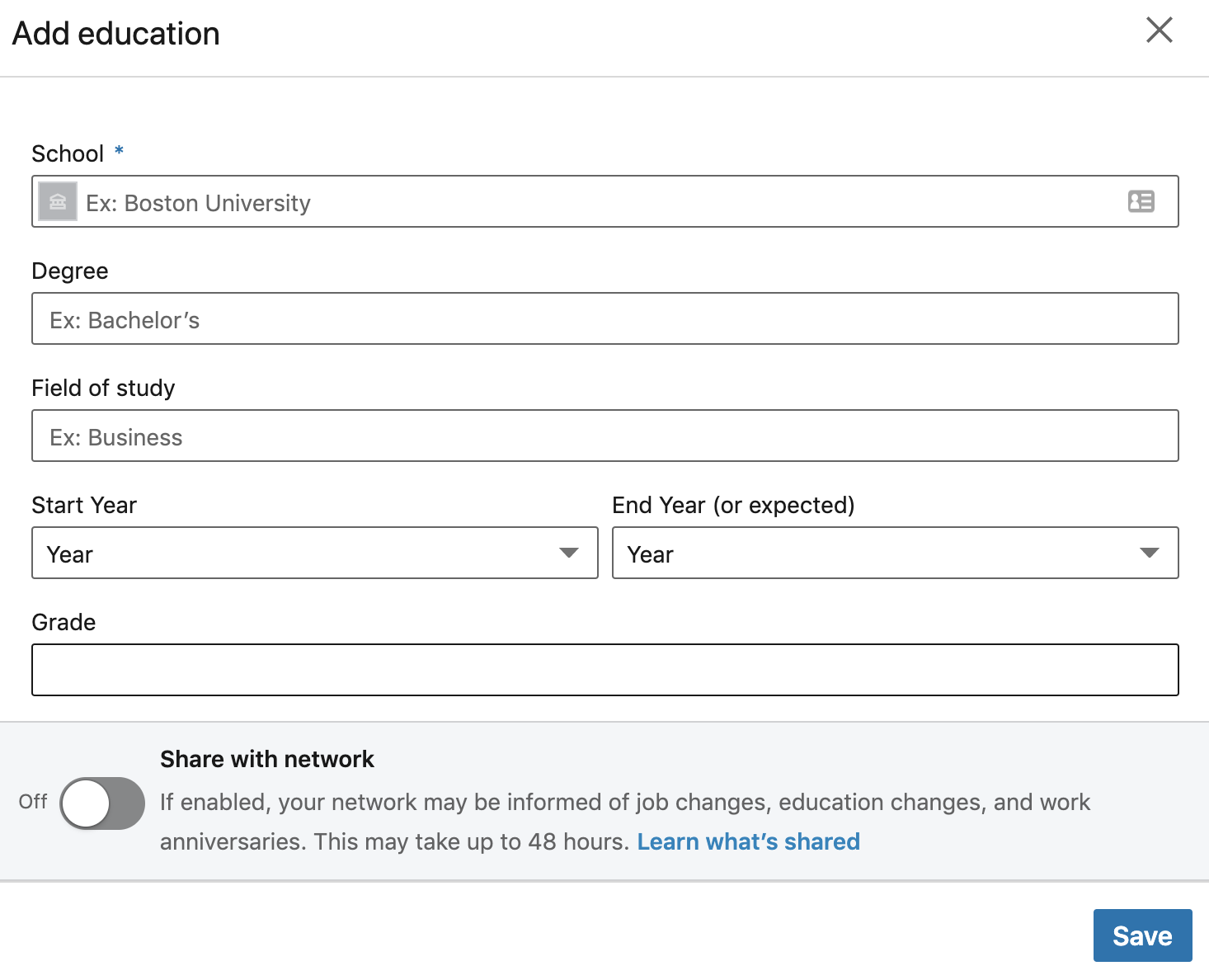
Though few on Twitter found him credible, he wasn’t mistaken on this front. In creating a profile on LinkedIn, the choices one is given are to a.) list a completed degree and leave off anything partially completed, no matter how much time was invested in a program (or minuscule its acceptance rate) or b.) list an incomplete degree without a clear way of explaining that it’s no longer being pursued or whether it will ever be obtained.
Screen Shot 2019 10 23 at 4.43.53 PM

LinkedIn doesn’t view the issue as its fault. Asked whether LinkedIn members might be posting incomplete degrees because of the company’s user interface, a spokesperson emailed us today, writing that LinkedIn’s user agreement and “professional community policy” guidelines — which, of course, no one reads or cares about — are “clear that members should provide factual information about themselves on LinkedIn.”

Added this person: “People should definitely add their education details to their LinkedIn profile. The education section includes ‘Start Year’ and ‘End Year (or expected)’ fields. If a member has a partial degree, we recommend they clearly state the status of their degree within the ‘Degree’ and/or ‘Description’ fields.”

Still, that “description” field isn’t easy to find, and why LinkedIn — which has more than 600 million users — hasn’t added fields for partially completed degrees is a bit of a mystery.

Cynically we will note that LinkedIn makes a lot of its revenue off recruitment services. Before it was acquired by Microsoft, and the companies’ financials were consolidated, 65 percent of LinkedIn’s revenue came from recruitment services. And often the more distinguished the degree, the more people will pay to associate themselves with the ostensible degree holder. (LinkedIn itself strongly encourages loading up one’s profile with education-related details, saying these attract “11x” more profile views.)

A much bigger factor, however, is human nature, argues Stanford professor Jeffrey Pfeffer, a renowned professor at Stanford’s Graduate School of Business who has written extensively about organization theory. Asked if he has reason to think that more students are listing incomplete degrees on LinkedIn — or even dropping out of school with less compunction, knowing they might — he points us to numbers published in 2001 by the payroll and benefits managing company ADP.

What they show: of 2.6 million background checks that the company performed that year, 44 percent of applicants were discovered to have lied about their work histories, 41 percent lied about their education, and 23 percent falsified credentials or licenses.

“People lie about everything all the time,” says Pfeffer. “I’m not sure that it’s any worse now than it was 10 or 20 or 30 years ago.”

It’s something recruiters anticipate, he says. He recalls a conversation with a top executive from the search giant Heidrick & Struggles, who Pfeffer had interviewed for one of the many books he has authored. “He said to me, ‘So many people make up credentials that we no longer use fudged credentials as a reason to disqualify a candidate.’ He said recruiters will correct what they find wrong with someone’s resume. But he said if they used exaggerated — even made-up — credentials as a reason to disqualify people, they would never have enough candidates.”

LinkedIn’s limited menu of options may give more cover to people. But Pfeffer cautions not to assign the company too much blame, no matter its reach. It’s a little like shooting the messenger, he suggests.

“Sure, LinkedIn could play some role. But they could change the way they operate tomorrow, and people would still find a way to make themselves look more accomplished than they are.”


24 Oct 2019

Elon Musk predicts Tesla energy could be ‘bigger’ than its EV business

Tesla CEO Elon Musk forecast that the company’s energy business will eventually be the same size as— or even bigger than — its automotive sector, the latest sign that the company plans to put more time and resources to scaling up its solar and storage products.

It could be bigger, but it will certainly be of a similar magnitude,” Musk said during an earnings call Wednesday. The company surprised Wall Street by reporting a return to profitability in the third quarter.

The bulk of Tesla’s revenue is generated from sales of its Model S, Model X and Model 3 electric vehicles. In the third quarter, automotive revenues were $5.35 billion. The company doesn’t break out revenue generated from solar, energy storage or other products and services. However, the total revenue in the third quarter was $6.3 billion, which gives some indication of the size of automotive compared to its other businesses.

Tesla’s energy and solar businesses languished for nearly two years as attention and resources were directed to the Model 3. That diversion of resources included redirecting battery cell production lines meant for its home Powerwall and commercial Powerpack energy storage products to the car because the company didn’t have enough cells.

“We had to do it because if we didn’t solve the Model 3, Tesla wouldn’t survived,” he said.So, unfortunately that shorted other parts of the company.”

Now, the company is committed scaling up energy storage and solar. Kunal Girotra, who initially joined Tesla in 2015 as a senior product manager for Powerwall, was promoted to senior director of the company’s energy operations.

In the third quarter, Tesla installed 43 megawatts of solar, a 48% increase from the previous quarter. Solar installations are still 54% lower than the same period last year.

Energy storage deployments have continued to grow, reaching an all-time high of 477 MWh in the third quarter, according to earnings posted Wednesday.

Part of this new effort includes its solar roof tile product, which was originally unveiled in 2016. Musk said that a new, third iteration of its solar roof tile will debut Thursday afternoon.

24 Oct 2019

Elon Musk: Model S, Model X production continues for ‘sentimental reasons’

Tesla continues to produce the Model S and Model X more for “sentimental reasons than anything else,” CEO Elon Musk said Wednesday during a call with investors, calling the electric vehicles “niche” products.

“They are really of minor importance to future,” Musk added.

Sales of Tesla Model 3 vehicles far outpace its the company’s older Model S and Model X vehicles. Tesla delivered 17,483 Model S and Model X vehicles in the third quarter, compared to 79,703 Model 3 cars. And Musk anticipates the Model Y, which has yet to be produced, could surpass Model 3 sales.

Still, while the Model S and X are more expensive and lower volume than the Model 3, the vehicles have been important to the financial health of the company for years. Tesla’s automotive gross margins have been buffeted in the past by sales of the higher-priced (and better margin per vehicle) Model S and X vehicles.

The vehicles might not be part of the company’s long-term future. But for now, Tesla is sticking with the two vehicles.

Tesla is increasing production on Model S and X lines for this quarter in response to increasing demand for the electric vehicles, CFO Zach Kirkhorn noted during the call.

As Tesla has launched, ramped and stabilized Model 3, the company is now able to focus its attention on the rest of its products, Kirkhorn said.

Tesla continues to see a strengthened order rate, which the company anticipates will be reflected in Model S and X deliveries in the fourth quarter, Kirkhorn added. 

Musk did take time to rave about the Model S, particularly the newer version, which has a new “Raven” power train.

“It’s so easy to drive, it makes you feel like Superman driving that car,” he added. “And it’s incredibly safe.”

Musk then described the X as “the faberge of cars,” before adding that “it’s an art piece basically.”

23 Oct 2019

Tesla is launching version three of its solar roof tile this week

Tesla will debut a new, third iteration of its solar roof tile this week – with an official debut tomorrow afternoon. Tesla CEO Elon Musk said during the company’s earnings call on Wednesday that it’ll make an official announcement detailing the differences in generation three on Thursday afternoon.

Tesla originally unveiled its solar roof tile product back in 2016, officially opened pre-orders in 2017. During the company’s annual shareholder meeting in June, Musk said that the product was already in tis third iteration, which he said improved performance and put the product on cost parity with cheap, non-solar roofing tiles, once you factor in savings over time on utility cost plus the cost of purchase for the new roof.

It seems like that version was in testing at that point, and is now ready for general consumer sales and purchase. The solar tiles have not seemed to have seen consumer installations in any kind of significant scale to date, with existing customers with reservations in place claiming they haven’t heard much in the way of installation timeline expectations. Perhaps we’ll learn more about availability and roll-out plans along with tomorrow’s ‘official’ launch of the version three product.

23 Oct 2019

Revolut launches publicly in Singapore, signs deal with Mastercard

London-based fintech startup Revolut has two pieces of news to announe this week. First, Revolut is expanding to Singapore after a long beta period. The company already has 30,000 customers over there and anyone can open an account now.

Singapore residents will be able to take advantage of all of Revolut’s core features. You can open an account from your phone, get a card and start spending anywhere in the world.

Revolut supports Singapore Dollar as well as 13 other currencies. You can top up your account, send and receive money from the app.

With a free account you can convert money in the app without any markup fee on weekdays up to S$9000 per month. You can also withdraw money anywhere in the world without any fee up to S$9000 per month.

Premium accounts cost S$9.99 per month and Metal accounts cost S$19.99 per month in Singapore. You get higher limits and a few additional features.

Revolut is currently available in the U.K., Europe and Australia. There are 7 million Revolut customers in total. The company is still working on its launch in the U.S. and Canada for later this year.

The other piece of news is that Revolut has signed a global partnership with Mastercard. Revolut has already been working with Mastercard to issue cards, so this is an expansion of the current deal.

Revolut can now issue cards that work on the Mastercard network in any market where Mastercard is accepted, which represents around 210 countries. It doesn’t mean that Revolut will launch in 210 countries. But the startup says that the first Revolut cards in the U.S. will work on Mastercard.

It also doesn’t mean that Revolut will work exclusively with Mastercard. The company also works with Visa and recently announced a partnership deal. But at least 50% of all existing and future Revolut cards in Europe will be Mastercard branded.

It shouldn’t matter much to end customers as I have yet to see a place that accepts Mastercard but not Visa, or Visa but not Mastercard. But Revolut is clearly using market competition to its advantage.

23 Oct 2019

Elon Musk says Tesla “early access” full self-driving could arrive by end of year

Tesla CEO Elon Musk said on the company’s earnings call today that the company’s full self-driving mode, in a feature-complete release, could arrive as early as the end of this year. That would be made available in an ‘early access’ mode which is essentially a limited beta, and Musk qualified that this isn’t a sure thing.

“While it’s going to be tight, it still does appear that will be at least in limited in early access release of a feature complete self-driving feature this year,” he said on the call.

He added that it’s “not for sure,” but that it “appears to be on track” for a limited private beta by year’s end.

This follows the release of Tesla’s Smart Summon automated parking lot driverless parking lot hailing feature. It allows Tesla owners to call their cars from their parking spots to pick them up from a curbside within the parking lot. The feature has been used plenty of times with mixed results reported from early use, but Musk also said that the company will be releasing an updated version of the software with improvements in the next “week or so.”

The Smart Summon update is an improvement built on the data taken from the “over a million” uses of the feature by Tesla owners already since its release at the end of September.

To make use of the full self-driving mode that Tesla plans to introduce, vehicle owners will have to own the FSD upgrade package, which is a $7,000 upgrade after it increased from $6,000 in August.

Tesla began shipping its new full self-driving computer hardware in all new vehicles beginning in April, moving to its own custom chip. This was to ensure that enabling the FSD feature would be a software-only update, which is something the company had claimed would be possible with a previous generation of self-driving computing hardware, but the challenge has clearly been more difficult than expected – estimated timelines for the feature’s deployment have also slipped multiple times.

23 Oct 2019

Bill McDermott aims to grow ServiceNow like he did SAP

Bill McDermott has landed. Two weeks ago, he stepped down as CEO at SAP after a decade leading the company. Today, ServiceNow announced that he will be its new CEO.

It’s unclear how quickly the move came together but the plan for him is clear: to scale revenue like he did in his last job.

Commenting during the company’s earning’s call today, outgoing CEO John Donahoe said that McDermott met all of the board’s criteria for its next leader. This includes the ability to expand globally, expand the markets it serves and finally scale the go-to-market organization internally, all in the service of building toward a $10 billion revenue goal. He believes McDermott checks all those boxes.

McDermott has his work cut out for him. The company’s 2018 revenue was $2.6 billion. Still, he fully embraced the $10 billion challenge. “Well let me answer that very simply, I completely stand by [the $10 billion goal], and I’m looking forward to achieving it,” he said with bravado during today’s call.

It’s worth noting that as the company strives to reach that lofty revenue goal in the coming years, it will be doing with a new CEO in McDermott, as well as a new CFO. The company is in the midst of a search to fill that key position, as well.

McDermott has been here before though. He points out that in the decade he was at SAP, under his leadership the company moved the market cap from $39 billion to $163 billion. Today, ServiceNow’s market cap is similar to when McDermott started at SAP at a little over $41 billion.

He also recognizes that this is going to be a new challenge. “I’ve seen a lot of different business models, and [SAP has] a very different business model than ServiceNow. This is a pure play cloud,” he said. That means as a leader, he says that has to think about product changes differently, how they fit in the overall platform, while maintaining simplicity and keeping the developer community in mind.

Ray Wang, founder and principal analyst at Constellation Research said that ServiceNow is at a point where it needs an enterprise-class CEO who understands tech, partnerships, systems integrators and real enterprise sales and marketing — and McDermott brings all of that to his new employer.

23 Oct 2019

As Tesla begins ‘trial’ Model 3 production in China, it closes in on a European factory

Tesla has started trial production of its Model 3 vehicle in its new Shanghai factory, which CEO Elon Musk called a “template for future growth.”

This trial basis includes all aspects of production, including body, paint and general assembly. Tesla said it is clearing final regulatory hurdles such as finalizing its manufacturing license. Once complete, the company will begin ramping production and delivering vehicles, the automaker said Wednesday in its third-quarter earnings report.

Tesla’s factory capacity is poised to grow even larger as it gets closer to picking a location in Europe for its third factory. The company said Wednesday it’s in the final stages of its site selection process. The eventual European factory is expected to produce both Model 3 and Model Y, Tesla said.

For now, Tesla’s future financial health is tied, in part, to its ability to ramp up sales in China, the world’s largest electric vehicle market.

In July 2018, Tesla struck a deal with the Chinese government to build a factory in Shanghai. It was a milestone for the Tesla and Musk, who has long viewed China as a crucial market. And it was particularly notable because China agreed for this to be a wholly owned Tesla factory, not a traditional joint venture with the government. Foreign companies have historically had to form a 50-50 joint venture with a local partner to build a factory in China.

Chinese President Xi Jinping has pushed forward plans to phase out joint-venture rules for foreign automakers by 2022. Tesla is one of the first beneficiaries of this rule change.

The opening of the China factory comes at a time of rising trade tensions between China and the United States. Tesla has been particularly exposed to relations between China and U.S., and the resulting rising tariffs. Tesla builds its electric sedans and SUVs at its factory in Fremont, Calif. and ships them to China, which subjects the vehicles to an import tariff.

“We believe China could become the biggest market for Model 3,” the company said in its third-quarter earnings report.

Tesla broke ground on the factory in China in January and was constructed in just 10 months, including the installation of stamping and other equipment. Musk called the speed of construction “unprecedented.”