Category: UNCATEGORIZED

23 Oct 2019

Google debuts new digital wellbeing ‘experiments’ like a notification mailbox, unlock clock & even a paper phone

Following the introduction of its digital wellbeing tools for Android at Google’s I/O developer conference last year, the company has expanded the feature set to include new options like “Focus mode” and better parental controls for families with children. Now, Google is trying something else. The company today introduced a set of experimental apps designed to help users be better aware of their device use and reduce their screen time.

The apps, which are a part of a new Digital Wellbeing Experiments platform, are very different from your standard screen time controls. They’re open-sourced projects designed to kickstart out-of-the-box thinking, but not necessarily must-have tools.

One experiment, Unlock Clock, simply shows you how often you unlock your phone.

Screen Shot 2019 10 23 at 6.08.37 PM

Another, We Flip, lets a group of friends or a family disconnect from technology altogether by flipping a big switch. And if anyone unlocks their phone, the session ends for everyone — almost like making screen time a competitive family sport.

Desert Island and Morph, meanwhile, take an app-centric approach to screen time reduction. The former requires you to go a day with only your most essential apps, while the latter helps you stay focused by giving you the right apps at the right time of day.

Screen Shot 2019 10 23 at 6.29.32 PM

That idea was popular in years past with Android launchers, like Cover, EverythingMe, and Aviate, for example. In these cases, different homescreen configurations and widgets would appear based on what time of day it was and what you were doing. However, the idea of smartphones that personalized themselves to our needs never really took off — perhaps because these experiences could never transition to iOS where Apple’s restrictions limited how much customization could take place.

Post Box is one of the more intriguing creations — it offers to hold your notifications until whatever time suits you. Notification spam is now arguably one of the worst side effects of becoming a smartphone user. It’s so bad, in fact, that both Apple and Google have had to redesign ways for users to reassert control.

Earlier this year, Apple CEO Tim Cook even said that he has gutted his notifications, touting the iOS feature to do so as some sort of miraculous invention — when in reality it was Apple’s flawed design of the notification system to begin with, that had allowed developers to continually interrupt us with their irrelevant pings. A mailbox-style system — like this new Google experiment provides — was another obvious choice, but one that wouldn’t have allowed an app ecosystem to blossom.

Then there is the most whimsical experiment of them all, Paper Phone.

This app will print you a custom booklet of the critical information you need that day, including favorite contacts, maps, meetings, tasks, weather info, and more.

paper phone

You can then take a short break from your device, without giving up access to your must-have information. It’s like time-traveling for those of us old enough to remember life before smartphones, and a small gift of freedom for those who have never been without.

Google says the Digital Wellbeing Experiments platform is open for contributions from any designers and developers who want to share their ideas for a more balanced relationship with technology.

“We hope these experiments inspire developers and designers to keep digital wellbeing top of mind when building technology. The more people that get involved, the more we can all learn how to build better technology for everyone,” said Google.

While the new experiments are less about fixing existing Google products and more about playing around with new ideas, Google has several other screen time/wellbeing initiatives underway, including its Android wellbeing features, YouTube’s ‘take a break’ reminders, Google Assistant routines, Gmail automation like auto-reply and send later, Family Link and more.

23 Oct 2019

Bitcoin and cryptocurrencies are having a very bad day

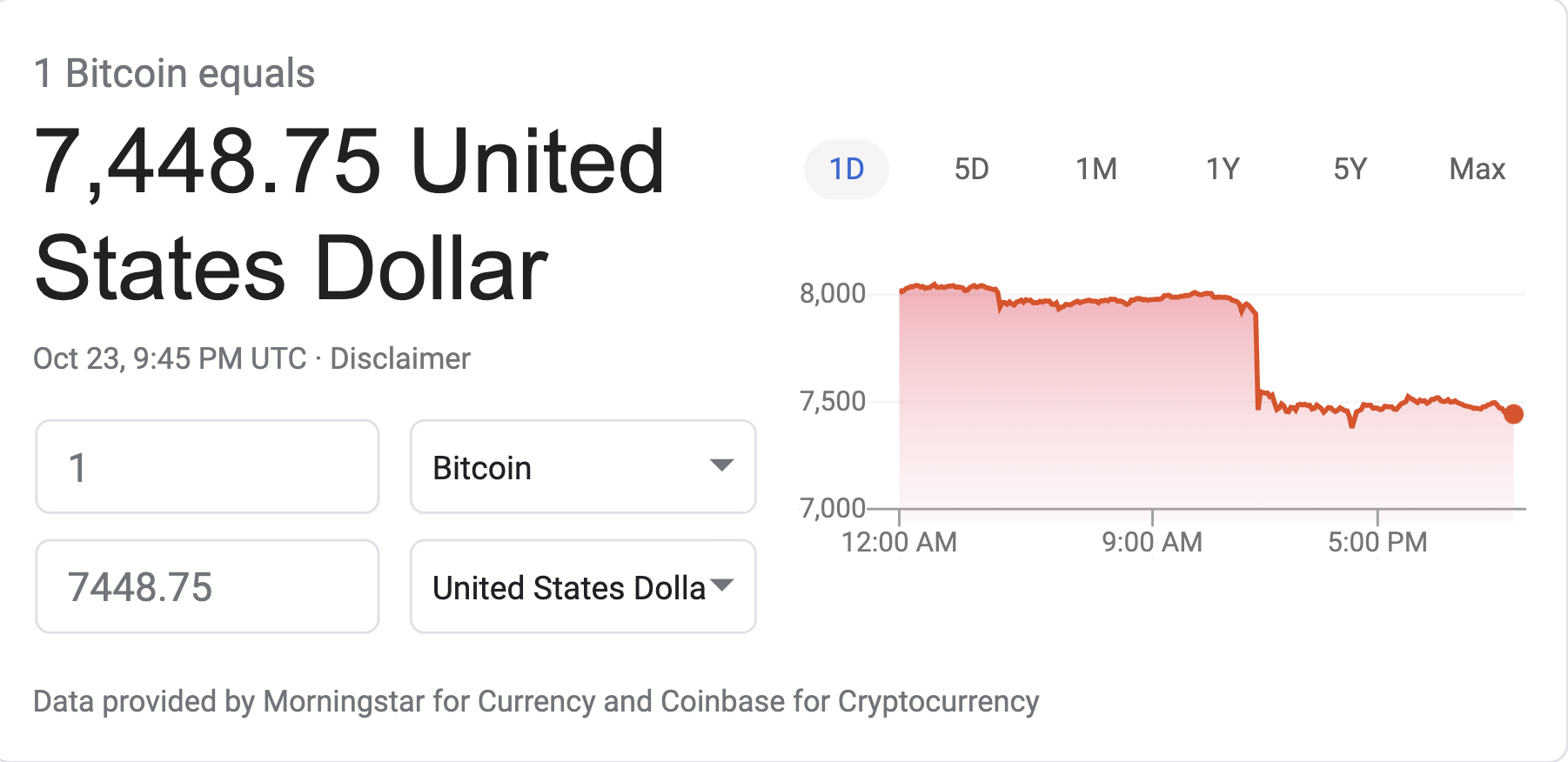
The price of Bitcoin and other cryptocurrencies tanked today, continuing a months-long slide that has seen the value of the digital currency slide by more than $2,000 from highs of above $10,000 earlier in the year.

Investors are still speculating about the cause of the crash, but hopeful cryptocurrency bulls before today had hoped that $8,000 would be the new floor for Bitcoin.

No longer. Today the price of Bitcoin dropped to $7,448.75, down from around $8,000 earlier in the day.

Screen Shot 2019 10 23 at 2.52.43 PM

Investors aren’t sure what’s behind the crash, but Bitcoin’s commentariat pointed to two likely culprits.

One was the underwhelming performance of Facebook’s chief executive Mark Zuckerberg in testimony before Congress on the Libra cryptocurrency that his company is leading the charge to create.

However, an underwhelming performance from Zuckerberg and the potential fate of Libra, which cryptocurrency purists have scoffed at anyway, may be less concerning for the Bitcoin crowd than developments happening in Google’s quantum computing research labs around the world.

Earlier today, Google declared quantum dominance, indicating that it had solved a problem using quantum computing that a supercomputer would have taken years to solve. That’s great news for theoretical physicists and quantum computing aficionados, but less good for investors who’ve put their faith (and billions of dollars) into a system of record whose value depends on its inability to be cracked by computing power.

When news of Google’s achievement first began trickling out in late September (thanks to reporting by the Financial Times), Bitcoin experts dismissed the notion that it would cause problems for the cryptocurrency.

“We still don’t even know if it’s possible to scale quantum computers; quite possible that adding qbits will have an exponential cost,” wrote early Bitcoin developer Peter Todd, on Twitter.

The comments, flagged by CoinTelegraph, seem to indicate that the economic cost of cracking Bitcoin’s cryptography is far beyond the means of even Alphabet’s multibillion-dollar budgets.

Still, it has been a dark few months for cryptocurrencies after steadily surging throughout the year. The real test, of course, of the viability of Bitcoin and the other cryptographically secured transaction mechanisms floating around the tech world these days is whether anyone will build viable products on their open architectures.

Aside from a few flash-in-the-pan fads, the jury is very much still out on what the verdict will be.

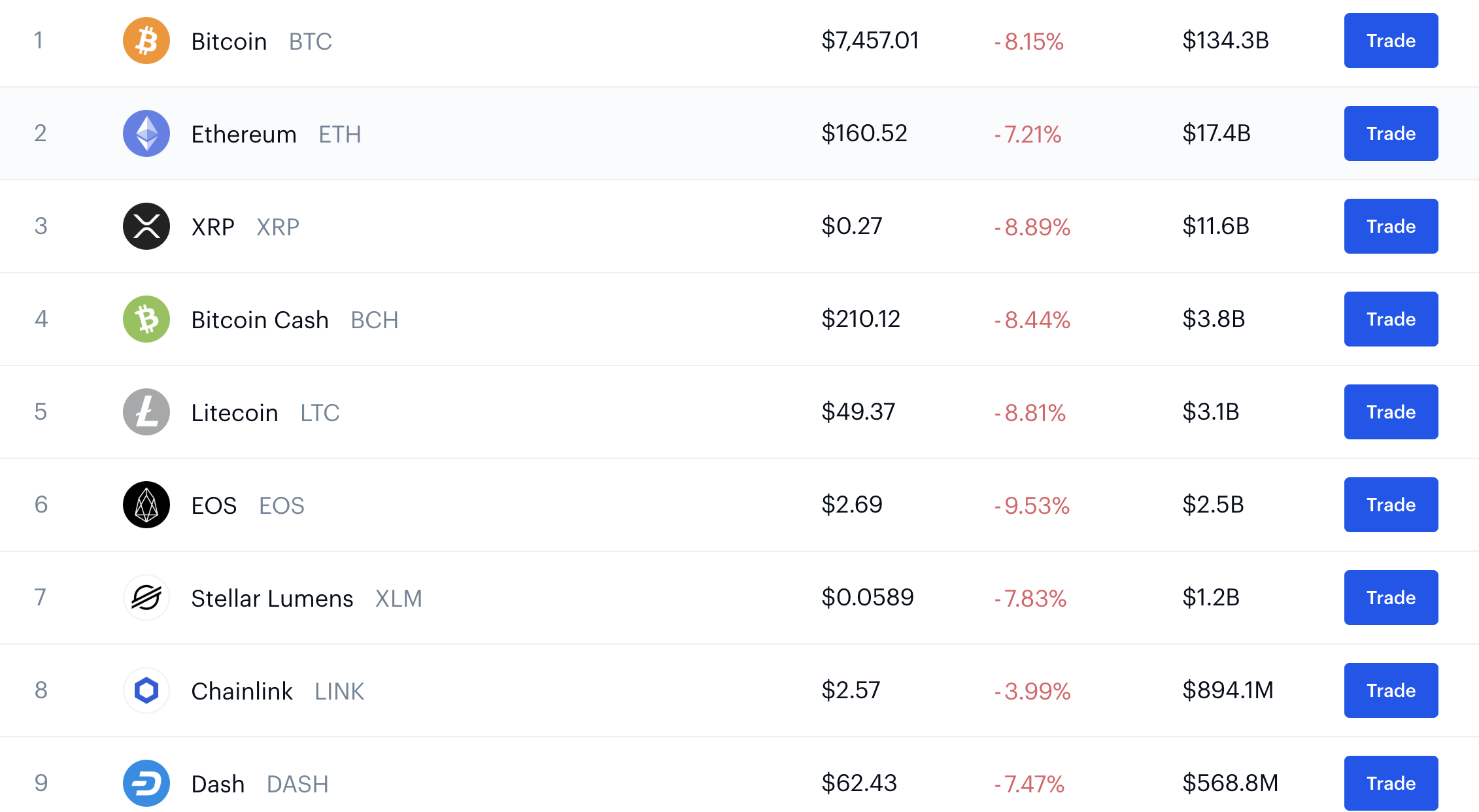
That uncertainty affects more than just Bitcoin, and, indeed, the rest of the market also tumbled, as Coindesk pricing charts indicate.

Screen Shot 2019 10 23 at 3.23.33 PM

23 Oct 2019

6 considerations for managing your cap table

Founders start a company because they have an idea they want to bring to market. As their company gains traction and matures, the way in which they manage their business needs to evolve to enable strategic decisions for growth.

Developing and properly managing a capitalization table (cap table) is one such necessary business evolution. In this context, capitalization is the sum and itemization of all those who hold equity in the company or the right to receive equity in the future. Tracking these items through a central means helps illustrate the ownership stakes in the business and what securities the company has outstanding.

For a first-time founder, it can be overwhelming to develop a cap table and make all related decisions. However, with the right resources and adoption of best practices, founders can better manage, maintain and leverage their cap table to provide actionable business intelligence and management.

For better business intelligence, look to your cap table

In many ways, the cap table is akin to the balance sheet in the sense that it represents the company’s position as of a certain point in time. The balance sheet shows the company’s assets and liabilities. The cap table shows the company’s ownership and accompanying economic and voting rights. The cap table includes factors such as shareholder information, ownership position, rights to purchase additional equity in the future, vesting schedules, voting percentages and purchase price. It takes all of the material information related to capitalization and summarizes it into a digestible format to help founders make executive-level decisions for soliciting stockholder approvals, issuing grants to new hires, raising additional rounds of financing, calculating liquidation waterfalls for a liquidity event, etc.

When it comes to how much founders need to own the cap table, think about it this way: Not every CFO needs to build out the financial statements. However, every CFO needs to have a high degree of confidence that their financial statements are accurate — with systems in place to ensure accuracy so they can spend their time using the financial statements to make strategic decisions. The same is true for founders’ involvement with their cap tables. Most companies rely on competent legal counsel to maintain their cap table and provide their executive team with actionable information in a digestible format.

Here are six best practices that help founders improve and maintain an effective cap table management process.

1. Familiarize yourself with its basic elements and formats

There are many different elements and formats of a cap table. Viewed as a spreadsheet, table or chart, the cap table can look different for every company at every stage of its growth. While the cap table tends to be simple in the beginning stages of the company, it will naturally evolve and become much more complicated as the company matures.

At a basic level, the cap table should list the equity stakes in a company, including common stock, preferred stock and stock options, and outline all of the ownership details for these securities. Other elements include transaction history and legal restrictions, such as sales, transfers, exercises of options, transfer restrictions and the conversion of debt to equity, among others.

The cap table should show the company’s overall capital structure at a glance, as well as detailed ownership information for each class and series of stock outstanding (see an example at the end of this article). Most importantly, it should always be accurate and up to date.

2. Recognize the importance of executive alignment

At its core, the cap table should be designed to help solve business issues for you. If you’re not using it to make decisions as an executive team, then it’s not serving a core purpose. The cap table is also critical to your legal team, so certain aspects may be primarily for their use, but if the company’s management doesn’t find the cap table helpful, that is a problem.

Creating good habits early on will serve you well as the business grows.

A good example of this is its role in the hiring process. Equity is a key consideration in talent recruitment and retention packages. Without an accurate cap table, you’ll find yourself in situations where you have to routinely ask yourself how many shares you can offer to a new hire, which can unnecessarily slow down the hiring process.

However, if you can use the cap table as a way to gain alignment on such matters, you can begin to use it to solve actual business problems. Rather than argue about which equity package to grant a new employee, your HR team can provide routine feedback on standardized equity packages to help improve or maintain competitive compensation.

3. Evaluate and implement tools to help you manage it

When it comes to understanding how detailed your cap table needs to be, compare it once again to the financial statements. In the early days of the business, financial statements don’t necessarily feel as valuable as they do in later stages of growth. They aren’t as critical to the business — yet — because it’s not hard to recreate it whenever you need information to make a decision.

However, as the business matures and grows, it becomes more difficult to recreate the financial statement on an ad hoc basis, and virtually impossible to hold the information accurately in your mind. The same holds true with the cap table: In the beginning, you might be able to rattle it off the top of your head or have it documented simply in Excel, but as you grow, the information becomes more complex and you need better, automated systems in place. As with financial statements, creating good habits early on will serve you well as the business grows.

Using cap management software provides better capabilities and version control than spreadsheets to manage this process. Free software, such as captable.io and Carta are great starting places for early-stage founders. Carta also provides additional features to manage your more complex cap table. Because the cap table’s ultimate purpose is to enable the executive and legal teams to make informed decisions, safeguards on administrative access and version control are critical features to consider when choosing which tool or application to use.

4. Determine and delegate ownership of the cap table

As you model new rounds of financing and analyze the impact on stakeholders, cap table management becomes a significantly valuable activity. This is where your legal team or outside counsel becomes even more advantageous to you as a founder. Delegating cap table management to your lawyer can further help you stay on top of critical changes and minimize errors, while enabling you to focus more on building and scaling the business. Creating and maintaining an accurate cap table requires an ability to read, understand and translate legal documents into numbers and formulas. It is best to rely on the expertise of your legal team for this to ensure the most accurate business decisions are made.

Your cap table should be well-managed, well-understood and up-to-date.

We frequently see founding teams make seemingly small mistakes, such as adding an individual’s name to the cap table before an equity grant has legally been made. This may lead one to believe that more stock is outstanding than is technically the case and can create errors when calculating the number of shares to be granted to subsequent stockholders — or miss making the grant altogether, which can have unfortunate tax consequences for the stockholder and potential liability for the company. Order of operations is critical to legal workflows and it’s best to leave the day to day cap table maintenance to your legal team.

5. Decide how much information to share with investors

When it comes to how much cap table information you should disclose to your investors, there isn’t a right or wrong answer. Commonly, providing investors with a summary cap table is a fairly standard practice. That allows investors to calculate their ownership position for their internal tracking and audit purposes. More often than not, investors don’t receive an itemized list of every shareholder or investor in the company. While preferences differ on this point, many of our clients prefer that any company-related discussions are directed to the executive team so they can address and control messaging. Of course, in many instances investors will know which of their peers have also invested, but sharing detailed equity positions, contact information and individual employees’ equity stakes is less common.

In Carta, investors generally have portfolio views with visibility into all of their companies. They might send you a request for access to your cap table so they can add you to their portfolio. In this scenario, the summary cap table is the most common approach people default to for the investors. If an investor feels strongly about receiving detailed cap table viewing privileges, they can make their case to the company, which may consider the request on an individual basis.

Major investors will typically have specific, private contractual rights to get regular financial statements and cap table updates. They might even have a representative who is a board observer or board member, in which case, they will have access to the information they want, as agreed to in the equity financing paperwork.

6. Choose how much to share with employees

Understanding the appropriate levels of information about your cap table to share with employees is another top consideration for founders. The key to this is determining the balance that you, as a founder, feel comfortable with in terms of employer transparency.

Some founders choose to be transparent about their cap tables and others opt not to disclose much and provide equity information on a need-to-know basis. The important part here is determining how you can best use the cap table to help your employees understand what they need to know.

For example, employees with equity want to understand what their payout is if the company sells. Regular communication or resources that provide employees with access to their holdings and options is a great approach to help motivate employees and improve talent retention, but can have unintended consequences.

For example, most companies will have their common stock valued after each round of financing. Some founders will want to share this number with the team so that people can understand that their stock is appreciating. That is very exciting and motivating — so long as everything is going well. However, if the stock’s appreciation is not meeting the team’s expectation (whether reasonable or not), then providing that information can significantly decrease morale. For this reason, the vast majority of companies choose not to disclose this information to the broader team.

Get proactive with your cap table

Your cap table should be well-managed, well-understood and up-to-date. Fortunately, the management process doesn’t need to become just another headache: With the proper considerations, communication, resources and ownership, you can put the correct processes and legal team in place efficiently, and effectively manage your cap table so it continues to help you scale your business — rather than slow it down.

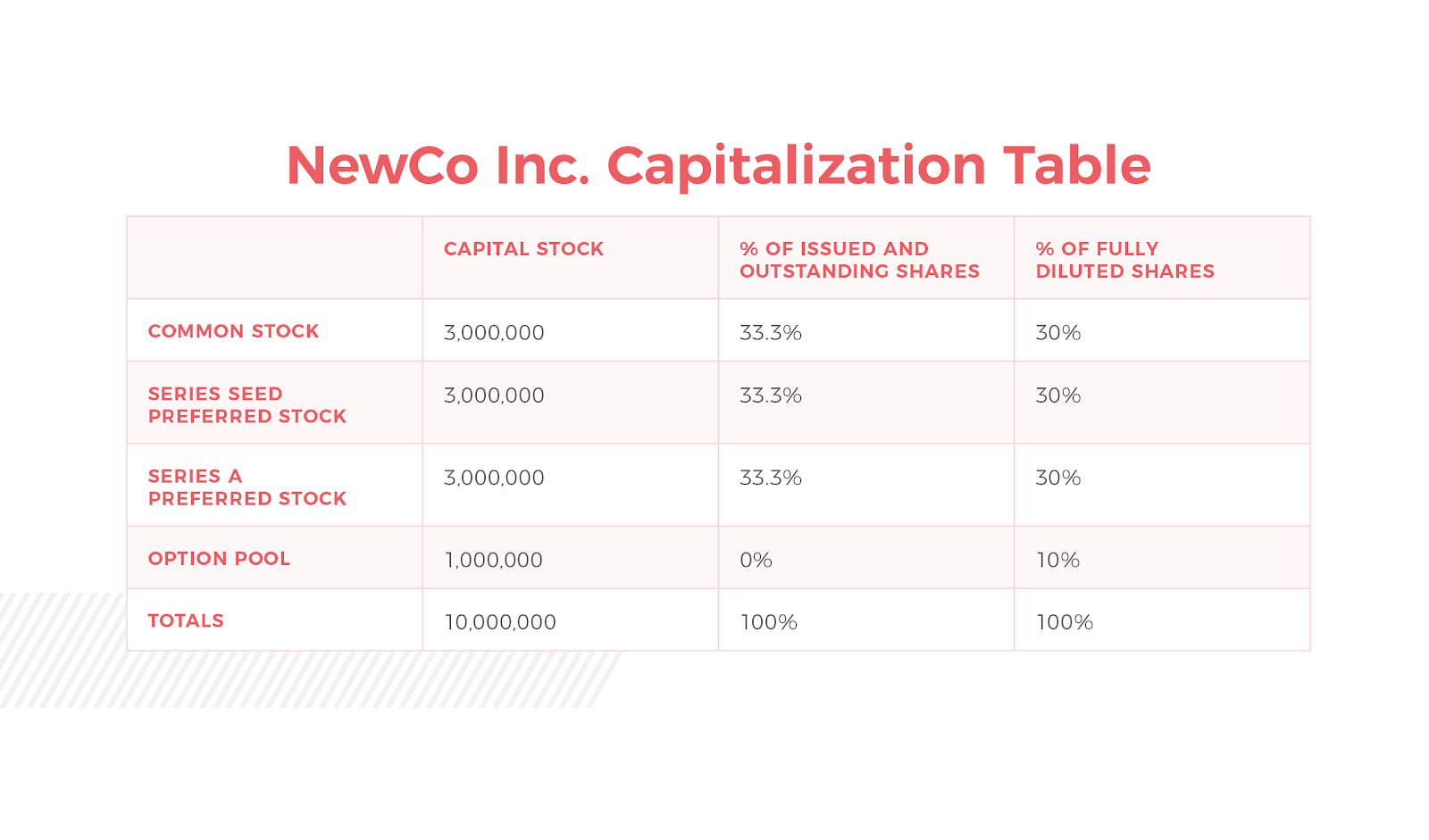
Sample cap table

This table represents a simple cap table showing a hypothetical breakdown of seed preferred stock, Series A preferred stock, common stock and the available option pool.
atrium sample cap table

All content presented herein is for informational purposes only. Nothing should be construed as legal advice. Transmission and receipt of this information is not intended to create, and does not constitute, an attorney-client relationship with Atrium LLP. There is no expectation of attorney-client privilege or confidentiality of anything you may communicate to us in this forum. Do not act upon any information presented without seeking professional counsel.


23 Oct 2019

Koan, launched by a cofounder of Jive Software, has raised $3 million in seed funding

Koan, a three-year-old online platform that aims to help teams achieve their objectives and stay engaged, has raised $3 million in seed funding led by Uncork Capital and Crosslink.

Koan, cofounded and led by CEO Matt Tucker — who previously cofounded Jive Software, an outfit that made social software for businesses and went public in 2011, then sold in 2017 —  is trying to set itself apart from the many other performance management tools by catering less to HR departments and targeting instead the chief operating officer or chief of staff.

Though these individuals today rely heavily on emails and spreadsheets — static products that can slow down execution — Koan tries to make them more efficient by providing them with a dashboard that makes it easier to track goals, provide feedback, and execute other people-management tasks, among other tools.

The company is also targeting leaders of small to mid-size companies. The broader idea is to help them with goal management, and to make it easier for them to make progress against their own metrics and goals.

Koan, which integrates with a wide number of third parties, from Salesforce to Slack, employs just 10 people at this point and is based in Portland, Ore., though Tucker works from Palo Alto, where, interestingly, he and his wife also operate a company called Blind Tiger Ice.

Inspired by their international travels to upgrade in some way their local dining (and drinks) experience, the nearly two-year-old company is becoming known in some tech circles for its “high-quality cocktail ice,” as Tucker describes it. Among its customers: Netflix, Facebook, Google, and the world-famous Yountville, Ca.-based restaurant French Laundry.

Every once in a while, too, says Tucker, his worlds collide. Recently, for example, the venture firm CRV called Blind Tiger to order ice for a party it was throwing. The portfolio company it was celebrating: Iterable, a growth marketing startup and also a Koan customer.

Koan has now raised $5 million altogether. Earlier investors include the Webb Investment Network, SV Angel, and Spider Capital, all of which participated in the company’s newest round.

Above, left to right: Cofounders Matt Tucker and Arend Naylor, an early engineer at Jive Software, cofounded by Tucker.

23 Oct 2019

Tesla surprises with a profit in the third quarter

Tesla returned to profitability in the third quarter after two periods of losses, according to earnings reported after market closed Wednesday.

The automaker’s third-quarter results included revenue of $6.3 billion and earnings per share, adjusted of $1.86. Analysts had expected losses of 42 cents per share.

The third-quarter report sent Tesla shares as high as 17% in after market trading.

Tesla’s third-quarter was slightly lower than the $6.35 billion generated in the previous period and more than 7.5% lower than the same quarter last year. But it nearly in line with analysts expectations.

Tesla was also able to improve its automotive gross margins, an important sign of its financial health. The automotive gross margin widened to 22.8% in the third quarter from 18.9% in the previous period. The automotive gross margin has not yet recovered to the 25.8% of the same quarter in 2018.

23 Oct 2019

Truebill raises $15M to build a comprehensive platform for personal finance

Personal finance startup Truebill announced today that it has raised $15 million in Series B funding.

The new funding was led by Eldridge Industries, with participation from Evolution VC previous investors including Cota Capital, Lucas Venture Group and YouTube co-founder Jawed Karim.

When the Y Combinator-backed startup raised seed funding back in 2016, it was focused on what Chief Revenue Officer Yahya Mokhtarzada now describes as “a single function” — helping users track all their subscriptions and recurring expenses, and then to cancel them when desired.

Mokhtarzada said the Truebill team subsequently saw an opportunity, given “the increasing degree of financial complexity in people’s lives,” to take “a more holistic view of personal finance.”

Truebill still offers subscription tracking, and Mokhtarzada said that’s usually what brings new users in. But it’s also added capabilities like automated budgeting, automated saving and bill negotiation. And this fall, it plans to launch additional features including bill pay, credit score monitoring and a rewards program.

Consumers have plenty of other personal finance tools to choose from, but Mokhtarzada said most of them are focused on fulfilling a specific need and will likely become less relevant as your financial situation changes.

“The other half is, if you look at the App Store, it’s filled with single point solutions,” he said. “As your financial life gets more sophisticated and complex, the consumer is ending up with five or more different point solutions. All of that needs to be consolidated into one place.”

Truebill says it currently has 500,000 active users. The basic product is free, then users can pay a price of their choosing for premium features like custom budget categories; Truebill also takes a cut of the savings when it negotiates lower bills.

The company recently opened new headquarters in Silver Spring, Maryland. Mokhtarzada said Truebill still has an office in San Francisco, but he noted that he and his co-founders/brothers previously built Webs.com in Silver Spring.

“San Francisco obviously has very competitive market — it’s harder to hire and very difficult to retain talent,” he added. “With the D.C. area, it feels like we’ve found an untapped market, with very talented engineers working for the government, working in an area of technology that’s not very exciting for them.”

23 Oct 2019

Founder-investor Natalie Massenet on how new brands win

Natalie Massenet, the fashion entrepreneur who founded the designer fashion portal Net-a-Porter, chaired the British Fashion Council for four years and is today runs Imaginary Ventures, a venture firm that’s focused on consumer startups, took the stage a bit ago at Vanity Fair’s New Establishment Summit. There, she was asked why Imaginary has funded more women founders than men (it’s just happened that way, suggested Massenet). She was also asked about starting a brand, and enumerated the ways that it has become dead simple to do it, from services like Shopify that make launching a storefront easy, to third party logistics companies that make shipping product a cinch, to services like Affirm that make it easier to get paid.

Massenet, of course, noted the challenges of operating in a sea of other brands, many of which are inclined to copy one another. In fact, she recounted that when Net-a-Porter launched, it did so, to her great aggravation, with copy published sideways and upside down on its website — a move that was then replicated by rivals that believe the mistake was by design.

But she also underscored the reasons that direct-to-consumer brands should, if they can swing it, set up actual brick-and-mortar spaces, which she noted that many are already doing.

23 Oct 2019

Legged lunar rover startup Spacebit taps Latin American partners for Moon mission

UK-based lunar rover startup Spacebit, a company developing robotic exploration hardware for use on the Moon, announced two new partners that will help it develop and finalize its technology ahead of its target mission date of 2021. The Ecuadorian Civilian Space Agency (EXA) and Mexico’s Dereum will be providing the technology that Spacebit will employ on both its deployer and the robot rover it’s preparing for use on the Moon.

This marks the first time that Latin American companies will participate in a mission to the lunar surface, and Spacebit CEO Pavlo Tanasyuk was joined by Dereum CEO Carlos Mariscal and EXA COO Ronnie Nader to talk about the news at the International Astronautical Congress in Washington, D.C.

“We have Ecuador, and Mexico as our technical partners,” Tanasyuk said. “So in addition to this being the first lunar mission from the UK, it also is the first Latin American mission with a consortium of Latin American countries participating along with the UK.”

Both the EXA and Dereum have strong technical chops when it comes to spacecraft and space-based robotics, with the EXA sousing on developing technology that is “efficient, cheap and reliable,” according to Nader, while Dereum’s Mariscal said that his organization is well-known globally for its work on building robots for use in space, with an extensive track record. Their expertise should help a lot in Spacebit’s efforts to build, test and validate its robotic lunar rover, which employs a novel walking system for getting around, whereas all rovers to date have used wheels for transportation.

Spacebit CEO Pavlo Tanasyuk

Spacebit CEO Pavlo Tanasyuk

“We are planning on doing a swarm technology exploration plan, where we have multiple small spider walking rovers deployed from a wheeled mothership, along with being able to have some redundancy and the ability to do 3D LIDAR scanning of the interior  lunar caves and lava tubes,” Tanasyuk said.

“It’s essentially a data as a service business model,” he added, explaining how they’ll seek to monetize the business. “Our primary focus for early missions are to do exploration and mapping of lunar lava tubes to be able to characterize the lunar subsurface environment for potential suitability for future human habitation.”

Spacebit, founded in 2014, is funded privately via Tanasyuk himself, along with a couple of other private investors. He said that his company is fully funded through its first mission, a berth aboard the Peregrine Moon lander being launched by Astrobotic in 2021 (which itself has a price tag of $1.7 million he said). The first mission won’t be an entire swarm, but a single rover sent up as a demonstration unit to prove out its technology.

23 Oct 2019

Vendr, already profitable, raises $2M to replace your enterprise sales team

Vendr has developed an enterprise SaaS solution for managing enterprise SaaS.

The new startup, founded by InVision’s former head of enterprise sales Ryan Neu, is another standout from Y Combinator’s latest batch. Contrary to the majority of those businesses, however, Vendr is already profitable.

In classic YC fashion, the company has created software to sell to other startups and as such, it was quick to gain the confidence of top venture capital investors. Headquartered in Boston, Vendr has raised a $2 million round led by F-Prime Capital, with participation from Ashton Kutcher’s Sound Ventures, Joe Montana’s Liquid2 Ventures, Garage VC and angel investors including Canva co-founder & chief operating officer Cliff Obrecht and HubSpot COO JD Sherman.

The company offers subscription-based software, priced depending on company headcount, that helps fast-growing businesses buy and manage enterprise SaaS. In short, the product cuts the human out of the sales process, allowing companies to purchase or upgrade software using software. The goal isn’t to eliminate the sales profession, rather to put an end to “persuasion driven” sales, Neu explains, and to make enterprise software purchases as easy as consumer product purchases.

Vendr 1

Boston-based Vendr graduated from the Y Combinator startup accelerator earlier this year.

“We see software sales actually going away because most people are tired of being sold to, they are tired of being persuaded, they want to transact,” Neu, who previously led sales at HubSpot, tells TechCruch. “Vendr was created to allow people to transact software without actually having to talk to people.”

Founded 14 months ago, Vendr has reached $1 million in annual recurring revenue, which, for context, has historically been amongst the benchmarks necessary for a SaaS startup to raise its Series A. Neu says the company is growing 15% month-over-month with monthly recurring revenue currently sitting at $96,500. Already profitable, Neu says they want to put themselves in a position in which they don’t have to raise any additional outside capital.

“I can’t imagine looking at the bank account every month and watching it deplete,” Neu said. “We want to be in a position where we can control our own destiny.”

Vendr currently operates with a team of six employees and 19 customers including Canva, Grammarly, GitLab, Brex, HubSpot and InVision. The company is also backed by Okta’s general counsel Jon Runyan, AppDynamics’ COO Dan Wright and YC partner Aaron Epstein.

23 Oct 2019

A scalable plan for onboarding your first 500 employees

Employee onboarding isn’t all desk balloons and company T-shirts — it’s a critical moment when new hires begin integrating into the culture and workflows of their new company. So, it’s no surprise that one of the most frequently-asked questions among first-time founders is how to run a successful onboarding process.

It’s a delicate balance. Founders don’t want to immediately throw new employees into the deep end. But, at the same time, they must help recent hires develop an understanding of the company’s history, vision, structure and goals, as well as introduce them to all the tools, processes, projects and information they’ll need to get started. When it’s done well, employees should find the process professional, rewarding and motivating.

Research shows that 28% of turnover happens during the first 90 days of employment and that structured onboarding programs increase retention by 82%. In my own experience working in recruiting at tech companies Twilio and AirBnb and in talent for venture firms Andreessen Horowitz and Lerer Hippeau, I’ve seen this to be true first-hand.

Onboarding looks different at each stage of a growing startup and responsibilities change hands over time. Here’s a breakdown of who’s typically in charge of the process at each phase of growth in a startup’s journey, as well as a pro tip from a company currently operating at that stage.

0-10 employees

In the very early days, the founder or CEO is the appropriate person to lead employee onboarding. It’s usually she or he that gave the employee the initial offer. This person should make sure that new employees have guidance regarding how to find their place within the lean team. The new hire should be introduced to everyone, shown how employees communicate within the company, be given the rundown on policies, shown where to sit and helped with their computer and benefits setup. Plus, they should receive a personalized, warm welcome that makes them excited to be part of the brand-new venture.

“The little things matter: the welcome email, the Slack announcement that it’s their first day, bios including fun facts about them, the company swag on their desk, buying their favorite snack for the office and more all help to make them feel welcomed, which helps support a successful onboarding process,” says Florent Peyre, cofounder of Small Door, a tech-enabled veterinary practice.

10-50 employees

At this stage, a startup is adding real headcount and its leadership team should be thinking about hiring its first dedicated HR or People person. After the company brings on a recruiter or HR manager, she or he can take over the bulk of the onboarding responsibilities, which should begin before new staffers’ official start dates.

“One typical mistake is thinking that onboarding starts on someone’s first day,” says Nora Apsel, co-founder of online mortgage broker Morty. “In the week prior to starting, we send new teammates an onboarding document customized to their role which includes everything from resources on the finance and mortgage industry to the services that we use at Morty, what their first week will look like and who on the team they’ll be working with.”

50-100 employees

Once a company starts approaching 100 employees, its HR leader will likely need additional support. That’s when it’s time to make a second HR hire—typically an HR assistant or coordinator. She or he will handle administrative tasks such as managing the HRIS (Human Resource Information System), filing paperwork, helping run onboarding for all new hires and assisting with recruiting efforts, such as posting open roles.