Category: UNCATEGORIZED

21 Oct 2019

Don’t miss out: Apply for the TC Hackathon at Disrupt Berlin 2019

The popular TC Hackathon is back in action at Disrupt Berlin 2019 on 11-12 December. We’re limiting the competition to 500 participants and seats are going fast. Don’t miss your chance to put your creative skills to the test and compete against some of the world’s top code poets.

Oh, you’ll love this part — it won’t cost you anything to apply or to participate. Who doesn’t love free? Apply to the TC Hackathon today.

Our Hackathon will push you to be your very best. Here’s how it works. The event takes place during the Disrupt conference in a dedicated section of Arena Berlin and — how cool is this — all participants receive a free Innovator pass to the show.

You and your team (either the one you bring or the one you find onsite) will choose from a series of sponsored challenges (more on that in a minute). Then buckle up and get ready to buckle down, because you’ll have less than 24 hours to design, build and present something great. We’re talking working prototypes that address real-world problems.

Don’t worry, we’ll keep you fed and caffeinated throughout the competition so you can focus on building a product with the potential to change the way we live, work and play — and thus dazzle the judges with your skill and creativity.

The Hackathon judges review every completed project, and they’ll pick only 10 teams to move into the finals. That final round takes place on day two, and each team gets a mere two minutes to pitch and impress — in front of judges and an appreciative crowd — on the Extra Crunch stage.

Sponsors present a variety of prizes (including cash) to the winners of their specific challenges, and then TechCrunch chooses one team as the best over-all hack — and awards them a $5,000 prize.

We’ll announce the sponsors, challenges and prizes in the coming weeks. But for now, the sponsored contests, prizes and winners from the Hackathon at Disrupt SF 2018 will give you an idea of what you can expect. You can also check out Quick Insurance — the overall winner at the Disrupt Berlin 2017 Hackathon.

The TC Hackathon takes place during Disrupt Berlin 2019 on 11-12 December. Only 500 people will make the cut and seats are filling quickly. Come show us your tech skills and build something awesome. Apply to the Hackathon today.

Is your company interested in sponsoring or exhibiting at Disrupt Berlin 2019? Contact our sponsorship sales team by filling out this form.

21 Oct 2019

Pixel 4 review: Google ups its camera game

Google’s first-party hardware has always been a drop in the bucket of global smartphone sales. Pixel devices have managed to crack the top five in the U.S. and Western Europe, but otherwise represent less than 1% of the overall market. It’s true, of course, that the company got a late start, largely watching on the sidelines as companies like Samsung and Huawei shipped millions of Android devices.

Earlier this year, Google admitted that it was feeling the squeeze of slowing smartphone sales along with the rest of the industry. During Alphabet’s Q1 earnings call, CEO Sundar Pichai noted that poor hardware numbers were a reflection of “pressure in the premium smartphone industry.”

Introduced at I/O, the Pixel 3a was an attempt to augment disappointing sales numbers with the introduction of a budget-tier device. With a starting price of $399, the device seemingly went over as intended. The 3a, coupled with more carrier partners, helped effectively double year over year growth for the line. Given all of this, it seems like a pretty safe bet that the six-month Pixel/Pixela cycle will continue, going forward.

Of course, the addition of a mid-range device adds more onus for the company to differentiate the flagship. With a starting price of $799, the Pixel 4 certainly isn’t expensive by modern flagship standards. But Google certainly needs to present enough distinguishing features to justify a $400 price gulf between devices — especially as the company disclosed software upgrades introduced on flagship devices will soon make their way onto their cheaper counterparts.

Indeed, the much-rumored and oft-leaked devices bring some key changes to the line. The company has finally given in and added a dual-camera setup to both premium models, along with an upgraded 90Hz display, face unlock, radar-based gestures and a whole bunch of additional software features.

The truth is that the Pixel has always occupied a strange place in the smartphone world. As the successor to Google’s Nexus partnerships, the product can be regarded as a showcase for Android’s most compelling features. But gone are the days of leading the pack with the latest version of the operating system. The fact that OnePlus devices already have Android 10 means Google’s going head to head against another reasonably price manufacturer of quality handsets.
google pixel 4 009

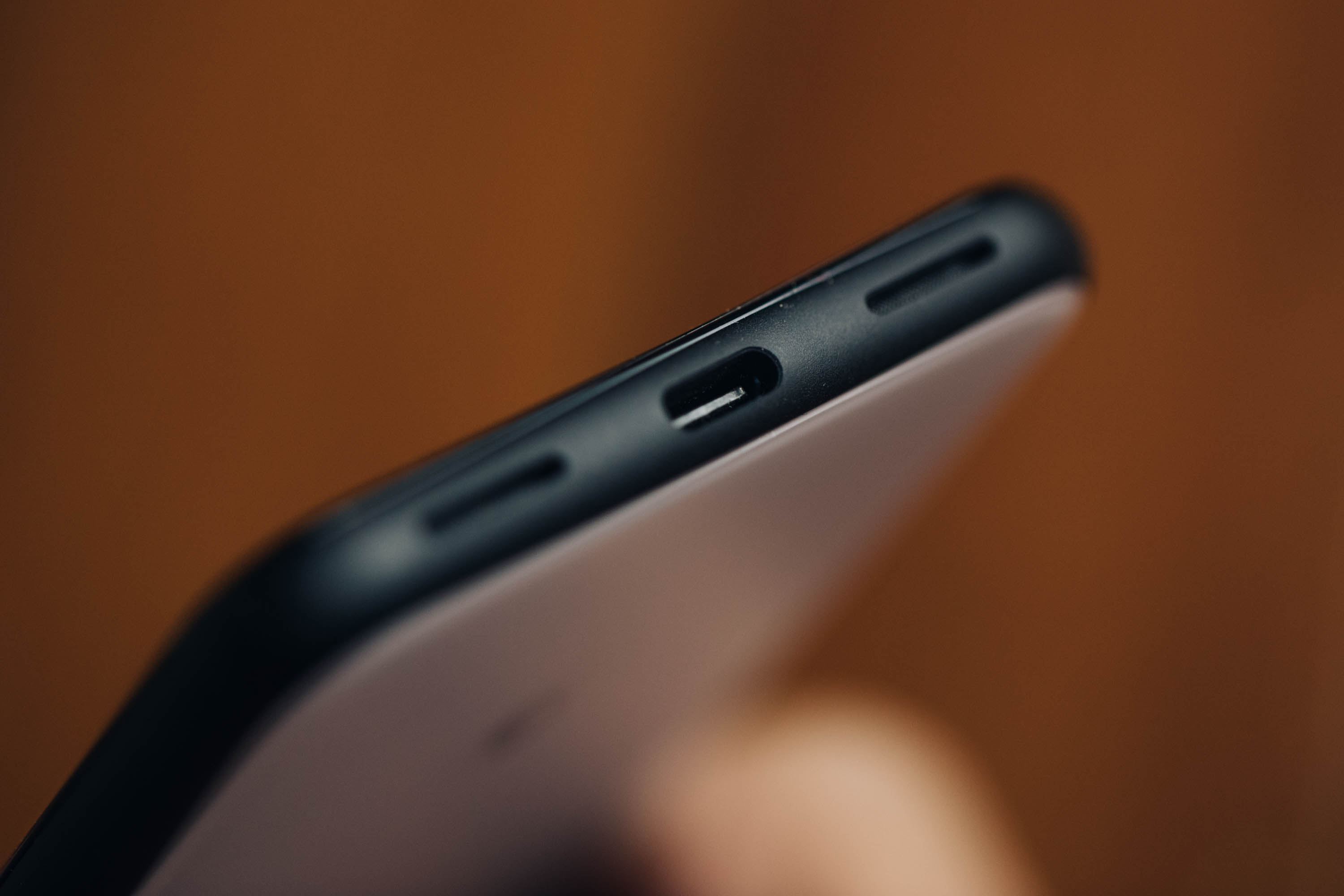
The Pixel line steps up a bit on the design side to distinguish the product from the “a” line. Google’s phones have never been as flashy as Samsung’s or Apple’s, and that’s still the case here, but a new dual-sided glass design (Gorilla Glass 5 on both), coupled with a metal band, does step up the premium feel a bit. The product is also a bit heavier and thicker than the 3, lending some heft to the device.

There are three colors now: black, white and a poppy “Oh So Orange,” which is available in limited quantities here in the U.S. The color power button continues to be a nice touch, lending a little character to the staid black and white devices. While the screen gets a nice update to 90Hz OLED, Google still has no interest in the world of notches or hole punches. Rather, it’s keeping pretty sizable bezels on the top and bottom.

The Pixel 4 gets a bit of a screen size boost from 5.5 to 5.7 inches, with an increase of a single pixel per inch, while the Pixel 4 XL stays put at 6.4 inches (with a PPI increase of 522 to 537). The dual front-facing camera has been ditched this time out, instead opting for the single eight megapixel, similar to what you’ll find on the 3a.

Storage hasn’t changed, with both 64 and 128GB options for both models; RAM has been bumped up to a default 6GB from 4GB last time out. The processor, too, is the latest and greatest from Qualcomm, bumping from a Snapdragon 845 to an 855. Interestingly, however, the batteries have actually been downgraded.
google pixel 4 013

The 4 and 4 XL sport a 2,800 and 3,700mAh, respectively. That should be augmented a bit by new battery-saving features introduced in Android 10, but even still, that’s not the direction you want to see these things going.

The camera is, in a word, great. Truth be told, I’ve been using it to shoot photos for the site since I got the phone last week. This Google Nest Mini review, Amazon Echo review and Virgin Galactic space suit news were all shot on the Pixel 4. The phone isn’t yet a “leave your DSLR at home” proposition, of course, but damn if it can’t take a fantastic photo in less than ideal and mixed light with minimal futzing around.

There’s no doubt that this represents a small but important shift in philosophy for Google. After multiple generations of suggesting that software solutions could do more than enough heavy lifting on image processing, the company’s finally bit the bullet and embraced a second camera. Sometimes forward progress means abandoning past stances. Remember when the company dug its heels in on keeping the headphone jack, only to drop it the following year?
google pixel 4 010

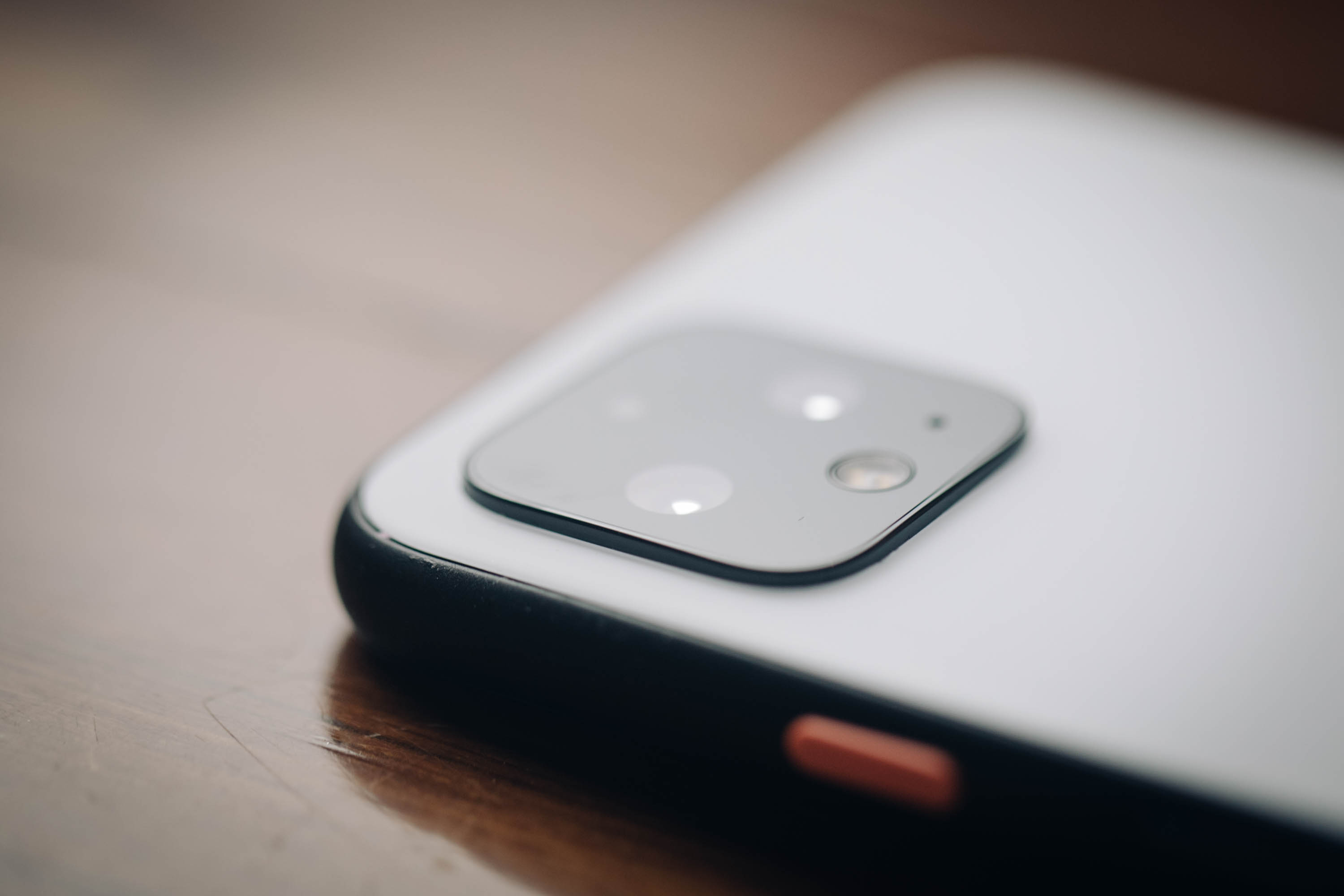
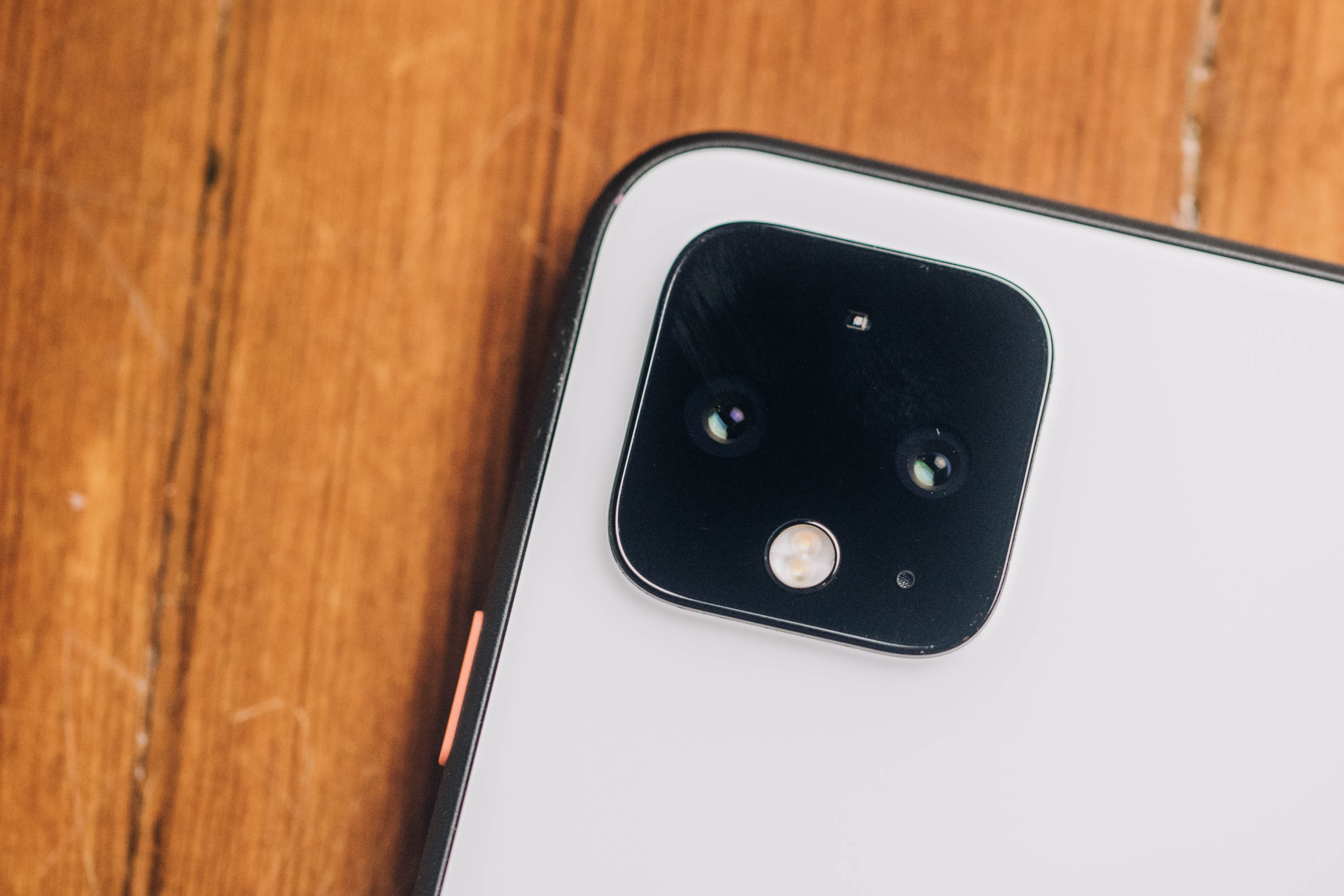
The addition of a second camera isn’t subtle, either. In fact, it’s hard to miss. Google’s adopted a familiar square configuration on the rear of the device. That’s just how phones look now, I suppose. Honestly, it’s fine once you conquer a bit of trypophobia, with a pair of lenses aligned horizontally and a sensor up top and flash on bottom — as one of last week’s presenters half joked, “we hope you’ll use it as a flash light.”

google pixel 4 008

That, of course, is a reference to the Pixel’s stellar low-light capabilities. It’s been a welcome feature, in an age where most smartphone users continue to overuse their flashes, completely throwing off the photo in the process. Perhaps the continued improvements will finally break that impulse in people — though I’m not really getting my hopes up on that front. Old habits, etc.

The 4 and 4 XL have the same camera set up, adopting the 12.2-megapixel (wide angle) lens from their predecessors and adding a 16-megapixel (telephoto) into the mix. I noted some excitement about the setup in my write-up. That’s not because the two-camera setup presents anything remarkable — certainly not in this area of three, four and five-camera flagships. It’s more about the groundwork that Google has laid out in the generations leading up to this device.

00100trPORTRAIT 00100 BURST20191016105119747 COVER 1

Essentially it comes down to this: Look at what the company has been able to accomplish using software and machine learning with a single camera setup. Now add a second telephoto camera into the mix. See, Super High Res Zoom is pretty impressive, all told. But if you really want a tighter shot without degrading the image in the process, optical zoom is still very much the way to go.

There’s a strong case to be made that the Pixel 4’s camera is the best in class. The pictures speak for themselves. The aforementioned TechCrunch shots were done with little or no manual adjustments or post-processing. Google offers on-screen adjustments, like the new dual-exposure control, which lets you manually adjust brightness and shadow brightness on the fly. Honestly, though, I find the best way to test these cameras is to use them the way most buyers will: by pointing and shooting.

[gallery ids="1900084,1900086,1900087,1900088,1900090,1900091,1900092"]

The fact is that a majority of people who buy these handsets won’t be doing much fiddling with the settings. As such, it’s very much on handset makers to ensure that users get the best photograph by default, regardless of conditions. Once again, software is doing much of the heavy lifting. Super Res Zoom works well in tandem with the new lens, while Live HDR+ does a better job approximating how the image will ultimately look once fully processed. Portrait mode shots look great, and the device is capable of capturing them at variable depths, meaning you don’t have to stand a specific distance from the subject to take advantage of the well-done artificial bokeh.

Our video producer, Veanne, who is admittedly a far better photographer than I can ever hope to be, tested out the camera for the weekend. 

[gallery ids="1900045,1900046,1900047,1900048,1900049,1900050,1900051,1900052"]

Although Veanne was mostly impressed by the Pixel 4’s camera and photo editing capabilities, here are three major gripes.

“Digital zoom is garbage.”

Google Pixel 4 digital zoom is garbage


“In low lighting situations, you lose ambiance. Saturday evening’s intimate, warmly lit dinner looked like a cafeteria meal.”

Pixel 4 camera sample


“Bright images in low lighting gives you the impression that the moving objects would be in focus as well. That is not the case.”


Other additions round out the experience, including “Frequent Faces,” which learns the faces of subjects you frequently photograph. Once again, the company is quick to point out that the feature is both off by default and all of the processing happens on the device. Turning it off also deletes all of the saved information. Social features have been improved, as well, with quick access to third-party platforms like Snapchat and Instagram.

Google keeps pushing out improvements to Lens, as well. This time out, language translation, document scanning and text copy and pasting can be performed with a quick tap. Currently the language translation is still a bit limited, with only support for English, Spanish, German, Hindi and Japanese. More will be “rolling out soon,” per the company.
google pixel 4 003

Gestures is a strange one. I’m far from the first to note that Google is far from the first to attempt the feature. The LG G8 ThinQ is probably the most recent prominent example of a company attempting to use gestures as a way to differentiate themselves. To date, I’ve not seen a good implementation of the technology — certainly not one I could ever see myself actually using day to day.

The truth is, no matter how interesting or innovative a feature is, people aren’t going to adopt it if it doesn’t work as advertised. LG’s implementation was a pretty big disappointment.

Simply put, the Pixel’s gestures are not that. They’re better in that, well, they work, pretty much as advertised. This is because the underlying technology is different. Rather than relying on cameras like other systems, the handset uses Project Soli, a long-promised system that utilizes a miniature radar chip to detect far more precise movement.

Soli does, indeed work, but the precision is going to vary a good deal from user to user. The thing is, simply detecting movement isn’t enough. Soli also needs to distinguish intention. That means the system is designed to weed out accidental gestures of the manner we’re likely making all the time around our phones. That means the system appears to be calibrated to bigger, intentional movements.
picka 2

That can be a little annoying for things like advancing tracks. I don’t think there are all that many instances where waving one’s hands across a device Obi-Wan Kenobi-style is really saving all that much time or effort versus touching a screen. If, however, Google was able to customize the experience to the individual over time using machine learning, it could be a legitimately handy feature.

That brings us to the next important point: functionality. So you’ve got this neat new piece of tiny radar that you’re sticking inside your phone. You say it’s low energy and more private than a camera. Awesome! So, how do you suggest I, you know, use it?

There are three key ways, at the moment:

  • Music playback
  • Alarm Silencing
  • Waving at Pokémon

The first two are reasonably useful. The primary use case I can think of are when, say, your phone is sitting in front of you at your desk. Like mine is, with me, right now. Swiping my hand left to right a few inches above the device advances the track. Right to left goes a track back. The movements need to be deliberate, from one end of the device to the other.

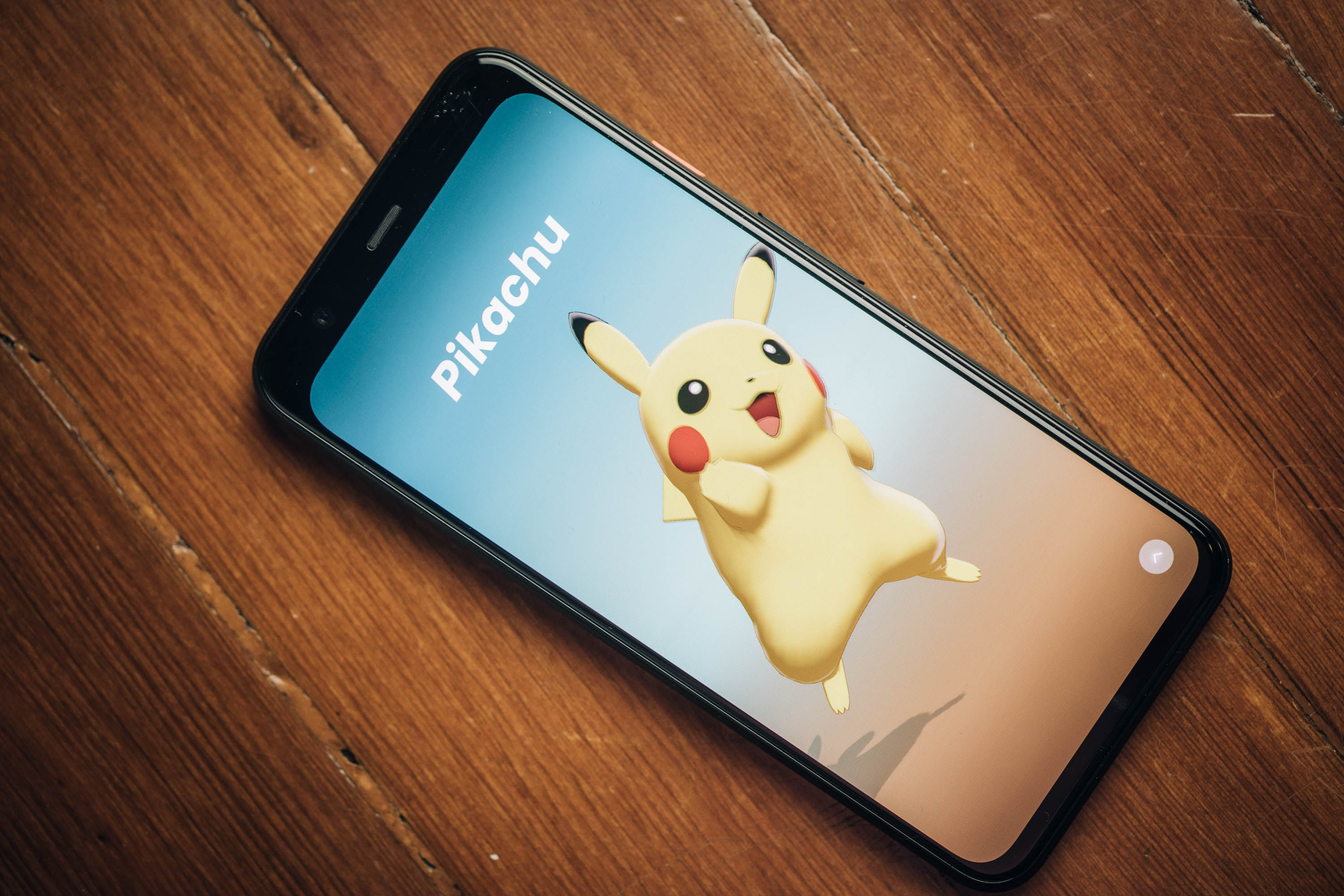
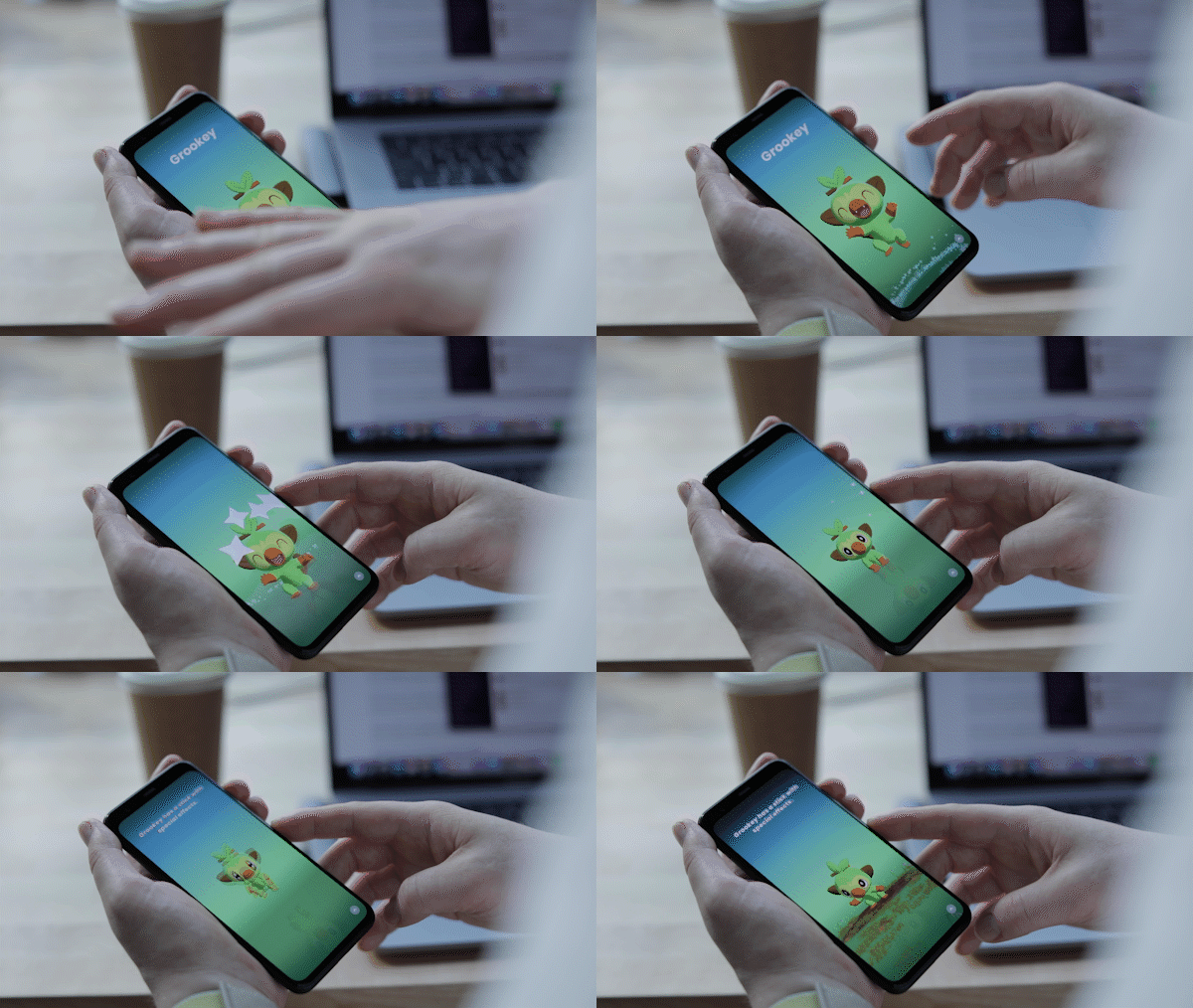
And then there’s the phenomenon of “Pokémon Wave Hello.” It’s not really correct to call the title a game, exactly. It’s little more than a way of showcasing Motion Sense — albeit an extremely delightful way.

You might have caught a glimpse of it at the keynote the other day. It came and went pretty quickly. Suddenly Pikachu was waving at the audience, appearing out of nowhere like so many wild Snorlaxes. Just as quickly, he was gone.

[gallery ids="1900104,1900106,1900107,1900108,1900109,1900110,1900111,1900112,1900113,1900114,1900115,1900116,1900117"]

More than anything, it’s a showcase title for the technology. A series of five Pokémon, beginning with Pikachu, appear demanding you interact with them through a series of waves. It’s simple, it’s silly and you’ll finish the whole thing in about three minutes. That’s not really the point, though. Pokémon Wave Hello exists to:

  1. Get you used to gestures.
  2. Demonstrate functionality beyond simple features. Gaming, AR — down the road, these things could ultimately find fun and innovative ways to integrate Soli.

For now, however, use is extremely limited. There are some fun little bits, including dynamic wallpaper that reacts to movement. The screen also glows subtly when detecting you — a nice little touch (there’s a similar effect for Assistant, as well).

Perhaps most practical, however, is the fact that the phone can detect when you’re reaching for it and begin the unlocking process. That makes the already fast new Face Unlock feature ever faster. Google ditched the fingerprint reader this time around, opting for neither a physical sensor nor in-screen reader. Probably for the best on the latter front, given the pretty glaring security woes Samsung experienced last week when a British woman accidentally spoofed the reader with a $3 screen protector. Yeeesh.

There are some nice security precautions on here. Chief among them is the fact that the unlock is done entirely on-device. All of the info is saved and processed on the phone’s Titan M chip, meaning it doesn’t get sent up to the cloud. That both makes it a speedier process and means Google won’t be sharing your face data with its other services — a fact Google felt necessary to point out, for obvious reasons.

For a select few of us, at least, Recorder feels like a legitimate game changer. And its ease of use and efficacy should be leaving startups like Otter.ai quaking at its potential, especially if/when Google opts to bring it to other Android handsets and iOS.

I was initially unimpressed by the app upon trying it out at last week’s launch event. It struggles to isolate audio in noisy environments — likely as much of a hardware as software constraint. One on one and it’s far better, though attempting to, say, record audio from a computer can still use some work.
google pixel 4 004

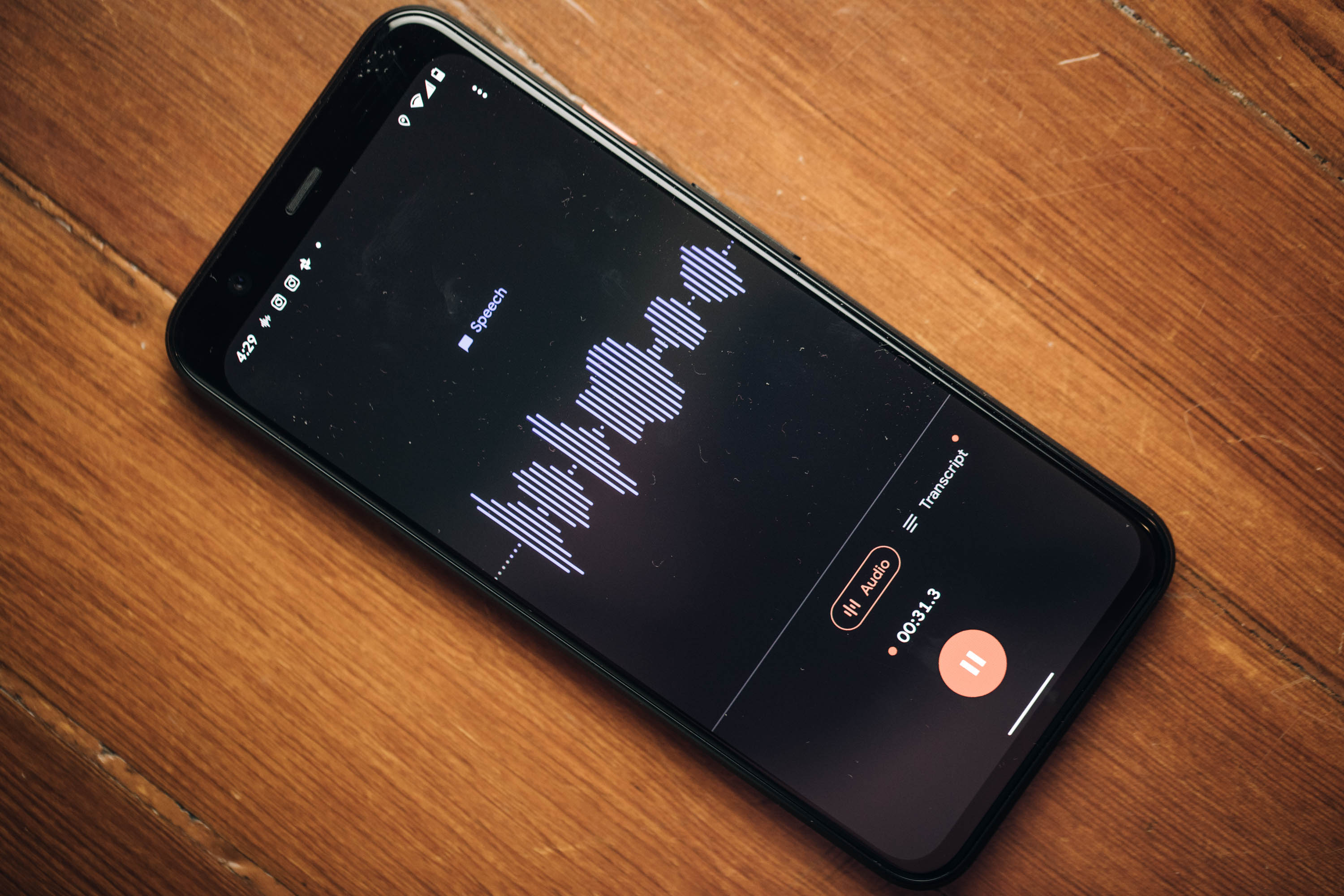
Open the app and hit record and you’ll see a waveform pop up. The line is blue when detecting speech and gray when hearing other sounds. Tap the Transcript button and you’ll see the speech populate the page in real time. From there you can save it with a title and tag the location.

The app will automatically tag keywords and make everything else searchable for easy access. In its first version, it already completely blows Apple’s Voice Memos out of the water. There’s no comparison, really. It’s in a different league. Ditto for other apps I’ve used over the years, like Voice Record.

Speaking to the product, the recording was still a little hit or miss. It’s not perfect — no AI I’ve encountered is. But it’s pretty good. I’d certainly recommend going back over the text before doing anything with it. Like Otter and other voice apps, you can play back the audio as it highlights words, karaoke-style.

The text can be saved to Google Drive, but can’t be edited in app yet. Audio can be exported, but not as a combined file. The punctuation leaves something to be desired and Recorder is not yet able to distinguish individual voices. These are all things a number of standalone services offer, along with a web-based platform. That means that none of them are out of business yet, but if I was running any of them, I’d be pretty nervous right about now.

As someone who does interviews for a living, however, I’m pretty excited by the potential here. I can definitely see Recorder become one of my most used work apps, especially after some of the aforementioned kinks get ironed out in the next version. As for those who don’t do this for a living, usefulness is probably a bit limited, though there are plenty of other potential uses, like school lecturers.
google pixel 4 005

The Pixel continues to distinguish itself through software updates and camera features. There are nice additions throughout that set it apart from the six-month-old 3a, as well, including a more premium design and new 90Hz display. At $799, the price is definitely a vast improvement over competitors like Samsung and Apple, while retaining flagship specs.

The Pixel 4 doesn’t exactly address what Google wants the Pixel to be, going forward. The Pixel 3a was confirmation that users were looking for a far cheaper barrier of entry. The Pixel 4, on the other hand, is priced above OnePlus’s excellent devices. Nor is the product truly premium from a design perspective.

It’s unclear what the future will look like as Google works to address the shifting smartphone landscape. In the meantime, however, the future looks bright for camera imaging, and Google remains a driving force on that front.

21 Oct 2019

The Surface Pro 7 is a competent upgrade with USB-C, refreshed processors, but little else that’s new

I’ll be the first to admit that when the first generation Surface two-in-one launched, I wasn’t sure this was a device that people actually wanted to use. But Microsoft was clearly on to something, as the proliferation of Surface Pro’s among coffee shop dwellers clearly shows. Earlier this month, Microsoft announced both the seventh generation Surface Pro 7 and the Surface Pro X. The X is probably the most interesting update in the Surface Pro’s recent history, with a slimmer profile, larger screen, thinner bezels and plenty of new internals. But the Pro 7, which is going on sale today, starting at $749, is a competent upgrade that gives Surface Pro users exactly what they want – even if it sticks to a tried and tested formula.

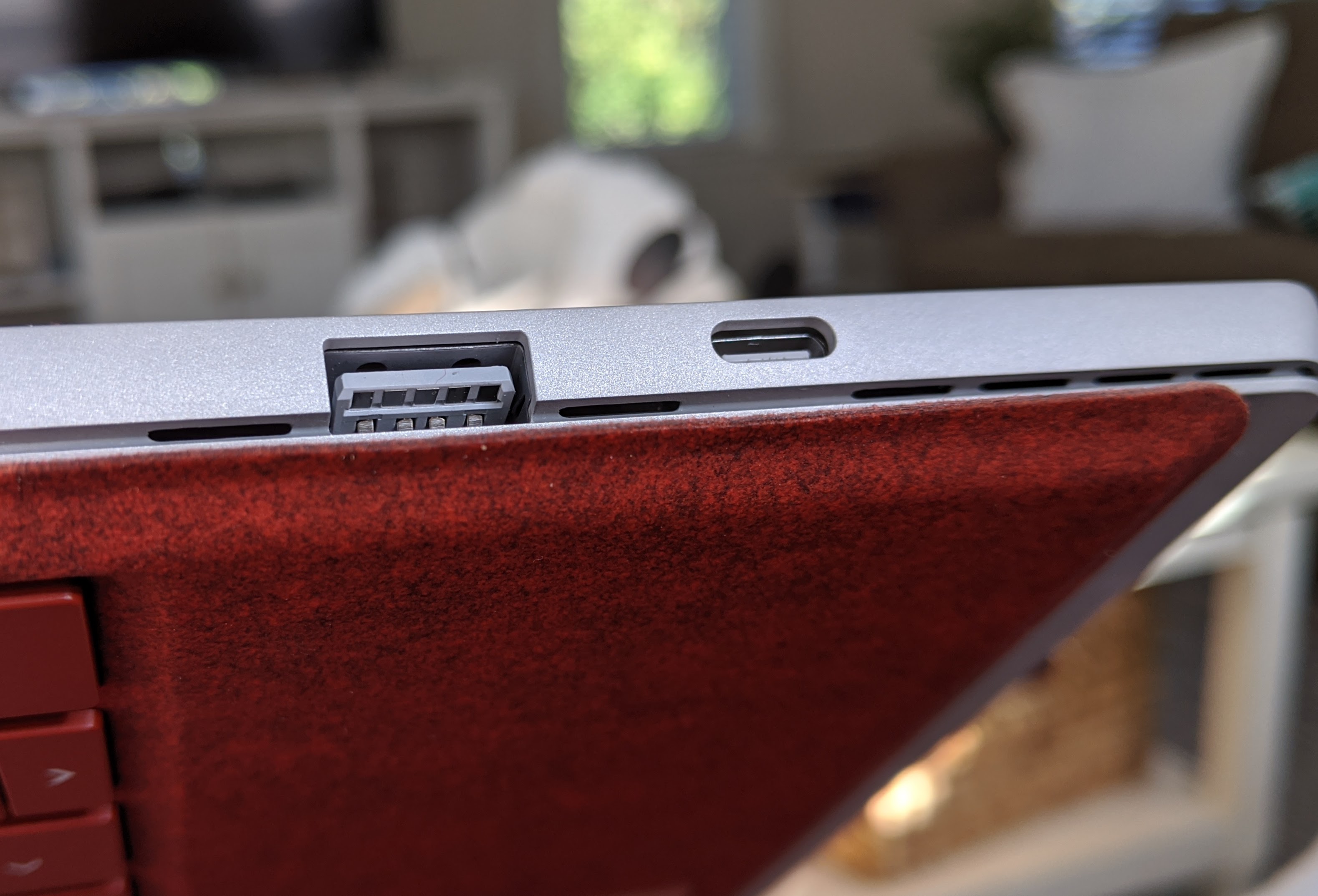
surface pro 7 usb c

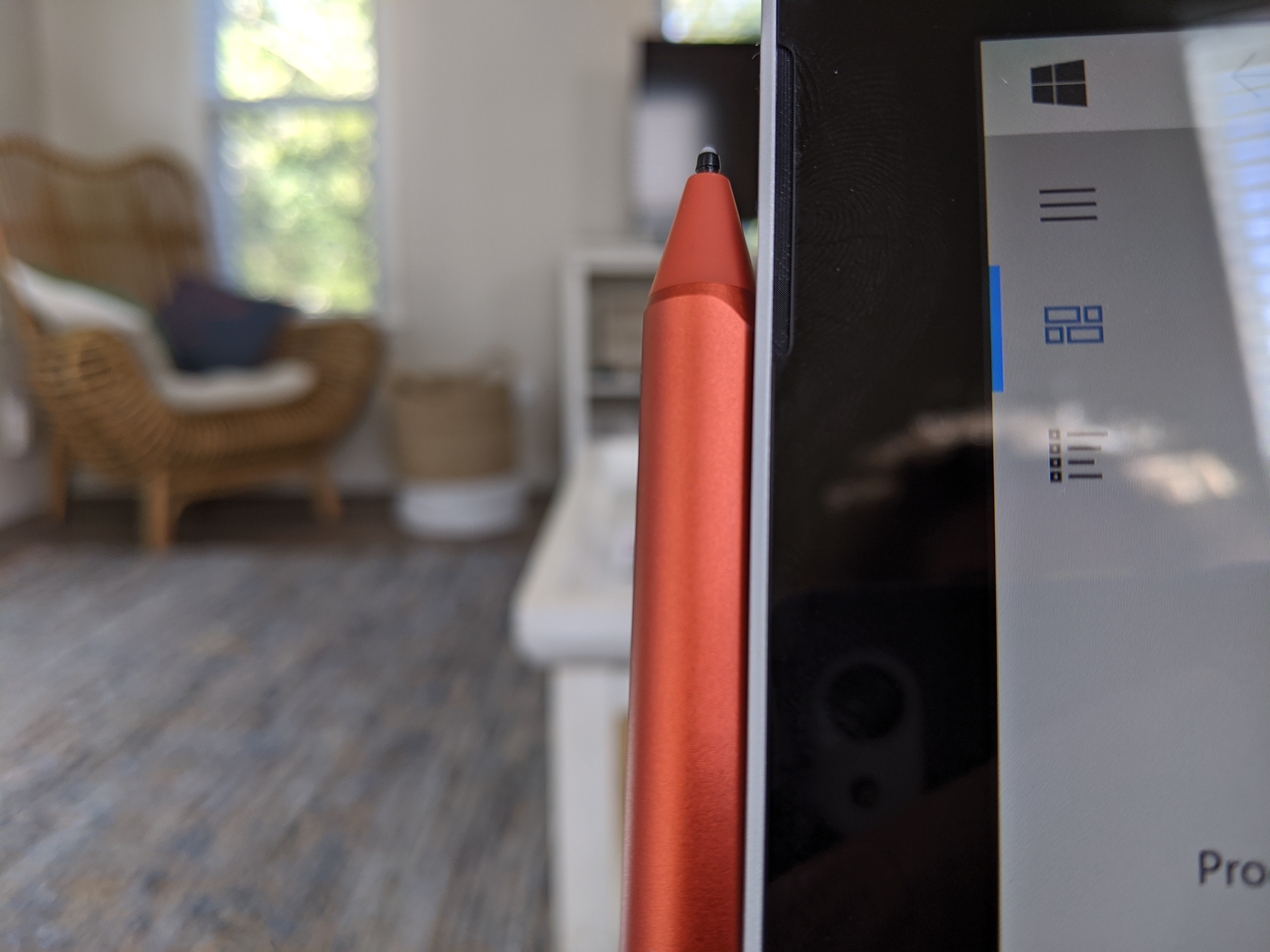
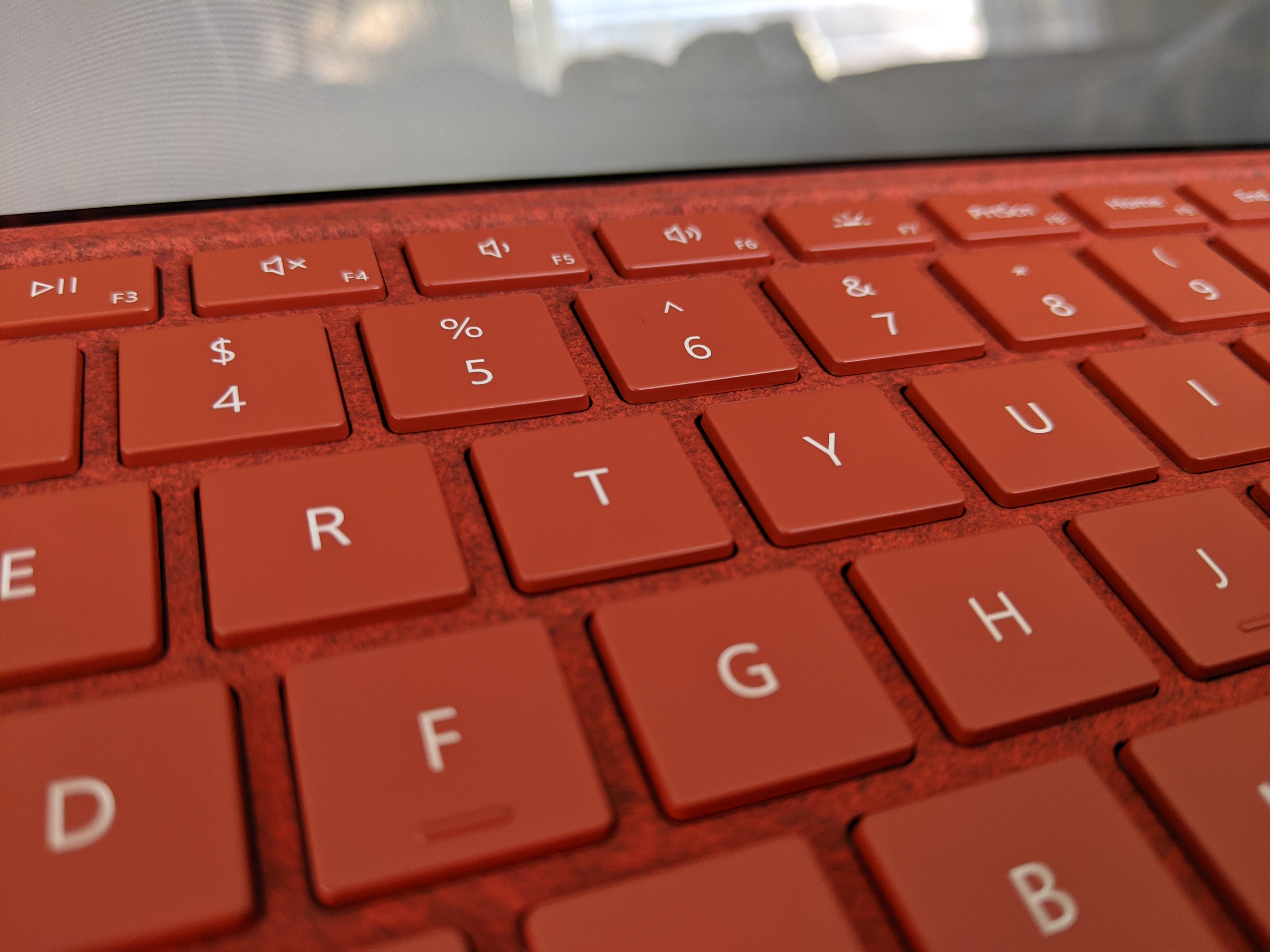
It’s pretty easy to sum up what’s new in the Surface Pro 7. There’s the new 10th-generation Intel chips and a USB-C port for both charging and attaching accessories. The Surface Pen and detachable keyboard remain optional — and somewhat pricey — accessories, though Microsoft tells me that a large percentage opt to get the type cover keyboard, with fewer opting for the pen. There are new colors for the accessories, though: poppy red (which is what Microsoft provided me with my test device and which is indeed very red) and ice blue. The type cover also feels a little bit stiffer, but that’s hard to quantify.

surface pro 7 red pen

The versions with Intel’s newest i3 and i5 chips are fanless, while the i7 version does have a fan.

And that’s pretty much it. The overall design remains the same, with its bezels that are starting to feel a bit too thick these days, and a thin strip of air vents around the sides. The kickstand is something Microsoft has pretty much perfected at this time, so it’s no surprise that it remains virtually unchanged. While Microsoft added a single USB-C port, the plug for the Surface connector is also still there to help you charge your Surface or connect it to a docking station.

Since you’re mostly going to use a Pro on the go, I don’t think only having a single USB-A and USB-C port is a major issue. If you’re using it at home, then getting the $199 Surface Dock is likely the way to go anyway.

As for the design, if it wasn’t for that USB-C port, you’d have a hard time telling the Pro 7 from the recent Surface Pros. Everything else looks pretty much identical to last couple of iterations.

I’ve used the i5-powered Pro 7 while I was travelling over the course of the last few days. Microsoft promises that the new Intel chips are up to twice as fast as their predecessors. I’m sure those numbers work out in artificial benchmarks. In daily use, I noticed that using the device did indeed feel a bit smoother than the last few Surfaces I tested that fell into the same price range as this machine. I’m among those that barely use the pen, but when I do, the experience feels seamless with no noticeable lag in most circumstances.

surface pro 7 red keyboard

Microsoft promises full-day battery life and that’s pretty much what I got, too, using the Surface to write for a few hours on the plane, surfing the web during a layover and watching Netflix in the evening.

If you’re in the market for a Surface Pro, this is obviously the one to get. If you own a Pro 5 or 6 and you’re still happy with their performance, then there’s no real reason to upgrade. Depending on your use case, the Surface Pro X may be the one to get anyway, but that’s still two weeks out and we’ll have to say how well it performs in the real world and if it’s worth the higher starting price of $999. Come back in two weeks and we’ll let you know.

21 Oct 2019

Rocket Lab aims to deliver small satellites to the Moon and beyond

Rocket Lab kicked off the International Astronautical Congress with the news that it’ll begin offering small satellite delivery service to orbits beyond low Earth orbit, where it currently operates – including delivering payloads all the way to the Moon. The longer-range service will be provided via its Photon spacecraft, which it’ll pair with a new additional stage to add range to the vehicle. The company expects to be able to begin serving customers with this new combined, longer range spacecraft possibly as early as Q4 2020.

This will extends significantly the launch startup’s effective operating range, which since it began serving customers last year has been entirely focused on the LEO range (from between around 200 miles and 1,200 miles above the surface of the Earth). Rocket Lab CEO and founder Peter Beck said in a press release announcing the news that this is in response to additional inbound interest in reaching these orbits, from both government and private sector clients.

Beck notes that this demand will only grow as we look to put more investment into human exploration and infrastructure establishing on and around the Moon (NASA’s Artemis program will involve both an Lunar Gateway orbital station with international cooperation and eventually establishment of a base on the Moon’s surface). Small satellites, he argues, will be instrumental in providing low-risk advance scouting and establishing the necessary advance infrastructure for establishing a larger, more permanent presence.

There’s existing demand, he says, too, with a lot of research equipment and “full satellites” already “on shelves” just waiting for a ride to deeper space than is currently available. In other words, Rocket Lab is very eager to point out that this move isn’t just predicting future demand, but addressing a current unmet need that already exists in the market.

Photon, the spacecraft Rocket Lab will use to accomplish this goal, is a an evolved version of the Kick Stage of Electron . Combining it with Electron will provide Rocket Lab’s customers with a “complete solution” for missions anywhere from LEO, to further out Earth orbits, all the way to covering anything between here and the Moon, the company says.

21 Oct 2019

Spiff pitches a way to automate sales commissions calculations

Spiff, a Salt Lake City-based company pitching a new service for calculating sales commissions for salespeople around the world, has raised $6 million in funding to sell its own product to the millions of Willie Lohman’s looking for an end to needless paperwork.

Spiff’s management team kicked in $500,000 for the new round, which also included commitments from Peak Ventures, Kickstart Seed Fund, Peterson Partners, and Pipeline Capital.

“Amazing as it may seem, there isn’t an effective, modern SaaS solution for managing incentive compensation,” said Jeron Paul, Spiff’s founder and chief executive. “Most companies use Excel or decades-old tech that’s really just professional services masquerading as software.”

Spiff’s own data indicates that 90% of businesses rely on spreadsheets alone to calculate commissions and it can take up to one month for sales representatives to learn about their commissions after they’ve closed deals.

Spiff already processes $4 million in calculations every month through thousands of deals working with software as a service vendors like Podium, Weave, Bitglass, Workato, Sendoso, HireVue, and Lucid

Paul has had a long career starting and selling businesses before he launched Spiff in 2018. The serial entrepreneur previously sold Capshare to a subsidiary of Morgan Stanley; launched and sold Scalar Analytics, and Boardlink, which was bought by ThomsonReuters, according to the company.

Spiff projects that the market for sales commissions in the U.S. is roughly $800 billion, with the incentive compensation market numbering in the trillions of dollars. It’s a big, niche, problem for customers that the company thinks its solution can address.

21 Oct 2019

Spiff pitches a way to automate sales commissions calculations

Spiff, a Salt Lake City-based company pitching a new service for calculating sales commissions for salespeople around the world, has raised $6 million in funding to sell its own product to the millions of Willie Lohman’s looking for an end to needless paperwork.

Spiff’s management team kicked in $500,000 for the new round, which also included commitments from Peak Ventures, Kickstart Seed Fund, Peterson Partners, and Pipeline Capital.

“Amazing as it may seem, there isn’t an effective, modern SaaS solution for managing incentive compensation,” said Jeron Paul, Spiff’s founder and chief executive. “Most companies use Excel or decades-old tech that’s really just professional services masquerading as software.”

Spiff’s own data indicates that 90% of businesses rely on spreadsheets alone to calculate commissions and it can take up to one month for sales representatives to learn about their commissions after they’ve closed deals.

Spiff already processes $4 million in calculations every month through thousands of deals working with software as a service vendors like Podium, Weave, Bitglass, Workato, Sendoso, HireVue, and Lucid

Paul has had a long career starting and selling businesses before he launched Spiff in 2018. The serial entrepreneur previously sold Capshare to a subsidiary of Morgan Stanley; launched and sold Scalar Analytics, and Boardlink, which was bought by ThomsonReuters, according to the company.

Spiff projects that the market for sales commissions in the U.S. is roughly $800 billion, with the incentive compensation market numbering in the trillions of dollars. It’s a big, niche, problem for customers that the company thinks its solution can address.

21 Oct 2019

Commercetools raises $145M from Insight for Shopify-style e-commerce APIs for large enterprises

Global retail e-commerce is expected to be a $25 trillion business this year, and today one of the companies that has built a set of tools to help larger enterprises to sell to consumers online has raised a large growth round to meet that demand. Commercetools, a German startup that provides a set of APIs that power e-commerce sales and related functions for large businesses, has raised $145 million (€130 million) in a growth round of funding led by Insight Partners, at a valuation that we understand from a close source is around $300 million.

The funding comes at the same time that commercetools is getting spun out by REWE, a German retail and tourist services giant that acquired the startup in 2015 for an undisclosed amount.

The route the company took after that is a not-totally-uncommon one for tech startups acquired by non-tech companies: commercetools had been acquired by REWE as part of a strategy to take some of its own e-commerce tech in-house, but commercetools had always continued to work with outside clients and has been growing at about 60-70% annually, CEO and co-founder Dirk Hoerig said in an interview.

Current companies include Audi, Bang & Olufsen, Carhartt, Yamaha and some very big names in retail products and services (including major telco/media brands in the USA that you will definitely know). Ultimately, the decision was taken to bring in outside funding and spin out the businesses as an independent startup once again to supercharge that growth. REWE will remain a significant shareholder with this deal.

Hoerig said that commercetools had raised only around $30 million in outside funding when it was a startup ahead of getting acquired.

Although e-commerce has grown over the last couple of years with slightly less momentum than in previous years given wider economic uncertainty, it continues to expand, and in that growth, we’ve seen a swing back to individual retail brands looking for ways of connecting more directly with customers outside of the third-party marketplaces (like Amazon) that have come to dominate how people spending money online.

That is giving a boost to those providing essentially non-tech businesses the tools to build e-commerce activity by offering “headless” tools that are attached to front-end systems designed by others.

Shopify, which focuses more on providing e-commerce tools by way of APIs to medium and smaller customers, has ballooned to some 800,000 customers. Commercetools focuses more on companies that typically generate revenues in excess of $100 million annually, Hoerig said.

Commercetools has no plans to expand to smaller companies — “We have no plan to compete against Shopify,” Hoerig said. Nor is there any strategy in place to extend into logistics, another important component of e-commerce services.

Instead, it wants to use the funding to continue expanding its business in North America and other parts of the world, as well as to continue building up its B2B2B offering — that is, tools for businesses to sell to other businesses. This is an area that companies like Alibaba are very strong in (and Amazon has been also growing its business), and the idea is to provide tools to let companies sell on their own sites either as a complement to, or to replace, third-party marketplaces.

Another area where it will continue to figure where it can play better is in the development of better online-to-offline technology.

Richard Wells and Matt Gatto of Insight are both joining the board with this deal.

“With a strong track record of investing in retail software leaders, we are excited to have the opportunity to invest in commercetools and help them scale up internationally,” said Wells in a statement. “In our opinion commercetools represents the next wave of enterprise commerce software and has the potential to unlock powerful innovation and growth within the e-commerce sector.”

21 Oct 2019

Gojek founder and CEO Nadiem Makarim resigns to join Indonesian cabinet; Soelistyo and Aluwi to be new co-CEOs

Nadiem Makarim, founder and CEO of Gojek, said on Monday he has stepped down from his role at the ride-hailing startup to join Indonesia president Joko Widodo’s cabinet.

The announcement, which has taken many by surprise, comes a day after Widodo was sworn in for a second term. Widodo has previously said that he wants young business executives to join his cabinet.

In a statement, a Gojek spokesperson told TechCrunch that Andre Soelistyo, Gojek Group President and Kevin Aluwi, Gojek co-founder, are taking over as co-CEOs of the startup.

“We are very proud that our founder will play such a significant role in moving Indonesia onto the global stage. It is unprecedented for a passionate local founder’s vision to be recognised as a model that can be up-scaled to help the development of an entire country,” the spokesperson said.

“We have planned for this possibility and there will be no disruption to our business. We will make an announcement on what this news means for Gojek within the next few days. We respect the process set out by the President and will not make a further comment until there is an official announcement from the Palace,” the spokesperson added.

Makarim said he was honored that the president asked him to join his cabinet as a minister. He did not reveal which position he would hold, but an announcement from Widodo is expected later this week. “I am very happy to be here today as it shows we are ready for innovation and to move forward,” he told reporters.

Makarim founded Gojek in 2010 as a two-wheeler hailing service. The startup has since expanded to include a range of services including mobile payments, food delivery, online shopping and most recently on-demand video streaming.

The startup has amassed more than 2 million driver partners and 400,000 merchants on its platform. Gojek was valued at almost $10 billion in its most recent financing round. The company, which operates in Singapore, Vietnam, and Thailand, clocked gross transaction worth $9 billion last year.

Makarim comes from a prominent Indonesian family: His parents are anti-corruption activist, while his grandfather is an independence hero.

20 Oct 2019

In a big reversal, Libra reportedly could peg its cryptocurrencies to national currencies

Facebook is willing to reverse course on its plans to tie its digital currency project to a synthetic currency tied to a basket of global currencies.

Reuters is reporting that Facebook’s head of the Libra project, David Marcus, told a group of bankers that the company’s main goal was to create a better payments system and was open to alternative approaches to the original structure of the project.

Facebook and its partners had intended to create its cryptocurrency by pegging it to a basket of national currencies whose holdings would be set by the Libra Association.

National banks considered the plan part of a dangerous end-run around their regulatory authority and have been holding up the project until they could assume tighter control over how the Facebook-architected cryptocurrency and payment technology would operate.

The scrutiny from regulators proved too much for some of Facebook’s largest, and earliest, partners in the Libra Association, whose members would determine how the cryptocurrency would operate.

In the past month seven of the Libra Association’s founding members dropped out including: PayPal, Mastercard, Visa, Ebay, and Stripe. Those seven represented a big chunk of the strategic value and commercial heft of the planned association, with Stripe, Mastercard, Visa, and Ebay standing in for a huge number of payment processors and merchant touchpoints that the new cryptocurrency would need were it to dramatically scale to the size Facebook wanted right out of the gate.

Now, in another strategic reversal, Marcus is conceding the synthetic currency in favor of stablecoins tied to the local currency in each market that Libra would operate.


“We could do it differently,” Reuters quoted the Libra Association chief as saying. “Instead of having a synthetic unit … we could have a series of stablecoins, a dollar stablecoin, a euro stablecoin, a sterling pound stable coin, etc.”

All of this is happening against the backdrop of Facebook’s stated launch date of June 2020 for the Libra cryptocurrency. Marcus told Reuters that the June launch was still the goal, but that the association would not move forward unless it had addressed the concerns of regulators and received the proper approvals.

Those approvals are becoming harder to come by as the regulators who overseen global monetary policy cast a more skeptical eye at on stablecoins as well.

Reuters reported that the G-20 financial overseers wrote in a statement that money laundering, illicit finance and consumer protection need to be evaluated before any stablecoin projects can “commence operation.”


20 Oct 2019

Should we rethink the politics of ‘blocking’?

Years ago, I wrote a piece criticizing a cover story by a well-known writer and political commentator that I’d met a few times, with whom I’d occasionally sparred on Twitter. The piece wasn’t merely a representation of my own views, but pulled in snarky tweets from other journalists disparaging her work too. It was a pile-on, and not my proudest moment.

The Writer wasn’t exactly thin-skinned; in fact, quite the contrary: She was a brash, sometimes obnoxious feminist with strong opinions, unafraid to speak her mind. I often agreed with her, even when I found her delivery abrasive. Still, after a couple of years with me as a thorn in her side, she decided she’d had enough—and so she did something that many readers will find familiar: She blocked me on Twitter.

The block button is an important tool that allows women and other vulnerable people to have some semblance of the same Twitter experience that the average white man might, free from constant harassment. I couldn’t tell you how many times I’ve used it over the years to drown out nasty ad hominems, sea lions, and of course, sexual harassment and worse. 

Twitter wasn’t always the “hell site” we know it as today. Many early users like me found professional advancement and lasting friendship in 140-character missives. But as the site grew, so did its potential for misuse. By 2014—two years shy of its tenth anniversary—Twitter had become central to the GamerGate controversy, ostensibly a dispute about issues of sexism and progressivism in gaming but on Twitter, a free-for-all of harassment and doxing of any woman even tangentially involved in the discussion. The harassment was so severe that it drove some women off the site permanently.

Out of GamerGate emerged better tools for blocking, tools like BlockTogether that allow individual users to share a list of people they’ve blocked. The idea behind these tools is that harassers are likely to have multiple targets, so why not make it easier for potential targets of harassment to block numerous would-be harassers all at once?

But BlockTogether and similar tools are not without flaws. Once you’re on a blocklist, it can be hard to get your name removed and if you end up, for whatever reason, on one created by a prominent or well-respected user, you may find yourself blocked by people you don’t know and would’ve enjoyed following. Some might call this reasonable collateral damage.

Numerous journalists and others have complained of finding themselves on a blocklist after a disagreement with an individual who uses them. I’m unfortunately on one used by a number of journalists. Why, you might ask, was I blocked in the first place? I remember quite clearly: It was for disagreeing with someone about the life sentence handed to Ross Ulbricht, the creator of the Silk Road website. For my opinion, I’ve lost the ability to follow or interact with dozens of journalists whose work I read.

Despite that, I don’t blame women or other minorities who’ve experienced harassment for using the block button liberally. Blocking someone isn’t a matter of free speech (unless of course the blocker in question is an elected official), as some of my harassers have claimed—rather, it’s often a matter of preserving one’s sanity. The block button, along with blocklists, are useful tools for curating space—not a safe space per se, but one free from random harassers, spammers, and the like. Think of it more as a large invite-only event, as opposed to a New York City street.

And yet, I can’t help but wonder if our liberal use of the block button prevents us from experiencing the kind of reconciliation that can happen in our offline communities. We often remove someone from our life, only for them to apologize their way back in later on. Even the Amish, who practice shunning as a matter of faith, allow for the repented to return.

twitter logo sketch wide inverted

Twitter’s architecture has changed over time, sometimes for better and sometimes for worse. Presently, its algorithm sometimes surfaces replies from people you do follow, to tweets from individuals you don’t, based on some assumption that you mind find them interesting. Occasionally, it will surface a reply from a friend to someone with a locked account or, in rare cases, to someone who blocks you, as it did for me the other day. Someone I follow had replied with an interesting comment to a tweet from The Writer—a tweet that, of course, I couldn’t see without logging out and going directly to her profile. And so I did.

What I found was someone who, with that same fierce energy, seemed a lot more thoughtful, with views more similar to mine than I remembered. I felt a momentary pang of sadness for the camaraderie that might have been. I realized the obvious: That we’ve both grown, alongside the backdrop of the horrific political environment that’s accompanied us through the past half-decade. “Have you thought about reaching out to her?” a friend asked.

Therein lies the rub: In the case of The Writer, I could reach out to her; we’ve met in person a few times, and we retain mutual friends. She might respond favorably, or with a “thanks but no thanks”, but either way, it’s unlikely she would deem my approach to be harassment. But there’s this other journalist I’ve never interacted with, who no doubt signed up to a blocklist that I happened to be on. I discovered that she blocked me when I went to read a tweet someone had DM’d me, and was disappointed—but reaching out to her through some other channel would seem weird, invasive. It isn’t worth it.

I recently reviewed my own list of blocked accounts (you can do so through your settings), a list that numbers well into the hundreds. Most aren’t worth revisiting—there’s sexual harassers and transphobes, Bahraini bots and Roseanne Barr, some Trumpites and a few high-profile right-wing accounts. But among them, close to the bottom of the list (coinciding with the early days of the block button), I spotted a few outliers, and decided to give them a second chance.

Technology is constantly changing and progressing and yet, the block button—and blocklists—remain in rudimentary form. They’re simply not priorities for companies whose focus is on profit. But were we to redesign them, perhaps we could find a way to make blocks time-limited, or at least provide users with more nuanced options. One such existing feature is Facebook’s “snooze” button, which allows users to “mute” another person for 30 days, with a reminder when that time period is up; I found that one particularly handy last summer while a friend was going heavy on self-promotion. I use Twitter’s “mute” function to rid my feed of people with whom I have to interact professionally and thus can’t block. And then there’s the “soft block”—a feature or bug, it isn’t clear—wherein one can block and unblock someone quickly on Twitter so that the user no longer follows them…at least until they wisen up (this feature/bug is made easier by the fact that Twitter seems to be perpetually plagued by an “unfollow bug”). These tools are helpful, but with all the riches these companies have, they could design something—with input from those most affected by harassment—that is less blunt, more elegant, more thoughtful.

Ultimately, the block button is an imperfect solution to a pervasive problem, and therefore remains as necessary as ever. I know that I’ll continue to use it as long as I’m on social media. But…don’t we deserve something better?