Category: UNCATEGORIZED

17 Oct 2019

Zubale, founded in Mexico City last year by two HBS grads, just raised $4.4 million to put locals to work over their smart phones

A year ago, at a demo day south of San Francisco, we watched a number of recently formed startups pitch investors on their companies. One that stood out to us at the time was Zubale, a Mexico City-based outfit whose founders were looking to connect big corporations with Latin Americans eager to address tasks on their behalf. A person could conduct on-the-ground market research for a brand, for example, then earn mobile phone credits or other redeemable digital rewards.

Fast forward and Zubale, which had 10 employees at the time, now has 40 full time employees, and it has completed 170,000 tasks on behalf of the consumer brands on which it is squarely focused — and for two reasons.

First, according to Zubale cofounder Allison Campbell, the retail industry across Latin America is a generating $2 trillion per year, but companies are also shelling out $40 billion on “super painful and high spend” that includes employees who complete in-store tasks like stocking shelves, checking prices, and building displays.

Campbell says Zubale can save — even make — these companies money by crowdsourcing the same tasks to independent contractors who can choose from an inventory of jobs near them that they want to complete.

Campell and her cofounder, Sebastian Monroy, also know a few things about retail in emerging markets. Before heading to HBS, Campbell spent nearly eight years with Walmart, as a merchandise manager, then as a  director of international strategic initiatives, roles that placed her in Gurgaon India, then Shanghai and Shenzhen, China. Monroy’s path has been a similar one; he spent more than seven years working in a variety of sales roles for Proctor & Gamble in Mexico before heading to Harvard, where he met Campbell on their first day of business school. (“We realized we were wearing the same exactly glasses and took a picture together,” she says with a laugh. They decided to team up on Zubale a a year later.)

Indeed, though one could see Zubale using its platform to crowdsource any number of tasks, a la TaskRabbit, the opportunity is so massive in catering to retailers that the startup plans to stay in its lane for the foreseeable future.

If anything, says Campell, Zubale — which plans to eventually expand from Mexico into other countries, including Brazil, Chile, and Peru — may end up offering the contractors more in the way of financial services products, given that there remains a dearth of these and that these individuals are constantly checking the app anyway.

It makes sense. While 85 percent of Mexico’s population of 125 million now has a smart phone — giving rise to more app-driven startups like Zubale — only 10 percent have a credit card, and only 35 percent have a checking account. It’s for that reason that many of the people who work for Zubale still choose to earn mobile phone credit and other digital rewards that they can redeem through making online purchases.

They “love us,” too, says Campbell, because they can “increase their income by 40 percent” by performing work for Zubale. In fact, she suggests Zubale hasn’t had to do much in the way of marketing, thanks to Facebook Groups where the company is discussed, as well as through other word of mouth, including workers’ friends who want more jobs and find it easier to find and complete jobs in 30-minute increments at the same store location rather than run from store to store or job to job. (On average, she adds, they complete 20 jobs for the company per week.)

Certainly, investors like the company. Campell and Monroy say they had a lot of inbound interest when they began seeking seed funding more recently. They chose the venture firm NFX to lead the $4.4 million round, given its expertise in marketplaces and network-effects driven businesses. Other participants in the round include Industry Ventures, Joe Montana’s Liquid 2 Ventures, and XFactor Fund, along with individual investors Jonathan Swanson (who is the chairman of Thumbtack), Sergio Romo (the CEO of Grow Mobility), and Bob White (the founder and a former managing director of Bain Capital).

Meanwhile, the company’s very first check came from the seed-stage firm Pear, which had hosted that demo day.

17 Oct 2019

New NVIDIA Shield Android TV streaming device leaks via Amazon listing

The fact that NVIDIA is updating its Shield TV hardware has already been telegraphed via FCC filing, but a leak earlier today paints much more of a detailed picture. An Amazon listing for a new NVIDIA Shield Pro set-top streaming device went live briefly before being taken down, showing a familiar hardware design, a new remote control, and listing some of the forthcoming feature updates new to this generation of hardware.

The listing, captured by the eagle-eyed Android TV Rumors and shared via Twitter, includes a $199.99 price point, specs that include 3GB of RAM, 2x USB ports, a new Nvidia Tegra X1+ chip and 16GB of onboard storage. In addition to the price, the Amazon listing had a release date for the new hardware of October 28.

If this Amazon page is accurate (and it looks indeed like an official product page that one would expect from NVIDIA), the new Shield TV’s processor will be “up to 25% faster than the previous generation,” and will offer “next-generation AI upscaling” for improving the quality of HD video on 4K-capable displays.

It’ll offer support for Dolby Vision HDR, plus surround sound with Dolby Atmos support, and provide “the most 4K HDR content of any streaming media player.” There’s also built-in Google Assistant support, which was offered on the existing hardware, and it’ll work with Alexa for hands-free control.

The feature photos for the listing show a new remote control, which has a pyramid-like design, as well as a lot more dedicated buttons on the face. There’s backlighting, and an IR blaster for TV control, as well as a “built-in lost remote locator” according to the now-removed Amazon page.

This Amazon page certainly paints a comprehensive picture of what to expect, and it looks like a compelling update to be sure. The listing is gone now, however, so stay tuned to find out if this is indeed the real thing, and if this updated streamer will indeed be available soon.

17 Oct 2019

HBO Max scores all 21 Studio Ghibli films

HBO’s streaming services have long succeeded on the strength of original programming, but in a post AT&T acquisition world, the company is having to create a streaming service supergroup of exceptional content to lure consumers into coughing up more cash.

HBO has been on a shopping spree for its HBO Max service. It bought right to Friends and The Big Bang Theory, and now it’s using its outsized checkbook to bring beloved Japanese animation group Studio Ghibli’s films onto the web exclusively on its platform for U.S. subscribers.

All 21 films from the studio, including classics like Princess Mononoke, Spirited Away, My Neighbor Totoro and Howl’s Moving Castle will be coming in 2020. The Wind Rises will be coming to the service in fall of 2020, the rest will come earlier in the spring.

This deal is hugely noteworthy for Studio Ghibli, as their classic films weren’t available to watch or download online legally in any capacity. It also seems that much of that was on purpose, and it seems that this long-held belief was changed with some of that HBO moola.

Terms of the deal weren’t disclosed, but here’s what a representative told Polygon this year.

“Studio Ghibli does not make their films available digitally, whether for download or streaming, anywhere in the world… They continue to believe that presentation is vital and particularly appreciate opportunities for audiences to experience the films together in a theatrical setting.”

This is a big win for HBO because anyone would’ve assumed that Studio Ghibli would’ve partnered with Disney, if anyone, for a streaming deal given their long-term relationship, but HBO Max seems to be keeping the checkbook handy and won this deal because of it.

17 Oct 2019

Zuckerberg on Chinese censorship: Is that the internet we want?

China is exporting its social values, political ads are an important part of free expression, and the definition of dangerous speech must be kept in check, Facebook’s CEO Mark Zuckerberg argued today.

He criticized how American companies that do business with China were becoming influenced by the country’s values. “While our services like WhatsApp are used by protestors and activists everywhere due to strong encryption and privacy practices, on TikTok, the Chinese app growing quickly around the world, mentions of these same protests are censored, even here in the US!” Zuckerberg said. “Is that the Internet that we want?”

Because Facebook couldn’t come to an agreement with Chinese censors and thereby doesn’t operate in the nation, “Now, we have more freedom to speak out and stand up for the values that we believe in and fight for free expression around the world.”

Zuckerberg Georgetown Speech

Zuckerberg spoke today at Georgetown University to share his thoughts on speech and “how we might address the challenges that more voice and the internet introduce, and the major threats to free expression around the world.” He discussed how “We want to the progress of free expression without the tension” leading people to advocate for pulling back on free expression. “Where do you draw the line?”

Zuckerberg says that Facebook now has 35,000 people working on security, and the company’s security budget is higher now than the whole revenue of the company when it IPO’d, which was $5 billion in 2012. Facebook removes or downranks content that is objectively dangerous. Still, he says that he doesn’t want to “let the definition of what is dangerous to expand beyond what’s absolutely necessary.”

17 Oct 2019

Google Maps adds more Waze-like features, including driving incident reports

Google Maps is starting to look a lot more like Waze. Google today announced a series of new features that will allow drivers using the Maps app on iOS to report accidents, speed traps, and traffic jams. And on both iOS and Android, users will be able to report other driving hazards and incidents, like road construction, lane closures, disabled vehicles, and objects in the road — like debris. These are all core Waze features and among the primary reasons why many users opt for Waze over Google Maps.

Google had already offered accident, speed traps, and traffic slowdown reports on Android before today.

The new updates follow a steady launch of Waze-like additions to the Google Maps app.

For example, Google launched speed limits and speed trap alerts in over 40 countries in Google Maps back in May. And it had been testing various driving hazard alerts before now. Google Maps had also previously adopted other Waze features, like the ability to add a stop to your route while in navigation mode, or the ability to view nearby gas prices.

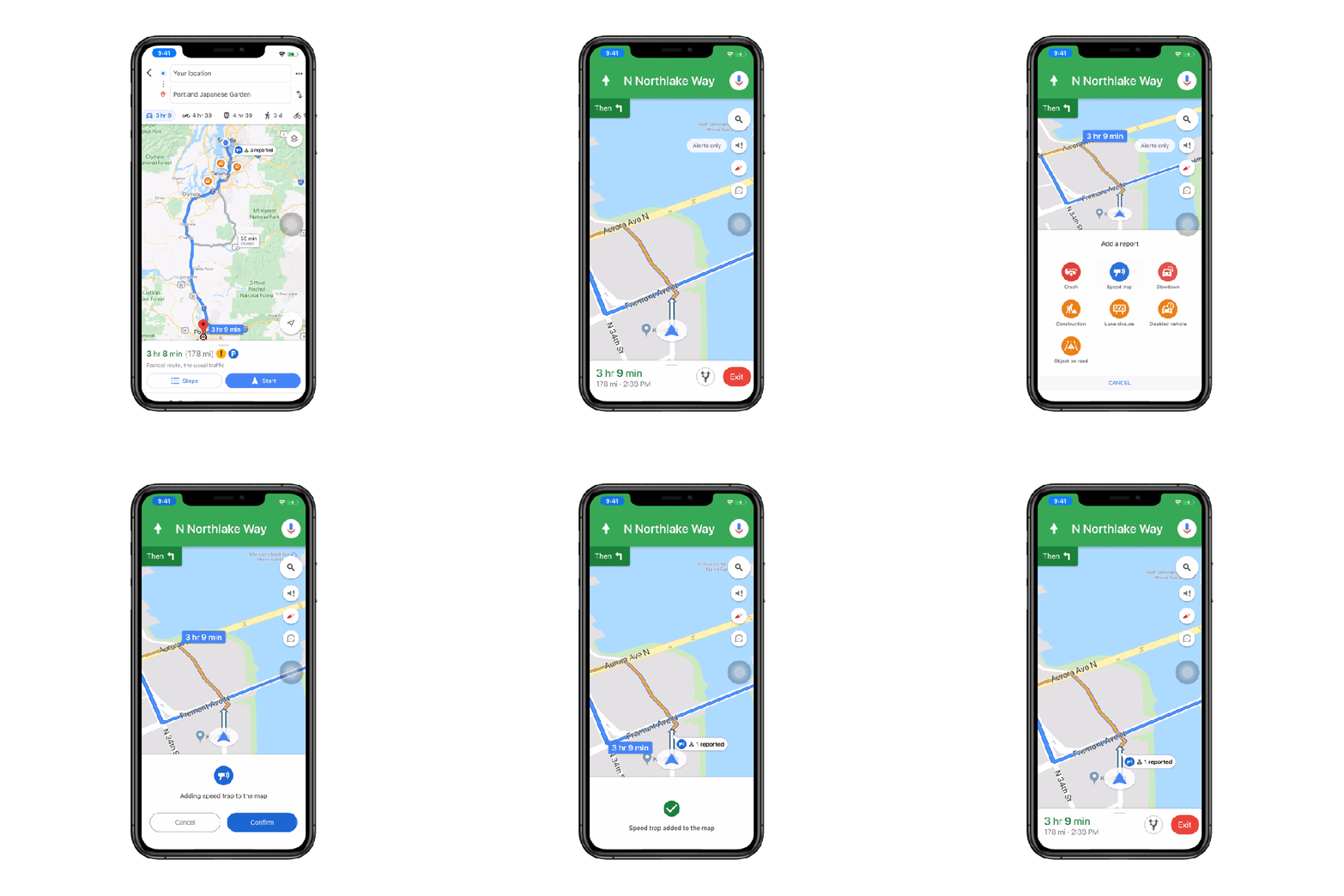
Mid trip UGC Report

When you’re navigating your route in Google Maps, you can tap to add a report then choose from a long list that now includes: Crash, Speed Trap, Slowdown, Construction, Lane Closure, Disabled vehicle, and Object on Road.

With the additions, Google is chipping away at the many reasons why people still turn to Waze.

However, Waze is still better for planning a trip by connecting to your personal calendar or Facebook events, while Google Maps has instead focused more on helping users plan their commutes. Waze also is more social and includes a carpooling service.

The benefit of more users switching to Maps means more aggregate data to help power Google’s other products. Data collection from Google Maps is behind features like those that show the wait times, popular times and visit duration at local businesses, for example. Plus, Google Maps is a jumping off point for Google’s My Business platform, which has more recently been challenging Facebook Pages by allowing Maps users to follow their favorite businesses to track promotions and events, and even message the businesses directly.

Google says the new Google Maps features start rolling out globally on Android and iOS this week.


17 Oct 2019

Juul will stop selling mango, creme, fruit and cucumber pod flavors in the U.S.

Juul has stopped selling a number of its flavored nicotine products — mango, creme, fruit and cucumber — in the U.S., pending a review by the U.S. Food and Drug Administration. Now, the vaping company will only sell the flavors that taste like tobacco, mint or menthol in the U.S., the company announced today.

“We must reset the vapor category by earning the trust of society and working cooperatively with regulators, policymakers, and stakeholders to combat underage use while providing an alternative to adult smokers,” Juul CEO K.C. Crosthwaite said in a statement.

This comes after Juul stopped actively supporting San Francisco’s Proposition C, ceased its advertising campaigns in the U.S and stopped lobbying the FDA on its draft flavor guidance.

But this doesn’t mean Juul is giving up on selling these flavors in the future. The company said it will continue to try to develop scientific evidence to support the use of those flavored products, as well as develop stricter measures to combat underage usage. Meanwhile, Juul is still selling all of its flavors outside of the U.S.

Earlier this week, a parent who lost her child filed a wrongful lawsuit against Juul. That suit is just one of several lawsuits Juul faces.

17 Oct 2019

Luna Display now supports older Macs as a secondary screen

Secondary display companies are among the latest to get a taste of Sherlocking, after Apple introduced Sidecar as part of the recent Catalina update. Honestly, the feature is far and away the best thing about the latest version of MacOS and as a number of third-party app developers have discovered over the decades, it’s hard to compete with native support.

For Duet Display, staying relevant meant adding Android tablet support. For Luna Display makers Astropad, it’s finding a way for users to dust off their old Macs. An update being released today brings the feature to the dongle-based technology.

ezgif.com video to gif

Mac-to-Mac lets Luna users use older Mac models as second screens, so you can, say, wireless connect a MacBook to, say, a Mac mini, iMac or even another MacBook. It’s probably less handy for most users than simple iPad connectivity, but there’s something to be said for something that puts old systems to use. For Astropad’s sake, hopefully Apple doesn’t feel the same way for its next update. 

Per Astropad,

For example, if you have an iMac at your office, and a laptop that moves with you between work and home, pair your laptop with your iMac when in the office to make use of both devices. Or if you’re just working from home, pair your laptop to your iMac or Mac Mini and harness the power of those super computers from your comfy sofa. Get yourself a snack in the kitchen without having to miss a beat when your co-worker sends you a funny dog GIF! The possibilities are endless!

The primary system needs to run El Capitan or later and the second needs to be on Mountain or newer. The connection works tethered or over WiFi. The company’s also offering a 25% discount on Luna for the next couple of days. 

17 Oct 2019

Tesla gets green light to start producing EVs in China

China’s industry ministry has add Tesla to a government list of approved automotive manufacturers, a designation that allows the electric automaker to begin producing vehicles in the country.

Tesla’s inclusion on the list published by the Ministry of Industry and Information Technology was reported by Reuters. A Chinese tech site also reported the news and provided a screenshot of MIIT’s approved automakers. Tesla is the first automaker listed.

TechCrunch has reached out to Tesla and will update when the company responds.

Tesla is building a $2 billion factory in Shanghai, its first manufacturing facility outside the United States.

In July, Tesla wrote in its quarterly earnings letter to shareholders that Model 3 production was on track to begin at its Shanghai factory by the end of the year. Starting production by November would be a critical milestone for the automaker if it hopes to continue to increase sales and avoid the high cost of shipping and tariffs.

Tesla wrote at the time that machinery was moved into the factory during the second quarter in preparation for the first phase of production.

The company also said in July that “depending on the timing of the Gigafactory Shanghai ramp, we continue to target production of over 500,000 vehicles globally in the 12-month period ending June 30, 2020.”

Tesla has said the production line at the factory in China will have a capacity of 150,000 units annually and will be a simplified, more cost-effective version of the Model 3 line at its Fremont, Calif. factory. Tesla has also said this second-generation Model 3 line will be at least 50% cheaper per unit of capacity than its Model 3-related lines in Fremont and at its Gigafactory in Sparks, Nev.

17 Oct 2019

The Information will launch Ticker, a tech news app that costs $29 per year

Since it was founded by journalist Jessica Lessin in 2013, The Information has stood out in the tech news landscape for its focus on an ad-free, subscription-driven business model (a focus that seems increasingly prescient).

Now, the upcoming launch of an app called Ticker suggests that the company is looking to expand its audience while maintaining that subscription model.

The Information describes Ticker as its first consumer app. The assumption is that anyone who’s currently paying the $399 annual fee for an Information subscription needs it for their job — whether they’re an investor, entrepreneur or some other professional in the tech industry.

The new app, meanwhile, is designed for anyone who might be interested in keeping up-to-date with the latest tech news, and it’s priced much more affordably, at $29 per year. (Information subscribers will get access as well.)

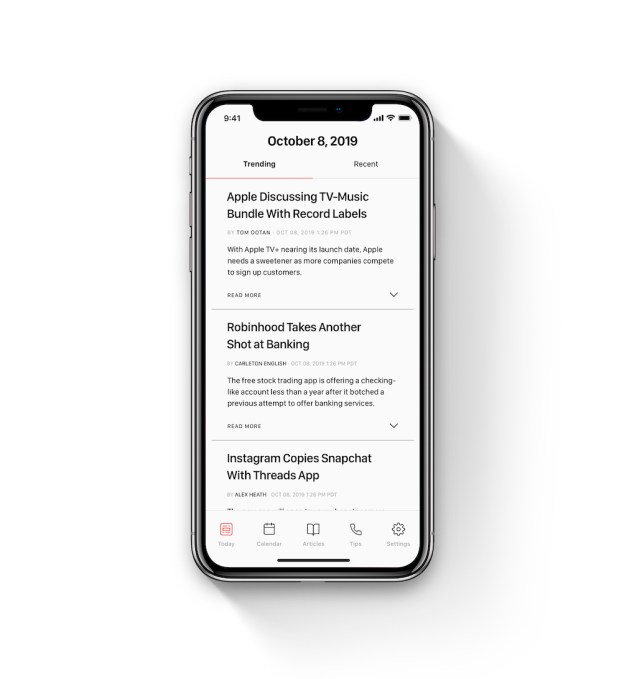
The Information ticker app

Apparently the app was inspired by the Briefing section of The Information website, which offers quick summaries (usually drawn from reporting by other publications) of major tech news.

Ticker, meanwhile, will include a section called Today with summaries of the day’s tech headlines — similar to Briefing, but written for a consumer audience. It will also include a calendar highlighting upcoming IPOs, conferences and other events that readers might want to know about. (Not included: The Information’s full articles and original reporting.)

“More and more, we’ve been hearing from readers who don’t have a business reason to follow tech but are finding it more and more central to their lives,” Lessin said in a statement. “We are launching Ticker for them — giving them access to the best summaries of the most significant news, written by our team at The Information.”

The company plans to launch Ticker later this fall. In the meantime, you can sign up here.

17 Oct 2019

‘Cloud kitchens’ is an oxymoron

The biggest wave in consumer products right now has all the hallmarks of another bubble of misplaced investor expectations and sadly lower margins.

Cloud kitchens (the category, and not just CloudKitchens the startup service) is essentially WeWork for restaurant kitchens. Instead of buying an expensive restaurant site on a heavily-walked street, a cloud kitchen is developed in a cheaper locale (an industrial district perhaps), with dozens of kitchen stations that are individually rentable for short periods of time by chefs and restaurant proprietors.

It’s a market that has exploded this year. CloudKitchens, which has been funded by former Uber founder and CEO Travis Kalanick, is perhaps the most well-known example, but others are competing, and none more so than meal delivery companies. DoorDash announced that it was opening a shared kitchen in Redwood City just this week, Amazon has announced it is getting in the game, and around the world, companies like India-based transportation network Ola are building out their own shared kitchens.

That has led to laudatory headlines galore. Mike Isaac and David Yaffe-Bellany talk about “the rise of the virtual restaurant” at the New York Times, while Douglas Bell, contributing to Forbes, wrote that “Deliveroo’s Virtual Restaurant Model Will Eat The Food Service Industry.”

And there are not just headlines, but predictions of doom as well for millions of small-business restaurant owners. Mike Moritz, the famed partner at Sequoia, wrote in the Financial Times earlier this year that:

The large chain restaurants that operate pick-up locations will be insulated from many of these services, as will the high-end restaurants that offer memorable experiences. But the local trattoria, taqueria, curry shop and sushi bar will be pressed to stay in business.

Latent in these pieces (there are dozens of them published on the web) lies a superficial storyline that’s appealing to the bright but not detail-oriented: that there are high software margins (or ‘cloud’ margins if you will) to come from a world in which kitchen space is suddenly shareable, and that’s going to lead to a complete disruption of restaurants as we know them.

It’s the same sort of storyline that propelled WeWork to meteoric heights before eventually crashing the last few weeks back down to reality. As Jesse Hempel wrote in Wired a few years ago about the shareable office startup: “Over time, this could be a much bigger opportunity than coworking spaces, one in which everything WeWork has built so far will simply feed an algorithm that will design a perfectly efficient approach to office space.”

Clearly, the AI algorithm for office efficiency (“WeWork Brain”?) wasn’t as profitable as hoped, with WeWork expected to lay off 500 software engineers in the coming weeks.

And yet despite the seeming collapse of WeWork and the destruction of its narrative, we still haven’t learned our lesson. As Isaac and Yaffe-Bellany discuss in their NYT piece, “No longer must restaurateurs rent space for a dining room. All they need is a kitchen — or even just part of one.” Now I know what the two mean here, but let’s be uncharitable for a moment: you can’t rent a part of a kitchen. No one rents the stovetop and not the prep area.

But it is that quickly slippery logic that can cause an entire industry to rise and eventually crumble. Just as with the whole “WeWork should really be valued as a software company” meme, the term ‘cloud kitchens’ implies the flexibility (and I guess margins?) of data centers, when in reality, they couldn’t be further away in practice from them. Commercial kitchens require regulatory licenses and inspections, constant monitoring and maintenance, not to mention massive kitchen staffs (they aren’t automated kitchens!).

So let’s look at how margins and leverage play out for the different players. If you are the owner of one of these cloud kitchens, how exactly do you get any pricing leverage in the marketplace? Isaac and Yaffe-Bellany again write, “Diners who order from the apps may have no idea that the restaurant doesn’t physically exist.”

That sounds plausible, but if consumers don’t know where these restaurants physically are, what is stopping an owner from switching its kitchen to another ‘cloud’? In fact, why not just switch regularly and force a constant bidding war between different clouds? Unlike actual cloud infrastructure, where switching costs are often extremely prohibitive, the switching costs in kitchens seems rather minimal, perhaps as simple as packing up a box or two of ingredients and walking down the street.

That’s why we are seeing almost no innovation coming from early-stage startups in this space. Deliveroo, Uber Eats, DoorDash, Ola, and more — let alone Amazon — are hardly under-funded startups.

In fact, this supposed rise of the cloud kitchen gets at the real crux of the matter: the true ‘expense’ of restaurants isn’t rent or labor, but in fact is really marketing: how do you acquire and retain customers in one of the most competitive industries around?

Isaac and Yaffe-Bellany argue that restaurants will join these meal delivery platforms to market their foods. “…[T]hey can hang a shingle inside a meal-delivery app and market their food to the app’s customers, without the hassle and expense of hiring waiters or paying for furniture and tablecloths.”

Let me tell you from the world of media: relying on other platforms to own your customers on your behalf and wait for ‘traffic’ is a losing proposition, and one that I expect the vast majority of restaurant entrepreneurs to grok pretty quickly.

Instead, it’s the meal delivery companies themselves that will take advantage of this infrastructure, an admission that actually says something provocative about their business models: that they are essentially inter-changeable, and the only way to get margin leverage in the industry is to market and sell their own private-label brands.

For example, I get the same food delivered from the same restaurants regularly, but change the service based on which coupon is best this week (for me, that’s Uber Eats, which offered me $100 if I spent it by Friday). That inter-changeability makes it hard to build a durable, profitable business. Uber Eats, for instance, is expected to be unprofitable for another half decade or more, while GrubHub’s profit margins remain mired in the single digits.

The great hope for these companies is that cloud kitchens can fill the hole in the accounting math. Private brands drive large profits to grocery stores due to their higher margins, and the hope is that an Uber Burger or a DoorDash Pizza might do the same.

The question, of course, is whether consumers “just want food” or whether they specifically want the pad thai from that restaurant down the street they love because it is raining and they don’t want to walk to it. Food brands have a prodigiously long gestation period, since food choices are deeply personal and take time to shift. Just because these meal delivery platforms start offering a burger or a rice bowl doesn’t suddenly mean that consumers are going to flock to those options.

All of which takes us back to those misplaced investor expectations. Cloud kitchens is an interesting concept, and I have no doubt that we will see these sorts of business models for kitchens sprout up across urban cities as an option for some restaurant owners. I’m also sure that there will be at least one digital-only brand that becomes successful and is mentioned in every virtual restaurant article going forward as proof that this model is going to upend the restaurant industry.

But the reality is that none of the players here — not the cloud kitchen owners themselves, not the restaurant owners, and not the meal delivery platforms — are going to transform their margin structures with this approach. Cloud kitchens is just adding more competition to one of most competitive industries in the world, and that isn’t a path to leverage.