Category: UNCATEGORIZED

17 Oct 2019

Microsoft accessibility grants go out to companies aiming to improve tech for the disabled

The tech world has a lot to offer those with disabilities, but it can be hard to get investors excited about the accessibility space. That’s why Microsoft’s AI for Accessibility grants are so welcome: equity-free Azure credits and cash for companies looking to adapt AI to the needs of those with disabilities. The company just announced ten more, including education for the blind startup ObjectiveEd.

The grant program was started a while back with a $5 million, 5-year mission to pump a little money into deserving startups and projects — and get them familiar with Microsoft’s cloud infrastructure, of course.

Applications are perennially accepted, and “anybody who wants to explore the value of AI and machine learning for people with disabilities is welcome to apply,” said Microsoft’s Mary Bellard. As long as they have “great ideas and roots in the disability community.”

Among the grantees this time around is ObjectiveEd, which I wrote about earlier this year. The company is working on an iPad-based elementary school curriculum for blind and low-vision students that’s also accessible to sighted kids and easy for teachers to deploy.

Part of that, as you might guess, is braille. But there aren’t nearly enough teachers capable of teaching braille as students who need to learn it, and the most common technique is very hands-on: a student reads braille (on a hardware braille display) out loud and a teacher corrects them. Depending on whether a student has access to the expensive braille display and a suitable tutor at home, that can mean as little as an hour a week dedicated to these crucial lessons.

ObjectiveEd 2

A refreshable braille display for use with apps like ObjectiveEd’s.

“We thought, wouldn’t it be cool if we could send a sentence to the braille display, have the student speak the words out loud, then have Microsoft’s Azure Services translate that to text and compare that to the braille display, then correct the student if necessary and move on. All within the context of a game, to make it fun,” said ObjectiveEd founder Marty Schultz.

And that’s just what the company’s next app does. Speech-to-text accuracy is high enough now that it can be used for a variety of educational and accessibility purposes, so all it will take for a student to get some extra time in on their braille lessons is an iPad and braille display — admittedly more than a thousand dollars worth of hardware, but no ever one said being blind was cheap.

Braille literacy is dropping, and, I suggested, no surprise there: With pervasive and effective audio interfaces, audio books, and screen readers, there are fewer times when blind and low-vision people truly need braille. But as Schulz and Bellard both pointed out, it’s great to be able to rely on audio for media consumption, but for serious engagement with the written word and many educational purposes, braille is either necessary or a very useful alternative to speech.

Both Schultz and Bellard noted that they are not trying to replace teachers at all — “Teachers teach, we help kids practice,” Schultz said. “We’re not experts in teaching, but we can follow their advice to make these tools useful to students.”

There are ten other grantees in this round of Microsoft’s program, covering a wide variety of approaches and technologies. I like the SmartEar, for instance, which listens for things like doorbells or alarms and alerts deaf people of them via their smartphone.

And City University of London has a great idea in personalizing object recognition. It’s pretty straightforward for a computer vision system to recognize a mug or keychain on a table. But for a blind person it’s more useful if a system can identify their mug or keychain, and then perhaps say, it’s on the brown table left of the door, or what have you.

Here are the ten grantees besides ObjectiveEd (descriptions provided by Microsoft, as I wasn’t able to investigate each one, but may in the future):

  • AbiliTrek : A platform for the disability community to rate and review the accessibility of any establishment, with the ability to tailor search results to the specific needs of any individual.
  • Azur Tech Concept – SmartEar : A service that actively listens for environmental sounds (i.e. doorbell, fire alarm, phone call) and retransmits them in colored flashes on small portable boxes or a smart phone to support the deaf community.
  • Balance for Autism – Financial Accessibility: An interactive program which provides information and activities designed to better match people with programs and services
  • City University of London – The ORBIT : Developing a data set to train AI systems for personalizing object recognition, which is becoming increasingly important for tools used by the blind community.
  • Communote – BeatCaps : A new form of transcription that uses beat tracking to generate subtitles that visualize the rhythm of music. These visualizations allow the hard of hearing to experience music.
  • Filmgsindl GmbH – EVE: A system that recognizes speech and generates automatic live subtitles for people with a hearing disability.
  • Humanistic Co-Design : A cooperative of individuals, organizations and institutions working together to increase awareness about how designers, makers, and engineers can apply their skills in collaboration with people who have disabilities.
  • iMerciv –  MapinHood : A Toronto-based startup developing a navigation app for pedestrians who are blind or have low vision and want to choose the routes they take if they’re walking to work, or to any other destination.
  • inABLE and I-Stem – I-Assistant: A serves that uses text-to-speech, speech recognition, and AI to give students a more interactive and conversational alternative to in-person testing in the classroom.
  • Open University – ADMINS : A chatbot that provides administrative support for people with disabilities who have difficulty filling out online academic forms.

The grants will take the form of Azure credits and/or cash for immediate needs like user studies and keeping the lights on. If you’re working on something you think might be a good match for this program, you can apply for it right here.

17 Oct 2019

Work management platform Asana launches new automation tools

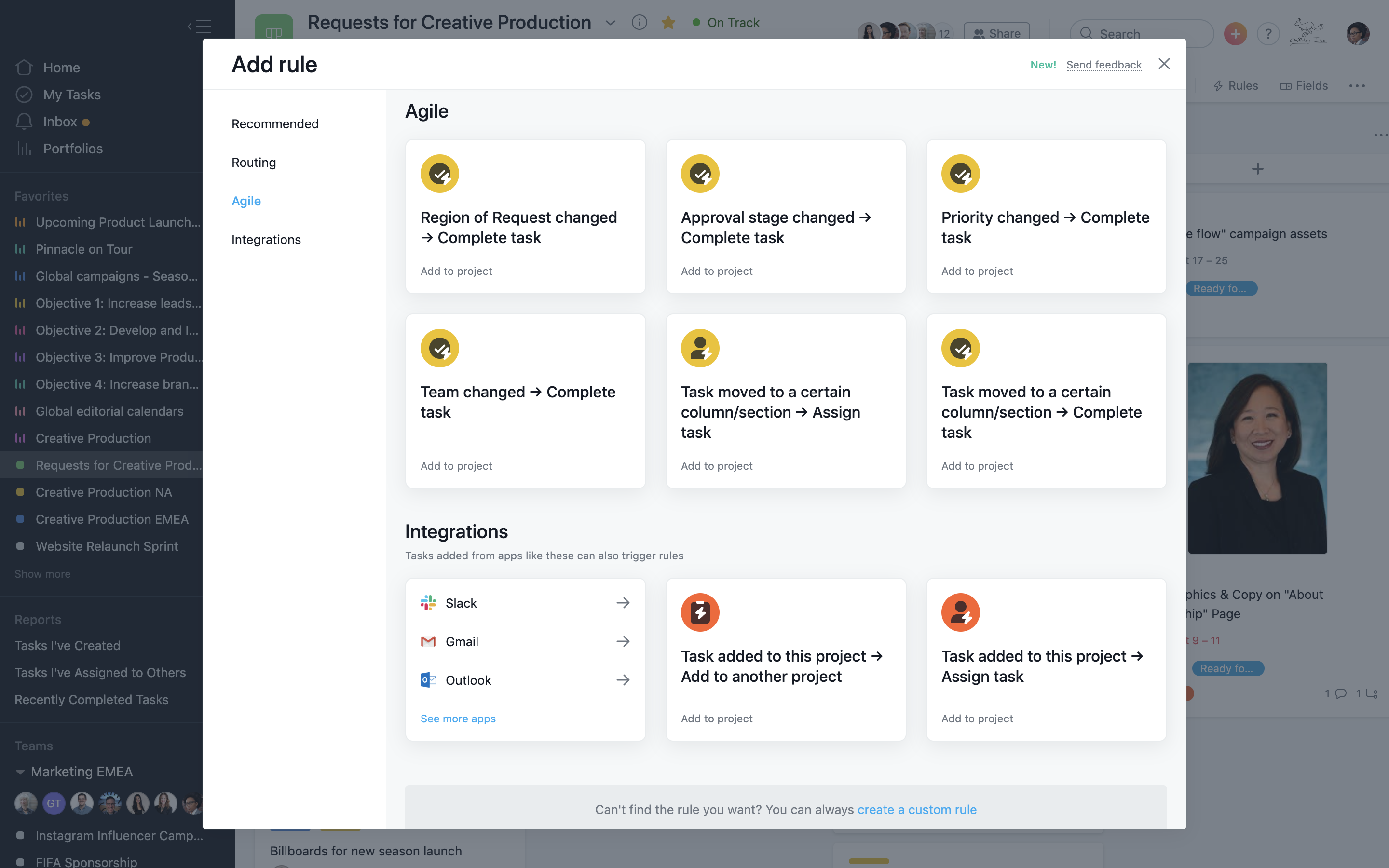
Work management platform Asana today announced the launch of a new feature that will take the work out of some of the most mundane and repetitive tasks on its platform. Asana Automation, as the new feature is called, allows users to create their own “if this then that” rules, but also features a new voice transcription service, as well as an OCR tool and new smart templates that integrate some of the service’s machine learning smarts.

“Earlier this year we launched Workload, empowering teams to be more agile when planning, monitoring and managing their efforts,” said Asana head of product said Alex Hood. “Now with Automation, we’re introducing the ability to automate your routine tasks so you can spend more energy on your craft and leave the repetitive busywork to Asana.”

Automation Rule and integration

The rule builder comes with over 70 pre-build and preset rules at launch, but users can obviously build their own rules as well. Asana customers can use the service to automatically route tasks to a specific team member, for example. Like with the rest of the new features the company announced today, the idea here is to automate many of the processes that keep teams busy all day, doing “work about work.”

The new OCR and transcription services, which are now available in Asana’s iPhone app, are pretty self-explanatory. They make it easier to capture what was said in a meeting or written on a whiteboard, which users can then assign to a given task in Asana.

Smart project templates, too, take some of the grunt work out of using Asana. “Now when using a template, such as an event plan or campaign launch, a complete workback schedule can be instantly layered on,” the company explains. “When a conflict arises between task deadlines, Asana will automatically correct, enabling teams to spend less time setting up projects and workflows, and more time getting work done.”

17 Oct 2019

Ekos announces $8M Series A to build software for craft breweries

Eskos, a Charlotte, NC startup that creates software to help craft breweries and other beverage companies organize their businesses, announced an $8 million Series A today led by Noro-Moseley Partners, an Atlanta  venture firm.

Prior to taking this funding, the company had bootstrapped for the previous five years, building a business with 1700 customers in 40 countries. The company has created an entire suite of tools to track everything from what’s in the tank, to recipes, raw materials, inventory and so on — everything you need to run a brewery, cidery or wine making business.

Prior to launching the company in 2014, the founders were thinking about building software for this market niche, so they went around and asked brewers what they were using to track their businesses. Some were just tracking it manually using clipboards and whiteboards. Others were using ERP software like SAP, Netsuite or Microsoft Dynamics. Some were using Google Sheets.

McKinney said he couldn’t believe that there wasn’t a set of tools specifically geared for this market, so he and co-founder and CTO Greg Forehand did what any good entrepreneurs would do. They built it. Today’s product includes an app to track the business on a mobile phone, and the ability to set up a drag and drop workflow for the entire operation.

He says he and Forehand actually came up with the business idea independently. He  became aware of Forehand in an early sales call. It was certainly odd that two people in the same city came up with the same idea at the same time. Eventually the two met and decided to join forces and form a business together.

It turned out to be a good decision. Upon launching in 2014, the business took off immediately. They got covered in a brewing industry publication, Brewbound, which helped spread the message. By the end of the first year they had 100 breweries on the platform. He said that word also spread by word of mouth, and although they planned on concentrating on the US market for starters, before they knew it they were getting calls from breweries in Canada, New Zealand and Australia. Today he says they have customers just about any place there is a brewery across 40 countries.

The company currently has 32 employees, including just two sales people, who also help the customers with initial setup for their particular needs. They have expanded from beer to cider to wine, and over time they hope to expand into other food and alcoholic beverage markets.

McKinney has big plans for the money. He wants to hire 40 new employees by the end of 2020 including sales and marketing folks, as well as software engineers. He says he recognizes that this will be a big change for his small operation, but it’s something they have been planning for and discussing over the last 8 months as they went through the process to find funding.

“I believe very much in being transparent with our team internally, so that nothing is really a surprise. Our team is pretty pumped about the opportunity for our customers and the things we’re going to build, and also getting some new team members in place,” he said.

17 Oct 2019

Galileo Financial raises $77 million for its fintech services that were 19 years in the making

Clay Wilkes had already been retired for six years when he launched Galileo Financial Services in 2000.

The serial entrepreneur who had been an early pioneer in telecommunications technologies (like voice over internet protocols) saw the need for better connectivity between secondary services and financial institutions 19 years ago, just as new digital services around payroll processing, transit vouchers, store cards, and other services were launching.

Now the company runs the backend integrations with financial institutions for some of the biggest names in financial technology and has just raised $77 million in financing from Accel Partners.

Not that Galileo necessarily needed the money. The company has been profitable for years since its bootstrapped beginnings and counts fintech giants like Chime Banking, Robinhood, Monzo, and Transferwise among its customers. In fact, the debit and credit card service provider will process nearly $26 billion in financing by the end of the year, according to the company.

For financial services companies that are launching these days there are a few ways to get to market quickly. One is to partner with a financial institution that will handle the money for them in accounts that are FDIC assured and the other is to become a financial provider that’s fully regulated themselves.

Most companies have opted for the second route, and when they do, they need to find a way to hook into a bank’s financial system and the payment technologies that form the backbone of transaction processing through the debit and credit cards that a huge portion fo the world relies on to buy things.

Accel partner John Locke, who is joining the Galileo board of directors, calls the company almost the flip side of the Braintree and Stripe investments that power transactions for most online merchants.

Rather than focus on the companies that are taking online orders and processing payments, Galileo deals with the consumers who are spending the money and powers the ways in which companies are trying to offer new services to get those consumers to switch from traditional banks to their upstart challengers (ironically still mostly powered by traditional banks).

“Through the API what they’re doing is creating and managing accounts, authorizing merchant transactions, monitoring fraud, initiating disputes and chargebacks, being able to configure products and a wide variety of product,” said Wilkes. “We support [direct deposit accounts] and we do credit products… all of these capabilities are capabilities that fit on our platform.”

Wilkes wouldn’t talk about the company’s valuation except to say that it’s worth “a substantial amount”.

What he will talk about is how Galileo will use the money it’s raised. The Salt Lake City-based startup is planning to greatly expand its geographical reach beyond North America. It’s “actively pursuing opportunities in Brazil and Colombia and Argentina,” according to Wilkes. In fact, the company plans to open an office in Mexico City in the coming months to service new Latin American business.

Meanwhile it already has something of a stranglehold on the market in the United Kingdom. “The top five largest fintechs in the UK are all clients today,” Wilkes said.

Unlike other companies in the market that take a fixed percentage of transactions, Galileo charges a variable amount of a few cents for every transaction that it processes to connect a startup with its banking back end.  

“We’re in a golden era of fintech innovation and Galileo has quietly built the API infrastructure layer powering the industry’s most innovative products,” said Locke in a statement. “Clay and his team have built a very impressive business with many parallels to companies like Qualtrics and Atlassian: bootstrapping first to build a quiet, profitable powerhouse and now, ready to go big globally. We’re excited to help Clay and team take Galileo to the next level.”


17 Oct 2019

Galileo Financial raises $77 million for its fintech services that were 19 years in the making

Clay Wilkes had already been retired for six years when he launched Galileo Financial Services in 2000.

The serial entrepreneur who had been an early pioneer in telecommunications technologies (like voice over internet protocols) saw the need for better connectivity between secondary services and financial institutions 19 years ago, just as new digital services around payroll processing, transit vouchers, store cards, and other services were launching.

Now the company runs the backend integrations with financial institutions for some of the biggest names in financial technology and has just raised $77 million in financing from Accel Partners.

Not that Galileo necessarily needed the money. The company has been profitable for years since its bootstrapped beginnings and counts fintech giants like Chime Banking, Robinhood, Monzo, and Transferwise among its customers. In fact, the debit and credit card service provider will process nearly $26 billion in financing by the end of the year, according to the company.

For financial services companies that are launching these days there are a few ways to get to market quickly. One is to partner with a financial institution that will handle the money for them in accounts that are FDIC assured and the other is to become a financial provider that’s fully regulated themselves.

Most companies have opted for the second route, and when they do, they need to find a way to hook into a bank’s financial system and the payment technologies that form the backbone of transaction processing through the debit and credit cards that a huge portion fo the world relies on to buy things.

Accel partner John Locke, who is joining the Galileo board of directors, calls the company almost the flip side of the Braintree and Stripe investments that power transactions for most online merchants.

Rather than focus on the companies that are taking online orders and processing payments, Galileo deals with the consumers who are spending the money and powers the ways in which companies are trying to offer new services to get those consumers to switch from traditional banks to their upstart challengers (ironically still mostly powered by traditional banks).

“Through the API what they’re doing is creating and managing accounts, authorizing merchant transactions, monitoring fraud, initiating disputes and chargebacks, being able to configure products and a wide variety of product,” said Wilkes. “We support [direct deposit accounts] and we do credit products… all of these capabilities are capabilities that fit on our platform.”

Wilkes wouldn’t talk about the company’s valuation except to say that it’s worth “a substantial amount”.

What he will talk about is how Galileo will use the money it’s raised. The Salt Lake City-based startup is planning to greatly expand its geographical reach beyond North America. It’s “actively pursuing opportunities in Brazil and Colombia and Argentina,” according to Wilkes. In fact, the company plans to open an office in Mexico City in the coming months to service new Latin American business.

Meanwhile it already has something of a stranglehold on the market in the United Kingdom. “The top five largest fintechs in the UK are all clients today,” Wilkes said.

Unlike other companies in the market that take a fixed percentage of transactions, Galileo charges a variable amount of a few cents for every transaction that it processes to connect a startup with its banking back end.  

“We’re in a golden era of fintech innovation and Galileo has quietly built the API infrastructure layer powering the industry’s most innovative products,” said Locke in a statement. “Clay and his team have built a very impressive business with many parallels to companies like Qualtrics and Atlassian: bootstrapping first to build a quiet, profitable powerhouse and now, ready to go big globally. We’re excited to help Clay and team take Galileo to the next level.”


17 Oct 2019

Pendo scores $100M Series E investment on $1 billion valuation

Pendo, the late stage startup that helps companies understand how customers are interacting with their apps, announced a $100 million Series E investment today on a valuation of $1 billion.

The round was led by Sapphire Ventures . Also participating were new investors General Atlantic and Tiger Global, and existing investors Battery Ventures, Meritech Capital, FirstMark, Geodesic Capital and Cross Creek. Pendo has now raised $206 million, according to the company.

Company CEO and co-founder Todd Olson says that one of the reasons they need so much money is they are defining a market, and the potential is quite large. “Honestly, we need to help realize the total market opportunity. I think what’s exciting about what we’ve seen in six years is that this problem of improving digital experiences is something that’s becoming top of mind for all businesses,” Olson said.

The company integrates with customer apps, capturing user behavior and feeding data back to product teams to help prioritize features and improve the user experience. In addition, the product provides ways to help those users either by walking them through different features, pointing out updates and new features or providing other notes. Developers can also ask for feedback to get direct input from users.

Olson says early on its customers were mostly other technology companies, but over time they have expanded into lots of other verticals including insurance, financial services and retail and these companies are seeing digital experience as increasingly important. “A lot of this money is going to help grow our go-to-market teams and our product teams to make sure we’re getting our message out there, and we’re helping companies deal with this transformation,” he says. Today, the company has over 1200 customers.

While he wouldn’t commit to going public, he did say it’s something the executive team certainly thinks about, and it and has started to put the structure in place to prepare should that time ever come. “This is certainly an option that we are considering, and we’re looking at ways in which to put us in a position to be able to do so, if and when the markets are good and we decide that’s the course we want to take.”

17 Oct 2019

How to radically change finance through startups at TechCrunch Disrupt Berlin

Fintech has been a very popular area for venture investment, and this is particularly true in Europe. Dozens of high-growth fintech startups have launched over the past decade, from challenger banks and neobanks to new payment services and better ways to save and invest wealth.

On the Extra Crunch stage at TechCrunch Disrupt Berlin, we wanted to dive deeper into what it takes to build a great fintech startup, and also radically reshape finance along the way. That’s why we invited two deep thinkers — Yoni Assia of eToro and Charlie Delingpole of ComplyAdvantage — to discuss how entrepreneurs today can affect the future of finance in the years to come, as well as the lessons learned from building their own successful fintech startups.

Assia has been a lifelong finance geek, day trading in his youth while learning computer science before eventually founding eToro in 2006. eToro’s social trading platform allows investors to follow peer investors and mirror their trades, all the while creating a hub for analysis and discussion around investment opportunities. The company has raised nearly a quarter billion dollars in venture capital according to Crunchbase.

Over the past few years, Assia has dived head first into the crypto world, and eToro now supports crypto trading in addition to more traditional public equities. Assia’s ambition has been to make eToro the single largest crypto trading platform in the world. Despite its popularity and success, eToro has almost always focused its efforts on the European and nearby market, and only this year officially launched its trading features in the U.S.

Delingpole has also had the entrepreneurial bug his entire life, and ComplyAdvantage is his third startup. ComplyAdvantage is an API-based know-your-customer/anti-money-laundering (KYC/AML) service for identifying the actors behind financial transactions. More than five years into the company, it has raised tens of millions in venture capital from the likes of Index Ventures and Balderton Capital to grow, and works with hundreds of customers processing data on tens of millions of names per day.

ComplyAdvantage’s product challenge is combining structured, semi-structured, and unstructured data in real-time to provide banks and other clients with risk assessments that are attuned to the changing nature of geopolitics every day. As such, Delingpole has had to work with everyone from financial asset control regulators to banking procurement directors to integrate his product into their workflows.

Together, Assia and Delingpole will discuss the changing landscape for fintech and how founders today can tackle the space.

Buy your ticket to Disrupt Berlin and join us on the Extra Crunch stage for an in-depth look at this white hot market.

17 Oct 2019

TruTag raises $7.5 million Series C for tiny, edible barcodes that can be placed on pills, food and vaping systems

TruTag Technologies, a company that creates microscopic, edible barcodes to authenticate medications, food, vaping pods and other products, has raised a $7.5 million Series C. The funding, led by Pangaea Ventures and Happiness Capital, will be used to further commercialize its technology and develop new solutions.

Along with earlier rounds, this brings TruTag’s total funding to $25 million. Its clients include PwC, which uses the company’s technology in its Food Trust Platform quality assurance program for Australian beef exports.

A high magnification of TruTag particles, each of is an edible “chip” that authenticates the product it is applied to.

A high magnification of TruTag particles, each of is an edible “chip” that authenticates the product it is applied to.

Called TruTags, the company’s tiny barcodes are made out of nano-porous silica, a material that has received GRAS (generally recognized as safe) notice from the U.S Food and Drug Administration, and can be placed directly on products or in packaging to track it through the supply and logistics chain.

TruTags are used with hyperspectral imaging technology, which is able to process much more wavelengths than other imaging methods, so it can collect more precise and detailed data from an image. When scanned, the barcodes provide information about where a product was manufactured, lot numbers, authorized distributors and safe use.

In email, TruTag chief executive officer Michael Bartholomeusz, who holds a PhD in materials engineering from the University of Virginia, told TechCrunch that the company sees the most growth opportunities in industries, such as pharmaceuticals, nutraceutical foods and cannabis, that deal with counterfeit products from the black market or the “grey market,” including products from unauthorized suppliers.

A conceptual photo of TruTags' technology.

A conceptual photo of TruTags’ technology.

“TruTags material is an already approved excipient in pills by the FDA. Pharmaceuticals and food comprise a very large portion of the global counterfeiting problem, and given the very unique edible feature of TruTag’s solution, this is a core area of focus for the company,” he says.

For example, the technology can be used to lock vaping systems so they only work with authentic vaping pods, helping reduce the number of counterfeit pods on the market. Bartholomeusz adds that TruTags is close to coming to market in the CBD space.

TruTags’ ability to be placed directly on products, its edibility and instant authentication in one to five seconds differentiates it from other solutions. Bartholomeusz notes that other quality assurance tech include specialized symbols, inks and holograms, though many of those products have the disadvantages of being replicable by high-quality printers or relying on consumers’ ability to recognize them.

In a press statement, Matthew Cohen, director of technology at Pangaea, which focuses on investing in advanced materials technology, said “Pangaea is excited to partner with TruTag and help the company expand its team and product portfolio. We believe TruTag’s edible barcode technology will help increase consumer confidence and ultimately save lives. TruTag is making our world better by utilizing compelling advanced materials and advanced material process innovations to combat rising problems such as drug counterfeiting.”

17 Oct 2019

TikTok makes education push in India

China’s TikTok today launched an education program in India as the popular short-video app looks to expand its offering and assuage local authority in one of its biggest markets.

TkTok, owned by the world’s most valued startup Bytedance, said it’s working with a number of content creators and firms to populate the platform with educational videos. These bite-sized videos cover a range of topics from school-level science and math concepts, languages, and life tips, motivation, and even reviews of gadgets.

The social platform, which is used by more than 120 million users in India each month, said its education program is aimed at “democratizing learning for the Indian digital community on the platform.”

It has partnered with social enterprise Josh Talks and The /Nudge Foundation, and edtech startups Vedantu, Toppr, Made Easy, GradeUp that will produce content for TikTok.

tiktok edutok

More to follow…

17 Oct 2019

Winnow raises $12M Series B for its food waste solution for commercial kitchens

Winnow, the U.K. startup that has developed smart kitchen tech to help commercial kitchens reduce food waste, is disclosing $12 million in Series B funding.

Backing the round is Ingka Group (a strategic partner to the IKEA franchisee system), Mustard Seed, Circularity Capital, D: Ax and The Ingenious Group. It follows a recent $8 million loan from The European Investment Bank (EIB), meaning that Winnow has added $20 million of capital in the last month.

Counting global clients such as IKEA and the Armani Hotel in Dubai, Winnow is on a mission to offer the hospitality industry technology to help cut down on food waste by making commercial kitchens ‘smarter.’ Its latest Winnow Vision product automates waste tracking by using computer vision to track what food is being discarded and therefore enabling kitchens to make better inventory decisions.

Notably, the Winnow system claims to have already reached and surpassed human levels of accuracy in identifying food being thrown away. “This means for clients, over time, these systems will enable their kitchens to automatically register food waste without any human interaction. Food will be thrown in the bin and the data will be captured automatically,” says the company.

More broadly, the idea, as Winnow founder and CEO Marc Zornes likes to put it, is that what gets measured, gets managed. The startups says that kitchens using Winnow tend to see a 40-70% reduction in food waste within 6-12 months, driving food cost savings between 2-8% in total.

Citing its main costs as “hardware and service delivery for each unit deployed,” Zornes says Winnow will use the new cash injection to further improve its technology and focus on “doubling down” on product development. This will include investing in new QA engineers to enhance development, through to front end developers to improve its reporting features.