Category: UNCATEGORIZED

30 Sep 2019

US sanctions two Russians for cyber-related election interference

The U.S. Treasury has imposed sanctions against two Russian nationals accused of working for a notorious disinformation unit.

In a statement, the Treasury said Igor Nesterov, 34; and Denis Kuzmin, 28, worked for the so-called Internet Research Agency, a secretive organization tasked with spreading disinformation and false news. The IRA was critical to the Russian government’s efforts to sow discord to try to influence the outcome of the 2016 U.S. presidential election.

The Treasury didn’t say for what reason the two Russian nationals were put on the list, only citing an executive order signed by President Trump last year to impose sanctions against Russians accused of foreign interference with a U.S. election.

A spokesperson for the Treasury did not immediately respond to a request for comment.

The report by special counsel Robert Mueller, who was tasked with investigating Russian meddling with the U.S. election and any ties to the then-Trump presidential campaign, said the IRA began its activities in 2014, two years prior to the election. The agency used Twitter and Facebook, among other online platforms, to spread false news. In one documented case, the agency set up two opposing real-life events to try to stoke up anger and aggressive political rhetoric.

30 Sep 2019

YouTube TV is now available on Fire TV devices

Earlier this year, Google and Amazon reached an agreement to bring their streaming video apps to each other’s platforms, following years of anti-competitive, anti-consumer behavior on both of their parts. Initially, the official YouTube app launched on Fire TV devices, while Prime Video launched on Chromecast and Android TV. Today, YouTube TV has also now become available on Fire TV devices, Amazon announced.

In a blog post, the company says the official YouTube TV app will launch on Fire TV Stick (2nd Generation), Fire TV Stick 4K, the all-new Fire TV Cube, plus Toshiba, Insignia, Element, and Westinghouse brand Fire TV Edition Smart TVs. It will also be supported on some previous generation Fire TV devices, including the Fire TV Cube (1st Gen), Fire TV (2nd Gen), Fire TV (3rd Gen — Pendant Design).

However, the app will not run on the 1st Gen Fire TV or Fire TV Stick.

YouTube TV is Google’s live TV streaming service, and a rival to Sling TV, Hulu with Live TV, PlayStation Vue, DirecTV Now (recently rebranded as AT&T TV NOW), and others. It offers over 70 channels from networks like Discovery, TNT, CNN, ESPN, FX and on-demand programming, as well as an unlimited cloud DVR. This year, it also had an exclusive range of MLB game broadcasts.

Amazon and Google had been at war for years, making things difficult for their end users. Amazon banned Google hardware from its shopping site on a number of occasions. They also feuded in 2017 over Amazon’s implementation of a YouTube player on its Echo Show, which Google said it did without consultation. YouTube pulled Amazon’s access, then Amazon worked around the problem by sending Echo users to the YouTube homepage instead.

While the companies battled, consumers lost out. And in the case of companies like Amazon and Google, those customer bases tend to overlap. A Chromecast user will want to watch Prime Video or buy Google products from Amazon. A FireTV user wants to watch YouTube. And so on.

As a result, the more neutral platform Roku became the most popular streaming platform in the U.S.

At the time of the original agreement, Amazon and Google said that other YouTube properties would come to Fire TV in the future, including YouTube Kids. That’s now the last remaining YouTube video app missing from Fire TV, and YouTube previously launched on Amazon hardware and YouTube TV begins rolling out today.

30 Sep 2019

McDonald’s starts selling its Beyond Meat-based “P.L.T.” sandwich in Canada

McDonald’s first foray into the plant-based protein patty market in North America is launching today in Canada.

The company’s “P.L.T.” (plant, lettuce, and tomato) sandwich, which uses patties from Beyond Meat, is now on sale at several locations in Canada.

This isn’t the first new vegetarian sandwich to launch at a “Golden Arches” location this year. Back in April, the company launched a new vegan sandwich for customers in its franchise locations across Germany.

McDonald’s has had vegetarian and vegan sandwich options on its international menu sporadically for years. Two years ago, it partnered with a specialty Norwegian food company called Orkla to launch its McVegan burger in Finland and Sweden.

With the launch in North American locations, McDonald’s is taking another step down the path toward potentially adding a vegetarian sandwich option to its menu in the U.S.

As the largest fast food restaurant in the world, any steps McDonald’s takes to move to adopt a plant-based protein product from Beyond Meat would represent a significant boost for the company.

It’s happening at a time when some of the world’s largest companies are beginning to launch their own meat-replacement products. Nestle, which partnered with McDonald’s on the launch of their vegan burger in Germany, is using products developed from the team responsible for Sweet Earth Foods.

Nestle bought the Moss Landing, Calif.-based business back in 2017 to get into the plant-based market, just as the company was beginning its work on a plant-based patty.

Other large food companies like Tyson have launched protein-based meat replacements, while industry players in the prepared food space including, McCain Foods have invested in Nuggs.

The fact that McDonald’s decided to go with Beyond for its North American debut points to the fact that the market for suppliers to the biggest restaurant chains is still contested.

Indeed, the major fast food burger chains appear to be taking a largely regional strategy with vendors as supply chain issues for meatless patties seemingly remain a concern.

For instance, while Burger King uses Impossible Foods patties for its Impossible Whopper, sources have said that the company may look for a regional supplier for plant-based products in Latin America.

And it’s important to note that these pilot tests don’t mean that fast food chains will stick to keeping plant based products on the menu. Even as Beyond Meat scores its huge win with its McDonald’s pilot across 28 locations in Canada, the company’s burgers were pulled from locations in another big regional Canadian fast food chain — Tim Hortons .

Beyond Meat benefits from a wider array of plant-based offerings than its closest competitor, Impossible Foods, which has stayed focused on a replacement for ground beef. The El Segundo, Calif.-based company has inked pilot deals with KFC for a plant-based chicken nugget, and a number of fast food outlets like Dunkin, are selling the company’s breakfast sausages.

But the competition extends beyond fast food chains. Big food service vendors like Sodexo and others that cater to corporations, colleges, and universities are trying to lock in suppliers of protein replacements as well.

Meanwhile, demand for alternative proteins continues to skyrocket, with most financial analysts predicting that the market for these types of products could take a significant bite out of the traditional meat industry over the next decade.

Analysts at Barclays predict the market for alternative proteins could hit $140 billion by 2029.

“During this test, we’re excited to hear what customers love about the P.L.T. to help our global markets better understand what’s best for their customers,” said Ann Wahlgren, McDonald’s VP of Global Menu Strategy,  in a statement last week. “This test allows us to learn more about real-world implications of serving the P.L.T., including customer demand and impact on restaurant operations.” .

30 Sep 2019

Spotify now lets you add podcasts to playlists

Spotify this morning announced a new feature that will allow users to add their podcasts to playlists. With the addition, users can create their own custom playlists of their favorite podcasts, or even those that combine music and audio — similar to Spotify’s own newly-launched “Your Daily Drive.”

With “Your Daily Drive,” Spotify put its personalization engine to work to combine both music and news from select sources. But with the ability to now build your own podcast-filled playlists, you won’t have to rely on Spotify’s curation as much.

Instead, you can build your own podcast playlists by tapping the three-dot menu to the right of the podcast episode and then “Add to playlist.” You can either choose to add it a playlist you’ve already created, or you can build a new one from scratch. You can continue to add more content to this playlist, including music, if you prefer.

The company says this functionality is something users have regularly requested since the integration of podcasts to its streaming music service. However, it’s not necessarily the easiest way to tune into the latest episodes of your favorite programs as it involves manual curation.

Many podcasts release new episodes every week or so — and don’t want to get stuck constantly building playlists for those. Instead, the feature makes more sense for curating a set of podcasts around a theme, or preparing yourself to binge your way through a few programs on a long commute or road trip, for example.

Spotify says today there are over 3 billion user-generated music playlists on its service, so it believes that its users will embrace this new curation ability, as well.

Once a podcast playlist has been created, it can be shared with friends or the public, just like music playlists can be. This could make for an interesting marketing tool for podcasters, who could put together playlists of their best episodes or those with high-profile guest stars, for example, as a way to introduce newcomers to their shows. But it could also serve as a way for friends to recommend their favorite shows to others, by putting together a list of their all-time favorite episodes.

For those interested in tracking news and entertainment, they could build playlists of podcast episodes from different sources all focused on the same topic. For instance, a playlist offering everyone’s reviews of the new iPhone.

The podcast playlist feature, for now, is mobile-only. On desktop, you can only stream the playlists you made, but can’t build them yet, Spotify says.


30 Sep 2019

Tencent to take 29% stake in multiplayer games maker Funcom

Chinese social media and gaming giant Tencent is taking a 29% stake to become the largest shareholder in Oslo-based Funcom.

The indie games developer is responsible for multiple adaptations involving the Conan the Barbarian franchise, such as Age of Conan and Conan Exiles, as well as a number of other multiplayer titles — including a forthcoming open world sandbox game that will be set in the Dune sci-fi universe.

The news that Tencent has entered into a share purchase agreement to acquire almost a third of the company was announced in a press release today. The Chinese giant has agreed to acquire all the shares belonging to the Norway-based KGJ Capital AS, which is currently the largest shareholder in Funcom.

Commenting in a statement, Funcom CEO Rui Casais said: “Tencent has a reputation for being a responsible long-term investor, and for its renowned operational capabilities in online games. The insight, experience, and knowledge that Tencent will bring is of great value to us and we look forward to working closely with them as we continue to develop great games and build a successful future for Funcom.”

Tencent, which has a substantial games operation of its own, also holds stakes in a number of other major games makers — including Riot Games, Epic, Supercell, Ubisoft, Paradox, Frontier and Miniclip.

A prolonged games licensing freeze in China dented Tencent’s profits last year. And earlier this year, while it reported record profits in its Q1 it also recorded its slowest revenue growth since going public.

Regulatory risk at home is one reason for Tencent to expand its stakes in overseas games developers and tap into a global audience to stoke growth.

30 Sep 2019

Amboss, the knowledge platform for medical professionals, scores €30M Series B

Amboss, the Berlin-based ‘medtech’ startup that originally offered a learning app for students but has since pivoted to a knowledge platform for medical professionals, has raised €30 million in Series B funding.

The round is led by Partech’s growth fund, with Target Global acting as a co-investor. Existing investors, Cherry Ventures, Wellington Partners and Holtzbrinck Digital, also participated.

Launched in 2014 as a study platform for medical students, Amboss has since evolved to offer what it claims is the “most comprehensive and technologically-advanced” knowledge platform for medical professionals. It has been developed by a group of 70 doctors and 40 software engineers who work together in small cross functional teams.

“Medical Knowledge does not find its way into practice efficiently,” argues Amboss co-CEO Benedikt Hochkirchen. “This has two main root causes: the way we educate doctors is outdated, and the way doctors access knowledge is inefficient”.

Specifically, he says that medical students are still taught to memorize facts, which become outdated quickly, and there isn’t enough emphasis on understanding and application. In contract, Amboss’ “smart learning” technology claims to not only help students achieve higher scores in their medical exams but furthers their contextual understanding and therefore lays the foundation “to be better prepared for clinical practice”.

“In clinical practice, doctors would adapt 50% of their decisions if they had the latest and precise knowledge at hand,” says Hochkirchen. “In real life on the wards, doctors lack the time to research and find the relevant knowledge. For them, Amboss’ smart guidance app is there to provide instant, convenient and reliable medical knowledge to carry out the best possible care”.

The end result, says the Amboss co-CEO, is that the startup’s app reduces the average research time needed for doctors to make a clinical decision from 30 minutes to 30 seconds. Crucially, its knowledge base contains the most recent medical facts and guidelines “in every single case”.

“Young doctors have to take over a lot of responsibility early in their career,” adds Hochkirchen. “Career starters are regularly the first touch point with a doctor when a patient enters a hospital. Often young doctors do not feel properly prepared for the real life challenges in those situations. Amboss is the source of choice to master those decisions e.g. with emergency algorithms and lead symptoms”.

Likewise, more experienced and specialised doctors can also find utility in Amboss, as guidelines and therapies of choice are constantly changing. “It is almost impossible for the doctor to stay up to date for every possible indication,” he says. “Amboss provides them with precise knowledge based on latest guidelines to ensure doctors choose the best therapy possible”.

Or, put a another way, Amboss is attempting to build a “Google for medicine”. “They are tackling a very exciting space which will have a positive impact on society, bringing knowledge levels and skillsets of medical doctors to a higher level,” Cherry Ventures’ Christian Meermann tells me.

Meanwhile, armed with new capital, Amboss says it will accelerate the global rollout of its product with a focus on the U.S. In addition, the startup will further develop its product, for both generalist and specialist doctors, “to help improve their daily clinical decision-making”.

30 Sep 2019

Africa’s top mobile phone seller Transsion lists in Chinese IPO

Chinese mobile-phone and device maker Transsion has listed in an IPO on Shanghai’s STAR Market, a Transsion spokesperson confirmed to TechCrunch. 

Headquartered in Shenzhen, Transsion is a top-seller of smartphones in Africa under its Tecno brand. The company has also started to support venture funding of African startups.

Transsion issued 80 million A-shares at an opening price of 35.15 yuan (≈ $5.00) to raise 2.8 billion yuan (or ≈ $394 million).

A-shares are the common shares issued by mainland Chinese companies and are normally available for purchases only by mainland citizens. 

Transsion’s IPO prospectus is downloadable (in Chinese) and its STAR Market listing application available on the Shanghai Stock Exchange’s website.

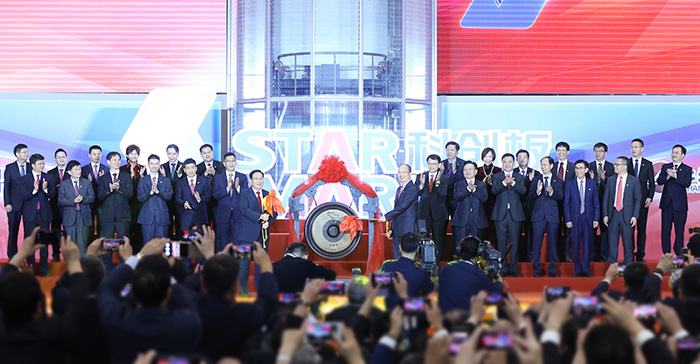
STAR is the Shanghai Stock Exchange’s new Nasdaq-style board for tech stocks that went live in July with some 25 companies going public.

Transsion plans to spend 1.6 billion yuan (or $227 million) of its STAR Market raise on building more phone assembly hubs and around 430 million yuan ($62 million) on research and development, including a mobile phone R&D center in Shanghai, a company spokesperson said.

To support its African sales network, Transsion maintains a manufacturing facility in Ethiopia.  The company recently announced plans to build an industrial park and R&D facility in India for manufacture of phones to Africa.

The IPO comes after Transsion announced its intent to go public and filed its first docs with the Shanghai Stock Exchange in April.

Listing on STAR Market puts Transsion on China’s new exchange — seen as an extension of Beijing’s ambition to become a hub for tech startups to raise public capital. Chinese regulators lowered profitability requirements for the STAR Market, which means pre-profit ventures can list.

China Star Market Opening July 2019 1

Transsion’s IPO comes when the company is actually in the black. The firm generated 22.6 billion yuan ($3.29 billion) in revenue in 2018, up from 20 billion yuan a year earlier. Net profit for the year slid to 654 million yuan, down from 677 million yuan in 2017, according to the firm’s prospectus.

Transsion sold 124 million phones globally in 2018, per company data. In Africa, Transsion holds 54% of the feature phone market — through its brands Tecno, Infinix and Itel — and in smartphone sales is second to Samsung and before Huawei, according to International Data Corporation stats.

Transsion has R&D centers in Nigeria and Kenya and its sales network in Africa includes retail shops in Nigeria, Kenya, Tanzania, Ethiopia and Egypt. The company also attracted attention for being one of the first known device makers to optimize its camera phones for African complexions.

On a 2019 research trip to Addis Ababa, TechCrunch learned the top entry-level Tecno smartphone was the W3, which lists for 3,600 Ethiopian Birr, or roughly $125.

In Africa, Transsion’s ability to build market share and find a sweet spot with consumers on price and features gives it prominence in the continent’s booming tech scene.

Africa already has strong mobile-phone penetration, but continues to undergo a conversion from basic USSD phones, to feature phones, to smartphones.

Smartphone adoption on the continent is low, at 34%, but expected to grow to 67% by 2025, according to GSMA.

This, added to an improving internet profile, is key to Africa’s tech scene. In top markets for VC and startup origination — such as Nigeria, Kenya, and South Africa — thousands of ventures are building business models around mobile-based products and digital applications.

If Transsion’s IPO enables higher smartphone conversion on the continent, that could enable more startups and startup opportunities — from fintech to VOD apps.

Another interesting facet to Transsion’s IPO is its potential to create greater influence from China in African tech, in particular as the Shenzhen company moves more definitely toward venture investing.

In August, Transsion funded Future Hub teamed up with Kenya’s Wapi Capital to source and fund early-stage African fintech startups.

China’s engagement with African startups has been light compared to China’s deal-making on infrastructure and commodities — further boosted in recent years as Beijing pushes its Belt and Road plan.

Transsion’s IPO is the second event this year — after Chinese owned Opera’s venture spending in Nigeria — to reflect greater Chinese influence and investment in the continent’s digital scene.

So in coming years, China could be less known for building roads and bridges in Africa and more for selling smartphones and providing VC for African startups.

29 Sep 2019

Kickstarter darling EcoFlow Delta battery generator is not what it seems

The Delta EcoFlow is a new battery generator available on Kickstarter with incredible claimed features. Most are true, some are not.

Device like the Delta offer incredible battery storage capacity. Designed for more than just recharging phones and tablets, these can run refrigerators, pumps, power tools and medical equipment. They’re great for emergencies, camping and general use where power is not available. Similar devices have been on the market for some years so I was eager to verify EcoFlow’s claims.

The EcoFlow Delta can recharge from a wall outlet to 80% in an hour. It’s amazing. The GoalZero Yeti battery of a similar size takes 25 hours. This capability means the Delta can be used and then reused more than competitors.

The device is currently on Kickstarter where it quickly acquired over $2 million from over 2,000 backers. The device’s features listed on the Kickstarter page are clear, but after testing a pre-production unit, I found several of these advertised capabilities and features misleading or false.

The Delta is the latest product from EcoFlow. The company’s founder, Eli Harris, says it’s “The world’s strongest battery generator.” I found the Delta to be a competent battery generator with similar capabilities to competitors but it’s hampered by loud fans.

In short, if you need a battery generator that can recharge much faster than others, the Delta is a great option. Otherwise, the GoalZero Yeti makes more sense for most people.

Battery generators are a safe and more portable option than their gas counterparts. There are no harmful fumes or fuel allowing them to be used indoors, nearer the appliances or tools. Most often (though not with the Delta) they’re silent, too, making them perfect for a camping or hunting companion.

In real-world operation, this quick recharge time could come in handy. Say, on a construction site or in an emergency incident where power is still available, but out of reach of an extension cord — situations where loud gas generators are generally used. While the Delta is louder than other battery generators, it is not as loud as a gas generator.

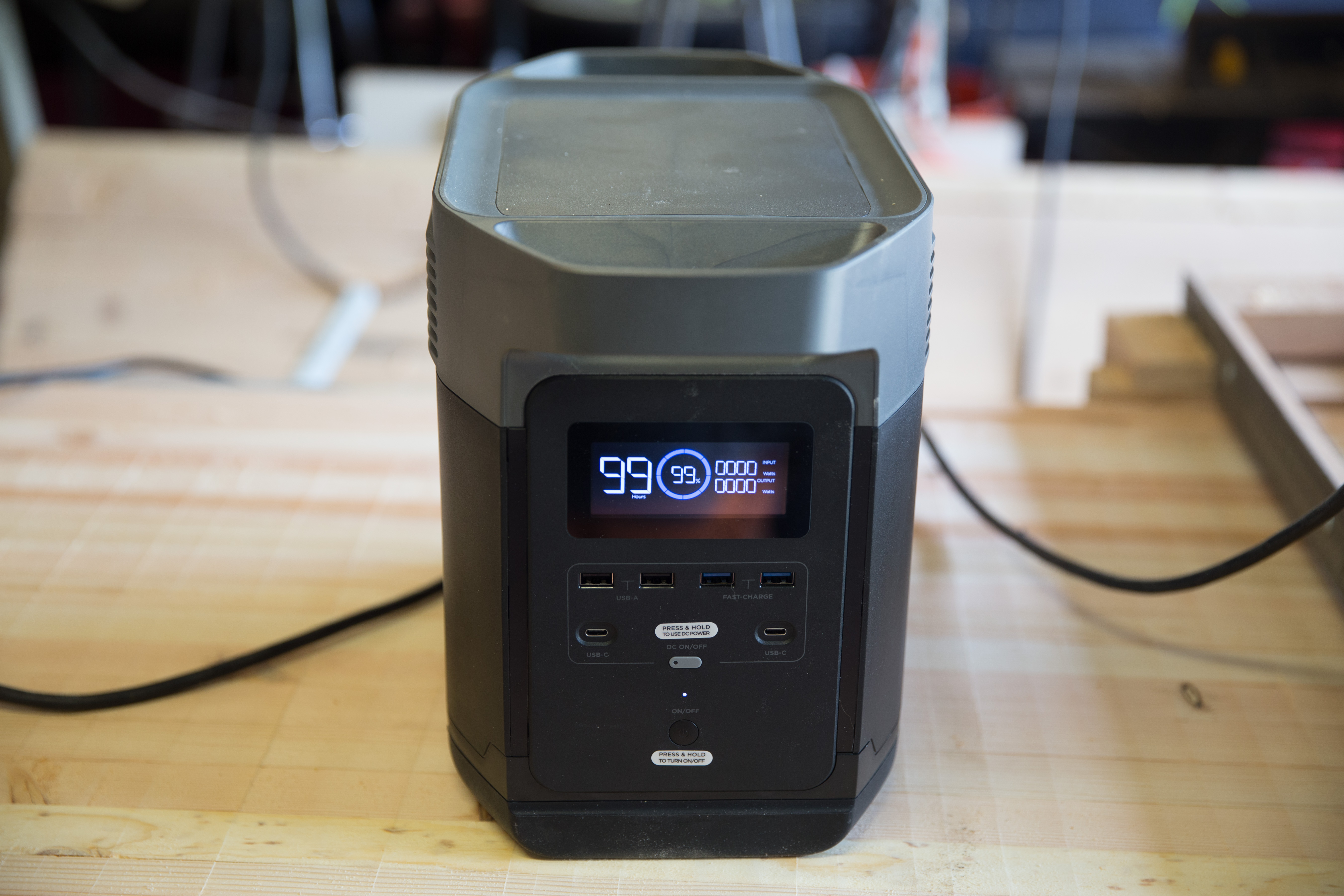
The Delta battery comes packaged with a warning that the battery must be fully charged before use. I generally ignore warnings, but I followed this one and immediately plugged it in. Instantly, fans whirled to life and the screen popped on displaying the current charge levels and how long it would take to get to 100%. The Delta was at 30% and would take 45 minutes to fully recharge. It worked as advertised and 45 minutes later the battery was at 100%.

Recharging the Delta battery was a noisy affair. The fans are loud and continue to run after the battery is fully charged. Compared to a GoalZero Yeti, this was a shock. The Yeti is silent where the Delta is not. I keep a Yeti 1400 in my basement, plugged in and ready to use. But with the Delta, even when the battery is fully charged, loud fans still run presumably to keep the unit cool. EcoFlow says the shelf life on the Delta is over a year where the GoalZero Yeti is six months. To me, I would rather have the battery constantly plugged into power so I know it’s ready to go when needed.

The Delta recharges without an AC power inverter (a power brick); it uses the same sort of cable as a desktop PC. The company says by passing through the inverter directly, the Delta can increase charging speed to more than 10 times the traditional AC to DC adapter cable. This also means it’s easier to replace a lost charging cable.

The Delta is much lighter than competing products and its design makes it easier to move. EcoFlow says it’s rugged, and it feels the part. Even my pre-production sample feels tough and ready to go to work. Large rubber pads keep the battery in place and the tough plastic feels more durable than competing products.

There are a handful of plugs and outlets around the device, including USB, USB-C and six AC outlets. It’s a lot and similar in capacity to large gas generators. Most battery generators have much fewer AC outlets, though I’ve often supplemented the capability with small power strips.
IMG 0544
Kickstarter Beware

The Delta is currently on Kickstarter for pre-order and exceeded its goal. I fear a good amount of backers will be upset to learn several notable advertised features are false or misleading.

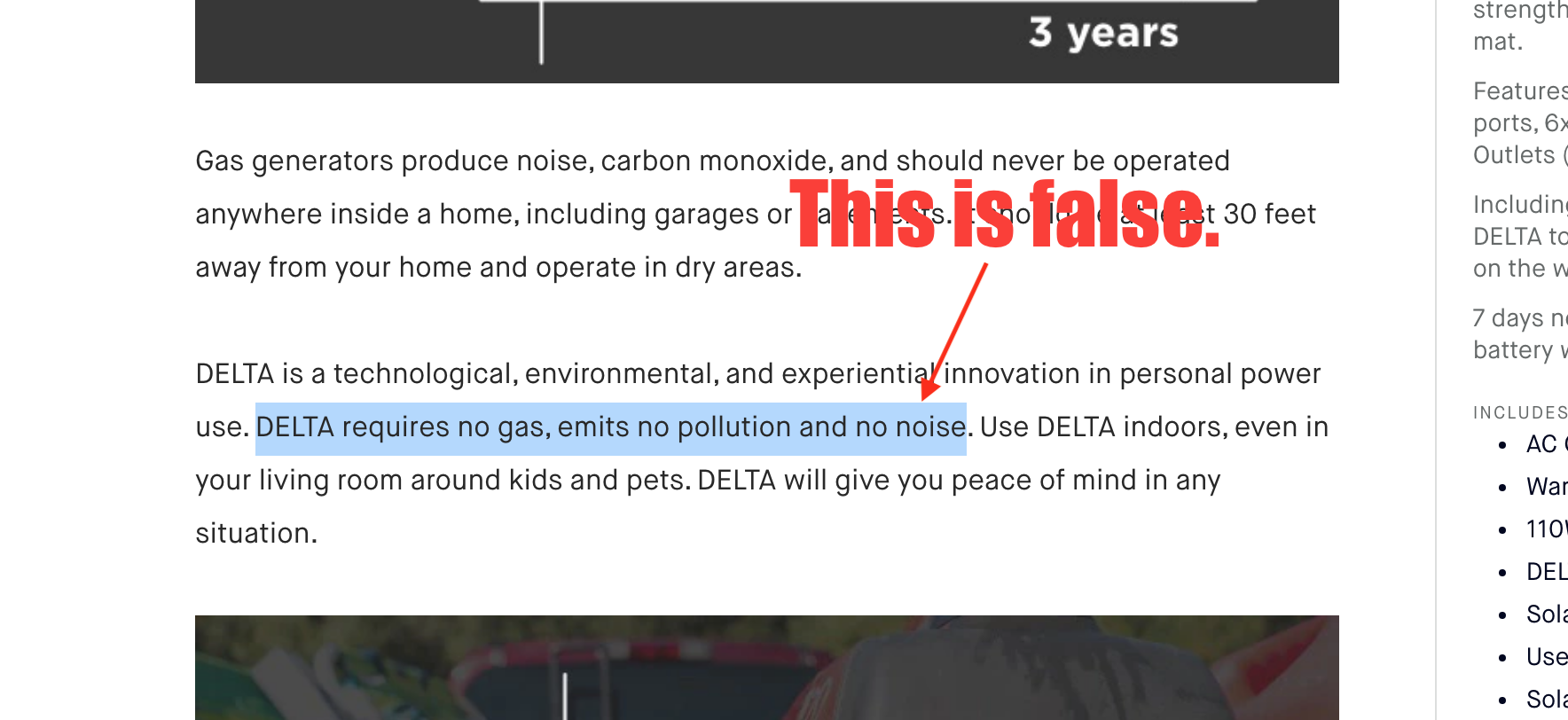
The Delta is not silent. Under operation, either recharging a cell phone or running a power tool, loud fans run on both sides of the battery. These fans run when recharging the battery, too — even when the battery is fully charged. The Kickstarter page and video lists throughout that the Delta produces no noise.
ecoflow delta

These fans detract from the appeal of the Delta battery. They’re loud. You have to raise your voice to speak over them. Because of these fans, I wouldn’t take the Delta camping or use it in the backyard for a quiet get-together. During power outage situations, I wouldn’t want to sleep near it. But I would use it for power tools — like EcoFlow does in one of its demo videos.

Only one of the four videos on the Kickstarter page allows potential owners to hear the Delta battery. The third video on the page shows the battery powering a hammer drill. Six seconds into the video, the drill stops running, and the battery’s fans are audible.

There are a handful of competing batteries that operate without noisy fans. I’ve taken GoalZero’s Yeti batteries camping and they’re great despite their heft. They’re truly silent and can still recharge from solar panels and car batteries. I’ve used battery generators from Jackery, too, and those are also silent.

I spoke with Ecoflow CEO and Founder Eli Harris during the run-up of this review. He was clear that Ecoflow’s main competitor is not other large batteries, but rather small gas generators available from Honda and others. And that makes a lot of sense. Those are the best selling generators available and widely used for emergency and convenience. These small generators are loud, and the Ecoflow Delta is quieter than those options while still offering most of the power capabilities.

When asked why the Kickstarter page is misleading, he said “that fallacy has never been called out” and he would check with his team about the use of “superlatives and blanket statements.” Three days later, the Kickstarter page still lists the false claims.

EcoFlow claims the Delta battery can run a variety of power tools, including drills, circular saws, power washers and welders. I found this capability hit or miss. Despite some tools being under the claimed amperage and wattage of the Delta battery, the battery wouldn’t power my small or large circular saw or power washer. EcoFlow also claims the battery can recharge a Tesla; it doesn’t recharge my Chevy Volt.

Many tools require extra power when starting up, and I found most of these surge requirements to exceed the capabilities of the Delta battery. This is the same with other batteries like the GoalZero Yeti. In fact, I couldn’t find one tool in my workshop that the Delta powered and the Yeti did not; they worked the same for me, and I have a lot of tools.

Don’t mistake what I’m saying. The EcoFlow Delta has impressive capabilities mainly around its recharge capabilities. This makes it an attractive option for the right use. It’s compact and solid. It has a lot of outlets and is easy to move. This could be a lifesaver in emergency situations where a person still has access to power.

The Delta has some downsides just like other battery generators. It doesn’t offer a dramatic increase in electrical output over competitors so don’t expect this battery to power larger devices. Don’t expect a silent operation, either. This massive battery is loud though, I admit, that’s a relative term. It’s louder than other battery generators but less loud than a gas generator.

I would rather have a silent battery generator that recharges slowly versus a noisy, fast-recharging battery. I use my battery generators camping and around the house when the power goes out. The Delta makes sense on a construction site or on the scene of a natural disaster. I just can’t get over the loud fans.


29 Sep 2019

Kickstarter darling EcoFlow Delta battery generator is not what it seems

The Delta EcoFlow is a new battery generator available on Kickstarter with incredible claimed features. Most are true, some are not.

Device like the Delta offer incredible battery storage capacity. Designed for more than just recharging phones and tablets, these can run refrigerators, pumps, power tools and medical equipment. They’re great for emergencies, camping and general use where power is not available. Similar devices have been on the market for some years so I was eager to verify EcoFlow’s claims.

The EcoFlow Delta can recharge from a wall outlet to 80% in an hour. It’s amazing. The GoalZero Yeti battery of a similar size takes 25 hours. This capability means the Delta can be used and then reused more than competitors.

The device is currently on Kickstarter where it quickly acquired over $2 million from over 2,000 backers. The device’s features listed on the Kickstarter page are clear, but after testing a pre-production unit, I found several of these advertised capabilities and features misleading or false.

The Delta is the latest product from EcoFlow. The company’s founder, Eli Harris, says it’s “The world’s strongest battery generator.” I found the Delta to be a competent battery generator with similar capabilities to competitors but it’s hampered by loud fans.

In short, if you need a battery generator that can recharge much faster than others, the Delta is a great option. Otherwise, the GoalZero Yeti makes more sense for most people.

Battery generators are a safe and more portable option than their gas counterparts. There are no harmful fumes or fuel allowing them to be used indoors, nearer the appliances or tools. Most often (though not with the Delta) they’re silent, too, making them perfect for a camping or hunting companion.

In real-world operation, this quick recharge time could come in handy. Say, on a construction site or in an emergency incident where power is still available, but out of reach of an extension cord — situations where loud gas generators are generally used. While the Delta is louder than other battery generators, it is not as loud as a gas generator.

The Delta battery comes packaged with a warning that the battery must be fully charged before use. I generally ignore warnings, but I followed this one and immediately plugged it in. Instantly, fans whirled to life and the screen popped on displaying the current charge levels and how long it would take to get to 100%. The Delta was at 30% and would take 45 minutes to fully recharge. It worked as advertised and 45 minutes later the battery was at 100%.

Recharging the Delta battery was a noisy affair. The fans are loud and continue to run after the battery is fully charged. Compared to a GoalZero Yeti, this was a shock. The Yeti is silent where the Delta is not. I keep a Yeti 1400 in my basement, plugged in and ready to use. But with the Delta, even when the battery is fully charged, loud fans still run presumably to keep the unit cool. EcoFlow says the shelf life on the Delta is over a year where the GoalZero Yeti is six months. To me, I would rather have the battery constantly plugged into power so I know it’s ready to go when needed.

The Delta recharges without an AC power inverter (a power brick); it uses the same sort of cable as a desktop PC. The company says by passing through the inverter directly, the Delta can increase charging speed to more than 10 times the traditional AC to DC adapter cable. This also means it’s easier to replace a lost charging cable.

The Delta is much lighter than competing products and its design makes it easier to move. EcoFlow says it’s rugged, and it feels the part. Even my pre-production sample feels tough and ready to go to work. Large rubber pads keep the battery in place and the tough plastic feels more durable than competing products.

There are a handful of plugs and outlets around the device, including USB, USB-C and six AC outlets. It’s a lot and similar in capacity to large gas generators. Most battery generators have much fewer AC outlets, though I’ve often supplemented the capability with small power strips.

IMG 0544
Kickstarter Beware

The Delta is currently on Kickstarter for pre-order and exceeded its goal. I fear a good amount of backers will be upset to learn several notable advertised features are false or misleading.

The Delta is not silent. Under operation, either recharging a cell phone or running a power tool, loud fans run on both sides of the battery. These fans run when recharging the battery, too — even when the battery is fully charged. The Kickstarter page and video lists throughout that the Delta produces no noise.

ecoflow delta

These fans detract from the appeal of the Delta battery. They’re loud. You have to raise your voice to speak over them. Because of these fans, I wouldn’t take the Delta camping or use it in the backyard for a quiet get-together. During power outage situations, I wouldn’t want to sleep near it. But I would use it for power tools — like EcoFlow does in one of its demo videos.

Only one of the four videos on the Kickstarter page allows potential owners to hear the Delta battery. The third video on the page shows the battery powering a hammer drill. Six seconds into the video, the drill stops running, and the battery’s fans are audible.

There are a handful of competing batteries that operate without noisy fans. I’ve taken GoalZero’s Yeti batteries camping and they’re great despite their heft. They’re truly silent and can still recharge from solar panels and car batteries. I’ve used battery generators from Jackery, too, and those are also silent.

I spoke with Ecoflow CEO and Founder Eli Harris during the run-up of this review. He was clear that Ecoflow’s main competitor is not other large batteries, but rather small gas generators available from Honda and others. And that makes a lot of sense. Those are the best selling generators available and widely used for emergency and convenience. These small generators are loud, and the Ecoflow Delta is quieter than those options while still offering most of the power capabilities.

When asked why the Kickstarter page is misleading, he said “that fallacy has never been called out” and he would check with his team about the use of “superlatives and blanket statements.” Three days later, the Kickstarter page still lists the false claims.

EcoFlow claims the Delta battery can run a variety of power tools, including drills, circular saws, power washers and welders. I found this capability hit or miss. Despite some tools being under the claimed amperage and wattage of the Delta battery, the battery wouldn’t power my small or large circular saw or power washer. EcoFlow also claims the battery can recharge a Tesla; it doesn’t recharge my Chevy Volt.

Many tools require extra power when starting up, and I found most of these surge requirements to exceed the capabilities of the Delta battery. This is the same with other batteries like the GoalZero Yeti. In fact, I couldn’t find one tool in my workshop that the Delta powered and the Yeti did not; they worked the same for me, and I have a lot of tools.

Don’t mistake what I’m saying. The EcoFlow Delta has impressive capabilities mainly around its recharge capabilities. This makes it an attractive option for the right use. It’s compact and solid. It has a lot of outlets and is easy to move. This could be a lifesaver in emergency situations where a person still has access to power.

The Delta has some downsides just like other battery generators. It doesn’t offer a dramatic increase in electrical output over competitors so don’t expect this battery to power larger devices. Don’t expect a silent operation, either. This massive battery is loud though, I admit, that’s a relative term. It’s louder than other battery generators but less loud than a gas generator.

I would rather have a silent battery generator that recharges slowly versus a noisy, fast-recharging battery. I use my battery generators camping and around the house when the power goes out. The Delta makes sense on a construction site or on the scene of a natural disaster. I just can’t get over the loud fans.
29 Sep 2019

Why is Dropbox reinventing itself?

According to Dropbox CEO Drew Houston, 80% of the product’s users rely on it, at least partially, for work.

It makes sense, then, that the company is refocusing to try and cement its spot in the workplace; to shed its image as “just” a file storage company (in a time when just about every big company has its own cloud storage offering) and evolve into something more immutably core to daily operations.

Earlier this week, Dropbox announced that the “new Dropbox” would be rolling out to all users. It takes the simple, shared folders that Dropbox is known for and turns them into what the company calls “Spaces” — little mini collaboration hubs for your team, complete with comment streams, AI for highlighting files you might need mid-meeting, and integrations into things like Slack, Trello and G Suite. With an overhauled interface that brings much of Dropbox’s functionality out of the OS and into its own dedicated app, it’s by far the biggest user-facing change the product has seen since launching 12 years ago.

Shortly after the announcement, I sat down with Dropbox VP of Product Adam Nash and CTO Quentin Clark . We chatted about why the company is changing things up, why they’re building this on top of the existing Dropbox product, and the things they know they just can’t change.

You can find these interviews below, edited for brevity and clarity.

Greg Kumparak: Can you explain the new focus a bit?

Adam Nash: Sure! I think you know this already, but I run products and growth, so I’m gonna have a bit of a product bias to this whole thing. But Dropbox… one of its differentiating characteristics is really that when we built this utility, this “magic folder”, it kind of went everywhere.